

The DOI matches its Crossref record; 15 of the 15 references it cites were found in a registry or an index.
Implementation of key demand-reduction measures of the WHO Framework Convention on Tobacco Control and change in smoking prevalence in 126 countries: an association study
Open accessAbstract
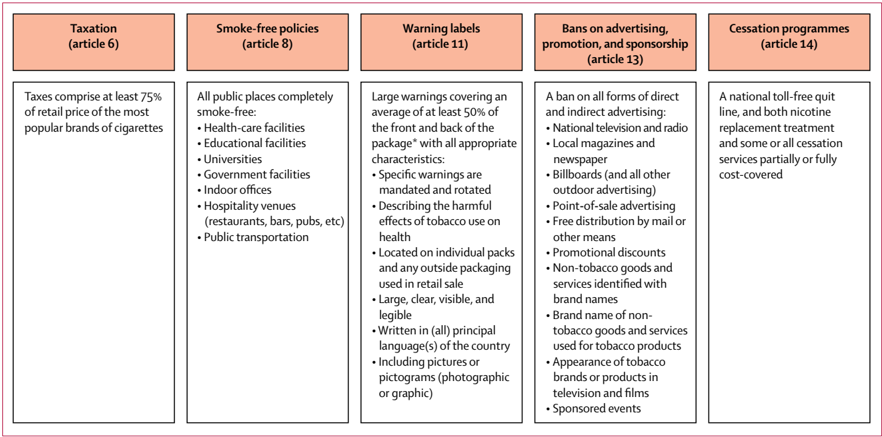
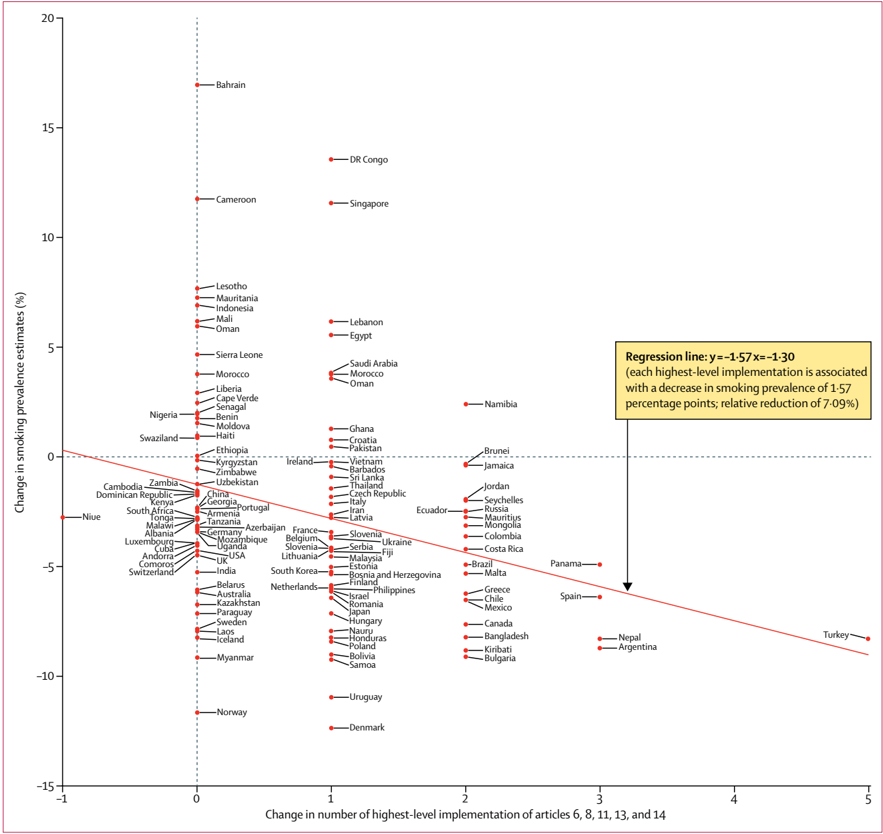
BACKGROUND: The WHO Framework Convention on Tobacco Control (WHO FCTC) has mobilised efforts among 180 parties to combat the global tobacco epidemic. This study examined the association between highest-level implementation of key tobacco control demand-reduction measures of the WHO FCTC and smoking prevalence over the treaty's first decade. METHODS: We used WHO data from 126 countries to examine the association between the number of highest-level implementations of key demand-reduction measures (WHO FCTC articles 6, 8, 11, 13, and 14) between 2007 and 2014 and smoking prevalence estimates between 2005 and 2015. McNemar tests were done to test differences in the proportion of countries that had implemented each of the measures at the highest level between 2007 and 2014. Four linear regression models were computed to examine the association between the predictor variable (the change between 2007 and 2014 in the number of key measures implemented at the highest level), and the outcome variable (the percentage point change in tobacco smoking prevalence between 2005 and 2015). FINDINGS: Between 2007 and 2014, there was a significant global increase in highest-level implementation of all key demand-reduction measures. The mean smoking prevalence for all 126 countries was 24·73% (SD 10·32) in 2005 and 22·18% (SD 8·87) in 2015, an average decrease in prevalence of 2·55 percentage points (SD 5·08; relative reduction 10·31%). Unadjusted linear regression showed that increases in highest-level implementations of key measures between 2007 and 2014 were significantly associated with a decrease in smoking prevalence between 2005 and 2015). Each additional measure implemented at the highest level was associated with an average decrease in smoking prevalence of 1·57 percentage points (95% CI -2·51 to -0·63, p=0·001) and an average relative decrease of 7·09% (-12·55 to -1·63, p=0·011). Controlling for geographical subregion, income level, and WHO FCTC party status, the per-measure decrease in prevalence was 0·94 percentage points (-1·76 to -0·13, p=0·023) and an average relative decrease of 3·18% (-6·75 to 0·38, p=0·079). This association was consistent across all three control variables. INTERPRETATION: Implementation of key WHO FCTC demand-reduction measures is significantly associated with lower smoking prevalence, with anticipated future reductions in tobacco-related morbidity and mortality. These findings validate the call for strong implementation of the WHO FCTC in the WHO's Global Action Plan for the Prevention and Control of Non-communicable Diseases 2013-2020, and in advancing the UN's Sustainable Development Goal 3, setting a global target of reducing tobacco use and premature mortality from non-communicable diseases by a third by 2030. FUNDING: Health Canada, Canadian Institutes of Health Research, Ontario Institute for Cancer Research and Canadian Cancer Society Research Institute.
Overview
The claims and statistics of this paper haven’t been checked yet.
Run the check — free, no account needed. It reads the open-access text and checks the sources it cites.
Integrity signals
Registry
Cites
Statistics
Figures
Verification
Claims the paper makes
The claims and statistics of this paper haven’t been checked yet.
Run the check — free, no account needed. It reads the open-access text and checks the sources it cites.
Claims other papers make about this one
Each is checked against this paper’s own text: does it say what the citing paper says it does?
The source backs part of the claim, not all of it — or backs it for a different population, condition or comparison.
In the citing paper
“The decade following the introduction of the WHO FCTC was the period of fastest decrease in the prevalence of smoking tobacco use across the largest number of countries.34”
From Spatial, temporal, and demographic patterns in prevalence of smoking tobacco use and attributable disease burden in 204 countries and territories, 1990–2019: a systematic analysis from the Global Burden of Disease Study 2019 (2021) · cites this paper as [34]
Experimental — accuracy not yet measured
Self-check
Percentages, sums and reported differences re-computed from the paper’s own numbers.
The self-check needs the paper’s full text.
Citations
Cites
The Health consequences of smoking—50 years of progress : a report of the Surgeon General
Lushniak, B. D., Samet, J. M., Pechacek, T. F., Norman, L., & Taylor, P. A. (2014) · Cited by 4,990
Shibuya, K., Ciecierski, C. C., Guindon, G. E., Bettcher, D. W., EVANS, D. B., & Murray, C. J. L. (2003) · BMJ · doi:10.1136/bmj.327.7407.154 · Cited by 1,239
Health warning messages on tobacco products: a review
Hammond, D. (2011) · Tobacco Control · doi:10.1136/tc.2010.037630 · Cited by 1,162
Global Effects of Smoking, of Quitting, and of Taxing Tobacco
Jha, P., & Peto, R. (2014) · New England Journal of Medicine · doi:10.1056/nejmra1308383 · Cited by 843
The conceptual framework of the International Tobacco Control (ITC) Policy Evaluation Project
Fong, G., Cummings, K., Borland, R., Hastings, G., Hyland, A., Giovino, G., Hammond, D., & Thompson, M. E. (2006) · Tobacco Control · doi:10.1136/tc.2005.015438 · Cited by 435
Self-citationExposing and addressing tobacco industry conduct in low-income and middle-income countries
Gilmore, A. B., Fooks, G., Drope, J., Bialous, S. A., & Jackson, R. R. (2015) · The Lancet · doi:10.1016/s0140-6736(15)60312-9 · Cited by 372
The Economic Impact of Smoking and of Reducing Smoking Prevalence: Review of Evidence
Ekpu, V. U., & Brown, A. K. (2015) · Tobacco Use Insights · doi:10.4137/tui.s15628 · Cited by 338
The Economics of Tobacco and Tobacco Control
Acharya, A. K., Angus, K., Asma, S., Bettcher, D. W., Blackman, K., Blecher, E., Borland, R., Ciecierski, C. C., Commar, A. A. L., Cui, M., et al. (2016) · Stirling Online Research Repository (University of Stirling) · Cited by 282
Self-citationTobacco control progress in low and middle income countries in comparison to high income countries
Anderson, C., Becher, H., & Winkler, V. (2016) · International Journal of Environmental Research and Public Health · doi:10.3390/ijerph13101039 · Cited by 85
The effect of MPOWER on smoking prevalence
Dubray, J., Schwartz, R. M., Chaiton, M., O’Connor, S. C., & Cohen, J. E. (2014) · Tobacco Control · doi:10.1136/tobaccocontrol-2014-051834 · Cited by 72
Cited by
Sorted by citations
Reitsma, M. B., Kendrick, P. J., Ababneh, E., Abbafati, C., Abbasi-Kangevari, M., Abdoli, A., Abedi, A., Abhilash, E. S., Abila, D. B., Aboyans, V., et al. (2021) · The Lancet · doi:10.1016/s0140-6736(21)01169-7 · Cited by 1,759
Bennett, J. E., Stevens, G. A., Mathers, C. D., Bonita, R., Rehm, J., Kruk, M. E., Riley, L. M., Dain, K., Kengne, A. P., Chalkidou, K., et al. (2018) · The Lancet · doi:10.1016/s0140-6736(18)31992-5 · Cited by 1,336
Global statistics on alcohol, tobacco and illicit drug use: 2017 status report
Peacock, A., Leung, J., Larney, S., Colledge‐Frisby, S., Hickman, M., Rehm, J. T., Giovino, G. A., West, R., Hall, W., Griffiths, P., et al. (2018) · Addiction · doi:10.1111/add.14234 · Cited by 1,093
Self-citationPlanning for tomorrow: global cancer incidence and the role of prevention 2020–2070
Soerjomataram, I., & Bray, F. (2021) · Nature Reviews Clinical Oncology · doi:10.1038/s41571-021-00514-z · Cited by 1,012
The effects of tobacco control policies on global smoking prevalence
Flor, L. S., Reitsma, M. B., Gupta, V., Ng, M., & Gakidou, E. (2021) · Nature Medicine · doi:10.1038/s41591-020-01210-8 · Cited by 299
Metadata
- Authors
- Gravely, S., Giovino, G. A., Craig, L., Commar, A., D'Espaignet, E. T., Schotte, K., & Fong, G. T.
- Affiliations
- University of Waterloo (CA)
- University at Buffalo, State University of New York (US)
- World Health Organization (CH)
- Ontario Institute for Cancer Research (CA)
- Corresponding author
- Fong, Geoffrey T
- Venue
- The Lancet Public Health
- Publisher
- Elsevier BV
- Published
- 2017-04
- Volume
- 2
- Issue
- 4
- Pages
- e166-e174
- ISSN
- 2468-2667 (ISSN-L)
- OpenAlex
- W2602423745
- Cited by
- 260
- References
- 15
- Citations by year
- 2026: 29 · 2025: 19 · 2024: 19 · 2023: 28 · 2022: 28 · 2021: 28 · 2020: 32 · 2019: 34 · 2018: 33 · 2017: 9
- FWCI
- 21.86
- Type
- journal article
- Language
- en
- Open access
- gold
- doi.org
- Licence
- Locations
- The Lancet Public Health (publishedVersion, cc-by-nc-nd)
- PubMed (publishedVersion)
- RUNE (Research UNE) (submittedVersion, cc-by-nc-nd)
- DOAJ (DOAJ: Directory of Open Access Journals) (submittedVersion, cc-by-sa)
- Funders
- Canadian Institutes of Health Research Foundation Grant (FDN-148477)
- Topics
- Health Sciences › Medicine › Public Health, Environmental and Occupational Health › Smoking Behavior and Cessation
- Health Sciences › Medicine › Public Health, Environmental and Occupational Health › Global Public Health Policies and Epidemiology
- Health Sciences › Medicine › Oncology › Global Cancer Incidence and Screening
- Keywords
- Framework Convention on Tobacco Control, tobacco control, smoking prevalence
- MeSH terms
- Smoking Prevention, Humans, International Cooperation, Smoking, Global Health, World Health Organization, Prevalence
About these checks
Registry, retraction, Cites and statistics results are computed, not judged, with one exception: a printed reference that no index lists is read once by a model before it counts as a citation error. Claims are extracted by a model and kept only when their quote appears verbatim in the text; each cited source is then checked, with a model’s help, for whether it says what the claim relies on. Those verdicts can be wrong — read the claim’s quote and the cited source before relying on one.
Statistics and arithmetic are recomputed, not judged.
Confidence bands are shown only for fields calibrated on our annotated test set. None is calibrated yet, so no band is shown.
What counts as a claim ›How we measure confidence ›How we check this ›
Are you an author, or do you see a problem with this page? Request a review
