

The DOI matches its Crossref record; 25 of the 26 references it cites were found in a registry or an index; 1 of the 6 sources its claims cite were checked for support.
Contribution of risk factors to excess mortality in isolated and lonely individuals: an analysis of data from the UK Biobank cohort study
Open accessAbstract
BACKGROUND: The associations of social isolation and loneliness with premature mortality are well known, but the risk factors linking them remain unclear. We sought to identify risk factors that might explain the increased mortality in socially isolated and lonely individuals. METHODS: We used prospective follow-up data from the UK Biobank cohort study to assess self-reported isolation (a three-item scale) and loneliness (two questions). The main outcomes were all-cause and cause-specific mortality. We calculated the percentage of excess risk mediated by risk factors to assess the extent to which the associations of social isolation and loneliness with mortality were attributable to differences between isolated and lonely individuals and others in biological (body-mass index, systolic and diastolic blood pressure, and handgrip strength), behavioural (smoking, alcohol consumption, and physical activity), socioeconomic (education, neighbourhood deprivation, and household income), and psychological (depressive symptoms and cognitive capacity) risk factors. FINDINGS: 466 901 men and women (mean age at baseline 56·5 years [SD 8·1]) were included in the analyses, with a mean follow-up of 6·5 years (SD 0·8). The hazard ratio for all-cause mortality for social isolation compared with no social isolation was 1·73 (95% CI 1·65-1·82) after adjustment for age, sex, ethnic origin, and chronic disease (ie, minimally adjusted), and was 1·26 (95% CI 1·20-1·33) after further adjustment for socioeconomic factors, health-related behaviours, depressive symptoms, biological factors, cognitive performance, and self-rated health (ie, fully adjusted). The minimally adjusted hazard ratio for mortality risk related to loneliness was 1·38 (95% CI 1·30-1·47), which reduced to 0·99 (95% CI 0·93-1·06) after full adjustment for baseline risks. INTERPRETATION: Isolated and lonely people are at increased risk of death. Health policies addressing risk factors such as adverse socioeconomic conditions, unhealthy lifestyle, and lower mental wellbeing might reduce excess mortality among the isolated and the lonely. FUNDING: Academy of Finland, NordForsk, and the UK Medical Research Council.
Overview
AI snapshot
Written from the paper’s full text.
TL;DR
In UK Biobank, socially isolated and lonely adults had higher mortality, but the excess risk was largely explained by socioeconomic, behavioural, psychological, and health-related factors. Social isolation retained a 26% higher fully adjusted mortality risk, whereas loneliness’s association was fully attenuated after adjustment.
Key findings
- Among 466,901 participants (mean age 56.5 years, SD 8.1; 55% women; 95% white), 9% were socially isolated and 6% lonely; during mean follow-up of 6.5 years (SD 0.8), 11,593 died.
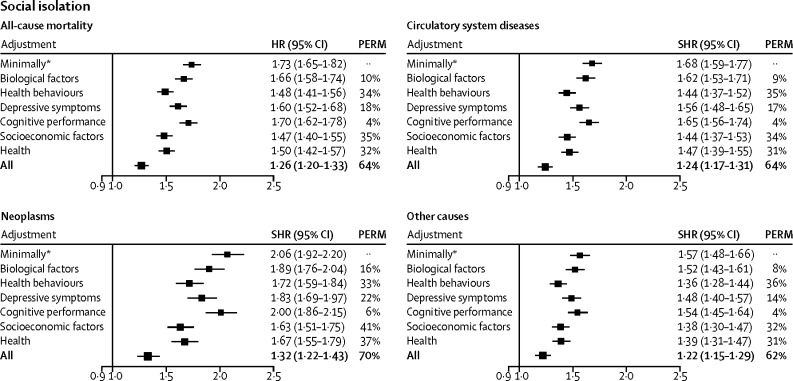
- Social isolation was associated with all-cause mortality: minimally adjusted HR 1.73 (95% CI 1.65–1.82), fully adjusted HR 1.26 (95% CI 1.20–1.33), with 64% overall attenuation after adjustment for biological, behavioural, socioeconomic, psychological, and self-rated health factors.
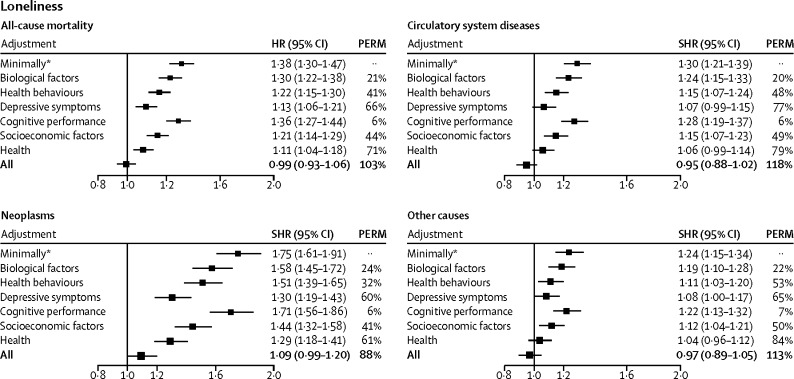
- Loneliness was associated with all-cause mortality: minimally adjusted HR 1.38 (95% CI 1.30–1.47), fully adjusted HR 0.99 (95% CI 0.93–1.06). Depressive symptoms (PERM 60–77%) and self-rated health (61–84%) were the strongest mediators for loneliness.
- For social isolation, the largest single explanatory groups were socioeconomic factors (35%), behavioural factors (34%), and self-rated health (32%); biological factors explained 10% and cognitive performance 4%.
Methods
- Prospective cohort analysis using UK Biobank baseline data and mortality follow-up from 2007–10 to Aug 14, 2015; 466,901 of 502,656 recruited participants had complete data on social isolation, loneliness, and mortality.
- Social isolation was measured with a three-item scale (living alone, infrequent friend/family visits, no weekly social activities), defined as score 2–3; loneliness was measured with two questions, defined as score 2.
- Cox proportional hazards models with age as timescale estimated all-cause mortality; competing-risks regression estimated cause-specific mortality; percentage of excess risk mediated (PERM) quantified contributions of biological, behavioural, socioeconomic, psychological, and self-rated health factors, with multiple imputation for missing data.
Limitations
- The paper states the response rate was low, so selection bias should be considered for population prevalence estimates; social network and interaction measures were simple; missing covariate data reduced sample size at successive adjustment stages; residual confounding and reverse causality cannot be ruled out; findings cannot be extrapolated beyond ages 40–69 years.
- The text also makes evident that the sample was predominantly white (95%) and from UK Biobank volunteers, which may limit generalizability to other populations.
Model-written summary. Check it against the paper before relying on it.
Integrity signals
Registry
Cites
Statistics
Figures
Verification
Claims the paper makes
31 Own result · 8 Own method · 5 Not checked yet · 5 Own interpretation · 1 Supported
Every source the paper cites for this claim was checked and supports it.
In the paper
“We measured only simple forms of the complex phenomenon of social networks and interaction, although similar results have been reported in studies using more advanced network analysis.27”
§ Contribution of risk factors to excess mortality in isolated and lonely individuals: an analysis of data from the UK Biobank cohort study > Discussion
What the sources say
- Supportedcites [27] Kroenke, 2013, Social networks, social support, and burden in relationships, and mortality after breast cancer diagnosis in the Life After Breast Cancer Epidemiology (LACE) study, Breast Cancer Res Treat source
The Methods (Data collection; page unavailable) describe a social-network measure built by assigning points for a limited set of relationships and activities, summing them, and dividing women into three categories. The Discussion (page unavailable) also notes that the study lacked information on numbers of friends. These passages support the claim that the study used relatively simple measures of social networks. (LLM, conf=0.86)
plain- Asserted: passes — The authors put it forward as true.
- Checkable: passes — It can be checked against evidence.
- Load-bearing: unclear — It is unclear whether the paper’s conclusions depend on it.
- Based: passes — The paper gives a reason why it holds.
- Supported
A result the paper reports from its own data — it cites no other source for it, so there is none to check. The quote shows it is in the paper.
In the paper
“In the sensitivity analysis testing for reverse-causation bias, the association between social isolation and all-cause mortality was still apparent (hazard ratio 1·22, 95% CI 1·08–1·38).”
§ Contribution of risk factors to excess mortality in isolated and lonely individuals: an analysis of data from the UK Biobank cohort study > Results
plaincorrelational- Asserted: passes — The authors put it forward as true.
- Checkable: passes — It can be checked against evidence.
- Load-bearing: passes — The paper’s conclusions depend on it.
- Based: passes — The paper gives a reason why it holds.
A result the paper reports from its own data — it cites no other source for it, so there is none to check. The quote shows it is in the paper.
In the paper
“decreased by 10% after adjustment for biological risk factors, 34% after adjustment for behavioural risk factors, 35% after adjustment for socioeconomic factors, 18% after adjustment for depressive symptoms, 4% after adjustment for cognitive performance, and 32% after adjustment for self-rated health”
§ Contribution of risk factors to excess mortality in isolated and lonely individuals: an analysis of data from the UK Biobank cohort study > Results
plaindirect- Asserted: passes — The authors put it forward as true.
- Checkable: passes — It can be checked against evidence.
- Load-bearing: passes — The paper’s conclusions depend on it.
- Based: passes — The paper gives a reason why it holds.
A result the paper reports from its own data — it cites no other source for it, so there is none to check. The quote shows it is in the paper.
In the paper
“although it was weaker in women than in men (appendix p 6).”
§ Contribution of risk factors to excess mortality in isolated and lonely individuals: an analysis of data from the UK Biobank cohort study > Results
plaincorrelational- Asserted: passes — The authors put it forward as true.
- Checkable: passes — It can be checked against evidence.
- Load-bearing: unclear — It is unclear whether the paper’s conclusions depend on it.
- Based: passes — The paper gives a reason why it holds.
A result the paper reports from its own data — it cites no other source for it, so there is none to check. The quote shows it is in the paper.
In the paper
“Depressive symptoms (PERM 60–77%) and self-rated health (61–84%) seemed to be the strongest mediators, in addition to socioeconomic (41–50%) and behavioural factors (32–53%; figure 2).”
§ Contribution of risk factors to excess mortality in isolated and lonely individuals: an analysis of data from the UK Biobank cohort study > Results
plaindirect- Asserted: passes — The authors put it forward as true.
- Checkable: passes — It can be checked against evidence.
- Load-bearing: passes — The paper’s conclusions depend on it.
- Based: passes — The paper gives a reason why it holds.
A result the paper reports from its own data — it cites no other source for it, so there is none to check. The quote shows it is in the paper.
In the paper
“This association was consistent across sex and age groups, ethnic groups, and participants with and without chronic disorders at baseline (appendix p 7).”
§ Contribution of risk factors to excess mortality in isolated and lonely individuals: an analysis of data from the UK Biobank cohort study > Results
plain- Asserted: passes — The authors put it forward as true.
- Checkable: passes — It can be checked against evidence.
- Load-bearing: unclear — It is unclear whether the paper’s conclusions depend on it.
- Based: passes — The paper gives a reason why it holds.
A result the paper reports from its own data — it cites no other source for it, so there is none to check. The quote shows it is in the paper.
In the paper
“and other causes (1·24, 1·15–1·34; figure 2).”
§ Contribution of risk factors to excess mortality in isolated and lonely individuals: an analysis of data from the UK Biobank cohort study > Results
plaincorrelational- Asserted: passes — The authors put it forward as true.
- Checkable: passes — It can be checked against evidence.
- Load-bearing: passes — The paper’s conclusions depend on it.
- Based: passes — The paper gives a reason why it holds.
A result the paper reports from its own data — it cites no other source for it, so there is none to check. The quote shows it is in the paper.
In the paper
“Lonely individuals had an increased risk of death from neoplasms (minimally adjusted sub-hazard ratio 1·75, 95% CI 1·61–1·91)”
§ Contribution of risk factors to excess mortality in isolated and lonely individuals: an analysis of data from the UK Biobank cohort study > Results
plaincorrelational- Asserted: passes — The authors put it forward as true.
- Checkable: passes — It can be checked against evidence.
- Load-bearing: passes — The paper’s conclusions depend on it.
- Based: passes — The paper gives a reason why it holds.
A result the paper reports from its own data — it cites no other source for it, so there is none to check. The quote shows it is in the paper.
In the paper
“When both isolation and loneliness were tested in the same model, only social isolation predicted all-cause mortality (hazard ratio 1·27, 95% CI 1·20–1·33).”
§ Contribution of risk factors to excess mortality in isolated and lonely individuals: an analysis of data from the UK Biobank cohort study > Results
plaincorrelational- Asserted: passes — The authors put it forward as true.
- Checkable: passes — It can be checked against evidence.
- Load-bearing: passes — The paper’s conclusions depend on it.
- Based: passes — The paper gives a reason why it holds.
A result the paper reports from its own data — it cites no other source for it, so there is none to check. The quote shows it is in the paper.
In the paper
“decreased by 10% after adjustment for biological risk factors, 34% after adjustment for behavioural risk factors, 35% after adjustment for socioeconomic factors, 18% after adjustment for depressive symptoms, 4% after adjustment for cognitive performance, and 32% after adjustment for self-rated health”
§ Contribution of risk factors to excess mortality in isolated and lonely individuals: an analysis of data from the UK Biobank cohort study > Results
plaindirect- Asserted: passes — The authors put it forward as true.
- Checkable: passes — It can be checked against evidence.
- Load-bearing: passes — The paper’s conclusions depend on it.
- Based: passes — The paper gives a reason why it holds.
- It may state two separate claims as one. 8
- Probably not a substantial claim. 9
A result the paper reports from its own data — it cites no other source for it, so there is none to check. The quote shows it is in the paper.
In the paper
“This association was consistent across sex and age groups, ethnic groups, and participants with and without chronic diseases at baseline, although it was weaker in women than in men (appendix p 6).”
§ Contribution of risk factors to excess mortality in isolated and lonely individuals: an analysis of data from the UK Biobank cohort study > Results
plaincorrelational- Asserted: passes — The authors put it forward as true.
- Checkable: passes — It can be checked against evidence.
- Load-bearing: passes — The paper’s conclusions depend on it.
- Based: passes — The paper gives a reason why it holds.
It may state two separate claims as one.
A result the paper reports from its own data — it cites no other source for it, so there is none to check. The quote shows it is in the paper.
In the paper
“The multivariable, minimally adjusted complete-case analysis showed similar associations between all-cause mortality and social isolation (hazard ratio 1·29, 95% CI 1·14–1·47) and loneliness (0·93, 0·77–1·11).”
§ Contribution of risk factors to excess mortality in isolated and lonely individuals: an analysis of data from the UK Biobank cohort study > Results
plaincorrelational- Asserted: passes — The authors put it forward as true.
- Checkable: passes — It can be checked against evidence.
- Load-bearing: passes — The paper’s conclusions depend on it.
- Based: passes — The paper gives a reason why it holds.
It may state two separate claims as one.
A result the paper reports from its own data — it cites no other source for it, so there is none to check. The quote shows it is in the paper.
In the paper
“but the fully adjusted sub-hazard ratios remained statistically significant and ranged from 1·32 to 1·22 (figure 1).”
§ Contribution of risk factors to excess mortality in isolated and lonely individuals: an analysis of data from the UK Biobank cohort study > Results
plaindirect- Asserted: passes — The authors put it forward as true.
- Checkable: passes — It can be checked against evidence.
- Load-bearing: passes — The paper’s conclusions depend on it.
- Based: passes — The paper gives a reason why it holds.
It may state two separate claims as one.
A result the paper reports from its own data — it cites no other source for it, so there is none to check. The quote shows it is in the paper.
In the paper
“The minimally adjusted hazard ratio for mortality risk related to loneliness was 1·38 (95% CI 1·30–1·47)”
- Also stated in: § Results · plain
“In the complete case analysis, the minimally adjusted hazard ratio for the risk of death from any cause in lonely individuals compared with those who were not lonely was 1·37 (95% CI 1·28–1·46).”
§ Contribution of risk factors to excess mortality in isolated and lonely individuals: an analysis of data from the UK Biobank cohort study > Abstract > Findings
plaincorrelationaln = 901- Asserted: passes — The authors put it forward as true.
- Checkable: passes — It can be checked against evidence.
- Load-bearing: passes — The paper’s conclusions depend on it.
- Based: passes — The paper gives a reason why it holds.
It may state two separate claims as one.
- Also stated in: § Results · plain
A result the paper reports from its own data — it cites no other source for it, so there is none to check. The quote shows it is in the paper.
In the paper
“Social isolation and loneliness were associated with higher levels of depressive symptoms, smoking, and high alcohol intake frequency, all of which are well established correlates of social isolation and loneliness (appendix p 3).”
§ Contribution of risk factors to excess mortality in isolated and lonely individuals: an analysis of data from the UK Biobank cohort study > Results
boostedcorrelational- Asserted: passes — The authors put it forward as true.
- Checkable: passes — It can be checked against evidence.
- Load-bearing: unclear — It is unclear whether the paper’s conclusions depend on it.
- Based: passes — The paper gives a reason why it holds.
It may state two separate claims as one.
What the paper did — it cites no source for this, so there is none to check. The quote shows it is in the paper.
In the paper
“To test whether reverse-causation bias (ie, the effect of chronic disease on social isolation) affected our results, we did a sensitivity analysis examining the association between social isolation and all-cause mortality (imputed data, but chronic disease missingness not imputed) after adjustment for all covariates in those without chronic disease at baseline.”
§ Contribution of risk factors to excess mortality in isolated and lonely individuals: an analysis of data from the UK Biobank cohort study > Methods > Statistical analysis
plain- Asserted: passes — The authors put it forward as true.
- Checkable: passes — It can be checked against evidence.
- Load-bearing: fails — The paper’s conclusions may not depend on it.
- Based: passes — The paper gives a reason why it holds.
Probably not a substantial claim. The paper’s conclusions may not depend on it.
What the paper did — it cites no source for this, so there is none to check. The quote shows it is in the paper.
In the paper
“The possibility of residual confounding cannot be completely ruled out in observational studies such as ours, although the association between social isolation and mortality remained even after adjustment for a wide range of potential confounders.”
§ Contribution of risk factors to excess mortality in isolated and lonely individuals: an analysis of data from the UK Biobank cohort study > Discussion
hedged- Asserted: passes — The authors put it forward as true.
- Checkable: passes — It can be checked against evidence.
- Load-bearing: fails — The paper’s conclusions may not depend on it.
- Based: passes — The paper gives a reason why it holds.
Probably not a substantial claim. The paper’s conclusions may not depend on it.
In the paper
“Similar questions are included in scales such as the revised UCLA Loneliness Scale.13”
§ Contribution of risk factors to excess mortality in isolated and lonely individuals: an analysis of data from the UK Biobank cohort study > Methods > Procedures
What the sources say
- Not checked yetcites [13] Hughes, 2004, A short scale for measuring loneliness in large surveys: results from two population-based studies, Res Aging source
plain- Asserted: passes — The authors put it forward as true.
- Checkable: passes — It can be checked against evidence.
- Load-bearing: fails — The paper’s conclusions may not depend on it.
- Based: passes — The paper gives a reason why it holds.
Probably not a substantial claim. The paper’s conclusions may not depend on it.
What the paper did — it cites no source for this, so there is none to check. The quote shows it is in the paper.
In the paper
“Missing data on the covariates reduced the sample size at each successive stage of the regression model adjustment, although the results were similar when the analyses were repeated with only participants who provided complete data on all the variables.”
§ Contribution of risk factors to excess mortality in isolated and lonely individuals: an analysis of data from the UK Biobank cohort study > Discussion
plaindirect- Asserted: passes — The authors put it forward as true.
- Checkable: passes — It can be checked against evidence.
- Load-bearing: fails — The paper’s conclusions may not depend on it.
- Based: passes — The paper gives a reason why it holds.
Probably not a substantial claim. The paper’s conclusions may not depend on it.
What the paper did — it cites no source for this, so there is none to check. The quote shows it is in the paper.
In the paper
“However, the response rate was low, and selection bias should be taken into account especially when making inferences about population prevalence figures.”
§ Contribution of risk factors to excess mortality in isolated and lonely individuals: an analysis of data from the UK Biobank cohort study > Discussion
plain- Asserted: passes — The authors put it forward as true.
- Checkable: passes — It can be checked against evidence.
- Load-bearing: fails — The paper’s conclusions may not depend on it.
- Based: passes — The paper gives a reason why it holds.
Probably not a substantial claim. The paper’s conclusions may not depend on it. It may state two separate claims as one.
In the paper
“although similar results have been reported in studies using more advanced network analysis.27”
§ Contribution of risk factors to excess mortality in isolated and lonely individuals: an analysis of data from the UK Biobank cohort study > Discussion
What the sources say
- Not checked yetcites [27] Kroenke, 2013, Social networks, social support, and burden in relationships, and mortality after breast cancer diagnosis in the Life After Breast Cancer Epidemiology (LACE) study, Breast Cancer Res Treat source
plain- Asserted: passes — The authors put it forward as true.
- Checkable: passes — It can be checked against evidence.
- Load-bearing: fails — The paper’s conclusions may not depend on it.
- Based: passes — The paper gives a reason why it holds.
Probably not a substantial claim. The paper’s conclusions may not depend on it.
What the paper did — it cites no source for this, so there is none to check. The quote shows it is in the paper.
In the paper
“Similarly, reverse causality can affect the results of observational research. For example, in our study, chronic disease might have affected the risk of both social isolation and mortality.”
§ Contribution of risk factors to excess mortality in isolated and lonely individuals: an analysis of data from the UK Biobank cohort study > Discussion
hedgedconditional- Asserted: passes — The authors put it forward as true.
- Checkable: passes — It can be checked against evidence.
- Load-bearing: fails — The paper’s conclusions may not depend on it.
- Based: passes — The paper gives a reason why it holds.
Probably not a substantial claim. The paper’s conclusions may not depend on it. It may state two separate claims as one.
What the paper did — it cites no source for this, so there is none to check. The quote shows it is in the paper.
In the paper
“although the results were similar when the analyses were repeated with only participants who provided complete data on all the variables.”
§ Contribution of risk factors to excess mortality in isolated and lonely individuals: an analysis of data from the UK Biobank cohort study > Discussion
plain- Asserted: passes — The authors put it forward as true.
- Checkable: passes — It can be checked against evidence.
- Load-bearing: fails — The paper’s conclusions may not depend on it.
- Based: passes — The paper gives a reason why it holds.
Probably not a substantial claim. The paper’s conclusions may not depend on it.
A conclusion the paper draws from its own results — it cites no other source for it, so there is none to check. The quote shows it is in the paper.
In the paper
“Finally, the sample comprised participants aged between 40 years and 69 years; hence, the findings cannot be extrapolated beyond this age range.”
§ Contribution of risk factors to excess mortality in isolated and lonely individuals: an analysis of data from the UK Biobank cohort study > Discussion
plain- Asserted: passes — The authors put it forward as true.
- Checkable: passes — It can be checked against evidence.
- Load-bearing: unclear — It is unclear whether the paper’s conclusions depend on it.
- Based: passes — The paper gives a reason why it holds.
It may state two separate claims as one.
In the paper
“We accounted for missing data by multiple imputation by chained equations, which generated five imputed datasets.22”
§ Contribution of risk factors to excess mortality in isolated and lonely individuals: an analysis of data from the UK Biobank cohort study > Methods > Statistical analysis
What the sources say
- Not checked yetcites [22] White, 2011, Multiple imputation using chained equations: issues and guidance for practice, Stat Med source
plain- Asserted: passes — The authors put it forward as true.
- Checkable: passes — It can be checked against evidence.
- Load-bearing: fails — The paper’s conclusions may not depend on it.
- Based: passes — The paper gives a reason why it holds.
Probably not a substantial claim. The paper’s conclusions may not depend on it.
The paper relies on this without support.
The associations between social isolation/loneliness and mortality are causal and the measured risk factors lie on the causal pathway, so that the percentage of excess risk mediated can be interpreted as mediation.
“We calculated the percentage of excess risk mediated by risk factors to assess the extent to which the associations of social isolation and loneliness with mortality were attributable to differences between isolated and lonely individuals and others in biological (body-mass index, systolic and diastolic blood pressure, and handgrip strength), behavioural (smoking, alcohol consumption, and physical”
The paper relies on this without support.
There is no unmeasured confounding of the associations between social isolation/loneliness and mortality beyond the covariates adjusted for.
“The possibility of residual confounding cannot be completely ruled out in observational studies such as ours, although the association between social isolation and mortality remained even after adjustment for a wide range of potential confounders.”
The paper relies on this without support.
The baseline risk factors adequately capture the mediating pathways over the follow-up period.
“We calculated the percentage of excess risk mediated by risk factors to assess the extent to which the associations of social isolation and loneliness with mortality were attributable to differences between isolated and lonely individuals and others in biological (body-mass index, systolic and diastolic blood pressure, and handgrip strength), behavioural (smoking, alcohol consumption, and physical”
The paper relies on this without support.
The UK Biobank cohort's selection bias does not materially affect the associations between social isolation/loneliness and mortality.
“However, the response rate was low, and selection bias should be taken into account especially when making inferences about population prevalence figures. However, prevalence and incidence were not the focus of the present study.”
Claims other papers make about this one
Each is checked against this paper’s own text: does it say what the citing paper says it does?
In the citing paper
“A major adverse consequence of the COVID-19 pandemic is likely to be increased social isolation and loneliness (as reflected in our surveys),4 which are strongly associated with anxiety, depression, self-harm, and suicide attempts across the lifespan.24, 25”
From Multidisciplinary research priorities for the COVID-19 pandemic: a call for action for mental health science (2020) · cites this paper as [24]
In the citing paper
“in non-pandemic contexts, evidence suggests that the prevalence of loneliness ranges from 6–76%; with variations across demographic groups [5,13–17] and countries [18,19].”
From Loneliness in the UK during the COVID-19 pandemic: Cross-sectional results from the COVID-19 Psychological Wellbeing Study (2020) · cites this paper as [17]
Self-check
Percentages, sums and reported differences re-computed from the paper’s own numbers.
Each contradiction between two passages listed here was confirmed by an independent check.
Rated major: it would touch a result — a value a result rests on, reported and recomputed p-values on opposite sides of the significance level, two passages that conflict with no sign which is right, or a cited work retracted before this paper was published.
In the paper
§ Contribution of risk factors to excess mortality in isolated and lonely individuals: an analysis of data from the UK Biobank cohort study > Results
“The multivariable, minimally adjusted complete-case analysis showed similar associations between all-cause mortality and social isolation (hazard ratio 1·29, 95% CI 1·14–1·47) and loneliness (0·93, 0·77–1·11).”
§ Contribution of risk factors to excess mortality in isolated and lonely individuals: an analysis of data from the UK Biobank cohort study > Results
“In the complete case analysis, the minimally adjusted hazard ratio for the risk of death from any cause in lonely individuals compared with those who were not lonely was 1·37 (95% CI 1·28–1·46).”
Citations
Cites
Spitzer, R. L. (1999) · JAMA · doi:10.1001/jama.282.18.1737 · Cited by 9,802
Multiple imputation using chained equations: Issues and guidance for practice
White, I. R., Royston, P., & Wood, A. M. (2011) · Statistics in Medicine · doi:10.1002/sim.4067 · Cited by 9,792
Social Relationships and Mortality Risk: A Meta-analytic Review
Holt-Lunstad, J., Smith, T. B., & Layton, J. B. (2010) · PLoS Medicine · doi:10.1371/journal.pmed.1000316 · Cited by 7,272
Social Relationships and Health
House, J. S., Landis, K. R., & Umberson, D. (1988) · Science · doi:10.1126/science.3399889 · Cited by 7,073
Loneliness and Social Isolation as Risk Factors for Mortality: A Meta-Analytic Review
Holt-Lunstad, J., Smith, T. B., Baker, M., Harris, T., & Stephenson, D. (2015) · Perspectives on Psychological Science · doi:10.1177/1745691614568352 · Cited by 6,043
BERKMAN, L. F., & SYME, S. L. (1979) · American Journal of Epidemiology · doi:10.1093/oxfordjournals.aje.a112674 · Cited by 5,341
A Short Scale for Measuring Loneliness in Large Surveys: Results From Two Population-Based Studies
Hughes, M. E., Waite, L. J., Hawkley, L. C., & Cacioppo, J. T. (2004) · Research on Aging · doi:10.1177/0164027504268574 · Cited by 4,781
Introduction to the Analysis of Survival Data in the Presence of Competing Risks
Austin, P. C., Lee, D. S., & Fine, J. P. (2016) · Circulation · doi:10.1161/circulationaha.115.017719 · Cited by 2,653
Social isolation, loneliness, and all-cause mortality in older men and women
Steptoe, A., Shankar, A., Demakakos, P., & Wardle, J. (2013) · Proceedings of the National Academy of Sciences · doi:10.1073/pnas.1219686110 · Cited by 2,503
Perceived social isolation and cognition
Cacioppo, J. T., & Hawkley, L. C. (2009) · Trends in Cognitive Sciences · doi:10.1016/j.tics.2009.06.005 · Cited by 2,144
Valtorta, N. K., Kanaan, M., Gilbody, S., Ronzi, S., & Hanratty, B. (2016) · Heart · doi:10.1136/heartjnl-2015-308790 · Cited by 1,971
Hemingway, H., & Marmot, M. G. (1999) · BMJ · doi:10.1136/bmj.318.7196.1460 · Cited by 1,342
Loneliness and health: potential mechanisms
Cacioppo, J. T., Hawkley, L. C., Crawford, L. E., Ernst, J. M., Burleson, M. H., Kowalewski, R. B., Malarkey, W. B., Van Cauter, E., & Berntson, G. G. (2002) · Psychosomatic Medicine · doi:10.1097/00006842-200205000-00005 · Cited by 1,149
Imputing missing covariate values for the Cox model
White, I. R., & Royston, P. J. (2009) · Statistics in Medicine · doi:10.1002/sim.3618 · Cited by 1,015
Elliott, P., Peakman, T. C., & Biobank, O. B. O. U. (2008) · International Journal of Epidemiology · doi:10.1093/ije/dym276 · Cited by 1,004
ESTIMATING THE PROPORTION OF TREATMENT EFFECT EXPLAINED BY A SURROGATE MARKER
Lin, D. Y., Fleming, T. R., & Gruttola, V. D. (1997) · Statistics in Medicine · doi:10.1002/(sici)1097-0258(19970715)16:13 · Cited by 521
Ganna, A., & Ingelsson, E. (2015) · The Lancet · doi:10.1016/s0140-6736(15)60175-1 · Cited by 411
Socioeconomic Status and Health: Mediating and Moderating Factors
Chen, E., & Miller, G. E. (2013) · Annual Review of Clinical Psychology · doi:10.1146/annurev-clinpsy-050212-185634 · Cited by 402
Valtorta, N., Kanaan, M. N., Gilbody, S. M., & Hanratty, B. (2016) · BMJ Open · doi:10.1136/bmjopen-2015-010799 · Cited by 387
Smıth, D. J., Nicholl, B. I., Cullen, B., Martin, D. J., Haq, Z. U., Evans, J. J., Gill, J. M. R., Roberts, B. A., Gallacher, J., Mackay, D., et al. (2013) · PLoS ONE · doi:10.1371/journal.pone.0075362 · Cited by 360
Lyall, D. M., Cullen, B., Allerhand, M. H., Smıth, D. J., Mackay, D., Evans, J. J., Anderson, J. J., Fawns‐Ritchie, C., McIntosh, A. M., Deary, I. J., et al. (2016) · PLoS ONE · doi:10.1371/journal.pone.0154222 · Cited by 247
Kroenke, C. H., Quesenberry, C., Kwan, M. L., Sweeney, C., Castillo, A., & Caan, B. J. (2013) · Breast Cancer Research and Treatment · doi:10.1007/s10549-012-2253-8 · Cited by 162
Hakulinen, C. A., Pulkki-Råbäck, L., Jokela, M. M., Ferrie, J. E., Aalto, A., Virtanen, M., Mika Kivimaki, B., Vahtera, J., & Elovainio, M. J. (2016) · Journal of Epidemiology & Community Health · doi:10.1136/jech-2015-206165 · Cited by 130
Self-citationThe importance of normalisation in the construction of deprivation indices.
Gilthorpe, M. S. (1995) · Journal of Epidemiology & Community Health · doi:10.1136/jech.49.suppl_2.s45 · Cited by 76
Stokes, J. E. (2016) · Research on Aging · doi:10.1177/0164027515624224 · Cited by 46
Cited by
Sorted by citations
Holmes, E. A., O'Connor, R. C., Perry, V. H., Tracey, I., Wessely, S., Arseneault, L., Ballard, C., Christensen, H., Cohen Silver, R., Everall, I., et al. (2020) · The Lancet Psychiatry · doi:10.1016/s2215-0366(20)30168-1 · Cited by 5,715
Hall, G., Laddu, D., Phillips, S. A., Lavie, C. J., & Arena, R. A. (2020) · Progress in Cardiovascular Diseases · doi:10.1016/j.pcad.2020.04.005 · Cited by 804
Groarke, J. M., Berry, E., Graham-Wisener, L., McKenna-Plumley, P. E., McGlinchey, E., & Armour, C. (2020) · PLOS ONE · doi:10.1371/journal.pone.0239698 · Cited by 727
Holt‐Lunstad, J. (2022) · Annual Review of Public Health · doi:10.1146/annurev-publhealth-052020-110732 · Cited by 642
Mattioli, A. V., Sciomer, S., Cocchi, C., Maffei, S., & Gallina, S. (2020) · Nutrition, Metabolism and Cardiovascular Diseases · doi:10.1016/j.numecd.2020.05.020 · Cited by 540
Metadata
- Authors
- Elovainio, M., Hakulinen, C., Pulkki-Råback, L., Virtanen, M., Josefsson, K., Jokela, M., Vahtera, J., & Kivimäki, M.
- Affiliations
- University of Helsinki (FI)
- Finnish Institute of Occupational Health (FI)
- Finnish Institute for Health and Welfare (FI)
- University of Turku (FI)
- Corresponding author
- Elovainio, Marko
- ORCID
- Venue
- The Lancet Public Health
- Publisher
- Elsevier BV
- Published
- 2017-06
- Volume
- 2
- Issue
- 6
- Pages
- e260-e266
- ISSN
- 2468-2667 (ISSN-L)
- PMC
- PMC5463031
- OpenAlex
- W2611831262
- Semantic Scholar
- 94f75fba3a76a3153f8bfe3202352047d45762a0
- Cited by
- 411
- References
- 26
- Citations by year
- 2026: 39 · 2025: 52 · 2024: 64 · 2023: 52 · 2022: 42 · 2021: 59 · 2020: 60 · 2019: 18 · 2018: 20 · 2017: 4
- FWCI
- 31.02
- Type
- journal article
- Language
- en
- Open access
- gold
- doi.org
- Locations
- The Lancet Public Health (publishedVersion, cc-by)
- Europe PMC (PubMed Central) (publishedVersion, cc-by)
- PubMed Central (publishedVersion, cc-by)
- PubMed (publishedVersion)
- UTUPub (University of Turku) (submittedVersion)
- DOAJ (DOAJ: Directory of Open Access Journals) (submittedVersion, cc-by-sa)
- UCL Discovery (University College London) (submittedVersion)
- Työväentutkimus Vuosikirja (submittedVersion)
- STM:n Hallinnonalan avoin julkaisuarkisto (Julkari) (submittedVersion)
- Funders
- Academy of Finland (265977)
- UK Medical Research Council (K013351)
- Topics
- Social Sciences › Health › Health disparities and outcomes
- Social Sciences › Psychology › Social Psychology › Death Anxiety and Social Exclusion
- Health Sciences › Medicine › Cardiology and Cardiovascular Medicine › Cardiac Health and Mental Health
- Keywords
- social isolation, loneliness, excess mortality, all-cause mortality, risk factors, mediation analysis, socioeconomic deprivation, health behavior, depressive symptoms, body mass index, blood pressure, grip strength, physical activity, alcohol consumption, smoking, cognitive ability, UK Biobank
About these checks
Registry, retraction, Cites and statistics results are computed, not judged, with one exception: a printed reference that no index lists is read once by a model before it counts as a citation error. Claims are extracted by a model and kept only when their quote appears verbatim in the text; each cited source is then checked, with a model’s help, for whether it says what the claim relies on. Those verdicts can be wrong — read the claim’s quote and the cited source before relying on one.
A language model drew the claims from the paper on 2026-10-06, under version 3 of the claim definition (model deepseek-v4.1-flash, prompt extract-v3).
A second model labelled each claim on 2026-10-06 (model jev-1.13-20260917, definition revision gold-guideline-v0.2).
Cited sources are checked with a language model’s help (gpt-6-sol).
Statistics and arithmetic are recomputed, not judged.
Confidence bands are shown only for fields calibrated on our annotated test set. None is calibrated yet, so no band is shown.
What counts as a claim ›How we measure confidence ›How we check this ›
Are you an author, or do you see a problem with this page? Request a review
