

The effect of socioeconomic deprivation on the association between an extended measurement of unhealthy lifestyle factors and health outcomes: a prospective analysis of the UK Biobank cohort
Open accessThe DOI matches its Crossref record; 29 of the 29 references it cites were found in a registry or an index.
Abstract
Background Combinations of lifestyle factors interact to increase mortality. Combinations of traditional factors such as smoking and alcohol are well described, but the additional effects of emerging factors such as television viewing time are not. The effect of socioeconomic deprivation on these extended lifestyle risks also remains unclear. We aimed to examine whether deprivation modifies the association between an extended score of lifestyle-related risk factors and health outcomes. Methods Data for this prospective analysis were sourced from the UK Biobank, a prospective population-based cohort study. We assigned all participants an extended lifestyle score, with 1 point for each unhealthy lifestyle factor (incorporating sleep duration and high television viewing time, in addition to smoking, excessive alcohol, poor diet [low intake of oily fish or fruits and vegetables, and high intake of red meat or processed meats], and low physical activity), categorised as most healthy (score 0–2), moderately healthy (score 3–5), or least healthy (score 6–9). Cox proportional hazards models were used to examine the association between lifestyle score and health outcomes (all-cause mortality and cardiovascular disease mortality and incidence), and whether this association was modified by deprivation. All analyses were landmark analyses, in which participants were excluded if they had an event (death or cardiovascular disease event) within 2 years of recruitment. Participants with non-communicable diseases (except hypertension) and missing covariate data were excluded from analyses. Participants were also excluded if they reported implausible values for physical activity, sleep duration, and total screen time. All analyses were adjusted for age, sex, ethnicity, month of assessment, history of hypertension, systolic blood pressure, medication for hypercholesterolaemia or hypertension, and body-mass index categories. Findings 328 594 participants aged 40–69 years were included in the study, with a mean follow-up period of 4·9 years (SD 0·83) after the landmark period for all-cause and cardiovascular disease mortality, and 4·1 years (0·81) for cardiovascular disease incidence. In the least deprived quintile, the adjusted hazard ratio (HR) in the least healthy lifestyle category, compared with the most healthy category, was 1·65 (95% CI 1·25–2·19) for all-cause mortality, 1·93 (1·16–3·20) for cardiovascular disease mortality, and 1·29 (1·10–1·52) for cardiovascular disease incidence. Equivalent HRs in the most deprived quintile were 2·47 (95% CI 2·04–3·00), 3·36 (2·36–4·76), and 1·41 (1·25–1·60), respectively. The HR for trend for one increment change towards least healthy in the least deprived quintile compared with that in the most deprived quintile was 1·25 (95% CI 1·12–1·39) versus 1·55 (1·40–1·70) for all-cause mortality, 1·30 (1·05–1·61) versus 1·83 (1·54–2·18) for cardiovascular disease mortality, and 1·10 (1·04–1·17) versus 1·16 (1·09–1·23) for cardiovascular disease incidence. A significant interaction was found between lifestyle and deprivation for all-cause and cardiovascular disease mortality (both p interaction <0·0001), but not for cardiovascular disease incidence (p interaction =0·11). Interpretation Wide combinations of lifestyle factors are associated with disproportionate harm in deprived populations. Social and fiscal policies that reduce poverty are needed alongside public health and individual-level interventions that address a wider range of lifestyle factors in areas of deprivation. Funding None.
Overview
The claims and statistics of this paper haven’t been checked yet.
Free: it reads the open-access text and checks the first 5 claims that cite a source we can check. Create a free account to check every claim.
Integrity signals
Registry
Cites
Statistics
Figures
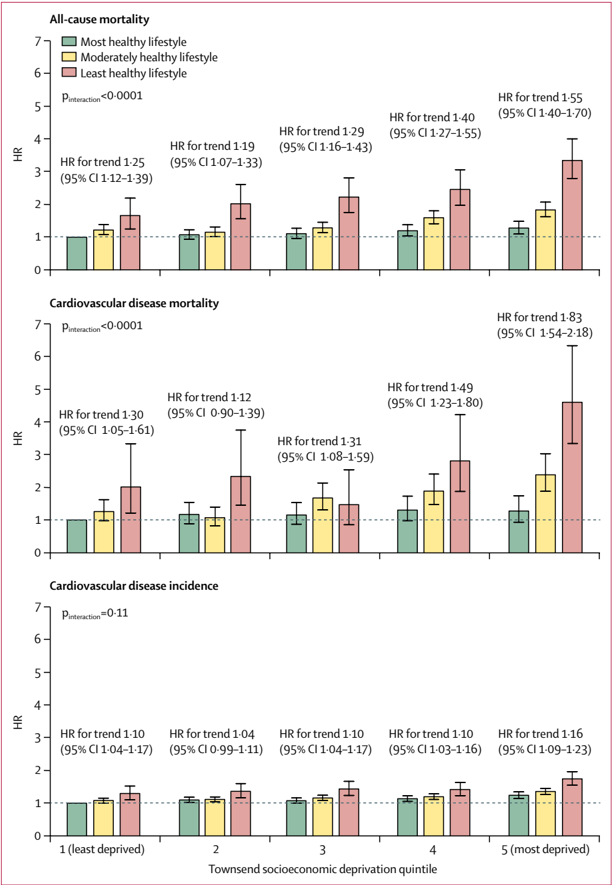
Verification
Claims the paper makes
The claims and statistics of this paper haven’t been checked yet.
Free: it reads the open-access text and checks the first 5 claims that cite a source we can check. Create a free account to check every claim.
Claims other papers make about this one
Each is checked against this paper’s own text: does it say what the citing paper says it does?
The source backs part of the claim, not all of it — or backs it for a different population, condition or comparison.
In the citing paper
“Social deprivation and psychosocial stress set the scene for increased risk [13].”
From 2019 ESC/EAS guidelines for the management of dyslipidaemias: lipid modification to reduce cardiovascular risk (2019) · cites this paper as [13]
Experimental — accuracy not yet measured
Self-check
Percentages, sums and reported differences re-computed from the paper’s own numbers.
The self-check needs the paper’s full text.
Citations
Cites
Sudlow, C., Gallacher, J., Allen, N., Beral, V., Burton, P., Danesh, J., Downey, P., Elliott, P., Green, J., Landray, M., et al. (2015) · PLOS Medicine · doi:10.1371/journal.pmed.1001779 · Cited by 12,728
Self-citationNaghavi, M., Abajobir, A. A., Abbafati, C., Abbas, K. M., Abd-Allah, F., Abera, S. F., Aboyans, V., Adetokunboh, O., Afshin, A., Agrawal, A., et al. (2017) · The Lancet · doi:10.1016/s0140-6736(17)32152-9 · Cited by 4,821
Closing the gap in a generation: health equity through action on the social determinants of health
Marmot, M., Friel, S., Bell, R., Houweling, T. A., & Taylor, S. (2008) · The Lancet · doi:10.1016/s0140-6736(08)61690-6 · Cited by 3,247
Health and Deprivation: Inequality and the North
Townsend, P. D., Phillimore, P., & Beattie, A. (1987) · DOAJ (DOAJ: Directory of Open Access Journals) · Cited by 1,473
Stringhini, S., Carmeli, C., Jokela, M., Avendaño, M., Muennig, P., Guida, F., Ricceri, F., d'Errico, A., Barros, H., Bochud, M., et al. (2017) · The Lancet · doi:10.1016/s0140-6736(16)32380-7 · Cited by 1,319
What makes UK Biobank special?
Collins, R. (2012) · The Lancet · doi:10.1016/s0140-6736(12)60404-8 · Cited by 1,128
Loef, M., & Walach, H. (2012) · Preventive Medicine · doi:10.1016/j.ypmed.2012.06.017 · Cited by 822
Long sleep duration and health outcomes: A systematic review, meta-analysis and meta-regression
Jike, M., Itani, O., Watanabe, N., Buysse, D. J., & Kaneita, Y. (2018) · Sleep Medicine Reviews · doi:10.1016/j.smrv.2017.06.011 · Cited by 768
Health and deprivation. Inequality and the North
Mackenbach, J. P. (1988) · Health Policy · doi:10.1016/0168-8510(88)90006-1 · Cited by 661
A systematic review on the clustering and co-occurrence of multiple risk behaviours
Meader, N., King, K., Moe-Byrne, T., Wright, K., Graham, H., Petticrew, M., Power, C., White, M., & Sowden, A. J. (2016) · BMC Public Health · doi:10.1186/s12889-016-3373-6 · Cited by 578
Cited by
Items 101–200 of 442
Klompstra, L. V., Löf, M., Björkelund, C., Hellénius, M.-L., Kallings, L., Orho‐Melander, M., Wennberg, P., Bendtsen, P., & Bendtsen, M. (2024) · Scientific Reports · doi:10.1038/s41598-024-71092-0 · Cited by 17
“Socio-economic status is considered the strongest predictor of engaging in multiple health risk behaviours 5,11 .”
BackgroundMaia, I., Oliveira, A., & Santos, A. C. (2023) · Food Security · doi:10.1007/s12571-023-01366-4 · Cited by 20
“…adverse behaviours in a combined lifestyle score, rather than looking at them separately, could be more informative (Sotos-Prieto et al., 2015; Foster et al., 2018) and capture better the influence of different health behaviours, considering their complexity and multiple dimensions (Jiao et…”
BackgroundMethodInfluentialZhao, S. S., Rogers, K., Kearsley‐Fleet, L., Watson, K. D., Bosworth, A., Galloway, J. B., Verstappen, S. M. M., Plant, D., BSRBR-RA Contributors Group, B. C., Gaston, H., et al. (2023) · Rheumatology · doi:10.1093/rheumatology/kead261 · Cited by 17
“These factors and how they interact with each other [28] should be areas for future study.”
BackgroundSelf-citationAssociation of a healthy lifestyle with mortality in older people
Robb, C. E., Carr, P. R., Ball, J., Owen, A. J., Beilin, L. J., Newman, A. B., Nelson, M. R., Reid, C. M., Orchard, S. G., Neumann, F., et al. (2023) · BMC Geriatrics · doi:10.1186/s12877-023-04247-9 · Cited by 23
Zhang, P., Zhong, J., Liu, X., & Sun, W. (2024) · Journal of Cachexia Sarcopenia and Muscle · doi:10.1002/jcsm.13525 · Cited by 18
“18 A higher score on this index indicates a higher level of socioeconomic deprivation.”
BackgroundAcute illness and death in children with adrenal insufficiency
Worth, C., Vyas, A., Banerjee, I., Lin, W., Jones, J., Stokes, H., Komlosy, N., Ball, S., & Clayton, P. (2021) · Frontiers in Endocrinology · doi:10.3389/fendo.2021.757566 · Cited by 16
The Relationship Between Sleep Traits and Tinnitus in UK Biobank: A Population-Based Cohort Study
Peng, J., Dong, Y., Luo, Y., Qiu, K., Cheng, D., Rao, Y., Song, Y., Pang, W., Mu, X., Hu, C., et al. (2022) · Ear and Hearing · doi:10.1097/aud.0000000000001273 · Cited by 17
Physical frailty, genetic predisposition, and incident arrhythmias
Zhang, Y., Liu, M., Li, J., Ruan, L., Wu, X., Zhang, C., & Chen, L. (2024) · Journal of Cachexia Sarcopenia and Muscle · doi:10.1002/jcsm.13499 · Cited by 17
Wu, H., Wei, J., Chen, W., Chen, L., Zhang, J., Wang, N., Wang, S., & Tan, X. W. (2024) · Arteriosclerosis Thrombosis and Vascular Biology · doi:10.1161/atvbaha.124.321214 · Cited by 21
Hire, A. J., & Franklin, B. D. (2024) · BMC Geriatrics · doi:10.1186/s12877-024-04858-w · Cited by 16
“People living in more socioeconomically-deprived circumstances tend to report poorer health, and have a higher likelihood of developing multiple long-term conditions [13].”
BackgroundKraftman, L., Hardelid, P., & Banks, J. W. (2021) · The Lancet Regional Health - Europe · doi:10.1016/j.lanepe.2021.100136 · Cited by 18
“Life-course decisions and environments will have impacts on health inequalities throughout one’s life since exposure to environmental hazards and health behaviours such as air pollution, poor diet, tobacco smoke and lack of exercise contribute to disease and mortality and are positively correlated with disadvantage [3…”
Effects of genetic ancestry and socioeconomic deprivation on ethnic differences in serum creatinine
Mariño‐Ramírez, L., Sharma, S., Rishishwar, L., Conley, A. B., Nagar, S. D., & Jordan, I. K. (2022) · Gene · doi:10.1016/j.gene.2022.146709 · Cited by 17
“Socioeconomic deprivation (SED): SED was modeled as a continuous variable using the Townsend deprivation index, which is a widely used measure of SED that is known to be associated with a variety of health outcomes (Foster et al., 2018).”
MethodDuan, M.-J., Dekker, L. H., Carrero, J. J., & Navis, G. J. (2022) · Prevention Science · doi:10.1007/s11121-022-01357-5 · Cited by 16
“After controlling for the aforementioned risk factors, socioeconomic status, such as low education and insufficient income, has been found to be associated with higher risk of type 2 diabetes (Foster et al., 2018; Maty et al., 2005; Vinke et al., 2020).”
BackgroundRisk of progression from pre‐diabetes to type 2 diabetes in a large UK adult cohort
Gardner, M. P., Wang, J., Hazlehurst, J., Sainsbury, C. A. R., Blissett, J. M., Nirantharakumar, K., Thomas, G. N., & Bellary, S. (2022) · Diabetic Medicine · doi:10.1111/dme.14996 · Cited by 21
Hu, W., Han, Q., Chu, J., Sun, N., Li, T., Feng, Z., He, Q., Ma, Z., Wang, Y., & Shen, Y. (2023) · Archives of Gerontology and Geriatrics · doi:10.1016/j.archger.2023.105051 · Cited by 15
Binnewies, J., Nawijn, L., Brandmaier, A. M., Baaré, W. F. C., Boraxbekk, C., Demnitz, N., Drevon, C. A., Fjell, A. M., Lindenberger, U., Madsen, K. S., et al. (2023) · Brain Research Bulletin · doi:10.1016/j.brainresbull.2023.110692 · Cited by 17
“Furthermore, as done in earlier research (10,29,31,32), the cumulative unhealthy lifestyle score we used assumes all lifestyle-related risk factors contribute equally while some factors may be more harmful to brain structure than others (9,71).”
BackgroundLa, R., Zhou, L., Yin, Y., Lu, L., Li, L., Jiang, D., Huang, L., & Wu, Q. (2024) · BMC Women s Health · doi:10.1186/s12905-024-03066-3 · Cited by 16
“Moreover, a prospective study confirmed the link between higher income levels and healthier lifestyle choices, ultimately leading to a diminished risk of negative health outcomes [48].”
BackgroundBonaccio, M., Gianfagna, F., Stival, C., Amerio, A., Bosetti, C., d’Oro, L. C., Odone, A., Stückler, D., Zucchi, A., Gallus, S., et al. (2022) · International Journal of Food Sciences and Nutrition · doi:10.1080/09637486.2022.2040009 · Cited by 15
Hu, G. X., Qin, H., Su, B., Bao, Y., Liang, Z., & Wang, Y. (2023) · Molecular Psychiatry · doi:10.1038/s41380-023-02338-y · Cited by 18
Identifying Markers of Cardiovascular Event-Free Survival in Familial Hypercholesterolemia
Khoury, É., Brisson, D., Roy, N., Tremblay, G., & Gaudet, D. (2020) · Journal of Clinical Medicine · doi:10.3390/jcm10010064 · Cited by 15
“These findings correlate well with evidence found in the literature, where the CV risk association of smoking [41–44] and psychosocial stress [45,46] have been extensively studied.”
ResultWu, Y., Luo, M., Tan, X. W., & Chen, L. (2022) · Journal of sport and health science/Journal of Sport and Health Science · doi:10.1016/j.jshs.2022.10.002 · Cited by 15
Li, F., Chen, L., Liu, B., Zhong, V. W., Deng, Y., Luo, D., Gao, C., Bao, W., & Rong, S. (2022) · BMC Medicine · doi:10.1186/s12916-022-02691-9 · Cited by 19
“Socioeconomic status was derived from Townsend deprivation index scores and categorized into quintiles (a higher score denoted a higher degree of deprivation) [18].”
Methoddo Nascimento, C. F., Duarte, Y. A. O., & Filho, A. D. P. C. (2022) · Cadernos de Saúde Pública · doi:10.1590/0102-311x00196821 · Cited by 13
Beydoun, M. A., Beydoun, H. A., Hu, Y., Li, Z., Wolf, C., Meirelles, O., Hooten, N. N., Launer, L. J., Evans, M. K., & Zonderman, A. B. (2023) · Brain Behavior and Immunity · doi:10.1016/j.bbi.2023.10.009 · Cited by 14
Kong, X., Huang, R., Geng, R., Wu, J., Li, J., Wu, Y., Zhao, Y., You, D., Yu, H., Du, M., et al. (2024) · BMC Public Health · doi:10.1186/s12889-024-19761-7 · Cited by 16
“According to the published studies, the definition of life-style contained the following six components: physical activity, alcohol intake, smoking status, dietary patterns, sedentary time, and sleep duration [20, 21].”
MethodJiang, L., Xu, L., Sun, W., Bian, K., & Wang, Y. (2025) · Aging Clinical and Experimental Research · doi:10.1007/s40520-025-03003-w · Cited by 17
“Socioeconomic deprivation was evaluated using the Townsend Deprivation Index, derived from participants’ postal codes and corre - sponding national census data, with higher scores indicat - ing greater deprivation [13 ].”
Growing Significance of High Fiber Diet in the Prevention of Some Chronic Diseases
Pal, M. S. (2022) · Nutrition and Food Processing · doi:10.31579/2637-8914/082 · Cited by 13
Vallée, A. (2023) · Public Health · doi:10.1016/j.puhe.2023.05.014 · Cited by 14
Barth, C., Galea, L. A. M., Jacobs, E. G., Lee, B. H., Westlye, L. T., & de Lange, A. G. (2025) · eLife · doi:10.7554/elife.99538.3 · Cited by 16
Vallée, A. (2023) · International Journal of Public Health · doi:10.3389/ijph.2023.1606328 · Cited by 12
“The adjustments were justi fi ed by their relationship with ASCVD risk and CV risk: education [56], income [30, 57], physical activity [58], smoking pack years [59], Townsend deprivation [30, 60] and BMI [61].”
Liu, F., Peng, Y., Wang, P., Qiao, Y., Si, C., Wang, X., Zhang, M., Chen, L., & Song, F. (2023) · Preventive Medicine · doi:10.1016/j.ypmed.2023.107742 · Cited by 16
Wu, H., Wei, J., Wang, S., Chen, W., Chen, L., Zhang, J., Wang, N., & Tan, X. Y. (2024) · Diabetes & Metabolic Syndrome Clinical Research & Reviews · doi:10.1016/j.dsx.2024.103066 · Cited by 12
Hot beverage intake and oesophageal cancer in the UK Biobank: prospective cohort study
Inoue‐Choi, M., Ramirez, Y., O’Connell, C., de González, A. B., Dawsey, S. M., Abnet, C. C., Freedman, N. D., & Loftfield, E. (2025) · British Journal of Cancer · doi:10.1038/s41416-025-02953-2 · Cited by 16
“We used the Townsend Deprivation Index, which is an area-level measure of material deprivation and factors in employment, car ownership, home ownership, and household crowding, to account socioeconomic status [12].”
Tambeur, W., Stijnen, P., Boer, G. V., Maertens, P., Weltens, C. G., Rademakers, F. E., Ridder, D. J. M. K. D., Vanhaecht, K., & Bruyneel, L. (2019) · BMJ Open · doi:10.1136/bmjopen-2019-029857 · Cited by 11
Abu‐Omar, K., Ziemainz, H., Loss, J., Laxy, M., Holle, R., Thiel, A., Herbert-Maul, A., Linder, S., Till, M., & Sauter, A. (2021) · Frontiers in Public Health · doi:10.3389/fpubh.2021.628630 · Cited by 19
“(4) RE-AIM as an evaluation framework fits CBPR only to a limited extent.”
BackgroundSlater, J., Kruger, R., Douwes, J. E., O’Brien, W. J., Corbin, M., Miles-Chan, J. L., & Breier, B. H. (2021) · Frontiers in Physiology · doi:10.3389/fphys.2021.684782 · Cited by 15
Duarte, M. A. D. S., Pintos‐Carrillo, S., Martínez‐Gómez, D., Sotos‐Prieto, M., Rodríguez‐Artalejo, F., & Cabanas‐Sánchez, V. (2024) · Frontiers in Public Health · doi:10.3389/fpubh.2024.1297060 · Cited by 14
Qu, Y., Zhang, G., Wu, Z., Luo, H., Chen, R., Jia, H., & Sun, X. (2024) · Health Data Science · doi:10.34133/hds.0148 · Cited by 11
“Based on the previous studies [25,26], we established 3 models: model 1 unadjusted; model 2 adjusted for baseline age and sex, race, assessment center, BMI, self-report histories of hypertension, diabetes, and cancer; and model 3 with additional adjustment for the healthy lifestyle score.”
MethodLee, S., Ma, X., Choi, Y., & Kim, Y. S. (2024) · Scientific Reports · doi:10.1038/s41598-024-62216-7 · Cited by 12
“However, there is still a lack of evidence on the association of PA with all-cause and CVD mortality risk by SES 20,27 .”
BackgroundAccelerometer‐measured physical activity timing with incident dementia
Ning, Y., Chen, M., Yang, H., & Jia, J. (2025) · Alzheimer s & Dementia · doi:10.1002/alz.14452 · Cited by 13
Associations between serum lipids and glaucoma: a cohort study of 400 229 UK Biobank participants
Ma, Y., Wu, Y., Hu, L., Chen, W., Zhang, X., Zheng, D., Congdon, N. G., Jin, G., & Liu, Z. (2025) · British Journal of Ophthalmology · doi:10.1136/bjo-2024-326062 · Cited by 11
“17 Smoking status, frequency of alcohol drinking, and statin use were determined by self-report.”
Prevalence of modifiable cardiovascular risk factors in Yazd inner-city municipalities
Mirzaei, M., Mirzaei, M., Sarsangi, A. R., & Bagheri, N. (2020) · BMC Public Health · doi:10.1186/s12889-020-8217-8 · Cited by 11
Hailer, Y. D. (2020) · Acta Orthopaedica · doi:10.1080/17453674.2020.1749810 · Cited by 12
A study of factors impacting disease based on the Charlson Comorbidity Index in UK Biobank
Wang, C., Zhang, X., Li, B., & Mu, D. (2023) · Frontiers in Public Health · doi:10.3389/fpubh.2022.1050129 · Cited by 12
Ariya, M., Sharafi, M., & Afrashteh, S. (2023) · Scientific Reports · doi:10.1038/s41598-023-44766-4 · Cited by 14
“Participants living in socioeconomically deprived areas had higher rates of CVDs and death, according to other research that also found results consistent with the findings of the current study 20–22 .”
BackgroundResultGhazalbash, S., Zargoush, M., Mowbray, F., & Costa, A. P. (2022) · Health Policy · doi:10.1016/j.healthpol.2022.01.004 · Cited by 12
Eating habit of adding salt to foods and incident sleep apnea: a prospective cohort study
Li, T., Song, L., Li, G., Li, F., Wang, X., Chen, L., Rong, S., & Zhang, L. (2023) · Respiratory Research · doi:10.1186/s12931-022-02300-6 · Cited by 12
“The Townsend deprivation index was applied to indicate socioeconomic status, and a high score was equated with a high socioeconomic deprivation [21].”
MethodWu, H., Li, S., Chen, L., Yang, X., & Tan, X. W. (2024) · Food & Function · doi:10.1039/d3fo04602h · Cited by 11
Maimaitiyiming, M., Yang, R., Da, H., Wang, J., Qi, X., Wang, Y., Dunk, M. M., & Xu, W. (2024) · American Journal of Clinical Nutrition · doi:10.1016/j.ajcnut.2024.08.029 · Cited by 13
Clarke, A. J., Christensen, M., Balabanski, A. H., Santos, A. D., Barber, P. A., Brown, A. D. H., Harwood, M. L. N., Mienna, C. S., Warne, D. K., Ahmed, M., et al. (2024) · The Lancet Healthy Longevity · doi:10.1016/j.lanhl.2024.100658 · Cited by 14
Basora, J., Villalobos, F., Pallejà-Millán, M., Babió, N., Goday, A., Zomeño, M. D., Pintó, X., Sacanella, E., & Salas‐Salvadó, J. (2021) · Nutrients · doi:10.3390/nu13103408 · Cited by 13
“A study carried out in the UK observed that individuals in the highest deprivation quintile had a greater prevalence risk of adhering to an unhealthy lifestyle (low consumption of olive oil, fish, fruits and vegetables, high consumption of red and processed meat, and low physical activity) [41].”
BackgroundKhaw, W.-F., Nasaruddin, N. H., Alias, N., Chan, Y. M., Tan, L., Cheong, S. M., Ganapathy, S. S., Yusoff, M. F. M., & Yong, H. Y. (2022) · Scientific Reports · doi:10.1038/s41598-022-20511-1 · Cited by 10
Dupuytren’s disease is a work-related disorder: results of a population-based cohort study
van den Berge, B. A., Wiberg, A., Werker, P. M. N., Broekstra, D. C., & Furniss, D. (2023) · Occupational and Environmental Medicine · doi:10.1136/oemed-2022-108670 · Cited by 11
The Associations of Chronotype and Shift Work With Rheumatoid Arthritis
Butler, T. D., Maidstone, R. J., Rutter, M. K., McLaughlin, J. T., Ray, D. W., & Gibbs, J. E. (2023) · Journal of Biological Rhythms · doi:10.1177/07487304231179595 · Cited by 14
Zeng, Q., Zhou, J., Meng, Q., Qian, W., Wang, Z., Yang, L., Wang, Z., Yang, T., Liu, L., Qin, Z., et al. (2023) · The Science of The Total Environment · doi:10.1016/j.scitotenv.2023.167744 · Cited by 10
Helicobacter pylori, persistent infection burden and structural brain imaging markers
Beydoun, M. A., Beydoun, H. A., Hu, Y., El‐Hajj, Z. W., Georgescu, M. F., Hooten, N. N., Li, Z., Weiss, J., Lyall, D. M., Waldstein, S. R., et al. (2024) · Brain Communications · doi:10.1093/braincomms/fcae088 · Cited by 12
Li, J., Li, J., Yu, Y., Sun, Y. B., Yu, B., Shen, W., Cai, L., Wang, N., Wang, B., & Lu, Y. (2024) · The journal of nutrition health & aging · doi:10.1016/j.jnha.2024.100342 · Cited by 9
Chaudhary, S., Mackay, D., Pell, J. P., Morris, J. S., Church, N. I., Fraser, A. G., & Stanley, A. J. (2020) · Alimentary Pharmacology & Therapeutics · doi:10.1111/apt.16170 · Cited by 11
Self-citationYang, F., Huangfu, N., Chen, S., Hu, T., Qu, Z., Wang, K., Cui, H., & Xie, X. (2022) · Nutrition Metabolism and Cardiovascular Diseases · doi:10.1016/j.numecd.2022.07.005 · Cited by 10
Is an unhealthy lifestyle more harmful for poor people?
Virtanen, M., & Kivimäki, M. (2018) · The Lancet Public Health · doi:10.1016/s2468-2667(18)30237-8 · Cited by 10
Hu, W., Zhang, W.-B., Liu, B.-P., & Jia, C.-X. (2024) · The Journals of Gerontology Series A · doi:10.1093/gerona/glae121 · Cited by 16
Hu, W., Zhao, C.-H., Huang, Y., Liu, B.-P., & Jia, C.-X. (2024) · npj Parkinson s Disease · doi:10.1038/s41531-024-00810-2 · Cited by 13
“Building on previous studies 29 – 31 , each lifestyle was treated as a binary variable (healthy vs. unhealthy).”
BackgroundMethodZhou, X., Liao, J., Liu, L., Meng, Y., Yang, D., Zhang, X., & Long, L. (2024) · Scientific Reports · doi:10.1038/s41598-024-79100-z · Cited by 15
“Townsend deprivation index was used to indicate socioeconomic status, with a high score indicating a high socioeconomic deprivation 30 .”
Schorr, K., Rodríguez‐Girondo, M., van den Berg, N., de Groot, C. P. G. M., Slagboom, P. E., & Beekman, M. (2024) · The journal of nutrition health & aging · doi:10.1016/j.jnha.2024.100463 · Cited by 9
Active Travel Mode and Incident Dementia and Brain Structure
Hou, C., Zhang, Y., Zhao, F., Lv, Y., Luo, M., Pan, C., Ding, D., & Chen, L. (2025) · JAMA Network Open · doi:10.1001/jamanetworkopen.2025.14316 · Cited by 10
Sun, Z., Bo, Y., Sun, L., Li, Z., Xue, M., Zhang, C., Zhao, Y., Cairang, Z., Yu, Z., Han, Z., et al. (2025) · Journal of Affective Disorders · doi:10.1016/j.jad.2025.119993 · Cited by 13
Jónsdóttir, G. A., Einarsson, G., Þorleifsson, G., Magnússon, S. H., Gunnarsson, A. F., Frigge, M. L., Gísladóttir, R. S., Unnsteinsdóttir, U., Gunnarsson, B., Walters, G. B., et al. (2021) · Intelligence · doi:10.1016/j.intell.2021.101565 · Cited by 9
Du, M., Liu, M., & Liu, J. (2023) · Journal of Clinical Sleep Medicine · doi:10.5664/jcsm.10732 · Cited by 12
Individual and joint effect of socioeconomic status and lifestyle factors on cancer in Korea
Tran, C. L., Choi, K. S., Kim, S., & Oh, J. (2023) · Cancer Medicine · doi:10.1002/cam4.6359 · Cited by 11
Vaiciurgis, V. T., Clancy, A., Charlton, K. E., Stefoska‐Needham, A., & Beck, E. J. (2024) · Public Health Nutrition · doi:10.1017/s1368980024000132 · Cited by 11
“People experiencing socio-economic disadvantage also experience disparities in accessing available, affordable and appropriate health services, exacerbating the diet-related health inequities (17,18) .”
BackgroundFan, Z., Xu, M., Chen, S., Wang, J., Gong, Y., Feng, X. L., & Yin, X. (2024) · The Journal of Allergy and Clinical Immunology In Practice · doi:10.1016/j.jaip.2024.04.009 · Cited by 11
Li, G., He, Q., Sun, M., Ma, Z., Zhao, H., Wang, Y., Feng, Z., Li, T., Chu, J., Hu, W., et al. (2024) · Journal of Affective Disorders · doi:10.1016/j.jad.2024.08.011 · Cited by 11
Nivel educativo y su asociación con niveles de actividad física en Chile
Garrido-Méndez, Á., Matus-Castillo, C. A., Poblete-Valderrama, F., Flores-Rivera, C., Petermann-Rocha, F. E., Rodríguez‐Rodríguez, F., Vásquez-Gómez, J., Díaz-Martínez, X., Beltrán, A., & Celis-Morales, C. A. (2020) · Revista médica de Chile · doi:10.4067/s0034-98872020000300295 · Cited by 15
Self-citationSelvaskandan, H., Hull, K. L., Adenwalla, S. F., Ahmed, S., Cusu, M.-C., Graham-Brown, M. P. M., Gray, L. J., Hall, M., Hamer, R., Kanbar, A., et al. (2022) · BMJ Open · doi:10.1136/bmjopen-2021-054869 · Cited by 12
Kim, E., Lee, H., Lloyd-jones, D., Ko, Y., Kim, B.-G., & Kim, H. (2024) · BMJ public health · doi:10.1136/bmjph-2023-000877 · Cited by 9
Mohammed, S., Bailey, G. A., Farr, I. W., Jones, C., Rawlings, A., Rees, S., Scully, S., Wang, T., & Evans, H. (2025) · BMC Public Health · doi:10.1186/s12889-025-22369-0 · Cited by 12
“Figure 2 shows age-adjusted odds ratios and 95% confidence intervals for the prevalence of diabetes mellitus in primary care, stratified by WIMD 2019 quin-tiles based on: [1] original-WIMD2019 [2], WIMD2019-minus-health, and [3] income-domain-only.”
Peckham, E. J., Allgar, V. L., Crosland, S., Heron, P., Johnston, G., Newbronner, E., Spanakis, P., Wadman, R., Walker, L. E., & Gilbody, S. M. (2021) · PLoS ONE · doi:10.1371/journal.pone.0258349 · Cited by 9
Choi, J.-S., Yun, E. K., & Byun, H. M. (2023) · Journal of Advanced Nursing · doi:10.1111/jan.15589 · Cited by 8
Chen, S., Pang, J., Huang, R., You, Y., Zhang, H., Xue, H., & Chen, X. (2023) · The Journal of Clinical Endocrinology & Metabolism · doi:10.1210/clinem/dgad346 · Cited by 12
Association between cardiovascular mortality and deprivation in the adult population of Russia
Zelenina, A. A., Shalnova, S. A., Аркадьевна, М. Г., Владимировна, К. А., Balanova, Y. А., Евстифеева, С. Е., Имаева, А. Э., Karamnova, N. S., Shvabskaya, O. B., & Maksimov, S. A. (2024) · CARDIOVASCULAR THERAPY AND PREVENTION · doi:10.15829/1728-8800-2024-3903 · Cited by 9
Chen, H.-W., Huang, R.-D., Li, L., Zhou, R., Cao, B., Liu, K., Wang, S.-A., Zhong, Q., Wei, Y.-F., & Wu, X. (2024) · Journal of Affective Disorders · doi:10.1016/j.jad.2024.05.054 · Cited by 9
HbA1c and the Risk of Lower Limb Ulcers Among Diabetic Patients: An Observational and Genetics Study
Guo, G., Guan, Y., Chen, Y., Ye, Y., Gan, Z., Cao, X., Chen, Z., & Hao, X. (2025) · Journal of Diabetes Research · doi:10.1155/jdr/4744194 · Cited by 14
Cerletti, P., Keidel, D., Imboden, M., Schindler, C., & Probst-Hensch, N. M. (2020) · Health and Quality of Life Outcomes · doi:10.1186/s12955-020-01557-z · Cited by 10
“According to a UK biobank study, physical inactivity significantly increased the all-cause mortality and cardiovascular disease mortality in middle- to old- aged subjects [18], which was also seen in a study of the Kadoorie biobank [19].”
BackgroundXie, J., Feng, Y., Newby, D., Zheng, B., Feng, Q., Prats‐Uribe, A., Li, C., Wareham, N. J., Paredes, R., & Prieto‐Alhambra, D. (2023) · Nature Communications · doi:10.1038/s41467-023-40310-0 · Cited by 8
Gutema, B. T., Chuka, A., Ayele, G., Tariku, E. Z., Aschalew, Z., Baharu, A., Degefa, N., & Gurara, M. K. (2020) · BMC Public Health · doi:10.1186/s12889-020-09998-3 · Cited by 9
Post-diagnostic lifestyle and mortality of cancer survivors: Results from a prospective cohort study
Huang, H., Zhao, Y., Yi, J., Chen, W., Li, J., Song, X., Ni, Y., Zhu, S., Zhang, Z., Xia, L., et al. (2024) · Preventive Medicine · doi:10.1016/j.ypmed.2024.108021 · Cited by 9
Epidemiology of Cholesteatoma in the UK Biobank
Wilson, E., Jennings, B. A., Khondoker, M. R., Philpott, C. M., Prinsley, P. R., & Brewer, D. S. (2024) · Clinical Otolaryngology · doi:10.1111/coa.14257 · Cited by 10
Netzer, R., & Gabyzon, M. E. (2023) · BMC Medical Education · doi:10.1186/s12909-023-04706-2 · Cited by 7
“Accordingly; these health conditions sometimes indicate lifestyle diseases that have a high impact on healthcare services and the individual [4, 5].”
BackgroundWu, W., Ma, W., Yuan, S., Feng, A., Li, L., Zheng, H., Li, S., He, N., Huang, Y., & Lyu, J. (2023) · Journal of the American Heart Association · doi:10.1161/jaha.123.031440 · Cited by 13
Liu, F., Xu, J., Wang, X., Peng, Y., Wang, P., Si, C., Gong, J., Zhou, H., Zhang, M., Chen, L., et al. (2024) · Phytomedicine · doi:10.1016/j.phymed.2024.155950 · Cited by 9
Wei, Y., Sun, D., Jaiswal, S., He, Y., Liu, X., & Wang, J. (2024) · BMC Medicine · doi:10.1186/s12916-024-03576-9 · Cited by 9
“These life-style factors have been shown to be interrelated, and their combined effects lead to stronger associations with health outcomes [14].”
BackgroundYe, X., Lou, C., & Shen, Z. (2025) · Molecular Nutrition & Food Research · doi:10.1002/mnfr.70059 · Cited by 7
Yamakita, M., Kanamori, S., Kondo, N., Ashida, T., Fujiwara, T., Tsuji, T., & Kondo, K. (2020) · Preventive Medicine Reports · doi:10.1016/j.pmedr.2020.101065 · Cited by 10
Maternal socio-economic disadvantage in Aotearoa New Zealand and the impact on midwifery care
Dixon, L., Neely, E., Eddy, A., Raven, B., & Bartle, C. (2020) · New Zealand College of Midwives · doi:10.12784/nzcomjnl56.2020.4.26-34 · Cited by 7
The open‐and‐shut case against inequality
Vandemoortele, J. (2020) · Development Policy Review · doi:10.1111/dpr.12484 · Cited by 10
Ma, Y., Wu, Y., Jin, L., Hu, L., Chen, W., Young, C. A., Zhang, X., Zheng, D., Liu, Z., & Jin, G. (2024) · Investigative Ophthalmology & Visual Science · doi:10.1167/iovs.65.11.12 · Cited by 6
He, P., Li, H., Liu, M., Ye, Z., Zhou, C., Zhang, Y., Yang, S., Zhang, Y., & Qin, X. (2025) · Chinese Medical Journal · doi:10.1097/cm9.0000000000003491 · Cited by 7
Risk factors for development of diabetic foot ulcer disease in two large contemporary UK cohorts
Gharibzadeh, S., Lee, J., HIGHTON, P. J., Greenlaw, N., Gillies, C., Zaccardi, F., Brennan, A., Pollard, D. J., Valabhji, J., Game, F. L., et al. (2025) · Diabetes Obesity and Metabolism · doi:10.1111/dom.16519 · Cited by 9
Health System Efficiency in European Countries: Network Data Envelopment Analysis Approach
Kujawska, J. (2021) · EUROPEAN RESEARCH STUDIES JOURNAL · doi:10.35808/ersj/2176 · Cited by 7
Evans, A., Mantzourani, E., Gillespie, D., Hughes, L., Sharpe, G., & Yip, N. (2022) · Journal of Public Health · doi:10.1093/pubmed/fdac148 · Cited by 6
Metadata
- Authors
- Foster, H. M. E., Celis-Morales, C. A., Nicholl, B. I., Petermann-Rocha, F., Pell, J. P., Gill, J. M. R., O'Donnell, C. A., & Mair, F. S.
- Affiliations
- University of Glasgow (GB)
- Corresponding author
- Mair, Frances S
- ORCID
- Venue
- The Lancet Public Health
- Publisher
- Elsevier BV
- Published
- 2018-12
- Volume
- 3
- Issue
- 12
- Pages
- e576-e585
- ISSN
- 2468-2667 (ISSN-L)
- OpenAlex
- W2901308462
- Semantic Scholar
- 27345529f29720a44d45b318cb53f8696990a08f
- Cited by
- 441
- References
- 29
- Citations by year
- 2026: 55 · 2025: 82 · 2024: 96 · 2023: 70 · 2022: 50 · 2021: 44 · 2020: 28 · 2019: 14 · 2018: 1
- FWCI
- 16.66
- Type
- journal article
- Language
- en
- Open access
- gold
- doi.org
- Licence
- cc-by
- www.elsevier.com/tdm/userlicense/1.0/ (tdm)
- creativecommons.org/licenses/by/4.0/ (vor)
- Locations
- The Lancet Public Health (publishedVersion, cc-by)
- PubMed (publishedVersion)
- ENLIGHTEN (Jurnal Bimbingan dan Konseling Islam) (acceptedVersion, cc-by-sa)
- DOAJ (DOAJ: Directory of Open Access Journals) (submittedVersion, cc-by-sa)
- Funders
- Medical Research Council (MC_PC_17228)
- Topics
- Health Sciences › Medicine › Cardiology and Cardiovascular Medicine › Cardiovascular Health and Risk Factors
- Social Sciences › Health › Health disparities and outcomes
- Health Sciences › Medicine › Public Health, Environmental and Occupational Health › Health and Lifestyle Studies
- Keywords
- socioeconomic deprivation, lifestyle score, all-cause mortality, cardiovascular mortality, cardiovascular disease incidence, television viewing, sleep duration, physical activity, alcohol consumption, smoking, diet, non-communicable diseases, hypertension, UK Biobank, middle-aged adults, health disparities, screen time, oily fish
- MeSH terms
- Adult, Aged, Cardiovascular Diseases, Cause of Death, Female, United Kingdom, Humans, Life Style, Male, Middle Aged, Mortality, Poverty, Prospective Studies, Risk Factors, Incidence, Biological Specimen Banks, Health Status Disparities
About these checks
Registry, retraction, Cites and statistics results are computed, not judged, with one exception: a printed reference that no index lists is read once by a model before it counts as a citation error. Claims are extracted by a model and kept only when their quote appears verbatim in the text; each cited source is then checked, with a model’s help, for whether it says what the claim relies on. Those verdicts can be wrong — read the claim’s quote and the cited source before relying on one.
Statistics and arithmetic are recomputed, not judged.
Confidence bands are shown only for fields calibrated on our annotated test set. None is calibrated yet, so no band is shown.
What counts as a claim ›How we measure confidence ›How we check this ›
Are you an author, or do you see a problem with this page? Request a review
Data sources
Bibliographic data: Semantic Scholar, OpenAlex, Crossref.
Contains information from the Semantic Scholar Academic Graph Datasets, made available under the ODC Attribution License (ODC-BY 1.0).
Semantic Scholar’s data is described in: Kinney, R., et al. (2023). The Semantic Scholar Open Data Platform. arXiv:2301.10140.
