

The effect of socioeconomic deprivation on the association between an extended measurement of unhealthy lifestyle factors and health outcomes: a prospective analysis of the UK Biobank cohort
Open accessThe DOI matches its Crossref record; 29 of the 29 references it cites were found in a registry or an index.
Abstract
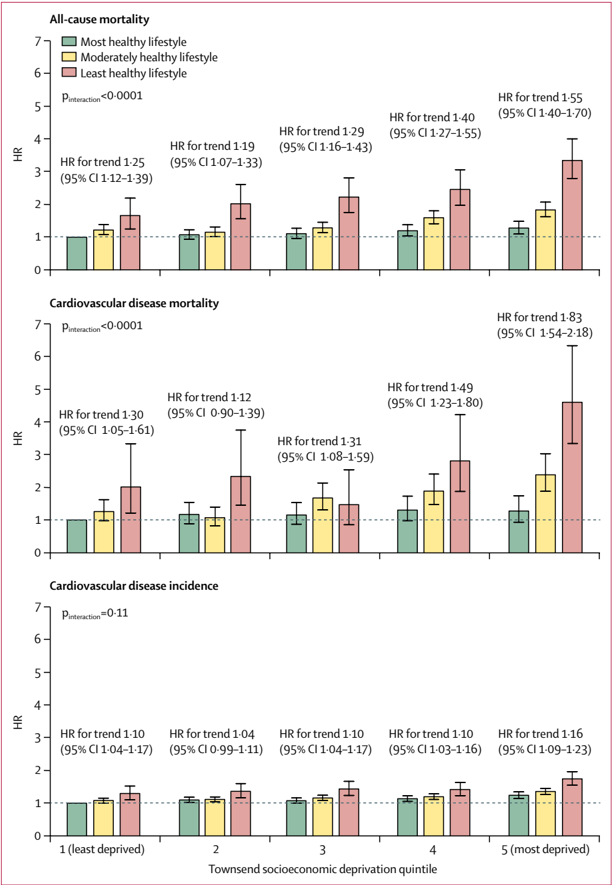
Background Combinations of lifestyle factors interact to increase mortality. Combinations of traditional factors such as smoking and alcohol are well described, but the additional effects of emerging factors such as television viewing time are not. The effect of socioeconomic deprivation on these extended lifestyle risks also remains unclear. We aimed to examine whether deprivation modifies the association between an extended score of lifestyle-related risk factors and health outcomes. Methods Data for this prospective analysis were sourced from the UK Biobank, a prospective population-based cohort study. We assigned all participants an extended lifestyle score, with 1 point for each unhealthy lifestyle factor (incorporating sleep duration and high television viewing time, in addition to smoking, excessive alcohol, poor diet [low intake of oily fish or fruits and vegetables, and high intake of red meat or processed meats], and low physical activity), categorised as most healthy (score 0–2), moderately healthy (score 3–5), or least healthy (score 6–9). Cox proportional hazards models were used to examine the association between lifestyle score and health outcomes (all-cause mortality and cardiovascular disease mortality and incidence), and whether this association was modified by deprivation. All analyses were landmark analyses, in which participants were excluded if they had an event (death or cardiovascular disease event) within 2 years of recruitment. Participants with non-communicable diseases (except hypertension) and missing covariate data were excluded from analyses. Participants were also excluded if they reported implausible values for physical activity, sleep duration, and total screen time. All analyses were adjusted for age, sex, ethnicity, month of assessment, history of hypertension, systolic blood pressure, medication for hypercholesterolaemia or hypertension, and body-mass index categories. Findings 328 594 participants aged 40–69 years were included in the study, with a mean follow-up period of 4·9 years (SD 0·83) after the landmark period for all-cause and cardiovascular disease mortality, and 4·1 years (0·81) for cardiovascular disease incidence. In the least deprived quintile, the adjusted hazard ratio (HR) in the least healthy lifestyle category, compared with the most healthy category, was 1·65 (95% CI 1·25–2·19) for all-cause mortality, 1·93 (1·16–3·20) for cardiovascular disease mortality, and 1·29 (1·10–1·52) for cardiovascular disease incidence. Equivalent HRs in the most deprived quintile were 2·47 (95% CI 2·04–3·00), 3·36 (2·36–4·76), and 1·41 (1·25–1·60), respectively. The HR for trend for one increment change towards least healthy in the least deprived quintile compared with that in the most deprived quintile was 1·25 (95% CI 1·12–1·39) versus 1·55 (1·40–1·70) for all-cause mortality, 1·30 (1·05–1·61) versus 1·83 (1·54–2·18) for cardiovascular disease mortality, and 1·10 (1·04–1·17) versus 1·16 (1·09–1·23) for cardiovascular disease incidence. A significant interaction was found between lifestyle and deprivation for all-cause and cardiovascular disease mortality (both p interaction <0·0001), but not for cardiovascular disease incidence (p interaction =0·11). Interpretation Wide combinations of lifestyle factors are associated with disproportionate harm in deprived populations. Social and fiscal policies that reduce poverty are needed alongside public health and individual-level interventions that address a wider range of lifestyle factors in areas of deprivation. Funding None.
Overview
The claims and statistics of this paper haven’t been checked yet.
Free: it reads the open-access text and checks the first 5 claims that cite a source we can check. Create a free account to check every claim.
Integrity signals
Registry
Cites
Statistics
Figures
Verification
Claims the paper makes
The claims and statistics of this paper haven’t been checked yet.
Free: it reads the open-access text and checks the first 5 claims that cite a source we can check. Create a free account to check every claim.
Claims other papers make about this one
Each is checked against this paper’s own text: does it say what the citing paper says it does?
The source backs part of the claim, not all of it — or backs it for a different population, condition or comparison.
In the citing paper
“Social deprivation and psychosocial stress set the scene for increased risk [13].”
From 2019 ESC/EAS guidelines for the management of dyslipidaemias: lipid modification to reduce cardiovascular risk (2019) · cites this paper as [13]
Experimental — accuracy not yet measured
Self-check
Percentages, sums and reported differences re-computed from the paper’s own numbers.
The self-check needs the paper’s full text.
Citations
Cites
Sudlow, C., Gallacher, J., Allen, N., Beral, V., Burton, P., Danesh, J., Downey, P., Elliott, P., Green, J., Landray, M., et al. (2015) · PLOS Medicine · doi:10.1371/journal.pmed.1001779 · Cited by 12,728
Self-citationNaghavi, M., Abajobir, A. A., Abbafati, C., Abbas, K. M., Abd-Allah, F., Abera, S. F., Aboyans, V., Adetokunboh, O., Afshin, A., Agrawal, A., et al. (2017) · The Lancet · doi:10.1016/s0140-6736(17)32152-9 · Cited by 4,821
Closing the gap in a generation: health equity through action on the social determinants of health
Marmot, M., Friel, S., Bell, R., Houweling, T. A., & Taylor, S. (2008) · The Lancet · doi:10.1016/s0140-6736(08)61690-6 · Cited by 3,247
Health and Deprivation: Inequality and the North
Townsend, P. D., Phillimore, P., & Beattie, A. (1987) · DOAJ (DOAJ: Directory of Open Access Journals) · Cited by 1,473
Stringhini, S., Carmeli, C., Jokela, M., Avendaño, M., Muennig, P., Guida, F., Ricceri, F., d'Errico, A., Barros, H., Bochud, M., et al. (2017) · The Lancet · doi:10.1016/s0140-6736(16)32380-7 · Cited by 1,319
What makes UK Biobank special?
Collins, R. (2012) · The Lancet · doi:10.1016/s0140-6736(12)60404-8 · Cited by 1,128
Loef, M., & Walach, H. (2012) · Preventive Medicine · doi:10.1016/j.ypmed.2012.06.017 · Cited by 822
Long sleep duration and health outcomes: A systematic review, meta-analysis and meta-regression
Jike, M., Itani, O., Watanabe, N., Buysse, D. J., & Kaneita, Y. (2018) · Sleep Medicine Reviews · doi:10.1016/j.smrv.2017.06.011 · Cited by 768
Health and deprivation. Inequality and the North
Mackenbach, J. P. (1988) · Health Policy · doi:10.1016/0168-8510(88)90006-1 · Cited by 661
A systematic review on the clustering and co-occurrence of multiple risk behaviours
Meader, N., King, K., Moe-Byrne, T., Wright, K., Graham, H., Petticrew, M., Power, C., White, M., & Sowden, A. J. (2016) · BMC Public Health · doi:10.1186/s12889-016-3373-6 · Cited by 578
Cited by
Items 201–300 of 442
Wang, Z., Zheng, Y., Ruan, H., Li, L., & He, S. (2023) · Journal of Epidemiology and Global Health · doi:10.1007/s44197-023-00095-3 · Cited by 6
“analyzing the data from UK Biobank cohort, they also found that the poor lifestyle score was associated with more risk of all-cause mortality and cardiovascular mortality for individuals in the most deprived group than that of the most affluent socioeconomic group [38].”
MethodFirst Iranian guidelines for the diagnosis, management, and treatment of hyperlipidemia in adults
Bagherikholenjani, F., Shahidi, S., Vaseghi, G., Ashoorion, V., Sarrafzadegan, N., Siavash, M., Heidarpour, M., Shahidi, S., Sadeghi, M., Mohammadifard, N., et al. (2024) · Journal of Research in Medical Sciences · doi:10.4103/jrms.jrms_318_23 · Cited by 12
“…and the consumption of alcohol and smoking, the results of studies also reported numerous adverse effects, including an increased risk of mortality due to all causes, specifically CVDs and cancers [74,75] The GDG felt that health disparities were likely to be reduced with this treatment approach.”
BackgroundNeuroticism personality, social contact, and dementia risk: A prospective cohort study
Liu, Y., Chang, J., Zhao, Y., & Tang, Y. (2024) · Journal of Affective Disorders · doi:10.1016/j.jad.2024.05.055 · Cited by 7
A Case for estradiol: younger brains in women with earlier menarche and later menopause
Luders, E., Poromaa, I. S., Barth, C., & Gaser, C. (2025) · GigaScience · doi:10.1093/gigascience/giaf060 · Cited by 10
Zhou, H., Mi, Y., Zhang, X., Sun, W., & Xu, W. (2025) · European Journal of Neurology · doi:10.1111/ene.70299 · Cited by 6
“Higher scores indicate greater socioeconomic deprivation [12].”
Ward, T. T., Medina‐Lara, A., Mujica-Mota, R. E., & Spencer, A. E. (2021) · Value in Health · doi:10.1016/j.jval.2020.12.022 · Cited by 7
Cucato, G. G., Snowden, C. P., McCone, E., Nesbitt, C. I., Nandhra, S., Fong, M., Kane, E., Rowland, M. K., Bhattarai, N., Court, P., et al. (2022) · PLoS ONE · doi:10.1371/journal.pone.0269999 · Cited by 6
“Moreover, since lower socioeconomic status is associated with poor health status, multiple risk factors, unhealthy lifestyle, and more barriers to behaviour change programs [13, 14], this intervention program would most likely benefit socioeconomically deprived patients.”
BackgroundO’Sullivan, D. J., Bearne, L., Harrington, J. M., & McVeigh, J. G. (2023) · Musculoskeletal Care · doi:10.1002/msc.1810 · Cited by 8
Wong, V. W.-H., Yiu, E. K. L., Ng, C. H., Sarris, J. J., & Ho, F. Y. (2024) · Journal of Affective Disorders · doi:10.1016/j.jad.2023.12.079 · Cited by 7
Zhao, Y., Song, Y., Li, X., & Guo, A. (2024) · Breast Cancer Research · doi:10.1186/s13058-024-01877-8 · Cited by 7
“A detailed description of the recruitment process and population characteristics have been described elsewhere [23].”
RetractedPopulation clustering of structural brain aging and its association with brain developmentPreprint
Duan, H., Shi, R., Kang, J., Banaschewski, T., Bokde, A. L. W., Büchel, C., Desrivières, S., Flor, H., Grigis, A., Garavan, H., et al. (2024) · eLife · doi:10.7554/elife.94970 · Cited by 7
“Results were consistent when using models adjusted for sex, age, and socioeconomic status (TDI, education and income; Foster et al., 2018 ; Townsend et al., 2023 ; Figure 4 ).”
Barth, C., Galea, L. A. M., Jacobs, E. G., Lee, B. H., Westlye, L. T., & de Lange, A. G. (2025) · eLife · doi:10.7554/elife.99538 · Cited by 20
“The lifestyle score was calculated using a published formula ( Foster et al., 2018 ), and included data on sleep, physical activity, nutrition, smoking, and alcohol consumption (see Appendix Note 3, Supplementary file 2 ).”
Shorter sleep: a new potential target to address cardiovascular and metabolic risk?
Boal, A. H., Gill, J. M. R., & Sattar, N. (2020) · Cardiovascular Research · doi:10.1093/cvr/cvz330 · Cited by 5
Self-citationFrailty and social contact with dementia risk: A prospective cohort study
Liu, Y., Chang, J., Zhao, Y., Gao, P., & Tang, Y. (2025) · Journal of Affective Disorders · doi:10.1016/j.jad.2025.01.112 · Cited by 7
Frailty, genetic predisposition, and incident chronic kidney disease
Zou, S., Sun, Y. B., Zhou, Y., Yu, B., Li, J., Yu, Y., Chen, J., Li, Y., Wang, N., & Wang, L. P. (2025) · Scientific Reports · doi:10.1038/s41598-025-97280-0 · Cited by 6
“Townsend deprivation index scores, indicative of socioeconomic deprivation, were derived from national census data, with a higher score reflecting greater deprivation 21 .”
Jackisch, J., Noor, N., Raitakari, O. T., Lehtimäki, T. J., Kähönen, M. A. P., Cullati, S., Delpierre, C., Kivimäki, M., & Carmeli, C. (2024) · BMJ Open · doi:10.1136/bmjopen-2023-078428 · Cited by 9
“61 To mitigate social inequalities in health, it is important to ask the question of whether intervening on health behaviours in the whole population has different effects for people from different socioeconomic backgrounds, as many health behaviour interventions are implemented on a population…”
Chang, J., Liu, Y., Zhao, Y., Gao, P., & Tang, Y. (2024) · Journal of Neurology · doi:10.1007/s00415-024-12580-1 · Cited by 5
“Socioeconomic status, derived from the Townsend Deprivation Index, was categorized as 1, 2–4, or 5, by integrating information about social class, employment, car availability, and housing, with higher scores reflecting greater socioeconomic deprivation [5, 7].”
Zhong, J., Cai, Q., Zheng, W., Chen, S., Wu, S., & Dong, S. (2024) · BMC Public Health · doi:10.1186/s12889-024-20205-5 · Cited by 7
Li, G., Ma, Z., Lu, Y.-J., Jiang, Y., Zhao, H., Sun, M., Wang, Y., He, Q., Feng, Z., Li, T., et al. (2024) · International Journal of Cardiology · doi:10.1016/j.ijcard.2024.132633 · Cited by 8
Zhao, Z., Yin, X., & Xu, M. (2024) · The Journals of Gerontology Series B · doi:10.1093/geronb/gbae173 · Cited by 6
Du, M., Tao, L., Liu, M., & Liu, J. (2022) · Nutrients · doi:10.3390/nu14235046 · Cited by 6
“As an indicator of socioeconomic status, the TDI indicates relative affluence as negative [24].”
BackgroundInclan, P. M., Brophy, R. H., Saccone, N. L., Ma, Y., Pham, V., & Yanik, E. L. (2024) · The Bone & Joint Journal · doi:10.1302/0301-620x.106b3.bjj-2023-0425.r2 · Cited by 5
Chen, Y., Miao, Y., & Zhang, Q. (2024) · Osteoporosis International · doi:10.1007/s00198-024-07126-0 · Cited by 6
“In this study, television viewing was employed as a surrogate for sedentary behavior during leisure time, and a daily duration of less than 4 h was established as the threshold for healthy levels [26].”
Zhou, S., Liang, Z., Li, Q., Tian, W., Song, S., Wang, Z., Huang, J., Ren, M., Liu, G., Xu, M., et al. (2024) · Public Health · doi:10.1016/j.puhe.2024.06.028 · Cited by 8
Addressing students’ traumatic experiences and impact of social supports: Scoping review
Amedu, A. N., Dwarika, V. M., & Victor-Aigbodion, V. (2025) · European Journal of Trauma & Dissociation · doi:10.1016/j.ejtd.2025.100512 · Cited by 12
D'Cunha, N. M., Foscolou, A., Tyrovolas, S., Chrysohoou, C. A., Rallidis, L. S., Polychronopoulos, E., Matalas, A., Sidossis, L. S., Naumovski, N., & Panagiotakos, D. B. (2020) · Nutrition and Healthy Aging · doi:10.3233/nha-190079 · Cited by 10
Oztumer, C. A., Chaudhry, R. M., & Alrubaiy, L. (2020) · BMJ Open Gastroenterology · doi:10.1136/bmjgast-2020-000524 · Cited by 4
Zhu, X., Zhang, X., Zhou, C., Li, B., Huang, Y., Li, C., Gu, C., Ma, M., Zhao, S., Fan, Y., et al. (2023) · Scandinavian Journal of Medicine and Science in Sports · doi:10.1111/sms.14501 · Cited by 7
Landberg, J., & Ramstedt, M. (2020) · Nordic Studies on Alcohol and Drugs · doi:10.1177/1455072520972303 · Cited by 6
“In line with previous research (Foster et al., 2018; Public Health Agency of Sweden, 2019; Skillgate et al., 2017), respondents received 1 point for each unhealthy lifestyle factor: current daily smoking, current daily use of snuff, less than 150 min per week of moderate PA, sleeping less than 7 hours or more than 9 h…”
MethodAssociation between falls and dementia risk: Evidence from three cohort studies
Li, A., Zhou, S., Chang, J., Wei, T., Zhao, B., Zhao, Y., Wang, Z., Xing, Y., & Tang, Y. (2025) · Journal of Translational Internal Medicine · doi:10.1515/jtim-2025-0057 · Cited by 5
“Scores on the Townsend deprivation index (TDI), [33] derived from census data related to unemployment, vehicle ownership, household overcrowding, and occupation, were divided into high (<−2.08), medium (−2.08 to 1.40), and low (>1.40) levels.”
InfluentialFang, Y., Huang, S., Zhang, H., Li, M., Zhang, H., Yang, W., & Yu, M. (2026) · European Journal of Preventive Cardiology · doi:10.1093/eurjpc/zwag170 · Cited by 5
Dai, L., Zuo, Y., Lv, Y., Zeng, H., & Chen, L. (2024) · Diabetes & Metabolic Syndrome Clinical Research & Reviews · doi:10.1016/j.dsx.2024.102971 · Cited by 4
Zhu, X., Huang, Y., Li, L., Zhang, X., Zhang, Z., Jiang, Y., Wu, X., Li, C., Zheng, Z. J., Bao, Z., et al. (2024) · The Journals of Gerontology Series A · doi:10.1093/gerona/glae300 · Cited by 6
Yao, X. I., Sun, S., Yang, Q., Tong, X., & Shen, C. (2025) · The Science of The Total Environment · doi:10.1016/j.scitotenv.2025.179137 · Cited by 5
Wang, J., Zhang, J., Zhu, Y., Ma, X., Wang, Y., Liu, K., Li, Z., Wang, J., Liang, R., He, S., et al. (2025) · Journal of Affective Disorders · doi:10.1016/j.jad.2025.03.115 · Cited by 4
Liu, S., Chen, Y., Zhang, A., Chen, X., Yuan, L., & Song, B. (2025) · BMC Pregnancy and Childbirth · doi:10.1186/s12884-025-07461-y · Cited by 6
“This system assigned 0 points for each lifestyle factor considered “not at risk” and 1 point for those “at risk”, summing these to create an unweighted score ranging from 0 to 9, with higher scores indicating an unhealthier lifestyle (Supplemental Table 2) [18].”
Hu, W., Liu, T.-S., Shen, Z., Tian, G., Wang, J., Zhao, Z., Liu, B.-P., & Jia, C.-X. (2025) · Brain Behavior and Immunity · doi:10.1016/j.bbi.2025.05.005 · Cited by 4
Hu, W., Shen, Z., Tian, G., Liu, B.-P., & Jia, C.-X. (2025) · Translational Psychiatry · doi:10.1038/s41398-025-03412-5 · Cited by 4
“Based on previous studies [29 – 31], we strati fi ed each lifestyle factor into healthy and unhealthy categories.”
Yang, Y., Chen, L., Liu, Q., Mu, M., Huang, J., Zhang, G., & Song, Q. (2025) · BMC Medicine · doi:10.1186/s12916-025-04224-6 · Cited by 5
“Townsend deprivation index (TDI) was utilized as a measure of area-level SES (ASES), which was derived from national census data according to postcodes of residence, incorporating car ownership, household overcrowding, owner occupation, and unemployment [31].”
Chen, H., Wang, X., Cao, Z., & Xu, C. (2025) · Social Science & Medicine · doi:10.1016/j.socscimed.2025.118542 · Cited by 4
Manfredi, L., Buscema, F., Giraudo, M. T., Sodano, B., Padroni, L., Destefanis, C., Freisling, H., Ferrari, P., Cesaroni, G., Uzzau, S., et al. (2025) · Journal of Epidemiology & Community Health · doi:10.1136/jech-2025-224476 · Cited by 5
“10 These elements support the hypothesis that lifestyle factors act as important mediators in the pathway through which SEP shapes NCDs and multimorbidity trajectories.”
Choi, W., Gao, B., Chen, J., Liang, T., Hu, W., Zhang, Z., Liao, N., Shi, H., Liu, S., Chen, Y., et al. (2025) · Lipids in Health and Disease · doi:10.1186/s12944-025-02687-3 · Cited by 4
Lee, D.-E., Park, Y. S., Jang, H.-M., Kim, B.-J., Kim, Y., Cho, S., & Kim, K. (2025) · BMC Medicine · doi:10.1186/s12916-025-04394-3 · Cited by 5
“Given that CVH-related behaviours complexly inter-play and simultaneously influence both mortality and multi-morbidity [9], it is important to assess their joint association as well as individual association.”
Hu, P., Wei, S., Chen, G., Chen, L., Tian, F., Zhuang, Z., Rao, M., Huang, Z., & Lin, H. (2025) · Journal of Hazardous Materials · doi:10.1016/j.jhazmat.2025.140506 · Cited by 4
Gestational Diabetes Mellitus and Accelerated Biological Aging in Middle-Aged and Elderly Women
Wang, B., Wang, N., Yin, X., Huang, Y.-H., Yu, G., Yang, J., Chong, Y. S., Lu, Y., Williams, M. A., Hu, F. B., et al. (2025) · Diabetes Care · doi:10.2337/dc25-1842 · Cited by 6
Transatlantic guidelines on dyslipidemia and cardiovascular risk: key differences across the pond
Agha, A. M., Virani, S. S., & Ballantyne, C. M. (2020) · Current Opinion in Endocrinology Diabetes and Obesity · doi:10.1097/med.0000000000000608 · Cited by 4
“Similarly, the ESC/EAS guidelines describe risk modifiers to be considered in risk assessment but include additional factors also associated with increased ASCVD risk, such as social deprivation/ lower socioeconomic status [21], physical inactivity, obstructive sleep apnea, left ventricular hypertrophy, and atrial fib…”
BackgroundPetermann-Rocha, F. E., Diaz‐Toro, F., Troncoso-Pantoja, C., Martínez-Sangüinetti, M. A., Leiva-Ordóñez, A. M., Nazar, G., Concha‐Cisternas, Y., Díaz-Martínez, X., Lanuza, F., Carrasco‐Marín, F., et al. (2023) · Public Health Nutrition · doi:10.1017/s1368980023002598 · Cited by 11
“– over a follow-up of 4·9 years of 328 594 UK Biobank participants – identified that those participants who followed a least healthy lifestyle had 2·06 times (95 % CI 1·86, 2·29) higher risk of dying compared with the healthiest participants (15) .”
BackgroundMethodSelf-citationJeyaparam, S., Agha-Jaffar, R., Mullins, E., Pinho‐Gomes, A., Khunti, K., & Robinson, S. (2024) · BMC Public Health · doi:10.1186/s12889-023-17261-8 · Cited by 6
Lifestyles' role in the relationship between socioeconomic deprivation and depression
Jing, W., Xu, M., Fan, Z., Yin, X., Xia, W., & Gong, Y. (2025) · Journal of Affective Disorders · doi:10.1016/j.jad.2025.119597 · Cited by 5
Jin, K., Neubeck, L., & Atherton, I. (2020) · European Journal of Cardiovascular Nursing · doi:10.1093/eurjcn/zvaa021 · Cited by 4
“These lifestyle risk factors are strongly associated with area deprivation (19, 22) and particularly”
BackgroundLiuzzo, G., & Volpe, M. (2021) · European Heart Journal · doi:10.1093/eurheartj/ehab287 · Cited by 2
van Bergen, A. P. L., van Loon, A., Hoff, S. J. M., Wolf, J., & van Hemert, A. M. (2021) · International Journal for Equity in Health · doi:10.1186/s12939-021-01471-w · Cited by 6
The impact of socioeconomic deprivation on congenital hand differences: A retrospective cohort study
Chan, C., Stirling, P., & Lam, W. L. (2021) · Hand surgery & rehabilitation · doi:10.1016/j.hansur.2021.12.005 · Cited by 6
Parra-Soto, S. L., Tumblety, C., Araya, C., Rezende, L. F. M., Ho, F. K. W., Pell, J. P., & Celis-Morales, C. A. (2023) · Journal of Physical Activity and Health · doi:10.1123/jpah.2022-0437 · Cited by 7
Self-citationGao, Y., Su, B., Luo, Y., Tian, Y., Hong, S., Gao, S., Xie, J., & Zheng, X. (2023) · Brain Behavior and Immunity · doi:10.1016/j.bbi.2023.10.019 · Cited by 5
“Each factor was categorized into healthy and unhealthy categories based on a published study (Foster et al., 2018).”
BackgroundGonzález-Fernández, F., Hun, N., Aiste, S., Aguilera, C., Cardenas, M., & Salazar, M. H. (2024) · Retos · doi:10.47197/retos.v54.102268 · Cited by 11
“En relación con el nivel educativo, investigaciones ante-riores han mostrado que aquellos individuos con un nivel educativo inferior tienden a presentar índices más bajos de AF (AF), y por ende, no alcanzar las recomendaciones esta-blecidas para esta (Chen et al., 2020; Foster et al., 2018).”
BackgroundPrevention in the 2020s: where is primary care?
Blane, D., Williamson, A. E., Macdonald, S., & O’Donnell, C. A. (2020) · British Journal of General Practice · doi:10.3399/bjgp20x711809 · Cited by 4
Self-citationThe ‘environmental exposome’ as a target to reimagine the cardiovascular prevention
Baragetti, A. (2024) · European Journal of Preventive Cardiology · doi:10.1093/eurjpc/zwae017 · Cited by 4
Barth, C., Galea, L. A. M., Jacobs, E. G., Lee, B. H., Westlye, L. T., & de Lange, A. G. (2024) · eLife · doi:10.7554/elife.99538.1 · Cited by 5
Molokhia, M., Wierzbicki, A. S., Williams, H., Kirubakaran, A., Devani, R., Durbaba, S., Ayis, S. A., & Qureshi, N. (2023) · Atherosclerosis · doi:10.1016/j.atherosclerosis.2023.117353 · Cited by 4
Yang, H., Lu, Z., Fu, Y., Wu, T., & Hou, Y. (2024) · Nutrition Metabolism and Cardiovascular Diseases · doi:10.1016/j.numecd.2024.10.001 · Cited by 3
Tamura, K., Deng, Y., Rogers, B., Moniruzzaman, M., Jagannathan, R., Hu, L., Miura, K., Roger, V. L., & Mariño‐Ramírez, L. (2025) · Open Heart · doi:10.1136/openhrt-2025-003225 · Cited by 3
“Participants had a mean follow-up of 14.2 years (SD±1.8) with 4 246 447 person-years for IHD and 14.4 years (SD±1.1) with 4 405 552 person-years for CeVD incidence.”
InfluentialSleep Quality and Outcomes in Preclinical Heart Failure: A Prospective UK Biobank Cohort Study
Zhu, F., Shearer, J. J., Joo, J., Miao, R., Wong, J. Y. Y., Goodney, G. A., Lim, J., Hashemian, M., Henríquez-Santos, G., Kim, J., et al. (2025) · The American Journal of Medicine · doi:10.1016/j.amjmed.2025.05.037 · Cited by 4
Liu, Z., Wang, J., Pan, X., Zhang, P., Yang, M., & Zhang, Y. (2025) · Frontiers in Nutrition · doi:10.3389/fnut.2025.1646627 · Cited by 3
Zhou, J. H., Li, H., Xia, C., Shi, W., Wang, J., Chen, C., Kraus, V. B., Ji, J. S., Lv, Y., Chen, W., et al. (2025) · Fundamental Research · doi:10.1016/j.fmre.2025.10.004 · Cited by 4
Comprehensive risk factor control in Type 2 diabetes and incident peripheral artery disease
Yu, X., Lian, Z., Wu, J., Tang, P., & Xiong, S. (2025) · European Journal of Preventive Cardiology · doi:10.1093/eurjpc/zwaf697 · Cited by 3
Fang, Y., Huang, S., Zhang, H., Li, M., Zhang, H., Yang, W., & Yu, M. (2025) · Cardiovascular Diabetology · doi:10.1186/s12933-025-03031-w · Cited by 4
“Socioeconomic status was evaluated with the Townsend deprivation index, derived from census-linked residential postal codes, where higher scores reflect greater area-level deprivation [15].”
Dobber, J. (2021) · Bohn Stafleu van Loghum eBooks · doi:10.1007/978-90-368-2600-6_18 · Cited by 3
Izah, S. C., UDOFIA, A. S., JOHNSON, I. U., & Etim, N. G. (2024) · Greener Journal of Epidemiology and Public Health · doi:10.15580/gjeph.2024.1.120424188 · Cited by 3
Zhou, H., Liu, F., Xu, J., Wang, X., Yu, P., Wang, P., Si, C., Gong, J., Gu, J., Qin, A., et al. (2025) · Food & Function · doi:10.1039/d4fo03332a · Cited by 3
Li, J., Jiang, L., Fu, Y., Zhang, K., Tan, X. W., Wang, N., Li, X., Lu, Y., & Wang, B. (2025) · The American Journal of Medicine · doi:10.1016/j.amjmed.2025.05.001 · Cited by 4
Associations of adherence to a healthy sleep pattern with the dementia risk in the UK biobank
Wei, T., Chang, J., Zhao, Y., Li, A., Sun, W., Liu, X., Liu, H., Xing, Y., Wang, Z., & Tang, Y. (2025) · Alzheimer s Research & Therapy · doi:10.1186/s13195-025-01864-x · Cited by 4
Social deprivation and paediatric chronic pain referrals in Ireland: a cross-sectional study
Matthews, E., Muldoon, M., O’Keeffe, N., & McCarthy, K. F. (2021) · Scandinavian Journal of Pain · doi:10.1515/sjpain-2021-0031 · Cited by 3
Kempel, M. K., Winding, T. N., Bøttcher, M., Hansen, S. N., & Andersen, J. H. (2023) · BMC Public Health · doi:10.1186/s12889-023-15942-y · Cited by 3
“Some of the association between childhood SEP and later cardiometabolic disease risk can be explained by differences in lifestyle and potential differences in the vulnerability to unhealthy lifestyle factors across SEP [6].”
BackgroundCollett, J., Lawrie, S., Bromley, S., Harling, P., Reed, A., Brusco, N. K., Coe, S., Coebergh, J. A., Carroll, C., Roberts, H. C., et al. (2023) · Clinical Rehabilitation · doi:10.1177/02692155231210969 · Cited by 5
“27 It is also of note that the exercise component included a practical session with a health professional, expert advice and reassurance been found to reduce barriers to participating in community exercise.”
Background[Effects of Television Screen Exposure on the Mental Health of Middle-aged and Older Adults].
Hu, Y. H., & Zhang, W. (2023) · PubMed Central · doi:10.12182/20230960504 · Cited by 4
Social support and trauma experiences of imprisoned men in Northern Ireland
McFadden, D., Davidson, G., & Butler, M. (2024) · International Journal of Law and Psychiatry · doi:10.1016/j.ijlp.2024.102005 · Cited by 6
Liu, Q., Fan, G., Bi, J., Fang, Q., Luo, F., Huang, X., Li, H., Liu, B., Yan, L., Guo, W., et al. (2024) · Diabetes Obesity and Metabolism · doi:10.1111/dom.15825 · Cited by 4
Frailty, social deprivation, and mortality among Medicare fee‐for‐service beneficiaries
Zhong, L., Sison, S. D. M., Cheslock, M., Liu, Y., Newmeyer, N., & Kim, D. H. (2024) · Journal of the American Geriatrics Society · doi:10.1111/jgs.19318 · Cited by 3
Yi, S., Kim, M., Won, C. W., & Park, Y. S. (2025) · Frontiers in Nutrition · doi:10.3389/fnut.2025.1543290 · Cited by 3
Santa-Ramírez, H.-A., Bilal, U., Marques-Vidal, P. M., Nehme, M., Guessous, I., Stringhini, S., & Joost, S. (2025) · Social Science & Medicine · doi:10.1016/j.socscimed.2025.117926 · Cited by 3
Li, C., Dite, G. S., Nguyen, T. L., Hopper, J. L., & Li, S. (2025) · BMC Medicine · doi:10.1186/s12916-025-03998-z · Cited by 3
“Deprivation and house income could reflect socioeconomic status, and socioeconomic status is positively related to a healthy lifestyle [19].”
Modesti, P. A., Jarraya, F., Mascherini, G., & Perticone, F. (2020) · Internal and Emergency Medicine · doi:10.1007/s11739-019-02263-5 · Cited by 3
Müller, M. J., Gaetjens, I., & Bosy-Westphal, A. (2015) · Springer eBooks · doi:10.1007/978-3-642-54573-3_60 · Cited by 3
Marek‐Iannucci, S., Palazzuoli, A., Babarto, M., Lazarevic, Z., Beltrami, M., & Fedele, F. (2024) · Nutrients · doi:10.3390/nu16213699 · Cited by 3
“The associations between certain rehabilitation programs, including lifestyle factors, diet habits, as well as physical activity, and their effects on cardiovascular (CV) and renal outcomes are not extensively investigated [10–12].”
BackgroundKe, D., Wang, Y., Hou, Y., Shao, W., Ke, J., Zhang, X., Yang, H., He, Z., & Lu, Z. (2025) · Frontiers in Nutrition · doi:10.3389/fnut.2025.1530908 · Cited by 4
Association between cardiovascular health, cancer and its prognosis: A prospective cohort study
Hou, Y., Shao, W., Wang, Y., Yang, H., Shao, R., & Lu, Z. (2025) · Public Health · doi:10.1016/j.puhe.2025.02.020 · Cited by 2
Association of healthy lifestyle with excess risk of dementia in individuals with hypertension
Lu, Y., Chang, J., Zhao, Y., Gao, P., & Tang, Y. (2025) · Journal of Alzheimer s Disease · doi:10.1177/13872877251344309 · Cited by 2
“21 Social activity was measured using three items, in accordance with a previous UK Biobank study, 22 including the number of people in the household (one point for living alone), frequency of friend or family visits (one point for less than once per month), and engagement in group activities once…”
Li, J., & Kuang, X. (2025) · International Journal of Surgery · doi:10.1097/js9.0000000000002681 · Cited by 4
Zhou, P., Geng, X., Zhang, C., Li, T., Li, F., Cao, Y., Mao, D., Liu, Y., Wang, N., Li, K., et al. (2025) · BMC Public Health · doi:10.1186/s12889-025-24359-8 · Cited by 4
“One previous study in the UK Biobank reported no significant interaction effect between area-level SES and an overall lifestyle score including physical activity, TV watching, and sleep duration on incident CVD [4].”
InfluentialAccelerated Biological Aging and Schizophrenia Risk: Evidence from the UK Biobank
Sun, Z., Guo, X., Wu, S., Jia, T., Kou, C., & Bai, W. (2025) · Schizophrenia Bulletin · doi:10.1093/schbul/sbaf210 · Cited by 4
Ethnic and demographic variation in consenting for research in the context of fertility treatment
Morris, C., Rymell, R., Mascarenhas, M., & Bhandari, H. M. (2021) · Human Fertility · doi:10.1080/14647273.2021.1876257 · Cited by 1
Kwok, M. K., Kawachi, I. I., Rehkopf, D. H., Ni, M. Y., Leung, G. M., & Schooling, C. M. (2022) · Frontiers in Public Health · doi:10.3389/fpubh.2021.726617 · Cited by 2
“Relative income deprivation has been linked with ischemic heart disease (IHD) mortality and/or incidence in the United States (12), the United Kingdom (13), and Japan (14).”
BackgroundPerception of Diet Control and Physical Activity Housewives: Experiences and Barrier
Kusumo, M. P. (2021) · Jurnal Pengabdian dan Pemberdayaan Masyarakat Indonesia · doi:10.59247/jppmi.v1i6.28 · Cited by 2
Landberg, J., & Thern, E. (2023) · BMC Public Health · doi:10.1186/s12889-023-16341-z · Cited by 2
“Lifestyle factors : In line with previous research, we created a lifestyle index to assess the possible contribution of several lifestyle factors: smoking, snuff use, BMI, physical activity and sleep, as well as fruit and vegetable intake [15, 24–26].”
MethodPrevention and Management of Multimorbidity in Southeast Asia: A Narrative Review
Feng, X., Sarma, H., & Kelly, M. (2024) · Public Health Challenges · doi:10.1002/puh2.218 · Cited by 3
Granic, A., Cooper, R., Hurst, C., Hillman, S. J., Dodds, R. M., Witham, M. D., & Sayer, A. A. (2024) · European Geriatric Medicine · doi:10.1007/s41999-024-01119-2 · Cited by 2
“…long-term conditions (LTC) as in [28]), and (c) lifestyle factors (BMI (weight/height 2 , kg/m 2 ), smoking, alcohol intake status, self-reported leisure time physical activity (LTPA) based on the metabolic equivalent of task (MET) as in [29], and fruit and vegetables intake (g/day) as in [30]).”
Cardiovascular health and risks of atrial fibrillation and its prognosis
Lu, Z., Ke, J., Yang, H., Zhang, X., Wang, Y., Hou, Y., & Shao, R. (2024) · American Journal of Preventive Cardiology · doi:10.1016/j.ajpc.2024.100915 · Cited by 4
Zheng, X. T., Huang, F. Y., Qi, Y. L., Sun, W., Zhang, X. R., Wang, Y. J., Zhang, Y. J., Li, Q. M., Liu, F., Li, C. W., et al. (2025) · Public Health · doi:10.1016/j.puhe.2025.02.039 · Cited by 3
Meyer, A. M., Pickert, L., Benzing, T. R., & Hoffmann, U. (2025) · DMW - Deutsche Medizinische Wochenschrift · doi:10.1055/a-2360-2837 · Cited by 2
Metadata
- Authors
- Foster, H. M. E., Celis-Morales, C. A., Nicholl, B. I., Petermann-Rocha, F., Pell, J. P., Gill, J. M. R., O'Donnell, C. A., & Mair, F. S.
- Affiliations
- University of Glasgow (GB)
- Corresponding author
- Mair, Frances S
- ORCID
- Venue
- The Lancet Public Health
- Publisher
- Elsevier BV
- Published
- 2018-12
- Volume
- 3
- Issue
- 12
- Pages
- e576-e585
- ISSN
- 2468-2667 (ISSN-L)
- OpenAlex
- W2901308462
- Cited by
- 441
- References
- 29
- Citations by year
- 2026: 55 · 2025: 82 · 2024: 96 · 2023: 70 · 2022: 50 · 2021: 44 · 2020: 28 · 2019: 14 · 2018: 1
- FWCI
- 16.66
- Type
- journal article
- Language
- en
- Open access
- gold
- doi.org
- Licence
- cc-by
- www.elsevier.com/tdm/userlicense/1.0/ (tdm)
- creativecommons.org/licenses/by/4.0/ (vor)
- Locations
- The Lancet Public Health (publishedVersion, cc-by)
- PubMed (publishedVersion)
- ENLIGHTEN (Jurnal Bimbingan dan Konseling Islam) (acceptedVersion, cc-by-sa)
- DOAJ (DOAJ: Directory of Open Access Journals) (submittedVersion, cc-by-sa)
- Funders
- Medical Research Council (MC_PC_17228)
- Topics
- Health Sciences › Medicine › Cardiology and Cardiovascular Medicine › Cardiovascular Health and Risk Factors
- Social Sciences › Health › Health disparities and outcomes
- Health Sciences › Medicine › Public Health, Environmental and Occupational Health › Health and Lifestyle Studies
- Keywords
- socioeconomic deprivation, lifestyle score, all-cause mortality, cardiovascular mortality, cardiovascular disease incidence, television viewing, sleep duration, physical activity, alcohol consumption, smoking, diet, non-communicable diseases, hypertension, UK Biobank, middle-aged adults, health disparities, screen time, oily fish
- MeSH terms
- Adult, Aged, Cardiovascular Diseases, Cause of Death, Female, United Kingdom, Humans, Life Style, Male, Middle Aged, Mortality, Poverty, Prospective Studies, Risk Factors, Incidence, Biological Specimen Banks, Health Status Disparities
About these checks
Registry, retraction, Cites and statistics results are computed, not judged, with one exception: a printed reference that no index lists is read once by a model before it counts as a citation error. Claims are extracted by a model and kept only when their quote appears verbatim in the text; each cited source is then checked, with a model’s help, for whether it says what the claim relies on. Those verdicts can be wrong — read the claim’s quote and the cited source before relying on one.
Statistics and arithmetic are recomputed, not judged.
Confidence bands are shown only for fields calibrated on our annotated test set. None is calibrated yet, so no band is shown.
What counts as a claim ›How we measure confidence ›How we check this ›
Are you an author, or do you see a problem with this page? Request a review
Data sources
Bibliographic data: Semantic Scholar, OpenAlex, Crossref.
Contains information from the Semantic Scholar Academic Graph Datasets, made available under the ODC Attribution License (ODC-BY 1.0).
Semantic Scholar’s data is described in: Kinney, R., et al. (2023). The Semantic Scholar Open Data Platform. arXiv:2301.10140.
