

The effect of socioeconomic deprivation on the association between an extended measurement of unhealthy lifestyle factors and health outcomes: a prospective analysis of the UK Biobank cohort
Open accessThe DOI matches its Crossref record; 29 of the 29 references it cites were found in a registry or an index.
Abstract
Background Combinations of lifestyle factors interact to increase mortality. Combinations of traditional factors such as smoking and alcohol are well described, but the additional effects of emerging factors such as television viewing time are not. The effect of socioeconomic deprivation on these extended lifestyle risks also remains unclear. We aimed to examine whether deprivation modifies the association between an extended score of lifestyle-related risk factors and health outcomes. Methods Data for this prospective analysis were sourced from the UK Biobank, a prospective population-based cohort study. We assigned all participants an extended lifestyle score, with 1 point for each unhealthy lifestyle factor (incorporating sleep duration and high television viewing time, in addition to smoking, excessive alcohol, poor diet [low intake of oily fish or fruits and vegetables, and high intake of red meat or processed meats], and low physical activity), categorised as most healthy (score 0–2), moderately healthy (score 3–5), or least healthy (score 6–9). Cox proportional hazards models were used to examine the association between lifestyle score and health outcomes (all-cause mortality and cardiovascular disease mortality and incidence), and whether this association was modified by deprivation. All analyses were landmark analyses, in which participants were excluded if they had an event (death or cardiovascular disease event) within 2 years of recruitment. Participants with non-communicable diseases (except hypertension) and missing covariate data were excluded from analyses. Participants were also excluded if they reported implausible values for physical activity, sleep duration, and total screen time. All analyses were adjusted for age, sex, ethnicity, month of assessment, history of hypertension, systolic blood pressure, medication for hypercholesterolaemia or hypertension, and body-mass index categories. Findings 328 594 participants aged 40–69 years were included in the study, with a mean follow-up period of 4·9 years (SD 0·83) after the landmark period for all-cause and cardiovascular disease mortality, and 4·1 years (0·81) for cardiovascular disease incidence. In the least deprived quintile, the adjusted hazard ratio (HR) in the least healthy lifestyle category, compared with the most healthy category, was 1·65 (95% CI 1·25–2·19) for all-cause mortality, 1·93 (1·16–3·20) for cardiovascular disease mortality, and 1·29 (1·10–1·52) for cardiovascular disease incidence. Equivalent HRs in the most deprived quintile were 2·47 (95% CI 2·04–3·00), 3·36 (2·36–4·76), and 1·41 (1·25–1·60), respectively. The HR for trend for one increment change towards least healthy in the least deprived quintile compared with that in the most deprived quintile was 1·25 (95% CI 1·12–1·39) versus 1·55 (1·40–1·70) for all-cause mortality, 1·30 (1·05–1·61) versus 1·83 (1·54–2·18) for cardiovascular disease mortality, and 1·10 (1·04–1·17) versus 1·16 (1·09–1·23) for cardiovascular disease incidence. A significant interaction was found between lifestyle and deprivation for all-cause and cardiovascular disease mortality (both p interaction <0·0001), but not for cardiovascular disease incidence (p interaction =0·11). Interpretation Wide combinations of lifestyle factors are associated with disproportionate harm in deprived populations. Social and fiscal policies that reduce poverty are needed alongside public health and individual-level interventions that address a wider range of lifestyle factors in areas of deprivation. Funding None.
Overview
The claims and statistics of this paper haven’t been checked yet.
Free: it reads the open-access text and checks the first 5 claims that cite a source we can check. Create a free account to check every claim.
Integrity signals
Registry
Cites
Statistics
Figures
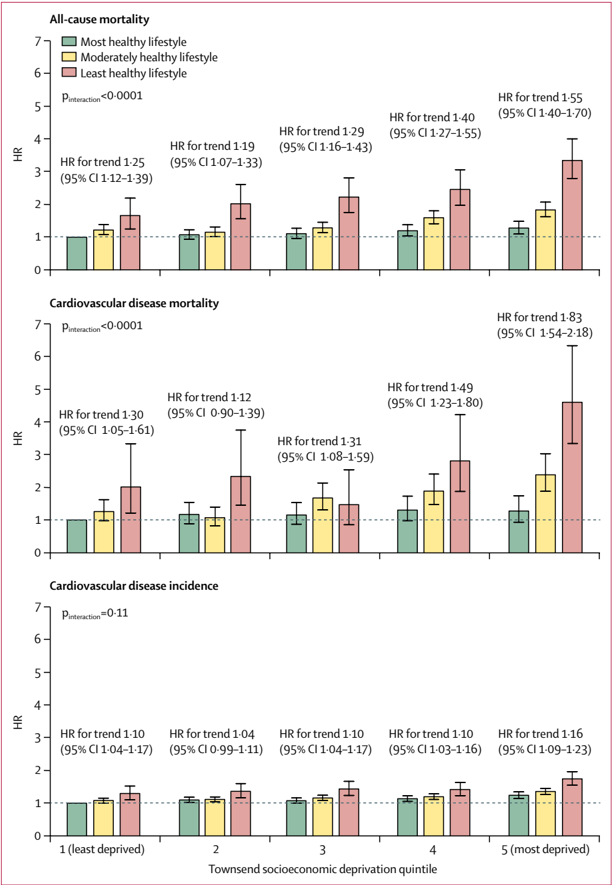
Verification
Claims the paper makes
The claims and statistics of this paper haven’t been checked yet.
Free: it reads the open-access text and checks the first 5 claims that cite a source we can check. Create a free account to check every claim.
Claims other papers make about this one
Each is checked against this paper’s own text: does it say what the citing paper says it does?
The source backs part of the claim, not all of it — or backs it for a different population, condition or comparison.
In the citing paper
“Social deprivation and psychosocial stress set the scene for increased risk [13].”
From 2019 ESC/EAS guidelines for the management of dyslipidaemias: lipid modification to reduce cardiovascular risk (2019) · cites this paper as [13]
Experimental — accuracy not yet measured
Self-check
Percentages, sums and reported differences re-computed from the paper’s own numbers.
The self-check needs the paper’s full text.
Citations
Cites
Sudlow, C., Gallacher, J., Allen, N., Beral, V., Burton, P., Danesh, J., Downey, P., Elliott, P., Green, J., Landray, M., et al. (2015) · PLOS Medicine · doi:10.1371/journal.pmed.1001779 · Cited by 12,728
Self-citationNaghavi, M., Abajobir, A. A., Abbafati, C., Abbas, K. M., Abd-Allah, F., Abera, S. F., Aboyans, V., Adetokunboh, O., Afshin, A., Agrawal, A., et al. (2017) · The Lancet · doi:10.1016/s0140-6736(17)32152-9 · Cited by 4,821
Closing the gap in a generation: health equity through action on the social determinants of health
Marmot, M., Friel, S., Bell, R., Houweling, T. A., & Taylor, S. (2008) · The Lancet · doi:10.1016/s0140-6736(08)61690-6 · Cited by 3,247
Health and Deprivation: Inequality and the North
Townsend, P. D., Phillimore, P., & Beattie, A. (1987) · DOAJ (DOAJ: Directory of Open Access Journals) · Cited by 1,473
Stringhini, S., Carmeli, C., Jokela, M., Avendaño, M., Muennig, P., Guida, F., Ricceri, F., d'Errico, A., Barros, H., Bochud, M., et al. (2017) · The Lancet · doi:10.1016/s0140-6736(16)32380-7 · Cited by 1,319
What makes UK Biobank special?
Collins, R. (2012) · The Lancet · doi:10.1016/s0140-6736(12)60404-8 · Cited by 1,128
Loef, M., & Walach, H. (2012) · Preventive Medicine · doi:10.1016/j.ypmed.2012.06.017 · Cited by 822
Long sleep duration and health outcomes: A systematic review, meta-analysis and meta-regression
Jike, M., Itani, O., Watanabe, N., Buysse, D. J., & Kaneita, Y. (2018) · Sleep Medicine Reviews · doi:10.1016/j.smrv.2017.06.011 · Cited by 768
Health and deprivation. Inequality and the North
Mackenbach, J. P. (1988) · Health Policy · doi:10.1016/0168-8510(88)90006-1 · Cited by 661
A systematic review on the clustering and co-occurrence of multiple risk behaviours
Meader, N., King, K., Moe-Byrne, T., Wright, K., Graham, H., Petticrew, M., Power, C., White, M., & Sowden, A. J. (2016) · BMC Public Health · doi:10.1186/s12889-016-3373-6 · Cited by 578
Cited by
Mach, F., Baigent, C., Catapano, A. L., Koskinas, K. C., Casula, M., Badimon, L., Chapman, M. J., De Backer, G. G., Delgado, V., Ference, B. A., et al. (2020) · European Heart Journal · doi:10.1093/eurheartj/ehz455 · Cited by 8,961
Mach, F., Baigent, C., Catapano, A. L., Koskinas, K. C., Casula, M., Badimon, L., Chapman, M. J., De Backer, G. G., Delgado, V., Ference, B. A., et al. (2019) · Atherosclerosis · doi:10.1016/j.atherosclerosis.2019.08.014 · Cited by 4,854
“Social deprivation and psychosocial stress set the scene for increased risk.(13) For those at moderate risk, other factors—including metabolic factors such as increased ApoB, lipoprotein(a) [Lp(a)], triglycerides (TGs), or C-reactive protein; the presence of albuminuria; the presence of atherosclerotic plaque in the c…”
2024 ESC Guidelines for the management of chronic coronary syndromes
Vrints, C., Andreotti, F., Koskinas, K. C., Rossello, X., Adamo, M., Ainslie, J., Banning, A. P., Budaj, A., Buechel, R. R., Chiariello, G. A., et al. (2024) · European Heart Journal · doi:10.1093/eurheartj/ehae177 · Cited by 2,774
Skou, S. T., Mair, F. S., Fortin, M., Guthrie, B., Nunes, B. P., Miranda, J. J., Boyd, C. M., Pati, S., Mtenga, S., & Smith, S. M. (2022) · Nature Reviews Disease Primers · doi:10.1038/s41572-022-00376-4 · Cited by 1,362
Self-citationZhang, Y.-B., Chen, C., Pan, X.-F., Guo, J., Li, Y., Franco, O. H., Liu, G., & Pan, A. (2021) · BMJ · doi:10.1136/bmj.n604 · Cited by 922
Han, H., Cao, Y., Feng, C., Zheng, Y., Dhana, K., Zhu, S., Shang, C., Yuan, C., & Zong, G. (2022) · Diabetes Care · doi:10.2337/dc21-1512 · Cited by 290
“Given that the association between an unhealthy lifestyle and mortality risk became stronger with increasing levels of socioeconomic deprivation (40), the influence of adherence to an overall healthy lifestyle might be underestimated.”
BackgroundLi, R., Li, R., Xie, J., Chen, J., Liu, S., Pan, A., & Liu, G. (2023) · The Lancet Healthy Longevity · doi:10.1016/s2666-7568(23)00211-8 · Cited by 166
Risk Factors of Severe COVID-19: A Review of Host, Viral and Environmental Factors
Zsichla, L., & Müller, V. (2023) · Viruses · doi:10.3390/v15010175 · Cited by 143
Physical Frailty, Genetic Predisposition, and Incident Parkinson Disease
Zheng, Z., Lv, Y., Rong, S., Sun, T., & Chen, L. (2023) · JAMA Neurology · doi:10.1001/jamaneurol.2023.0183 · Cited by 111
Wang, T., Li, Y., & Zheng, X. (2023) · Journal of Public Health · doi:10.1007/s10389-023-01825-4 · Cited by 141
“The more severe the deprivation is, the higher the CVRFs prevalence is, which may indirectly affect CVD incidence (Pujades-Rodriguez et al. 2014; Foster et al. 2018).”
Petermann-Rocha, F. E., Parra-Soto, S. L., Gray, S. R., Anderson, J. J., Welsh, P. I., Gill, J. M. R., Sattar, N. A., Ho, F. K. W., Celis-Morales, C. A., & Pell, J. P. (2020) · European Heart Journal · doi:10.1093/eurheartj/ehaa939 · Cited by 109
“We previously demonstrated that the association between an unhealthy lifestyle and CVD mortality became stronger with increasing levels of deprivation.(22) Therefore, individuals in our study who were more deprived but adopted a healthier lifestyle, such as fish intake, could have a greater protective effect.”
BackgroundSelf-citationYe, X., Wang, Y., Zou, Y., Tu, J., Tang, W., Yu, R., Yang, S., & Huang, P. (2023) · Infectious Diseases of Poverty · doi:10.1186/s40249-023-01056-5 · Cited by 113
“Similar trends have ever been observed in another two UKB-based studies, which evaluated the joint effects of socioeconomic and lifestyle factors on CVD and all-cause mortality [19, 32].”
BackgroundResultZhang, N., Liu, X., Wang, L., Zhang, Y., Xiang, Y., Cai, J., Xu, H. Y., Xiao, X., & Zhao, X. (2024) · Cardiovascular Diabetology · doi:10.1186/s12933-024-02347-3 · Cited by 109
Inoue‐Choi, M., Ramirez, Y., Cornelis, M. C., de González, A. B., Freedman, N. D., & Loftfield, E. (2022) · Annals of Internal Medicine · doi:10.7326/m22-0041 · Cited by 111
“Participants were assigned a Townsend deprivation score as a socioeconomic status indicator (21).”
MethodAlbalak, G., Stijntjes, M., van Bodegom, D., Jukema, J. W., Atsma, D. E., van Heemst, D., & Noordam, R. (2022) · European Journal of Preventive Cardiology · doi:10.1093/eurjpc/zwac239 · Cited by 95
Paudel, S., Ahmadi, M. N., Phongsavan, P., Hamer, M., & Stamatakis, E. (2023) · British Journal of Sports Medicine · doi:10.1136/bjsports-2022-105435 · Cited by 104
“5 Studies using a single individual-level SES measure have shown inconsistent results.”
BackgroundResultInfluentialLifestyle Factors in the Association of Shift Work and Depression and Anxiety
Xu, M., Yin, X., & Gong, Y. (2023) · JAMA Network Open · doi:10.1001/jamanetworkopen.2023.28798 · Cited by 115
Low-grade inflammation as mediator between diet and behavioral disinhibition: A UK Biobank study
Shi, H., Schweren, L., ter Horst, R., Bloemendaal, M., van Rooij, D., Vásquez, A. A., Hartman, C. A., & Buitelaar, J. K. (2022) · Brain Behavior and Immunity · doi:10.1016/j.bbi.2022.07.165 · Cited by 91
Zhao, Y., Li, Y., Zhuang, Z., Song, Z., Wang, W., Huang, N., Dong, X. Y., Xiao, W., Jia, J., Liu, Z., et al. (2022) · Diabetologia · doi:10.1007/s00125-022-05761-y · Cited by 91
“Fourth, the UK Biobank participants tended to bemore affluent and had better socioeconomic status than people in less developed countries, thus limiting the generalisability of our results [17, 55].”
BackgroundResultHanlon, P., Jani, B. D., Nicholl, B., Lewsey, J., McAllister, D. A., & Mair, F. S. (2022) · PLOS Medicine · doi:10.1371/journal.pmed.1003931 · Cited by 73
“Also, unhealthy lifestyle factors disproportionately impact mortality risk in the context of higher socioeconomic deprivation [29].”
BackgroundSelf-citationChen, L., Li, X., Lv, Y., Tan, X. W., Zhong, V. W., Rong, S., Liu, G., & Liu, L. (2022) · Age and Ageing · doi:10.1093/ageing/afac311 · Cited by 84
Boonpor, J., Parra-Soto, S. L., Petermann-Rocha, F. E., Ferrari, G., Welsh, P. I., Pell, J. P., Sattar, N. A., Gill, J. M. R., Ho, F. K. W., Gray, S. R., et al. (2021) · BMJ Open Diabetes Research & Care · doi:10.1136/bmjdrc-2020-001865 · Cited by 77
Self-citationChen, X., Chu, J., Hu, W., Sun, N., He, Q., Liu, S., Feng, Z., Li, T., Han, Q., & Shen, Y. (2022) · European Journal of Public Health · doi:10.1093/eurpub/ckac104 · Cited by 71
Horwood, P. F., Tarantola, A., Goarant, C., Matsui, M., Klement-Frutos, E., Umezaki, M., Navarro, S., & Greenhill, A. R. (2019) · Frontiers in Immunology · doi:10.3389/fimmu.2019.02184 · Cited by 81
Wu, Y., Xiong, T., Tan, X. W., & Chen, L. (2022) · BMC Medicine · doi:10.1186/s12916-022-02675-9 · Cited by 77
“Socioeconomic deprivation was evaluated by Townsend deprivation index scores, and higher scores represent higher levels of socioeconomic deprivation [26].”
MethodAlzheimer’s and Parkinson’s Diseases Predict Different COVID-19 Outcomes: A UK Biobank Study
Yu, Y., Travaglio, M., Popovic, R., Leal, N. S., & Martins, L. M. (2021) · Geriatrics · doi:10.3390/geriatrics6010010 · Cited by 74
Bennett, R., Keeble, M., Zorbas, C., Sacks, G., Driessen, C., Grigsby‐Duffy, L., Adams, J., Burgoine, T., & Backholer, K. (2023) · Obesity Reviews · doi:10.1111/obr.13671 · Cited by 83
Wang, B., Wang, N., Sun, Y. B., Tan, X. W., Zhang, J., & Lu, Y. (2022) · Neurology · doi:10.1212/wnl.0000000000201231 · Cited by 71
Ehrhardt, M. J., Liu, Q., Dixon, S. B., Caron, E., Redd, D., Shelton, K., Huang, I., Bhakta, N. H., Ness, K. K., Mulrooney, D. A., et al. (2023) · JAMA Network Open · doi:10.1001/jamanetworkopen.2022.55395 · Cited by 62
Chadeau‐Hyam, M., Bodinier, B., Vermeulen, R. C. H., Karimi, M., Zuber, V., Castagné, R., Elliott, J., Muller, D. C., Petrović, D., Whitaker, M. D., et al. (2020) · EClinicalMedicine · doi:10.1016/j.eclinm.2020.100658 · Cited by 68
Nagar, S. D., Nápoles, A. M., Jordan, I. K., & Mariño‐Ramírez, L. (2021) · EClinicalMedicine · doi:10.1016/j.eclinm.2021.100960 · Cited by 71
“To study levels of SED, we use the Townsend index of deprivation, a widely used measure of SED that is known to be associated with worse health outcomes [31].”
MethodGlobal epidemiology and burden of interstitial lung disease
Spagnolo, P., Guler, S. A., Chaudhuri, N., Udwadia, Z., Sésé, L., Kaul, B., Enghelmayer, J. I., Valenzuela, C., Malhotra, A., Ryerson, C. J., et al. (2025) · The Lancet Respiratory Medicine · doi:10.1016/s2213-2600(25)00129-8 · Cited by 83
Chan, M. S., van den Hout, A., Pujades-Rodriguez, M., Jones, M. M., Matthews, F. E., Jagger, C., Raine, R., & Bajekal, M. (2019) · International Journal of Epidemiology · doi:10.1093/ije/dyz052 · Cited by 57
Li, D., Xie, J., Wang, L., Sun, Y., Hu, Y., & Tian, Y. (2023) · BMC Medicine · doi:10.1186/s12916-023-02783-0 · Cited by 58
“Then, participants were subsequently categorized into three categories: most healthy (scored 0, 1, or 2), moderately healthy (scored 3, 4, or 5), and least healthy (scored 6, 7, 8, or 9) [25].”
BackgroundMethodWang, B., Fu, Y., Tan, X. W., Wang, N., Qi, L., & Lu, Y. (2024) · BMC Medicine · doi:10.1186/s12916-024-03343-w · Cited by 240
“Given that the association between lifestyle and mortality risk is stronger with higher levels of socioeconomic deprivation [37], the effect estimates of risk factor target achievement in this study might have been underestimated.”
BackgroundLounassalo, I., Hirvensalo, M. H., Palomäki, S. H., Salin, K., Tolvanen, A. J., Pahkala, K., Rovio, S., Fogelholm, M., Yang, X., Hutri‐Kähönen, N., et al. (2021) · BMC Public Health · doi:10.1186/s12889-021-10554-w · Cited by 62
“A study examining smoking, alcohol intake, diet, PA, television viewing, and sleep together showed that a combination of multiple health-compromising behaviors was strongly associated with cardiovascular disease mortality and all-cause mortality [12] while a combination of multiple health-enhancing behaviors have been…”
BackgroundSocioeconomic status and cardiovascular health in the COVID-19 pandemic
Naylor-Wardle, J., Rowland, B. W., & Kunadian, V. (2021) · Heart · doi:10.1136/heartjnl-2020-318425 · Cited by 48
Han, X., Lee, S. S., Ingold, N., McArdle, N., Khawaja, A. P., MacGregor, S., & Mackey, D. A. (2021) · BMC Medicine · doi:10.1186/s12916-021-01973-y · Cited by 45
“We also included the Townsend deprivation index to represent socioeconomic status (data field 189) in the UK Biobank, with higher Townsend deprivation score representing a greater degree of deprivation [36], whereas a self-rated social standing was used in the CLSA cohort to represent socioeconomic status (the self-ra…”
MethodImpact of Environmental Factors on Hypertension and Associated Cardiovascular Disease
Rios, F. J. O., Montezano, A. C. I., Camargo, L. L., & Touyz, R. M. (2023) · Canadian Journal of Cardiology · doi:10.1016/j.cjca.2023.07.002 · Cited by 62
Jiang, R., Geha, P., Rosenblatt, M., Wang, Y., Fu, Z., Foster, M. L., Dai, W., Calhoun, V. D., Sui, J., Spann, M. N., et al. (2025) · Science Advances · doi:10.1126/sciadv.adt1083 · Cited by 52
“Lifestyle factors included smoking status (never, previous, and current), alcohol intake frequency (a categorical variable ranging from “never” to “daily or almost daily”) and sedentary status [determined from television watching time and categorized using 4 hours/day as a cutoff ( 65 )].”
Poulton, T. E., Moonesinghe, R., Raine, R., Martin, P., Anderson, I. D., Bassett, M. G., Cromwell, D. A., Davies, E., Eugene, N., Grocott, M. P. W., et al. (2019) · British Journal of Anaesthesia · doi:10.1016/j.bja.2019.08.022 · Cited by 44
Vinke, P. C., Navis, G. J., Kromhout, D., & Corpeleijn, E. (2020) · EClinicalMedicine · doi:10.1016/j.eclinm.2019.100252 · Cited by 46
“In the UK Biobank, an extended score of unhealthy lifestyle factors had a much stronger association with cardiovascular and all-cause mortality in lower SES groups [26].”
BackgroundResultNutrition and Rheumatoid Arthritis Onset: A Prospective Analysis Using the UK Biobank
Mazzucca, C. B., Scotti, L., Cappellano, G., Barone‐Adesi, F., & Chiocchetti, A. (2022) · Nutrients · doi:10.3390/nu14081554 · Cited by 42
“Higher values of the index are suggestive of higher socioeconomic deprivation [38].”
BackgroundZhu, Y., Duan, M.-J., Riphagen, I. J., Minović, I., Mierau, J. O., Carrero, J. J., Bakker, S. J. L., Navis, G. J., & Dekker, L. H. (2021) · International Journal of Epidemiology · doi:10.1093/ije/dyab079 · Cited by 49
“Thus, the proportion of individuals with high lifestyle risk index might be underestimated, although the distribution of the lifestyle risk index is comparable to that in a previous study.(25) In fact, misclassification of lifestyle in a more disadvantaged group would flatten the association between ISED and the lifes…”
ResultFahed, A. C., Wang, M., Patel, A. P., Ajufo, E. C., Maamari, D. J., Aragam, K. G., Brockman, D., Vosburg, T., Ellinor, P. T., Ng, K., et al. (2022) · JAMA Network Open · doi:10.1001/jamanetworkopen.2022.2687 · Cited by 50
Chen, S., Pang, J., Huang, R., Xue, H., & Chen, X. (2023) · Hepatology International · doi:10.1007/s12072-023-10486-0 · Cited by 46
“Townsend deprivation index is an index to measure the social deprivation in which the subject lives [24].”
BackgroundA framework for measuring and modelling low-carbon lifestyles
Pettifor, H., Agnew, M. D., & Wilson, C. (2023) · Global Environmental Change · doi:10.1016/j.gloenvcha.2023.102739 · Cited by 42
Comorbidity of patients with noncommunicable diseases in general practice. Eurasian guidelines
Drapkina, O. M., Васильевна, К. А., Калинина, А. М., Avdeev, S. N., Викторович, А. М., Алексеева, Л. И., Almazova, I. I., Andreenko, Е. Y., Antipushina, D. N., Balanova, Y. А., et al. (2024) · CARDIOVASCULAR THERAPY AND PREVENTION · doi:10.15829/1728-8800-2024-3996 · Cited by 65
Dai, L., Liu, M., & Chen, L. (2021) · Frontiers in Nutrition · doi:10.3389/fnut.2021.740855 · Cited by 44
Kim, K., Zheng, Y., Joyce, B. T., Jiang, H., Greenland, P., Jacobs, D. R., Zhang, K., Liu, L., Allen, N. B., Wilkins, J. T., et al. (2022) · Clinical Epigenetics · doi:10.1186/s13148-022-01304-9 · Cited by 46
“Since many lifestyle- and health-related exposures correlate with one another [11], assessing multiple components as a combination is important because of potential synergistic interactions [1], particularly when studying chronic disease risks [1, 26].”
BackgroundFatima, Y., Bucks, R. S., Mamun, A. A., Skinner, I., Rosenzweig, I., Leschziner, G., & Skinner, T. C. (2020) · Sleep Medicine · doi:10.1016/j.sleep.2020.10.020 · Cited by 38
Ma, H., Liu, F., Li, J., Chen, J., Cao, J., Chen, S., Liu, X., Yang, X., Huang, K., Shen, C., et al. (2023) · Hypertension · doi:10.1161/hypertensionaha.122.20061 · Cited by 42
An immunogenetic basis for lung cancer risk
Krishna, C., Tervi, A. M., Saffern, M., Wilson, E. A., Yoo, S., Mars, N., Roudko, V., Cho, B. A., Jones, S. E., Vaninov, N., et al. (2024) · Science · doi:10.1126/science.adi3808 · Cited by 48
“…body mass index (BMI), Townsend deprivation index [a measure of socioeconomic deprivation previouslyassociatedwith outcomes in theUK Biobank ( 62 )], assessment center (England/ Scotland/Wales), and five genetic ancestry principal components to account for population structure.”
BackgroundMethodFoster, H. M. E., Polz, P., Mair, F. S., Gill, J. M. R., & O’Donnell, C. A. (2021) · BMJ Open · doi:10.1136/bmjopen-2020-042212 · Cited by 43
Self-citationLi, L., Ouyang, F., He, J., Qiu, D., Luo, D., & Xiao, S. (2022) · Frontiers in Public Health · doi:10.3389/fpubh.2022.878126 · Cited by 47
Maroto-Rodríguez, J., Ortolá, R., Carballo‐Casla, A., Iriarte-Campo, V., Salinero-Fort, M. Á., Rodríguez‐Artalejo, F., & Sotos‐Prieto, M. (2023) · Cardiovascular Diabetology · doi:10.1186/s12933-023-01999-x · Cited by 42
“Although recent studies have used extended lifestyle scores [13, 14] that partly overlap with the MEDLIFE index, the latter is unique because it represents a traditional Mediterranean culture with a comprehensive number of items representing a specific way of living.”
BackgroundMair, F. S., & Jani, B. (2020) · The Lancet Public Health · doi:10.1016/s2468-2667(20)30001-3 · Cited by 34
Self-citationRiley, J., Antza, C., Kempegowda, P., Subramanian, A., Chandan, J. S., Gokhale, K. M., Thomas, G. N., Sainsbury, C. A. R., Tahrani, A. A., & Nirantharakumar, K. (2021) · Diabetes Care · doi:10.2337/dc20-1027 · Cited by 43
Tegegne, T. K., Islam, S. M. S., & Maddison, R. (2022) · Scientific Reports · doi:10.1038/s41598-022-22469-6 · Cited by 43
“In addition, adults with increasing socioeconomic deprivation scores had an increased risk of being diagnosed with CVD. People living in socioeconomic deprived areas had multiple lifestyle risk behaviours, experience high CVD rates, and premature mortality [46, 51, 52].”
BackgroundDietary pattern modifies the risk of MASLD through metabolomic signature
Wu, H., Wei, J., Wang, S., Chen, L., Zhang, J., Wang, N., & Tan, X. (2024) · JHEP Reports · doi:10.1016/j.jhepr.2024.101133 · Cited by 49
Long-term systemic glucocorticoid therapy and weight gain: a population-based cohort study
Fardet, L., Nazareth, I., & Petersen, I. (2020) · Rheumatology · doi:10.1093/rheumatology/keaa289 · Cited by 37
Wang, Y., Su, B., Alcalde‐Herraiz, M., Barclay, N. L., Tian, Y., Li, C., Wareham, N. J., Paredes, R., Xie, J., & Prieto‐Alhambra, D. (2024) · Nature Communications · doi:10.1038/s41467-024-50495-7 · Cited by 40
“Similar methods of de fi ning lifestyle score have been used in the same UK Biobank cohort 57 as well as external cohorts 16,28 .”
Multimorbidity clusters and their associations with health-related quality of life in two UK cohorts
Steell, L., Krauth, S. J., Ahmed, S., Dibben, G. O., McIntosh, E., Hanlon, P., Lewsey, J., Nicholl, B. I., McAllister, D., Smith, S. M., et al. (2025) · BMC Medicine · doi:10.1186/s12916-024-03811-3 · Cited by 41
“These clusters, inter-estingly, contained the highest proportions of men and people from the most socioeconomically deprived areas, who may be at increased risk from unhealthy lifestyle factors and thus require complex interventions with consideration of sociodemographic factors [40].”
Self-citationSkogen, J. C., Bøe, T., Thørrisen, M. M., Riper, H. M., & Aas, R. W. (2019) · BMC Public Health · doi:10.1186/s12889-019-7648-6 · Cited by 36
Foster, H. M. E., Ho, F. K. W., Mair, F. S., Jani, B., Sattar, N. A., Katikireddi, S. V., Pell, J. P., Niedzwiedz, C. L., Hastie, C. E., Anderson, J. J., et al. (2022) · BMC Infectious Diseases · doi:10.1186/s12879-022-07132-9 · Cited by 38
“Therefore, we also estimated interaction based on the model coefficients to calculate three measures of additive interaction between lifestyle score and Townsend deprivation index on COVID-19 outcomes: relative excess risk due to interaction (RERI), attributable portion due to interaction, and a synergy Index [16, 33].”
BackgroundMethodResultInfluentialSelf-citationWang, X., Wang, T., Hua, J., Cai, M., Qian, Z. M., Wang, C., Li, H., McMillin, S. E., Aaron, H. E., Xie, C., et al. (2022) · The Science of The Total Environment · doi:10.1016/j.scitotenv.2022.159890 · Cited by 33
Hormone Therapy and Biological Aging in Postmenopausal Women
Liu, Y., & Li, C. (2024) · JAMA Network Open · doi:10.1001/jamanetworkopen.2024.30839 · Cited by 40
Röger-Offergeld, U., Kurfer, E., & Brandl-Bredenbeck, H. P. (2023) · Frontiers in Public Health · doi:10.3389/fpubh.2023.1205808 · Cited by 54
Olsen, J. R., Thornton, L. E., Tregonning, G., & Mitchell, R. (2022) · Social Science & Medicine · doi:10.1016/j.socscimed.2022.115502 · Cited by 29
“Recent studies have highlighted that a complex and wide range of social and lifestyle factors are associated with disproportionate harm in deprived populations (Foster et al., 2018).”
BackgroundBricca, A., Jäger, M., Johnston, M., Zangger, G., Harris, L. K., Midtgaard, J., & Skou, S. T. (2022) · International Journal of Behavioral Medicine · doi:10.1007/s12529-022-10092-8 · Cited by 35
Maharani, A., Sinclair, D. R., Chandola, T., Bower, P., Clegg, A. P., Hanratty, B., Nazroo, J. Y., Pendleton, N., Tampubolon, G., Todd, C. J., et al. (2023) · Age and Ageing · doi:10.1093/ageing/afad034 · Cited by 36
“The relationship between neighbourhood deprivation, less healthy lifestyles and higher mortality rates is well established [35, 36].”
Xiong, S., Hou, N., Tang, F., Li, J., & Deng, H. (2023) · Diabetology & Metabolic Syndrome · doi:10.1186/s13098-023-01186-8 · Cited by 32
“…processed and unprocessed meats) [24], adequate sleep duration (7–9 h/day), less sedentary behaviour ( 4 h per day of television viewing time) [25], frequent social contact (at least 2 of the 3 predefined characteris-tics—living with other people, regular friends or family visits, and…”
BackgroundHurst, J. E., Tehan, P. E., Hussey, K. K., & Woodburn, J. (2021) · Vascular Medicine · doi:10.1177/1358863x20981132 · Cited by 27
Lifestyle, Genetic Susceptibility, and the Risk of Idiopathic Pulmonary Fibrosis
Ma, Y., Cui, F., Li, D., Wang, J., Tang, L., Xie, J., Hu, Y., & Tian, Y. (2023) · CHEST Journal · doi:10.1016/j.chest.2023.04.008 · Cited by 27
Fitness, Fatness, and Mortality in Men and Women From the UK Biobank: Prospective Cohort Study
Tarp, J., Grøntved, A., Sánchez-Lastra, M. A., Dalene, K. E., Ding, D., & Ekelund, U. (2021) · Journal of the American Heart Association · doi:10.1161/jaha.120.019605 · Cited by 30
“…summarizing dietary patterns based on meeting at least 2 of 3 healthy eating targets: (1) ≤3 weekly servings of red meat and ≤1 servings per week of processed meat 29 ; (2) ≥2 servings per week of fish including at least 1 with oily fish 30 ; and (3) ≥5 servings per day of fruits and vegetables.”
The influence of social and economic environment on health
Vidal, D. G., Oliveira, G., Pontes, M., Maia, R. L., & Ferraz, M. P. (2022) · Elsevier eBooks · doi:10.1016/b978-0-12-822794-7.00005-8 · Cited by 39
Socioeconomic status, cardiovascular risk profile, and premature coronary heart disease
Khan, S. U., Nguyen, R. T., Javed, Z., Singh, M., Elizondo, J. V., Cainzos‐Achirica, M., & Nasir, K. (2022) · American Journal of Preventive Cardiology · doi:10.1016/j.ajpc.2022.100368 · Cited by 27
“In contrast, Foster et al highlighted that a combination of lifestyle factors was associated with increased hazard ratios for both cardiovascular disease mortality and CVD incidence in socioeconomic deprived populations from the UK Biobank [33].”
BackgroundTan, C. H., & Tan, J. J. X. (2023) · GeroScience · doi:10.1007/s11357-023-00780-y · Cited by 32
Sun, C., Liu, H., Xu, F., Qin, Y., Wang, P., Zhou, Q., Liu, D., Jia, S., & Zhang, Q. (2022) · BMC Geriatrics · doi:10.1186/s12877-022-03017-3 · Cited by 27
Huang, Y., Ma, Y., Gao, P., Cui, X.-H., Hou, J., Chi, H., Fu, Y., Wang, Z., Feng, J., Cheng, W., et al. (2024) · npj Parkinson s Disease · doi:10.1038/s41531-024-00633-1 · Cited by 28
Thern, E., & Landberg, J. (2020) · Addiction · doi:10.1111/add.15213 · Cited by 30
“Adapted from previous research [23], a life‐style index was created using available information from the surveys on various life‐style factors.”
MethodUnderstanding How Much TV is Too Much
Foster, H. M. E., Ho, F. K. W., Sattar, N. A., Welsh, P. I., Pell, J. P., Gill, J. M. R., Gray, S. R., & Celis-Morales, C. A. (2020) · Mayo Clinic Proceedings · doi:10.1016/j.mayocp.2020.04.035 · Cited by 26
“This fits with previous research that demonstrated an interaction between deprivation and a broad range of lifestyle factors, including TV time.(33)”
ResultSelf-citationDarlington‐Pollock, F., Green, M. A., & Simpson, L. (2021) · Journal of Public Health · doi:10.1093/pubmed/fdab023 · Cited by 22
Anderson, A. R., Kurz, A. S., Szabo, Y. Z., McGuire, A. P., & Frankfurt, S. B. (2022) · Journal of Health Psychology · doi:10.1177/13591053211072685 · Cited by 29
“In Nudelman et al.’s (2019) study on behavior clustering, there were some differences in the most central behaviors between males and females and between low SES and high SES individuals.”
BackgroundDuan, M.-J., Zhu, Y., Dekker, L. H., Mierau, J. O., Corpeleijn, E., Bakker, S. J. L., & Navis, G. J. (2022) · Journal of General Internal Medicine · doi:10.1007/s11606-022-07548-8 · Cited by 36
Prediction performance and fairness heterogeneity in cardiovascular risk models
Kartoun, U., Khurshid, S. S., Kwon, B. C., Patel, A. P., Batra, P., Philippakis, A., Khera, A. V., Ellinor, P. T., Lubitz, S. A., & Ng, K. (2022) · Scientific Reports · doi:10.1038/s41598-022-16615-3 · Cited by 29
Lifestyle medicine: a cultural shift in medicine that can drive integration of care
Fallows, E. (2023) · Future Healthcare Journal · doi:10.7861/fhj.2023-0094 · Cited by 29
Liu, F., Si, C., Chen, L., Peng, Y., Wang, P., Wang, X., Gong, J., Zhou, H., Gu, J., Qin, A., et al. (2024) · Molecular Nutrition & Food Research · doi:10.1002/mnfr.202400448 · Cited by 22
Schindler, L. S., Subramaniapillai, S., Barth, C., van der Meer, D., Pedersen, M. L., Kaufmann, T., Maximov, I. I., Linge, J., Leinhard, O. D., Beck, D., et al. (2022) · NeuroImage Clinical · doi:10.1016/j.nicl.2022.103239 · Cited by 32
“fish and red meats, sleep duration, television viewing time, current and past smoking status, and alcohol use) (Foster et al., 2018), femalespecific factors including number of previous childbirths (de Lange et al.”
McGeoch, L. J., Ross, S., Massa, M. S., Lewington, S., & Clarke, R. (2023) · Journal of Public Health · doi:10.1093/pubmed/fdad090 · Cited by 29
Tan, Y. Y., Chang, W. H., Katsoulis, M., Denaxas, S., King, K. C., Cox, M. P., Davie, C. A., Balloux, F., & Lai, A. G. (2024) · The Lancet Digital Health · doi:10.1016/s2589-7500(24)00152-3 · Cited by 23
Ranta, R., Mulrooney, H. M., & Ichijo, A. (2021) · Social Sciences & Humanities Open · doi:10.1016/j.ssaho.2021.100125 · Cited by 23
Vallée, A. (2023) · International Journal of Environmental Research and Public Health · doi:10.3390/ijerph20042869 · Cited by 26
“These adjustments were justified by their relationship with ASCVD risk and CV risk: education [30], income [31], couple [32], physical activity [33], Townsend deprivation [34], BMI [35], CKD [36] and triglycerides [37].”
BackgroundLifestyle, an integrative concept: Cross‐disciplinary insights for low‐carbon research
Agnew, M. D., Pettifor, H., & Wilson, C. (2023) · Wiley Interdisciplinary Reviews Energy and Environment · doi:10.1002/wene.490 · Cited by 35
“Public health research for example, recognizes that broad societal drivers like deprivation operate alongside cognitions to constrain and shape lifestyles (Foster et al., 2018).”
BackgroundInfluentialLife's Essential 8 and Poor Brain Health Outcomes in Middle-Aged Adults
Clocchiatti‐Tuozzo, S., Rivier, C. A., Renedo, D. B., Huo, S., Hawkes, M. A., de Havenon, A., Schwamm, L. H., Sheth, K. N., Gill, T. M., & Falcone, G. J. (2024) · Neurology · doi:10.1212/wnl.0000000000209990 · Cited by 28
Comparing Genetic and Socioenvironmental Contributions to Ethnic Differences in C-Reactive Protein
Nagar, S. D., Conley, A. B., Sharma, S., Rishishwar, L., Jordan, I. K., & Mariño‐Ramírez, L. (2021) · Frontiers in Genetics · doi:10.3389/fgene.2021.738485 · Cited by 24
“The Townsend deprivation index is a widely used measure of socioeconomic deprivation known to be associated with poor health outcomes (Foster et al., 2018).”
MethodLiu, F., Lv, Y., Peng, Y., Qiao, Y., Wang, P., Si, C., Wang, X., Gong, J., Zhou, H., Zhang, M., et al. (2023) · Journal of Translational Medicine · doi:10.1186/s12967-023-04522-8 · Cited by 23
“Townsend deprivation index was applied to indicate socioeconomic status, with higher scores equating to higher socioeconomic deprivation [28].”
MethodZhang, Y., Zhang, T., Liu, Y., Bai, S., Jiang, J., Zhou, H., Luan, J., Cao, L., Lv, Y., Zhang, Q., et al. (2023) · Diabetes & Metabolic Syndrome Clinical Research & Reviews · doi:10.1016/j.dsx.2023.102873 · Cited by 18
Disease activity and its predictors in early inflammatory arthritis: findings from a national cohort
Yates, M., Ledingham, J. M., Hatcher, P. A., Adas, M. A., Hewitt, S., Bartlett‐Pestell, S., Rampes, S., Norton, S., & Galloway, J. B. (2021) · Rheumatology · doi:10.1093/rheumatology/keab107 · Cited by 19
Beydoun, M. A., Beydoun, H. A., Gale, S. D., Hedges, D., Weiss, J., Li, Z., Erickson, L. D., Hooten, N. N., Launer, L. J., Evans, M. K., et al. (2023) · Brain Behavior and Immunity · doi:10.1016/j.bbi.2023.06.028 · Cited by 20
Metadata
- Authors
- Foster, H. M. E., Celis-Morales, C. A., Nicholl, B. I., Petermann-Rocha, F., Pell, J. P., Gill, J. M. R., O'Donnell, C. A., & Mair, F. S.
- Affiliations
- University of Glasgow (GB)
- Corresponding author
- Mair, Frances S
- ORCID
- Venue
- The Lancet Public Health
- Publisher
- Elsevier BV
- Published
- 2018-12
- Volume
- 3
- Issue
- 12
- Pages
- e576-e585
- ISSN
- 2468-2667 (ISSN-L)
- OpenAlex
- W2901308462
- Semantic Scholar
- 27345529f29720a44d45b318cb53f8696990a08f
- Cited by
- 441
- References
- 29
- Citations by year
- 2026: 55 · 2025: 82 · 2024: 96 · 2023: 70 · 2022: 50 · 2021: 44 · 2020: 28 · 2019: 14 · 2018: 1
- FWCI
- 16.66
- Type
- journal article
- Language
- en
- Open access
- gold
- doi.org
- Licence
- cc-by
- www.elsevier.com/tdm/userlicense/1.0/ (tdm)
- creativecommons.org/licenses/by/4.0/ (vor)
- Locations
- The Lancet Public Health (publishedVersion, cc-by)
- PubMed (publishedVersion)
- ENLIGHTEN (Jurnal Bimbingan dan Konseling Islam) (acceptedVersion, cc-by-sa)
- DOAJ (DOAJ: Directory of Open Access Journals) (submittedVersion, cc-by-sa)
- Funders
- Medical Research Council (MC_PC_17228)
- Topics
- Health Sciences › Medicine › Cardiology and Cardiovascular Medicine › Cardiovascular Health and Risk Factors
- Social Sciences › Health › Health disparities and outcomes
- Health Sciences › Medicine › Public Health, Environmental and Occupational Health › Health and Lifestyle Studies
- Keywords
- socioeconomic deprivation, lifestyle score, all-cause mortality, cardiovascular mortality, cardiovascular disease incidence, television viewing, sleep duration, physical activity, alcohol consumption, smoking, diet, non-communicable diseases, hypertension, UK Biobank, middle-aged adults, health disparities, screen time, oily fish
- MeSH terms
- Adult, Aged, Cardiovascular Diseases, Cause of Death, Female, United Kingdom, Humans, Life Style, Male, Middle Aged, Mortality, Poverty, Prospective Studies, Risk Factors, Incidence, Biological Specimen Banks, Health Status Disparities
About these checks
Registry, retraction, Cites and statistics results are computed, not judged, with one exception: a printed reference that no index lists is read once by a model before it counts as a citation error. Claims are extracted by a model and kept only when their quote appears verbatim in the text; each cited source is then checked, with a model’s help, for whether it says what the claim relies on. Those verdicts can be wrong — read the claim’s quote and the cited source before relying on one.
Statistics and arithmetic are recomputed, not judged.
Confidence bands are shown only for fields calibrated on our annotated test set. None is calibrated yet, so no band is shown.
What counts as a claim ›How we measure confidence ›How we check this ›
Are you an author, or do you see a problem with this page? Request a review
Data sources
Bibliographic data: Semantic Scholar, OpenAlex, Crossref.
Contains information from the Semantic Scholar Academic Graph Datasets, made available under the ODC Attribution License (ODC-BY 1.0).
Semantic Scholar’s data is described in: Kinney, R., et al. (2023). The Semantic Scholar Open Data Platform. arXiv:2301.10140.
