

The effect of socioeconomic deprivation on the association between an extended measurement of unhealthy lifestyle factors and health outcomes: a prospective analysis of the UK Biobank cohort
Open accessThe DOI matches its Crossref record; 29 of the 29 references it cites were found in a registry or an index.
Abstract
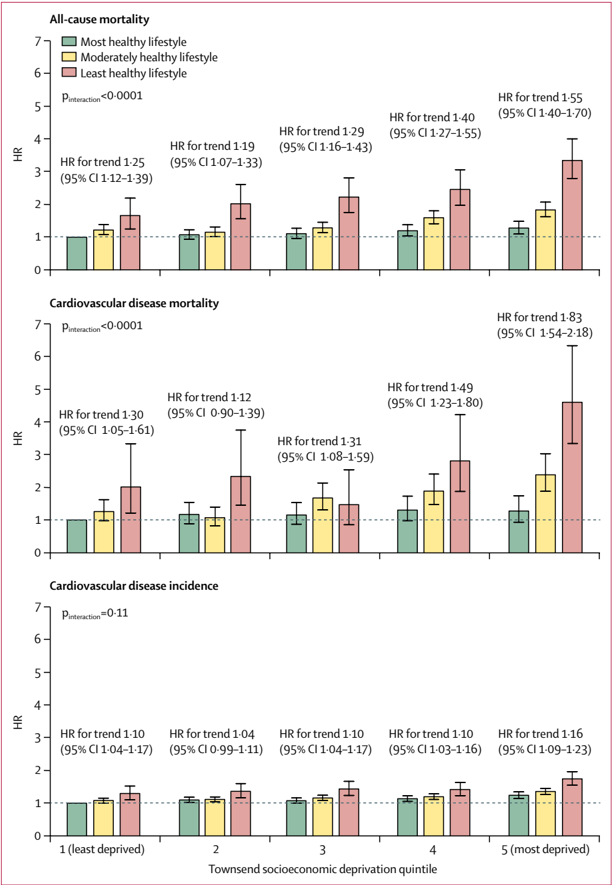
Background Combinations of lifestyle factors interact to increase mortality. Combinations of traditional factors such as smoking and alcohol are well described, but the additional effects of emerging factors such as television viewing time are not. The effect of socioeconomic deprivation on these extended lifestyle risks also remains unclear. We aimed to examine whether deprivation modifies the association between an extended score of lifestyle-related risk factors and health outcomes. Methods Data for this prospective analysis were sourced from the UK Biobank, a prospective population-based cohort study. We assigned all participants an extended lifestyle score, with 1 point for each unhealthy lifestyle factor (incorporating sleep duration and high television viewing time, in addition to smoking, excessive alcohol, poor diet [low intake of oily fish or fruits and vegetables, and high intake of red meat or processed meats], and low physical activity), categorised as most healthy (score 0–2), moderately healthy (score 3–5), or least healthy (score 6–9). Cox proportional hazards models were used to examine the association between lifestyle score and health outcomes (all-cause mortality and cardiovascular disease mortality and incidence), and whether this association was modified by deprivation. All analyses were landmark analyses, in which participants were excluded if they had an event (death or cardiovascular disease event) within 2 years of recruitment. Participants with non-communicable diseases (except hypertension) and missing covariate data were excluded from analyses. Participants were also excluded if they reported implausible values for physical activity, sleep duration, and total screen time. All analyses were adjusted for age, sex, ethnicity, month of assessment, history of hypertension, systolic blood pressure, medication for hypercholesterolaemia or hypertension, and body-mass index categories. Findings 328 594 participants aged 40–69 years were included in the study, with a mean follow-up period of 4·9 years (SD 0·83) after the landmark period for all-cause and cardiovascular disease mortality, and 4·1 years (0·81) for cardiovascular disease incidence. In the least deprived quintile, the adjusted hazard ratio (HR) in the least healthy lifestyle category, compared with the most healthy category, was 1·65 (95% CI 1·25–2·19) for all-cause mortality, 1·93 (1·16–3·20) for cardiovascular disease mortality, and 1·29 (1·10–1·52) for cardiovascular disease incidence. Equivalent HRs in the most deprived quintile were 2·47 (95% CI 2·04–3·00), 3·36 (2·36–4·76), and 1·41 (1·25–1·60), respectively. The HR for trend for one increment change towards least healthy in the least deprived quintile compared with that in the most deprived quintile was 1·25 (95% CI 1·12–1·39) versus 1·55 (1·40–1·70) for all-cause mortality, 1·30 (1·05–1·61) versus 1·83 (1·54–2·18) for cardiovascular disease mortality, and 1·10 (1·04–1·17) versus 1·16 (1·09–1·23) for cardiovascular disease incidence. A significant interaction was found between lifestyle and deprivation for all-cause and cardiovascular disease mortality (both p interaction <0·0001), but not for cardiovascular disease incidence (p interaction =0·11). Interpretation Wide combinations of lifestyle factors are associated with disproportionate harm in deprived populations. Social and fiscal policies that reduce poverty are needed alongside public health and individual-level interventions that address a wider range of lifestyle factors in areas of deprivation. Funding None.
Overview
The claims and statistics of this paper haven’t been checked yet.
Free: it reads the open-access text and checks the first 5 claims that cite a source we can check. Create a free account to check every claim.
Integrity signals
Registry
Cites
Statistics
Figures
Verification
Claims the paper makes
The claims and statistics of this paper haven’t been checked yet.
Free: it reads the open-access text and checks the first 5 claims that cite a source we can check. Create a free account to check every claim.
Claims other papers make about this one
Each is checked against this paper’s own text: does it say what the citing paper says it does?
The source backs part of the claim, not all of it — or backs it for a different population, condition or comparison.
In the citing paper
“Social deprivation and psychosocial stress set the scene for increased risk [13].”
From 2019 ESC/EAS guidelines for the management of dyslipidaemias: lipid modification to reduce cardiovascular risk (2019) · cites this paper as [13]
Experimental — accuracy not yet measured
Self-check
Percentages, sums and reported differences re-computed from the paper’s own numbers.
The self-check needs the paper’s full text.
Citations
Cites
Sudlow, C., Gallacher, J., Allen, N., Beral, V., Burton, P., Danesh, J., Downey, P., Elliott, P., Green, J., Landray, M., et al. (2015) · PLOS Medicine · doi:10.1371/journal.pmed.1001779 · Cited by 12,728
Self-citationNaghavi, M., Abajobir, A. A., Abbafati, C., Abbas, K. M., Abd-Allah, F., Abera, S. F., Aboyans, V., Adetokunboh, O., Afshin, A., Agrawal, A., et al. (2017) · The Lancet · doi:10.1016/s0140-6736(17)32152-9 · Cited by 4,821
Closing the gap in a generation: health equity through action on the social determinants of health
Marmot, M., Friel, S., Bell, R., Houweling, T. A., & Taylor, S. (2008) · The Lancet · doi:10.1016/s0140-6736(08)61690-6 · Cited by 3,247
Health and Deprivation: Inequality and the North
Townsend, P. D., Phillimore, P., & Beattie, A. (1987) · DOAJ (DOAJ: Directory of Open Access Journals) · Cited by 1,473
Stringhini, S., Carmeli, C., Jokela, M., Avendaño, M., Muennig, P., Guida, F., Ricceri, F., d'Errico, A., Barros, H., Bochud, M., et al. (2017) · The Lancet · doi:10.1016/s0140-6736(16)32380-7 · Cited by 1,319
What makes UK Biobank special?
Collins, R. (2012) · The Lancet · doi:10.1016/s0140-6736(12)60404-8 · Cited by 1,128
Loef, M., & Walach, H. (2012) · Preventive Medicine · doi:10.1016/j.ypmed.2012.06.017 · Cited by 822
Long sleep duration and health outcomes: A systematic review, meta-analysis and meta-regression
Jike, M., Itani, O., Watanabe, N., Buysse, D. J., & Kaneita, Y. (2018) · Sleep Medicine Reviews · doi:10.1016/j.smrv.2017.06.011 · Cited by 768
Health and deprivation. Inequality and the North
Mackenbach, J. P. (1988) · Health Policy · doi:10.1016/0168-8510(88)90006-1 · Cited by 661
A systematic review on the clustering and co-occurrence of multiple risk behaviours
Meader, N., King, K., Moe-Byrne, T., Wright, K., Graham, H., Petticrew, M., Power, C., White, M., & Sowden, A. J. (2016) · BMC Public Health · doi:10.1186/s12889-016-3373-6 · Cited by 578
Cited by
Items 301–400 of 442
He, W., Mi, N., Jin, K., Jin, B., Zhong, R., Liu, Z., Lin, Y., Yue, P., Xia, B., He, Q., et al. (2025) · Frontiers in Endocrinology · doi:10.3389/fendo.2025.1573203 · Cited by 4
Lin, W.-Y., Lin, P.-Y., Wu, C.-D., Liang, W.-M., & Kuo, H.-W. (2025) · PLoS ONE · doi:10.1371/journal.pone.0324070 · Cited by 2
“The author concludes that wide combinations of lifestyle factors are associated with disproportionate harm in deprived populations [27].”
Shrestha, D., Wisely, N. A., Bampouras, T. M., Subar, D. A., Shelton, C., & Gaffney, C. J. (2025) · PLoS ONE · doi:10.1371/journal.pone.0328056 · Cited by 3
Unhealthy lifestyles accelerated aging and consequential musculoskeletal morbidity
Zhou, H., Liang, J., Mak, J. K. L., Cui, Z., Ling, D., Hägg, S., & Wang, Q. (2025) · Journal of Bone and Mineral Metabolism · doi:10.1007/s00774-025-01630-x · Cited by 2
“The UHLS was constructed following the methodology described by Foster et al. [18], whose findings demonstrated that an extended lifestyle score—incorporating both traditional and emerging unhealthy lifestyle factors (e.g., sleep duration and television viewing time)—was associated with a…”
Empirical Evidences for Urban Influences on Public Health in Hamburg
von Szombathely, M., Bechtel, B., Lemke, B., Oßenbrügge, J., Pohl, T., & Pott, M. (2019) · Applied Sciences · doi:10.3390/app9112303 · Cited by 4
“Additionally, confounders such as gender, age or income, and behavioral variables such as smoking status, alcohol consumption, or physical activity have to be taken into account as effect-modifying variables [34,35,47,73].”
BackgroundMetabolic risk factors link unhealthy lifestyles to the risk of colorectal polyps in China
Xu, N., Cong, X., Sun, R., Yin, L., Zhang, J., & Pu, Y. (2023) · Preventive Medicine Reports · doi:10.1016/j.pmedr.2023.102314 · Cited by 3
“Combining traditional and emerging factors in extended lifestyle scores could inform future public health policy(Foster et al., 2018).”
BackgroundMethodInfluentialHou, Y., Yang, H., Xu, Y., Wang, K., Fu, Y., & Lu, Z. (2024) · International Journal of Cardiology · doi:10.1016/j.ijcard.2024.131829 · Cited by 4
Socioeconomic inequalities in lifestyle-related health outcomes
Pool, U. (2019) · The Lancet Public Health · doi:10.1016/s2468-2667(19)30003-9 · Cited by 2
Wang, Y., Su, B., Alcalde‐Herraiz, M., Barclay, N. L., Tian, Y., Li, C., Wareham, N. J., Paredes, R., Xie, J., & Prieto‐Alhambra, D. (2024) · medRxiv · doi:10.1101/2024.01.30.24302040 · Cited by 2
How Can Muscle-Strengthening Activities Be Promoted in School Settings?
Cox, A. (2024) · Springer eBooks · doi:10.1007/978-3-031-65595-1_15 · Cited by 2
Gressier, M., Frost, G. S., Hill, Z., Li, D., Olney, J., Pineda, E., Targett, V. C., Young, M., & Sassi, F. (2024) · British Journal Of Nutrition · doi:10.1017/s0007114524001806 · Cited by 1
“Data from the National Diet and Nutrition Survey (2019) shows that sugar intakes have fallen for some age groups which, in older children and adolescents, appears to be partly driven by soft drinks contributing less to sugar intakes, likely because of the changes made to drinks included in the SDIL…”
Physical activity, air pollution, and incident long-term conditions: a prospective cohort study
Huang, M., Olsen, J., Trost, S. G., Celis-Morales, C. A., Pell, J. P., & Ho, F. K. W. (2025) · BMC Medicine · doi:10.1186/s12916-025-04338-x · Cited by 1
“It is known that people living in more deprived areas were disproportionally exposed to air pollutants [15] and were more likely to develop long-term conditions [16], suggesting possible confounding by social deprivation.”
Self-citationYang, Y., Liu, H., Chen, L., & Filippidis, F. T. (2025) · Nutrients · doi:10.3390/nu17193115 · Cited by 2
“The Townsend deprivation index (quartile) was defined based on the postcode of residence using aggregated data on unemployment, car and home ownership, and household over-crowding, with higher scores indicating greater levels of socioeconomic deprivation [25].”
Yang, Z., Huang, L.-Y., Luo, X., Zhang, X. H., Tan, C., Tan, L., Sun, F.-R., & Xu, W. M. (2025) · Journal of Affective Disorders · doi:10.1016/j.jad.2025.120451 · Cited by 3
Wang, D., Zhou, L., Hao, X., Chen, Z., Wang, B., & Li, W. (2025) · Journal of Diabetes Research · doi:10.1155/jdr/8974749 · Cited by 1
Iavarone, I., Cortés, S., Asmus, C. I. R. F., Marsili, D., Ramos-Bonilla, J. P., Tamayo‐Ortiz, M., & Pasetto, R. (2025) · Environmental Epidemiology · doi:10.1097/ee9.0000000000000435 · Cited by 1
EAT-Lancet and plant-based diets, plasma metabolomic signatures, and biological aging
Li, J., Li, J., Xu, X., Zhang, K., Wang, N., Lu, Q., Wang, B., & Lu, Y. (2025) · npj Aging · doi:10.1038/s41514-025-00306-0 · Cited by 3
“TDI was assessed in terms of unemployment, car and home-ownership, and household overcrowding, with a higher score indicating a higher degree of deprivation 63 .”
Wilson, C. L., Dhaduk, R., Zhou, X., Matt, G. Y., Yasui, Y., Im, C., Armstrong, G. T., Dixon, S. B., Sapkota, Y., Wang, Z., et al. (2025) · JNCI Journal of the National Cancer Institute · doi:10.1093/jnci/djaf356 · Cited by 1
LI, S., Wu, Y., Yan, Y., Du, Y., Chen, S., Tobias, D. K., Zhang, C., & Bao, W. (2026) · American Journal of Preventive Cardiology · doi:10.1016/j.ajpc.2025.101406 · Cited by 1
“Covariates : Information on covariates (including age, self-reported race/ethnicity, Townsend deprivation index [21], education, and reproductive history) was obtained by baseline self-reported questionnaires.”
Yang, Y., Liu, Q., Filippidis, F. T., Lu, P., & Guo, Y. (2026) · Journal of Hazardous Materials · doi:10.1016/j.jhazmat.2026.141188 · Cited by 1
Yin, Q., Xu, R., Wang, D., & Li, J. (2026) · Frontiers in Public Health · doi:10.3389/fpubh.2026.1714359 · Cited by 1
Shift work, genetic risk, and incident gout: a prospective cohort study in the UK Biobank
Wu, C., Zhang, H., Xia, J., Peng, B., Chen, J., Wang, M., Wu, S., Jiang, Z., Ji, S., Yang, Y., et al. (2026) · Archives of Public Health · doi:10.1186/s13690-026-01888-1 · Cited by 1
“Part Ⅱ was lifestyle factors, which contained smoking status (never, previous, and current), drinking frequencies (frequent, infrequent, and never) [24], and diet quality scores (0/1/2/3/4), calculated as per a previous study (details in the Supplementary information section) [25].”
Bally, E., Şencan, I. M. M., Vasiljev, V., Juraga, D., Pelechá-Salvador, M., Doñate-Martínez, A., Gow, R., Costa-Ruiz, B., Gallego‐Valadés, A., Borrás, T. A., et al. (2026) · BMC Public Health · doi:10.1186/s12889-026-27027-7 · Cited by 1
“However, NCDs disproportionately impact specific populations, with socioeconomic inequalities playing a pivotal role in shaping both risk exposure and health outcomes [2, 3].”
Hu, W., Liu, T.-S., Shen, Z., Tian, G., Jia, C.-X., & Liu, B.-P. (2026) · Psychological Medicine · doi:10.1017/s0033291726103535 · Cited by 2
“…or prior smokers versus others), drinking (daily or almost daily alcohol consumption versus others), physical activity (PA, 150 min/week of moderate-intensity PA or < 75 min/week of vigorous-intensity PA versus others), and sleep duration (<7 or > 9 hours/day versus others) (Foster et al., 2018).”
Chronotype, Genetic Risk, Lifestyle, and Risk of Depression and Anxiety: A Prospective Cohort Study
Wang, D., Shao, Z., chen, Z., Hao, X., & Li, W. (2026) · MedComm · doi:10.1002/mco2.70736 · Cited by 1
Wang, Z., Yang, J., Huang, W., & Li, D. (2026) · Environmental Research · doi:10.1016/j.envres.2026.124589 · Cited by 1
Tian, Z., Yan, X., Xue, F., Yang, J., & Li, N. (2026) · Cardiovascular Diabetology · doi:10.1186/s12933-026-03260-7 · Cited by 1
“In line with prior reports [58], sedentary behavior was defined as ≥ 4 h/day of television viewing and unhealthy sleep duration as < 7 h or > 9 h/day.”
Determinantes sociales de la Salud y enfermedades prevalentes.
Solís, P. P. (2019) · Folia Humanística · doi:10.30860/0056 · Cited by 1
SOCIO DEMOGRAPHIC PROFILE OF PATIENTS USING OTHER SUBSTANCES IN PATIENTS OF ALCOHOL USE DISORDER
Shah, P., Desai, B., Jagani, K., Pipalava, A. K., & Savaliya, P. (2022) · INTERNATIONAL JOURNAL OF SCIENTIFIC RESEARCH · doi:10.36106/ijsr/2501083 · Cited by 1
Rogers, I., Grice-Jackson, T., Ford, E. M., Howat, J., Salimkumar, R., Frere‐Smith, K., O’Connor, N., Bastiaens, H., & van Marwijk, H. (2023) · PLOS Digital Health · doi:10.1371/journal.pdig.0000395 · Cited by 1
Population clustering of structural brain aging and its association with brain development
Duan, H., Shi, R., Kang, J., Banaschewski, T., Bokde, A. L. W., Büchel, C., Desrivières, S., Flor, H., Grigis, A., Garavan, H., et al. (2024) · eLife · doi:10.7554/elife.94970.3 · Cited by 2
López‐Bazo, E. (2024) · Spatial and Spatio-temporal Epidemiology · doi:10.1016/j.sste.2024.100648 · Cited by 4
“…who have used deprivation as a determinant of the general health condition and the incidence of other diseases (Stafford and Marmot, 2003; Havard et al., 2008; Juh ´ asz et al., 2010; Lamnisos et al., 2019; Charlton et al., 2013; Foster et al., 2018; Naughton et al., 2021; Silva et al., 2023).”
Müller, M. J., Gätjens, I., & Bosy‐Westphal, A. (2024) · Springer eBooks · doi:10.1007/978-3-662-67662-2_68 · Cited by 2
Multimorbidity in the working-age population of Serbia: Results from the 2019 National Health Survey
Radić, I., Harhaji, S., Dragnic, N. R., Mijatović-Jovanović, V., Čanković, S., & Čanković, D. (2024) · Vojnosanitetski pregled · doi:10.2298/vsp231025034r · Cited by 1
Seidenfeld, J., Stechuchak, K. M., Smith, V. A., Stanwyck, C., Perfect, C. R., Houtven, C. H. V., & Hastings, S. N. (2024) · Journal of Geriatric Emergency Medicine · doi:10.17294/2694-4715.1080 · Cited by 1
“35-37 One possibility is that patients living in low disadvantaged neighborhoods found other means to seek health care during the first year of the pandemic; previous work has demonstrated that lower ADI is associated with more willingness to use video visits among Veterans.”
BackgroundGlycated hemoglobin levels and abdominal aortic aneurysm incidence in primary prevention populations
Wu, Z., Li, W., Hu, J., Ip, H. I., Nabi, G., He, S., Pu, H., Liu, Y., Qiu, P., Liu, X., et al. (2025) · Journal of Vascular Surgery · doi:10.1016/j.jvs.2025.03.480 · Cited by 1
Chen, R., Zhou, Y., Xu, M., Gong, Y., Xia, W., & Yin, X. (2025) · BMJ Open Diabetes Research & Care · doi:10.1136/bmjdrc-2025-005336 · Cited by 1
Helen Salisbury: Is lifestyle a choice?
Salisbury, H. (2020) · BMJ · doi:10.1136/bmj.m2701 · Cited by 1
Rey-López, J. P., Frederick, K. W., Foster, H. M. E., Petermann-Rocha, F. E., Sattar, N. A., Pell, J. P., Gill, J. M. R., Gray, S. R., & Celis-Morales, C. A. (2020) · Journal of Sports Sciences · doi:10.1080/02640414.2020.1797438 · Cited by 1
Self-citationSpatial perspectives in family health research
Coman, E., Steinbach, S., & Cao, G. (2021) · Family Practice · doi:10.1093/fampra/cmab165 · Cited by 1
Gatfield, E. R., Bataineh, A., Kurdi, B. E., Mukesh, M. B., & Loo, S. W. (2022) · European Journal of Cancer Care · doi:10.1111/ecc.13668 · Cited by 1
“Patients living in socioeconomically deprived areas are more likely to suffer with physical health comorbidities such as cardiovascular disease (Foster et al., 2018).”
BackgroundGigante, G., & Giuliani, A. (2022) · Entropy · doi:10.3390/e25010021 · Cited by 1
“All-cause mortality is a very coarse grain, albeit very reliable, index to check the health implications of lifestyle determinants [1], systemic threats [2] and socio-demographic factors [3].”
BackgroundCalonge‐Pascual, S. (2019) · UPM Digital Archive (Technical University of Madrid) · doi:10.20868/upm.thesis.57433 · Cited by 3
Sofianopoulou, E., Church, C., Coghlan, G., Howard, L., Johnson, M., Kiely, D. G., Lawrie, A., Lordan, J. L., Wilkins, M. R., Wort, S. J., et al. (2020) · European Respiratory Journal · doi:10.1183/13993003.02334-2019 · Cited by 1
Vitamin D and socioeconomic deprivation mediate COVID-19 ethnic health disparitiesPreprint
Mariño‐Ramírez, L., Ahmad, M., Rishishwar, L., Nagar, S. D., Lee, K. K., Norris, E. T., & Jordan, I. K. (2021) · medRxiv · doi:10.1101/2021.09.20.21263865 · Cited by 1
Kartoun, U., Khurshid, S. S., Kwon, B. C., Patel, A. P., Batra, P., Philippakis, A., Khera, A. V., Ellinor, P. T., Lubitz, S. A., & Ng, K. (2021) · Research Square · doi:10.21203/rs.3.rs-936366/v1 · Cited by 1
“1) 195 (39) Hypertensive therapy (%) 50.”
Tegegne, T. K., Islam, S. M. S., & Maddison, R. (2022) · Research Square · doi:10.21203/rs.3.rs-1986313/v1 · Cited by 1
Xie, J., Feng, Y., Newby, D., Zheng, B., Feng, Q., Prats‐Uribe, A., Li, C., Wareham, N. J., Paredes, R., & Prieto‐Alhambra, D. (2022) · medRxiv · doi:10.1101/2022.10.26.22281547 · Cited by 1
Tegegne, T. K., Islam, S. M. S., & Maddison, R. (2022) · Research Square · doi:10.21203/rs.3.rs-1986313/v2 · Cited by 1
Population clustering of structural brain aging and its association with brain developmentPreprint
Duan, H., Shi, R., Kang, J., Banaschewski, T., Bokde, A. L. W., Büchel, C., Desrivières, S., Flor, H., Grigis, A., Garavan, H., et al. (2024) · eLife · doi:10.7554/elife.94970.2 · Cited by 2
do Nascimento, C. F. (2021) · Digital Library of Theses and Dissertations (Universidade de São Paulo) · doi:10.11606/t.6.2021.tde-13102021-192542
COVID-19 outcomes in people with diabetes in Wales: a secondary analysis of the ABCD audit
Williams, D. M., Davies, J., Field, B. C. T., Gandhi, R. A., Harris, S. M., Khunti, K., Nagi, D. K., Narendran, P., Rea, R. D., Ruan, Y., et al. (2021) · British Journal of Diabetes · doi:10.15277/bjd.2021.319
Batty, G. D., & de Mestral, C. (2019) · Epidemiology · doi:10.1097/ede.0000000000001076
Porta, M. S. (2021) · Faculty Opinions – Post-Publication Peer Review of the Biomedical Literature · doi:10.3410/f.739171135.793581883
Sousa, B. L. A. (2022) · Digital Library of Theses and Dissertations (Universidade de São Paulo) · doi:10.11606/t.5.2022.tde-23092022-125630
Foster, H. M. E., Polz, P., Gill, J. M. R., Celis-Morales, C. A., Mair, F. S., & O’Donnell, C. A. (2023) · Wellcome Open Research · doi:10.12688/wellcomeopenres.18708.1 · Cited by 40
Self-citationUntangling Socioeconomic Health Inequalities: Reinforcing the Evidence Base for Public Health
Zhu, Y. (2023) · University of Groningen research database (University of Groningen / Centre for Information Technology) · doi:10.33612/diss.771413564
Genetic confounding in health disparities researchPreprint
Gupta, S., Sharma, S., Jordan, I. K., & Mariño‐Ramírez, L. (2023) · Research Square · doi:10.21203/rs.3.rs-3580017/v1
Population clustering of structural brain aging and its association with brain developmentPreprint
Duan, H., Shi, R., Kang, J., Banaschewski, T., Bokde, A. L. W., Büchel, C., Desrivières, S., Flor, H., Grigis, A., Garavan, H., et al. (2024) · eLife · doi:10.7554/elife.94970.1
Healthy Eating Patterns, Genetic Predisposition, and Risk of Dementia: A Prospective Cohort StudyPreprint
Di, H., Liu, S., Chen, B., Wu, Q., Hu, W.-L., Qin, T., Peng, X., Pan, A., Liu, G., Guo, Y., et al. (2024) · SSRN Electronic Journal · doi:10.2139/ssrn.4781317
Foster, H. M. E., Mair, F. S., & O’Donnell, C. A. (2024) · Health Expectations · doi:10.1111/hex.70069 · Cited by 3
Self-citationAlqahtani, S. M. M., Alqahtani, S., Asiri, F. Y. M., Asiri, A. A. Y., Asiri, T. A. H., Asiri, M. A. M., alqhtani, M. T. M., Mawtah, M. I. B. A., Alzabadani, M. A. H., & Balhareth, A. A. A. (2024) · Journal of Ecohumanism · doi:10.62754/joe.v3i8.5329 · Cited by 1
Living conditions, lifestyles and self-rated health in Italy
Fratte, C. D., Gerosa, S., Lariccia, F., & Castro, D. L. (2025) · Rivista italiana di economia, demografia e statistica · doi:10.71014/sieds.v79i1.296
Yin, S., Li, D., Yang, Y., Wang, Q., Yuan, L., & Si, K. (2025) · Annals of Epidemiology · doi:10.1016/j.annepidem.2025.03.010
Moore, N., Cushley, L. N., Wright, D., McCann, R., Moutray, T., Pető, T., Azuara‐Blanco, A., & Jackson, A. J. (2025) · BMJ Open Ophthalmology · doi:10.1136/bmjophth-2024-001868
Barth, C., Galea, L. A. M., Jacobs, E. G., Lee, B. H., Westlye, L. T., & de Lange, A. G. (2025) · eLife · doi:10.7554/elife.99538.2 · Cited by 2
Xiang, B., Song, M., Zhang, Y., Liu, Q., Huang, Q., & Wáng, Q. (2025) · Public Health · doi:10.1016/j.puhe.2025.105752
Zhao, Y., Wang, Y., Xu, Z., Xiang, J., Zhou, C., Li, X. L., Ye, S., Yue, S., Hou, X., Wang, J., et al. (2025) · BMC Cardiovascular Disorders · doi:10.1186/s12872-025-04930-2 · Cited by 2
“Unhealthy lifestyles are significantly associated with disproportionate harm in disadvantaged populations, and a significant association between lifestyle and disadvantage for cardiovascular disease mortality has been observed [9].”
Calonge‐Pascual, S., Asensio-Jaray, S., Izquierdo, J. M., & Burgueño, R. (2025) · Revista Interuniversitaria de Formación del Profesorado Continuación de la antigua Revista de Escuelas Normales · doi:10.47553/rifop.v100ine.107700
Multimorbidity - A Public Health Challenge
Djordjevic, O., Radovanovic, J., Djordjević, G., Babic, Z., Djurovic, N., Lazarevic, R., & Galić, I. (2025) · EABR. Experimental and Applied Biomedical Research · doi:10.2478/eabr-2025-0006
Duan, M.-J., Poelman, M. P., Corpeleijn, E., & Biesbroek, S. (2026) · Progress in Cardiovascular Diseases · doi:10.1016/j.pcad.2026.07.002 · Cited by 2
Coffey, C., Ritchie, S. C., Pennells, L. A. M., Wood, A., Inouye, M., & Lambert, S. A. (2025) · medRxiv · doi:10.1101/2025.09.18.25336069
Abedeen, Z. U., Ullah, Z., Zaib, M., Saleem, A., & Qader, F. (2025) · Journal of Bone and Mineral Metabolism · doi:10.1007/s00774-025-01646-3
“Foster et al. recommended that intervention studies are required to confirm lifestyle changes and associated health benefits [2] .”
Occupational status and outcomes in acute myocardial infarction: a prospective cohort study
Zhu, Y., Wang, J., Cai, Q., Qiao, Y., Yang, J., Xu, H., Su, S., Gao, X., Li, W., Yang, Y., et al. (2025) · BMC Public Health · doi:10.1186/s12889-025-24564-5 · Cited by 1
Photoreceptor layer thinning is an early biomarker for type 2 diabetes: a cohort study in UK Biobank
Ma, Y., Wu, Y., Hu, L., Zhang, X., Zheng, D., Liu, Z., & Jin, G. (2025) · Eye · doi:10.1038/s41433-025-04068-7 · Cited by 1
Addressing socioeconomic inequalities in perinatal outcomes in the UK: a critical discussion
Elumogo, D. C., & Rayment‐Jones, H. (2025) · Midwifery · doi:10.1016/j.midw.2025.104649
Geng, C., Pang, R., Xia, Y., Wu, Y., Zhu, J., & Chen, Y. (2025) · Frontiers in Oncology · doi:10.3389/fonc.2025.1643394
Li, S., Duan, N., Chen, Q., & Jiang, H. (2025) · Journal of Affective Disorders · doi:10.1016/j.jad.2025.120785
Wang, B., Fu, Y., Tan, X., Wang, N., Qi, L., & Lu, Y. (2024) · Figshare · doi:10.6084/m9.figshare.25397494
Liu, F., Lv, Y., Peng, Y., Qiao, Y., Wang, P., Si, C., Wang, X., Gong, J., Zhou, H., Zhang, M., et al. (2023) · Figshare · doi:10.6084/m9.figshare.24209048
Zhang, N., Liu, X., Wang, L., Zhang, Y., Xiang, Y., Cai, J., Xu, H., Xiao, X., & Zhao, X. (2024) · Figshare · doi:10.6084/m9.figshare.26751188
Lounassalo, I., Hirvensalo, M., Palomäki, S. H., Salin, K., Tolvanen, A. J., Pahkala, K., Rovio, S., Fogelholm, M., Yang, X., Hutri-Kähönen, N., et al. (2021) · Figshare · doi:10.6084/m9.figshare.14252248
La, R., Zhou, L., Yin, Y., Lu, L., Li, L., Jiang, D., Huang, L., & Wu, Q. (2024) · Figshare · doi:10.6084/m9.figshare.25558975
Wu, Y., Xiong, T., Tan, X., & Chen, L. (2024) · Figshare · doi:10.6084/m9.figshare.26551939
Li, F., Chen, L., Liu, B., Zhong, V. W., Deng, Y., Luo, D., Gao, C., Bao, W., & Rong, S. (2024) · Figshare · doi:10.6084/m9.figshare.26554736
Xiong, S., Hou, N., Tang, F., Li, J., & Deng, H. (2024) · Figshare · doi:10.6084/m9.figshare.26630923
Cerletti, P., Keidel, D., Imboden, M., Schindler, C., & Probst-Hensch, N. (2020) · Figshare · doi:10.6084/m9.figshare.13120798
Maroto-Rodríguez, J., Ortolá, R., Carballo‐Casla, A., Iriarte-Campo, V., Salinero-Fort, M. Á., Rodríguez-Artalejo, F., & Sotos‐Prieto, M. (2023) · Figshare · doi:10.6084/m9.figshare.24248010
Lounassalo, I., Hirvensalo, M., Palomäki, S. H., Salin, K., Tolvanen, A. J., Pahkala, K., Rovio, S., Fogelholm, M., Yang, X., Hutri-Kähönen, N., et al. (2021) · Figshare · doi:10.6084/m9.figshare.14252239
Ye, X., Wang, Y., Zou, Y., Tu, J., Tang, W., Yu, R., Yang, S., & Huang, P. (2024) · Figshare · doi:10.6084/m9.figshare.26564985
Lounassalo, I., Hirvensalo, M., Palomäki, S. H., Salin, K., Tolvanen, A. J., Pahkala, K., Rovio, S., Fogelholm, M., Yang, X., Hutri-Kähönen, N., et al. (2021) · Figshare · doi:10.6084/m9.figshare.14252242
La, R., Zhou, L., Yin, Y., Lu, L., Li, L., Jiang, D., Huang, L., & Wu, Q. (2024) · Figshare · doi:10.6084/m9.figshare.25558927
Lounassalo, I., Hirvensalo, M., Palomäki, S. H., Salin, K., Tolvanen, A. J., Pahkala, K., Rovio, S., Fogelholm, M., Yang, X., Hutri-Kähönen, N., et al. (2021) · Figshare · doi:10.6084/m9.figshare.14252245
Ye, X., Wang, Y., Zou, Y., Tu, J., Tang, W., Yu, R., Yang, S., & Huang, P. (2024) · Figshare · doi:10.6084/m9.figshare.26564982
Additional file 1 of Association of a healthy lifestyle with mortality in older people
Robb, C. E., Carr, P. R., Ball, J., Owen, A., Beilin, L. J., Newman, A. B., Nelson, M. R., Reid, C. M., Orchard, S. G., Neumann, F., et al. (2023) · Figshare · doi:10.6084/m9.figshare.24295683
Prather, H., Goldring, A., Leupold, O., Rau, O. R., Press, J. M., Sokunbi, G. O., Sandhu, H. S., & Cheng, J. (2026) · American Journal of Lifestyle Medicine · doi:10.1177/15598276261415815
Deng, Y., Geng, X., Lin, Z., Yang, M., Lin, Q., Zheng, Z., Su, W., Zhan, M., Chen, L., Sun, T., et al. (2026) · Nicotine & Tobacco Research · doi:10.1093/ntr/ntaf209
Metadata
- Authors
- Foster, H. M. E., Celis-Morales, C. A., Nicholl, B. I., Petermann-Rocha, F., Pell, J. P., Gill, J. M. R., O'Donnell, C. A., & Mair, F. S.
- Affiliations
- University of Glasgow (GB)
- Corresponding author
- Mair, Frances S
- ORCID
- Venue
- The Lancet Public Health
- Publisher
- Elsevier BV
- Published
- 2018-12
- Volume
- 3
- Issue
- 12
- Pages
- e576-e585
- ISSN
- 2468-2667 (ISSN-L)
- OpenAlex
- W2901308462
- Semantic Scholar
- 27345529f29720a44d45b318cb53f8696990a08f
- Cited by
- 441
- References
- 29
- Citations by year
- 2026: 55 · 2025: 82 · 2024: 96 · 2023: 70 · 2022: 50 · 2021: 44 · 2020: 28 · 2019: 14 · 2018: 1
- FWCI
- 16.66
- Type
- journal article
- Language
- en
- Open access
- gold
- doi.org
- Licence
- cc-by
- www.elsevier.com/tdm/userlicense/1.0/ (tdm)
- creativecommons.org/licenses/by/4.0/ (vor)
- Locations
- The Lancet Public Health (publishedVersion, cc-by)
- PubMed (publishedVersion)
- ENLIGHTEN (Jurnal Bimbingan dan Konseling Islam) (acceptedVersion, cc-by-sa)
- DOAJ (DOAJ: Directory of Open Access Journals) (submittedVersion, cc-by-sa)
- Funders
- Medical Research Council (MC_PC_17228)
- Topics
- Health Sciences › Medicine › Cardiology and Cardiovascular Medicine › Cardiovascular Health and Risk Factors
- Social Sciences › Health › Health disparities and outcomes
- Health Sciences › Medicine › Public Health, Environmental and Occupational Health › Health and Lifestyle Studies
- Keywords
- socioeconomic deprivation, lifestyle score, all-cause mortality, cardiovascular mortality, cardiovascular disease incidence, television viewing, sleep duration, physical activity, alcohol consumption, smoking, diet, non-communicable diseases, hypertension, UK Biobank, middle-aged adults, health disparities, screen time, oily fish
- MeSH terms
- Adult, Aged, Cardiovascular Diseases, Cause of Death, Female, United Kingdom, Humans, Life Style, Male, Middle Aged, Mortality, Poverty, Prospective Studies, Risk Factors, Incidence, Biological Specimen Banks, Health Status Disparities
About these checks
Registry, retraction, Cites and statistics results are computed, not judged, with one exception: a printed reference that no index lists is read once by a model before it counts as a citation error. Claims are extracted by a model and kept only when their quote appears verbatim in the text; each cited source is then checked, with a model’s help, for whether it says what the claim relies on. Those verdicts can be wrong — read the claim’s quote and the cited source before relying on one.
Statistics and arithmetic are recomputed, not judged.
Confidence bands are shown only for fields calibrated on our annotated test set. None is calibrated yet, so no band is shown.
What counts as a claim ›How we measure confidence ›How we check this ›
Are you an author, or do you see a problem with this page? Request a review
Data sources
Bibliographic data: Semantic Scholar, OpenAlex, Crossref.
Contains information from the Semantic Scholar Academic Graph Datasets, made available under the ODC Attribution License (ODC-BY 1.0).
Semantic Scholar’s data is described in: Kinney, R., et al. (2023). The Semantic Scholar Open Data Platform. arXiv:2301.10140.
