

The DOI matches its Crossref record; 27 of the 27 references it cites were found in a registry or an index.
Inequalities in life expectancy in six large Latin American cities from the SALURBAL study: an ecological analysis
Open accessAbstract
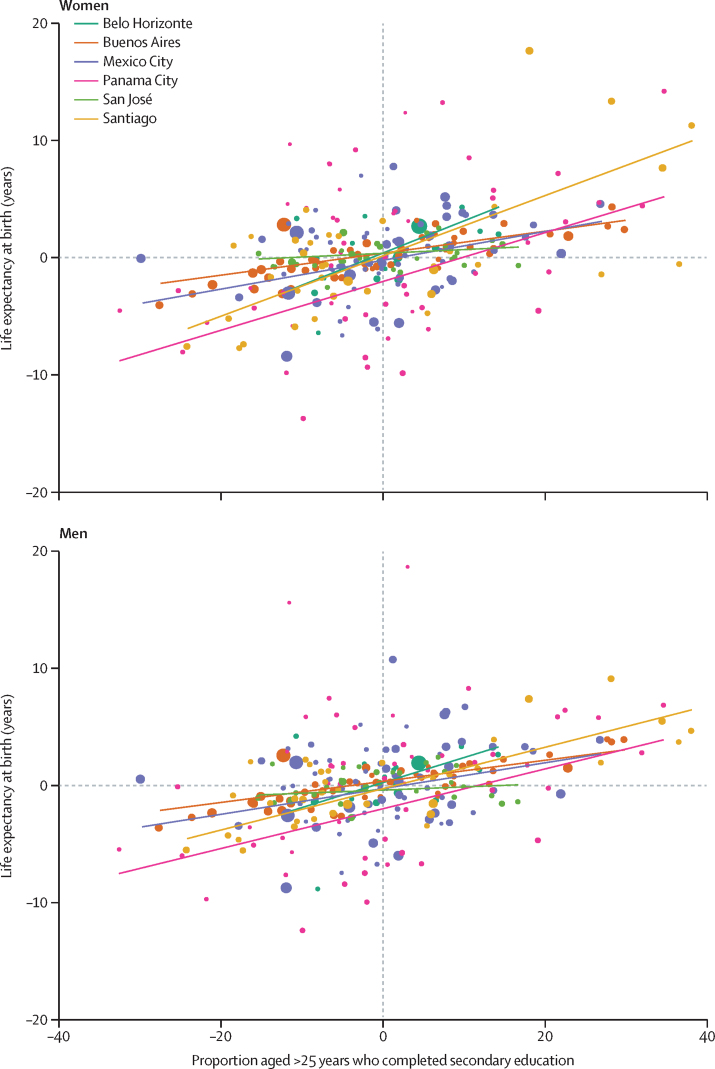
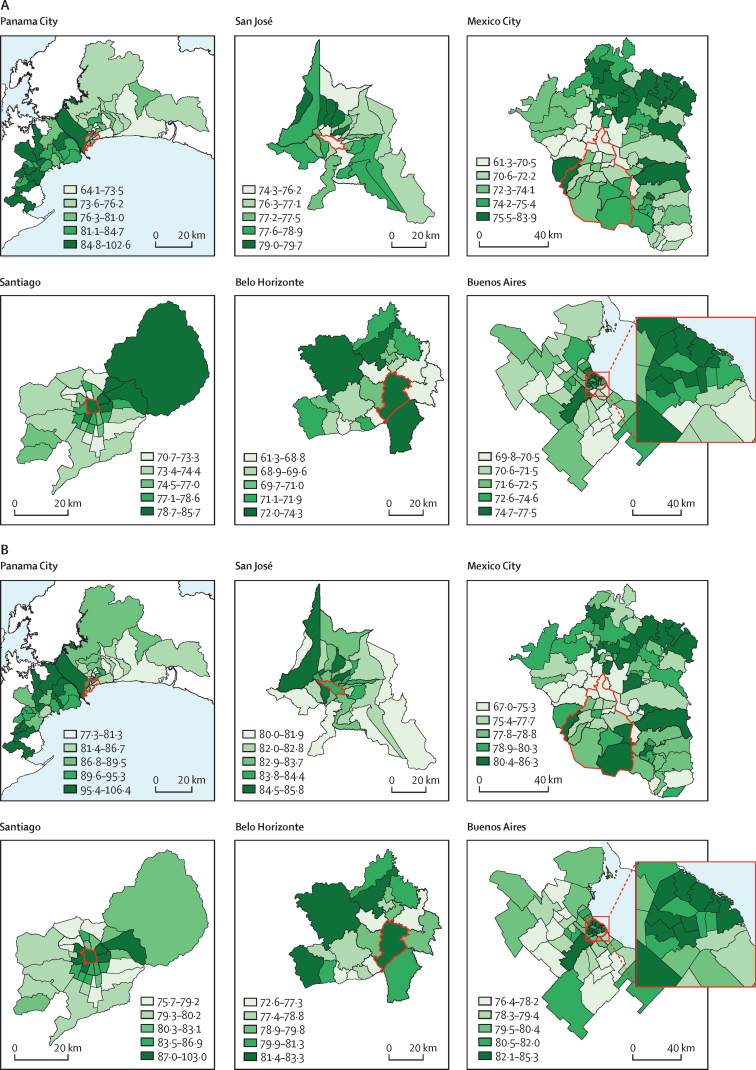
BACKGROUND: Latin America is one of the most unequal regions in the world, but evidence is lacking on the magnitude of health inequalities in urban areas of the region. Our objective was to examine inequalities in life expectancy in six large Latin American cities and its association with a measure of area-level socioeconomic status. METHODS: In this ecological analysis, we used data from the Salud Urbana en America Latina (SALURBAL) study on six large cities in Latin America (Buenos Aires, Argentina; Belo Horizonte, Brazil; Santiago, Chile; San José, Costa Rica; Mexico City, Mexico; and Panama City, Panama), comprising 266 subcity units, for the period 2011-15 (expect for Panama city, which was for 2012-16). We calculated average life expectancy at birth by sex and subcity unit with life tables using age-specific mortality rates estimated from a Bayesian model, and calculated the difference between the ninth and first decile of life expectancy at birth (P90-P10 gap) across subcity units in cities. We also analysed the association between life expectancy at birth and socioeconomic status at the subcity-unit level, using education as a proxy for socioeconomic status, and whether any geographical patterns existed in cities between subcity units. FINDINGS: We found large spatial differences in average life expectancy at birth in Latin American cities, with the largest P90-P10 gaps observed in Panama City (15·0 years for men and 14·7 years for women), Santiago (8·9 years for men and 17·7 years for women), and Mexico City (10·9 years for men and 9·4 years for women), and the narrowest in Buenos Aires (4·4 years for men and 5·8 years for women), Belo Horizonte (4·0 years for men and 6·5 years for women), and San José (3·9 years for men and 3·0 years for women). Higher area-level socioeconomic status was associated with higher life expectancy, especially in Santiago (change in life expectancy per P90-P10 change unit-level of educational attainment 8·0 years [95% CI 5·8-10·3] for men and 11·8 years [7·1-16·4] for women) and Panama City (7·3 years [2·6-12·1] for men and 9·0 years [2·4-15·5] for women). We saw an increase in life expectancy at birth from east to west in Panama City and from north to south in core Mexico City, and a core-periphery divide in Buenos Aires and Santiago. Whereas for San José the central part of the city had the lowest life expectancy and in Belo Horizonte the central part of the city had the highest life expectancy. INTERPRETATION: Large spatial differences in life expectancy in Latin American cities and their association with social factors highlight the importance of area-based approaches and policies that address social inequalities in improving health in cities of the region. FUNDING: Wellcome Trust.
Overview
The claims and statistics of this paper haven’t been checked yet.
Run the check — free, no account needed. It reads the open-access text and checks the sources it cites.
Integrity signals
Registry
Cites
Statistics
Figures
Verification
Claims the paper makes
The claims and statistics of this paper haven’t been checked yet.
Run the check — free, no account needed. It reads the open-access text and checks the sources it cites.
Claims other papers make about this one
Each is checked against this paper’s own text: does it say what the citing paper says it does?
The source backs part of the claim, not all of it — or backs it for a different population, condition or comparison.
In the citing paper
“Although urban areas are generally wealthier than rural areas, wide disparities in socioeconomic status (SES) and segregation into wealthy and poor sub-city units mean that cities contain a microcosm of social gradients – and inequities in health – present in the rest of the country [7–9].”
From Social epidemiology of urban COVID-19 inequalities in Latin America and Canada (2024) · cites this paper as [9]
Experimental — accuracy not yet measuredIn the citing paper
“The lack of association between IFR and SES in the oldest age group can be attributed to a lower life expectancy (23), which is factored into the estimation of SES (see methods for details), and the fact that elderly people might be, in general, healthier enough to survive until that age.”
From Socioeconomic status determines COVID-19 incidence and related mortality in Santiago, Chile (2021) · cites this paper as [23]
Self-check
Percentages, sums and reported differences re-computed from the paper’s own numbers.
The self-check needs the paper’s full text.
Citations
Cites
Multiple Imputation for Nonresponse in Surveys
Rubin, D. B. (1987) · Wiley Series in Probability and Statistics · doi:10.1002/9780470316696 · Cited by 20,701
(2017) · The SHAFR Guide Online · doi:10.1163/2468-1733_shafr_sim010030025 · Cited by 2,357
Demography, Measuring and Modeling Population Processes
Véron, J., Preston, S. H., Heuveline, P., & Guillot, M. (2002) · Population · doi:10.2307/1535065 · Cited by 1,709
Multiple Imputation for Nonresponse in Surveys.
Kershaw, C. D., & Rubin, D. B. (1989) · Biometrics · doi:10.2307/2532070 · Cited by 392
Data Mining for Scientific and Engineering Applications
(2001) · Massive computing · doi:10.1007/978-1-4615-1733-7 · Cited by 280
International Handbook of Adult Mortality
Bonneux, L. G. A., Rogers, R. G., & Crimmins, E. M. (2011) · International handbooks of population · doi:10.1007/978-90-481-9996-9 · Cited by 272
Introduction: Income distribution and economics
Atkinson, A. B., & Bourguignon, F. (2000) · Handbook of income distribution · doi:10.1016/s1574-0056(00)80003-2 · Cited by 268
Educational inequality and intergenerational mobility in Latin America: A new database
Neidhöfer, G., Serrano, J., & Gasparini, L. (2018) · Journal of Development Economics · doi:10.1016/j.jdeveco.2018.05.016 · Cited by 198
Telles, E., Flores, R. D., & Urrea-Giraldo, F. (2015) · Research in Social Stratification and Mobility · doi:10.1016/j.rssm.2015.02.002 · Cited by 167
Building a Data Platform for Cross-Country Urban Health Studies: the SALURBAL Study
the SALURBAL Group, Quistberg, D. A., Roux, A. V. D., Bilal, U., Moore, K., Ortigoza, A. F., Rodrı́guez, D. A., Sarmiento, O. L., Frenz, P., Friche, A. A. D. L., et al. (2018) · Journal of Urban Health · doi:10.1007/s11524-018-00326-0 · Cited by 163
Self-citation
Cited by
Sorted by citations
Items 101–153 of 153
Schnake-Mahl, A. S., Anfuso, G., Hernandez, S. M., & Bilal, U. (2024) · Epidemiology · doi:10.1097/ede.0000000000001797 · Cited by 3
Self-citationSocial health inequalities in healthy ageing, Colombia 2018
Ortiz, Y. N. F., & Peñaloza-Quintero, R. E. (2025) · Discover Social Science and Health · doi:10.1007/s44155-025-00186-5 · Cited by 2
“Building on these findings, this study aligns with patterns observed in other Latin American countries, where health inequalities are deeply influenced by the interplay of socioeconomic and demographic factors [34–36].”
Pefaur, J., Toro, L., Lorca, E., Torres, R., & on behalf of the FUTAC Team (2021) · Transplantation · doi:10.1097/tp.0000000000004001 · Cited by 2
“For example, a 2019 study conducted in 6 Latin American cities showed an inverse association between socioeconomic status and life expectancy.(32) It was concluded that in Santiago, the capital of Chile, the 10% with the highest income in the population had a longer life expectancy of between 8.”
BackgroundEvaluating Urban Multidimensional Inequalities in Peru from the Capability Approach
Clausen, J., & Barrantes, N. (2024) · The urban book series · doi:10.1007/978-3-031-59746-6_3 · Cited by 1
The Urban Bias in Latin American Avoidable Mortality
García, J. (2024) · European Journal of Population / Revue européenne de Démographie · doi:10.1007/s10680-024-09716-4 · Cited by 1
“They have also examined the heterogeneity in life expectancy among the populations of some of the region’s largest cities (Bilal et al., 2019).”
de Lima, E. E. C., Queiroz, B. L., Freire, F. H. M. D. A., & Gonzaga, M. R. (2024) · Demographic Research · doi:10.4054/demres.2024.51.44 · Cited by 1
Serafim, M. B., Santana, P., Corsi, A. C., & Barrozo, L. V. (2025) · Cities & Health · doi:10.1080/23748834.2025.2461858 · Cited by 1
“Bilal et al .”
Global Perspective of CKD: Chile
Toro, L., Lorca, E., Borquez, T., & on behalf of the Chilean Society of Nephrology (2025) · Kidney360 · doi:10.34067/kid.0000000898 · Cited by 1
Within-City Average Life Expectancy “Gaps”: A Useful Health Equity Metric
Spoer, B. R., Nelson, I. S., Lee, M., Vierse, A., Chen, A. S., Titus, A. R., Thorpe, L., & Gourevitch, M. N. (2026) · Journal of Urban Health · doi:10.1007/s11524-025-01023-5 · Cited by 1
“These results are in line with prior research that has explored LEGs in a smaller number of major US [5, 6] and international cities [7] and research identifying strong associations between social drivers of health and similar mortality measures in urban geographies [8, 9].”
Cognitive life expectancy by educational attainment in Mexican adults aged 60 and older
Castro, J. E. C., Mehta, N. K., Wong, R., & Downer, B. G. (2023) · Salud Pública de México · doi:10.21149/14746 · Cited by 1
“26 The higher total life expectancies in our analysis were mainly driven by the increase in cognitively healthy life expectancy.”
BackgroundMudanças no uso e ocupação do solo e suas influências no clima urbano de cidades médias
Mendes, F. H., & Aravena, H. I. R. (2024) · Revista LABVERDE · doi:10.11606/issn.2179-2275.labverde.2024.181743 · Cited by 1
Understanding life and death in Latin America
Lanas, F. T., & Pamela Serón, S. (2021) · Nature Medicine · doi:10.1038/s41591-021-01277-x · Cited by 1
Sarmiento, O. L., Baldovino-Chiquillo, L., Rubio, M. A., Martínez‐Herrera, E., Arellana, J., Vives, A., Aguilera, M., Villadiego, V., Olivares, D., Zaupa, A., et al. (2023) · doi:10.18235/0005190 · Cited by 1
Self-citationMoreno‐Palacios, J. (2021) · International braz j urol · doi:10.1590/s1677-5538.ibju.2021.04.03
“A limitation in the Latin American scenario is the low educational level (1), which in this study proved to be a factor for inadequate response, so we as clinicians should take enough time to promote correct responses.”
Backgroundde Aquino, S. L., & Zimmermann, S. A. (2021) · Desenvolvimento em Debate · doi:10.51861/ded.dmvu.1.001
Aravena, H. I. R., & Mendes, F. H. (2021) · Geographicalia · doi:10.26754/ojs_geoph/geoph.2021735214
Ferreccio, R. L. (2021) · Netherlands Journal of Legal Philosophy · doi:10.5553/njlp/221307132021050002004
Tirachini, A., Guevara, C. Á., Munizaga, M. A., Carrasco, J. A., Astroza, S., & Hurtubia, R. (2022) · SSRN Electronic Journal · doi:10.2139/ssrn.4022866
Kämpfe um Gesundheitsgerechtigkeit
Waegerle, L. (2023) · Sozial- und Kulturgeographie · doi:10.14361/9783839456224-014
Moreno, X., Monsalves, M. J., Rueda, S., et al. (2024) · Cambridge Prisms Global Mental Health · doi:10.1017/gmh.2024.9.pr10
Moreno, X., Monsalves, M. J., Rueda, S., et al. (2024) · Cambridge Prisms Global Mental Health · doi:10.1017/gmh.2024.9.pr9
Moreno, X., Monsalves, M. J., Rueda, S., et al. (2024) · Cambridge Prisms Global Mental Health · doi:10.1017/gmh.2024.9.pr8
Moreno, X., Monsalves, M. J., Rueda, S., et al. (2023) · Cambridge Prisms Global Mental Health · doi:10.1017/gmh.2024.9.pr7
Moreno, X. (2023) · Cambridge Prisms Global Mental Health · doi:10.1017/gmh.2024.9.pr6
Moreno, X., Monsalves, M. J., Rueda, S., et al. (2023) · Cambridge Prisms Global Mental Health · doi:10.1017/gmh.2024.9.pr5
Moreno, X., Monsalves, M. J., Rueda, S., et al. (2023) · Cambridge Prisms Global Mental Health · doi:10.1017/gmh.2024.9.pr4
Moreno, X., Monsalves, M. J., Rueda, S., et al. (2023) · Cambridge Prisms Global Mental Health · doi:10.1017/gmh.2024.9.pr3
Moreno, X., Monsalves, M. J., Rueda, S., et al. (2023) · Cambridge Prisms Global Mental Health · doi:10.1017/gmh.2024.9.pr2
Moreno, X. (2023) · Cambridge Prisms Global Mental Health · doi:10.1017/gmh.2024.9.pr1
Costa, A. C. D. O., Ramos, D. D. O., & Paes-Sousa, R. (2024) · Ciência & Saúde Coletiva · doi:10.1590/1413-81232024298.19602022en
Atención Primaria Universal: de programa pionero a política de Estado
Artaza, O., & Schweizer, J. P. R. (2025) · Cuadernos Médico Sociales · doi:10.56116/cms.v65.n1.2025.2268
Quispe-Haro, C., & Kang, S. (2025) · Journal of Global Health Science · doi:10.35500/jghs.2025.7.e9
Torlaschi, A. L., Carneglia, G., & Pereiro, N. (2025) · The Journal of Climate Change and Health · doi:10.1016/j.joclim.2025.100572
“From a life-course perspective, the aging process can be understood within its specific context, shaped by prevailing socio-historical and cultural determinants [5,16,17].”
de Oliveira, D. C. R. S., Gouveia, N., Tumas, N., Carolina Nazzal, N., Alfaro, T., Kroker-Lobos, M. F., Miranda, J. J., Ramírez‐Zea, M., Oliveira, T., Caiaffa, W. T., et al. (2025) · Journal of Global Health · doi:10.7189/jogh.15.04262
“Additionally, prior studies have used this method [ 5 , 57 , 61 ], yielding reliable results consistent with the literature.”
Self-citationCause of death diversity in multi-group settings: an application to Latin America and the Caribbean
Calazans, J. A., & Permanyer, I. (2025) · Population Health Metrics · doi:10.1186/s12963-025-00436-3
“These inequalities, in turn, translate into high heterogeneity in life expectancy and causes of death between and within countries [13, 17].”
Baeza, F., Vives Vergara, A., González, F., Orlando, L., Valdebenito, R., Cortínez-O’Ryan, A., Slesinski, C., & Diez Roux, A. V. (2021) · Figshare · doi:10.6084/m9.figshare.14429249
Self-citationPerner, M. S., Trotta, A., Bilal, U., Acharya, B., Quick, H. S., Pacífico, N., Berazategui, R., Alazraqui, M., & Diez Roux, A. V. (2023) · Figshare · doi:10.6084/m9.figshare.24217542
Self-citationBaeza, F., Vives Vergara, A., González, F., Orlando, L., Valdebenito, R., Cortínez-O’Ryan, A., Slesinski, C., & Diez Roux, A. V. (2021) · Figshare · doi:10.6084/m9.figshare.14429246
Self-citationPerner, M. S., Trotta, A., Bilal, U., Acharya, B., Quick, H. S., Pacífico, N., Berazategui, R., Alazraqui, M., & Diez Roux, A. V. (2024) · Figshare · doi:10.6084/m9.figshare.24217607
Self-citationRosário, E., Severo, M., Francisco, D., Brito, M., & Costa, D. (2021) · Figshare · doi:10.6084/m9.figshare.14677150
Perner, M. S., Trotta, A., Bilal, U., Acharya, B., Quick, H. S., Pacífico, N., Berazategui, R., Alazraqui, M., & Diez Roux, A. V. (2024) · Figshare · doi:10.6084/m9.figshare.26620456
Self-citationConcha, I. D., Valdebenito, R., López, F. G., Romero, L. O., & Vergara, A. V. (2026) · BMC Public Health · doi:10.1186/s12889-025-25815-1
“Like other metropolitan cities in South America, Santiago—the capital of Chile—is characterized by pronounced socioeconomic segregation, which is mirrored by overall health [18] and COVID-19 outcomes [19].”
Socioeconomic disparities in adult mortality in Latin America
Buitrago, G., Poggetto, S. M. D., Bancalari, A., Berlinski, S., de la Mata, D., & Vera‐Hernández, M. (2026) · BMJ Global Health · doi:10.1136/bmjgh-2024-018400
Cao, N., Yu, L., & Pan, C. (2026) · Humanities and Social Sciences Communications · doi:10.1057/s41599-026-06888-8
“The impacts of education on health outcomes have been widely acknowledged (Bilal et al., 2019; Bound, Geronimus, Rodriguez, and Waidmann, 2015; Robitaille et al., 2018).”
Valencia-Aguirre, S., Castañeda-Orjuela, C. A., Gutiérrez-Clavijo, J. C., Cotes‐Cantillo, K., & García‐Basteiro, A. L. (2026) · BMJ Global Health · doi:10.1136/bmjgh-2025-019144
Vecchio, G., González, D. S., & Castillo, P. (2026) · Journal of Transport Geography · doi:10.1016/j.jtrangeo.2026.104718
Castillo‐Riquelme, M., Roux, A. V. D., Melly, S. J., Yamada, G., Pino, P., Nazzal, C., Quistberg, D. A., Hurtubia, R., Rudolph, P. R., & Sarmiento, O. L. (2026) · Cities · doi:10.1016/j.cities.2026.107378
Leist, A. K., Teyssier, E., & Mur, J. (2026) · Frontiers in Aging Neuroscience · doi:10.3389/fnagi.2026.1823638
“Life expectancy of marginalized groups differs from that of the majority when stratified by socioeconomic status in Europe (Mackenbach et al., 2019), by county, race and ethnicity in the United States (Dwyer-Lindgren et al., 2022), and across Latin American cities (Bilal et al., 2019).”
Genero, S., Trotta, A., Magno, L., Perner, M. S., Alfaro, T., Higuera-Mendieta, D. R., Bilal, U., & Alazraqui, M. (2026) · The Lancet Regional Health - Americas · doi:10.1016/j.lana.2026.101580
“28,30 Second, on our outcome, we relied on vital registration to quantify HIV/AIDS-related deaths.”
Self-citationHealth and equity outcomes of ciclovías in latin America: A scoping review
Lyons, E., & Carrieri, D. (2026) · Advances in transport policy and planning · doi:10.1016/bs.atpp.2026.07.006
Medrano-Blanco, M. A., Martinez, A. G., Campos, J. S., Grijalba, O., García, E. H., López, E. R., & Rosenthal, M. (2026) · City and Environment Interactions · doi:10.1016/j.cacint.2026.100451
Metadata
- Authors
- Bilal, U., Alazraqui, M., Caiaffa, W. T., Lopez-Olmedo, N., Martinez-Folgar, K., Miranda, J. J., Rodriguez, D. A., Vives, A., & Diez-Roux, A. V.
- Affiliations
- Drexel University (US)
- Universidad Nacional de Lanús (AR)
- Universidade Federal de Minas Gerais (BR)
- Universidad Peruana Cayetano Heredia (PE)
- Pontificia Universidad Católica de Chile (CL)
- Corresponding author
- Bilal, Usama
- Venue
- The Lancet Planetary Health
- Publisher
- Elsevier BV
- Published
- 2019-12
- Volume
- 3
- Issue
- 12
- Pages
- e503-e510
- ISSN
- 2542-5196 (ISSN-L)
- PMC
- PMC6926471
- OpenAlex
- W2994707839
- Cited by
- 153
- References
- 27
- Citations by year
- 2026: 11 · 2025: 18 · 2024: 22 · 2023: 24 · 2022: 23 · 2021: 45 · 2020: 8 · 2019: 2
- FWCI
- 18.94
- Type
- journal article
- Language
- en
- Update notices
- erratum (2020-01-01)
- Open access
- gold
- doi.org
- Licence
- Locations
- The Lancet Planetary Health (publishedVersion, cc-by)
- PubMed Central (publishedVersion, cc-by)
- PubMed (publishedVersion)
- LSHTM Research Online (London School of Hygiene and Tropical Medicine) (acceptedVersion)
- Florida International University Digital Commons (Florida International University) (submittedVersion, cc-by)
- DOAJ (DOAJ: Directory of Open Access Journals) (submittedVersion, cc-by-sa)
- Funders
- National Institutes of Health (DP5OD26429)
- Wellcome Trust (205177/Z/16/Z)
- Topics
- Social Sciences › Health › Health disparities and outcomes
- Social Sciences › Health › Public Health and Social Inequalities
- Social Sciences › Demography › Insurance, Mortality, Demography, Risk Management
- Keywords
- life expectancy, health disparities, urban health, area-level socioeconomic status, educational attainment, regional variation in mortality, Latin American cities, sex differences in longevity, life tables, Panama City, Santiago, Mexico City, Buenos Aires, Belo Horizonte
- MeSH terms
- Adolescent, Adult, Aged, Argentina, Brazil, Child, Child, Preschool, Chile, Cities, Costa Rica, Female, Humans, Infant, Infant, Newborn, Life Expectancy, Male, Mexico, Middle Aged, Panama, Socioeconomic Factors, Young Adult
About these checks
Registry, retraction, Cites and statistics results are computed, not judged, with one exception: a printed reference that no index lists is read once by a model before it counts as a citation error. Claims are extracted by a model and kept only when their quote appears verbatim in the text; each cited source is then checked, with a model’s help, for whether it says what the claim relies on. Those verdicts can be wrong — read the claim’s quote and the cited source before relying on one.
Statistics and arithmetic are recomputed, not judged.
Confidence bands are shown only for fields calibrated on our annotated test set. None is calibrated yet, so no band is shown.
What counts as a claim ›How we measure confidence ›How we check this ›
Are you an author, or do you see a problem with this page? Request a review
