

Extreme events and gender-based violence: a mixed-methods systematic review
Open accessThe DOI matches its Crossref record; 98 of the 98 references it cites were found in a registry or an index.
Abstract
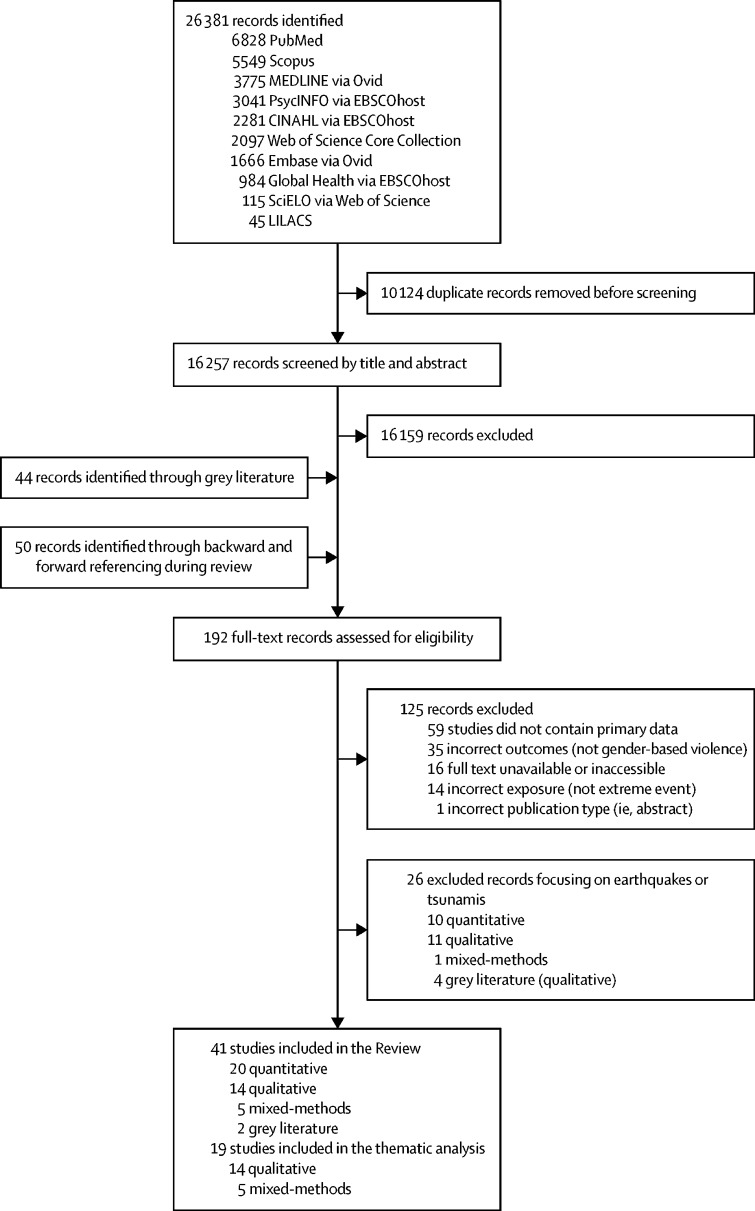
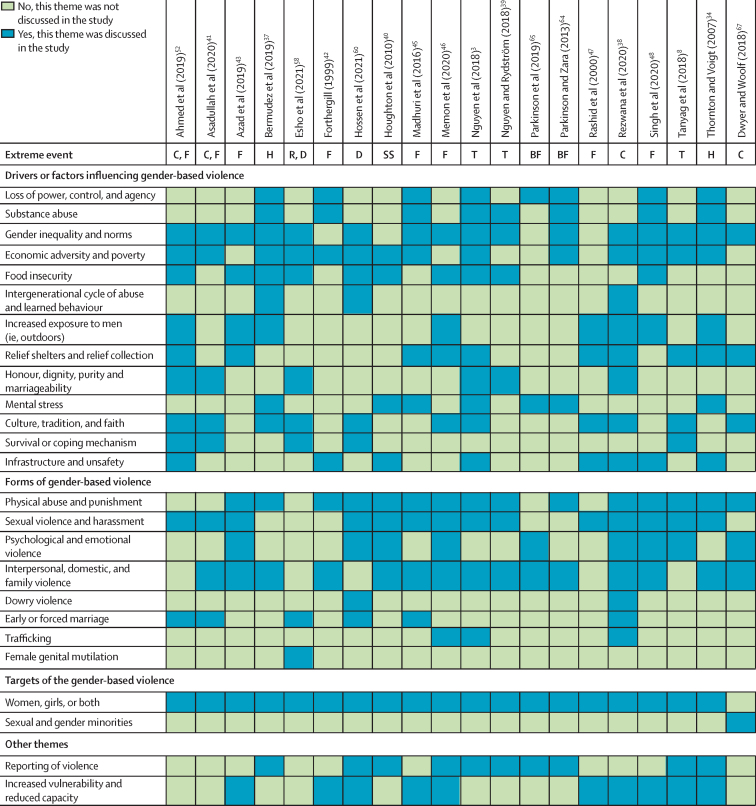
The intensity and frequency of extreme weather and climate events are expected to increase due to anthropogenic climate change. This systematic review explores extreme events and their effect on gender-based violence (GBV) experienced by women, girls, and sexual and gender minorities. We searched ten databases until February, 2022. Grey literature was searched using the websites of key organisations working on GBV and Google. Quantitative studies were described narratively, whereas qualitative studies underwent thematic analysis. We identified 26 381 manuscripts. 41 studies were included exploring several types of extreme events (ie, storms, floods, droughts, heatwaves, and wildfires) and GBV (eg, sexual violence and harassment, physical violence, witch killing, early or forced marriage, and emotional violence). Studies were predominantly cross-sectional. Although most qualitative studies were of reasonable quality, most quantitative studies were of poor quality. Only one study included sexual and gender minorities. Most studies showed an increase in one or several GBV forms during or after extreme events, often related to economic instability, food insecurity, mental stress, disrupted infrastructure, increased exposure to men, tradition, and exacerbated gender inequality. These findings could have important implications for sexual-transformative and gender-transformative interventions, policies, and implementation. High-quality evidence from large, ethnographically diverse cohorts is essential to explore the effects and driving factors of GBV during and after extreme events.
Overview
The claims and statistics of this paper haven’t been checked yet.
Free: it reads the open-access text and checks the first 5 claims that cite a source we can check. Create a free account to check every claim.
Integrity signals
Registry
Cites
Statistics
Figures
Verification
Claims the paper makes
The claims and statistics of this paper haven’t been checked yet.
Free: it reads the open-access text and checks the first 5 claims that cite a source we can check. Create a free account to check every claim.
Claims other papers make about this one
Each is checked against this paper’s own text: does it say what the citing paper says it does?
The source backs part of the claim, not all of it — or backs it for a different population, condition or comparison.
In the citing paper
“However, several literature reviews have shown that survivors of IPV are at higher risk in terms of limited access to supports, worsening mental health and increased exposure and exacerbation of already existing IPV in contexts of SLEs such as economic instability, climate events, and disasters [31–33].”
From Locked down, locked out: a cross-sectional study on experiences of intimate partner violence (IPV) and barriers to formal and informal support during COVID-19 lockdowns in Ontario (2025) · cites this paper as [33]
Experimental — accuracy not yet measuredThe source backs part of the claim, not all of it — or backs it for a different population, condition or comparison.
In the citing paper
“Besides the rebel groups incentivized by higher recruitment potential during economic downturns, the undermined capacity of the state to mediate conflicts and guarantee public income support, food aid, employment, and human security would also give way to increasing conflict at the communal and individual levels, including criminal and gender-based violence (Kim 2016, van Daalen et al 2022).”
From The impacts of climate change on violent conflict risk: a review of causal pathways (2024) · cites this paper as van Daalen et al 2022
Experimental — accuracy not yet measured
Self-check
Percentages, sums and reported differences re-computed from the paper’s own numbers.
The self-check needs the paper’s full text.
Citations
Cites
The PRISMA 2020 statement: An updated guideline for reporting systematic reviews
Page, M. J., McKenzie, J. E., Bossuyt, P. M., Boutron, I., Hoffmann, T. C., Mulrow, C. D., Shamseer, L., Tetzlaff, J. M., Akl, E. A., Brennan, S. E., et al. (2021) · BMJ · doi:10.1136/bmj.n71 · Cited by 108,283
Preferred Reporting Items for Systematic Reviews and Meta-Analyses: the PRISMA statement
Moher, D., Liberati, A., Tetzlaff, J., Altman, D. G., & for the PRISMA Group (2009) · BMJ · doi:10.1136/bmj.b2535 · Cited by 83,823
Preferred reporting items for systematic reviews and meta-analyses: the PRISMA Statement.
(2009) · PubMed Central · Cited by 44,859
The PRISMA 2020 statement: an updated guideline for reporting systematic reviews
Page, M. J., McKenzie, J., Bossuyt, P., Boutron, I., Hoffmann, T., mulrow, C., Shamseer, L., Tetzlaff, J., Akl, E., Brennan, S. E., et al. (2020) · doi:10.31222/osf.io/v7gm2_v1 · Cited by 8,090
The PRISMA 2020 statement: an updated guideline for reporting systematic reviews
Page, M. J., McKenzie, J., Bossuyt, P., Boutron, I., Hoffmann, T., mulrow, C., Shamseer, L., Tetzlaff, J., Akl, E., Brennan, S. E., et al. (2020) · doi:10.31222/osf.io/v7gm2 · Cited by 5,177
Changes in Climate Extremes and their Impacts on the Natural Physical Environment
Seneviratne, S. I., Nicholls, N., Easterling, D., Goodess, C. M., Kanae, S., Kossin, J., Luo, Y., Marengo, J., McInnes, K., Rahimi, M., et al. (2012) · Managing the Risks of Extreme Events and Disasters to Advance Climate Change Adaptation · doi:10.1017/cbo9781139177245.006 · Cited by 2,399
Watts, N., Amann, M., Arnell, N., Ayeb-Karlsson, S., Beagley, J., Belesova, K., Boykoff, M., Byass, P., Cai, W., Campbell-Lendrum, D., et al. (2021) · The Lancet · doi:10.1016/s0140-6736(20)32290-x · Cited by 1,943
Self-citationWeather and Climate Extreme Events in a Changing Climate
(2023) · Climate Change 2021 – The Physical Science Basis · doi:10.1017/9781009157896.013 · Cited by 1,784
A comparison of methods to detect publication bias in meta‐analysis
Macaskill, P., Walter, S. D., & Irwig, L. (2001) · Statistics in Medicine · doi:10.1002/sim.698 · Cited by 1,286
Research works printed but not linked: 1
- Thornton WE Voigt L Disaster rape: vulnerability of women to sexual assaults during Hurricane Katrina J Public Manag Soc Policy 13 2007 23 49
Cited by
Romanello, M., Di Napoli, C., Drummond, P., Green, C., Kennard, H., Lampard, P., Scamman, D., Arnell, N., Ayeb-Karlsson, S., Ford, L. B., et al. (2022) · The Lancet · doi:10.1016/s0140-6736(22)01540-9 · Cited by 1,710
Self-citationvan Daalen, K. R., Tonne, C., Semenza, J. C., Rocklöv, J., Markandya, A., Dasandi, N., Jankin, S., Achebak, H., Ballester, J., Bechara, H., et al. (2024) · The Lancet Public Health · doi:10.1016/s2468-2667(24)00055-0 · Cited by 290
Self-citationClimate change impacts on child and adolescent health and well-being: A narrative review
Proulx, K., Daelmans, B. M. E. G., Baltag, V., & Banati, P. (2024) · Journal of Global Health · doi:10.7189/jogh.14.04061 · Cited by 149
Vulnerability of migrant women during disasters: a scoping review of the literature
Trentin, M., Rubini, E., Bahattab, A. A. S., Loddo, M., Corte, F. D., Ragazzoni, L., & Valente, M. (2023) · International Journal for Equity in Health · doi:10.1186/s12939-023-01951-1 · Cited by 78
Equity and modeling in sustainability science: Examples and opportunities throughout the process
Giang, A., Edwards, M. R., Fletcher, S. M., Gardner‐Frolick, R., Gryba, R., Mathias, J., Venier-Cambron, C., Anderies, J. M., Berglund, E. Z., Carley, S. R., et al. (2024) · Proceedings of the National Academy of Sciences · doi:10.1073/pnas.2215688121 · Cited by 81
Lithium brine mining affects geodiversity and Sustainable Development Goals
Rentier, E. S., Hoorn, C., & Seijmonsbergen, A. C. (2024) · Renewable and Sustainable Energy Reviews · doi:10.1016/j.rser.2024.114642 · Cited by 52
Associations between climate change-related factors and sexual health: A scoping review
Logie, C. H., Toccalino, D., MacKenzie, F., Hasham, A., Narasimhan, M., Donkers, H., Lorimer, N., & Malama, K. (2024) · Global Public Health · doi:10.1080/17441692.2023.2299718 · Cited by 50
“The primary causes are systematic social and patri-archal structures enabling and normalising GBV ’ (p. e519) (Van Daalen et al., 2022).”
Dewi, S. P., Kasim, R., Sutarsa, I. N., & Dykgraaf, S. H. (2024) · BMC Health Services Research · doi:10.1186/s12913-024-11695-5 · Cited by 65
“Gender-based violence during or after crises often increases due to factors such as financial hardship, hunger, mental stress, damaged infrastructure, increased exposure to men in some cultures, societal norms, and deepening gender inequality [159].”
BackgroundGlobal food policy report 2023: Rethinking food crisis responses
International Food Policy Research Institute (IFPRI), Ecker, O., Läderach, P., & Maystadt, J.-F. (2023) · CGSPace A Repository of Agricultural Research Outputs (Consultative Group for International Agricultural Research) · doi:10.2499/9780896294417 · Cited by 55
Munala, L., Allen, E. M., Frederick, A. J., & Ngunjiri, A. S. W. (2023) · International Journal of Environmental Research and Public Health · doi:10.3390/ijerph20237124 · Cited by 37
The association between gender equality and climate adaptation across the globe
Pinho‐Gomes, A., & Woodward, M. (2024) · BMC Public Health · doi:10.1186/s12889-024-18880-5 · Cited by 30
“Climate migration and extreme events expose women to increased risk of gender-based violence and trafficking due to economic instability, food insecurity, mental stress, disrupted infrastructure, increased exposure to men [8, 9].”
BackgroundClimate change and sexual and reproductive health: what implications for future research?
Rousseau, C. (2023) · Sexual and Reproductive Health Matters · doi:10.1080/26410397.2023.2232196 · Cited by 39
“This aggravation of violence is exacerbated by gender norms and patriarchal structures which enable and normalise such violence.(27,32) The COVID-19 pandemic, which presents complex and still imprecise interactions with climate C Rousseau Sexual and Reproductive Health Matters 2023;31(1):1–7”
BackgroundAyeb‐Karlsson, S., Chandra, A., & McNamara, K. E. (2023) · Climatic Change · doi:10.1007/s10584-023-03624-y · Cited by 43
Afzal, F., Das, A., & Chatterjee, S. (2024) · Indian Journal of Community Medicine · doi:10.4103/ijcm.ijcm_165_23 · Cited by 30
“[48,49] Researchers have reported that in the Indian subcontinent, men-dominated climate-driven migration (such as due to drought and agricultural income collapse) has a spin-off effect that the female members of the household may experience GBV and sexual assault in the absence of the male in the…”
BackgroundBridging the gender, climate, and health gap: the road to COP29
van Daalen, K. R., Jung, L., Dada, S., Othman, R., Barrios‐Ruiz, A., Malolos, G. Z., Wu, K.-T., Garza-Salas, A., El-Gamal, S., Ezzine, T., et al. (2024) · The Lancet Planetary Health · doi:10.1016/s2542-5196(24)00270-5 · Cited by 47
“96,97,100 Furthermore, gender diverse people face stigmatisation and discrimination in many communities, creating increased barriers to accessible and good quality health services and basic needs, particularly during the aftermath of extreme events.”
Self-citationClimate Change and Mental Health
Clayton, S., & Crandon, T. (2024) · Annual Review of Clinical Psychology · doi:10.1146/annurev-clinpsy-081423-025932 · Cited by 57
An, J., Wang, Q., Bai, Z., Du, X., Yu, D., & Mo, X. (2025) · BMC Public Health · doi:10.1186/s12889-025-22814-0 · Cited by 38
“The actual number was estimated with DisMod-MR 2.1 [23], a Bayesian meta-regression tool that estimates non-fatal health outcomes by location, age, sex, and year.”
InfluentialThe impacts of climate change on violent conflict risk: a review of causal pathways
Xie, X., Hao, M., Ding, F., Scheffran, J., Ide, T., Maystadt, J.-F., Qian, Y., Wang, Q., Chen, S., Wu, J., et al. (2024) · Environmental Research Communications · doi:10.1088/2515-7620/ad8a21 · Cited by 25
Flores, E. C., Brown, L. J., Kakuma, R., Eaton, J., & Dangour, A. D. (2023) · Environmental Research Letters · doi:10.1088/1748-9326/ad153f · Cited by 31
Impacts of Extreme-High-Temperature Events on Vegetation in North China
Yang, Q., Jiang, C. P., & Ding, T. (2023) · Remote Sensing · doi:10.3390/rs15184542 · Cited by 24
The Relationship between Climate Action and Poverty Reduction
Lankes, H. P., Macquarie, R., Soubeyran, É., & Stern, N. H. (2023) · The World Bank Research Observer · doi:10.1093/wbro/lkad011 · Cited by 33
Climate Change, Families, and Human Development: Review of the Evidence
Cuartas, J. A., Varela, L. R., Spitzer, J. E., Brieant, A. E., Ghazanfar, A., Lansford, J. E., & Sanson, A. V. (2025) · Journal of Cognition and Development · doi:10.1080/15248372.2025.2468187 · Cited by 24
“Complementing these primary studies, a systematic review including 41 quantitative and qualitative studies provided summative evidence for mixed associations between climate change-related hazards and intimate partner and gender-based violence (van Daalen et al., 2022).”
Impact of Climate Change on Reproductive Health and Pregnancy Outcomes: A Systematic Review
Papadiochou, A., Diamanti, A., Metallinou, D., Georgakopoulou, V., Taskou, C., Kagkouras, I., & Sarantaki, A. (2024) · Cureus · doi:10.7759/cureus.68221 · Cited by 42
“Women are at an increased risk of gender-based and domestic violence, sexual intimidation, human trafficking, and rape and are 14 times more likely than men to die in disasters [62].”
BackgroundA Call to Action for Gender Equity in Climate Leadership
Wray, B., Veidis, E. M., Flores, E. C., Phillips, A. A., Alani, O., & Barry, M. (2023) · American Journal of Tropical Medicine and Hygiene · doi:10.4269/ajtmh.22-0674 · Cited by 30
“Violence Gender-based violence—including sexual assault, domestic abuse,(44,68) and intimate partner violence(69)— has been found to increase during and after extreme weather events and is often related to economic instability, food insecurity, mental stress, damaged infrastructure, increased exposure to men, and patr…”
BackgroundA systematic review of the inequality of health burdens related to climate change
Song, X., Zhang, S., Huang, H., Ding, Q., Guo, F., Zhang, Y., Li, J., Li, M., Cai, W., & Wang, C. (2024) · Frontiers of Environmental Science & Engineering · doi:10.1007/s11783-024-1823-4 · Cited by 24
Gendered impacts of climate change: evidence from weather shocks
Fruttero, A., Halim, D. L., Broccolini, C., Coelho, B., Gninafon, H., & Muller, N. (2024) · Environmental Research Climate · doi:10.1088/2752-5295/ad8025 · Cited by 40
Logie, C. H., Okumu, M., Admassu, Z., Perez‐Brumer, A., Ahmed, R., Luna, M. L., MacKenzie, F., Kortenaar, J., Berry, I., Hakiza, R., et al. (2023) · AIDS and Behavior · doi:10.1007/s10461-023-04240-8 · Cited by 18
“Sexual and gender-based violence (SGBV), a risk factor for poorer HIV prevention and care outcomes, [12] is associated with extreme weather events [13], water insecurity [14], and food insecurity [15].”
The global health community at international climate change negotiations
van Daalen, K. R., Wyma, N., Schauer-Berg, J., Blom, I. M., Mattijsen, J. C., Othman, R., Eissa, M., Parks, R. M., Wyns, A., Aboushady, A. T., et al. (2024) · BMJ Global Health · doi:10.1136/bmjgh-2024-015292 · Cited by 18
Levy, S. R., Gopang, M., Ramírez, L. F., Bernardo, A. B. I., Ruck, M. D., & Sternisko, A. (2023) · Social Issues and Policy Review · doi:10.1111/sipr.12103 · Cited by 32
Logie, C. H., Loutet, M. G., Mackenzie, F., Okumu, M., Leggett, R., Akinwande, S. F., Lukone, S. O., Kisubi, N., Kyambadde, P., Otika, L., et al. (2025) · Global Public Health · doi:10.1080/17441692.2025.2503863 · Cited by 14
“…were associated with SGBV, aligning with the evidence base that pathways from EWE to SGBV include infrastructure damage and community-level increased economic insecurity and inequitable gender norms (Logie, Okumu, Tailor, et al., 2024; Thurston et al., 2021; K. R. van Daalen et al., 2022).”
Doherty, F., Rao, S., & Radney, A. (2023) · International Social Work · doi:10.1177/00208728231186006 · Cited by 17
Canavan, C., & Ide, T. (2024) · International Journal of Disaster Risk Reduction · doi:10.1016/j.ijdrr.2024.104558 · Cited by 13
Cooper, M., Cunsolo, A., Aylward, B., Yamamoto, S. S., & Harper, S. L. (2025) · Social Science & Medicine · doi:10.1016/j.socscimed.2025.118002 · Cited by 28
A meta-review of disaster research
Waseem, H. B., & Rana, I. A. (2025) · Natural Hazards · doi:10.1007/s11069-025-07296-y · Cited by 16
Drought, Extreme Heat, and Intimate Partner Violence in Low- and Middle-Income Countries
Pin, W., Chu, L., Ban, J., Asare, E. O., Sivakami, M., Restrepo, A., Chimoyi, L., Sullivan, T. P., & Chen, K. (2025) · JAMA Network Open · doi:10.1001/jamanetworkopen.2025.27818 · Cited by 12
‘Does Our Work Matter?’ The Role of Organizational Researchers in Extreme (War)Times
Rouleau, L. (2023) · Organization Studies · doi:10.1177/01708406221131937 · Cited by 13
Kafi, K. M., Ponrahono, Z., & Barau, A. A. (2024) · Climatic Change · doi:10.1007/s10584-024-03714-5 · Cited by 16
Mannell, J., Brown, L. J., Jordaan, E., Hatcher, A. M., & Gibbs, A. (2024) · PLOS Climate · doi:10.1371/journal.pclm.0000478 · Cited by 14
Advances in weather and climate extreme studies: a systematic comparative review
Kafi, K. M., & Ponrahono, Z. (2024) · Discover Geoscience · doi:10.1007/s44288-024-00079-1 · Cited by 21
Murphy, N., Azzopardi, P. S., & Bohren, M. A. (2023) · International Journal of Disaster Risk Reduction · doi:10.1016/j.ijdrr.2023.103561 · Cited by 11
New York State Climate Impacts Assessment Chapter 07: Human Health and Safety
Barnes, J., Sheffield, P. E., Graber, N. M., Jessel, S., Lanza, K., Limaye, V. S., Morrow, F., Sauthoff, A., Schmeltz, M. T., Smith, S., et al. (2024) · Annals of the New York Academy of Sciences · doi:10.1111/nyas.15244 · Cited by 14
Weather and Crime—Cautious evidence from South Africa
Peters, J., Bruederle, A., & Roberts, G. (2022) · Q Open · doi:10.1093/qopen/qoac033 · Cited by 12
Sustainability in Obstetrics and Gynecology
Wright, K. N., Melnyk, A. I., Emont, J., & van Dis, J. (2023) · Obstetrics and Gynecology · doi:10.1097/aog.0000000000005435 · Cited by 11
Logie, C. H., Hasham, A., Kagunda, J., Evelia, H., Gachoki, C., Omondi, B., Wanjiru, M., Gittings, L., Borek, S. V., Newman, P. A., et al. (2025) · BMJ Global Health · doi:10.1136/bmjgh-2024-016637 · Cited by 14
Hot Weather and Violence Against Women: A Global Scoping Review
Mulambo, C. H., Thakur, R., & Mathew, S. (2025) · International Journal of Environmental Research and Public Health · doi:10.3390/ijerph22071069 · Cited by 13
“There have been reviews published linking extreme climate events to VAW [10] and high temperatures to crime [11], but there have not been any reviews that specifically focus on the effects of high temperatures on VAW.”
Bellis, M. A., McManus, S., Hughes, K. E., Adisa, O., & Ford, K. (2024) · International Journal of Environmental Research and Public Health · doi:10.3390/ijerph21030352 · Cited by 15
“Climate change and rising temperatures have been found to increase violence, including collective, sexual, and domestic violence [36,37].”
BackgroundHeat and Organization Studies: Organizing in a world approaching 50°C
Dentoni, D. (2024) · Organization Studies · doi:10.1177/01708406241261442 · Cited by 11
“Under heat stress, gender-based violence experienced by sexual and gender minorities may increase (van Daalen et al., 2022).”
Climate attribution of interpersonal violence: International evidence
Li, J., Feng, C. Q., & Yang, J. (2023) · Environmental Research · doi:10.1016/j.envres.2023.116836 · Cited by 23
How do extreme weather events contribute to violence against children?
Datzberger, S., Howard‐Merrill, L., Parkes, J., & Iorfa, S. K. (2024) · Child Abuse & Neglect · doi:10.1016/j.chiabu.2024.107093 · Cited by 12
“Two recent systematic reviews (Thurston et al., 2021; van Daalen et al., 2022) and a comprehensive study (Casta ˜ neda Camey et al., 2020) provide oundational guidance about the interlinkages o climate related EWEs, GBV and VAWG .”
Flood exposure and intimate partner violence in low- and middle-income countries
Guo, Y., Zhu, Y., Fatmi, Z., Zhou, L., He, C., Bachwenkizi, J., Kan, H., & Chen, R. (2025) · Nature Water · doi:10.1038/s44221-025-00389-9 · Cited by 9
“Previous research has linked extreme weather events (EWEs) such as droughts 9,10 , extreme heat 11–14 and earthquakes 15–17 to increased violent behaviours 18 , including IPV 19,20 .”
InfluentialFive Insights for Avoiding Global Collapse
Herrington, G. (2022) · MDPI eBooks · doi:10.3390/books978-3-0365-3721-4 · Cited by 12
The link between drought and violence against women and girls in the Horn of Africa
Bellizzi, S., Molek, K., & Nivoli, A. (2022) · International Journal of Gynecology & Obstetrics · doi:10.1002/ijgo.14499 · Cited by 8
Bellizzi, S., Molek, K., & Nivoli, A. (2022) · Journal of Pediatric and Adolescent Gynecology · doi:10.1016/j.jpag.2022.10.005 · Cited by 8
Same same but different: Examining climate change impacts on human security in Vanuatu and Guam
Vogler, A. (2024) · Global Environmental Change · doi:10.1016/j.gloenvcha.2024.102935 · Cited by 9
Parzniewski, S., Luo, X., Ru, S., Ozbilge, N., Breen, K., & Wu, H. (2025) · Frontiers in Sociology · doi:10.3389/fsoc.2025.1541039 · Cited by 9
Addressing gender-based violence through social protection: a scoping review
Cookson, T. P., Fuentes, L., & Bitterly, J. (2024) · Development in Practice · doi:10.1080/09614524.2023.2290438 · Cited by 18
“…Cislaghi 2020; Fuentes 2020), legal structures that undermine women’s rights (Macaulay 2021; Walsh and Menjívar 2016), and risk multipliers related to health (Schulkind et al. 2016) and geography (Maclin et al. 2022), or presence of crisis or conflict (Murphy et al. 2023; van Daalen et al. 2022).”
Cao, Y., Lü, H., Duan, P., Wang, D., & Wei, G. (2024) · Frontiers in Psychology · doi:10.3389/fpsyg.2023.1241862 · Cited by 11
Palmer, A., Danioko, A., & Koski, A. (2024) · Sustainable Development · doi:10.1002/sd.3201 · Cited by 9
Psychosocial effects of gender-based violence among women in Vhembe district: A qualitative study
Rikhotso, R., Netangaheni, R. T., & Mhlanga, N. L. (2023) · South African Journal of Psychiatry · doi:10.4102/sajpsychiatry.v29i0.2012 · Cited by 9
Singh, L., Abbas, S. M., Roberts, B., Thompson, N., & Singh, N. (2023) · BMJ Global Health · doi:10.1136/bmjgh-2023-013477 · Cited by 11
Self-citationHow do Climate Change and Environmental Degradation contribute to Violence against Children?Preprint
Datzberger, S., Howard‐Merrill, L., Iorfa, S. K., & Parkes, J. (2023) · SocArXiv (OSF Preprints) · doi:10.31235/osf.io/zpxc8 · Cited by 10
Mannell, J., Tevaga, P., Isaako, P. E., Alisi-Fesili, F., Apelu, L., Moananu, K., Faumuina, T., Sinclair, L., Tanielu, H., Lowe, H., et al. (2025) · BMJ Public Health · doi:10.1136/bmjph-2024-001088 · Cited by 7
Couto, M. T., Senent‐Valero, M., dos Santos, L. A., Carmo, M. M., Matijasevich, A., & Pastor‐Valero, M. (2025) · Frontiers in Public Health · doi:10.3389/fpubh.2025.1555386 · Cited by 13
Baschieri, A., Udeh, C., Yunusa, Z., & SNOW, R. C. (2025) · Studies in Family Planning · doi:10.1111/sifp.70006 · Cited by 7
Flores, E. C., Flores, A. F., Abarca-Diaz, B., Camizan-Castro, R., Mendoza-Lozada, E., Ortiz, F., & Kakuma, R. (2025) · The Lancet Regional Health - Americas · doi:10.1016/j.lana.2025.101109 · Cited by 17
Narasimhan, M., Logie, C. H., Brizuela, V., & MacNeil, A. (2025) · Global Public Health · doi:10.1080/17441692.2025.2547846 · Cited by 6
“Increased flooding has also been linked to increased gender-based violence (van Daalen et al., 2022).”
Strydom, K., Akande, J. O., & Asaleye, A. J. (2024) · Journal of risk and financial management · doi:10.3390/jrfm17020051 · Cited by 5
Azoulay, C. (2024) · Gynécologie Obstétrique Fertilité & Sénologie · doi:10.1016/j.gofs.2024.03.004 · Cited by 5
Climate change and human health: Primary, secondary, and tertiary effects
Butler, C. D. (2024) · Elsevier eBooks · doi:10.1016/b978-0-443-18515-1.00007-1 · Cited by 8
How climate change could drive an increase in gender-based violence
Rodrigues, M. (2022) · Nature · doi:10.1038/d41586-022-01903-9 · Cited by 5
Gender, Mental Health, and Climate Change: Impacts on Women and Gender Minorities
Chekuri, B., Sood, N., Campbell, H., Vurgeç, B. A., Isom, J., Ojiaku, N., & Sorensen, C. J. (2024) · Springer eBooks · doi:10.1007/978-3-031-56736-0_5 · Cited by 6
Logie, C. H., MacNeil, A., Hasham, A., Evelia, H., Kagunda, J., Borek, S. V., Omondi, B., Gachoki, C., Wanjiru, M., Gittings, L., et al. (2025) · AIDS and Behavior · doi:10.1007/s10461-025-04759-y · Cited by 5
“…work, HIV, LGBTQ) that both increased exposure to sexual violence and reduced access to healthcare; pre-existing social (e.g., stigma) and structural (e.g., criminalization) vulnerabilities may amplify the harmful impacts of extreme weather events by reducing access to HIV services [11, 30, 91].”
Bhanbhro, S., & Ali, I. (2025) · The Journal of Maternal-Fetal & Neonatal Medicine · doi:10.1080/14767058.2025.2539354 · Cited by 4
“Similarly, a mixed-methods global systematic review published in the Lancet also found a rise in gender-based violence during or after extreme weather events [37].”
The long shadow of natural disasters: educational impacts of the 1991 cyclone in Bangladesh
Abdullah-Al-Baki, C., & Ahmed, A. (2025) · World Development · doi:10.1016/j.worlddev.2025.107286 · Cited by 6
Stadler, L., Benya, S. A., Ziervogel, G., & Holden, P. B. (2025) · Wiley Interdisciplinary Reviews Climate Change · doi:10.1002/wcc.70035 · Cited by 7
“…and girls following the KwaZulu-Natal floods found that the floods resulted in no widespread increase in violence for most (Jewkes et al. 2023), other studies outside of South Africa have found that gender-based violence generally increases with extreme climatic events (van Daalen et al. 2022).”
Gender, Development, and Recognition of Anthropogenic Climate Change
Verner, M., Vu, H. T., Marlon, J. R., Lee, S., Carman, J., Rosenthal, S. A., & Leiserowitz, A. (2025) · World Development · doi:10.1016/j.worlddev.2025.107169 · Cited by 6
Vara-Horna, A., Asencios-Gonzalez, Z. B., Quipuzco-Chicata, L., Díaz-Rosillo, A., & Rojas, D. G. S. (2023) · Sustainability · doi:10.3390/su152316195 · Cited by 8
Hertzog, L., Makate, M., Chipanta, D., Banougnin, B. H., Mchenga, M., Pereira, G. F., Nyadanu, S. D., Dunne, J., Tallman, P. S., Collins, S. M., et al. (2025) · PLOS Global Public Health · doi:10.1371/journal.pgph.0004752 · Cited by 4
Women and planetary health in Asia-Pacific
Gan, C. C. R., McNamara, C., Gunasiri, H., Oliva, P., & Sebar, B. (2023) · Frontiers in Climate · doi:10.3389/fclim.2023.1058432 · Cited by 4
Murphy, N., Azzopardi, P. S., Bowen, K., Quinn, P., Rarama, T., Dawainavesi, A., & Bohren, M. A. (2023) · PLOS Global Public Health · doi:10.1371/journal.pgph.0001624 · Cited by 5
“This supports recent literature highlighting how existing norms and practices increase SRHR risks in disasters, and the importance of addressing these factors before disasters occur [8,55].”
BackgroundRainfall and intimate partner violence
Le, K. T., & Nguyen, M. (2024) · Population and Environment · doi:10.1007/s11111-024-00460-9 · Cited by 7
“At the same time, adverse rainfall conditions such as droughts raise women’s dependence on men for sustenance, exposing them to higher threats of intimate partner violence (Duflo, 2012; Cools et al., 2020; van Daalen et al., 2022).”
Can Digital Health Improve Healthcare Access for Migrants
Leadership, N.-H. F. I. G. H., Hou, L., An, N., & Lin, V. K.-W. (2024) · NAM Perspectives · doi:10.31478/202408b · Cited by 7
Dijkerman, S., Hossain, J., Persson, M., Konika, R. A., & Paul, D. (2025) · Women s Health · doi:10.1177/17455057251339283 · Cited by 8
Environmental Reproductive Justice and Social Work Praxis
Velez, C. M., Machado‐Escudero, Y., Gilliam, C. C., & Sloan, L. M. (2022) · Smith College Studies in Social Work · doi:10.1080/00377317.2022.2123426 · Cited by 4
“…women (Caridade et al., 2022; Desai & Mandal, 2021), it is right to assume that as a population already at high risk for violence, environmental and reproductive injustices are likely to disproportionately impact transgender individuals and communities by way of violence (Van Daalen et al., 2022).”
BackgroundIdriss-Wheeler, D., Surkan, P., Bainbridge, S., & El-Khatib, Z. (2025) · BMC Public Health · doi:10.1186/s12889-025-25124-7 · Cited by 3
“…(IPV), COVID-19 pandemic, Formal support, Informal support, Barriers, Canada risk in terms of limited access to supports, worsening mental health and increased exposure and exacerbation of already existing IPV in contexts of SLEs such as economic instability, climate events, and disasters [31–33].”
Osman, Y. M. M., Shaban, M. M., & Shaban, M. (2025) · Women and Birth · doi:10.1016/j.wombi.2025.102092 · Cited by 5
Unterhalter, E. (2025) · International Review of Education · doi:10.1007/s11159-025-10193-y · Cited by 3
“…violence, on which no articles were published, despite a rising interest in the issue in the wake of the HIV/AIDS pandemic beginning in the 1980s (Dunne et al. 2006; Parkes 2015), and later linked with wider concerns about violence against women (Parkes et al. 2016; van Daalen et al. 2022).”
Slick, J., & Hertz, G. (2024) · International Journal of Disaster Risk Reduction · doi:10.1016/j.ijdrr.2024.104529 · Cited by 8
Narvey, C. S., Kaukinen, C. E., Piquero, N. L., & Piquero, A. R. (2024) · Journal of Contemporary Criminal Justice · doi:10.1177/10439862241245880 · Cited by 5
“As is true of many extreme events, the COVID-19 pandemic raised concerns about an increase in gender-based violence, including femicide, due to lockdowns, economic stress, and limited access to support services (van Daalen et al., 2022).”
BackgroundThe Ethics of Care in Disaster Contexts from a Gender and Intersectional Perspective
Arias, R. G., Rodríguez, M. A. F., & Saavedra, A. G. F. (2024) · Philosophies · doi:10.3390/philosophies9030064 · Cited by 3
Baliki, G., Daccache, M. A., Ghattas, H., & Brück, T. (2024) · Food Security · doi:10.1007/s12571-024-01460-1 · Cited by 8
“However, considering that exposure to conflict shapes production and consumption behavior (Brück et al., 2019b; Martin-Shields & Stojetz, 2019; Van Daalen et al., 2022; Verwimp & Munoz-Mora, 2018; Verwimp et al., 2019), more research is needed to investigate the role of contextual factors such as…”
Schulte, C., Erhardt‐Ohren, B., & Prata, N. (2025) · PLOS Climate · doi:10.1371/journal.pclm.0000558 · Cited by 4
Lokot, M., Sultana, N., Hidrobo, M., Ahmed, A., Hoddinott, J. F., Rakshit, D., Roy, S., & Ranganathan, M. (2025) · Social Science & Medicine · doi:10.1016/j.socscimed.2025.117901 · Cited by 8
Burdens of interpersonal violence in adolescents and young adults
Fu, L., Liu, K., Wang, B., Tian, T., Lu, Z., Zhang, W., Bian, J., & Zou, H. (2025) · Pediatric Research · doi:10.1038/s41390-025-04114-w · Cited by 2
Logie, C. H., Admassu, Z., Hasham, A., Evelia, H., Kagunda, J., Omondi, B., Gachoki, C., Chege, M. W., Gittings, L., Dorea, C. C., et al. (2025) · Journal of the International Association of Providers of AIDS Care (JIAPAC) · doi:10.1177/23259582251362938 · Cited by 5
“While we found associations between EWEs and lower SRP, and EWEs are linked with increased SGBV 55 – 57 and gender inequities, 57 scant research has looked at EWEs and SRP.”
Climate change and nursing research: a scoping review
Richards, C. A., Dyer, A., Vera, M., & Postma, J. M. (2025) · Environmental Research Health · doi:10.1088/2752-5309/ae0c2c · Cited by 2
Impact of Social, Political, and Environmental Events on Violence Against Women in the Indo-Pacific
Stenger, H., Oo, P. P., Gan, C. C. R., Davies, S. E., & True, J. (2025) · Trauma Violence & Abuse · doi:10.1177/15248380251381819 · Cited by 4
“Our scoping review builds on existing systematic and scoping reviews, specifically Murphy et al. (2023), Thurston et al. (2021) and van Daalen et al. (2022).”
Gender-based violence experienced by transgender people in China: A scoping review
Liao, J., Bailey, J., Mercer, C. H., & Witney, T. (2025) · International Journal of STD & AIDS · doi:10.1177/09564624251405966 · Cited by 2
“English search terms were created based on previous reviews related to GBVand trans health undertaken in other settings 8,26 and were re fi ned after discussion with a librarian.”
Examining the adaptive capacity to flood disaster in Tlokweng village, Botswana
Sejie, G. A., Mosarwane, K., & Gaogane, L. (2025) · Discover Health Systems · doi:10.1007/s44250-025-00335-2 · Cited by 2
“The findings are consistent with a systematic review examining extreme events and their effect on the gender-based violence experienced by women, girls, and sexual and gender minorities [23].”
Singh, N., Moharaj, P., & Sahoo, D. (2026) · Environmental Development · doi:10.1016/j.envdev.2026.101445 · Cited by 6
Metadata
- Authors
- van Daalen, K. R., Kallesøe, S. S., Davey, F., Dada, S., Jung, L., Singh, L., Issa, R., Emilian, C. A., Kuhn, I., Keygnaert, I., & Nilsson, M.
- Affiliations
- Simon Fraser University (CA)
- University of Cambridge (GB)
- University College Dublin (IE)
- Leipzig University (DE)
- London School of Hygiene & Tropical Medicine (GB)
- University College London (GB)
- Umeå University (SE)
- Venue
- The Lancet Planetary Health
- Publisher
- Elsevier BV
- Published
- 2022-06
- Volume
- 6
- Issue
- 6
- Pages
- e504-e523
- ISSN
- 2542-5196 (ISSN-L)
- PMC
- PMC10073035
- OpenAlex
- W4282823121
- Semantic Scholar
- 994b708d79b0ccf411144df182d4d4285e56c176
- Cited by
- 199
- References
- 95
- Citations by year
- 2026: 54 · 2025: 59 · 2024: 49 · 2023: 30 · 2022: 7
- FWCI
- 5.04
- Type
- journal article
- Language
- en
- Open access
- gold
- doi.org
- Licence
- cc-by
- www.elsevier.com/tdm/userlicense/1.0/ (tdm)
- www.elsevier.com/legal/tdmrep-license (tdm)
- creativecommons.org/licenses/by/4.0/ (vor)
- Locations
- The Lancet Planetary Health (publishedVersion, cc-by)
- PubMed Central (publishedVersion, cc-by)
- PubMed (publishedVersion)
- Apollo (University of Cambridge) (submittedVersion, cc-by)
- DiVA at Umeå University (Umeå University) (submittedVersion, other-oa)
- Ghent University Academic Bibliography (Ghent University) (submittedVersion)
- UCL Discovery (University College London) (submittedVersion)
- Funders
- Bill & Melinda Gates Foundation
- Gates Cambridge Trust (OP114)
- Topics
- Social Sciences › Health › Intimate Partner and Family Violence
- Social Sciences › Gender Studies › Gender, Security, and Conflict
- Physical Sciences › Environmental Science › Health, Toxicology and Mutagenesis › Climate Change and Health Impacts
- Keywords
- gender-based violence, extreme weather events, climate change, women, girls, sexual and gender minorities, sexual violence, harassment, physical violence, early marriage, forced marriage, food insecurity, economic instability, gender inequality, disasters, gender-transformative interventions
- MeSH terms
- Gender-Based Violence, Cross-Sectional Studies, Female, Humans, Male, Violence
About these checks
Registry, retraction, Cites and statistics results are computed, not judged, with one exception: a printed reference that no index lists is read once by a model before it counts as a citation error. Claims are extracted by a model and kept only when their quote appears verbatim in the text; each cited source is then checked, with a model’s help, for whether it says what the claim relies on. Those verdicts can be wrong — read the claim’s quote and the cited source before relying on one.
Statistics and arithmetic are recomputed, not judged.
Confidence bands are shown only for fields calibrated on our annotated test set. None is calibrated yet, so no band is shown.
What counts as a claim ›How we measure confidence ›How we check this ›
Are you an author, or do you see a problem with this page? Request a review
Data sources
Bibliographic data: Semantic Scholar, OpenAlex, Crossref.
Contains information from the Semantic Scholar Academic Graph Datasets, made available under the ODC Attribution License (ODC-BY 1.0).
Semantic Scholar’s data is described in: Kinney, R., et al. (2023). The Semantic Scholar Open Data Platform. arXiv:2301.10140.
