

Extreme events and gender-based violence: a mixed-methods systematic review
Open accessThe DOI matches its Crossref record; 98 of the 98 references it cites were found in a registry or an index.
Abstract
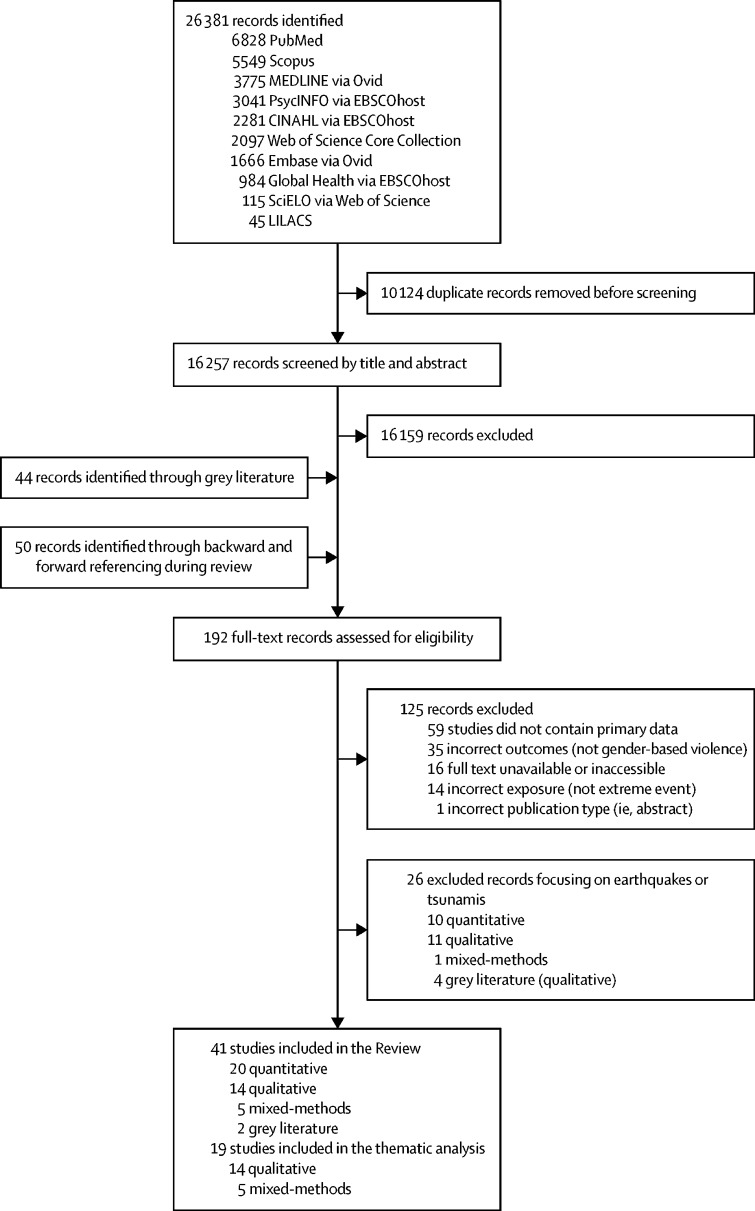
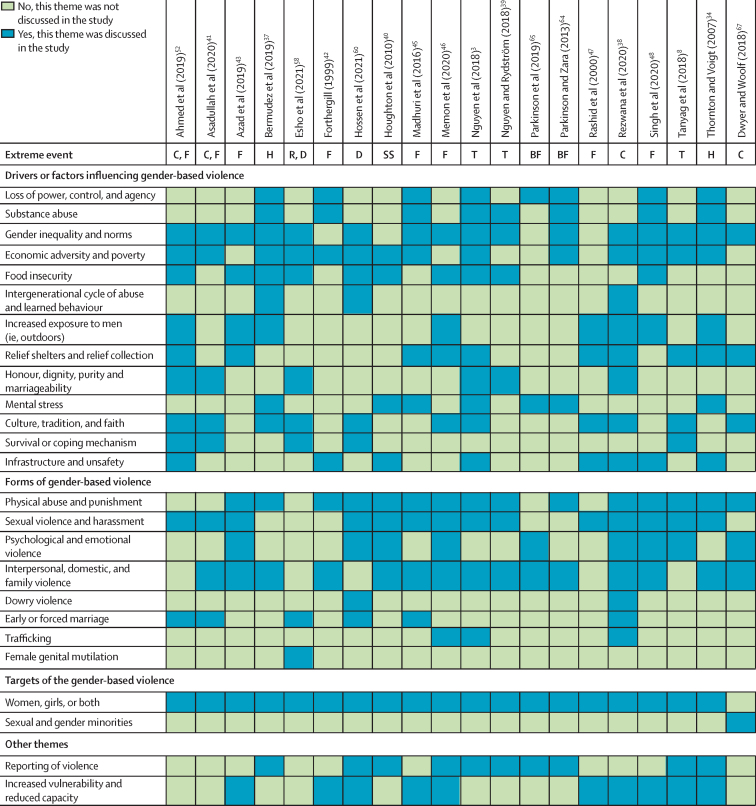
The intensity and frequency of extreme weather and climate events are expected to increase due to anthropogenic climate change. This systematic review explores extreme events and their effect on gender-based violence (GBV) experienced by women, girls, and sexual and gender minorities. We searched ten databases until February, 2022. Grey literature was searched using the websites of key organisations working on GBV and Google. Quantitative studies were described narratively, whereas qualitative studies underwent thematic analysis. We identified 26 381 manuscripts. 41 studies were included exploring several types of extreme events (ie, storms, floods, droughts, heatwaves, and wildfires) and GBV (eg, sexual violence and harassment, physical violence, witch killing, early or forced marriage, and emotional violence). Studies were predominantly cross-sectional. Although most qualitative studies were of reasonable quality, most quantitative studies were of poor quality. Only one study included sexual and gender minorities. Most studies showed an increase in one or several GBV forms during or after extreme events, often related to economic instability, food insecurity, mental stress, disrupted infrastructure, increased exposure to men, tradition, and exacerbated gender inequality. These findings could have important implications for sexual-transformative and gender-transformative interventions, policies, and implementation. High-quality evidence from large, ethnographically diverse cohorts is essential to explore the effects and driving factors of GBV during and after extreme events.
Overview
The claims and statistics of this paper haven’t been checked yet.
Free: it reads the open-access text and checks the first 5 claims that cite a source we can check. Create a free account to check every claim.
Integrity signals
Registry
Cites
Statistics
Figures
Verification
Claims the paper makes
The claims and statistics of this paper haven’t been checked yet.
Free: it reads the open-access text and checks the first 5 claims that cite a source we can check. Create a free account to check every claim.
Claims other papers make about this one
Each is checked against this paper’s own text: does it say what the citing paper says it does?
The source backs part of the claim, not all of it — or backs it for a different population, condition or comparison.
In the citing paper
“However, several literature reviews have shown that survivors of IPV are at higher risk in terms of limited access to supports, worsening mental health and increased exposure and exacerbation of already existing IPV in contexts of SLEs such as economic instability, climate events, and disasters [31–33].”
From Locked down, locked out: a cross-sectional study on experiences of intimate partner violence (IPV) and barriers to formal and informal support during COVID-19 lockdowns in Ontario (2025) · cites this paper as [33]
Experimental — accuracy not yet measuredThe source backs part of the claim, not all of it — or backs it for a different population, condition or comparison.
In the citing paper
“Besides the rebel groups incentivized by higher recruitment potential during economic downturns, the undermined capacity of the state to mediate conflicts and guarantee public income support, food aid, employment, and human security would also give way to increasing conflict at the communal and individual levels, including criminal and gender-based violence (Kim 2016, van Daalen et al 2022).”
From The impacts of climate change on violent conflict risk: a review of causal pathways (2024) · cites this paper as van Daalen et al 2022
Experimental — accuracy not yet measured
Self-check
Percentages, sums and reported differences re-computed from the paper’s own numbers.
The self-check needs the paper’s full text.
Citations
Cites
The PRISMA 2020 statement: An updated guideline for reporting systematic reviews
Page, M. J., McKenzie, J. E., Bossuyt, P. M., Boutron, I., Hoffmann, T. C., Mulrow, C. D., Shamseer, L., Tetzlaff, J. M., Akl, E. A., Brennan, S. E., et al. (2021) · BMJ · doi:10.1136/bmj.n71 · Cited by 108,283
Preferred Reporting Items for Systematic Reviews and Meta-Analyses: the PRISMA statement
Moher, D., Liberati, A., Tetzlaff, J., Altman, D. G., & for the PRISMA Group (2009) · BMJ · doi:10.1136/bmj.b2535 · Cited by 83,823
Preferred reporting items for systematic reviews and meta-analyses: the PRISMA Statement.
(2009) · PubMed Central · Cited by 44,859
The PRISMA 2020 statement: an updated guideline for reporting systematic reviews
Page, M. J., McKenzie, J., Bossuyt, P., Boutron, I., Hoffmann, T., mulrow, C., Shamseer, L., Tetzlaff, J., Akl, E., Brennan, S. E., et al. (2020) · doi:10.31222/osf.io/v7gm2_v1 · Cited by 8,090
The PRISMA 2020 statement: an updated guideline for reporting systematic reviews
Page, M. J., McKenzie, J., Bossuyt, P., Boutron, I., Hoffmann, T., mulrow, C., Shamseer, L., Tetzlaff, J., Akl, E., Brennan, S. E., et al. (2020) · doi:10.31222/osf.io/v7gm2 · Cited by 5,177
Changes in Climate Extremes and their Impacts on the Natural Physical Environment
Seneviratne, S. I., Nicholls, N., Easterling, D., Goodess, C. M., Kanae, S., Kossin, J., Luo, Y., Marengo, J., McInnes, K., Rahimi, M., et al. (2012) · Managing the Risks of Extreme Events and Disasters to Advance Climate Change Adaptation · doi:10.1017/cbo9781139177245.006 · Cited by 2,399
Watts, N., Amann, M., Arnell, N., Ayeb-Karlsson, S., Beagley, J., Belesova, K., Boykoff, M., Byass, P., Cai, W., Campbell-Lendrum, D., et al. (2021) · The Lancet · doi:10.1016/s0140-6736(20)32290-x · Cited by 1,943
Self-citationWeather and Climate Extreme Events in a Changing Climate
(2023) · Climate Change 2021 – The Physical Science Basis · doi:10.1017/9781009157896.013 · Cited by 1,784
A comparison of methods to detect publication bias in meta‐analysis
Macaskill, P., Walter, S. D., & Irwig, L. (2001) · Statistics in Medicine · doi:10.1002/sim.698 · Cited by 1,286
Research works printed but not linked: 1
- Thornton WE Voigt L Disaster rape: vulnerability of women to sexual assaults during Hurricane Katrina J Public Manag Soc Policy 13 2007 23 49
Cited by
Items 101–200 of 200
Climate change, livelihoods, gender and violence in Rukiga, Uganda: Intersections and pathways
Muhumuza, R., Colombini, M., Zilstorf, P., Collee, I., Namanya, G., Katongole, J., & Mayhew, S. (2026) · PLOS Global Public Health · doi:10.1371/journal.pgph.0005393 · Cited by 3
Munala, L., Allen, E. M., Ngunjiri, A. S. W., & Frederick, A. J. (2024) · Women · doi:10.3390/women4020014 · Cited by 2
“Droughts, deforestation, and floods can reduce supplies, forcing girls to walk further and thus increasing their risk of physical and sexual violence [21,22].”
BackgroundEliminating gender-based violence can unlock the solutions to ending all violence
O’Leary, P., & Tsui, M. (2025) · International Social Work · doi:10.1177/00208728241309149 · Cited by 2
Parzniewski, S., Fackelmann, E., Ru, S., Breen, K., & Wu, H. (2025) · Journal of Homosexuality · doi:10.1080/00918369.2025.2465417 · Cited by 5
“…oppression in the wider context of climate change is important because climate-related crises can exacerbate existing vulnerabilities (Simmonds et al., 2022; van Daalen et al., 2022), leading to increased risks of violence for marginalized groups, including 2SLGBTQIA+ university college students.”
Emotions and violences: Everyday coloniality
Scríbano, A. (2025) · Violence An International Journal · doi:10.1177/26330024251324947 · Cited by 3
Phelan, A., & van Daalen, K. R. (2023) · Oxford University Press eBooks · doi:10.1093/law/9780197687710.003.0020 · Cited by 1
Wamue-Ngare, G., Okemwa, P., Kimunio, I., Miruka, S. O., Okong’o, G., Kamau, P., Maina, L., Njuguna, J., Kiruja, L., & Okoth, S. H. (2025) · Social Sciences & Humanities Open · doi:10.1016/j.ssaho.2025.101339 · Cited by 1
Flood-related violence against women
Epstein, A., Nagata, J. M., & Weiser, S. D. (2025) · Nature Water · doi:10.1038/s44221-025-00410-1 · Cited by 1
Cleland, C., Coney, C., O’Kane, N., & Hunter, R. F. (2025) · Cities & Health · doi:10.1080/23748834.2025.2508053 · Cited by 3
Dijkerman, S., McMullen, H., Hammond, N., & Coalition, S. A. R. H. A. R. (. A. C. J. (2025) · Frontiers in Reproductive Health · doi:10.3389/frph.2025.1569484 · Cited by 1
“…from climate change exacerbates existing inequalities for many social groups; for example, by interrupting educational opportunities for girls and exacerbating the drivers of SGBV, reproductive coercion, child, early and forced marriage and unions (CEFMU), and poor mental health (6, 37 – 41).”
Cardoso, M. R., Sánchez, O. D. R., Greenwald, M., Surita, F. G., & Goodman, A. (2025) · Trauma Violence & Abuse · doi:10.1177/15248380251367411 · Cited by 1
“…et al., 2021; Steckley et al., 2022; Su et al., 2021; Sutton & Beech, 2023; Tallman et al., 2023; Thiel et al., 2022; Trentin et al., 2023; Uzobo & Ayinmoro, 2023; Uzoho et al., 2023; van Daalen et al., 2022; Viero et al., 2021; Wake & Kandula, 2022; Waller et al., 2022; Weeks et al., 2024).”
InfluentialClimate Change in Clinical Practice
McDermott‐Levy, R., Huffling, K., Kelly, M. M., & Rubinstein, S. (2025) · Journal of Obstetric, Gynecologic & Neonatal Nursing · doi:10.1016/j.jogn.2025.10.010 · Cited by 1
Oo, P. P., Stenger, H., Gan, C. C. R., Davies, S. E., & True, J. (2026) · International Journal of Disaster Risk Reduction · doi:10.1016/j.ijdrr.2026.106027 · Cited by 4
A pathways framework for the climate change-mental health-violence nexus in informal settlements
Winter, S. C. (2026) · Urban Climate · doi:10.1016/j.uclim.2026.102844 · Cited by 2
Logie, C. H., Admassu, Z., MacNeil, A., Hasham, A., Kagunda, J., Evelia, H., Gachoki, C., Omondi, B., Chege, M. W., Mwangi, M., et al. (2026) · AIDS and Behavior · doi:10.1007/s10461-026-05109-2 · Cited by 1
“…and heavy rain, increase HIV risk among AGYW through numerous pathways, including increased transactional sex [5, 6, 13], condomless sex [5, 14, 15], earlier sexual debut [15], early, child and forced marriage [16], and increased exposure to sexual and intimate partner violence (IPV) [17, 18].”
Logie, C. H., MacNeil, A., Hasham, A., Kagunda, J., Evelia, H., Gachoki, C., Omondi, B., Wanjiru, M., Borek, S. V., Gittings, L., et al. (2026) · Sexual Health · doi:10.1071/sh25161 · Cited by 1
Brizuela, V., Onyango, B., Mutunga, C., Aibe, S., Ajayi, A. I., Ateva, E., Haq, S. M. A., Brown, M. L., Haque, M. M., Hardee, K., et al. (2026) · PLOS Climate · doi:10.1371/journal.pclm.0000835 · Cited by 1
Logie, C. H., MacNeil, A., & Narasimhan, M. (2026) · Health Promotion Practice · doi:10.1177/15248399261477744 · Cited by 1
Smith, J. A. B. (2023) · Cambridge University Press eBooks · doi:10.1017/9781009378260.022 · Cited by 1
Using the Flipped Classroom Model to Prevent Sexual Violence in Special Needs Children
Mutiawati, M., Syahputra, A., Nelly, N., Desita Ria Yusian, T. B., Lestari, S., Rusyidah, R., & Saudah, S. (2023) · Journal of Educational Management and Learning · doi:10.60084/jeml.v1i2.107 · Cited by 3
COVID-19 lockdown: The triple effects on gender-based violence
Canwat, V. (2024) · World Development Perspectives · doi:10.1016/j.wdp.2024.100617 · Cited by 1
Fronteiras, D. I. S. (2024) · Revista Global Crossings. · doi:10.69818/gc.v1.n1.205-312.2024
Personal computer usage and teasing among geographic information systems students
Osman, A., Mensah, B., Yalley, C. E., & Poku, A. A. (2023) · Social Sciences & Humanities Open · doi:10.1016/j.ssaho.2023.100600 · Cited by 1
Planetary health: challenging power and privilege is key to a fairer and healthier future
Gepp, S., Otieno, M. A., & Buse, K. (2024) · BMJ · doi:10.1136/bmj.q853 · Cited by 1
“8 Evidence, such as increases in genderbasedviolenceafterextremeweatherevents 9 and the threat of uninhabitability of some Small Island Developing States 10 exemplifies how climate change worsens inequality.”
BackgroundMannell, J., Brown, L. J., Jordaan, E., Hatcher, A. M., & Gibbs, A. (2024) · SSRN Electronic Journal · doi:10.2139/ssrn.4800400 · Cited by 1
Droughts and Domestic Violence: Measuring the Gender-Climate Nexus
Aguilar-Gómez, S., & Salazar-Díaz, A. (2025) · doi:10.18235/0013368 · Cited by 5
Child Marriage and Climatic Factors: Evidence from Survey Data in KenyaPreprint
Williams, E. M., Tejedor‐Garavito, N., Bonnie, A., Dorey, P., Priyatikanto, R., Tatem, A. J., Johnson, M., Pezzulo, C., & Musyoka, M. P. (2025) · Research Square · doi:10.21203/rs.3.rs-7797744/v1 · Cited by 1
Contexts for Public Health Practice
Watson, K., Yates, J., & Gillam, S. (2023) · Cambridge University Press eBooks · doi:10.1017/9781009378260.014
Levy, B. S. (2024) · Oxford University Press eBooks · doi:10.1093/oso/9780197683293.003.0010
Women's health, the climate crisis and the pathway to a net‐zero health system
Kumar, A. S., Hunt, K. F., Nair, M., & Clack, A. (2024) · The Obstetrician & Gynaecologist · doi:10.1111/tog.12934 · Cited by 1
Fono, Z., & Kasa, L. (2024) · E-Journal of Humanities Arts and Social Sciences · doi:10.38159/ehass.20245721
Heat Impacts, Adaptations and Inequities
Chersich, M. (2024) · CABI eBooks · doi:10.1079/9781800620025.0011
Castro, J. A. G. (2025) · SSRN Electronic Journal · doi:10.2139/ssrn.5071191
Noroña-Gallo, S., Romo-Moya, D., Hidalgo-Granja, J., & Arrobo-Andrade, C. (2025) · INNOVA Research Journal · doi:10.33890/innova.v10.n2.2025.2779
Elevating women's voices in transnational climate litigation
Burri, N., & Reyes, L. A. D. (2025) · Routledge eBooks · doi:10.4324/9781003470632-8 · Cited by 2
Mapping sexual and gender minority inclusion in national adaptation plans globally
Goodwin, S., & Goldsmith, L. (2026) · npj Climate Action · doi:10.1038/s44168-026-00363-5
Hyun, M., & Nguyen, H. T. (2025) · Global Political Economy · doi:10.1332/26352257y2025d000000034
Troy, C. L. C., & Thier, K. (2025) · Emerald Group Publishing Limited eBooks · doi:10.1108/978-1-83797-811-320251001
AI-Mediated Ecological Resilience & Gender-Based Violence (GBV) in Climate-Vulnerable CommunitiesPreprint
Jibril, A. M. (2025) · SSRN Electronic Journal · doi:10.2139/ssrn.5388812
Tavan, A., Mashkoori, A., Aminafshar, A., Khazaei, A., Salahi, S., & Farahmandnia, H. (2025) · BMC Emergency Medicine · doi:10.1186/s12873-025-01338-1
Borghi, E. N., Teck, J. T. W., Roe, L., Zlatkute, G., & Baldacchino, A. (2025) · International Journal of Social Psychiatry · doi:10.1177/00207640251362317
“Worldwide, GBV primarily affects women and girls and can take the form of physical, emotional, psychological, sexual and socio-economic violence and practices such as child marriage and female genital mutilation (Daalen et al., 2022).”
Hasan, M. Z., Deol, T. K., Khurana, D., Miller, E. S., & Closser, S. (2026) · Global Implementation Research and Applications · doi:10.21203/rs.3.rs-7632123/v1
The silent epidemic: domestic violence and its devastating impact on women's health
Soares, J. M., Krakauer, D., & Baracat, E. C. (2025) · Revista da Associação Médica Brasileira · doi:10.1590/1806-9282.2025718edit
“What makes these findings particularly troubling is the window they provide into the long-term health consequences of domestic violence 7 .”
InfluentialNot Alone, but Together: Community Level Empowerment of Women and Intimate Partner Violence in India
Sinha, D. U., Mitra, C., Dhar, P., Sam, S., Dutta, M., & Husain, Z. (2025) · Spatial Demography · doi:10.1007/s40980-025-00148-0
“Finally, while recent studies have identified the associa - tion between temperature and IPV at the individual level (Henke & Hsu, 2020; Sanz-1 Barbero et al., 2018; van Daalen et al., 2022), the present study broadens the analysis by using spatial statistical methods.”
Takashino, N., & Keeni, M. (2025) · Springer eBooks · doi:10.1007/978-3-032-01012-4_12
Shah, L. S. (2025) · Zeitschrift für Hebammenwissenschaft · doi:10.1007/s44476-025-00018-0
Trentin, M., Rubini, E., Bahattab, A. A. S., Loddo, M., Corte, F. D., Ragazzoni, L., & Valente, M. (2023) · Figshare · doi:10.6084/m9.figshare.23733031
Trentin, M., Rubini, E., Bahattab, A. A. S., Loddo, M., Corte, F. D., Ragazzoni, L., & Valente, M. (2023) · Figshare · doi:10.6084/m9.figshare.23733025
Trentin, M., Rubini, E., Bahattab, A. A. S., Loddo, M., Corte, F. D., Ragazzoni, L., & Valente, M. (2023) · Figshare · doi:10.6084/m9.figshare.23733028
Additional file 1 of The association between gender equality and climate adaptation across the globe
Pinho‐Gomes, A., & Woodward, M. (2024) · Figshare · doi:10.6084/m9.figshare.25902341
Bansal, P., Wu, H., & Parzniewski, S. (2025) · Springer eBooks · doi:10.1007/978-3-032-00313-3_2 · Cited by 1
Heatwaves and healthcare: Bridging data and frontline practice
Tonnelier, M. (2025) · Srpski medicinski casopis Lekarske komore · doi:10.5937/smclk6-61317
Women under the weather: how climate change affects women’s sexual and reproductive health
Lee, S. (2026) · Elsevier eBooks · doi:10.1016/b978-0-443-40368-2.00004-0
Palantza, C., Davis, M., Witteveen, A. B., & Padilla-Medina, D. M. (2026) · International Journal of Environmental Research and Public Health · doi:10.3390/ijerph23030319 · Cited by 2
“This objective for greater understanding is pressing, as climate change is speculated to incur more crises, including pandemics [78], which typically cause spikes in IPV and hamper help-seeking, especially among those with pre-existing vulnerability [79,80].”
Flesher, C. (2026) · Climate and Development · doi:10.1080/17565529.2026.2632737
A nők jogai és a vízhez való jog metszéspontjai a globális vízválságban
Oláh, E. E. (2026) · Iustum Aequum Salutare · doi:10.69695/ias.2026.1.05
İklim Değişikliği ve Kadın Ruh Sağlığına Yansımaları
Belen, H. M., & Meriç, M. (2026) · Özgür Yayınları eBooks · doi:10.58830/ozgur.pub1235.c4996
Alawiyah, T., Utomo, N. A., Barid, V. B., & Fathony, A. (2026) · Springer climate · doi:10.1007/978-3-032-15334-0_6
Mental Health Impacts of Climate Change and Resilience Among Women in Coastal and Northern GhanaPreprint
Kwakye, J. (2026) · Research Square · doi:10.21203/rs.3.rs-9149543/v1
Larson, P. S., Goldstick, J. E., Kappelman, J., Stribley, S. L., Jeon, J., & Wiebe, D. J. (2026) · Environmental Research · doi:10.1016/j.envres.2026.124479
An environmental justice perspective on transgender and gender diverse health
Weitz, B., Sharma, S., Pednekar, N., & Katz‐Wise, S. L. (2026) · International Journal of Transgender Health · doi:10.1080/26895269.2026.2666243
Women and Maternal Infectious Diseases in a Changing Climate
van Daalen, K. R., Charnley, G. E. C., Marrufo, T. J., Stewart-Ibarra, A. M., Filippi, V., & Lowe, R. (2026) · Springer eBooks · doi:10.1007/978-3-032-21237-5_2
Verma, S. K., Gupta, N., Anand, S., Anand, Y., & Kumar, R. (2026) · Discover Sustainability · doi:10.1007/s43621-026-03518-w
“Based on the literature [66–68], this study used a mixed-methods approach combining a thematic literature review and bibliometric analysis.”
Do disasters always increase intimate partner violence?
Leng, A., & Tandon, S. A. (2026) · Oxford Economic Papers · doi:10.1093/oep/gpag003
Eltigani, B., Hoffmann, R., & Cluver, L. D. (2026) · The Lancet Planetary Health · doi:10.1016/j.lanplh.2026.101448
The gendered nature of disasters: a review and analysis of flood impacts
Aznar-Crespo, P., Maciá, C. N., Aledo, A., & Fuster, M. (2026) · Environmental Sociology · doi:10.1080/23251042.2026.2687602
Semiotics of Gender-Based Violence as Genocide
Bhattacharyya, R. (2026) · Springer eBooks · doi:10.1007/978-3-031-84546-8_20-1
Interventions to Survive Both Gender-Based Violence and the Volcanic Eruption on La Palma (Spain)
Arias, R. G., Álvarez, N. F., García, P. S., Rodríguez, M. A. F., & Gómez, Y. F. (2026) · Affilia · doi:10.1177/08861099261462534
Kwauk, C. T., Hayhurst, L. M. C., & Iqbal, I. (2026) · Frontiers in Sports and Active Living · doi:10.3389/fspor.2026.1678036
“…the world (59), we highlight the gendered dimensions of climate emotions and the emotional labor borne by women and girls and athlete activists carrying out global environmental activism, especially in contexts where climate stress exacerbates gender inequality and gender-based violence (60 – 62).”
Rising Heat and Rising Harm: A Systematic Review of Heat and Gender-Based Violence
Pearson, I., Flouris, A. D., Woods, Z., & Ranganathan, M. (2026) · Trauma Violence & Abuse · doi:10.1177/15248380261460839
Equity and justice in heat planning across small, midsize, and large cities in the US
Qin, X., Sullivan, A., & Gianotti, A. G. S. (2026) · Landscape and Urban Planning · doi:10.1016/j.landurbplan.2026.105758
Maternal and Child Health in the Era of Climate Change: Impacts, Interventions, Research Gaps
Prost, A., Devakumar, D., Sato, P., Nagginda, H. P., Mohamed, M., McGushin, A., & Romanello, M. B. (2026) · Springer eBooks · doi:10.1007/978-1-0716-5436-1_7
Conceptualising and operationalising gender-transformative climate change adaptation
Sarkar, A., & Bandyopadhyay, N. (2026) · Progress in Disaster Science · doi:10.1016/j.pdisas.2026.100670
Malik, A., & Shackleton, H. (2026) · International Journal of Disaster Risk Reduction · doi:10.1016/j.ijdrr.2026.106352
The Double Burden: Climate Extremes and the Escalation of Non-communicable Diseases
Shamsuddin, A. S., Mutalib, M. A., Zakaria, N. H., Udin, N. M., Ezani, E., Nurdin, A., Mustafa, H. F., Ismail, S. N. S., Alfian, A. R., Rahmat, M. R., et al. (2026) · Springer climate · doi:10.1007/978-3-032-24533-5_5
Nascimento, B. D. S., Shishane, K., Adair, L., Ferenczi, N., Cao, X., Ackah, M. A. A., & May, M. (2026) · Behavioral Sciences · doi:10.3390/bs16081388
Logie, C. H., Admassu, Z., Okumu, M., Mackenzie, F., Lukone, S. O., Kisubi, N., Loutet, M. G., Kyambadde, P., Gittings, L., Mehta, R. V., et al. (2026) · International Health · doi:10.1093/inthealth/ihag082
MacNeil, A., Logie, C. H., Kagunda, J., Evelia, H., Hasham, A., Gachoki, C., Chege, M. W., Omondi, B., & Gittings, L. (2026) · Health & Place · doi:10.1016/j.healthplace.2026.103730
Too Costly to Reform: Climate Shocks and the Fiscal Politics of Women's Legal RightsPreprint
Tribin, A. M., Behr, D. M., Trumbić, T., & Liang, S. (2026) · SSRN Electronic Journal · doi:10.2139/ssrn.7360561
Flynn, A., Berecki‐Gisolf, J., True, J., & Adeyeri, O. E. (2026) · Social Science & Medicine · doi:10.1016/j.socscimed.2026.119827
Intimate partner violence in sub-Saharan Africa under climate change and socioeconomic scenarios
Peisker, J., Hoffmann, R., Baschieri, A., Udeh, C., & Striessnig, E. (2026) · Global Environmental Change · doi:10.1016/j.gloenvcha.2026.103224
Kwakye, J. (2026) · Mental Health Science · doi:10.1002/mhs2.70057
Sattar, M. A. (2026) · Open Journal of Social Sciences · doi:10.4236/jss.2026.149026
Mabena, K. M. E., & Gumede, D. (2026) · Discover Education · doi:10.1007/s44217-026-01844-9
“While most studies [2, 21, 25, 28, 29] use systematic reviews, a scoping review is better suited for this study due to limited published evidence and the prevalence of grey literature in this area.”
Ayeb‐Karlsson, S., Harasym, M. C., Johns, H. D., Mathews, M. A., & Raju, E. (2026) · Gender Issues · doi:10.1007/s12147-026-09428-5
“The pandemic can be studied in a similar way to climatic changes and shocks, as additional pressures that further intensify VAWC (Ayeb-Karlsson et al., 2023; Thurston et al., 2021; van Daalen et al., 2022).”
Frontline Perspectives: WIC Clinic Emergency Preparedness Following Hurricane Helene
Riley, A., Zhao, E., Scales, S. E., & Horney, J. A. (2026) · Maternal and Child Health Journal · doi:10.1007/s10995-026-04325-5
“Rates of gender-based violence increase in post-disaster settings across many types of disasters, which can disrupt access to social support networks and increase stress and isolation leading to coercive control (Van Daalen et al., 2022).”
Logie, C. H., Mackenzie, F., Okumu, M., Akinwande, S. F., Hakiza, R., Musoke, D. K., Nakitende, A., Katisi, B., & Kyambadde, P. (2026) · Journal of Water Sanitation and Hygiene for Development · doi:10.2166/washdev.2026.037
Oweini, A. A., & Nassereddine, S. (2026) · Gender Issues · doi:10.1007/s12147-026-09445-4
“Gender-based violence and male-perpetrated harm are more common in societies that promote traditional masculine ideals, such as dominance, emotional suppression, and toughness, according to cross-cultural research (Van Daalen et al., 2022).”
Kimemia, G. W., Balami, I., Kozuki, N., Abubakar, A. J., Umar, J., Bakari, M. A., Muhammed, H. S., & Ojemu, F. J. (2026) · medRxiv · doi:10.64898/2026.10.01.26364542
Kremer, P. D. (2026) · Cities & Health · doi:10.1080/23748834.2026.2741510
Vahedi, L., Pradhan, S., Zaïdi, S., Brizuela, V., Rashid, S. F., Adawy, M. E., Hajjeh, R., Gaffey, M. F., & Bhutta, Z. A. (2026) · iScience · doi:10.1016/j.isci.2026.117794
When climate risk enters the household: Climate disasters and intimate partner emotional violence
Chang, X., Cai, X., & Xu, W. (2026) · Climate Risk Management · doi:10.1016/j.crm.2026.100898
Rodríguez, M. A. F., Gómez, Y. F., Arias, R. G., Álvarez, N. F., & García, P. S. (2026) · Disasters · doi:10.1111/disa.70077
Understanding the Complex Linkages Between Climate Change and Gender-Based Violence Globally
Anariba, S. E. B., Thiede, B. C., & Sexsmith, K. (2026) · Violence Against Women · doi:10.1177/10778012261498904
Global Greenspace Indicator Dataset
Stowell, J. (2023) · Harvard Dataverse · doi:10.7910/dvn/tmwyhb · Cited by 1
Apatinga, G. A., Dickson‐Anderson, S. E., & Schuster‐Wallace, C. J. (2026) · Local Environment · doi:10.1080/13549839.2026.2742951
Vereen, R. J., Affolter, E., Greeson, K. M., & Drumm, C. M. (2026) · Frontiers in Climate · doi:10.3389/fclim.2026.1969151
Metadata
- Authors
- van Daalen, K. R., Kallesøe, S. S., Davey, F., Dada, S., Jung, L., Singh, L., Issa, R., Emilian, C. A., Kuhn, I., Keygnaert, I., & Nilsson, M.
- Affiliations
- Simon Fraser University (CA)
- University of Cambridge (GB)
- University College Dublin (IE)
- Leipzig University (DE)
- London School of Hygiene & Tropical Medicine (GB)
- University College London (GB)
- Umeå University (SE)
- Venue
- The Lancet Planetary Health
- Publisher
- Elsevier BV
- Published
- 2022-06
- Volume
- 6
- Issue
- 6
- Pages
- e504-e523
- ISSN
- 2542-5196 (ISSN-L)
- PMC
- PMC10073035
- OpenAlex
- W4282823121
- Semantic Scholar
- 994b708d79b0ccf411144df182d4d4285e56c176
- Cited by
- 199
- References
- 95
- Citations by year
- 2026: 54 · 2025: 59 · 2024: 49 · 2023: 30 · 2022: 7
- FWCI
- 5.04
- Type
- journal article
- Language
- en
- Open access
- gold
- doi.org
- Licence
- cc-by
- www.elsevier.com/tdm/userlicense/1.0/ (tdm)
- www.elsevier.com/legal/tdmrep-license (tdm)
- creativecommons.org/licenses/by/4.0/ (vor)
- Locations
- The Lancet Planetary Health (publishedVersion, cc-by)
- PubMed Central (publishedVersion, cc-by)
- PubMed (publishedVersion)
- Apollo (University of Cambridge) (submittedVersion, cc-by)
- DiVA at Umeå University (Umeå University) (submittedVersion, other-oa)
- Ghent University Academic Bibliography (Ghent University) (submittedVersion)
- UCL Discovery (University College London) (submittedVersion)
- Funders
- Bill & Melinda Gates Foundation
- Gates Cambridge Trust (OP114)
- Topics
- Social Sciences › Health › Intimate Partner and Family Violence
- Social Sciences › Gender Studies › Gender, Security, and Conflict
- Physical Sciences › Environmental Science › Health, Toxicology and Mutagenesis › Climate Change and Health Impacts
- Keywords
- gender-based violence, extreme weather events, climate change, women, girls, sexual and gender minorities, sexual violence, harassment, physical violence, early marriage, forced marriage, food insecurity, economic instability, gender inequality, disasters, gender-transformative interventions
- MeSH terms
- Gender-Based Violence, Cross-Sectional Studies, Female, Humans, Male, Violence
About these checks
Registry, retraction, Cites and statistics results are computed, not judged, with one exception: a printed reference that no index lists is read once by a model before it counts as a citation error. Claims are extracted by a model and kept only when their quote appears verbatim in the text; each cited source is then checked, with a model’s help, for whether it says what the claim relies on. Those verdicts can be wrong — read the claim’s quote and the cited source before relying on one.
Statistics and arithmetic are recomputed, not judged.
Confidence bands are shown only for fields calibrated on our annotated test set. None is calibrated yet, so no band is shown.
What counts as a claim ›How we measure confidence ›How we check this ›
Are you an author, or do you see a problem with this page? Request a review
Data sources
Bibliographic data: Semantic Scholar, OpenAlex, Crossref.
Contains information from the Semantic Scholar Academic Graph Datasets, made available under the ODC Attribution License (ODC-BY 1.0).
Semantic Scholar’s data is described in: Kinney, R., et al. (2023). The Semantic Scholar Open Data Platform. arXiv:2301.10140.
