

Generative artificial intelligence and ethical considerations in health care: a scoping review and ethics checklist
Open accessThe DOI matches its Crossref record; 63 of the 63 references it cites were found in a registry or an index.
Abstract
The widespread use of Chat Generative Pre-trained Transformer (known as ChatGPT) and other emerging technology that is powered by generative artificial intelligence (GenAI) has drawn attention to the potential ethical issues they can cause, especially in high-stakes applications such as health care, but ethical discussions have not yet been translated into operationalisable solutions. Furthermore, ongoing ethical discussions often neglect other types of GenAI that have been used to synthesise data (eg, images) for research and practical purposes, which resolve some ethical issues and expose others. We did a scoping review of the ethical discussions on GenAI in health care to comprehensively analyse gaps in the research. To reduce the gaps, we have developed a checklist for comprehensive assessment and evaluation of ethical discussions in GenAI research. The checklist can be integrated into peer review and publication systems to enhance GenAI research and might be useful for ethics-related disclosures for GenAI-powered products and health-care applications of such products and beyond.
Overview
The claims and statistics of this paper haven’t been checked yet.
Free: it reads the open-access text and checks the first 5 claims that cite a source we can check. Create a free account to check every claim.
Integrity signals
Registry
Cites
Statistics
Figures
Verification
Claims the paper makes
The claims and statistics of this paper haven’t been checked yet.
Free: it reads the open-access text and checks the first 5 claims that cite a source we can check. Create a free account to check every claim.
Self-check
Percentages, sums and reported differences re-computed from the paper’s own numbers.
The self-check needs the paper’s full text.
Citations
Cites
PRISMA Extension for Scoping Reviews (PRISMA-ScR): Checklist and Explanation
Tricco, A. C., Lillie, E., Zarin, W., O'Brien, K. K., Colquhoun, H., Levac, D., Moher, D., Peters, M. D. J., Horsley, T., Weeks, L., et al. (2018) · Annals of Internal Medicine · doi:10.7326/m18-0850 · Cited by 43,565
The global landscape of AI ethics guidelines
Jobin, A., Ienca, M., & Vayena, E. (2019) · Nature Machine Intelligence · doi:10.1038/s42256-019-0088-2 · Cited by 6,220
Collins, G. S., Moons, K. G. M., Dhiman, P., Riley, R. D., Beam, A. L., Van Calster, B., Ghassemi, M., Liu, X., Reitsma, J. B., van Smeden, M., et al. (2024) · BMJ · doi:10.1136/bmj-2023-078378 · Cited by 4,718 · cited 1×
“…on ethical considerations of GenAI, research developing GenAI could use it in addition to existing model development guidelines (eg, TRIPOD 56,57 or CLAIM 58,59 ) and other tools to enhance ethical discussion (eg, the Ethical Operating System Toolkit 60 and the Organisation for Economic…”
MethodCollins, G. S., Reitsma, J. B., Altman, D. G., & Moons, K. G. M. (2015) · BMJ · doi:10.1136/bmj.g7594 · Cited by 4,388 · cited 2×
“As the TREGAI checklist focuses on ethical considerations of GenAI, research developing GenAI could use it in addition to existing model development guidelines (eg, TRIPOD 56,57 or CLAIM 58,59 ) and other tools to enhance ethical discussion (eg, the Ethical Operating System Toolkit 60 and the Organisation for Economic…”
MethodLarge language models encode clinical knowledge
Singhal, K., Azizi, S., Tu, T., Mahdavi, S. S., Wei, J., Chung, H. W., Scales, N., Tanwani, A., Cole-Lewis, H., Pfohl, S., et al. (2023) · Nature · doi:10.1038/s41586-023-06291-2 · Cited by 4,083 · cited 2×
“…their responsibilities in preventing ethical issues from arising in the first place 16 and by developing benchmarks to evaluate the ethics of LLMs to facilitate future mitigation, 10 but such discussions are not easily operationalised in future GenAI research without detailed actionable guides.”
BackgroundLarge Language Models Encode Clinical Knowledge
Singhal, K., Azizi, S., Tu, T., Mahdavi, S. S., Wei, J., Chung, H. W., Scales, N., Tanwani, A., Cole-Lewis, H., Pfohl, S., et al. (2022) · arXiv · doi:10.48550/arxiv.2212.13138 · Cited by 4,083
Checklist for Artificial Intelligence in Medical Imaging (CLAIM): a guide for authors and reviewers
Mongan, J., Moy, L., & Kahn, C. E. (2020) · Radiology: Artificial Intelligence · doi:10.1148/ryai.2020200029 · Cited by 1,443 · cited 2×
“As the TREGAI checklist focuses on ethical considerations of GenAI, research developing GenAI could use it in addition to existing model development guidelines (eg, TRIPOD 56,57 or CLAIM 58,59 ) and other tools to enhance ethical discussion (eg, the Ethical Operating System Toolkit 60 and the Organisation for Economic…”
MethodAcosta, J. N., Falcone, G. J., Rajpurkar, P., & Topol, E. J. (2022) · Nature Medicine · doi:10.1038/s41591-022-01981-2 · Cited by 1,365
Self-citationThe ethics of AI in health care: A mapping review
Morley, J., Machado, C. C. V., Burr, C., Cowls, J., Joshi, I., Taddeo, M., & Floridi, L. (2020) · Social Science & Medicine · doi:10.1016/j.socscimed.2020.113172 · Cited by 1,105 · cited 3×
“…TREGAI checklist live online 55 to allow timely updates, so that we can incorporate additional ethical principles (eg, from existing literature 26,39 and emerging multimodal GenAI research 2 ), updates in recommended actions, or future progress in GenAI regulations and guidelines to facilitate…”
BackgroundThe imperative for regulatory oversight of large language models (or generative AI) in healthcare
Meskó, B., & Topol, E. J. (2023) · npj Digital Medicine · doi:10.1038/s41746-023-00873-0 · Cited by 1,047
Self-citationProceedings of the 2024 CHI Conference on Human Factors in Computing Systems
(2024) · doi:10.1145/3613904 · Cited by 896
What ChatGPT and generative AI mean for science
Stokel-Walker, C., & Van Noorden, R. (2023) · Nature · doi:10.1038/d41586-023-00340-6 · Cited by 828
Large Language Models in Medical Education: Opportunities, Challenges, and Future Directions
Abd-alrazaq, A., AlSaad, R., Alhuwail, D., Ahmed, A., Healy, P. M., Latifi, S., Aziz, S., Damseh, R., Alabed Alrazak, S., & Sheikh, J. (2023) · JMIR Medical Education · doi:10.2196/48291 · Cited by 722 · cited 10×
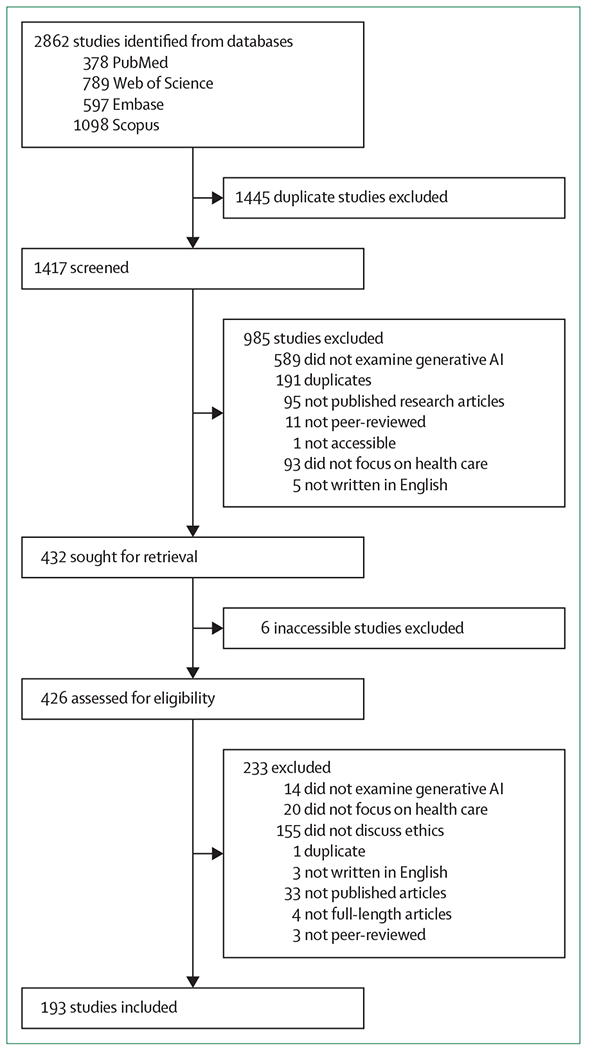
“We excluded articles that were not within the domain of health care, did not apply GenAI, or did not discuss ethical issues in relation to the use of GenAI in health care.”
BackgroundInfluentialRegulating ChatGPT and other Large Generative AI Models
Hacker, P., Engel, A., & Mauer, M. (2023) · 2023 ACM Conference on Fairness Accountability and Transparency · doi:10.1145/3593013.3594067 · Cited by 466 · cited 1×
“12 Similarly, general users of GenAI are unlikely to understand the technology well enough to prescribe a reasonable amount of trust on its output or be able to identify potential misinformation.”
BackgroundSemantic reconstruction of continuous language from non-invasive brain recordings
Tang, J., LeBel, A., Jain, S., & Huth, A. G. (2023) · Nature Neuroscience · doi:10.1038/s41593-023-01304-9 · Cited by 442 · cited 3×
“50 This approach might be called reverse-mindreading.”
BackgroundArtificial intelligence for good health: a scoping review of the ethics literature.
Murphy, K., Di Ruggiero, E., Upshur, R., Willison, D. J., Malhotra, N., Cai, J. C., Malhotra, N., Lui, V., & Gibson, J. (2021) · BMC Medical Ethics · doi:10.1186/s12910-021-00577-8 · Cited by 435 · cited 1×
“26,39,63,64 Similar discussions are extending to GenAI, 16,25,30 possibly by adopting and expanding ethical frameworks from other domains to health care, 65 but they are not easily translated into improved research practice.”
BackgroundEvaluating large language models on medical evidence summarization
Tang, L., Sun, Z., Idnay, B., Nestor, J. G., Soroush, A., Elias, P. A., Xu, Z., Ding, Y., Durrett, G., Rousseau, J. F., et al. (2023) · npj Digital Medicine · doi:10.1038/s41746-023-00896-7 · Cited by 423
Evaluating Large Language Models on Medical Evidence Summarization
Tang, L., Sun, Z., Idnay, B., Nestor, J. G., Soroush, A., Elias, P. A., Xu, Z., Ding, Y., Durrett, G., Rousseau, J., et al. (2023) · doi:10.1101/2023.04.22.23288967 · Cited by 423
Generative Adversarial Networks: A Survey Toward Private and Secure Applications
Cai, Z., Xiong, Z., Xu, H., Wang, P., Li, W., & Pan, Y. (2022) · ACM Computing Surveys · doi:10.1145/3459992 · Cited by 376 · cited 1×
“Notably, GAN (and related GenAI methods) 19 are often used as solutions to address some ethical concerns in medical research (eg, to protect privacy by masking images and videos, 20,21 or by creating synthetic data).”
BackgroundSeeing Beyond the Brain: Conditional Diffusion Model with Sparse Masked Modeling for Vision Decoding
Chen, Z., Qing, J., Xiang, T., Yue, W. L., & Zhou, J. H. (2023) · IEEE Computer Society Conference on Computer Vision and Pattern Recognition/Proceedings - IEEE Computer Society Conference on Computer Vision and Pattern Recognition/Proceedings · doi:10.1109/cvpr52729.2023.02175 · Cited by 331
The shaky foundations of large language models and foundation models for electronic health records
Wornow, M., Xu, Y., Thapa, R., Patel, B., Steinberg, E., Fleming, S., Pfeffer, M. A., Fries, J., & Shah, N. H. (2023) · npj Digital Medicine · doi:10.1038/s41746-023-00879-8 · Cited by 324 · cited 1×
“…the increased complexity in the models and application settings will further complicate how model reliability is evaluated (which is already challenging for existing LLMs) 45–47 and the extended capability and wide adoption of such technology can amplify the impact of related ethical issues.”
BackgroundHigh-resolution image reconstruction with latent diffusion models from human brain activity
Takagi, Y., & Nishimoto, S. (2023) · 2023 IEEE/CVF Conference on Computer Vision and Pattern Recognition (CVPR) · doi:10.1109/cvpr52729.2023.01389 · Cited by 297
Synthetic data generation for tabular health records: A systematic review
Hernandez, M., Epelde, G., Alberdi, A., Cilla, R., & Rankin, D. (2022) · Neurocomputing · doi:10.1016/j.neucom.2022.04.053 · Cited by 278 · cited 3×
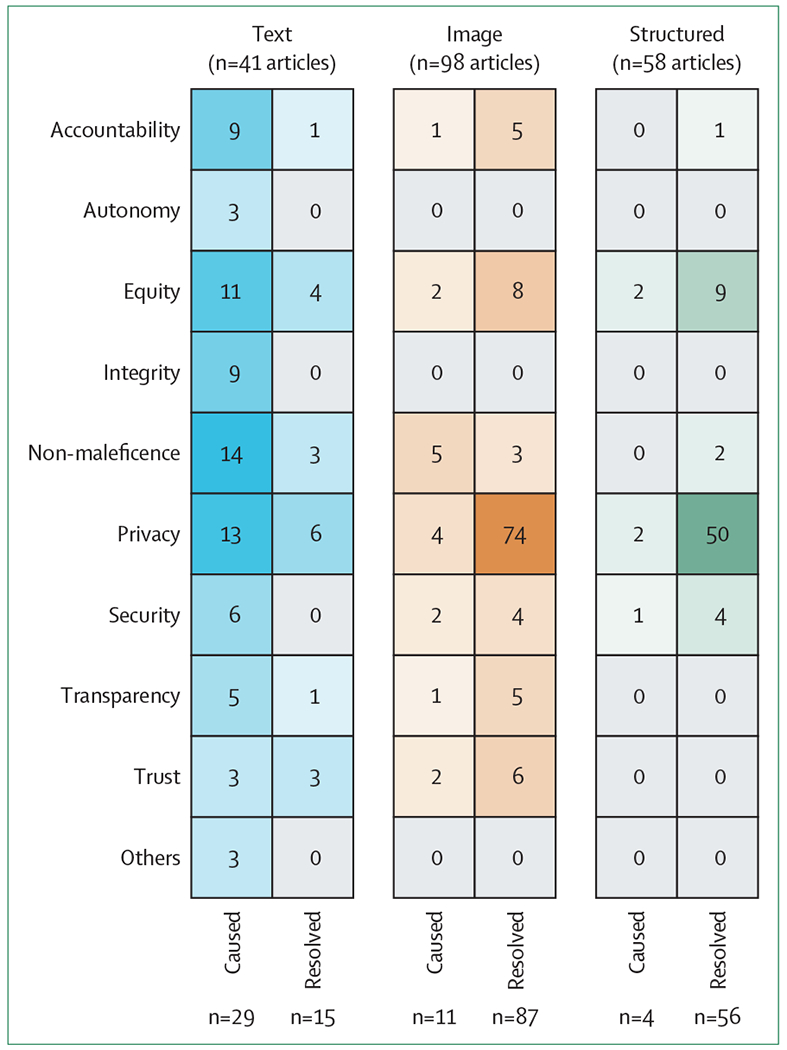
“9,22,23,33 One article introduced metrics to quantify privacy preservation and utility for structured data, but more work is needed to extend for image or text modalities, and to preserve important characteristics of the original data and across small patient subgroups.”
BackgroundLarge language model (ChatGPT) as a support tool for breast tumor board
Sorin, V., Klang, E., Sklair-Levy, M., Cohen, I., Zippel, D. B., Balint Lahat, N., Konen, E., & Barash, Y. (2023) · npj Breast Cancer · doi:10.1038/s41523-023-00557-8 · Cited by 218
Putting ChatGPT’s Medical Advice to the (Turing) Test: Survey Study
Nov, O., Singh, N., & Mann, D. (2023) · JMIR Medical Education · doi:10.2196/46939 · Cited by 198 · cited 1×
“Specifically, some articles directly assessed human trust on LLMs as these models can generate human-like conversations 28 or used LLMs to explain AI systems for improved trust and transparency.”
BackgroundAI Chatbots, Health Privacy, and Challenges to HIPAA Compliance
Marks, M., & Haupt, C. E. (2023) · JAMA · doi:10.1001/jama.2023.9458 · Cited by 171
The Challenges for Regulating Medical Use of ChatGPT and Other Large Language Models
Minssen, T., Vayena, E., & Cohen, I. G. (2023) · JAMA · doi:10.1001/jama.2023.9651 · Cited by 168
Operationalising ethics in artificial intelligence for healthcare: a framework for AI developers
Solanki, P., Grundy, J., & Hussain, W. (2023) · AI and Ethics · doi:10.1007/s43681-022-00195-z · Cited by 157 · cited 5×
“…the TREGAI checklist live online 55 to allow timely updates, so that we can incorporate additional ethical principles (eg, from existing literature 26,39 and emerging multimodal GenAI research 2 ), updates in recommended actions, or future progress in GenAI regulations and guidelines to…”
BackgroundMethodInfluentialCatchpole, K., & Russ, S. (2015) · BMJ Quality & Safety · doi:10.1136/bmjqs-2015-004431 · Cited by 154 · cited 1×
“Checklists do have their limitations 54 and checklist ethics is especially notorious for undermining thorough ethical reflection.”
BackgroundOniani, D., Hilsman, J., Peng, Y., Poropatich, R. K., Pamplin, J. C., Legault, G. L., & Wang, Y. (2023) · npj Digital Medicine · doi:10.1038/s41746-023-00965-x · Cited by 143 · cited 1×
“26,39,63,64 Similar discussions are extending to GenAI, 16,25,30 possibly by adopting and expanding ethical frameworks from other domains to health care, 65 but they are not easily translated into improved research practice.”
BackgroundThe credibility of dietary advice formulated by ChatGPT: Robo-diets for people with food allergies
Niszczota, P., & Rybicka, I. (2023) · Nutrition · doi:10.1016/j.nut.2023.112076 · Cited by 138
Li, J., Cairns, B. J., Li, J., & Zhu, T. (2023) · npj Digital Medicine · doi:10.1038/s41746-023-00834-7 · Cited by 126
Responsible AI: Requirements and challenges
Ghallab, M. (2019) · AI Perspectives · doi:10.1186/s42467-019-0003-z · Cited by 120 · cited 1×
“10,38 Recommendations and guides have been made on the general application of AI for health care, 14,26,39,40 but currently they are not consistently operationalised in GenAI applications.”
BackgroundMertes, S., Huber, T., Weitz, K., Heimerl, A., & André, E. (2022) · Frontiers in Artificial Intelligence · doi:10.3389/frai.2022.825565 · Cited by 119 · cited 1×
“31 Additionally, GenAI was used to improve accountability of, and hence trust in, image classification by improving input quality.”
MethodPaladugu, P., Ong, J., Nelson, N. G., Kamran, S. A., Waisberg, E., Zaman, N., Kumar, R., DIAS, R. D., Lee, A. G., & Tavakkoli, A. (2023) · Annals of Biomedical Engineering · doi:10.1007/s10439-023-03304-z · Cited by 114
Self-citationXue, S., Guo, R., Bohn, K. P., Matzke, J., Viscione, M., Alberts, I., Meng, H., Sun, C., Zhang, M., Zhang, M., et al. (2021) · European Journal of Nuclear Medicine and Molecular Imaging · doi:10.1007/s00259-021-05644-1 · Cited by 113
Ng, F. Y. C., Thirunavukarasu, A. J., Cheng, H., Tan, T. F., Gutierrez, L., Lan, Y., Ong, J. C. L., Chong, Y. S., Ngiam, K. Y., Ho, D., et al. (2023) · Cell Reports Medicine · doi:10.1016/j.xcrm.2023.101230 · Cited by 113
Self-citationBlease, C., Worthen, A., & Torous, J. (2024) · Psychiatry Research · doi:10.1016/j.psychres.2024.115724 · Cited by 113
Generative AI entails a credit–blame asymmetry
Mann, S. P., Earp, B. D., Nyholm, S. R., Danaher, J., Møller, N., Bowman‐Smart, H., Hatherley, J. J., Koplin, J. J., Plozza, M., Rodger, D., et al. (2023) · Nature Machine Intelligence · doi:10.1038/s42256-023-00653-1 · Cited by 105
Self-citationA Multifaceted benchmarking of synthetic electronic health record generation models
Yan, C., Yan, Y., Wan, Z., Zhang, Z., Omberg, L., Guinney, J., Mooney, S. D., & Malin, B. A. (2022) · Nature Communications · doi:10.1038/s41467-022-35295-1 · Cited by 95
NExT-GPT: Any-to-Any Multimodal LLM
Wu, S., Fei, H., Qu, L., Ji, W., & Chua, T. (2023) · arXiv (Cornell University) · doi:10.48550/arxiv.2309.05519 · Cited by 93
Adversarial Attacks Against Deep Generative Models on Data: A Survey
Sun, H., Zhu, T., Zhang, Z., Jin, D., Xiong, P., & Zhou, W. (2023) · IEEE Transactions on Knowledge and Data Engineering · doi:10.1109/tkde.2021.3130903 · Cited by 90 · cited 1×
“…by editing or injecting fake evidence for diseases into medical images, or have been targeted in cyberattacks to steal confidential information, 36,37 among other malicious activities, but such topics are more often discussed from purely technical perspectives rather than from ethical…”
BackgroundA translational perspective towards clinical AI fairness
Liu, M., Ning, Y., Teixayavong, S., Mertens, M., Xu, J., Ting, D. S. W., Cheng, L. T.-E., Ong, J. C. L., Teo, Z. L., Tan, T. F., et al. (2023) · npj Digital Medicine · doi:10.1038/s41746-023-00918-4 · Cited by 82
Self-citationHarnessing Biomedical Literature to Calibrate Clinicians’ Trust in AI Decision Support Systems
Yang, Q., Hao, Y., Quan, K., Yang, S., Zhao, Y., Kuleshov, V., & Wang, F. (2023) · Proceedings of the 2023 CHI Conference on Human Factors in Computing Systems · doi:10.1145/3544548.3581393 · Cited by 72
Kuo, N. I.-H., García, F., Sönnerborg, A. B., Böhm, M., Kaiser, R., Zazzi, M., Polizzotto, M. N., Jorm, L. R., & Barbieri, S. (2023) · Journal of Biomedical Informatics · doi:10.1016/j.jbi.2023.104436 · Cited by 67
Rahimzadeh, V., Kostick-Quenet, K., Blumenthal Barby, J., & McGuire, A. L. (2023) · The American Journal of Bioethics · doi:10.1080/15265161.2023.2233358 · Cited by 66 · cited 1×
“6 However, medical applications of GenAI raise additional ethical concerns due to the ongoing discussions on general AI.”
BackgroundRainey, S., Martin, S., Christen, A., Mégevand, P., & Fourneret, E. (2020) · Science and Engineering Ethics · doi:10.1007/s11948-020-00218-0 · Cited by 65 · cited 1×
“51,52 Only two of the four papers explicitly discussed these kinds of ethical concerns, in which one paper performed additional experiments to show preservation of patient privacy 50 and the other paper only highlighted the general need for regulations.”
BackgroundSynthetic electronic health records generated with variational graph autoencoders
Nikolentzos, G., Vazirgiannis, M., Xypolopoulos, C., Lingman, M., & Brandt, E. G. (2023) · npj Digital Medicine · doi:10.1038/s41746-023-00822-x · Cited by 65
Dado, T., Güçlütürk, Y., Ambrogioni, L., Ras, G., Bosch, S., van Gerven, M. A. J., & Güçlü, U. (2022) · Scientific Reports · doi:10.1038/s41598-021-03938-w · Cited by 64
A Medical Ethics Framework for Conversational Artificial Intelligence
Fournier-Tombs, E., & McHardy, J. (2023) · Journal of Medical Internet Research · doi:10.2196/43068 · Cited by 62
Cacciamani, G. E., Eppler, M., Ganjavi, C., Pekan, A., Biedermann, B. M., Collins, G. S., & Gill, I. S. (2023) · arXiv (Cornell University) · doi:10.48550/arxiv.2307.08974 · Cited by 40
Kunze, K. N., Jang, S. J., Fullerton, M. A., Vigdorchik, J. M., & Haddad, F. S. (2023) · The Bone & Joint Journal · doi:10.1302/0301-620x.105b6.bjj-2023-0156 · Cited by 38
Patient researchers — the missing link?
Riggare, S. S. (2020) · Nature Medicine · doi:10.1038/s41591-020-1080-4 · Cited by 34
(2024) · doi:10.1038/s42256-023-00717-2 · Cited by 30
Benchmarking medical large language models
Bakhshandeh, S. (2023) · Nature Reviews Bioengineering · doi:10.1038/s44222-023-00097-7 · Cited by 25
Neurotechnologies under the Eye of Bioethics
Vidal, C. (2022) · eNeuro · doi:10.1523/eneuro.0072-22.2022 · Cited by 17
DeepSynthBody: the beginning of the end for data deficiency in medicine
Thambawita, V. L., Hicks, S. A., Isaksen, J. L., Stensen, M. H., Haugen, T. B., Kanters, J. K., Parasa, S., de Lange, T., Johansen, H. D., Johansen, D., et al. (2021) · International Conference on Applied Artificial Intelligence (ICAPAI) · doi:10.1109/icapai49758.2021.9462062 · Cited by 17
A Review of Malicious Altering Healthcare Imagery using Artificial Intelligence
Hussain, F., Ksantini, R., & Hammad, M. (2021) · International Conference on Innovation and Intelligence for Informatics, Computing, and Technologies (3ICT) · doi:10.1109/3ict53449.2021.9582068 · Cited by 6
Park, C., Jeong, H. K., Henao, R., & Kheterpal, M. (2022) · JMIR Dermatology · doi:10.2196/35497 · Cited by 5
Research works printed but not linked: 1
- 18. Goodfellow I, Pouget-Abadie J, Mirza M, Generative adversarial nets. 2014. https://papers.nips.cc/paper_files/paper/2014/hash/5ca3e9b122f61f8f06494c97b1afccf3-Abstract.html (accessed Oct 23, 2023).
Cited by
Ethical and regulatory challenges of large language models in medicine
Ong, J. C. L., Chang, S. Y.-H., William, W., Butte, A. J., Shah, N. H., Chew, L. S. T., Liu, N., Doshi-Velez, F., Lu, W., Savulescu, J., et al. (2024) · The Lancet Digital Health · doi:10.1016/s2589-7500(24)00061-x · Cited by 342
Self-citationRetrieval-augmented generation for generative artificial intelligence in health care
Yang, R., Ning, Y., Keppo, E., Liu, M., Hong, C., Bitterman, D. S., Ong, J. C. L., Ting, D. S. W., & Liu, N. (2025) · npj Health Systems · doi:10.1038/s44401-024-00004-1 · Cited by 273
Self-citationAndersen, J. P., Degn, L., Fishberg, R., Graversen, E. K., Horbach, S. P. J. M., Schmidt, E. K., Schneider, J. W., & Sørensen, M. P. (2025) · Technology in Society · doi:10.1016/j.techsoc.2025.102813 · Cited by 119
Fountzilas, E., Pearce, T., Baysal, M. A., Chakraborty, A., & Tsimberidou, A. M. (2025) · npj Digital Medicine · doi:10.1038/s41746-025-01471-y · Cited by 190
Zhang, R., Liu, G., Liu, Y., Zhao, C., Wang, J., Xu, Y., Niyato, D. T., Kang, J., Li, Y., Mao, S., et al. (2026) · IEEE Communications Surveys & Tutorials · doi:10.1109/comst.2026.3651702 · Cited by 158
Metadata
- Authors
- Ning, Y., Teixayavong, S., Shang, Y., Savulescu, J., Nagaraj, V., Miao, D., Mertens, M., Ting, D. S. W., Ong, J. C. L., Liu, M., Cao, J., Dunn, M., Vaughan, R., Ong, M. E. H., Sung, J. J.-Y., Topol, E. J., & Liu, N.
- Affiliations
- Duke-NUS Medical School (SG)
- National University of Singapore (SG)
- Imperial College London (GB)
- University of Antwerp (BE)
- SingHealth (SG)
- Singapore General Hospital (SG)
- Hangzhou Dianzi University (CN)
- Nanyang Technological University (SG)
- Scripps Research Institute (US)
- Corresponding author
- Liu, Nan
- ORCID
- Venue
- The Lancet Digital Health
- Publisher
- Elsevier BV
- Published
- 2024-11
- Volume
- 6
- Issue
- 11
- Pages
- e848-e856
- ISSN
- 2589-7500 (ISSN-L)
- PMC
- PMC11542614
- OpenAlex
- W4402564190
- Cited by
- 212
- References
- 61
- Citations by year
- 2026: 108 · 2025: 98 · 2024: 6
- FWCI
- 4.78
- Type
- journal article
- Language
- en
- Update notices
- erratum (2024-11-01)
- Open access
- gold
- doi.org
- Licence
- cc-by
- www.elsevier.com/tdm/userlicense/1.0/ (tdm)
- www.elsevier.com/legal/tdmrep-license (tdm)
- creativecommons.org/licenses/by/4.0/ (vor)
- Locations
- The Lancet Digital Health (publishedVersion, cc-by)
- PubMed (publishedVersion)
- PubMed Central (acceptedVersion, cc-by)
- Funders
- National Center for Advancing Translational Sciences (UM1TR004407, WT203132/Z/16/Z)
- European Commission (HORIZON-MSCA-2022-PF-01-01, 101107292 PredicGenX)
- Wellcome Trust (WT203132/Z/16/Z, 226801)
- Duke-NUS Medical School
- National Institutes of Health
- National Medical Research Council (MOH-000655-00, MOH-001014-00)
- National University of Singapore
- Ministry of Health -Singapore
- Agency for Science, Technology and Research (A20H4g2141, H20C6a0032)
- Topics
- Health Sciences › Medicine › Health Informatics › Artificial Intelligence in Healthcare and Education
- Physical Sciences › Computer Science › Artificial Intelligence › Ethics and Social Impacts of AI
- Health Sciences › Medicine › Public Health, Environmental and Occupational Health › Ethics and bioethics in healthcare
- Keywords
- generative AI, health care ethics, ChatGPT, synthetic data generation, artificial intelligence in healthcare, peer review
- MeSH terms
- Artificial Intelligence, Delivery of Health Care, Humans, Checklist
About these checks
Registry, retraction, Cites and statistics results are computed, not judged, with one exception: a printed reference that no index lists is read once by a model before it counts as a citation error. Claims are extracted by a model and kept only when their quote appears verbatim in the text; each cited source is then checked, with a model’s help, for whether it says what the claim relies on. Those verdicts can be wrong — read the claim’s quote and the cited source before relying on one.
Statistics and arithmetic are recomputed, not judged.
Confidence bands are shown only for fields calibrated on our annotated test set. None is calibrated yet, so no band is shown.
What counts as a claim ›How we measure confidence ›How we check this ›
Are you an author, or do you see a problem with this page? Request a review
Data sources
Bibliographic data: Semantic Scholar, OpenAlex, Crossref.
Contains information from the Semantic Scholar Academic Graph Datasets, made available under the ODC Attribution License (ODC-BY 1.0).
Semantic Scholar’s data is described in: Kinney, R., et al. (2023). The Semantic Scholar Open Data Platform. arXiv:2301.10140.
