

The DOI matches its Crossref record; 19 of the 21 references it cites were found in a registry or an index.
Hybrid closed-loop glucose control compared with sensor augmented pump therapy in older adults with type 1 diabetes: an open-label multicentre, multinational, randomised, crossover study
Open accessAbstract
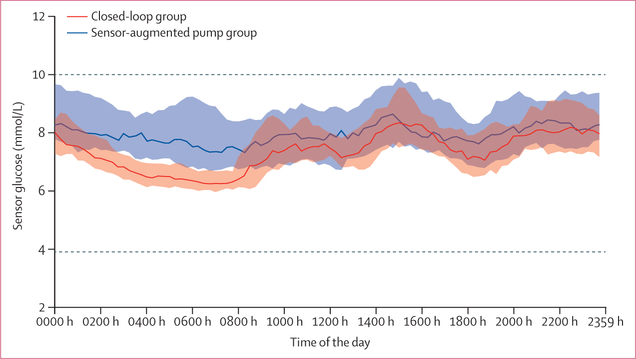
Background Older adults with type 1 diabetes have distinct characteristics that can make optimising glycaemic control challenging. We sought to test our hypothesis that hybrid closed-loop glucose control is safe and more effective than sensor-augmented pump (SAP) therapy in older adults with type 1 diabetes. Methods In an open-label, multicentre, multinational (UK and Austria), randomised, crossover study, adults aged 60 years and older with type 1 diabetes using insulin pump therapy underwent two 16-week periods comparing hybrid closed-loop (CamAPS FX, CamDiab, Cambridge, UK) and SAP therapy in random order. Block randomisation by means of central randomisation software to one of two treatment sequences was stratified by centre. The primary endpoint was the proportion of time sensor glucose was in target range between 3·9 and 10·0 mmol/L. Analysis for the primary endpoint and adverse events was by intention-to-treat. The study has completed and is registered at ClinicalTrials.gov NCT04025762. Findings 38 participants were enrolled. One participant withdrew during run-in because of difficulties with the study pump infusion sets. 37 participants (median [IQR] age 68 [63–70] years, mean [SD] baseline glycated haemoglobin [HbA 1c ]; 7·4% [0·9%]; 57 [10] mmol/mol) were randomly assigned between Sept 4, 2019, and Oct 2, 2020. The proportion of time with glucose between 3·9 and 10·0 mmol/L was significantly higher in the closed-loop group compared to the SAP group (79·9% [SD 7·9] vs 71·4% [13·2], difference 8·6 percentage points [95% CI 6·3 to 11·0]; p<0·0001). Two severe hypoglycaemia events occurred during the SAP period. There were two non-treatment related serious adverse events: cardiac arrest from pulmonary embolism associated with COVID-19 during the SAP period resulting in death, and a hospital presentation for parenteral hydrocortisone because of COVID-19 in a participant with adrenal insufficiency during the run-in period. Interpretation Hybrid closed-loop insulin delivery is safe and achieves superior glycaemic control to SAP therapy in older adults with long duration of type 1 diabetes. Importantly this was achieved without increasing the risk of hypoglycaemia in this population with risk factors for severe hypoglycaemia. This suggests that hybrid closed-loop therapy is a clinically important treatment option for older adults with type 1 diabetes. Funding National Institute of Diabetes and Digestive and Kidney Diseases.
Overview
The claims and statistics of this paper haven’t been checked yet.
Run the check — free, no account needed. It reads the open-access text and checks the sources it cites.
Integrity signals
Registry
Cites
Statistics
Figures
Verification
Claims the paper makes
The claims and statistics of this paper haven’t been checked yet.
Run the check — free, no account needed. It reads the open-access text and checks the sources it cites.
Claims other papers make about this one
Each is checked against this paper’s own text: does it say what the citing paper says it does?
The cited source says what the claim attributes to it.
In the citing paper
“In contrast to the ORACL study, no significant differences in hypoglycemia were observed.”
From 13. Older Adults: Standards of Care in Diabetes—2024 (2024) · cites this paper as [45]
The cited source says what the claim attributes to it.
In the citing paper
“They found that hybrid closedloop insulin delivery improved the proportion of time glucose was in range largely due to decreases in hyperglycemia.”
From 13. Older Adults: Standards of Care in Diabetes—2024 (2024) · cites this paper as [45]
The cited source says what the claim attributes to it.
In the citing paper
“In contrast to the ORACL study, no significant differences in hypoglycemia were observed.”
From 13. Older Adults: Standards of Care in Diabetes—2025 (2025) · cites this paper as [48]
The cited source says what the claim attributes to it.
In the citing paper
“In a different open-label, crossover design clinical trial in 37 older adults (aged ≥60 years), 16 weeks of treatment with a hybrid closed-loop advanced insulin delivery system improved TIR and reduced time above range compared with sensor-augmented pump therapy; however, in contrast to the ORACL study, no significant differences in hypoglycemia were observed (53).”
From 13. Older Adults: Standards of Care in Diabetes—2026 (2026) · cites this paper as [53]
Self-check
Percentages, sums and reported differences re-computed from the paper’s own numbers.
The self-check needs the paper’s full text.
Citations
Cites
Controlling the False Discovery Rate: A Practical and Powerful Approach to Multiple Testing
Benjamini, Y., & Hochberg, Y. (1995) · Journal of the Royal Statistical Society Series B: Statistical Methodology · doi:10.1111/j.2517-6161.1995.tb02031.x · Cited by 109,482
Battelino, T., Danne, T., Bergenstal, R. M., Amiel, S. A., Beck, R., Biester, T., Bosi, E., Buckingham, B. A., Cefalu, W. T., Close, K. L., et al. (2019) · Diabetes Care · doi:10.2337/dci19-0028 · Cited by 4,237
Self-citationState of Type 1 Diabetes Management and Outcomes from the T1D Exchange in 2016–2018
Foster, N. C., Beck, R. W., Miller, K. M., Clements, M. A., Rickels, M. R., DiMeglio, L. A., Maahs, D. M., Tamborlane, W. V., Bergenstal, R., Smith, E., et al. (2019) · Diabetes Technology & Therapeutics · doi:10.1089/dia.2018.0384 · Cited by 1,907
Six-Month Randomized, Multicenter Trial of Closed-Loop Control in Type 1 Diabetes
Brown, S. A., Kovatchev, B. P., Raghinaru, D., Lum, J. W., Buckingham, B. A., Kudva, Y. C., Laffel, L. M., Levy, C. J., Pinsker, J. E., Wadwa, R. P., et al. (2019) · New England Journal of Medicine · doi:10.1056/nejmoa1907863 · Cited by 1,030
Home Use of an Artificial Beta Cell in Type 1 Diabetes
Thabit, H., Tauschmann, M., Allen, J. M., Leelarathna, L., Hartnell, S., Wilinska, M. E., Acerini, C. L., Dellweg, S., Benesch, C., Heinemann, L., et al. (2015) · New England Journal of Medicine · doi:10.1056/nejmoa1509351 · Cited by 450
Self-citationBekiari, E., Kitsios, K., Thabit, H., Tauschmann, M., Athanasiadou, E., Karagiannis, T., Haidich, A.-B., Hovorka, R., & Tsapas, A. (2018) · BMJ · doi:10.1136/bmj.k1310 · Cited by 437
Self-citationPratley, R. E., Kanapka, L. G., Rickels, M. R., Ahmann, A., Aleppo, G., Beck, R., Bhargava, A., Bode, B. W., Carlson, A., Chaytor, N. S., et al. (2020) · JAMA · doi:10.1001/jama.2020.6928 · Cited by 375
Livingstone, S. J., Looker, H. C., Hothersall, E. J., Wild, S. H., Lindsay, R. S., Chalmers, J., Cleland, S. J., Leese, G., McKnight, J. A., Morris, A. D., et al. (2012) · PLoS Medicine · doi:10.1371/journal.pmed.1001321 · Cited by 356
Bergenstal, R. M., Nimri, R., Beck, R. W., Criego, A., Laffel, L., Schatz, D., Battelino, T., Danne, T., Weinzimer, S. A., Sibayan, J., et al. (2021) · The Lancet · doi:10.1016/s0140-6736(20)32514-9 · Cited by 344
Self-citationWeinstock, R. S., Xing, D., Maahs, D. M., Michels, A., Rickels, M. R., Peters, A. L., Bergenstal, R. M., Harris, B., DuBose, S. N., Miller, K. M., et al. (2013) · The Journal of Clinical Endocrinology & Metabolism · doi:10.1210/jc.2013-1589 · Cited by 338
Cited by
Sorted by citations
Items 101–127 of 127
Pharmacotherapy of type 1 diabetes - part 2 Today
Rendell, M. S. (2025) · Expert Opinion on Pharmacotherapy · doi:10.1080/14656566.2025.2479598
Wang, Y., Alexandre‐Heymann, L., Messier, V., Boudreau, V., Bandini, A., Kelly, B., Gravel, A., Gagnon, C., Brazeau, A., & RABASA-LHORET, R. P. R. (2025) · Endocrine Practice · doi:10.1016/j.eprac.2025.03.009
Wiles, J. (2025) · Springer eBooks · doi:10.1007/978-3-031-88835-9_7
Clin‐ STAR Corner: Practice Changing Advances in Diabetes Care
Kahkoska, A. R., Ortega, J., Bilal, A., & Pratley, R. E. (2025) · Journal of the American Geriatrics Society · doi:10.1111/jgs.19595
Anandhakrishnan, A., Liarakos, A. L., Dhatariya, K., Gallen, G., Choudhary, P., Lumb, A. N., Wilmot, E. G., & Hussain, S. (2025) · Diabetes Obesity and Metabolism · doi:10.1111/dom.70027
Boucles fermées chez la personne âgée : promesse technologique ou défi gériatrique ?
Charbit, J., & Meyer, L. (2025) · Médecine des Maladies Métaboliques · doi:10.1016/j.mmm.2025.08.006
Algeffari, M., & Alotaibi, E. A. (2025) · Cureus · doi:10.7759/cureus.98093
Simpson, R., Lunt, H., Hewapathirana, N. M., Love, L., Heenan, H. F., Lenton, J., & Hansen, P. (2025) · doi:10.2196/preprints.86029
Godoi, A., Reis Marques, I., Padrão, E. M. H., Mahesh, A., Hespanhol, L. C., Riceto Loyola Júnior, J. E., de Souza, I. A. F., Moreira, V. C. S., Silva, C. H., Miyawaki, I. A., et al. (2024) · Figshare · doi:10.6084/m9.figshare.26620396
Croos, J., Shooshtarian, A. K., Stotesbury, B., Gallen, G., Ismail, K., Rosenthal, M. J., Cheah, Y. S., Calcia, M., Lovie, K., Ahuja, A., et al. (2026) · Diabetes Obesity and Metabolism · doi:10.1111/dom.70432
Bilal, A., Thabit, H., Nutter, P. W., & Harper, S. (2026) · Frontiers in Sports and Active Living · doi:10.3389/fspor.2026.1718510
Self-citationHermanns, N., Ehrmann, D., Heinemann, L., Roos, T., Kulzer, B., Resl, M., Mader, J. K., Brandt, D., Trümpy, C., Koch, L. M., et al. (2026) · Journal of Diabetes Science and Technology · doi:10.1177/19322968261444045
Self-citationDeng, C., Fan, W., Xie, Y., Tang, X., Jiang, H., Niu, X., Yan, D., Su, H., Kuang, H., Tian, L., et al. (2026) · Diabetes Obesity and Metabolism · doi:10.1111/dom.70833
Gómez, M. A. R., Múñoz, Ó., Henao, D. C., Parra, D., Martínez, Y. O., García, M., Vasquez, V., Galvis, S., & Medina, A. M. G. (2026) · Clinical Medicine Insights Endocrinology and Diabetes · doi:10.1177/11795514261471400
CYRANKA, K. M., Matejko, B., SUSUL, K., Surowiec, P., Wawszczyk, M., Cukierman‐Yaffe, T., Malecki, M., & Klupa, T. (2026) · Diabetes Obesity and Metabolism · doi:10.1111/dom.71170
Volčanšek, Š., Vidmar, P., Janež, A., & Skvarča, A. (2026) · Frontiers in Endocrinology · doi:10.3389/fendo.2026.1910192
Ratan, P., Abreu, M., Saldarriaga, L., Faria, H. S., & Trevisan, T. L. (2026) · Diabetes Research and Clinical Practice · doi:10.1016/j.diabres.2026.113492
Oktavian, P., Wungu, C. D. K., Amin, I. M., & Mudjanarko, S. W. (2026) · Diabetes Research and Clinical Practice · doi:10.1016/j.diabres.2026.113542
Insulin Delivery and Technology
Parab, R., & Shirke, M. (2026) · Springer eBooks · doi:10.1007/978-3-032-24854-1_5
Smart Pharmaceutical Systems: Sensor-Enabled Delivery, Feedback Control, and Therapeutic Autonomy
Benali, A., Boudiaf, K., & Touati, S. (2026) · Journal of Applied Pharmaceutical Technologies and Systems · doi:10.68159/f721269020
Holt, R. I. G., DeVries, J. H., Fischl, A. H., Hirsch, I. B., Kirkman, M. S., Klupa, T., Ludwig, B., Nørgaard, K., Pettus, J., Renard, É., et al. (2026) · Diabetologia · doi:10.1007/s00125-026-06833-z
Hohendorff, J., Klupa, T., Wrobel, M., Grzelka‐Wozniak, A., Sochacka-Tatara, E., PLONKA-STEPIEN, M., Zych, Z., Matejko, B., ADAMCZYK-HOHENDORFF, M. M., Rokicka, D., et al. (2026) · Diabetes Obesity and Metabolism · doi:10.1111/dom.71339
Oktavian, P., Wungu, C. D. K., Amin, I. M., & Mudjanarko, S. W. (2026) · The Journal of Clinical Endocrinology & Metabolism · doi:10.1210/clinem/dgag344
Trawley, S. L., Christiaens, A., Stephens, A. N., McAuley, S. A., Forbes, A., Maltese, G., Abdelhafiz, A. H., & Sinclair, A. J. (2026) · Diabetes Research and Clinical Practice · doi:10.1016/j.diabres.2026.113589
Poojitha, C., Sai, P. T. N., & Mercy, B. (2026) · International Conference on Emerging Techniques in Computational Intelligence (ICETCI) · doi:10.1109/icetci71772.2026.11710799
Diabetes mellitus im Alter – Praxisempfehlung der DDG
Zeyfang, A., Lee-Barkey, Y.-H., & Bahrmann, A. (2026) · Diabetologie und Stoffwechsel · doi:10.1055/a-2866-0305
Galeano, F., Mobilia, A. R. C., Fimognari, F. L., Oteri, V., Cannarella, R., Papa, G., Moli, R. L., Piticchio, T., Pino, A. D., Marco, M. D., et al. (2026) · Endocrine · doi:10.1007/s12020-026-04816-z
Metadata
- Authors
- Boughton, C. K., Hartnell, S., Thabit, H., Mubita, W. M., Draxlbauer, K., Poettler, T., Wilinska, M. E., Hood, K. K., Mader, J. K., Narendran, P., Leelarathna, L., Evans, M. L., & Hovorka, R.
- Affiliations
- Cambridge University Hospitals NHS Foundation Trust (GB)
- Manchester Academic Health Science Centre (GB)
- University Hospitals Birmingham NHS Foundation Trust (GB)
- Medical University of Graz (AT)
- Wellcome/MRC Institute of Metabolic Science (GB)
- Stanford Medicine (US)
- Corresponding author
- Boughton, Charlotte K
- ORCID
- Venue
- The Lancet Healthy Longevity
- Publisher
- Elsevier BV
- Published
- 2022-03
- Volume
- 3
- Issue
- 3
- Pages
- e135-e142
- ISSN
- 2666-7568 (ISSN-L)
- PMC
- PMC8967297
- OpenAlex
- W4221125458
- Cited by
- 127
- References
- 21
- Citations by year
- 2026: 25 · 2025: 37 · 2024: 29 · 2023: 25 · 2022: 11
- FWCI
- 18.90
- Type
- journal article
- Language
- en
- Open access
- gold
- doi.org
- Licence
- Locations
- The Lancet Healthy Longevity (publishedVersion, cc-by-nc-nd)
- PubMed (publishedVersion)
- PubMed Central (acceptedVersion, cc-by-nc-nd)
- Research Explorer (The University of Manchester) (submittedVersion)
- Apollo (University of Cambridge) (submittedVersion, cc-by)
- Apollo (University of Cambridge) (submittedVersion, cc-by-nc-nd)
- Apollo (cc-by)
- Apollo
- Funders
- National Institute for Health and Care Research
- Eli Lilly and Company
- Juvenile Diabetes Research Foundation United Kingdom
- National Institute of Diabetes and Digestive and Kidney Diseases (1DP3DK112176-01)
- Wellcome Trust
- Topics
- Health Sciences › Medicine › Endocrinology, Diabetes and Metabolism › Diabetes Management and Research
- Health Sciences › Medicine › Endocrinology, Diabetes and Metabolism › Diabetes Treatment and Management
- Health Sciences › Medicine › Endocrinology, Diabetes and Metabolism › Diabetes Management and Education
- Keywords
- hybrid closed-loop insulin delivery, sensor-augmented pump therapy, type 1 diabetes, older adults, glycemic control, time in range, hypoglycemia, insulin pump therapy, COVID-19 pandemic, adrenal insufficiency, HbA1c, adverse events, cortisol, pulmonary embolism
- MeSH terms
- COVID-19, Aged, Blood Glucose, Diabetes Mellitus, Type 1, Glucose, Humans, Hypoglycemia, Hypoglycemic Agents, Insulin, Insulin Infusion Systems, Middle Aged, Treatment Outcome, Cross-Over Studies
About these checks
Registry, retraction, Cites and statistics results are computed, not judged, with one exception: a printed reference that no index lists is read once by a model before it counts as a citation error. Claims are extracted by a model and kept only when their quote appears verbatim in the text; each cited source is then checked, with a model’s help, for whether it says what the claim relies on. Those verdicts can be wrong — read the claim’s quote and the cited source before relying on one.
Statistics and arithmetic are recomputed, not judged.
Confidence bands are shown only for fields calibrated on our annotated test set. None is calibrated yet, so no band is shown.
What counts as a claim ›How we measure confidence ›How we check this ›
Are you an author, or do you see a problem with this page? Request a review
