

A RESPONSE TO COMMUNITY QUESTIONS ON THE MARINE20 RADIOCARBON AGE CALIBRATION CURVE: MARINE RESERVOIR AGES AND THE CALIBRATION OF 14 C SAMPLES FROM THE OCEANS
Open accessThe DOI matches its Crossref record; 80 of the 80 references it cites were found in a registry or an index; none of the 76 sources its claims cite is checked for support yet.
Abstract
Radiocarbon ( 14 C) concentrations in the oceans are different from those in the atmosphere. Understanding these ocean-atmospheric 14 C differences is important both to estimate the calendar ages of samples which obtained their 14 C in the marine environment, and to investigate the carbon cycle. The Marine20 radiocarbon age calibration curve is created to address these dual aims by providing a global-scale surface ocean record of radiocarbon from 55,000–0 cal yr BP that accounts for the smoothed response of the ocean to variations in atmospheric 14 C production rates and factors out the effect of known changes in global-scale palaeoclimatic variables. The curve also serves as a baseline to study regional oceanic 14 C variation. Marine20 offers substantial improvements over the previous Marine13 curve. In response to community questions, we provide a short intuitive guide, intended for the lay-reader, on the construction and use of the Marine20 calibration curve. We describe the choices behind the making of Marine20, as well as the similarities and differences compared with the earlier Marine calibration curves. We also describe how to use the Marine20 curve for calibration and how to estimate Δ R —the localized variation in the oceanic 14 C levels due to regional factors which are not incorporated in the global-scale Marine20 curve. To aid understanding, illustrative worked examples are provided.
Overview
CoChat Summary
TL;DR
This response explains the Marine20 marine radiocarbon calibration curve and how to use it, including updating ΔR values for local marine reservoir effects. It emphasizes that Marine20 improves on Marine13 by modeling global-scale marine reservoir age changes with the BICYCLE carbon cycle model, while warning that constant ΔR assumptions and polar, closed-basin, and deep-ocean applications remain problematic.
Key findings
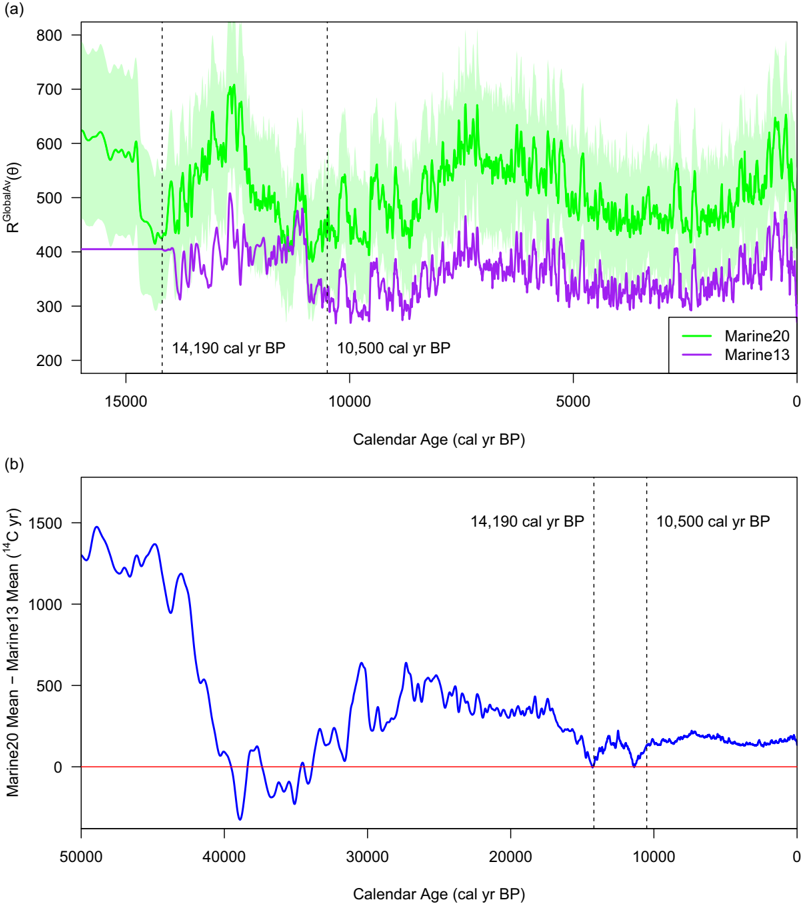
- Marine20 uses BICYCLE to estimate global-scale marine reservoir age changes, R20_GlobalAv(θ), from 55,000–0 cal yr BP; Marine13 instead set R13_GlobalAv constant at 405 14C yrs from 55,000–14,190 cal yr BP, so Marine20 better separates global from local effects.
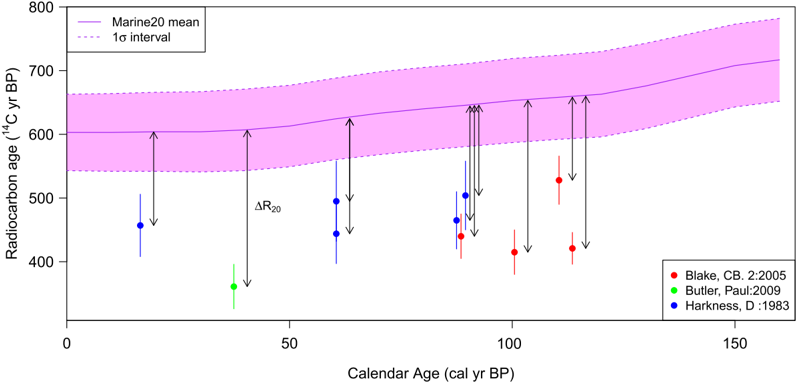
- Marine20 and Marine13 are offset by ∼150 14C yrs in the recent past/Holocene, so users must recalculate ΔR13 as ΔR20; the worked Dublin example gives ΔR20 = −201 ± 46 14C yrs (1σ).
- Marine20 is not recommended for polar regions outside ca. 40°S–40°N older than ca. 11.5 cal kyr BP when using a constant Holocene-based ΔR; bracketing maximum- and minimum-depletion calibration scenarios can differ by up to 1500 calendar years.
- Southern Hemisphere atmospheric 14C is 36 ± 27 14C yrs older than Northern Hemisphere atmospheric 14C, and ΔR20 at Southern Hemisphere ocean sites includes this interhemispheric offset; closed seas, large lakes, and deep/intermediate ocean samples are not covered by Marine20.
Methods
- Community questions were collated through Dr. Irka Hajdas, Dr. Christine Hatté, and Prof. Tim Jull, then grouped thematically; the paper provides an intuitive guide and worked examples rather than new primary data.
- Marine20 construction is described as using the BICYCLE carbon cycle box model, with a 500-member ensemble varying inputs, forced by IntCal20 posterior realisations and a prescribed atmospheric CO2 spline from six Antarctic ice cores.
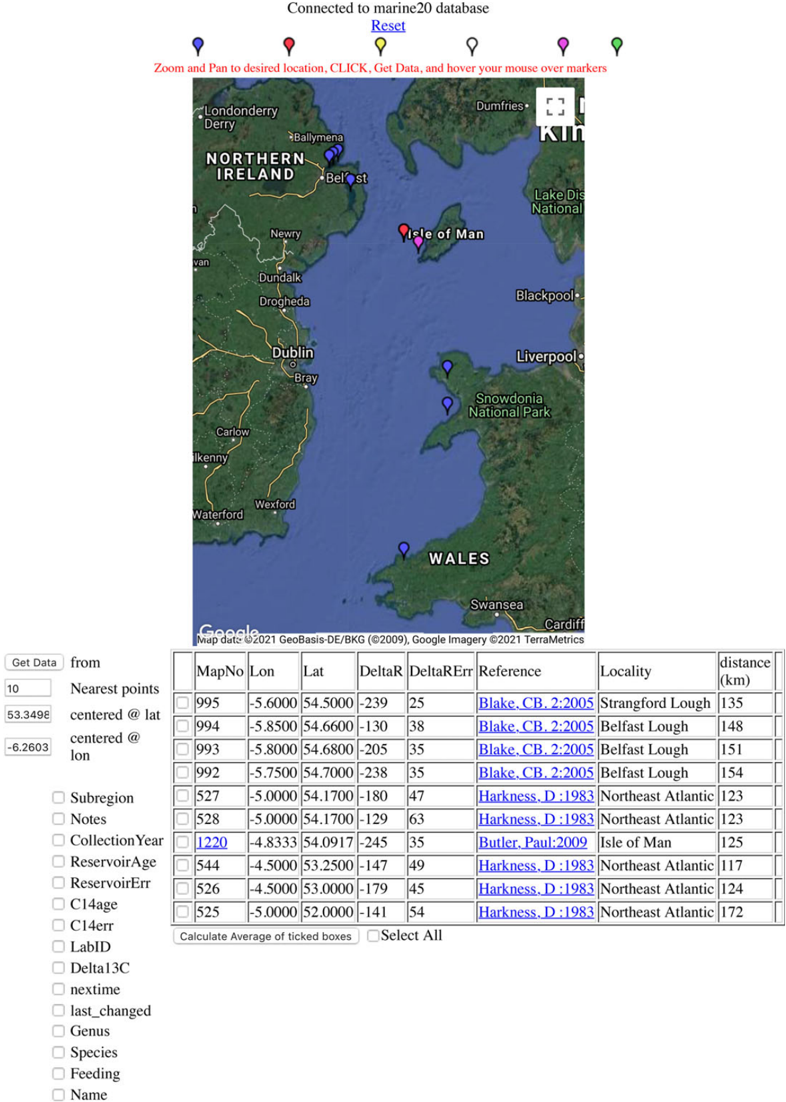
- ΔR recalculation examples use the marine radiocarbon reservoir database (http://calib.org/marine/) and the deltar software; the Dublin example selects the 10 nearest marine 14C samples.
Limitations
- The paper states that treating ΔR(θ) as approximately constant is a significant approximation, that regional data-based marine calibration curves are extremely challenging due to sparse marine 14C data and independent calendar ages, and that it does not endorse specific regional curve products.
- The paper states that Marine20 is not intended for closed seas and large lakes, that polar glacial calibration remains a challenge, that no exact date is given for when significant ΔR(θ) changes occurred in polar regions, and that deep/intermediate ocean calibration is not currently possible.
- Evident from the text: this is a lay-reader response that minimizes technical detail and refers readers to Heaton et al. (2020) for modeling details; it does not present a new calibration curve or new primary measurements.
Model-written summary. Check it against the paper before relying on it.
Integrity signals
Registry
Cites
Statistics
Figures
Verification
Claims the paper makes
0 Valid · 3 Not valid · 49 Not checked · 172 Own results and interpretations
A result the paper states — it cites no source for it, so there is none to check. The quote shows it is in the paper.
In the paper
“The improvements in Marine20 are mainly seen in the period from 55,000-10,500 cal yr BP, in particular from 55,000-14,190 cal yr BP.”
§ A RESPONSE TO COMMUNITY QUESTIONS ON THE MARINE20 RADIOCARBON AGE CALIBRATION CURVE: MARINE RESERVOIR AGES AND THE CALIBRATION OF 14 C SAMPLES FROM THE OCEANS > 2.2 Why is Marine20 an Improvement over Marine13?
plainstates an association- Asserted: passes — The authors put it forward as true.
- Checkable: passes — It can be checked against evidence.
- Load-bearing: passes — The paper’s conclusions depend on it.
- Based: passes — The paper gives a reason why it holds.
A result the paper states — it cites no source for it, so there is none to check. The quote shows it is in the paper.
In the paper
“There are however also some differences in the implementation of the Marine20 model compared to the Marine13 box model for the period 10,500-0 cal yr BP.”
§ A RESPONSE TO COMMUNITY QUESTIONS ON THE MARINE20 RADIOCARBON AGE CALIBRATION CURVE: MARINE RESERVOIR AGES AND THE CALIBRATION OF 14 C SAMPLES FROM THE OCEANS > 2.2 Why is Marine20 an Improvement over Marine13?
plain- Asserted: passes — The authors put it forward as true.
- Checkable: passes — It can be checked against evidence.
- Load-bearing: unclear — It is unclear whether the paper’s conclusions depend on it.
- Based: passes — The paper gives a reason why it holds.
A check of a cited source is scheduled, or we don’t hold its full text yet; the claim is checked once it runs.
In the paper
“However, critically they have the same fundamental shape back to 10,500 cal yr BP (Figures 1a and b, also Figure 7 in Heaton et al. 2020).”
§ A RESPONSE TO COMMUNITY QUESTIONS ON THE MARINE20 RADIOCARBON AGE CALIBRATION CURVE: MARINE RESERVOIR AGES AND THE CALIBRATION OF 14 C SAMPLES FROM THE OCEANS > 3.1.3
What the sources say
- Not checked yetcites Heaton et al. 2020 matched to “Marine20—The Marine Radiocarbon Age Calibration Curve (0–55,000 cal BP)” (2020) source
A check is scheduled.
boosted- Asserted: passes — The authors put it forward as true.
- Checkable: passes — It can be checked against evidence.
- Load-bearing: passes — The paper’s conclusions depend on it.
- Based: passes — The paper gives a reason why it holds.
- Not checked yet
A check of a cited source is scheduled, or we don’t hold its full text yet; the claim is checked once it runs.
In the paper
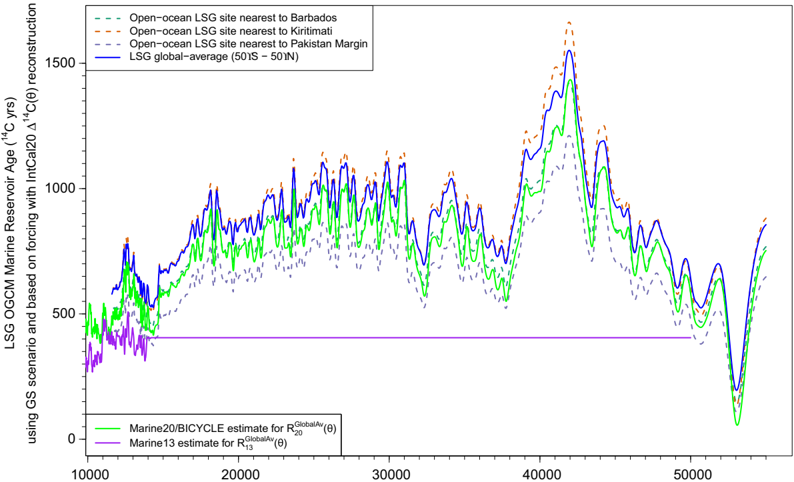
“We see little difference between the relative shapes of the BICYCLEgenerated R 20 GlobalAv (θ) and the regional MRA estimates provided by the LSG OGCM (Butzin et al. 2020) as shown in Figure 2-see also Figure 4 in Heaton et al. (2020).”
§ A RESPONSE TO COMMUNITY QUESTIONS ON THE MARINE20 RADIOCARBON AGE CALIBRATION CURVE: MARINE RESERVOIR AGES AND THE CALIBRATION OF 14 C SAMPLES FROM THE OCEANS > 3.2.1 Why did you choose the BICYCLE model to make Marine20 rather than other models?
What the sources say
- Not checked yetcites Butzin et al. 2020 matched to “A short note on marine reservoir age simulations used in IntCal20” (2020) source
A check is scheduled.
- Not checked yetcites Heaton et al. (2020) matched to “Marine20—The Marine Radiocarbon Age Calibration Curve (0–55,000 cal BP)” (2020) source
A check is scheduled.
plain- Asserted: passes — The authors put it forward as true.
- Checkable: passes — It can be checked against evidence.
- Load-bearing: passes — The paper’s conclusions depend on it.
- Based: passes — The paper gives a reason why it holds.
- Not checked yet
In the paper
“These bracketing calendar age intervals are however wide-with differences of up to 1500 calendar years between the maximum-and minimum-depletion calibration scenarios.”
§ A RESPONSE TO COMMUNITY QUESTIONS ON THE MARINE20 RADIOCARBON AGE CALIBRATION CURVE: MARINE RESERVOIR AGES AND THE CALIBRATION OF 14 C SAMPLES FROM THE OCEANS > 3.1.5 Are there situations where I should still use Marine13?
What the sources say
- Not matchedcites Heaton et al. 2022
An author–year citation the paper’s reference list doesn’t settle. We don’t search these by name.
plain- Asserted: passes — The authors put it forward as true.
- Checkable: passes — It can be checked against evidence.
- Load-bearing: passes — The paper’s conclusions depend on it.
- Based: passes — The paper gives a reason why it holds.
- Not matched
128 more claims
Create a free account to see all 224 claims and to verify the 61 references still open.
- It may state two separate claims as one. 43
- Probably not a substantial claim. 54
- The quote only partly states this claim. 1
Self-check
Percentages, sums and reported differences re-computed from the paper’s own numbers.
Each contradiction between two passages listed here was confirmed by an independent check.
Rated minor: it would not touch a result — a value no result rests on, a p-value that stays on the same side of the significance level, or a conflict that is clerical, resolved elsewhere in the paper, or outside its own findings.
In the paper
§ A RESPONSE TO COMMUNITY QUESTIONS ON THE MARINE20 RADIOCARBON AGE CALIBRATION CURVE: MARINE RESERVOIR AGES AND THE CALIBRATION OF 14 C SAMPLES FROM THE OCEANS > 2.2 Why is Marine20 an Improvement over Marine13?
“Marine13 set R 13 GlobalAv (θ) to be constant 405 14 C yrs throughout this period (Figures 1a and 2).”
§ A RESPONSE TO COMMUNITY QUESTIONS ON THE MARINE20 RADIOCARBON AGE CALIBRATION CURVE: MARINE RESERVOIR AGES AND THE CALIBRATION OF 14 C SAMPLES FROM THE OCEANS > References
“IntCal13 and Marine13 radiocarbon age calibration curves 0-50,000 years cal BP.”
Citations
Cites
IntCal13 and Marine13 radiocarbon age calibration curves 0–50,000 years cal BP
Reimer, P. J., Bard, E., Bayliss, A., Beck, J. W., Blackwell, P. G., Ramsey, C. B., Buck, C. E., Cheng, H., Edwards, R. L., Friedrich, M., et al. (2013) · Radiocarbon · doi:10.2458/azu_js_rc.55.16947 · Cited by 14,591
Self-citationThe IntCal20 Northern Hemisphere Radiocarbon Age Calibration Curve (0–55 cal kBP)
Reimer, P. J., Austin, W. E. N., Bard, E., Bayliss, A., Blackwell, P. G., Bronk Ramsey, C., Butzin, M., Cheng, H., Edwards, R. L., Friedrich, M., et al. (2020) · Radiocarbon · doi:10.1017/rdc.2020.41 · Cited by 7,900 · cited 4×
“We discuss this further in Section 3.1.3.”
BackgroundInfluentialSelf-citationINTCAL98 Radiocarbon Age Calibration, 24,000–0 cal BP
Stuiver, M., Reimer, P. J., Bard, E., Beck, J. W., Burr, G. S., Hughen, K. A., Kromer, B., McCormac, G., Van Der Plicht, J., & Spurk, M. (1998) · Radiocarbon · doi:10.1017/s0033822200019123 · Cited by 4,421
Self-citationIntCal09 and Marine09 radiocarbon age calibration curves, 0–50,000 years cal BP
Reimer, P. J., Baillie, M. G. L., Bard, E., Bayliss, A., Beck, J. W., Blackwell, P. G., Bronk Ramsey, C., Buck, C. E., Burr, G. S., Edwards, R. L., et al. (2009) · Radiocarbon · doi:10.1017/s0033822200034202 · Cited by 4,290 · cited 7×
“This is particularly the case when studying changes in the last glacial period since Marine09 and Marine13 incorporated no global-scale carbon cycle changes (see Figure 2 and Section 3).”
BackgroundMethodInfluentialSelf-citationBayesian calibration of computer models
Kennedy, M. C., & O'Hagan, A. (2001) · Journal of the Royal Statistical Society Series B: Statistical Methodology · doi:10.1111/1467-9868.00294 · Cited by 4,222 · cited 1×
“In the case of a model-based Marine calibration curve, uncertainty arises from two sources (Kennedy and O ’ Hagan 2001).”
Marine20—The Marine Radiocarbon Age Calibration Curve (0–55,000 cal BP)
Heaton, T. J., Köhler, P., Butzin, M., Bard, E., Reimer, R. W., Austin, W. E. N., Bronk Ramsey, C., Grootes, P. M., Hughen, K. A., Kromer, B., et al. (2020) · Radiocarbon · doi:10.1017/rdc.2020.68 · Cited by 2,161
Self-citationA global ocean carbon climatology: Results from Global Data Analysis Project (GLODAP)
Key, R. M., Kozyr, A., Sabine, C. L., Lee, K., Wanninkhof, R., Bullister, J. L., Feely, R. A., Millero, F. J., Mordy, C., & Peng, T. ‐. (2004) · Global Biogeochemical Cycles · doi:10.1029/2004gb002247 · Cited by 1,652
SHCal20 Southern Hemisphere calibration, 0–55,000 years cal BP
Hogg, A. G., Heaton, T. J., Hua, Q., Palmer, J. G., Turney, C. S., Southon, J., Bayliss, A., Blackwell, P. G., Boswijk, G., Bronk Ramsey, C., et al. (2020) · Radiocarbon · doi:10.1017/rdc.2020.59 · Cited by 1,530 · cited 9×
“…specific, and time dependent, MRA estimate into: where R GlobalAv ( θ ) captures the global-scale MRA effects and the oceanic smoothing of high-frequency 14 C production rate changes; and Δ R Location ( θ ) the local depletion factors (Bard 1988; Stuiver and Braziunas 1993; Heaton et al. 2020).”
BackgroundMethodResultInfluentialSelf-citationMarine04 Marine Radiocarbon Age Calibration, 0–26 Cal Kyr Bp
Hughen, K. A., Baillie, M. G. L., Bard, E., Warren Beck, J., Bertrand, C. J. H., Blackwell, P. G., Buck, C. E., Burr, G. S., Cutler, K. B., Damon, P. E., et al. (2004) · Radiocarbon · doi:10.1017/s0033822200033002 · Cited by 1,184
Self-citationModeling Atmospheric 14C Influences and 14C Ages of Marine Samples to 10,000 BC
Stuiver, M., & Braziunas, T. F. (1993) · Radiocarbon · doi:10.1017/s0033822200013874 · Cited by 1,076
Research works printed but not linked: 1
- van Beek P, Reyss J-L, Paterne M, Gersonde R, van der Loeff MR, Kuhn G. 2002. 226 Ra in barite: absolute dating of Holocene Southern Ocean sediments and reconstruction of sea-surface Response to Marine20 Questions 269 https://doi.org/10.1017/RDC.2022.66 Published online by Cambridge University Press reservoir ages. Geology 30:731-734. doi: 10.1130/ 0091-7613(2002)030<0731:RIBADO>2.0.CO;2. · doi:10.1130/0091-7613(2002)030<0731:ribado>2.0.co;2
Cited by
Marine Radiocarbon Calibration in Polar Regions: A Simple Approximate Approach using Marine20
Heaton, T., Butzin, M., Bard, É., Ramsey, C. B., Hughen Konrad, A., Köhler, P., & Reimer, P. J. (2022) · Oxford University Research Archive (ORA) (University of Oxford) · doi:10.1017/rdc.2023.42 · Cited by 51
Self-citationThe marine reservoir age of Greenland coastal waters
Pearce, C., Özdemir, K. S., Mathiasen, R. F., Detlef, H., & Olsen, J. (2023) · Geochronology · doi:10.5194/gchron-5-451-2023 · Cited by 31
A marine record of Patagonian ice sheet changes over the past 140,000 years
Hagemann, J. R., Lamy, F., Arz, H. W., Lembke‐Jene, L., Auderset, A., Harada, N., Ho, S. L., Iwasaki, S., Kaiser, J., Lange, C. B., et al. (2024) · Proceedings of the National Academy of Sciences · doi:10.1073/pnas.2302983121 · Cited by 24
Ownsworth, E., Selby, D. S., Lloyd, J. M., Knutz, P. C., Szidat, S., Andrews, J. T., & Cofaigh, C. Ó. (2023) · Quaternary Science Reviews · doi:10.1016/j.quascirev.2023.108082 · Cited by 22
Ulm, S., O’Grady, D., Petchey, F., Hua, Q., Jacobsen, G., Linnenlucke, L., David, B., Rosendahl, D., Bunbury, M. M. E., Bird, M. I., et al. (2023) · Radiocarbon · doi:10.1017/rdc.2023.95 · Cited by 22
Self-citation
Metadata
- Authors
- Heaton, T. J., Bard, E., Bronk Ramsey, C., Butzin, M., Hatté, C., Hughen, K. A., Köhler, P., & Reimer, P. J.
- Affiliations
- University of Leeds (GB)
- Alfred-Wegener-Institut Helmholtz-Zentrum für Polar- und Meeresforschung (DE)
- Woods Hole Oceanographic Institution (US)
- Queen's University Belfast (GB)
- Corresponding author
- Heaton, T J
- Venue
- Radiocarbon
- Publisher
- Cambridge University Press (CUP)
- Published
- 2022-11-02
- Volume
- 65
- Issue
- 1
- Pages
- 247-273
- ISSN
- 0033-8222 (ISSN-L)
- 1945-5755
- OpenAlex
- W4308147449
- Cited by
- 86
- References
- 77
- Citations by year
- 2026: 21 · 2025: 17 · 2024: 8 · 2023: 38 · 2022: 2
- FWCI
- 22.95
- Type
- journal article
- Language
- en
- Open access
- hybrid
- doi.org
- Locations
- Radiocarbon (publishedVersion, cc-by)
- Oxford University Research Archive (ORA) (University of Oxford) (publishedVersion, other-oa)
- Research Portal (Queen's University Belfast) (publishedVersion, cc-by)
- HAL (submittedVersion, cc-by)
- Helmholtz-Zentrum für Polar-und Meeresforschung (Alfred-Wegener-Institut) (submittedVersion, other-oa)
- White Rose Research Online (University of Leeds, The University of Sheffield, University of York) (submittedVersion, cc-by)
- Helmholtz Centre for Ocean Research Kiel (GEOMAR) (submittedVersion, cc-by)
- Funders
- Equipex
- Agence Nationale de la Recherche (ANR-21-CE01-0023, ANR-10-EQPX-0024)
- Bundesministerium für Bildung und Forschung (01LP1919A, 01LP1505B)
- Topics
- Social Sciences › Archeology › Archaeology and ancient environmental studies
- Physical Sciences › Earth and Planetary Sciences › Atmospheric Science › Geology and Paleoclimatology Research
- Physical Sciences › Earth and Planetary Sciences › Atmospheric Science › Tree-ring climate responses
- Keywords
- marine reservoir age, carbon cycle
About these checks
Registry, retraction, Cites and statistics results are computed, not judged, with one exception: a printed reference that no index lists is read once by a model before it counts as a citation error. Claims are extracted by a model and kept only when their quote appears verbatim in the text; each cited source is then checked, with a model’s help, for whether it says what the claim relies on. Those verdicts can be wrong — read the claim’s quote and the cited source before relying on one.
A language model drew the claims from the paper on 2026-11-24, under version 3 of the claim definition (model deepseek-v4.1-flash, prompt extract-v3).
A second model labelled each claim on 2026-11-24 (model jev-1.13-20260917, definition revision gold-guideline-v0.2).
Statistics and arithmetic are recomputed, not judged.
Confidence bands are shown only for fields calibrated on our annotated test set. None is calibrated yet, so no band is shown.
What counts as a claim ›How we measure confidence ›How we check this ›
Are you an author, or do you see a problem with this page? Request a review
How to cite
Cite CoChat for the checks on this page, and the paper for its own findings.
- This page
- CoChat. (2026). Citation check: A RESPONSE TO COMMUNITY QUESTIONS ON THE MARINE20 RADIOCARBON AGE CALIBRATION CURVE: MARINE RESERVOIR AGES AND THE CALIBRATION OF 14 C SAMPLES FROM THE OCEANS. https://app.cochat.ai/papers/10.1017/rdc.2022.66
- The paper
- Heaton, T. J., Bard, E., Bronk Ramsey, C., Butzin, M., Hatté, C., Hughen, K. A., Köhler, P., & Reimer, P. J. (2023). A RESPONSE TO COMMUNITY QUESTIONS ON THE MARINE20 RADIOCARBON AGE CALIBRATION CURVE: MARINE RESERVOIR AGES AND THE CALIBRATION OF 14 C SAMPLES FROM THE OCEANS. Radiocarbon. https://doi.org/10.1017/rdc.2022.66
Data sources
Bibliographic data: Semantic Scholar, OpenAlex, Crossref.
Contains information from the Semantic Scholar Academic Graph Datasets, made available under the ODC Attribution License (ODC-BY 1.0).
Semantic Scholar’s data is described in: Kinney, R., et al. (2023). The Semantic Scholar Open Data Platform. arXiv:2301.10140.
