

THE SIZE INHERITED AGE EFFECT ON RADIOCARBON DATES OF ALLUVIAL DEPOSITS: REDATING CHARCOAL FRAGMENTS IN A SAND-BED STREAM, MACDONALD RIVER, NSW, AUSTRALIA
Open accessThe DOI matches its Crossref record; 47 of the 47 references it cites were found in a registry or an index; none of the 33 sources its claims cite is checked for support yet.
Abstract
Radiocarbon dates on charred plant remains are often used to define the chronology of archives such as lake cores and fluvial sequences. However, charcoal is often older than its depositional context because old-wood can be burnt and a range of transport and storage stages exist between the woodland and stream or lake bed (“inherited age”). In 1978, Blong and Gillespie dated four size fractions of charcoal found floating or saltating in the Macdonald River, Australia. They found larger fragments gave younger age estimates, raising the possibility that taphonomic modifications could help identify the youngest fragments. In 1978 each date required 1000s charcoal fragments. This study returns to a sample from the Macdonald River to date individual charcoal fragments and finds the inherited age may be more than 1700 years (mode 250 years) older than the collection date. Taphonomic factors, e.g., size, shape or fungal infestation cannot identify the youngest fragments. Only two fragments on short-lived materials correctly estimated the date of collection. In SE Australia, this study suggests that wood charcoal will overestimate the age of deposition, taphonomic modifications cannot be used to identify which are youngest, and multiple short-lived materials are required to accurately estimate the deposition age.
Overview
CoChat Summary
TL;DR
This study re-dated 33 individual charcoal fragments from a 1978 Macdonald River sample to test whether inherited age in alluvial charcoal can be reduced by selecting taphonomically younger fragments. It finds inherited ages can exceed 1700 years (mode around 250 years), and taphonomic traits did not identify the youngest fragments; only short-lived materials gave ages near collection.
Key findings
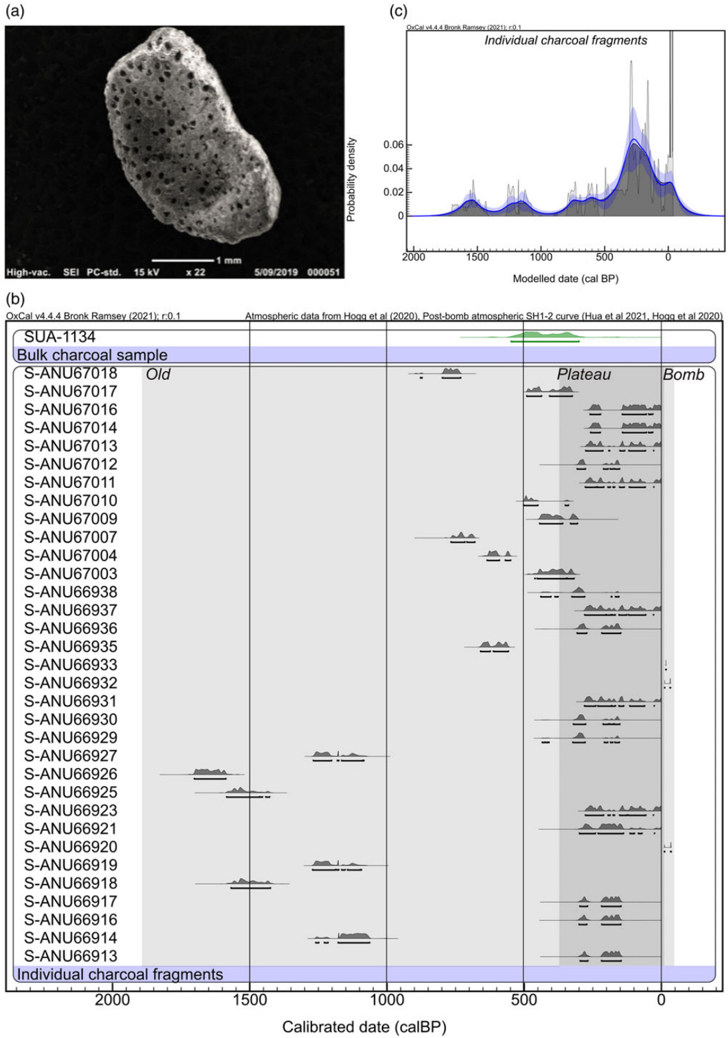
- Among 33 dated fragments, ages spanned more than 1700 years; the mass-weighted mean was 965 ± 100 BP, significantly older than the original bulk estimate of 440 ± 80 BP, and a Kernel Density Model peaked some 250 years prior to collection.
- Only three charcoal samples fell within the bomb period (post AD 1950), and only two were within error of the 1978 collection date; to have a 70% chance of obtaining at least one date within 20 years of collection, 10 pieces of charcoal would need to be dated.
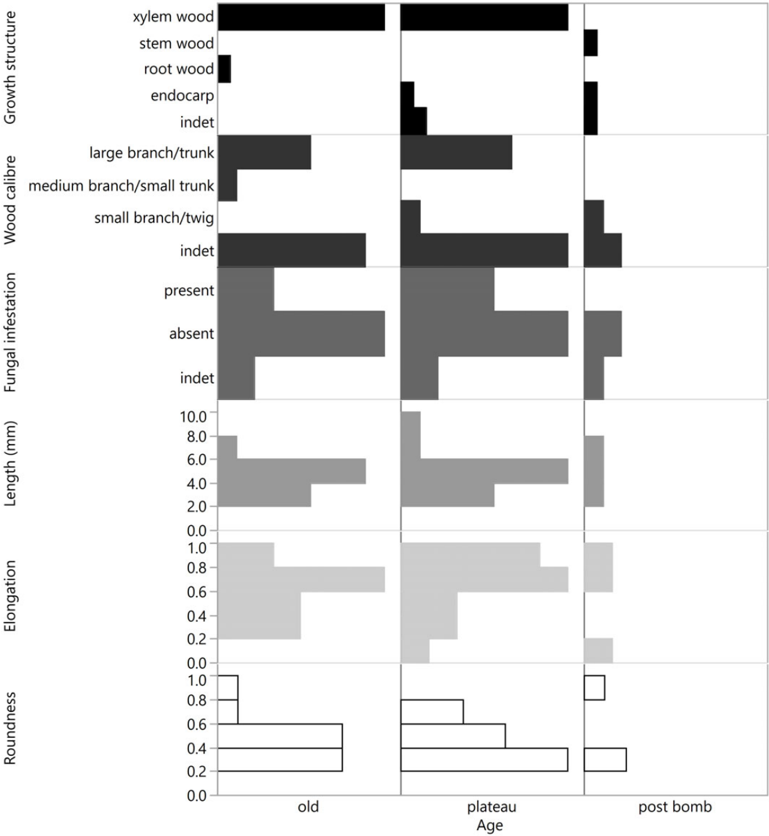
- Taphonomic factors such as size, shape, elongation, roundness, and fungal infestation could not identify the youngest fragments; only two short-lived fragments correctly estimated the date of collection, while xylem wood and wood from large branches or trunks always had an inherited age of more than 20 years.
- The conclusions state that charcoal fragments more than 4 mm in size are often more than 200 years older than their date of deposition, and multiple short-lived materials are required to accurately estimate deposition age.
Methods
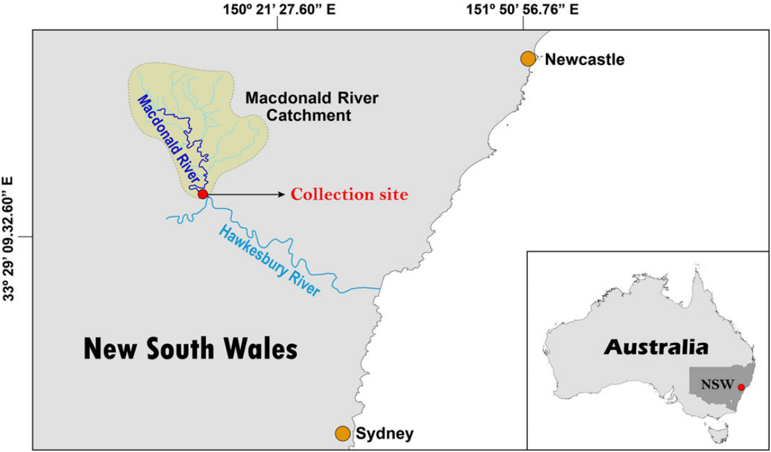
- The study revisited sample SUA-1134 (440 ± 80 BP, unpublished), collected 15.5 km upstream of the Macdonald River confluence with the Hawkesbury River on 15 September 1978; 36 charred plant fragments were randomly selected, and 33 were dated after three were too small.
- Fragments were freeze-dried, examined by SEM at ×22 and ×80 magnification (and ×400/×1000 for most samples), and analyzed with reflected light microscopy at ×50 to ×500 magnification; 12 dendrological and taphonomic features were assessed, including vitrification, clay infill, precipitate nodules, fungal infestation, elongation, roundness, growth structure, and wood calibre.
- After pretreatment with HCl/NaOH/HCl, samples were combusted, graphitized, and measured by NEC Single Stage AMS at the Australian National University; dates were calibrated against SHCal20 or Bomb21 SHCal1-2 in OxCal v.4.4, and %C was measured volumetrically.
Limitations
- The paper states that most fragments could not be taxonomically identified because of high vitrification, mineral precipitates, small size, and poor preservation; only one fragment was identified as cf. Eucalyptus, and most fragments were indeterminable for wood calibre (n=19).
- The paper states that the small number of charcoal fragments studied contrasts with the 1000s needed in the 1970s, that the calibration plateau limits precision, and that further data are required to assess whether the 250-year mode applies across SE Australia or other environments; causal factors cannot be deconvolved, and inherited age may differ before European invasion and in the 20th century.
- Evident from the text: one sample was poorly charred (48%C), some clay remained trapped within vessels, and the sample was collected shortly after a series of floods, so the inherited-age estimate may differ from other flow or drought conditions.
Model-written summary. Check it against the paper before relying on it.
Integrity signals
Registry
Cites
Statistics
Figures
Verification
Claims the paper makes
0 Valid · 0 Not valid · 25 Not checked · 34 Own results and interpretations
A result the paper reports from its own data — it cites no other source for it, so there is none to check. The quote shows it is in the paper.
In the paper
“This study returns to a sample from the Macdonald River to date individual charcoal fragments and finds the inherited age may be more than 1700 years (mode 250 years) older than the collection date.”
- Also stated in: § Radiocarbon Dating · plain
“Ages ranged dramatically within the sample, with the oldest being more than 1700 years old, scattering around the original Sydney Radiocarbon lab age (Figure 2b; Supplementary Table 1).”
§ THE SIZE INHERITED AGE EFFECT ON RADIOCARBON DATES OF ALLUVIAL DEPOSITS: REDATING CHARCOAL FRAGMENTS IN A SAND > Abstract
plainstates a possible cause- Asserted: passes — The authors put it forward as true.
- Checkable: passes — It can be checked against evidence.
- Load-bearing: passes — The paper’s conclusions depend on it.
- Based: passes — The paper gives a reason why it holds.
- Rests on 3 assumptions not shown here.
- Also stated in: § Radiocarbon Dating · plain
A result the paper reports from its own data — it cites no other source for it, so there is none to check. The quote shows it is in the paper.
In the paper
“Only two fragments on short-lived materials correctly estimated the date of collection.”
- Also stated in: § DISCUSSION · plain
“Two (S-ANU66920 and 66932) dated to within 20 years of 1978.”
§ THE SIZE INHERITED AGE EFFECT ON RADIOCARBON DATES OF ALLUVIAL DEPOSITS: REDATING CHARCOAL FRAGMENTS IN A SAND > Abstract
plain- Asserted: passes — The authors put it forward as true.
- Checkable: passes — It can be checked against evidence.
- Load-bearing: passes — The paper’s conclusions depend on it.
- Based: passes — The paper gives a reason why it holds.
- Rests on 3 assumptions not shown here.
- Also stated in: § DISCUSSION · plain
In the paper
“Placing these dates within a single Phase Kernel Density Model in OxCal (Ramsey 2017) shows a peak some 250 years prior to collection, with three smaller peaks at older ages (Figure 2c).”
§ THE SIZE INHERITED AGE EFFECT ON RADIOCARBON DATES OF ALLUVIAL DEPOSITS: REDATING CHARCOAL FRAGMENTS IN A SAND > Radiocarbon Dating
What the sources say
- Not checked yetcites Ramsey 2017 matched to “Methods for Summarizing Radiocarbon Datasets” (2017) source
plain- Asserted: passes — The authors put it forward as true.
- Checkable: passes — It can be checked against evidence.
- Load-bearing: passes — The paper’s conclusions depend on it.
- Based: passes — The paper gives a reason why it holds.
- Rests on 3 assumptions not shown here.
A result the paper reports from its own data — it cites no other source for it, so there is none to check. The quote shows it is in the paper.
In the paper
“Vitrification (glassy appearance) of part or all of the cell anatomy structures was prominent in the charcoal samples at varying levels from fusion of cells (n=28) to strong refractiveness (n=4) and minimal in an endocarp sample (n=1).”
§ THE SIZE INHERITED AGE EFFECT ON RADIOCARBON DATES OF ALLUVIAL DEPOSITS: REDATING CHARCOAL FRAGMENTS IN A SAND > Inherited Age Effect on Alluvial Deposits 7
plainn = 28- Asserted: passes — The authors put it forward as true.
- Checkable: passes — It can be checked against evidence.
- Load-bearing: unclear — It is unclear whether the paper’s conclusions depend on it.
- Based: passes — The paper gives a reason why it holds.
A result the paper reports from its own data — it cites no other source for it, so there is none to check. The quote shows it is in the paper.
In the paper
“To have a 70% chance of obtaining at least one date within 20 years of collection (i.e., within the bomb peak), 10 pieces of charcoal would need to be dated.”
§ THE SIZE INHERITED AGE EFFECT ON RADIOCARBON DATES OF ALLUVIAL DEPOSITS: REDATING CHARCOAL FRAGMENTS IN A SAND > Radiocarbon Dating
hedgedstates an associationn = 3- Asserted: passes — The authors put it forward as true.
- Checkable: passes — It can be checked against evidence.
- Load-bearing: unclear — It is unclear whether the paper’s conclusions depend on it.
- Based: passes — The paper gives a reason why it holds.
21 more claims
Create a free account to see all 59 claims and to verify the 27 references still open.
- It may state two separate claims as one. 23
- Probably not a substantial claim. 18
Self-check
Percentages, sums and reported differences re-computed from the paper’s own numbers.
Each contradiction between two passages listed here was confirmed by an independent check.
Rated minor: it would not touch a result — a value no result rests on, a p-value that stays on the same side of the significance level, or a conflict that is clerical, resolved elsewhere in the paper, or outside its own findings.
In the paper
§ THE SIZE INHERITED AGE EFFECT ON RADIOCARBON DATES OF ALLUVIAL DEPOSITS: REDATING CHARCOAL FRAGMENTS IN A SAND > DISCUSSION
“Old (> 300 cal BP; >cal AD 1650, n=14).”
§ THE SIZE INHERITED AGE EFFECT ON RADIOCARBON DATES OF ALLUVIAL DEPOSITS: REDATING CHARCOAL FRAGMENTS IN A SAND > DISCUSSION
“Plateau (300-0 cal BP; cal AD 1650-1955, n=16)”
Citations
Cites
Bayesian Analysis of Radiocarbon Dates
Bronk Ramsey, C. (2009) · Radiocarbon · doi:10.1017/s0033822200033865 · Cited by 8,725
Discussion Reporting of 14 C Data
Stuiver, M., & Polach, H. A. (1977) · Radiocarbon · doi:10.1017/s0033822200003672 · Cited by 5,640
SHCal20 Southern Hemisphere calibration, 0–55,000 years cal BP
Hogg, A. G., Heaton, T. J., Hua, Q., Palmer, J. G., Turney, C. S., Southon, J., Bayliss, A., Blackwell, P. G., Boswijk, G., Bronk Ramsey, C., et al. (2020) · Radiocarbon · doi:10.1017/rdc.2020.59 · Cited by 1,530 · cited 1×
“All age estimates have been calibrated against SHCal20 (Hogg et al. 2020) or Bomb21 SHCal1-2 (Hua et al. 2022) in OxCal v.4.4 (Ramsey 2009b).”
InfluentialDealing with outliers and offsets in radiocarbon dating
Bronk Ramsey, C. (2009) · Radiocarbon · doi:10.1017/s0033822200034093 · Cited by 1,204 · cited 2×
“All age estimates have been calibrated against SHCal20 (Hogg et al. 2020) or Bomb21 SHCal1-2 (Hua et al. 2022) in OxCal v.4.4 (Ramsey 2009b).”
InfluentialMethods for Summarizing Radiocarbon Datasets
Ramsey, C. B. (2017) · Radiocarbon · doi:10.1017/rdc.2017.108 · Cited by 1,179
Particle shape: a review and new methods of characterization and classification
BLOTT, S. J., & PYE, K. (2008) · Sedimentology · doi:10.1111/j.1365-3091.2007.00892.x · Cited by 879
Carlquist, S. (2001) · Springer Series in Wood Science · doi:10.1007/978-3-662-04578-7 · Cited by 774
ATMOSPHERIC RADIOCARBON FOR THE PERIOD 1950–2019
Hua, Q., Turnbull, J. C., Santos, G. M., Rakowski, A. Z., Ancapichún, S., De Pol-Holz, R., Hammer, S., Lehman, S. J., Levin, I., Miller, J. B., et al. (2022) · Radiocarbon · doi:10.1017/rdc.2021.95 · Cited by 458
Radiocarbon dating and the “old wood” problem: The case of the Hohokam chronology
Schiffer, M. B. (1986) · Journal of Archaeological Science · doi:10.1016/0305-4403(86)90024-5 · Cited by 425
Charcoal analysis and dendrology: data from archaeological sites in north-western France
Marguerie, D., & Hunot, J.-Y. (2007) · Journal of Archaeological Science · doi:10.1016/j.jas.2006.10.032 · Cited by 344
Research works printed but not linked: 7
- lvessalo-Pfäffli M-S. 1995. Fiber atlas: identification of papermaking fibers. Berlin: Springer.
- Raven PH, Evert RF, Eichhorn SE. 2005. Biology of plants. New York: W.H. Freeman and Company.
- Department of Environment and Climate Change. 2008. The native vegetation of Yengo and Parr reserves and surrounds. Department of Environment and Climate Change, Hurstville, NSW.
- Hather JG. 2013. Archaeobotanical guide to root and tuber identification. Havertown, USA: Oxbow Books.
- McFadgen BG. 1982. Dating New Zealand archaeology by radiocarbon. New Zealand Journal of Science 25:379-392.
- Wheeler E, Baas P, Gasson PE. 1989. International Association of Wood Anatomists list of microscopic features for hardwood identification. International Association of Wood Anatomists Bulletin 10: 219-332.
- Hopkins M, Graham A, Head J, Ash J, Armstrong T. 1998. Identification and radiocarbon dating of relict charcoal: uses and constraints in palaeoecology. In: Hope GS, editor. Identifying wood charcoal remains as palaeo evidence for regions of central and north east Australia. Canberra: Australian National University. p. 67-103.
Cited by
Exotic ceramics from the Murray Islands, Eastern Torres Strait
Nutman, E., Clark, G., Leclerc, M., Anenburg, M., Willsher, J., Scorsini, E., Gaffney, D., Summerhayes, G. R., Gibbs, M., Huntley, J., et al. (2024) · Journal of Archaeological Science Reports · doi:10.1016/j.jasrep.2024.104727 · Cited by 8
Carroll, A. L., Philibosian, B. E., Sillett, S. C., Antoine, M. E., & Kozaci, Ö. (2025) · Quaternary Science Advances · doi:10.1016/j.qsa.2025.100283 · Cited by 2
Holocene Lake Sediments Reveal Alluvial Fan History With Links to Climate, Wildfire, and Earthquakes
Gavin, D. G., Struble, W., & Fonstad, M. A. (2024) · Journal of Geophysical Research Earth Surface · doi:10.1029/2024jf007778 · Cited by 1
Gouramanis, C., Chua, S., Etchebes, M., Klinger, Y., Xu, X., & Tapponnier, P. E. (2026) · Palaeogeography Palaeoclimatology Palaeoecology · doi:10.1016/j.palaeo.2026.113929
Fire Histories and Rainforest Aboriginal Archaeology in the Wet Tropics Bioregion, North Queensland
Cosgrove, R., Ferrier, Å., King, F., May, L., Haberle, S. G., Raymont, E., Barlow, C., Field, J. H., Moss, P., & Stager, R. (2025) · Archaeology in Oceania/Archæology & physical anthropology in Oceania · doi:10.1002/arco.70010
Self-citationTrullenque-Blanco, V., Juez, C., Montealegre-Gracia, A. L., & Ollero, A. (2026) · Earth-Science Reviews · doi:10.1016/j.earscirev.2026.105718
Badino, F., Juan, O., & Pini, R. (2026) · Environmental Archaeology · doi:10.1080/14614103.2026.2755209
Rossato, S., Martin, S., Ivy-Ochs, S. D., Viganò, A., Monegato, G., Prosser, G., Vockenhuber, C., & Rigo, M. (2026) · Palaeogeography Palaeoclimatology Palaeoecology · doi:10.1016/j.palaeo.2026.114180
Metadata
- Authors
- Wood, R., King, F., Esmay, R., Chen, Q., Schneider, L., Dotte-Sarout, E., Fallon, S., Fryirs, K., Gillespie, R., & Blong, R.
- Affiliations
- Australian National University (AU)
- La Trobe University (AU)
- The University of Sydney (AU)
- Macquarie University (AU)
- Corresponding author
- Wood, Rachel
- ORCID
- Venue
- Radiocarbon
- Publisher
- Cambridge University Press (CUP)
- Published
- 2023-11-08
- Volume
- 66
- Issue
- 5
- Pages
- 1006-1019
- ISSN
- 0033-8222 (ISSN-L)
- 1945-5755
- OpenAlex
- W4388479818
- Cited by
- 8
- References
- 47
- Citations by year
- 2026: 4 · 2025: 2 · 2024: 2
- FWCI
- 3.40
- Type
- journal article
- Language
- en
- Open access
- hybrid
- doi.org
- Locations
- Radiocarbon (publishedVersion, cc-by)
- Macquarie University (publishedVersion, cc-by)
- UWA Profiles and Research Repository (UWA) (publishedVersion, cc-by)
- Oxford University Research Archive (ORA) (University of Oxford) (publishedVersion, cc-by)
- Funders
- Natural Environment Research Council (NE/V003917/1)
- Topics
- Social Sciences › Archeology › Archaeology and ancient environmental studies
- Physical Sciences › Environmental Science › Global and Planetary Change › Fire effects on ecosystems
- Life Sciences › Agricultural and Biological Sciences › Soil Science › Soil and Environmental Studies
- Keywords
- charcoal dating, alluvial deposits, taphonomy, sand-bed streams, fungal infestation
About these checks
Registry, retraction, Cites and statistics results are computed, not judged, with one exception: a printed reference that no index lists is read once by a model before it counts as a citation error. Claims are extracted by a model and kept only when their quote appears verbatim in the text; each cited source is then checked, with a model’s help, for whether it says what the claim relies on. Those verdicts can be wrong — read the claim’s quote and the cited source before relying on one.
A language model drew the claims from the paper on 2026-11-24, under version 3 of the claim definition (model deepseek-v4.1-flash, prompt extract-v3).
A second model labelled each claim on 2026-11-24 (model jev-1.13-20260917, definition revision gold-guideline-v0.2).
Statistics and arithmetic are recomputed, not judged.
Confidence bands are shown only for fields calibrated on our annotated test set. None is calibrated yet, so no band is shown.
What counts as a claim ›How we measure confidence ›How we check this ›
Are you an author, or do you see a problem with this page? Request a review
Data sources
Bibliographic data: Semantic Scholar, OpenAlex, Crossref.
Contains information from the Semantic Scholar Academic Graph Datasets, made available under the ODC Attribution License (ODC-BY 1.0).
Semantic Scholar’s data is described in: Kinney, R., et al. (2023). The Semantic Scholar Open Data Platform. arXiv:2301.10140.
