

Laboratories of Democratic Backsliding
Open accessThe DOI matches its Crossref record; 142 of the 147 references it cites were found in a registry or an index, and 2 are not checked yet; 8 of the 55 sources its claims cite were checked for support.
Abstract
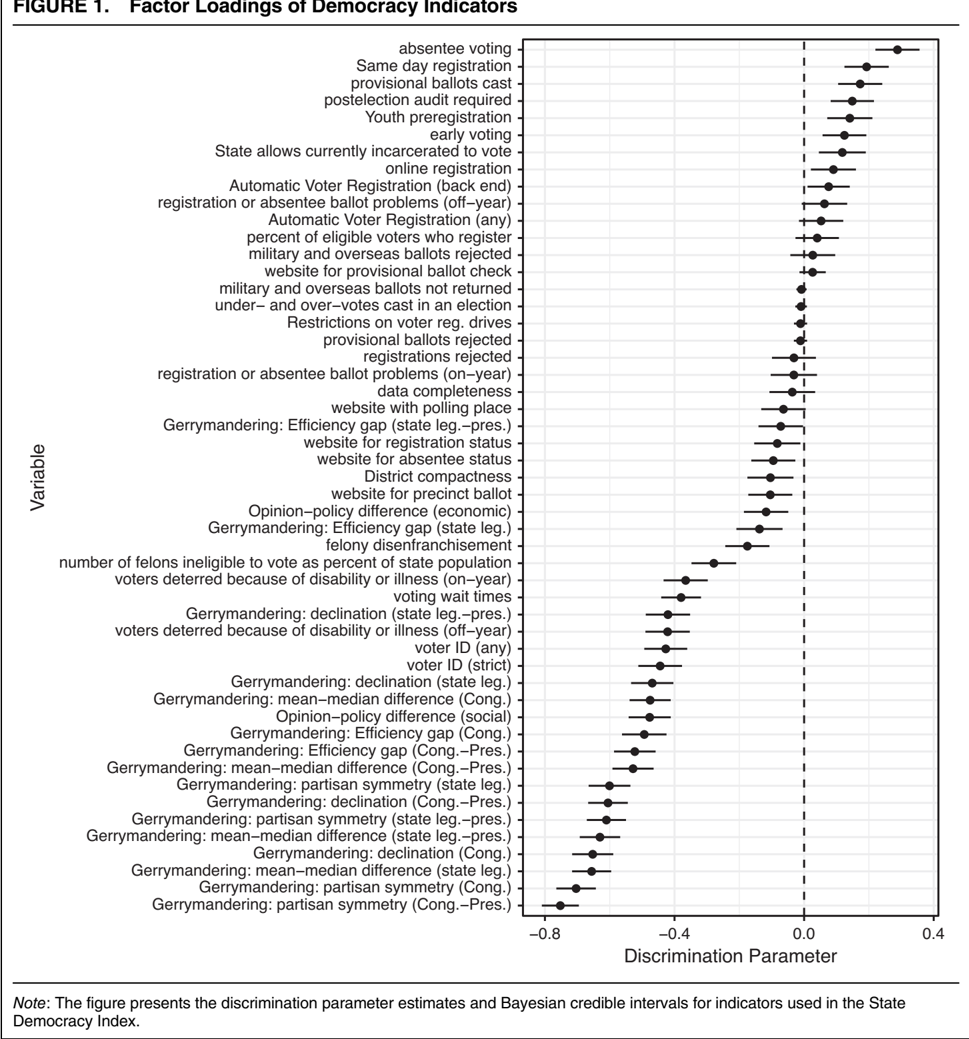
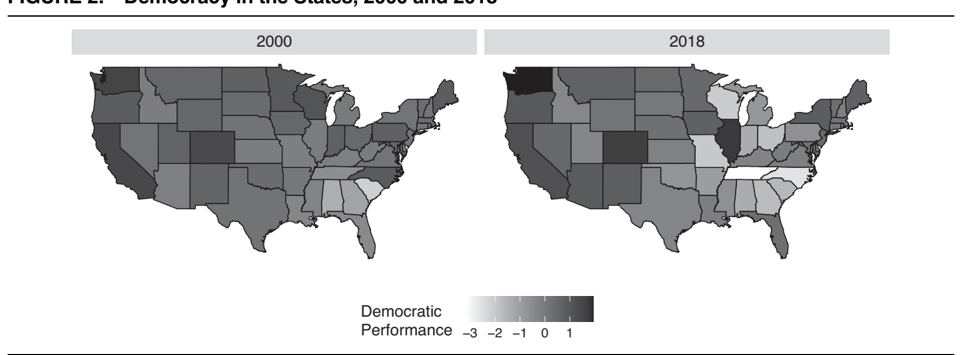
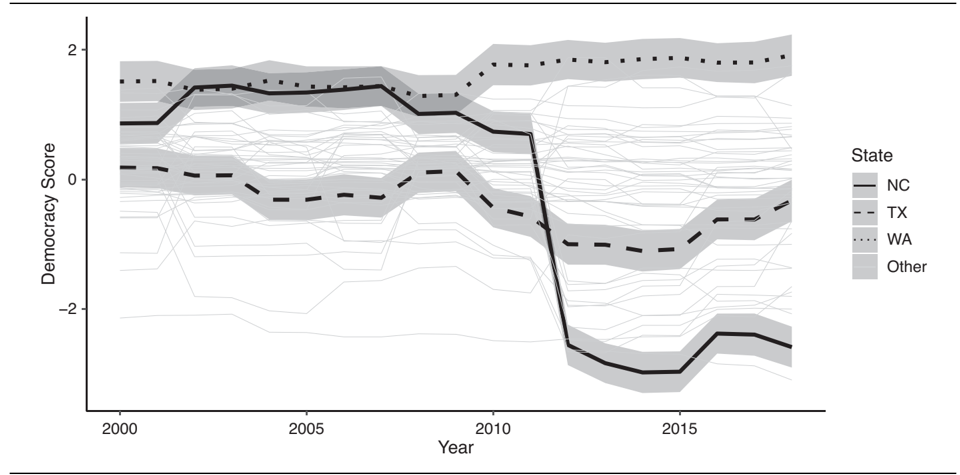
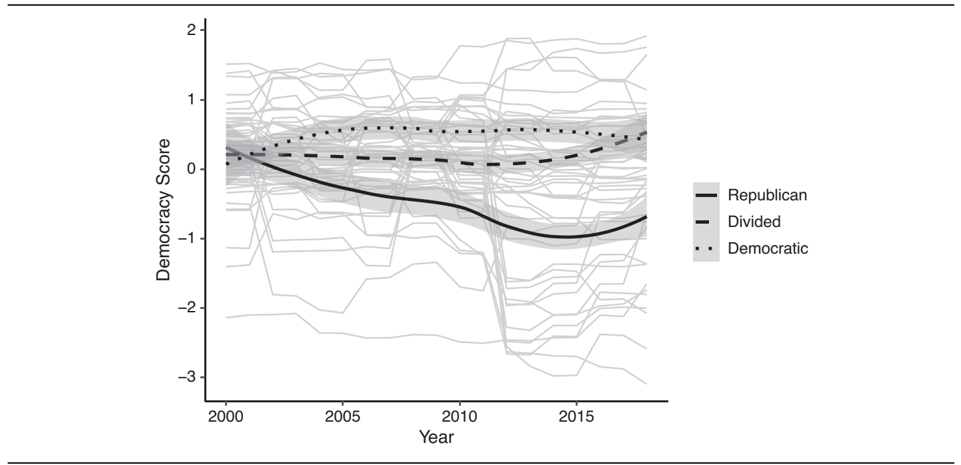
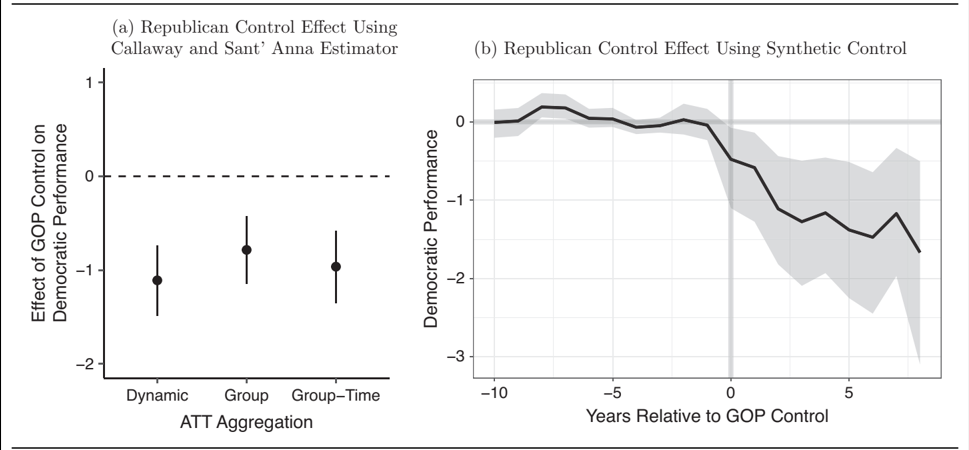
The Trump presidency generated concern about democratic backsliding and renewed interest in measuring the national democratic performance of the United States. However, the US has a decentralized form of federalism that administers democratic institutions at the state level. Using 51 indicators of electoral democracy from 2000 to 2018, I develop a measure of subnational democratic performance, the State Democracy Index. I then test theories of democratic expansion and backsliding based in party competition, polarization, demographic change, and the group interests of national party coalitions. Difference-in-differences results suggest a minimal role for all factors except Republican control of state government, which dramatically reduces states’ democratic performance during this period.
Verified 2026-11-25 · 2 references not checked yet
Overview
CoChat Summary
## TL;DR
The paper builds a new State Democracy Index for the 50 U.S. states from 2000–2018 using 51 indicators of electoral democracy and uses it to test competing explanations for democratic change. It finds that Republican control of state government is the dominant driver of democratic backsliding, with effects around one-half of a standard deviation, while competition, polarization, and within-state racial demographic change matter little.
## Key findings
- The main State Democracy Index is built from 51 indicators of electoral democracy covering 2000–2018.
- Across model specifications, Republican control of state government reduces democratic performance by about 0.442 to 0.481 standard deviations; the paper summarizes the effect as about one-half of a standard deviation.
- In contrast, the estimated effects of competition are much smaller, about 0.141 to 0.206 standard deviations, and polarization is “very small” and in the unexpectedly positive direction.
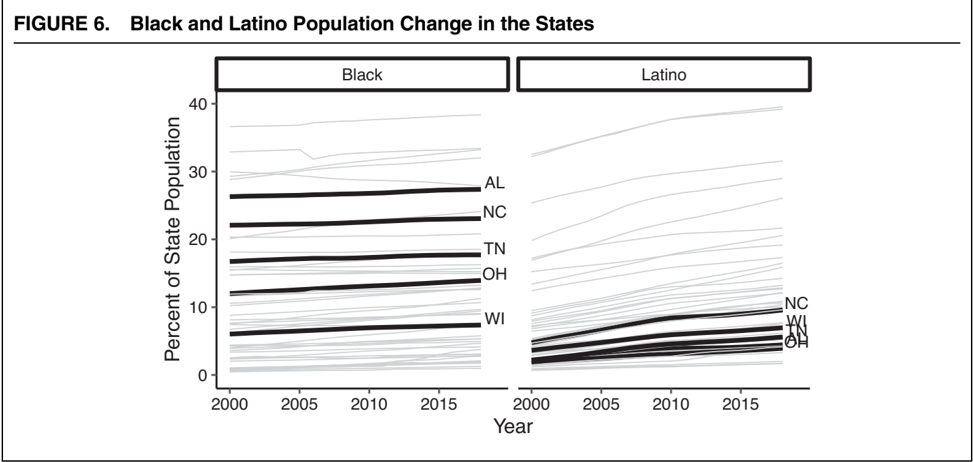
- For racial demographic change, the paper reports that trends in Black and Latino population proportions have little effect on state democratic performance; the one statistically significant interaction, Republican control × Latino population change, is 0.325 and described as small in substantive magnitude.
## Methods
- The study constructs a latent State Democracy Index for state-year units using Bayesian factor analysis for mixed data over 51 indicators; the paper also estimates an alternative simple additive index as a robustness check.
- The main data span the 50 states from 2000 to 2018; Nebraska is excluded from the regression analyses because it has a nonpartisan unicameral legislature.
- The main analysis uses a difference-in-differences design with state and year fixed effects, and robustness checks include generalized synthetic control and Callaway and Sant’Anna-style treatment-effect aggregation.
## Limitations
- The paper explicitly notes that the 2000–2018 time span is short, and says this limits the ability to compare contemporary variation with earlier eras such as slavery and Jim Crow.
- The text makes evident that the measure is limited to contemporary state variation and does not directly capture older, more extreme differences in regime type; this is stated in the paper as a limitation of the period covered.
- The paper also notes, as a methodological limitation, that Bayesian latent-dimension models require parameter constraints and that some indicator parameters can be “wrong” in theoretical terms; the author addresses this with robustness checks and an additive index.
Model-written summary. Check it against the paper before relying on it.
Integrity signals
Registry
Cites
Statistics
Figures
Verification
Claims the paper makes
8 Valid · 5 Not valid · 27 Not checked · 83 Own results and interpretations
The cited sources support only part of this claim — read each source’s verdict below.
In the paper
“Coercive state authority, seen in extreme forms in authoritarian policing and mass incarceration, are also mostly administered with state-level authority (Miller 2008; Soss and Weaver 2017; Weaver and Prowse 2020).”
What the sources say
- Not checked — no full text of the sourcecites Miller 2008 matched to “The Perils of Federalism” (2008) source
- Partly supportedcites Soss and Weaver 2017 matched to “Police Are Our Government: Politics, Political Science, and the Policing of Race–Class Subjugated Communities” (2017) sourceExperimental — accuracy not yet measured
The section “Governance, Citizenship, and the American Polity” describes policing and carceral practices as instruments of coercive state power. But the paper does not establish that they are mostly administered under state-level authority; “The Expansion of Policing and Reconstitution of Police Power” instead discusses local police agencies alongside federal funding and agendas. Its use of “state power” does not specify the U.S. state-government level. (LLM, conf=0.84)
- Not checked — no full text of the sourcecites Weaver and Prowse 2020 matched to “Racial authoritarianism in U.S. democracy” (2020) source
plain- Asserted: passes — The authors put it forward as true.
- Checkable: passes — It can be checked against evidence.
- Load-bearing: unclear — It is unclear whether the paper’s conclusions depend on it.
- Based: passes — The paper gives a reason why it holds.
Every source the paper cites for this claim was checked and supports it.
In the paper
“In particular, I use Bayesian factor analysis for mixed data (Quinn 2004) because the democracy indicators may be binary (e.g., same-day voter registration), ordinal (e.g., disenfranchisement of all, some, or no felons), or continuous (e.g., legislative district efficiency gap).”
What the sources say
- Supportedcites Quinn 2004 matched to “Bayesian Factor Analysis for Mixed Ordinal and Continuous Responses” (2004) source
The Introduction (page not provided) describes a Bayesian factor-analysis model for indicators that mix ordinal and continuous responses. Section 4.1 (page not provided) applies it to dichotomous, ordinal, and continuous variables. The citation identifies the method used for the State Democracy Index; it does not attribute that index or its specific indicators to Quinn. (LLM, conf=0.93)
plainstates a cause- Asserted: passes — The authors put it forward as true.
- Checkable: passes — It can be checked against evidence.
- Load-bearing: passes — The paper’s conclusions depend on it.
- Based: passes — The paper gives a reason why it holds.
- Supported
Every source the paper cites for this claim was checked and supports it.
In the paper
“Bartels (2020, 22752), for instance, finds that ' substantial numbers of Republicans endorse statements contemplating violations of key democratic norms, including respect for the law and for the outcomes of elections and eschewing the use of force in pursuit of political ends '”
What the sources say
- Supportedcites Bartels 2020 matched to “Ethnic antagonism erodes Republicans’ commitment to democracy” (2020) source
The paper’s Abstract states the attributed finding almost verbatim. It identifies respect for the law, election outcomes, and rejection of political violence as the democratic norms at issue; the following passage gives the survey responses underlying that finding. (LLM, conf=0.95)
plain- Asserted: passes — The authors put it forward as true.
- Checkable: passes — It can be checked against evidence.
- Load-bearing: unclear — It is unclear whether the paper’s conclusions depend on it.
- Based: passes — The paper gives a reason why it holds.
- Supported
A result the paper reports from its own data — it cites no other source for it, so there is none to check. The quote shows it is in the paper.
In the paper
“Difference-in-differences results suggest a minimal role for all factors except Republican control of state government, which dramatically reduces states ' democratic performance during this period.”
- Also stated in: § INTRODUCTION · boosted
“Across measures and model specifications, the results are remarkably clear: Republican control of state government reduces democratic performance.”
boostedstates a cause- Asserted: passes — The authors put it forward as true.
- Checkable: passes — It can be checked against evidence.
- Load-bearing: passes — The paper’s conclusions depend on it.
- Based: passes — The paper gives a reason why it holds.
- Also stated in: § INTRODUCTION · boosted
A result the paper reports from its own data — it cites no other source for it, so there is none to check. The quote shows it is in the paper.
In the paper
“The magnitude of democratic contraction from Republican control is surprisingly large, about one-half of a standard deviation.”
plainstates a cause- Asserted: passes — The authors put it forward as true.
- Checkable: passes — It can be checked against evidence.
- Load-bearing: passes — The paper’s conclusions depend on it.
- Based: passes — The paper gives a reason why it holds.
65 more claims
Create a free account to see all 123 claims and to verify the 4 references still open.
- It may state two separate claims as one. 28
- Probably not a substantial claim. 28
Citations
Cites
Mostly Harmless Econometrics: An Empiricist's Companion
Angrist, J. D., & Pischke, J.-S. (2009) · doi:10.1515/9781400829828 · Cited by 9,467
Difference-in-Differences with multiple time periods
Callaway, B., & Sant’Anna, P. H. C. (2021) · Journal of Econometrics · doi:10.1016/j.jeconom.2020.12.001 · Cited by 9,126
Difference-in-differences with variation in treatment timing
Goodman-Bacon, A. (2021) · Journal of Econometrics · doi:10.1016/j.jeconom.2021.03.014 · Cited by 8,046
Capitalism, Socialism and Democracy.
Robinson, J., & Schumpeter, J. A. (1943) · The Economic Journal · doi:10.2307/2226398 · Cited by 6,529
A Rational Theory of the Size of Government
Meltzer, A. H., & Richard, S. F. (1981) · Journal of Political Economy · doi:10.1086/261013 · Cited by 5,485
Mostly Harmless Econometrics: An Empiricist's Companion
Angrist, J. D., & Pischke, J.-S. (2008) · doi:10.2307/j.ctvcm4j72 · Cited by 5,051
(1990) · Choice Reviews Online · doi:10.5860/choice.27-2963 · Cited by 3,601
Competitive Authoritarianism: Hybrid Regimes after the Cold War
Levitsky, S., & Way, L. A. (2010) · doi:10.1017/cbo9780511781353 · Cited by 3,459
Concept Misformation in Comparative Politics
Sartori, G. (1970) · American Political Science Review · doi:10.2307/1958356 · Cited by 3,318 · cited 2×
“Thus, the conceptualization of electoral democracy as a subcomponent means it takes us “ up ” the ladder of generality (Sartori 1970), applying to more cases, whereas its conceptualization as a diminished subtype takes us “ down ” the ladder of generality. investigating the democratic performance…”
BackgroundMethodConstituency Influence in Congress
Miller, W. E., & Stokes, D. E. (1963) · American Political Science Review · doi:10.2307/1952717 · Cited by 2,293
Research works printed but not linked: 6
- Riker, William H. 1975. ' Federalism. ' In Handbook of Political Science: Governmental Institutions and Processes , eds. Fred I. Greenstein and Nelson W. Polsby, 93 -172. Reading, MA: Addison-Wesley.
- Levitsky, Steven, and Daniel Ziblatt. 2018. How Democracies Die . New York: Broadway Books.
- Dahl, Robert A. 2003. HowDemocraticis the American Constitution? New Haven, CT: Yale University Press.
- Dionne, E. J., Jr., Norman J. Ornstein, and Thomas E. Mann. 2017. One Nation after Trump: A Guide for the Perplexed, the Disillusioned, the Desperate, and the Not-Yet Deported . New York: St. Martin ' s Press.
- Hertel-Fernandez, Alexander. 2019. State Capture: How Conservative Activists, Big Businesses, and Wealthy Donors Reshaped the American State -and the Nation . New York: Oxford University Press.
- Gessen, Masha. 2016. ' Autocracy: Rules for Survival. ' New York Review , November 10. https://www.nybooks.com/daily/2016/11/10/ trump-election-autocracy-rules-for-survival/. - Gibson, Edward L. 2005. ' Boundary Control: Subnational Authoritarianism in Democratic Countries. ' World Politics 58 (1): 101 -32.
Cited by
Reference Points and Democratic Backsliding
Grillo, E., & Prato, C. (2023) · American Journal of Political Science · doi:10.1111/ajps.12672 · Cited by 113
How climate policy commitments influence energy systems and the economies of US states
Bergquist, P., & Warshaw, C. (2022) · Nature Communications · doi:10.1038/s41467-023-40560-y · Cited by 70
How to study democratic backsliding
Druckman, J. N. (2024) · Political Psychology · doi:10.1111/pops.12942 · Cited by 56
US State Policy Contexts and Population Health
Montez, J. K., & Grumbach, J. M. (2023) · Milbank Quarterly · doi:10.1111/1468-0009.12617 · Cited by 58
“54,57,58”
BackgroundSelf-citationDemocracy by Deterrence: Norms, Constitutions, and Electoral Tilting
Helmke, G., Kroeger, M., & Paine, J. (2022) · American Journal of Political Science · doi:10.1111/ajps.12668 · Cited by 45
Causal Panel Analysis under Parallel Trends: Lessons from a Large Reanalysis Study
CHIU, A., LAN, X., LIU, Z., & XU, Y. (2026) · American Political Science Review · doi:10.1017/s0003055425000243 · Cited by 48
Theories of Democratic Backsliding
Grillo, E., Luo, Z., Nalepa, M., & Prato, C. (2024) · Annual Review of Political Science · doi:10.1146/annurev-polisci-041322-025352 · Cited by 97
The Forum: Global Challenges to Democracy? Perspectives on Democratic Backsliding
Bartels, L. M., Daxecker, U., Hyde, S., Lindberg, S. I., & Nooruddin, I. (2023) · International Studies Review · doi:10.1093/isr/viad019 · Cited by 90
Illiberal regimes and international organizations
Cottiero, C., Hafner-Burton, E. M., Haggard, S. M., Prather, L., & Schneider, C. J. (2024) · The Review of International Organizations · doi:10.1007/s11558-024-09556-1 · Cited by 51
“…democratic regress as a result of actions taken by illiberal executives that are elected (Arriola et al., 2021; Bartels, 2023; Bermeo, 2016a; Grumbach, 2023; Hafner-Burton & Schneider, 2023; Haggard & Kaufman, 2021a, 2021b; Levitsky & Ziblatt, 2018; Mainwaring & Pérez-Liñán, 2014;…”
Carrillo, I. R., King, K. Q., & Schafft, K. A. (2021) · Rural Sociology · doi:10.1111/ruso.12402 · Cited by 36
What If We Are the WEIRD Ones? A Call (and Roadmap) for More Non-WEIRD Entrepreneurship Research
Shepherd, D. A., Wincent, J., & Chase, S. R. (2025) · Entrepreneurship Theory and Practice · doi:10.1177/10422587251347051 · Cited by 48
“Indeed, while the quality of democracy can vary within a democratic country (e.g., Grumbach [2023] reports that the quality of democracy is lowest in the United States for Tennessee, North Carolina, and Wisconsin), it is an overreach to categorize these regions as non-democratic.”
Causal Panel Analysis under Parallel Trends: Lessons from a Large Reanalysis Study *Preprint
Chiu, A., Lan, X., Liu, Z., et al. (2023) · SSRN Electronic Journal · doi:10.2139/ssrn.4490035 · Cited by 22
The Politics of Bathroom Access and Exclusion in the United States
Chatfield, S. (2024) · Cambridge University Press eBooks · doi:10.1017/9781009429085 · Cited by 19
Jang, H., & Kreiss, D. (2024) · The International Journal of Press/Politics · doi:10.1177/19401612241235819 · Cited by 19
“…Republican partisan efforts to legally limit the participation of political opponents through electoral rules (such as around voter identification) (Grumbach 2023), and the express attempt by a sitting Republican president to prevent the peaceful transfer of power through an attempted auto-coup…”
Vampa, D., Boni, F., Fiseha, A., Kenny, M., López‐Santana, M., & Zulianello, M. (2025) · Regional & Federal Studies · doi:10.1080/13597566.2025.2518752 · Cited by 17
“They can also harbour authoritarian enclaves or contribute to democratic erosion (Grumbach 2022, 2023).”
Civil Society, Realized: Equipping the Mass Public to Express Choice and Negotiate Power
Han, H. C., & Kim, J. Y. (2022) · The Annals of the American Academy of Political and Social Science · doi:10.1177/00027162221077471 · Cited by 14
Countering the Wave of Democratic Backsliding and the Crisis of Democracy in West Africa
Arthur, P. (2025) · Insight on Africa · doi:10.1177/09750878241312188 · Cited by 19
“A final argument is that by Grumbach (2023), who noted the role played by polarisation in democratic contractions.”
What Can We Learn about the Effects of Democracy Using Cross-National Data?
Doucette, J. (2024) · American Political Science Review · doi:10.1017/s0003055424001278 · Cited by 15
Thomas, E. F., O'Donnell, A. W., Osborne, D., Bird, L. H., Yip, L., Buonaiuto, E., Lizzio‐Wilson, M., Skitka, L. J., & Wenzel, M. (2025) · Political Psychology · doi:10.1111/pops.13075 · Cited by 13
“Conspiracy and misinformation regarding the electoral process and outcome were widely circulated during the US Presidential Election (see Grumbach, 2023; Wang & van Prooijen, 2023).”
Lobo, J. R. F., Marinho, M., Peci, A., & Guedes-Neto, J. V. (2025) · Policy Studies · doi:10.1080/01442872.2025.2546382 · Cited by 14
“Although the democracy-authoritarianism divide exists at lower levels of government (Grumbach 2023; Leonard 2024), it was far more salient at the national level during the administration of far-right President Jair Bolsonaro.”
Democratic Vulnerabilities and Pathways for Reform
Mettler, S. B., Lieberman, R. C., Michener, J., Pepinsky, T. B., & Roberts, K. M. (2022) · The Annals of the American Academy of Political and Social Science · doi:10.1177/00027162221077516 · Cited by 12
The impact of voter confusion in ranked choice voting
Atkeson, L. R., McKown‐Dawson, E., Santucci, J., & Saunders, K. L. (2024) · Social Science Quarterly · doi:10.1111/ssqu.13366 · Cited by 9
What is a “regime”? Three definitions and their implications for the future of regime studies
Cianetti, L., Panta, G. D., & Owen, C. (2025) · Democratization · doi:10.1080/13510347.2025.2483418 · Cited by 27
Jansa, J. M., Motta, M., & Herrick, R. (2021) · American Politics Research · doi:10.1177/1532673x211055050 · Cited by 8
“The flexibility of the hybrid IRT model has led it to be used in a number of similar applications, such as the extraction of a single measure of statelevel democracy (Grumbach, 2021).”
MethodElectoral Democracy and Working‐Age Mortality
Montez, J. K., Cheng, K. J. G., & Grumbach, J. M. (2023) · Milbank Quarterly · doi:10.1111/1468-0009.12658 · Cited by 12
Self-citationState cigarette taxes, smoking cessation, and implications for the educational gradient in mortality
Riley, A. R. (2024) · Social Science & Medicine · doi:10.1016/j.socscimed.2024.117398 · Cited by 7
Dynamic Democratic Backsliding
Yeung, E. S. F. (2025) · British Journal of Political Science · doi:10.1017/s0007123425100847 · Cited by 10
“Under the leadership of former governors Pat McCrory and Scott Walker, for example, North Carolina and Wisconsin suffered substantial decreases in democratic performance (Grumbach 2023).”
Democratic Backsliding in the American States: The Case of Judicial Independence
Leonard, M. E. (2024) · Publius: The Journal of Federalism · doi:10.1093/publius/pjae009 · Cited by 7
Unity makes strength: Patterns of democratic resistance against autocratization
Panzano, G., & Tomini, L. (2026) · European Journal of Political Research · doi:10.1017/s1475676525100595 · Cited by 7
Anti‐Democratic Influence: The Effect of Citizens United on State Democratic Performance
Fordham, R. F. (2024) · Legislative Studies Quarterly · doi:10.1111/lsq.12447 · Cited by 8
The Policy Process in Democratic Backsliding: A Proposed Framework of Analysis
Silva, M. M. D. S. E., & Gomide, A. D. Á. (2024) · International series on public policy · doi:10.1007/978-3-031-65707-8_1 · Cited by 6
Rising Threats to U.S. Democracy: Roots and Responses
Skocpol, T. R. (2025) · PS Political Science & Politics · doi:10.1017/s1049096524001033 · Cited by 8
Election Denial as a News Coverage Dilemma: A Survey Experiment with Local Journalists
Peterson, E., McGregor, S. C., & Block, R. (2025) · Political Communication · doi:10.1080/10584609.2025.2456524 · Cited by 10
“…practices to cover election denial or adopt alternatives has important implications for the political information environment and is relevant for other situations where democratic backsliding and disinformation present journalists with similar challenges (Graves et al., 2016; Grumbach, 2023).”
Studying personality and social structure
Antonoplis, S. (2024) · Social and Personality Psychology Compass · doi:10.1111/spc3.12932 · Cited by 10
Evaluating the Minority Candidate Penalty with a Regression Discontinuity Approach
White, A. R., Shah, P. R., Juenke, E. G., & Fraga, B. L. (2024) · British Journal of Political Science · doi:10.1017/s0007123423000583 · Cited by 5
“The results may also help address a larger set of questions around increasing descriptive representation and more polarized backsliding on substantive representation in the US in the twenty-first century (Enders and Scott 2019; Grumbach 2022), which we consider in the conclusion.”
BackgroundGreenberger, M., & Smith, J. (2025) · The Journal of Race Ethnicity and Politics · doi:10.1017/rep.2025.33 · Cited by 4
“For example, Grumbach (2023) measures democratic variation within states in the twenty-first century.”
The Rikerian Arrow at the Heart of Democratic Backsliding: A System Theory Approach
Woods, D. (2025) · Chinese Political Science Review · doi:10.1007/s41111-025-00314-1 · Cited by 4
Intersectional trends in poor mental health and health inequities across the US
Blaikie, K., Mooney, S. J., Hill, H. D., Rhew, I. C., & Hajat, A. (2024) · SSM - Mental Health · doi:10.1016/j.ssmmh.2024.100349 · Cited by 8
Democratic Backsliding and Ethnic Politics: The Republican Party in the United States
Lieberman, R. C., & Schlozman, D. (2024) · Comparative Political Studies · doi:10.1177/00104140241302714 · Cited by 8
“So we are hesitant to make too much of these nonetheless suggestive data (Grumbach, 2023).”
Voting access reforms and policy feedback effects on political efficacy and trust
Trexler, A., Martinez, M., & SoRelle, M. E. (2025) · Policy Studies Journal · doi:10.1111/psj.70022 · Cited by 4
January 6th and De-Democratization in the United States
Castañeda, E., & Jenks, D. (2023) · Social Sciences · doi:10.3390/socsci12040238 · Cited by 8
Prianto, A. L., & Yuslaini, N. (2024) · JWP (Jurnal Wacana Politik) · doi:10.24198/jwp.v9i2.53451 · Cited by 4
Right to Work or Right to Vote? Labor Policy and American Democracy
Frymer, P., Grumbach, J. M., & Hill, C. (2025) · Perspectives on Politics · doi:10.1017/s1537592724001427 · Cited by 5
Self-citationUnder China’s shadow: Authoritarian rule and domestic political divisions in Thailand
Chow, W., Khemanitthathai, S., & Han, E. (2025) · International Relations of the Asia-Pacific · doi:10.1093/irap/lcaf002 · Cited by 5
Direct Democracy Backsliding, 1950-2024Preprint
Matsusaka, J. G. (2023) · SSRN Electronic Journal · doi:10.2139/ssrn.4522377 · Cited by 4
Yesilkagit, K., & Christensen, J. (2026) · Governance · doi:10.1111/gove.70124 · Cited by 6
Shen-Bayh, F. F. (2024) · Oxford University Press eBooks · doi:10.1093/oxfordhb/9780198871996.013.57 · Cited by 6
Sandoval, J. P. (2024) · Perspectives on Politics · doi:10.1017/s1537592724001130 · Cited by 3
Dismantling While Accumulating: Dynamics of Local Participatory Institutions in the Philippines
Saguin, K. I., & Medina-Guce, C. (2024) · International series on public policy · doi:10.1007/978-3-031-65707-8_8 · Cited by 3
Jang, W., & Yoo, D. (2024) · Democratization · doi:10.1080/13510347.2024.2434662 · Cited by 7
Which States Adopt Election-Subversion Policies?
Grumbach, J. M., & Hill, C. (2023) · The Annals of the American Academy of Political and Social Science · doi:10.1177/00027162241232809 · Cited by 5
Self-citationElitism versus Populism: Experiments on the Dual Threat to American Democracy
Bram, C. (2025) · Cambridge University Press eBooks · doi:10.1017/9781009546898 · Cited by 4
State Labor Laws and Government Responsiveness to Public Opinion
DiSalvo, D., Flavin, P., & Hartney, M. T. (2023) · Political Research Quarterly · doi:10.1177/10659129221145938 · Cited by 4
Division on the Christian right: Republican pastors and the use of force
Shady, S. N., Hooghe, L., & Marks, G. W. (2024) · Politics and Religion · doi:10.1017/s1755048324000191 · Cited by 4
“The chief independent variables are biblical literalism, Christian nationalism, White grievance, and election distrust (see the online Appendix for wording).”
BackgroundFirst survive, then thrive: major urban centres and resistance against autocratisation
Tomini, L., Sandri, G., & Szymański, A. (2025) · Contemporary Politics · doi:10.1080/13569775.2025.2457224 · Cited by 9
“Crucially for our purposes, relatively few scholars have begun exploring the role of subnational entities in shaping processes of democratisation and autocratisation – and only recently (Gervasoni, 2024; Grumbach, 2023; Pérez Sandoval, 2023).”
Media Capture, Survival of the Corruptest and Journalistic Agency: The Case of Bulgaria
Slavtcheva‐Petkova, V., Pogson, M., & Karadjov, C. D. (2025) · The International Journal of Press/Politics · doi:10.1177/19401612251319939 · Cited by 2
“…powers such as the United States has attracted a considerable amount of scholarly and popular attention (e.g., Diamond 2019; Foa and Mounk 2017; Grumbach 2023; Ginsburg and Hug 2018; Levitsky and Ziblatt 2018; Merkel 2020; Norris 2017), due to larger societal structural issues both within…”
Partisans' evaluations of unconstitutional legislative activity
Banda, K. K., Cluverius, J., & Kirkland, J. H. (2025) · Policy Studies Journal · doi:10.1111/psj.70033 · Cited by 2
Race, Reform, and Recalls: The Movement Against “Progressive” Prosecutors
Goldberg, A. (2025) · The Journal of Race Ethnicity and Politics · doi:10.1017/rep.2025.10043 · Cited by 2
Using LLMs to Enhance Democracy
Lazar, S., & Manuali, L. (2026) · Minds and Machines · doi:10.1007/s11023-026-09767-y · Cited by 28
“…the hubris of the 1990s (Fukuyama, 2020), the last two decades have seen democratic institutions come under increasing pressure, with the global rise of authoritarianism and a growing sense that democracy is in crisis (Diamond, 2020; Kingzette et al., 2021; Scheppele, 2022; Grumbach, 2023).”
Zubizarreta, D., Beccia, A. L., Matthay, E. C., Jahn, J. L., & Schnake-Mahl, A. S. (2026) · Social Science & Medicine · doi:10.1016/j.socscimed.2026.119536 · Cited by 2
The Effects of Proportional Representation on Election Lawmaking: Evidence from New Zealand
Ferrer, J. (2022) · Representation · doi:10.1080/00344893.2022.2032292 · Cited by 1
“This also comports with evidence in the United States that uni fi ed Republican control is the most important determinant to explaining the adoption of voting restriction (Bentele & O ’ Brien, 2013; Biggers & Hanmer, 2017; Grumbach, 2021; Hicks et al., 2015).”
The US Presidency: Power and Constraint
Brettschneider, C. L., & Calvelli, A. G. (2024) · Annual Review of Political Science · doi:10.1146/annurev-polisci-051120-113134 · Cited by 2
Secure majorities, unequal districts: One person, one vote & state bipartisanship
Hayes, S. D., & Gaynor, S. W. (2024) · Electoral Studies · doi:10.1016/j.electstud.2024.102835 · Cited by 3
Is There Linkage Between State Citizen Civility & State Legislative Civility?
Pierce, J. C., Schreckhise, W. D., Kurtz, K. T., Lovrich, N. P., Benjamin, F., Steel, B. S., & Stehr, S. D. (2024) · State and Local Government Review · doi:10.1177/0160323x241271269 · Cited by 2
“…that through the legislative process, legislatures by-and-large reflect the preferences of their citizens in their work, albeit at times imperfectly (e.g., Caughey and Warshaw 2018; Erikson, Wright, and McIver 1993; Haider-Markel and Kaufman 2006; Lax and Phillips 2012; but see Grumbach 2023).”
Democratic backsliding and support for public good provision in the European Union
Heermann, M., Baute, S., & Leuffen, D. (2025) · Journal of European Public Policy · doi:10.1080/13501763.2025.2503973 · Cited by 5
“…implications of democratic backsliding for international cooperation but also the challenges that backsliding in federated units poses for the overall democratic quality and legitimacy of (quasi-) federal systems (see also Grumbach, 2023 for the case of the contemporary US; Kaufman et al. , 2024).”
Has the Roberts Court Helped Donald Trump and the GOP Rig Elections and Erode American Democracy?
Peretti, T. J. (2024) · The Annals of the American Academy of Political and Social Science · doi:10.1177/00027162251335138 · Cited by 4
Federalism and Polarization: How Can Research Be More Relevant?
Weissert, C. S. (2025) · Publius The Journal of Federalism · doi:10.1093/publius/pjaf060 · Cited by 14
Democratic Backsliding Damages Foreign Public Support for Security CooperationPreprint
Inouye, R. J., Horiuchi, Y., Jo, E. A., & Matush, K. (2025) · SSRN Electronic Journal · doi:10.2139/ssrn.5610710 · Cited by 5
Garoupa, N. M., & Spruk, R. (2024) · Social Indicators Research · doi:10.1007/s11205-024-03364-1 · Cited by 3
“And third, the democratic backsliding in the United States after the election of Donald Trump is a subject of rigorous debate and discussion (Grumbach, 2023; Kaufman & Haggard, 2019).”
Did Changes to the Voting Rights Act Cause Electoral Backsliding in the States?
Malmberg, A. (2024) · Election Law Journal Rules Politics and Policy · doi:10.1089/elj.2023.0052 · Cited by 1
The Consequences of Elite Action Against Elections
Porter, R., Harden, J. J., Anderson, E. J., de Freitas, G., Dobson, M. R., Hemmen, A., & Schroeder, E. (2025) · British Journal of Political Science · doi:10.1017/s0007123425100926 · Cited by 2
“…policies enacted by state legislatures have exacerbated this polarization (Campos et al. 2024; Fordham 2024) and contributed to democratic decline (Grumbach 2023), particularly in states where the presidential election in 2020 was closely contested (Grumbach and Hill 2023, but see Druckman et al.…”
The importance of local racial demographic changes in democratic erosion in the mass American public
Thompson, A. I., & McCabe, S. (2025) · Proceedings of the National Academy of Sciences · doi:10.1073/pnas.2501150122 · Cited by 2
Baumert, J.-F., & Harmening, M. (2026) · Quality & Quantity · doi:10.1007/s11135-026-02615-2 · Cited by 1
Procedural Polarization: How Election Rules Shape Voters’ Confidence
Clinton, J. D. (2026) · American Political Science Review · doi:10.1017/s000305542610166x · Cited by 1
Gender Equality as Foundational to Democracy: Theory and Evidence of Gendered Political Culture(s)
Lefkofridi, Z., Beloshitzkaya, V., Górny, J., & Lotter, L. (2026) · Politics and Governance · doi:10.17645/pag.11716 · Cited by 1
“At the time of writing, we are witnessing democratic backsliding in Europe (Krizsán & Roggeband, 2018; Lombardo et al., 2021; Pető, 2021) and in the US (Grumbach, 2023; Haggard & Kaufman, 2021).”
Attitudes Toward Electoral System Reform and Party System Change in the U.S.
Mayne, Q., & Singh, S. P. (2026) · American Political Science Review · doi:10.1017/s0003055426101658 · Cited by 1
“…democratic deconsolidation (Foa and Mounk 2017; Levitsky and Ziblatt 2018), and not least given ongoing efforts to re-engineer electoral institutions in ways that undermine democratic principles (Grumbach 2023; Haggard and Kaufman 2021), work has begun to appear on this question in recent years.”
Partisanship and Voting Rule Trade-offs
Doherty, D., Dowling, C., Miller, M. G., & Milyo, J. D. (2026) · American Politics Research · doi:10.1177/1532673x261470402 · Cited by 1
“…to which changes in voting laws affect voter participation or election outcomes continues to be a matter of scholarly debate (Atkeson et al., 2010; Fraga & Miller, 2022; Grimmer et al., 2018; Grimmer & Hersh, 2024; Grumbach, 2023; Miller et al., 2026; Miller & Morris, 2026; Morris & Miller, 2026).”
Karatekin, C., Mason, S. M., Latner, M., Gresham, B. L., Corcoran, F., Hing, A. K., & Barnes, A. J. (2023) · Social Science & Medicine · doi:10.1016/j.socscimed.2023.116344 · Cited by 2
Naughton, D. C. (2024) · Scholarly Horizons University of Minnesota Morris Undergraduate Journal · doi:10.61366/2576-2176.1133 · Cited by 1
Han, J. Y. (2024) · Political Studies Review · doi:10.1177/14789299241249136 · Cited by 1
“In a broader sense, my theoretical framework is related to the literature on democratic backslidings, seeking to theorize under which conditions voters are willing to tolerate politicians’ misconducts (Graham and Svolik, 2020; Grumbach, 2023; Krishnarajan, 2023).”
Bell, L. C., Rank, A. D., & Whaley, C. O. (2024) · Political pedagogies · doi:10.1007/978-3-031-55155-0_1 · Cited by 1
Collaborative diffusion: The dynamics of policy output in COVID ‐19 interstate compacts
Pollert, I., Olvera, J. G., Desmarais, B. A., et al. (2025) · Policy Studies Journal · doi:10.1111/psj.70008 · Cited by 1
“The policymaking actions we observe may be driven by the efforts of actors who are themselves not public officials, and include national party organizations or interest groups embedded in ideological networks (Garrett & Jansa, 2015; Grumbach, 2023).”
Perceived Partisan Preemption: When and Where States Override Local School Boards
Goldberg, M., Kitchens, K., & Baldwin, L. (2025) · State and Local Government Review · doi:10.1177/0160323x251343024 · Cited by 1
“The questions of preemption and decision-making fit in a larger discussion of democracy during a period of democratic backsliding driven in part by state governments, as documented by Grumbach (2023).”
Elections and Representation in American Municipal Administration
Marsh, W. Z. C., Olson, M. P., Reeves, A., & Wong, J. D. (2025) · Political Research Quarterly · doi:10.1177/10659129251389624 · Cited by 1
Swing State? The Impact of Twenty Years of Florida Election Law Post-HAVA
Barsky, C. S., Clark, A. D., & Bustinza, M. A. (2023) · Springer eBooks · doi:10.1007/978-3-031-42749-7_7 · Cited by 1
Rights Regimes and Interstate Migration DecisionsPreprint
Nelson, M. J., & Witko, C. (2022) · doi:10.33774/apsa-2022-zbwgv · Cited by 1
US State Climate Policy Commitments, the Energy System, and the EconomyPreprint
Bergquist, P., & Warshaw, C. (2022) · SSRN Electronic Journal · doi:10.2139/ssrn.4174547 · Cited by 1
Gaudette, J., Hill, S. J., Kousser, T. B., Lockhart, M., Romero, M., & Uribe, L. (2023) · OSF Preprints (OSF Preprints) · doi:10.31219/osf.io/x9zg5 · Cited by 3
Election Denial as a News Coverage Dilemma: A Survey Experiment with Local JournalistsPreprint
Peterson, E., McGregor, S. C., & Block, R. (2024) · doi:10.31235/osf.io/sw2q8 · Cited by 1
Federalism: A Comprehensive Review of Its Evolution, Typologies, and Contemporary Issues
Kong, L. (2025) · Encyclopedia · doi:10.3390/encyclopedia5040156 · Cited by 6
Electoral Competition with Targeted Voting CostsPreprint
Judd, G., Sasso, G., & Steel, R. (2022) · SocArXiv (OSF Preprints) · doi:10.31235/osf.io/gsb3r · Cited by 1
Flavin, P. (2022) · American Politics Research · doi:10.1177/1532673x221112632
Undemocratic Incumbents and the Shifting Electorate: Evidence from Polish ElectionsPreprint
Jacob, M. S. (2023) · SSRN Electronic Journal · doi:10.2139/ssrn.4546342
Passarella, S. (2023) · SSRN Electronic Journal · doi:10.2139/ssrn.4664532
Safeguarding Infant Lives: The Unappreciated Effects of Voting Rights Enforcement
Rhodes, J. H. (2024) · American Journal of Public Health · doi:10.2105/ajph.2023.307566
How Democratically-Elected Leaders Calculate the Costs of Subverting Democracy through TwitterPreprint
Timoneda, J. C., & Escribà-Folch, A. (2024) · Social Science Research Network · doi:10.2139/ssrn.4706550
Judicial Elections and Judicial Behaviour
Nelson, M. J., & Burnham, M. (2024) · Oxford University Press eBooks · doi:10.1093/oxfordhb/9780192898579.013.19
Rhodes, J. H., & Eichen, A. (2024) · The Forum · doi:10.1515/for-2024-2012
The Consequences of Elite Action Against ElectionsPreprint
Porter, R., Harden, J. J., Anderson, E. J., de Freitas, G., Dobson, M. R., Hemmen, A., & Schroeder, E. (2024) · OSF Preprints (OSF Preprints) · doi:10.31219/osf.io/3du8x
Partisan differences in perceived levels of democracy across presidential administrations
Cheng, G. D., Does, S., & Shih, M. J. (2024) · Humanities and Social Sciences Communications · doi:10.1057/s41599-024-03451-1 · Cited by 3
“In an era of political polarization, partisans are not perceiving the overall declining state of democracy over time (Flinders, 2022; Grumbach, 2022; Whitt et al., 2021).”
Metadata
- Authors
- GRUMBACH, J. M.
- Affiliations
- University of Washington (US)
- Corresponding author
- GRUMBACH, JACOB M.
- ORCID
- GRUMBACH, JACOB M.
- Venue
- American Political Science Review
- Publisher
- Cambridge University Press (CUP)
- Published
- 2022-12-01
- Volume
- 117
- Issue
- 3
- Pages
- 967-984
- ISSN
- 0003-0554 (ISSN-L)
- 1537-5943
- OpenAlex
- W4311053785
- Semantic Scholar
- 73365a7201422c630060c299a3e8f045e2358cac
- Cited by
- 135
- References
- 124
- Citations by year
- 2026: 25 · 2025: 46 · 2024: 38 · 2023: 15 · 2022: 7
- FWCI
- 86.53
- Type
- journal article
- Language
- en
- Open access
- hybrid
- doi.org
- Locations
- American Political Science Review (publishedVersion, cc-by)
- RePEc: Research Papers in Economics (submittedVersion)
- Funders
- Vanderbilt University
- University of Minnesota
- Johns Hopkins University
- University of Oregon
- University of California, San Diego
- Topics
- Social Sciences › Political Science and International Relations › Electoral Systems and Political Participation
- Social Sciences › Political Science and International Relations › Political Theory and Democracy
- Social Sciences › Sociology and Political Science › Political Conflict and Governance
- Keywords
- democratic backsliding, subnational democracy, electoral democracy, state government, party competition, political polarization, group interests, democratic expansion, Trump administration
About these checks
Registry, retraction, Cites and statistics results are computed, not judged, with one exception: a printed reference that no index lists is read once by a model before it counts as a citation error. Claims are extracted by a model and kept only when their quote appears verbatim in the text; each cited source is then checked, with a model’s help, for whether it says what the claim relies on. Those verdicts can be wrong — read the claim’s quote and the cited source before relying on one.
The claim verdicts this report counts are experimental: their accuracy is not yet measured.
A language model drew the claims from the paper on 2026-10-10, under version 3 of the claim definition (model deepseek-v4.1-flash, prompt extract-v3).
A second model labelled each claim on 2026-10-10 (model jev-1.13-20260917, definition revision gold-guideline-v0.2).
Cited sources are checked with a language model’s help (gpt-6-sol).
Statistics and arithmetic are recomputed, not judged.
Confidence bands are shown only for fields calibrated on our annotated test set. None is calibrated yet, so no band is shown.
What counts as a claim ›How we measure confidence ›How we check this ›
Are you an author, or do you see a problem with this page? Request a review
Data sources
Bibliographic data: Semantic Scholar, OpenAlex, Crossref.
Contains information from the Semantic Scholar Academic Graph Datasets, made available under the ODC Attribution License (ODC-BY 1.0).
Semantic Scholar’s data is described in: Kinney, R., et al. (2023). The Semantic Scholar Open Data Platform. arXiv:2301.10140.
