

Laboratories of Democratic Backsliding
Open accessThe DOI matches its Crossref record; 141 of the 147 references it cites were found in a registry or an index, and 3 are not checked yet; 8 of the 55 sources its claims cite were checked for support.
Abstract
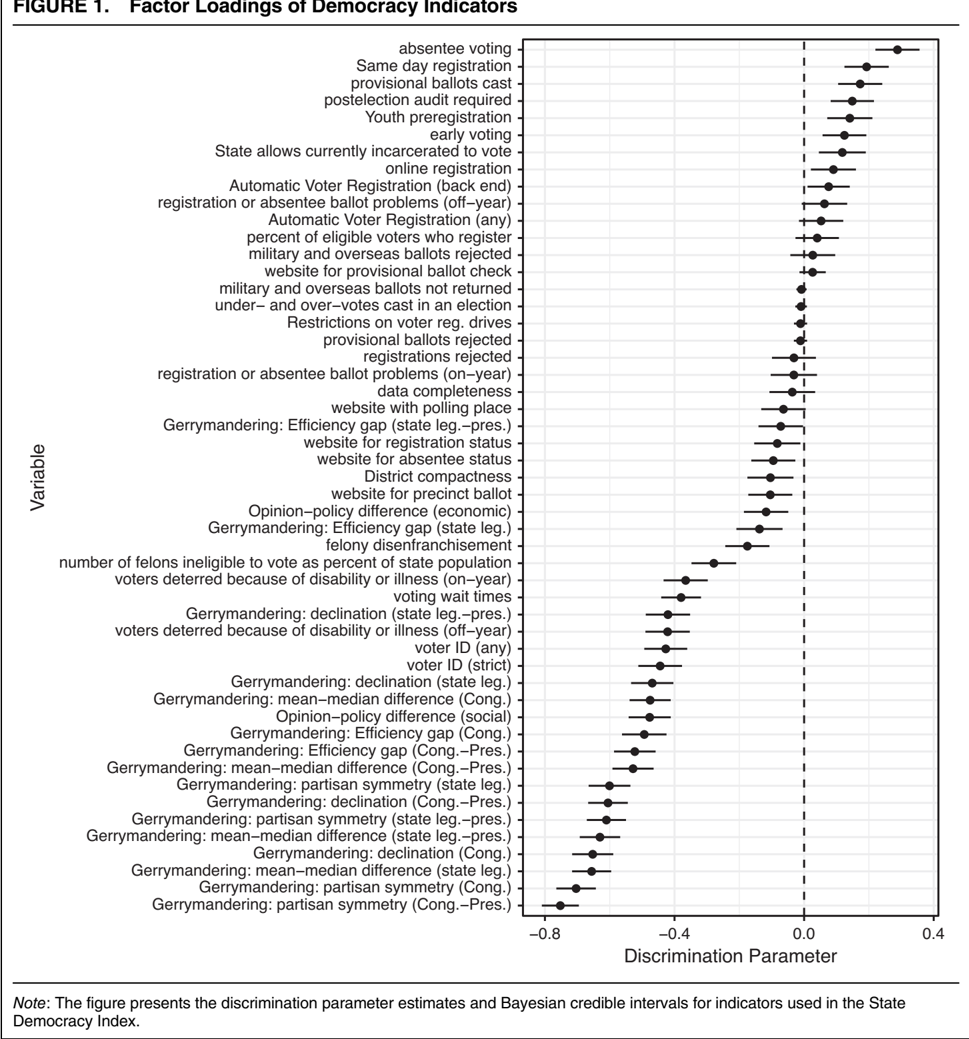
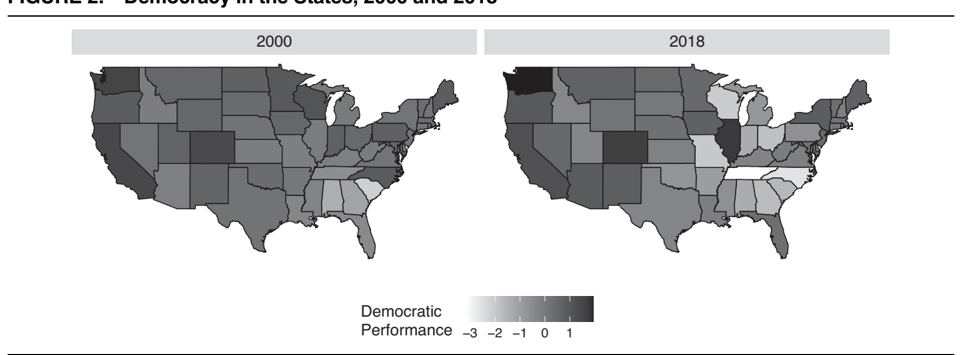
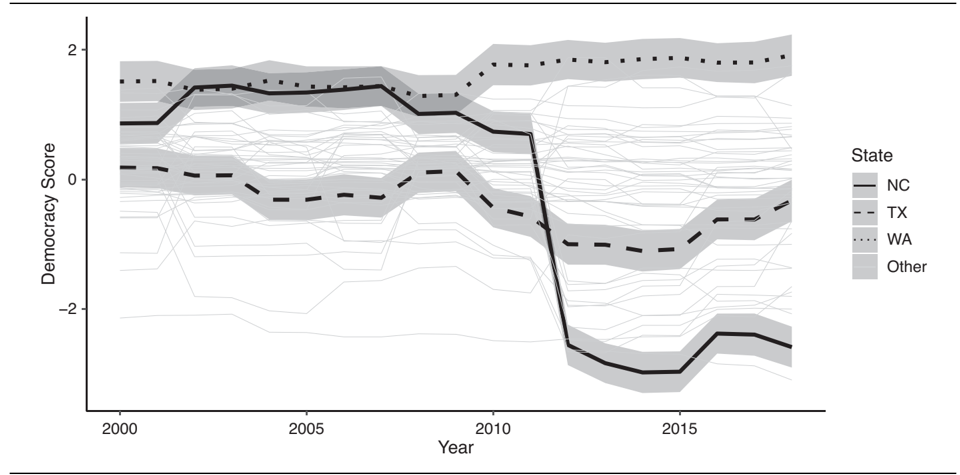
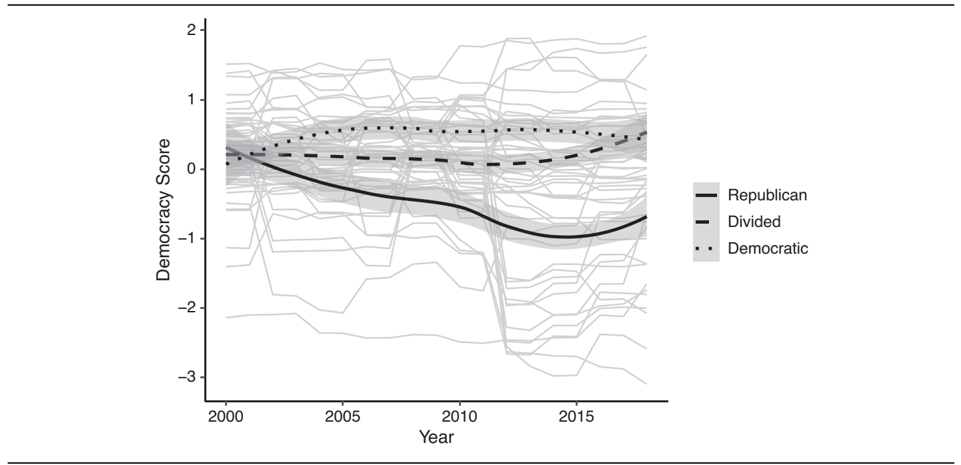
The Trump presidency generated concern about democratic backsliding and renewed interest in measuring the national democratic performance of the United States. However, the US has a decentralized form of federalism that administers democratic institutions at the state level. Using 51 indicators of electoral democracy from 2000 to 2018, I develop a measure of subnational democratic performance, the State Democracy Index. I then test theories of democratic expansion and backsliding based in party competition, polarization, demographic change, and the group interests of national party coalitions. Difference-in-differences results suggest a minimal role for all factors except Republican control of state government, which dramatically reduces states’ democratic performance during this period.
Verified 2026-11-22 · 3 references not checked yet
Overview
CoChat Summary
## TL;DR
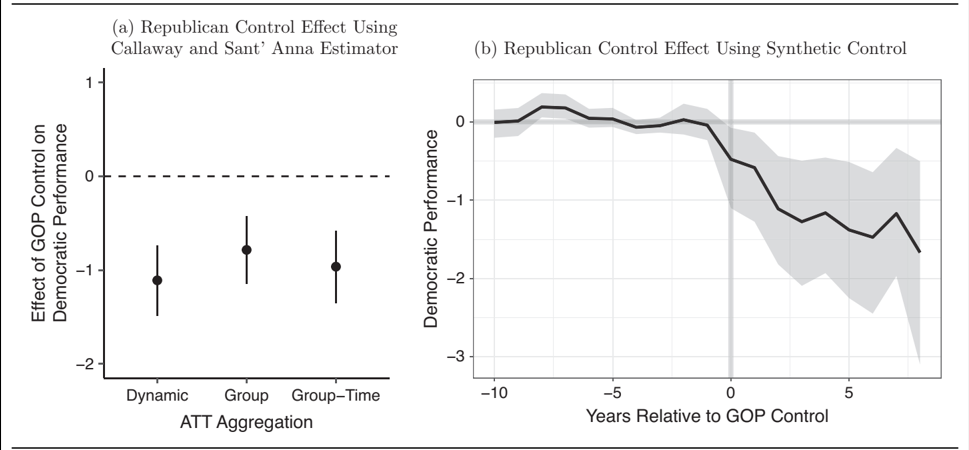
The paper builds a new State Democracy Index for the 50 U.S. states from 2000–2018 using 51 indicators of electoral democracy and uses it to test competing explanations for democratic change. It finds that Republican control of state government is the dominant driver of democratic backsliding, with effects around one-half of a standard deviation, while competition, polarization, and within-state racial demographic change matter little.
## Key findings
- The main State Democracy Index is built from 51 indicators of electoral democracy covering 2000–2018.
- Across model specifications, Republican control of state government reduces democratic performance by about 0.442 to 0.481 standard deviations; the paper summarizes the effect as about one-half of a standard deviation.
- In contrast, the estimated effects of competition are much smaller, about 0.141 to 0.206 standard deviations, and polarization is “very small” and in the unexpectedly positive direction.
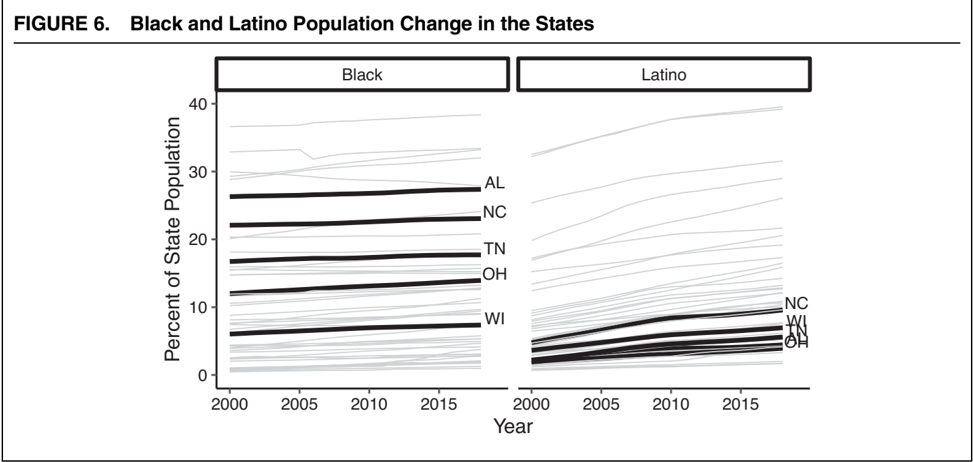
- For racial demographic change, the paper reports that trends in Black and Latino population proportions have little effect on state democratic performance; the one statistically significant interaction, Republican control × Latino population change, is 0.325 and described as small in substantive magnitude.
## Methods
- The study constructs a latent State Democracy Index for state-year units using Bayesian factor analysis for mixed data over 51 indicators; the paper also estimates an alternative simple additive index as a robustness check.
- The main data span the 50 states from 2000 to 2018; Nebraska is excluded from the regression analyses because it has a nonpartisan unicameral legislature.
- The main analysis uses a difference-in-differences design with state and year fixed effects, and robustness checks include generalized synthetic control and Callaway and Sant’Anna-style treatment-effect aggregation.
## Limitations
- The paper explicitly notes that the 2000–2018 time span is short, and says this limits the ability to compare contemporary variation with earlier eras such as slavery and Jim Crow.
- The text makes evident that the measure is limited to contemporary state variation and does not directly capture older, more extreme differences in regime type; this is stated in the paper as a limitation of the period covered.
- The paper also notes, as a methodological limitation, that Bayesian latent-dimension models require parameter constraints and that some indicator parameters can be “wrong” in theoretical terms; the author addresses this with robustness checks and an additive index.
Model-written summary. Check it against the paper before relying on it.
Integrity signals
Registry
Cites
Statistics
Figures
Verification
Claims the paper makes
8 Valid · 5 Not valid · 27 Not checked · 83 Own results and interpretations
The cited sources support only part of this claim — read each source’s verdict below.
In the paper
“Coercive state authority, seen in extreme forms in authoritarian policing and mass incarceration, are also mostly administered with state-level authority (Miller 2008; Soss and Weaver 2017; Weaver and Prowse 2020).”
What the sources say
- Not checked — no full text of the sourcecites Miller 2008 matched to “The Perils of Federalism” (2008) source
- Partly supportedcites Soss and Weaver 2017 matched to “Police Are Our Government: Politics, Political Science, and the Policing of Race–Class Subjugated Communities” (2017) sourceExperimental — accuracy not yet measured
The section “Governance, Citizenship, and the American Polity” describes policing and carceral practices as instruments of coercive state power. But the paper does not establish that they are mostly administered under state-level authority; “The Expansion of Policing and Reconstitution of Police Power” instead discusses local police agencies alongside federal funding and agendas. Its use of “state power” does not specify the U.S. state-government level. (LLM, conf=0.84)
- Not checked — no full text of the sourcecites Weaver and Prowse 2020 matched to “Racial authoritarianism in U.S. democracy” (2020) source
plain- Asserted: passes — The authors put it forward as true.
- Checkable: passes — It can be checked against evidence.
- Load-bearing: unclear — It is unclear whether the paper’s conclusions depend on it.
- Based: passes — The paper gives a reason why it holds.
Every source the paper cites for this claim was checked and supports it.
In the paper
“In particular, I use Bayesian factor analysis for mixed data (Quinn 2004) because the democracy indicators may be binary (e.g., same-day voter registration), ordinal (e.g., disenfranchisement of all, some, or no felons), or continuous (e.g., legislative district efficiency gap).”
What the sources say
- Supportedcites Quinn 2004 matched to “Bayesian Factor Analysis for Mixed Ordinal and Continuous Responses” (2004) source
The Introduction (page not provided) describes a Bayesian factor-analysis model for indicators that mix ordinal and continuous responses. Section 4.1 (page not provided) applies it to dichotomous, ordinal, and continuous variables. The citation identifies the method used for the State Democracy Index; it does not attribute that index or its specific indicators to Quinn. (LLM, conf=0.93)
plainstates a cause- Asserted: passes — The authors put it forward as true.
- Checkable: passes — It can be checked against evidence.
- Load-bearing: passes — The paper’s conclusions depend on it.
- Based: passes — The paper gives a reason why it holds.
- Supported
Every source the paper cites for this claim was checked and supports it.
In the paper
“Bartels (2020, 22752), for instance, finds that ' substantial numbers of Republicans endorse statements contemplating violations of key democratic norms, including respect for the law and for the outcomes of elections and eschewing the use of force in pursuit of political ends '”
What the sources say
- Supportedcites Bartels 2020 matched to “Ethnic antagonism erodes Republicans’ commitment to democracy” (2020) source
The paper’s Abstract states the attributed finding almost verbatim. It identifies respect for the law, election outcomes, and rejection of political violence as the democratic norms at issue; the following passage gives the survey responses underlying that finding. (LLM, conf=0.95)
plain- Asserted: passes — The authors put it forward as true.
- Checkable: passes — It can be checked against evidence.
- Load-bearing: unclear — It is unclear whether the paper’s conclusions depend on it.
- Based: passes — The paper gives a reason why it holds.
- Supported
A result the paper reports from its own data — it cites no other source for it, so there is none to check. The quote shows it is in the paper.
In the paper
“Difference-in-differences results suggest a minimal role for all factors except Republican control of state government, which dramatically reduces states ' democratic performance during this period.”
- Also stated in: § INTRODUCTION · boosted
“Across measures and model specifications, the results are remarkably clear: Republican control of state government reduces democratic performance.”
boostedstates a cause- Asserted: passes — The authors put it forward as true.
- Checkable: passes — It can be checked against evidence.
- Load-bearing: passes — The paper’s conclusions depend on it.
- Based: passes — The paper gives a reason why it holds.
- Also stated in: § INTRODUCTION · boosted
A result the paper reports from its own data — it cites no other source for it, so there is none to check. The quote shows it is in the paper.
In the paper
“The magnitude of democratic contraction from Republican control is surprisingly large, about one-half of a standard deviation.”
plainstates a cause- Asserted: passes — The authors put it forward as true.
- Checkable: passes — It can be checked against evidence.
- Load-bearing: passes — The paper’s conclusions depend on it.
- Based: passes — The paper gives a reason why it holds.
65 more claims
Create a free account to see all 123 claims and to verify the 2 references still open.
- It may state two separate claims as one. 28
- Probably not a substantial claim. 28
Citations
Cites
Mostly Harmless Econometrics: An Empiricist's Companion
Angrist, J. D., & Pischke, J.-S. (2009) · doi:10.1515/9781400829828 · Cited by 9,467
Difference-in-Differences with multiple time periods
Callaway, B., & Sant’Anna, P. H. C. (2021) · Journal of Econometrics · doi:10.1016/j.jeconom.2020.12.001 · Cited by 9,126
Difference-in-differences with variation in treatment timing
Goodman-Bacon, A. (2021) · Journal of Econometrics · doi:10.1016/j.jeconom.2021.03.014 · Cited by 8,046
Capitalism, Socialism and Democracy.
Robinson, J., & Schumpeter, J. A. (1943) · The Economic Journal · doi:10.2307/2226398 · Cited by 6,529
A Rational Theory of the Size of Government
Meltzer, A. H., & Richard, S. F. (1981) · Journal of Political Economy · doi:10.1086/261013 · Cited by 5,485
Mostly Harmless Econometrics: An Empiricist's Companion
Angrist, J. D., & Pischke, J.-S. (2008) · doi:10.2307/j.ctvcm4j72 · Cited by 5,051
(1990) · Choice Reviews Online · doi:10.5860/choice.27-2963 · Cited by 3,601
Competitive Authoritarianism: Hybrid Regimes after the Cold War
Levitsky, S., & Way, L. A. (2010) · doi:10.1017/cbo9780511781353 · Cited by 3,459
Concept Misformation in Comparative Politics
Sartori, G. (1970) · American Political Science Review · doi:10.2307/1958356 · Cited by 3,318 · cited 2×
“Thus, the conceptualization of electoral democracy as a subcomponent means it takes us “ up ” the ladder of generality (Sartori 1970), applying to more cases, whereas its conceptualization as a diminished subtype takes us “ down ” the ladder of generality. investigating the democratic performance…”
BackgroundMethodConstituency Influence in Congress
Miller, W. E., & Stokes, D. E. (1963) · American Political Science Review · doi:10.2307/1952717 · Cited by 2,293
Democracy with Adjectives: Conceptual Innovation in Comparative Research
Collier, D., & Levitsky, S. (1997) · World Politics · doi:10.1353/wp.1997.0009 · Cited by 2,132
Democratic authority: a philosophical framework
(2008) · Choice Reviews Online · doi:10.5860/choice.45-6431 · Cited by 1,581
Bobo, L., & Hutchings, V. L. (1996) · American Sociological Review · doi:10.2307/2096302 · Cited by 1,562
Acemoglu, D., Naidu, S., Restrepo, P., & Robinson, J. A. (2019) · Journal of Political Economy · doi:10.1086/700936 · Cited by 1,524 · cited 7×
“16 In robustness checks in the Appendix, I use an additional measure of electoral rather than legislative competitiveness from O’Brian (2019), which I code as −∣0:5−Dvotes∣, whereDvotes is the two-party share of votes in the state’s U.S. House election(s) that went to Democratic candidates.17 As is customary, these me…”
MethodInfluentialPolarized America: The Dance of Ideology and Unequal Riches
Abrams, S. J. (2007) · Perspectives on Politics · doi:10.1017/s1537592707071873 · Cited by 1,316
Capitalism and Social Democracy
Przeworski, A. (1985) · Cambridge University Press eBooks · doi:10.1017/cbo9781139171830 · Cited by 1,274
Status threat, not economic hardship, explains the 2016 presidential vote
Mutz, D. C. (2018) · Proceedings of the National Academy of Sciences · doi:10.1073/pnas.1718155115 · Cited by 1,236
Federalism: origin, operation, significance
Riker, W. H. (1964) · Medical Entomology and Zoology · Cited by 1,221
Statehouse democracy: public opinion and policy in the American states
(1995) · Choice Reviews Online · doi:10.5860/choice.32-3008 · Cited by 1,216
Reconstruction: America's unfinished revolution, 1863-1877
(1988) · Choice Reviews Online · doi:10.5860/choice.26-1104 · Cited by 1,119 · cited 1×
“” State and local governments directly and indirectly enforced a racial hierarchy for most of U.S. history (DuBois 1935; Foner 1988).”
BackgroundGRAHAM, M. H., & SVOLIK, M. W. (2020) · American Political Science Review · doi:10.1017/s0003055420000052 · Cited by 1,044
Bois, W. E. B. D. (2007) · Medical Entomology and Zoology · Cited by 940
Generalized Synthetic Control Method: Causal Inference with Interactive Fixed Effects Models
Xu, Y. (2017) · Political Analysis · doi:10.1017/pan.2016.2 · Cited by 938 · cited 2×
“I supplement traditional two-way fixed effects models with a generalized synthetic control estimator from (Xu 2017) and alternative methods of aggregating treatment effects from Call-away and Sant ’ Anna (2020) that avoid potential weighting problems in multiperiod difference-in-differences designs.”
MethodPolitical Man: The Social Bases of Politics
Chapman, B. (1961) · International Affairs · doi:10.2307/2611074 · Cited by 860
The Ideological Mapping of American Legislatures
SHOR, B., & McCARTY, N. (2011) · American Political Science Review · doi:10.1017/s0003055411000153 · Cited by 757 · cited 2×
“Legislative polarization measures are from Shor and McCarty (2011).”
BackgroundDifference-in-Differences with Variation in Treatment Timing
Goodman-Bacon, A. (2018) · doi:10.3386/w25018 · Cited by 757
Hacker, J. S., & Pierson, P. (2010) · Politics & Society · doi:10.1177/0032329210365042 · Cited by 741
Democracy as a Latent Variable
Treier, S., & Jackman, S. (2008) · American Journal of Political Science · doi:10.1111/j.1540-5907.2007.00308.x · Cited by 680 · cited 1×
“For the main State Democracy Index measure, I model democracy as a latent variable (Treier and Jackman 2008).”
BackgroundBlack Rights/White Wrongs: The Critique of Racial Liberalism
Mills, C. W. (2017) · doi:10.1093/acprof:oso/9780190245412.001.0001 · Cited by 675 · cited 1×
“As I address in Appendix Section A5, scholars across disciplines (including the V-Dem team) have conceptualized additional important subcomponents of democracy such as liberalism, egalitarianism, deliberation, and inclusion (for examples, see Michener 2018; Mills 2017; Phillips 1991).”
BackgroundGay Rights in the States: Public Opinion and Policy Responsiveness
LAX, J. R., & PHILLIPS, J. H. (2009) · American Political Science Review · doi:10.1017/s0003055409990050 · Cited by 666
Politics in the American States: A Comparative Analysis
(2018) · CQ Press eBooks · doi:10.4135/9781506363646 · Cited by 647
Soss, J., & Weaver, V. (2017) · Annual Review of Political Science · doi:10.1146/annurev-polisci-060415-093825 · Cited by 591 · cited 3×
“An important insight of recent research has been the central role of the carceral state, whether the state represses its citizenry through authoritarian policing and mass incarceration, in shaping democratic performance (Soss and Weaver 2017).”
BackgroundThe Increasingly United States: How and Why American Political Behavior Nationalized
Hopkins, D. J. (2018) · doi:10.7208/chicago/9780226530406.001.0001 · Cited by 587 · cited 1×
“Voters are increasingly focused on national rather than state and local politics (Hopkins 2018), in part due to the decline of state and local politics journalism (Martin and McCrain 2019; Moskowitz 2021).”
BackgroundThe Democratic Deficit in the States
Lax, J. R., & Phillips, J. H. (2012) · American Journal of Political Science · doi:10.1111/j.1540-5907.2011.00537.x · Cited by 574 · cited 1×
“Incongruent or unresponsive policy outcomes are signs of a “ democratic deficit ” (Caughey and Warshaw 2018; Lax and Phillips 2012).”
BackgroundCapitalism, Socialism and Democracy
Schumpeter, J. A. (2010) · Routledge eBooks · doi:10.4324/9780203857090 · Cited by 573
How democratic is the American Constitution?
(2002) · Choice Reviews Online · doi:10.5860/choice.40-0581 · Cited by 550
Boundary Control: Subnational Authoritarianism in Democratic Countries
Gibson, E. L. (2005) · World Politics · doi:10.1353/wp.2006.0018 · Cited by 517
Beyond Ideology: Politics, Principles, and Partisanship in the U. S. Senate
Lee, F. E. (2009) · doi:10.7208/chicago/9780226470771.001.0001 · Cited by 455 · cited 5×
“…legislatures and executive branches, most studies use legislative majority size as the main measure of competition, whether in the U.S. Congress (Lee 2009) or state politics (Teele 2018b) 17 O ’ Brian (2019) collected vote-share data from David and Claggett (2008) and CQ Press ’ s Voting and…”
BackgroundInfluentialHollyer, J. R., Rosendorff, B. P., & Vreeland, J. R. (2011) · The Journal of Politics · doi:10.1017/s0022381611000880 · Cited by 450
The State of Democratic Theory
Shapiro, I. (2009) · Princeton University Press eBooks · doi:10.1515/9781400825899 · Cited by 437 · cited 1×
“Liberal democracy may also include considerations of transparency of decision making and policy information (Shapiro 2009), and, empirically, democ-racies are more transparent than are nondemocracies (Hollyer, Rosendorff, and Vreeland 2011).”
BackgroundOff center: the Republican revolution and the erosion of American democracy
(2006) · Choice Reviews Online · doi:10.5860/choice.43-3686 · Cited by 429
Identity Crisis: The 2016 Presidential Campaign and the Battle for the Meaning of America
Sides, J., Tesler, M., & Vavreck, L. (2018) · doi:10.2307/j.ctvc77mmb · Cited by 426
We Who Are Dark: The Philosophical Foundations of Black Solidarity
Shelby, T. (2005) · Harvard University Press eBooks · doi:10.4159/9780674043527 · Cited by 417
Double Take: A Reexamination of Democracy and Autocracy in Modern Polities
Gleditsch, K. S., & Ward, M. D. (1997) · Journal of Conflict Resolution · doi:10.1177/0022002797041003002 · Cited by 385 · cited 1×
“This study follows the conceptual and measurement strategies of comparative cross-national democracy research (e.g., Gleditsch and Ward 1997; Lindberg et al. 2014).”
MethodFragmented Democracy: Medicaid, Federalism, and Unequal Politics
Michener, J. (2018) · Cambridge University Press eBooks · doi:10.1017/9781108224987 · Cited by 381 · cited 1×
“As I address in Appendix Section A5, scholars across disciplines (including the V-Dem team) have conceptualized additional important subcomponents of democracy such as liberalism, egalitarianism, deliberation, and inclusion (for examples, see Michener 2018; Mills 2017; Phillips 1991).”
BackgroundConservative Parties and the Birth of Modern Democracy in Europe
Ziblatt, D. (2017) · doi:10.1017/9781139030335 · Cited by 353 · cited 2×
“Tor instance, Ziblatt (2017) points to the importance of conservative parties as historical coalitions of groups with economic incentives to constrain democracy.”
BackgroundBoundary Control: Subnational Authoritarianism in Federal Democracies
Gibson, E. L. (2013) · Cambridge University Press eBooks · doi:10.1017/cbo9781139017992 · Cited by 350
Policy Preferences and Policy Change: Dynamic Responsiveness in the American States, 1936–2014
CAUGHEY, D., & WARSHAW, C. (2018) · American Political Science Review · doi:10.1017/s0003055417000533 · Cited by 340
Local News and National Politics
MARTIN, G. J., & McCRAIN, J. (2019) · American Political Science Review · doi:10.1017/s0003055418000965 · Cited by 331 · cited 1×
“Voters are increasingly focused on national rather than state and local politics (Hopkins 2018), in part due to the decline of state and local politics journalism (Martin and McCrain 2019; Moskowitz 2021).”
BackgroundA Racial/Ethnic Diversity Interpretation of Politics and Policy in the States of the U.S.
Hero, R. E., & Tolbert, C. J. (1996) · American Journal of Political Science · doi:10.2307/2111798 · Cited by 325 · cited 1×
“A third theoretical tradition suggests that the racial demographics of state populations shapes politics and policy (Hero and Tolbert 1996).”
BackgroundV-Dem: A New Way to Measure Democracy
Lindberg, S. I., Coppedge, M., Gerring, J., & Teorell, J. (2014) · Journal of Democracy · doi:10.1353/jod.2014.0040 · Cited by 322 · cited 3×
“This study follows the conceptual and measurement strategies of comparative cross-national democracy research (e.g., Gleditsch and Ward 1997; Lindberg et al. 2014).”
BackgroundMethodRacial Realignment: The Transformation of American Liberalism, 1932–1965
Delton, J. (2017) · Journal of American History · doi:10.1093/jahist/jax268 · Cited by 314
Hajnal, Z. L., & Lee, T. (2011) · doi:10.1515/9781400838776 · Cited by 308 · cited 1×
“Partisan competition can incentivize parties to incorporate new voters (Hajnal and Lee 2011; Teele 2018b) or generate brinksmanship and scorched-earth tactics (Lee 2009).”
BackgroundLet Them Eat Tweets: How the Right Rules in an Age of Extreme Inequality
Diament, S. M. (2021) · Political Science Quarterly · doi:10.1002/polq.13255 · Cited by 303
Bayesian Factor Analysis for Mixed Ordinal and Continuous Responses
Quinn, K. M. (2004) · Political Analysis · doi:10.1093/pan/mph022 · Cited by 282 · cited 1×
“In particular, I use Bayesian factor analysis for mixed data (Quinn 2004) because the democracy indicators may be binary (e.g., same-day voter registration), ordinal (e.g., disenfranchisement of all, some, or no felons), or continuous (e.g., legislative district efficiency gap).”
MethodFrom Backwaters to Major Policymakers: Policy Polarization in the States, 1970–2014
Grumbach, J. M. (2018) · Perspectives on Politics · doi:10.1017/s153759271700425x · Cited by 275
Self-citationThe Space between Us: Social Geography and Politics
Enos, R. D. (2017) · doi:10.1017/9781108354943 · Cited by 272 · cited 2×
“Status threat stemming from local racial demographic change can provoke institutional backlash against the democratic inclusion of Black and Latino Americans or of recent immigrants (e.g., Bobo and Hutchings 1996; Enos 2017).”
BackgroundThe Dynamics of State Policy Liberalism, 1936–2014
Caughey, D., & Warshaw, C. (2016) · American Journal of Political Science · doi:10.1111/ajps.12219 · Cited by 271 · cited 3×
“…five indicators a positive or negative difficulty parameter based on whether it is theoretically democracy expanding or contracting (for a similar application to state policy liberalism, see Caughey and Warshaw 2016). state-level turnout of the voting-eligible public in Figure A2 in the Appendix.”
BackgroundResultElection Laws, Mobilization, and Turnout: The Unanticipated Consequences of Election Reform
Burden, B. C., Canon, D. T., Mayer, K. R., & Moynihan, D. P. (2014) · American Journal of Political Science · doi:10.1111/ajps.12063 · Cited by 271 · cited 1×
“An additional large body of research has asked how state electoral policies affect participation (e.g., Burden et al. 2014; Gerber, Huber, and Hill 2013).”
BackgroundThe Right to Vote: The Contested History of Democracy in the United States
Gordon, A. D., & Keyssar, A. (2001) · The American Historical Review · doi:10.2307/2692979 · Cited by 270 · cited 3×
“Prominent theories in political science point to partisan competition (Keyssar 2000), ideological polarization (Lieberman et al. 2019), racial demographic change , and the group interests of national party coalitions (Hacker and Pierson 2020) as important drivers of democratic change.”
BackgroundCampaign Finance and Political Polarization: When Purists Prevail
La Raja, R., & Schaffner, B. (2015) · University of Michigan Press eBooks · doi:10.3998/ump.13855466.0001.001 · Cited by 240
Democratic Authority: A Philosophical Framework
Estlund, D. M. (2009) · Princeton University Press eBooks · doi:10.1515/9781400831548 · Cited by 229 · cited 1×
“Liberal democracy captures whether a society protects civil rights and liberties (Brettschneider 2010; Estlund 2009), especially for minority populations who have been historically subjugated (Glaude 2017; Shelby 2005).”
Ethnic antagonism erodes Republicans’ commitment to democracy
Bartels, L. M. (2020) · Proceedings of the National Academy of Sciences · doi:10.1073/pnas.2007747117 · Cited by 222
The New Immigration Federalism
Gulasekaram, P., & Ramakrishnan, S. K. (2015) · Cambridge University Press eBooks · doi:10.1017/cbo9781316282410 · Cited by 221
Giraudy, A. (2015) · Oxford University Press eBooks · doi:10.1093/acprof:oso/9780198706861.001.0001 · Cited by 215 · cited 1×
“There is scholarly interest in measuring subnational democratic performance at the country level (see Giraudy 2015; McMann 2018), and a small number of quantitative measures of democracy within other countries ’ political subunits (Harbers, Bartman, and van Wingerden 2019), but I have not found…”
BackgroundMiller, L. L. (2008) · doi:10.1093/acprof:oso/9780195331684.001.0001 · Cited by 212 · cited 1×
“Coercive state authority, seen in extreme forms in authoritarian policing and mass incarceration, are also mostly administered with state-level authority (Miller 2008; Soss and Weaver 2017; Weaver and Prowse 2020).”
BackgroundAlrababa’h, A., Marble, W., Mousa, S., & Siegel, A. A. (2021) · American Political Science Review · doi:10.1017/s0003055421000423 · Cited by 212
Paths out of Dixie: the democratization of authoritarian enclaves in America's Deep South, 1944-1972
(2015) · Choice Reviews Online · doi:10.5860/choice.191208 · Cited by 210
(1991) · Women's Studies International Forum · doi:10.1016/0277-5395(91)90076-t · Cited by 205
Democracy in Black: How Race Still Enslaves the American Soul
Glaude, E. S., Fsc, D. M. M., Jenkins, A., & Mallory, N. (2016) · La Salle University Digital Commons (La Salle University) · Cited by 198
Statehouse Democracy: Public Opinion and Policy in the American States
Erikson, R. S., Wright, G., & McIver, J. P. (1994) · Cambridge University Press eBooks · doi:10.1017/cbo9780511752933 · Cited by 195
Election Timing and the Electoral Influence of Interest Groups
Anzia, S. F. (2011) · The Journal of Politics · doi:10.1017/s0022381611000028 · Cited by 194
Ideological Donors, Contribution Limits, and the Polarization of American Legislatures
Barber, M. J. (2016) · The Journal of Politics · doi:10.1086/683453 · Cited by 191 · cited 1×
“…be interested in investigating the role of interest groups or money in politics on state democratic performance (Anzia and Moe 2017; Hertel-Fernandez 2016), perhaps by exploiting variation in state campaign finance policy (Barber 2016; La Raja and Schaffner 2015) or election timing (Anzia 2011).”
From Open Secrets to Secret Voting: Democratic Electoral Reforms and Voter Autonomy
Mares, I. (2015) · doi:10.1017/cbo9781316178539 · Cited by 191
Who Passes Business’s “Model Bills”? Policy Capacity and Corporate Influence in U.S. State Politics
Hertel-Fernandez, A. (2014) · Perspectives on Politics · doi:10.1017/s1537592714001601 · Cited by 183
Change They Can't Believe In: The Tea Party and Reactionary Politics in America
Parker, C. S., & Barreto, M. A. (2014) · doi:10.23943/princeton/9780691163611.001.0001 · Cited by 171
Explaining Government Growth in the U.S. States
Garand, J. C. (1988) · American Political Science Review · doi:10.2307/1962494 · Cited by 165 · cited 1×
“Importantly, liberal democracy is conceptually distinct from “ policy liberalism ” (Caughey and Warshaw 2016), “ size of government ” (Garand 1988), and other concepts that capture the left – right orientation of policy outcomes across political systems.”
BackgroundDemocratization by Elections? Opposition Weakness in Africa
Rakner, L., & van de Walle, N. (2009) · Journal of Democracy · doi:10.1353/jod.0.0096 · Cited by 163 · cited 3×
“Although contemporary state electoral legislation, like that of the Jim Crow era, has been found by courts to have been “ motivated at least in part by an unconstitutional intent to target African American voters, ” 29 battles over voting rights from the 1890s through 1970s primarily involved battles between large lan…”
BackgroundWelzel, C. (2007) · International Political Science Review · doi:10.1177/0192512107079640 · Cited by 162
Smolka, R. G. (1975) · History Reviews of New Books · doi:10.1080/03612759.1975.9946795 · Cited by 159
Political Parties and Representation of the Poor in the American States
Rigby, E., & Wright, G. C. (2013) · American Journal of Political Science · doi:10.1111/ajps.12007 · Cited by 158
GRAHAM, M. H., & Svolik, M. W. (2019) · SSRN Electronic Journal · doi:10.2139/ssrn.3354559 · Cited by 153
The perils of federalism: race, poverty, and the politics of crime control
(2009) · Choice Reviews Online · doi:10.5860/choice.46-5313 · Cited by 152
Local News, Information, and the Nationalization of U.S. Elections
MOSKOWITZ, D. J. (2021) · American Political Science Review · doi:10.1017/s0003055420000829 · Cited by 149 · cited 2×
“Others might study how state democracy is affected by declining state and local politics journalism (Moskowitz 2021) or by voters ’ attitudes toward democratic institutions (Graham and Svolik 2020; Miller and Davis 2020; Welzel 2007).”
BackgroundElectoral Accountability for State Legislative Roll Calls and Ideological Representation
ROGERS, S. (2017) · American Political Science Review · doi:10.1017/s0003055417000156 · Cited by 140 · cited 1×
“…the other (Caughey and Warshaw 2018; Erikson, Wright, and McIver 1993; Flavin and Franko 2017; Gay 2007; Lax and Phillips 2009; 2012; Pacheco 2013; Rogers 2017; Simonovits, Guess, and Nagler 2019), including whether state governmental responsiveness to the mass public is affected by the influence…”
BackgroundThe Trump Presidency and American Democracy: A Historical and Comparative Analysis
Lieberman, R. C., Mettler, S., Pepinsky, T. B., Roberts, K. M., & Valelly, R. (2019) · Perspectives on Politics · doi:10.1017/s1537592718003286 · Cited by 140 · cited 3×
“As Lieberman et al. (2019, 2) argue, “hyperpolarization magnifies tendencies for the partisan capture of institutions that are supposed to exercise checks and balances but may instead be turned into unaccountable instruments of partisan or incumbent advantage.” It generates conflict about and within oversight agencies…”
BackgroundInfluentialDo Politicians Use Policy to Make Politics? The Case of Public-Sector Labor Laws
Anzia, S. F., & Moe, T. M. (2016) · American Political Science Review · doi:10.1017/s0003055416000484 · Cited by 138 · cited 1×
“Scholars might be interested in investigating the role of interest groups or money in politics on state democratic performance (Anzia and Moe 2017; Hertel-Fernandez 2016), perhaps by exploiting variation in state campaign finance policy (Barber 2016; La Raja and Schaffner 2015) or election timing…”
BackgroundHow the West Was Won: Competition, Mobilization, and Women’s Enfranchisement in the United States
Teele, D. L. (2018) · The Journal of Politics · doi:10.1086/696621 · Cited by 137
White Backlash: Immigration, Race, and American Politics
Hawley, G. (2016) · Political Science Quarterly · doi:10.1002/polq.12465 · Cited by 133
Democratic rights: the substance of self-government
(2007) · Choice Reviews Online · doi:10.5860/choice.45-2295 · Cited by 131
Bottom-Up Challenges to National Democracy: Mexico's (Legal) Subnational Authoritarian Enclaves
Benton, A. L. (2012) · Comparative Politics · doi:10.5129/001041512800078931 · Cited by 121 · cited 2×
“2 There is also a literature on the existence of “ authoritarian enclaves ” within democratic countries (e.g., Benton 2012; Gibson 2013), which are “ characterized by an adherence to recognizably authoritarian norms and procedures in contrast to those of the [national] democratic regime ” (Gilley…”
BackgroundResultIdentity Crisis: The 2016 Presidential Campaign and the Battle for the Meaning of America
Sides, J., Tesler, M., & Vavreck, L. (2019) · doi:10.2307/j.ctvktrvp5 · Cited by 120
Forging the franchise: the political origins of the women’s vote
Lopetegui, A. E. (2019) · Democratization · doi:10.1080/13510347.2019.1625890 · Cited by 111
Boundary Control: Subnational Authoritarianism in Federal Democracies
Gibson, E. (2013) · doi:10.1017/cbo9781139017992.004 · Cited by 109
Identifying the Effect of All-Mail Elections on Turnout: Staggered Reform in the Evergreen State
Gerber, A. S., Huber, G. A., & Hill, S. J. (2013) · Political Science Research and Methods · doi:10.1017/psrm.2013.5 · Cited by 108
Understanding the Adoption of Voter Identification Laws in the American States
Biggers, D. R., & Hanmer, M. J. (2017) · American Politics Research · doi:10.1177/1532673x16687266 · Cited by 100 · cited 2×
“As states grow more racially diverse due to immigration and internal migration, 15 some voters might demand restrictions on democracy to block the political inclusion and empowerment of new voters of color (Abrajano and Hajnal 2017; Biggers and Hanmer 2017; Myers and Levy 2018).”
BackgroundResultPolitical Integration and Political Development
Weiner, M. (1965) · The Annals of the American Academy of Political and Social Science · doi:10.1177/000271626535800107 · Cited by 98 · cited 1×
“Scholars point to the consolidation of a competitive party system to explain large-scale expansions of democracy in the US (Teele 2018a), Africa (Rakner and Van de Walle 2009), Europe (Mares 2015), and around the world (Weiner 1965).”
BackgroundBrettschneider, C. L. (2009) · Princeton University Press eBooks · doi:10.1515/9781400828104 · Cited by 96
How to Measure Legislative District Compactness If You Only Know It When You See It
Kaufman, A. R., King, G., & Komisarchik, M. (2021) · American Journal of Political Science · doi:10.1111/ajps.12603 · Cited by 86
Government's Unequal Attentiveness to Citizens' Political Priorities
Flavin, P., & Franko, W. W. (2016) · Policy Studies Journal · doi:10.1111/psj.12184 · Cited by 82
Democratic enclaves in authoritarian regimes
Gilley, B. (2010) · Democratization · doi:10.1080/13510341003700196 · Cited by 79 · cited 1×
“…also a literature on the existence of “ authoritarian enclaves ” within democratic countries (e.g., Benton 2012; Gibson 2013), which are “ characterized by an adherence to recognizably authoritarian norms and procedures in contrast to those of the [national] democratic regime ” (Gilley 2010, 389).”
ResultRock the Registration: Same Day Registration Increases Turnout of Young Voters
Grumbach, J. M., & Hill, C. (2021) · The Journal of Politics · doi:10.1086/714776 · Cited by 79
Self-citationThe Thermostatic Model of Responsiveness in the American States
Pacheco, J. (2013) · State Politics & Policy Quarterly · doi:10.1177/1532440013487388 · Cited by 77 · cited 1×
“…outcomes on the other (Caughey and Warshaw 2018; Erikson, Wright, and McIver 1993; Flavin and Franko 2017; Gay 2007; Lax and Phillips 2009; 2012; Pacheco 2013; Rogers 2017; Simonovits, Guess, and Nagler 2019), including whether state governmental responsiveness to the mass public is affected by…”
BackgroundCost of Voting in the American States
Li, Q., Pomante, M. J., & Schraufnagel, S. (2018) · Election Law Journal: Rules, Politics, and Policy · doi:10.1089/elj.2017.0478 · Cited by 76
The Ideological Mapping of American LegislaturesPreprint
Shor, B., & McCarty, N. M. (2010) · SSRN Electronic Journal · doi:10.2139/ssrn.1676863 · Cited by 76
Racial Population Projections and Reactions to Alternative News Accounts of Growing Diversity
Myers, D., & Levy, M. (2018) · The ANNALS of the American Academy of Political and Social Science · doi:10.1177/0002716218766294 · Cited by 74 · cited 1×
“As states grow more racially diverse due to immigration and internal migration, 15 some voters might demand restrictions on democracy to block the political inclusion and empowerment of new voters of color (Abrajano and Hajnal 2017; Biggers and Hanmer 2017; Myers and Levy 2018).”
BackgroundRacial Realignment: The Transformation of American Liberalism, 1932-1965
Schickler, E. (2016) · doi:10.1515/9781400880973 · Cited by 74
Forceful Federalism against American Racial Inequality
King, D. S. (2017) · Government and Opposition · doi:10.1017/gov.2016.52 · Cited by 69 · cited 2×
“The concept of authoritarian or undemocratic enclaves within partly or fully democratic countries is also seen in historical research on the role of the U.S. states in racially authoritarian and undemocratic governance (King 2017; Kousser 1974; Mickey 2015).”
BackgroundThe Impact of Partisan Gerrymandering on Political Parties
Stephanopoulos, N. O., & Warshaw, C. (2020) · Legislative Studies Quarterly · doi:10.1111/lsq.12276 · Cited by 69
Campaign Finance Regulations and Public Policy
GILENS, M., PATTERSON, S., & HAINES, P. (2021) · American Political Science Review · doi:10.1017/s0003055421000149 · Cited by 67
Measuring Subnational Democracy
McMann, K. M. (2016) · Democratization · doi:10.1080/13510347.2017.1307822 · Cited by 62 · cited 1×
“There is scholarly interest in measuring subnational democratic performance at the country level (see Giraudy 2015; McMann 2018), and a small number of quantitative measures of democracy within other countries ’ political subunits (Harbers, Bartman, and van Wingerden 2019), but I have not found…”
BackgroundThe Effect of White Social Prejudice on Support for American Democracy
Miller, S. V., & Davis, N. T. (2020) · The Journal of Race Ethnicity and Politics · doi:10.1017/rep.2019.55 · Cited by 60
(1995) · Choice Reviews Online · doi:10.5860/choice.32-5339 · Cited by 58 · cited 1×
“Despite such important advances in the comparative and American political development literatures, there is little in the way of systematic quantitative measurement of subnational democratic performance (but see Hill 1994).”
BackgroundConceptualizing and measuring subnational democracy across Indian states
Harbers, I., Bartman, J. M., & van Wingerden, E. (2019) · Democratization · doi:10.1080/13510347.2019.1606797 · Cited by 57
Election Timing and the Electoral Influence of Interest Groups
Anzia, S. F. (2011) · doi:10.2139/ssrn.1480428 · Cited by 55
State Partisan Balance Data, 1937 - 2011
Klarner, C. (2013) · Harvard Dataverse · doi:10.7910/dvn/lzhmg3 · Cited by 52
Racial authoritarianism in U.S. democracy
Weaver, V. M., & Prowse, G. (2020) · Science · doi:10.1126/science.abd7669 · Cited by 49 · cited 2×
“Coercive state authority, seen in extreme forms in authoritarian policing and mass incarceration, are also mostly administered with state-level authority (Miller 2008; Soss and Weaver 2017; Weaver and Prowse 2020).”
BackgroundExplaining Liberal Policy Woes in the States: The Role of Donors
Hertel‐Fernandez, A. (2016) · PS Political Science & Politics · doi:10.1017/s1049096516000706 · Cited by 48 · cited 1×
“Scholars might be interested in investigating the role of interest groups or money in politics on state democratic performance (Anzia and Moe 2017; Hertel-Fernandez 2016), perhaps by exploiting variation in state campaign finance policy (Barber 2016; La Raja and Schaffner 2015) or election timing…”
BackgroundShufeldt, G., & Flavin, P. (2012) · State Politics & Policy Quarterly · doi:10.1177/1532440012451154 · Cited by 46 · cited 1×
“17 As is customary, these measures are smoothed into rolling averages across three election cycles (e.g., Ranney 1976; Shufeldt and Flavin 2012), but I lag them in statistical models such that they capture electoral competition in the three previous election cycles prior to the state ’ s democratic…”
BackgroundStewart, C. H., III, Ansolabehere, S. D., & Persily, N. (2016) · Stanford Law Review · Cited by 44
Abrajano, M., & Hajnal, Z. L. (2015) · Princeton University Press eBooks · doi:10.23943/princeton/9780691164434.001.0001 · Cited by 44
Responsiveness without Representation: Evidence from Minimum Wage Laws in U.S. States
Simonovits, G., Guess, A. M., & Nagler, J. (2018) · American Journal of Political Science · doi:10.1111/ajps.12412 · Cited by 42 · cited 1×
“…and Warshaw 2018; Erikson, Wright, and McIver 1993; Flavin and Franko 2017; Gay 2007; Lax and Phillips 2009; 2012; Pacheco 2013; Rogers 2017; Simonovits, Guess, and Nagler 2019), including whether state governmental responsiveness to the mass public is affected by the influence of…”
BackgroundSubstance and Change in Congressional Ideology: NOMINATE and Its Alternatives
Caughey, D., & Schickler, E. (2016) · Studies in American Political Development · doi:10.1017/s0898588x16000092 · Cited by 41
Race, Representation, and the Voting Rights Act
Schuit, S. A., & Rogowski, J. C. (2016) · American Journal of Political Science · doi:10.1111/ajps.12284 · Cited by 40
Gay, C. (2007) · The Journal of Politics · doi:10.1111/j.1468-2508.2007.00542.x · Cited by 38 · cited 1×
“…and state legislative votes and policy outcomes on the other (Caughey and Warshaw 2018; Erikson, Wright, and McIver 1993; Flavin and Franko 2017; Gay 2007; Lax and Phillips 2009; 2012; Pacheco 2013; Rogers 2017; Simonovits, Guess, and Nagler 2019), including whether state governmental…”
BackgroundThe New Immigration Federalism
Gulasekaram, P., & Ramakrishnan, S. (2015) · doi:10.1017/cbo9781316282410.007 · Cited by 37
Capitalism and Social Democracy
Roxborough, I., & Przeworski, A. (1987) · British Journal of Sociology · doi:10.2307/590589 · Cited by 28
Beyond Marble Cakes and Picket Fences: What U.S. Federalism Scholars Can Learn from Comparative Work
Weissert, C. S. (2011) · The Journal of Politics · doi:10.1017/s0022381611000855 · Cited by 22 · cited 1×
“Not only are states not separate, atomized polities from each other horizontally; they are embedded in complex relationships with the federal government vertically in a structure resembling more of a “ marble cake ” than the “ layer cake ” of classical dual federalism (Weissert 2011).”
BackgroundInterest Group Activists and the Polarization of State Legislatures
Grumbach, J. M. (2020) · Legislative Studies Quarterly · doi:10.1111/lsq.12244 · Cited by 21 · cited 1×
“Political investments by groups in the Democratic and Republican party coalitions have made the party coalitions more nationally coordinated (Grumbach 2019; Hacker and Pierson 2020; Hertel-Fernandez 2019).”
BackgroundSelf-citationDisenfranchisement and Economic Inequality: Downstream Effects of Shelby County v. Holder
Aneja, A., & Avenancio-León, C. F. (2019) · AEA Papers and Proceedings · doi:10.1257/pandp.20191085 · Cited by 18
Forging the Franchise: The Political Origins of the Women's Vote
Teele, D. L. (2018) · Project Muse (Johns Hopkins University) · doi:10.1515/9780691184272 · Cited by 18
33. A Paradox in the Theory of Democracy
Wollheim, R. (2016) · Democracy · doi:10.7312/blau17412-041 · Cited by 15 · cited 1×
“However, I wish to note the tensions of Wollheim ’ s paradox (Wollheim 2016), in which a legitimate democratic majority supports an undemocratic policy.”
Backgroundde la Garza, R. O., DeSipio, L., Falcón, A., et al. (2019) · Routledge eBooks · doi:10.4324/9780429041761 · Cited by 11 · cited 1×
“But in anera of highly nationalized Americanpolitics (Hopkins 27 In interpreting this result, it is important to consider the considerable political heterogeneity of Latino Americans and its relationship to geography and national origin group (de la Garza et al. 2019).”
BackgroundThe Registration and Turnout Effects of Automatic Voter RegistrationPreprint
McGhee, E. M., Hill, C., & Romero, M. (2021) · SSRN Electronic Journal · doi:10.2139/ssrn.3933442 · Cited by 10
Rocco, P. (2021) · Cambridge University Press eBooks · doi:10.1017/9781108999601.012 · Cited by 8
One-Party States and Legislator Extremism in the US House, 1876–2012
O'Brian, N. (2019) · The Journal of Politics · doi:10.1086/704223 · Cited by 3
Party Strength in the United States: 1872-1996
David, P. T., & Claggett, W. J. M. (2008) · ICPSR Data Holdings · doi:10.3886/icpsr06895.v1 · Cited by 3
Replication Data for: Laboratories of Democratic Backsliding
Grumbach, J. M. (2022) · Harvard Dataverse · doi:10.7910/dvn/jnv3xo · Cited by 1
Self-citationCaughey, D., & Warshaw, C. (2017) · Harvard Dataverse · doi:10.7910/dvn/k3qwzw · Cited by 1
Kaufman, A. R., King, G., & Komisarchik, M. (2018) · Harvard Dataverse · doi:10.7910/dvn/fa8fvf · Cited by 1
Xu, Y. (2016) · Harvard Dataverse · doi:10.7910/dvn/8akacj · Cited by 1
Rogers, S. (2017) · Harvard Dataverse · doi:10.7910/dvn/tku9wh
Replication Data for: Rock the Registration: Same Day Registration Increases Turnout of Young Voters
Grumbach, J. M., & Hill, C. (2020) · Harvard Dataverse · doi:10.7910/dvn/aw5lu8
Self-citationGerber, A. S., Huber, G. A., & Hill, S. J. (2013) · Harvard Dataverse · doi:10.7910/dvn/4qxbns
Hollyer, J. R., Rosendorff, B. P., & Vreeland, J. R. (2010) · doi:10.2139/ssrn.1684813
The Impact of Partisan Gerrymandering on Political Parties
Stephanopoulos, N., & Warshaw, C. (2019) · doi:10.2139/ssrn.3330695
Research works printed but not linked: 6
- Riker, William H. 1975. ' Federalism. ' In Handbook of Political Science: Governmental Institutions and Processes , eds. Fred I. Greenstein and Nelson W. Polsby, 93 -172. Reading, MA: Addison-Wesley.
- Levitsky, Steven, and Daniel Ziblatt. 2018. How Democracies Die . New York: Broadway Books.
- Dahl, Robert A. 2003. HowDemocraticis the American Constitution? New Haven, CT: Yale University Press.
- Dionne, E. J., Jr., Norman J. Ornstein, and Thomas E. Mann. 2017. One Nation after Trump: A Guide for the Perplexed, the Disillusioned, the Desperate, and the Not-Yet Deported . New York: St. Martin ' s Press.
- Hertel-Fernandez, Alexander. 2019. State Capture: How Conservative Activists, Big Businesses, and Wealthy Donors Reshaped the American State -and the Nation . New York: Oxford University Press.
- Gessen, Masha. 2016. ' Autocracy: Rules for Survival. ' New York Review , November 10. https://www.nybooks.com/daily/2016/11/10/ trump-election-autocracy-rules-for-survival/. - Gibson, Edward L. 2005. ' Boundary Control: Subnational Authoritarianism in Democratic Countries. ' World Politics 58 (1): 101 -32.
Cited by
Reference Points and Democratic Backsliding
Grillo, E., & Prato, C. (2023) · American Journal of Political Science · doi:10.1111/ajps.12672 · Cited by 113
How climate policy commitments influence energy systems and the economies of US states
Bergquist, P., & Warshaw, C. (2022) · Nature Communications · doi:10.1038/s41467-023-40560-y · Cited by 70
How to study democratic backsliding
Druckman, J. N. (2024) · Political Psychology · doi:10.1111/pops.12942 · Cited by 56
US State Policy Contexts and Population Health
Montez, J. K., & Grumbach, J. M. (2023) · Milbank Quarterly · doi:10.1111/1468-0009.12617 · Cited by 58
“54,57,58”
BackgroundSelf-citationDemocracy by Deterrence: Norms, Constitutions, and Electoral Tilting
Helmke, G., Kroeger, M., & Paine, J. (2022) · American Journal of Political Science · doi:10.1111/ajps.12668 · Cited by 45
Metadata
- Authors
- GRUMBACH, J. M.
- Affiliations
- University of Washington (US)
- Corresponding author
- GRUMBACH, JACOB M.
- ORCID
- GRUMBACH, JACOB M.
- Venue
- American Political Science Review
- Publisher
- Cambridge University Press (CUP)
- Published
- 2022-12-01
- Volume
- 117
- Issue
- 3
- Pages
- 967-984
- ISSN
- 0003-0554 (ISSN-L)
- 1537-5943
- OpenAlex
- W4311053785
- Cited by
- 135
- References
- 124
- Citations by year
- 2026: 25 · 2025: 46 · 2024: 38 · 2023: 15 · 2022: 7
- FWCI
- 86.53
- Type
- journal article
- Language
- en
- Open access
- hybrid
- doi.org
- Locations
- American Political Science Review (publishedVersion, cc-by)
- RePEc: Research Papers in Economics (submittedVersion)
- Funders
- Vanderbilt University
- University of Minnesota
- Johns Hopkins University
- University of Oregon
- University of California, San Diego
- Topics
- Social Sciences › Political Science and International Relations › Electoral Systems and Political Participation
- Social Sciences › Political Science and International Relations › Political Theory and Democracy
- Social Sciences › Sociology and Political Science › Political Conflict and Governance
- Keywords
- democratic backsliding, subnational democracy, electoral democracy, state government, party competition, political polarization, group interests, democratic expansion, Trump administration
About these checks
Registry, retraction, Cites and statistics results are computed, not judged, with one exception: a printed reference that no index lists is read once by a model before it counts as a citation error. Claims are extracted by a model and kept only when their quote appears verbatim in the text; each cited source is then checked, with a model’s help, for whether it says what the claim relies on. Those verdicts can be wrong — read the claim’s quote and the cited source before relying on one.
The claim verdicts this report counts are experimental: their accuracy is not yet measured.
A language model drew the claims from the paper on 2026-10-10, under version 3 of the claim definition (model deepseek-v4.1-flash, prompt extract-v3).
A second model labelled each claim on 2026-10-10 (model jev-1.13-20260917, definition revision gold-guideline-v0.2).
Cited sources are checked with a language model’s help (gpt-6-sol).
Statistics and arithmetic are recomputed, not judged.
Confidence bands are shown only for fields calibrated on our annotated test set. None is calibrated yet, so no band is shown.
What counts as a claim ›How we measure confidence ›How we check this ›
Are you an author, or do you see a problem with this page? Request a review
Data sources
Bibliographic data: Semantic Scholar, OpenAlex, Crossref.
Contains information from the Semantic Scholar Academic Graph Datasets, made available under the ODC Attribution License (ODC-BY 1.0).
Semantic Scholar’s data is described in: Kinney, R., et al. (2023). The Semantic Scholar Open Data Platform. arXiv:2301.10140.
