

The DOI matches its Crossref record; 50 of the 51 references it cites were found in a registry or an index.
Do patients with schizophrenia exhibit aberrant salience?
Open accessAbstract
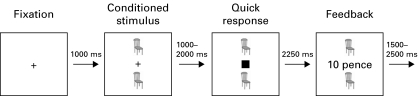
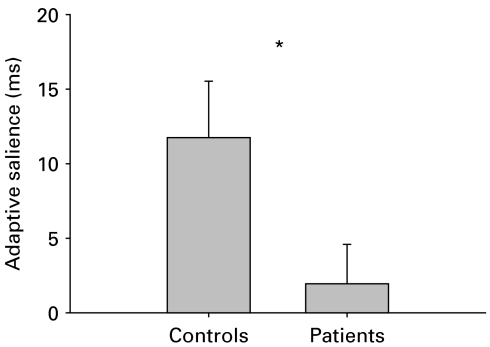
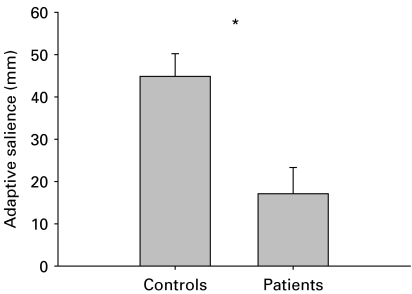
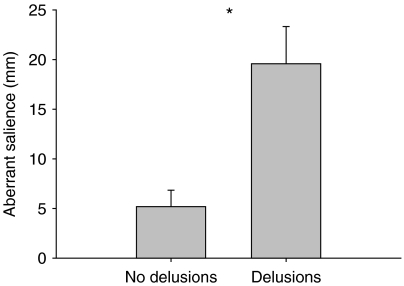
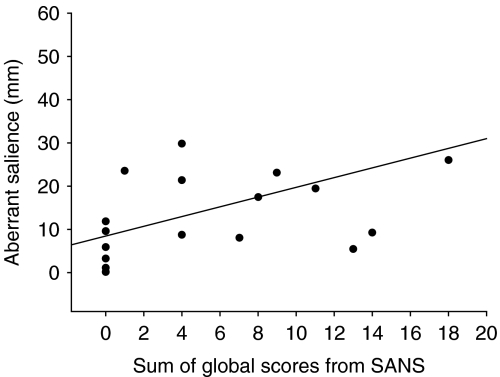
Background: It has been suggested that some psychotic symptoms reflect ‘aberrant salience’, related to dysfunctional reward learning. To test this hypothesis we investigated whether patients with schizophrenia showed impaired learning of task-relevant stimulus–reinforcement associations in the presence of distracting task-irrelevant cues. Method: We tested 20 medicated patients with schizophrenia and 17 controls on a reaction time game, the Salience Attribution Test. In this game, participants made a speeded response to earn money in the presence of conditioned stimuli (CSs). Each CS comprised two visual dimensions, colour and form. Probability of reinforcement varied over one of these dimensions (task-relevant), but not the other (task-irrelevant). Measures of adaptive and aberrant motivational salience were calculated on the basis of latency and subjective reinforcement probability rating differences over the task-relevant and task-irrelevant dimensions respectively. Results: Participants rated reinforcement significantly more likely and responded significantly faster on high-probability-reinforced relative to low-probability-reinforced trials, representing adaptive motivational salience. Patients exhibited reduced adaptive salience relative to controls, but the two groups did not differ in terms of aberrant salience. Patients with delusions exhibited significantly greater aberrant salience than those without delusions, and aberrant salience also correlated with negative symptoms. In the controls, aberrant salience correlated significantly with ‘introvertive anhedonia’ schizotypy. Conclusions: These data support the hypothesis that aberrant salience is related to the presence of delusions in medicated patients with schizophrenia, but are also suggestive of a link with negative symptoms. The relationship between aberrant salience and psychotic symptoms warrants further investigation in unmedicated patients.
Overview
The claims and statistics of this paper haven’t been checked yet.
Run the check — free, no account needed. It reads the open-access text and checks the sources it cites.
Integrity signals
Registry
Cites
Statistics
Figures
Verification
Claims the paper makes
The claims and statistics of this paper haven’t been checked yet.
Run the check — free, no account needed. It reads the open-access text and checks the sources it cites.
Claims other papers make about this one
Each is checked against this paper’s own text: does it say what the citing paper says it does?
In the citing paper
“However, on a neurophysiological level, a prediction error of this nature could cause an increase in the phasic activity of midbrain dopaminergic neurons, given the role that these particular neurons are believed to play in signaling salience in general and prediction errors in particular.[62][63][64][65]”
From Schizophrenia, myelination, and delayed corollary discharges: a hypothesis (2012) · cites this paper as [65]
Self-check
Percentages, sums and reported differences re-computed from the paper’s own numbers.
The self-check needs the paper’s full text.
Citations
Cites
(1998) · The Journal of Clinical Psychiatry · Cited by 19,139
(1998) · PubMed · Cited by 10,216
A neural substrate of prediction and reward
Schultz, W., Dayan, P., & Montague, P. R. (1997) · Science · doi:10.1126/science.275.5306.1593 · Cited by 9,388
A Rating Scale for Mania: Reliability, Validity and Sensitivity
Young, R. C., Biggs, J. T., Ziegler, V. E., & Meyer, D. A. (1978) · British Journal of Psychiatry · doi:10.1192/bjp.133.5.429 · Cited by 8,744
The mini international neuropsychiatric interview
Lecrubier, Y., Sheehan, D. V., Hergueta, T., & Weiller, E. (1998) · European Psychiatry · doi:10.1016/s0924-9338(99)80239-9 · Cited by 5,899
What is the role of dopamine in reward: hedonic impact, reward learning, or incentive salience?
Berridge, K. C., & Robinson, T. E. (1998) · Brain Research Reviews · doi:10.1016/s0165-0173(98)00019-8 · Cited by 4,127
Dopamine, learning and motivation.
Wise, R. A. (2004) · Nature Reviews Neuroscience · doi:10.1038/nrn1406 · Cited by 3,379
Kapur, S. (2003) · American Journal of Psychiatry · doi:10.1176/appi.ajp.160.1.13 · Cited by 2,813
Scale for the Assessment of Negative Symptoms (SANS)*
(1989) · The British Journal of Psychiatry · doi:10.1192/s0007125000291502 · Cited by 2,710
Scale for Assessment of Positive Symptoms (SAPS) 1984
Andreasen, N. C. (1995) · Open Scholarship Institutional Repository (Washington University in St. Louis) · Cited by 2,423
Research works printed but not linked: 2
- Wechsler, 1981, Wechsler Adult Intelligence Scale – Revised
- Wechsler, 2001, Wechsler Test of Adult Reading Manual
Cited by
Sorted by citations
Items 201–262 of 262
Margariti, M. M., & Vlachos, I. I. (2022) · Medical Hypotheses · doi:10.1016/j.mehy.2022.110915 · Cited by 5
Baharnoori, M., Bartholomeusz, C., Boucher, A. A., Buchy, L., Chaddock, C., Chiliza, B., Föcking, M., Fornito, A., Gallego, J. A., Hori, H., et al. (2010) · Schizophrenia Research · doi:10.1016/j.schres.2010.09.008 · Cited by 6
Visual worry in patients with schizophrenia
Kowalski, J., & Styła, R. (2022) · Journal of Psychiatric Research · doi:10.1016/j.jpsychires.2022.07.007 · Cited by 4
The dark side of dopaminergic therapies in Parkinson’s disease: shedding light on aberrant salience
Poletti, M. (2017) · CNS Spectrums · doi:10.1017/s1092852917000219 · Cited by 4
Associative Learning and Derived Attention in Humans
Pelley, M. E. L., Beesley, T., & Griffiths, O. (2016) · Wiley eBooks · doi:10.1002/9781118650813.ch6 · Cited by 4
Dykxhoorn, J. L., Hollander, A., Lewis, G., Magnusson, C., Dalman, C., & Kirkbride, J. B. (2018) · doi:10.31234/osf.io/b7gys · Cited by 4
Predictive coding in psychopathology: mechanistic model or metaphorical re-description?
Alotaibi, A. S. (2026) · Frontiers in Human Neuroscience · doi:10.3389/fnhum.2025.1743028 · Cited by 3
Zhang, L., Wang, W., Ruan, Y., Li, Z., Yanjun, Yanjun, Tian, Y., & Wang, K. (2024) · Psychiatry Research Neuroimaging · doi:10.1016/j.pscychresns.2024.111881 · Cited by 3
Vaidya, B. P., Shenoy, S., & Praharaj, S. K. (2024) · Indian Journal of Psychiatry · doi:10.4103/indianjpsychiatry.indianjpsychiatry_521_24 · Cited by 3
Cannabis Use, Schizotypy and Kamin Blocking Performance
Dawes, C., Bickerdike, A., O’Neill, C., Pereira, S. C., Waddington, J. L., Moran, P. M., & O’Tuathaigh, C. M. P. (2021) · Frontiers in Psychiatry · doi:10.3389/fpsyt.2021.633476 · Cited by 3
Søndergaard, A., Gregersen, M., Wilms, M., Brandt, J. M., Hjorthøj, C. R., Ohland, J., Rohd, S. B., Hemager, N., Andreassen, A. K., Knudsen, C. B., et al. (2024) · Schizophrenia Research · doi:10.1016/j.schres.2024.01.004 · Cited by 3
Experimental Medicine in Psychiatry New Approaches in Schizophrenia, Depression and Cognition
Dawson, G. R. (2015) · Current topics in behavioral neurosciences · doi:10.1007/7854_2015_5016 · Cited by 4
Jalali, S. (2013) · International Neuropsychiatric Disease Journal · doi:10.9734/indj/2013/6192 · Cited by 3
Cicero, D. C., Hicks, J. A., & King, L. A. (2015) · Imagination Cognition and Personality · doi:10.1177/0276236615572593 · Cited by 3
Forrest, A. D., Bang, J., Featherstone, R. E., Bloom, J. H., Luminais, M. S., Zhang, R. V., Gajewski, C. R., McMullen, M. F., Liang, Y., & Siegel, S. J. (2018) · Experimental Brain Research · doi:10.1007/s00221-017-5152-8 · Cited by 3
Neurodivergence in Sound: Sonification as a Tool for Mental Health Awareness
Nadri, C., Matar, H. A., Morrison, S., Tiemann, A., Song, I., Lee, T. H., & Jeon, M. (2023) · International Conference on Auditory Display (ICAD) · doi:10.21785/icad2023.7111 · Cited by 2
Ambarini, T., Hartini, N., Surjaningrum, E., Chusairi, A., Arifianto, D., Syulthoni, Z. B., Puspitasari, I. M., Adiati, R. P., & Schultze-Lutter, F. (2025) · Asian Journal of Psychiatry · doi:10.1016/j.ajp.2025.104430 · Cited by 2
Refining mechanistic models of hallucinations for enhanced translatability
Buck, J., Iigaya, K., & Horga, G. (2025) · Translational Psychiatry · doi:10.1038/s41398-025-03773-x · Cited by 2
Methods for assessing aberrant and adaptive salience
Baklushev, M. E., Nazarova, M. A., Novikov, P. A., & Nikulin, V. V. (2023) · S S Korsakov Journal of Neurology and Psychiatry · doi:10.17116/jnevro202312308130 · Cited by 2
Reward processing in young people with self-harm behaviour
Yavuz, E., Rodrigues, R., Pascual-Sánchez, A., Lingford-Hughes, A. R., & Simplicio, M. C. D. (2024) · Journal of Psychiatric Research · doi:10.1016/j.jpsychires.2024.09.038 · Cited by 2
Kapanaiah, S. K. T., Grimm, C., & Kätzel, D. (2024) · Schizophrenia · doi:10.1038/s41537-024-00513-w · Cited by 2
Kéri, S. (2012) · Magyar Pszichológiai Szemle · doi:10.1556/mpszle.67.2012.2.3 · Cited by 2
Kozunova, G. L. (2016) · Journal of Modern Foreign Psychology · doi:10.17759/jmfp.2016050409 · Cited by 2
Neuroimaging and the At-Risk Mental State
Lin, Y.-S., Fusar‐Poli, P., & Borgwardt, S. (2019) · Springer eBooks · doi:10.1007/978-3-319-97307-4_6 · Cited by 2
Genetic Basis of Auditory Verbal Hallucinations in Schizophrenia
Bose, A., Shivakumar, V., & Venkatasubramanian, G. (2018) · Springer eBooks · doi:10.1007/978-3-319-75124-5_8 · Cited by 2
Data gathering ability contributes to visual organization and probabilistic reasoning
Bernadyn, T. F., & Feigenson, K. A. (2018) · Heliyon · doi:10.1016/j.heliyon.2018.e00582 · Cited by 5
Knott, T. S., Whyte, A. J., Dhawan, S. S., Tait, D. S., & Brown, V. J. (2024) · Neuroscience · doi:10.1016/j.neuroscience.2024.07.034 · Cited by 2
van Os, J. (2014) · Schizophrenia Research · doi:10.1016/s0920-9964(14)70221-x · Cited by 1
Reward Processing in Motivational and Affective Disorders
Skandali, N. (2016) · Frontiers research topics · doi:10.3389/978-2-88919-986-0 · Cited by 1
Suker, S., Mihov, Y., Wolf, A., Mueller, S., & Hasler, G. (2023) · Schizophrenia Bulletin Open · doi:10.1093/schizbullopen/sgad023 · Cited by 1
Enhanced instructed fear learning in delusion-pronenessPreprint
Louzolo, A., Almeida, R., Guitart‐Masip, M., Björnsdotter, M., Ingvar, M., Olsson, A., & Petrović, P. (2018) · bioRxiv (Cold Spring Harbor Laboratory) · doi:10.1101/264739 · Cited by 1
Nguyen, R. (2018) · TSpace (University of Toronto) · Cited by 1
Alpha Event-related Desynchronization During Reward Processing in SchizophreniaPreprint
Marton, T. F., Roach, B. J., Holroyd, C. B., Ford, J. M., McQuaid, J. R., Mathalon, D. H., & Fryer, S. L. (2021) · bioRxiv (Cold Spring Harbor Laboratory) · doi:10.1101/2021.02.25.432936 · Cited by 1
Williams, S. A., Gwilt, M., Hock, R. M., Taylor, C., Loayza, J., Stevenson, C. W., Cassaday, H. J., & Bast, T. (2021) · bioRxiv (Cold Spring Harbor Laboratory) · doi:10.1101/2021.06.02.446736 · Cited by 1
A dopaminergic basis of behavioral controlPreprint
Ballard, I. C., Furman, D. J., Berry, A. S., White, R. L., Jagust, W. J., Kayser, A. S., & D’Esposito, M. (2024) · bioRxiv (Cold Spring Harbor Laboratory) · doi:10.1101/2024.09.17.613524 · Cited by 1
From Reward Learning to the Bayesian Brain: 20 Years of Aberrant Salience
Feldman, H., & Schmack, K. (2025) · American Journal of Psychiatry · doi:10.1176/appi.ajp.20250650 · Cited by 1
Interactions in psychosis : linking environment, brain and genes
Collip, D. (2011) · Research Publications (Maastricht University) · doi:10.26481/dis.20110914dc
Allosteric Modulators: Potential Treatment for Schizophrenia
Daya, R. P. (2012) · The Meducator · doi:10.15173/m.v1i20.786
Delfin, C. (2014) · Högskolan Kristianstad Publikationer
Intuitive coding: Vision and delusion
Rǎdulescu, A. (2011) · Philosophical Psychology · doi:10.1080/09515089.2010.533264
Salience Attribution Differences by Dopamine Transporter Genotype
Bercik, D. (2011) · DigitalGeorgetown (Georgetown University Library)
Egyéni különbségek az alkotó gondolkodásban: Pszichózis az adaptív működésben?
Polner, B., & Kéri, S. (2015) · Magyar Pszichológiai Szemle · doi:10.1556/0016.2015.70.3.3 · Cited by 1
Richter, A. (2017) · eDiss (Georg-August-Universität Göttingen) · doi:10.53846/goediss-6346
Reckless, G. E., Andreassen, O. A., & Østefjells, T. (2015)
Cognition and apathy in normal pressure hydrocephalus
Peterson, K. A. (2017) · Apollo (University of Cambridge) · doi:10.17863/cam.22049
Lefebvre, O., Leleu, V., Mehmet, M., & Yon, V. (2018) · L Encéphale · doi:10.1016/j.encep.2018.07.001
The role of migration and social environments in the risk of psychotic disorders
Dykxhoorn, J. L. (2019) · UCL Discovery (University College London)
Berridge, K. C. (2011) · Faculty Opinions – Post-Publication Peer Review of the Biomedical Literature · doi:10.3410/f.13371000.14741108
What is Measured as Aberrant Salience?Preprint
Testal, J. F. R., Fuentes-Márquez, S., Senín‐Calderón, C., Fernández-León, S., Ceballos-Munuera, C., Garcelán, S. P., & Fonseca‐Pedrero, E. (2022) · SSRN Electronic Journal · doi:10.2139/ssrn.4046579
Overshadowing and salience attribution in relation to cannabis use
Dawes, C., McGreal, S. J., Marwaha, S., Prados, J., Reheis, A., Dumitrescu, A., Waddington, J. L., Moran, P. M., & O’Tuathaigh, C. M. P. (2024) · Schizophrenia Research Cognition · doi:10.1016/j.scog.2024.100315
Mindfulness predicts reduced aberrant salience and improves stress managementPreprint
Wießner, I., Souza, J. P., Demarzo, M., & Tófoli, L. F. (2024) · Research Square · doi:10.21203/rs.3.rs-4528848/v1
Die Entdeckung der Bedeutung von Bedeutung
Kätzel, D. (2024) · Nervenheilkunde · doi:10.1055/a-2389-7566
Dopamine dysfunction in psychosis
McCutcheon, R. A., & Zauchenberger, C.-Z. (2025) · Handbook of behavioral neuroscience · doi:10.1016/b978-0-443-29867-7.00035-9
Web-Based Psychological Interventions for Body Image and Weight-Related Disorders
Argyrides, M., & Anastasiades, E. (2026) · Springer eBooks · doi:10.1007/978-3-032-08980-9_15
Polese, D., Mazzetta, A., Costanzi, F., Cozza, G., Niolu, C., Causi, F. S. L., Nardo, G. D., Caserta, D., Parisi, P., Siracusano, A., et al. (2026) · Journal of Affective Disorders · doi:10.1016/j.jad.2026.121416
Associations between aberrant salience and hoarding severity in a community sample
Rivers, H., Collins, C., Neave, N., & Smailes, D. (2025) · Cognitive Neuropsychiatry · doi:10.1080/13546805.2026.2629986
Wießner, I., Falchi-Carvalho, M., Laborde, S., Barros, H., Bolcont, R., Gurgel, M. M. M., Mograbi, D. C., Coelho, N., Palhano-Fontes, F., & de Araujo, D. (2026) · Research Square · doi:10.21203/rs.3.rs-9640916/v1
Beyond single-person paradigms: N400 alterations in a social context in schizophrenia
Fullajtár, M., Kakuszi, B., Bitter, I., & Czobor, P. (2026) · Frontiers in Psychiatry · doi:10.3389/fpsyt.2026.1922640
Salience attribution in addiction and psychosis
Freeman, T. P. (2013) · UCL Discovery (University College London)
Psychic embedding — vision and delusionPreprint
Rǎdulescu, A. (2008) · CogPrints (University of Southampton)
Cannabinoids, Monoamines, COMT and Schizophrenia: Pathobiological Mechanisms in Psychosis
O’Tuathaigh, C. M. P., Desbonnet, L., & Waddington, J. L. (2013) · Springer eBooks · doi:10.1007/978-1-4614-7940-6_14
Metadata
- Authors
- Roiser, J. P., Stephan, K. E., den Ouden, H. E. M., Barnes, T. R. E., Friston, K. J., & Joyce, E. M.
- Affiliations
- Wellcome Centre for Human Neuroimaging (GB)
- Imperial College London (GB)
- Corresponding author
- Roiser, J. P.
- Venue
- Psychological Medicine
- Publisher
- Cambridge University Press (CUP)
- Published
- 2008-06-30
- Volume
- 39
- Issue
- 2
- Pages
- 199-209
- ISSN
- 0033-2917 (ISSN-L)
- 1469-8978
- PMC
- PMC2635536
- OpenAlex
- W2100040139
- Cited by
- 262
- References
- 51
- Citations by year
- 2026: 5 · 2025: 8 · 2024: 16 · 2023: 11 · 2022: 14 · 2021: 15 · 2020: 15 · 2019: 12 · 2018: 17 · 2017: 13 · 2016: 26 · 2015: 18 · 2014: 15 · 2013: 17 · 2012: 17
- FWCI
- 9.81
- Type
- journal article
- Language
- en
- Open access
- hybrid
- doi.org
- Licence
- cc-by-nc-sa
- www.cambridge.org/core/terms (unspecified)
- Locations
- Psychological Medicine (publishedVersion, cc-by-nc-sa)
- Europe PMC (PubMed Central) (publishedVersion, cc-by-nc-sa)
- PubMed Central (publishedVersion, cc-by-nc-sa)
- PubMed (publishedVersion)
- Zurich Open Repository and Archive (University of Zurich) (acceptedVersion, other-oa)
- Radboud Repository (Radboud University) (submittedVersion)
- UCL Discovery (University College London) (submittedVersion)
- Zurich Open Repository and Archive (University of Zurich) (submittedVersion, other-oa)
- Radboud Repository (Radboud University) (submittedVersion, other-oa)
- Zurich Open Repository and Archive (University of Zurich)
- Funders
- Wellcome Trust (064607 /z/01/z, 064607, 088130)
- University College London
- Topics
- Health Sciences › Medicine › Psychiatry and Mental health › Schizophrenia research and treatment
- Life Sciences › Neuroscience › Cognitive Neuroscience › Neural and Behavioral Psychology Studies
- Social Sciences › Arts and Humanities › Philosophy › Mental Health and Psychiatry
- Keywords
- schizophrenia, aberrant salience, motivational salience, delusions, negative symptoms, anhedonia, schizotypy, reward learning, reaction time, reinforcement probability
- MeSH terms
- Adaptation, Psychological, Adolescent, Adult, Conditioning, Psychological, Dopamine, Feedback, Female, Fixation, Ocular, Humans, Learning, Male, Middle Aged, Motivation, Psychological Tests, Psychotic Disorders, Reaction Time, Reinforcement, Psychology, Reward, Schizophrenia, Schizophrenic Psychology, Young Adult
About these checks
Registry, retraction, Cites and statistics results are computed, not judged, with one exception: a printed reference that no index lists is read once by a model before it counts as a citation error. Claims are extracted by a model and kept only when their quote appears verbatim in the text; each cited source is then checked, with a model’s help, for whether it says what the claim relies on. Those verdicts can be wrong — read the claim’s quote and the cited source before relying on one.
Statistics and arithmetic are recomputed, not judged.
Confidence bands are shown only for fields calibrated on our annotated test set. None is calibrated yet, so no band is shown.
What counts as a claim ›How we measure confidence ›How we check this ›
Are you an author, or do you see a problem with this page? Request a review
