

The DOI matches its Crossref record; 50 of the 51 references it cites were found in a registry or an index.
Do patients with schizophrenia exhibit aberrant salience?
Open accessAbstract
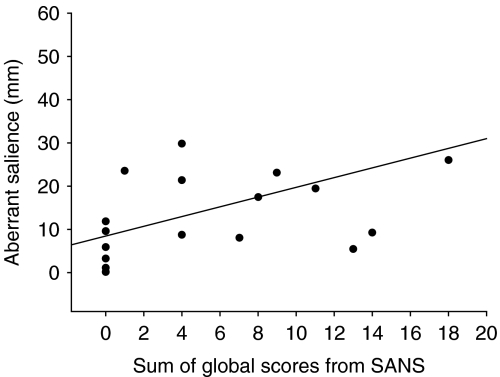
Background: It has been suggested that some psychotic symptoms reflect ‘aberrant salience’, related to dysfunctional reward learning. To test this hypothesis we investigated whether patients with schizophrenia showed impaired learning of task-relevant stimulus–reinforcement associations in the presence of distracting task-irrelevant cues. Method: We tested 20 medicated patients with schizophrenia and 17 controls on a reaction time game, the Salience Attribution Test. In this game, participants made a speeded response to earn money in the presence of conditioned stimuli (CSs). Each CS comprised two visual dimensions, colour and form. Probability of reinforcement varied over one of these dimensions (task-relevant), but not the other (task-irrelevant). Measures of adaptive and aberrant motivational salience were calculated on the basis of latency and subjective reinforcement probability rating differences over the task-relevant and task-irrelevant dimensions respectively. Results: Participants rated reinforcement significantly more likely and responded significantly faster on high-probability-reinforced relative to low-probability-reinforced trials, representing adaptive motivational salience. Patients exhibited reduced adaptive salience relative to controls, but the two groups did not differ in terms of aberrant salience. Patients with delusions exhibited significantly greater aberrant salience than those without delusions, and aberrant salience also correlated with negative symptoms. In the controls, aberrant salience correlated significantly with ‘introvertive anhedonia’ schizotypy. Conclusions: These data support the hypothesis that aberrant salience is related to the presence of delusions in medicated patients with schizophrenia, but are also suggestive of a link with negative symptoms. The relationship between aberrant salience and psychotic symptoms warrants further investigation in unmedicated patients.
Overview
The claims and statistics of this paper haven’t been checked yet.
Run the check — free, no account needed. It reads the open-access text and checks the sources it cites.
Integrity signals
Registry
Cites
Statistics
Figures
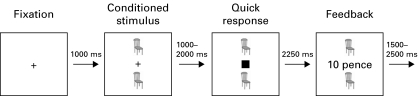
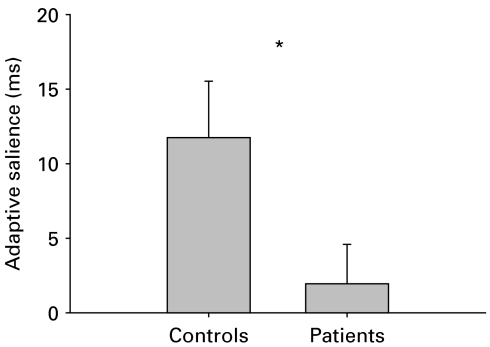
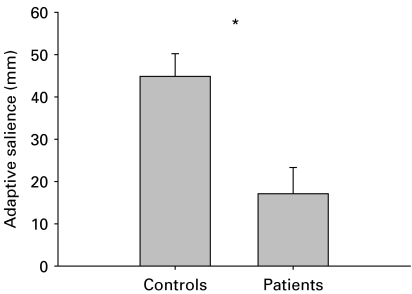
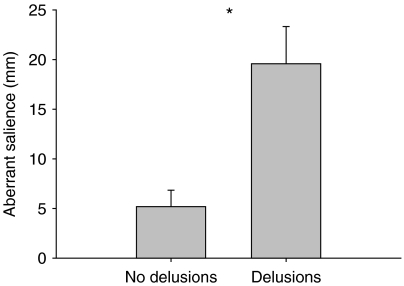
Verification
Claims the paper makes
The claims and statistics of this paper haven’t been checked yet.
Run the check — free, no account needed. It reads the open-access text and checks the sources it cites.
Claims other papers make about this one
Each is checked against this paper’s own text: does it say what the citing paper says it does?
In the citing paper
“However, on a neurophysiological level, a prediction error of this nature could cause an increase in the phasic activity of midbrain dopaminergic neurons, given the role that these particular neurons are believed to play in signaling salience in general and prediction errors in particular.[62][63][64][65]”
From Schizophrenia, myelination, and delayed corollary discharges: a hypothesis (2012) · cites this paper as [65]
Self-check
Percentages, sums and reported differences re-computed from the paper’s own numbers.
The self-check needs the paper’s full text.
Citations
Cites
(1998) · The Journal of Clinical Psychiatry · Cited by 19,139
(1998) · PubMed · Cited by 10,216
A neural substrate of prediction and reward
Schultz, W., Dayan, P., & Montague, P. R. (1997) · Science · doi:10.1126/science.275.5306.1593 · Cited by 9,388
A Rating Scale for Mania: Reliability, Validity and Sensitivity
Young, R. C., Biggs, J. T., Ziegler, V. E., & Meyer, D. A. (1978) · British Journal of Psychiatry · doi:10.1192/bjp.133.5.429 · Cited by 8,744
The mini international neuropsychiatric interview
Lecrubier, Y., Sheehan, D. V., Hergueta, T., & Weiller, E. (1998) · European Psychiatry · doi:10.1016/s0924-9338(99)80239-9 · Cited by 5,899
What is the role of dopamine in reward: hedonic impact, reward learning, or incentive salience?
Berridge, K. C., & Robinson, T. E. (1998) · Brain Research Reviews · doi:10.1016/s0165-0173(98)00019-8 · Cited by 4,127
Dopamine, learning and motivation.
Wise, R. A. (2004) · Nature Reviews Neuroscience · doi:10.1038/nrn1406 · Cited by 3,379
Kapur, S. (2003) · American Journal of Psychiatry · doi:10.1176/appi.ajp.160.1.13 · Cited by 2,813
Scale for the Assessment of Negative Symptoms (SANS)*
(1989) · The British Journal of Psychiatry · doi:10.1192/s0007125000291502 · Cited by 2,710
Scale for Assessment of Positive Symptoms (SAPS) 1984
Andreasen, N. C. (1995) · Open Scholarship Institutional Repository (Washington University in St. Louis) · Cited by 2,423
The debate over dopamine’s role in reward: the case for incentive salience
Berridge, K. C. (2007) · Psychopharmacology · doi:10.1007/s00213-006-0578-x · Cited by 2,347
Grace, A. A. (1991) · Neuroscience · doi:10.1016/0306-4522(91)90196-u · Cited by 1,831
Jablensky, A., Sartorius, N., Ernberg, G., Anker, M., Korten, A., Cooper, J. E., Day, R., & Bertelsen, A. (1992) · Psychological Medicine. Monograph Supplement · doi:10.1017/s0264180100000904 · Cited by 1,769
Dopamine-dependent prediction errors underpin reward-seeking behaviour in humans
Pessiglione, M., Seymour, B., Flandin, G., Dolan, R. J., & Frith, C. D. (2006) · Nature · doi:10.1038/nature05051 · Cited by 1,584
Laruelle, M., Abi-Dargham, A., van Dyck, C. H., Gil, R., D'Souza, C. D., Erdos, J., McCance, E., Rosenblatt, W., Fingado, C., Zoghbi, S. S., et al. (1996) · Proceedings of the National Academy of Sciences · doi:10.1073/pnas.93.17.9235 · Cited by 1,291
A depression rating scale for schizophrenics
Addington, D. E., Addington, J., & Schıssel, B. (1990) · Schizophrenia Research · doi:10.1016/0920-9964(90)90005-r · Cited by 1,270
Increased baseline occupancy of D 2 receptors by dopamine in schizophrenia
Abi-Dargham, A., Rodenhiser, J., Printz, D., Zea-Ponce, Y., Gil, R., Kegeles, L. S., Weiss, R., Cooper, T. B., Mann, J. J., Van Heertum, R. L., et al. (2000) · Proceedings of the National Academy of Sciences · doi:10.1073/pnas.97.14.8104 · Cited by 1,020
Putatively psychosis-prone subjects 10 years later.
Chapman, L. J., Chapman, J. P., Kwapil, T. R., Eckblad, M., & Zinser, M. C. (1994) · Journal of Abnormal Psychology · doi:10.1037/0021-843x.103.2.171 · Cited by 977
Reward, Motivation, and Reinforcement Learning
Dayan, P., & Balleine, B. W. (2002) · Neuron · doi:10.1016/s0896-6273(02)00963-7 · Cited by 855
Dopamine neurons and their role in reward mechanisms
Schultz, W. (1997) · Current Opinion in Neurobiology · doi:10.1016/s0959-4388(97)80007-4 · Cited by 809
Wyvell, C. L., & Berridge, K. C. (2000) · The Journal of Neuroscience · doi:10.1523/jneurosci.20-21-08122.2000 · Cited by 764
Genes, dopamine and cortical signal-to-noise ratio in schizophrenia
Winterer, G., & Weinberger, D. R. (2004) · Trends in Neurosciences · doi:10.1016/j.tins.2004.08.002 · Cited by 610
Reasoning in Deluded Schizophrenic and Paranoid Patients
Garety, P. A., HEMSLEY, D. R., & Wessely, S. C. (1991) · The Journal of Nervous and Mental Disease · doi:10.1097/00005053-199104000-00003 · Cited by 602
Dysfunction of ventral striatal reward prediction in schizophrenia
Juckel, G., Schlagenhauf, F., Koslowski, M., Wüstenberg, T., Villringer, A., Knutson, B., Wrase, J., & Heinz, A. (2006) · NeuroImage · doi:10.1016/j.neuroimage.2005.07.051 · Cited by 578
The dopamine hypothesis of schizophrenia: focus on the dopamine receptor
Snyder, S. H. (1976) · American Journal of Psychiatry · doi:10.1176/ajp.133.2.197 · Cited by 557
Substantia nigra/ventral tegmental reward prediction error disruption in psychosis
Murray, G. K., Corlett, P. R., Clark, L., Pessiglione, M., Blackwell, A. D., Honey, G., Jones, P. B., Bullmore, E. T., Robbins, T. W., & Fletcher, P. C. (2008) · Molecular Psychiatry · doi:10.1038/sj.mp.4002058 · Cited by 532
Schizophrenia : manifestations, incidence and course in different cultures
Zhablenski, A. V. (1992) · Cambridge University Press eBooks · Cited by 506
Differential Encoding of Losses and Gains in the Human Striatum
Seymour, B., Daw, N. D., Dayan, P., Singer, T., & Dolan, R. J. (2007) · Journal of Neuroscience · doi:10.1523/jneurosci.0400-07.2007 · Cited by 479
Psychotic Disorders in Urban Areas: An Overview of the Study on Low Prevalence Disorders
Jablensky, A. V., McGrath, J. J., Herrman, H., Castle, D. J., Gureje, O., Evans, M., Carr, V. J., Morgan, V. A., Korten, A. E., & Harvey, C. A. (2000) · Australian & New Zealand Journal of Psychiatry · doi:10.1080/j.1440-1614.2000.00728.x · Cited by 394
Do we still believe in the dopamine hypothesis? New data bring new evidence.
Abi-Dargham, A. (2004) · International Journal of Neuropsychopharmacology · doi:10.1017/s1461145704004110 · Cited by 373
Short scales for measuring schizotypy.
Mason, O., Linney, Y., & Claridge, G. (2005) · Schizophrenia Research · doi:10.1016/j.schres.2005.06.020 · Cited by 355
Waltz, J. A., Frank, M. J., Robinson, B. M., & Gold, J. M. (2007) · Biological Psychiatry · doi:10.1016/j.biopsych.2006.09.042 · Cited by 326
Presynaptic dopamine function in striatum of neuroleptic-naive schizophrenic patients
Hietala, J. A., Syvälahti, E. K. G., Kuoppamäki, M., Hietala, J., Syvälahti, E. K. G., Haaparanta‐Solin, M., Kuoppamäki, M., Ruotsalainen, U., Vuorio, K. A., Räkköläinen, V., et al. (1995) · The Lancet · doi:10.1016/s0140-6736(95)91801-9 · Cited by 325
Heerey, E. A., & Gold, J. M. (2007) · Journal of Abnormal Psychology · doi:10.1037/0021-843x.116.2.268 · Cited by 248
Presynaptic Dopaminergic Dysfunction in Schizophrenia
McGowan, S., Lawrence, A. D., Sales, T., Quested, D. J., & Grasby, P. M. (2004) · Archives of General Psychiatry · doi:10.1001/archpsyc.61.2.134 · Cited by 229
The formation of abnormal associations in schizophrenia: Neural and behavioral evidence
Jensen, J., Willeit, M., Zipursky, R. B., Savina, I., Smith, A. J., Menon, M., Crawley, A. P., & Kapur, S. (2008) · Neuropsychopharmacology · doi:10.1038/sj.npp.1301437 · Cited by 225
Single Indicator of Risk for Schizophrenia: Probable Fact or Likely Myth?
Claridge, G. (1994) · Schizophrenia Bulletin · doi:10.1093/schbul/20.1.151 · Cited by 211
Amphetamine modulates human incentive processing
Knutson, B., Bjork, J. M., Fong, G. W., Hommer, D., Mattay, V. S., & Weinberger, D. R. (2004) · Neuron · doi:10.1016/j.neuron.2004.06.030 · Cited by 174
The Influence of Expected Value on Saccadic Preparation
Milstein, D. M., & Dorris, M. C. (2007) · Journal of Neuroscience · doi:10.1523/jneurosci.0577-07.2007 · Cited by 144
Stefanis, N. C., Os, J. V., Avramopoulos, D., Smyrnis, N., Evdokimidis, I., Hantoumi, I., & Stefanis, C. N. (2004) · Biological Psychiatry · doi:10.1016/j.biopsych.2004.06.038 · Cited by 138
Cognitive heterogeneity in first-episode schizophrenia
Joyce, E. M., Hutton, S. B., Mutsatsa, S. H., & Barnes, T. R. E. (2005) · The British Journal of Psychiatry · doi:10.1192/bjp.187.6.516 · Cited by 137
Self-citationNeural Response to Emotional Salience in Schizophrenia
Taylor, S. F., Phan, K. L., Britton, J. C., & Liberzon, I. (2005) · Neuropsychopharmacology · doi:10.1038/sj.npp.1300679 · Cited by 136
Chaotic behavior in dopamine neurodynamics.
King, R., Barchas, J. D., & Huberman, B. A. (1984) · Proceedings of the National Academy of Sciences · doi:10.1073/pnas.81.4.1244 · Cited by 92
Garmezy, N. (1952) · Journal of Personality · doi:10.1111/j.1467-6494.1952.tb01109.x · Cited by 80
Delusions, superstitious conditioning and chaotic dopamine neurodynamics
Shaner, A. L. (1999) · Medical Hypotheses · doi:10.1054/mehy.1997.0656 · Cited by 49
Deficit symptoms in schizophrenia: negative symptoms versus neuroleptic‐induced deficits
Schooler, N. R. (1994) · Acta Psychiatrica Scandinavica · doi:10.1111/j.1600-0447.1994.tb05827.x · Cited by 48
Do neuroleptics impair learning in schizophrenic patients?
Cutmore, T. (1990) · Schizophrenia Research · doi:10.1016/0920-9964(90)90035-6 · Cited by 44
Motivation and performance in schizophrenia.
Cohen, B. D. (1956) · Journal of Abnormal & Social Psychology · doi:10.1037/h0048262 · Cited by 43
Synthesizing Schizophrenia: A Bottom-Up, Symptomatic Approach
Robbins, T. W. (2005) · Schizophrenia Bulletin · doi:10.1093/schbul/sbi044 · Cited by 39
Miller, R. J. (1993) · International review of neurobiology · doi:10.1016/s0074-7742(08)60571-1 · Cited by 35
Research works printed but not linked: 2
- Wechsler, 1981, Wechsler Adult Intelligence Scale – Revised
- Wechsler, 2001, Wechsler Test of Adult Reading Manual
Cited by
Sorted by citations
The Dopamine Hypothesis of Schizophrenia: Version III--The Final Common Pathway
Howes, O. D., & Kapur, S. (2009) · Schizophrenia Bulletin · doi:10.1093/schbul/sbp006 · Cited by 2,693
van Os, J., & Kapur, S. (2009) · The Lancet · doi:10.1016/s0140-6736(09)60995-8 · Cited by 1,971
Perceiving is believing: a Bayesian approach to explaining the positive symptoms of schizophrenia
Fletcher, P. C., & Frith, C. D. (2009) · Nature Reviews Neuroscience · doi:10.1038/nrn2536 · Cited by 1,462
Dysconnection in schizophrenia: from abnormal synaptic plasticity to failures of self-monitoring
Stephan, K. E., Friston, K. J., & Frith, C. D. (2009) · Schizophrenia Bulletin · doi:10.1093/schbul/sbn176 · Cited by 1,134
Self-citationComputational psychiatry as a bridge from neuroscience to clinical applications
Huys, Q. J. M., Maia, T. V., & Frank, M. J. (2016) · Nature Neuroscience · doi:10.1038/nn.4238 · Cited by 1,002
Metadata
- Authors
- Roiser, J. P., Stephan, K. E., den Ouden, H. E. M., Barnes, T. R. E., Friston, K. J., & Joyce, E. M.
- Affiliations
- Wellcome Centre for Human Neuroimaging (GB)
- Imperial College London (GB)
- Corresponding author
- Roiser, J. P.
- Venue
- Psychological Medicine
- Publisher
- Cambridge University Press (CUP)
- Published
- 2008-06-30
- Volume
- 39
- Issue
- 2
- Pages
- 199-209
- ISSN
- 0033-2917 (ISSN-L)
- 1469-8978
- PMC
- PMC2635536
- OpenAlex
- W2100040139
- Cited by
- 262
- References
- 51
- Citations by year
- 2026: 5 · 2025: 8 · 2024: 16 · 2023: 11 · 2022: 14 · 2021: 15 · 2020: 15 · 2019: 12 · 2018: 17 · 2017: 13 · 2016: 26 · 2015: 18 · 2014: 15 · 2013: 17 · 2012: 17
- FWCI
- 9.81
- Type
- journal article
- Language
- en
- Open access
- hybrid
- doi.org
- Licence
- cc-by-nc-sa
- www.cambridge.org/core/terms (unspecified)
- Locations
- Psychological Medicine (publishedVersion, cc-by-nc-sa)
- Europe PMC (PubMed Central) (publishedVersion, cc-by-nc-sa)
- PubMed Central (publishedVersion, cc-by-nc-sa)
- PubMed (publishedVersion)
- Zurich Open Repository and Archive (University of Zurich) (acceptedVersion, other-oa)
- Radboud Repository (Radboud University) (submittedVersion)
- UCL Discovery (University College London) (submittedVersion)
- Zurich Open Repository and Archive (University of Zurich) (submittedVersion, other-oa)
- Radboud Repository (Radboud University) (submittedVersion, other-oa)
- Zurich Open Repository and Archive (University of Zurich)
- Funders
- Wellcome Trust (064607 /z/01/z, 064607, 088130)
- University College London
- Topics
- Health Sciences › Medicine › Psychiatry and Mental health › Schizophrenia research and treatment
- Life Sciences › Neuroscience › Cognitive Neuroscience › Neural and Behavioral Psychology Studies
- Social Sciences › Arts and Humanities › Philosophy › Mental Health and Psychiatry
- Keywords
- schizophrenia, aberrant salience, motivational salience, delusions, negative symptoms, anhedonia, schizotypy, reward learning, reaction time, reinforcement probability
- MeSH terms
- Adaptation, Psychological, Adolescent, Adult, Conditioning, Psychological, Dopamine, Feedback, Female, Fixation, Ocular, Humans, Learning, Male, Middle Aged, Motivation, Psychological Tests, Psychotic Disorders, Reaction Time, Reinforcement, Psychology, Reward, Schizophrenia, Schizophrenic Psychology, Young Adult
About these checks
Registry, retraction, Cites and statistics results are computed, not judged, with one exception: a printed reference that no index lists is read once by a model before it counts as a citation error. Claims are extracted by a model and kept only when their quote appears verbatim in the text; each cited source is then checked, with a model’s help, for whether it says what the claim relies on. Those verdicts can be wrong — read the claim’s quote and the cited source before relying on one.
Statistics and arithmetic are recomputed, not judged.
Confidence bands are shown only for fields calibrated on our annotated test set. None is calibrated yet, so no band is shown.
What counts as a claim ›How we measure confidence ›How we check this ›
Are you an author, or do you see a problem with this page? Request a review
