

The DOI matches its Crossref record; 50 of the 51 references it cites were found in a registry or an index.
Do patients with schizophrenia exhibit aberrant salience?
Open accessAbstract
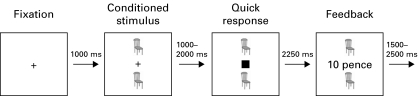
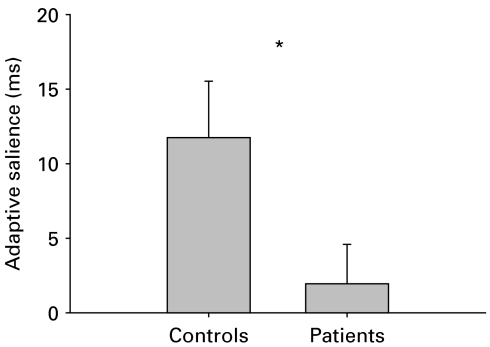
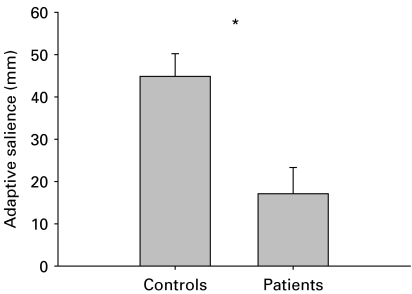
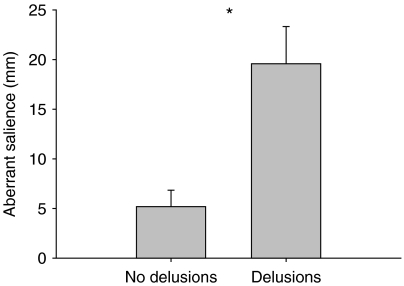
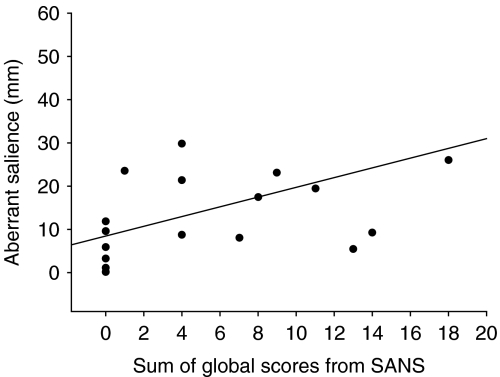
Background: It has been suggested that some psychotic symptoms reflect ‘aberrant salience’, related to dysfunctional reward learning. To test this hypothesis we investigated whether patients with schizophrenia showed impaired learning of task-relevant stimulus–reinforcement associations in the presence of distracting task-irrelevant cues. Method: We tested 20 medicated patients with schizophrenia and 17 controls on a reaction time game, the Salience Attribution Test. In this game, participants made a speeded response to earn money in the presence of conditioned stimuli (CSs). Each CS comprised two visual dimensions, colour and form. Probability of reinforcement varied over one of these dimensions (task-relevant), but not the other (task-irrelevant). Measures of adaptive and aberrant motivational salience were calculated on the basis of latency and subjective reinforcement probability rating differences over the task-relevant and task-irrelevant dimensions respectively. Results: Participants rated reinforcement significantly more likely and responded significantly faster on high-probability-reinforced relative to low-probability-reinforced trials, representing adaptive motivational salience. Patients exhibited reduced adaptive salience relative to controls, but the two groups did not differ in terms of aberrant salience. Patients with delusions exhibited significantly greater aberrant salience than those without delusions, and aberrant salience also correlated with negative symptoms. In the controls, aberrant salience correlated significantly with ‘introvertive anhedonia’ schizotypy. Conclusions: These data support the hypothesis that aberrant salience is related to the presence of delusions in medicated patients with schizophrenia, but are also suggestive of a link with negative symptoms. The relationship between aberrant salience and psychotic symptoms warrants further investigation in unmedicated patients.
Overview
The claims and statistics of this paper haven’t been checked yet.
Run the check — free, no account needed. It reads the open-access text and checks the sources it cites.
Integrity signals
Registry
Cites
Statistics
Figures
Verification
Claims the paper makes
The claims and statistics of this paper haven’t been checked yet.
Run the check — free, no account needed. It reads the open-access text and checks the sources it cites.
Claims other papers make about this one
Each is checked against this paper’s own text: does it say what the citing paper says it does?
In the citing paper
“However, on a neurophysiological level, a prediction error of this nature could cause an increase in the phasic activity of midbrain dopaminergic neurons, given the role that these particular neurons are believed to play in signaling salience in general and prediction errors in particular.[62][63][64][65]”
From Schizophrenia, myelination, and delayed corollary discharges: a hypothesis (2012) · cites this paper as [65]
Self-check
Percentages, sums and reported differences re-computed from the paper’s own numbers.
The self-check needs the paper’s full text.
Citations
Cites
(1998) · The Journal of Clinical Psychiatry · Cited by 19,139
(1998) · PubMed · Cited by 10,216
A neural substrate of prediction and reward
Schultz, W., Dayan, P., & Montague, P. R. (1997) · Science · doi:10.1126/science.275.5306.1593 · Cited by 9,388
A Rating Scale for Mania: Reliability, Validity and Sensitivity
Young, R. C., Biggs, J. T., Ziegler, V. E., & Meyer, D. A. (1978) · British Journal of Psychiatry · doi:10.1192/bjp.133.5.429 · Cited by 8,744
The mini international neuropsychiatric interview
Lecrubier, Y., Sheehan, D. V., Hergueta, T., & Weiller, E. (1998) · European Psychiatry · doi:10.1016/s0924-9338(99)80239-9 · Cited by 5,899
What is the role of dopamine in reward: hedonic impact, reward learning, or incentive salience?
Berridge, K. C., & Robinson, T. E. (1998) · Brain Research Reviews · doi:10.1016/s0165-0173(98)00019-8 · Cited by 4,127
Dopamine, learning and motivation.
Wise, R. A. (2004) · Nature Reviews Neuroscience · doi:10.1038/nrn1406 · Cited by 3,379
Kapur, S. (2003) · American Journal of Psychiatry · doi:10.1176/appi.ajp.160.1.13 · Cited by 2,813
Scale for the Assessment of Negative Symptoms (SANS)*
(1989) · The British Journal of Psychiatry · doi:10.1192/s0007125000291502 · Cited by 2,710
Scale for Assessment of Positive Symptoms (SAPS) 1984
Andreasen, N. C. (1995) · Open Scholarship Institutional Repository (Washington University in St. Louis) · Cited by 2,423
Research works printed but not linked: 2
- Wechsler, 1981, Wechsler Adult Intelligence Scale – Revised
- Wechsler, 2001, Wechsler Test of Adult Reading Manual
Cited by
Sorted by citations
Items 101–200 of 262
Frydecka, D., Misiak, B., Kotowicz, K., Pionke‐Ubych, R., Krężołek, M., Cechnicki, A., & Gawęda, Ł. (2020) · European Psychiatry · doi:10.1192/j.eurpsy.2020.31 · Cited by 32
Autism Tendencies and Psychosis Proneness Interactively Modulate Saliency Cost
Abu-Akel, A. M., Apperly, I. A., Wood, S. J., Hansen, P., & Mevorach, C. (2016) · Schizophrenia Bulletin · doi:10.1093/schbul/sbw066 · Cited by 33
Assessing the construct validity of aberrant salience
Schmidt, K. (2009) · Frontiers in Behavioral Neuroscience · doi:10.3389/neuro.08.058.2009 · Cited by 33
Neural circuitry of novelty salience processing in psychosis risk: Association with clinical outcome
Modinos, G., Allen, P., Zugman, A., Dima, D., Azis, M., Samson, C., Bonoldi, I., Quinn, B., Gifford, G. W. G., Smart, S. E., et al. (2020) · Schizophrenia Bulletin · doi:10.1093/schbul/sbz089 · Cited by 31
Impairment in acquisition of conditioned fear in schizophrenia
Tuominen, L. J., Romaniuk, L., Milad, M. R., GOFF, D. C., Hall, J., & Holt, D. J. (2021) · Neuropsychopharmacology · doi:10.1038/s41386-021-01193-1 · Cited by 30
Ceaser, A. E., & Barch, D. M. (2016) · Frontiers in Human Neuroscience · doi:10.3389/fnhum.2015.00687 · Cited by 33
Whitford, T. J., Kubicki, M. R., Pelavin, P. E., Lucia, D., Schneiderman, J. S., Pantelis, C., McCarley, R. W., & Shenton, M. E. (2014) · Schizophrenia Research · doi:10.1016/j.schres.2014.08.033 · Cited by 30
The computational psychiatry of reward: broken brains or misguided minds?
Moutoussis, M., Story, G. W., & Dolan, R. J. (2015) · Frontiers in Psychology · doi:10.3389/fpsyg.2015.01445 · Cited by 28
Hua, J. P. Y., Karcher, N. R., Merrill, A. M., O’Brien, K. J., Straub, K. T., Trull, T. J., & Kerns, J. G. (2019) · Cognitive Affective & Behavioral Neuroscience · doi:10.3758/s13415-019-00698-z · Cited by 29
Modeling subjective relevance in schizophrenia and its relation to aberrant salience
Katthagen, T., Mathys, C., Deserno, L., Walter, H., Kathmann, N., Heinz, A., & Schlagenhauf, F. (2018) · PLOS Computational Biology · doi:10.1371/journal.pcbi.1006319 · Cited by 29
Reckless, G. E., Andreassen, O. A., Server, A., Østefjells, T., & Jensen, J. (2015) · NeuroImage Clinical · doi:10.1016/j.nicl.2015.04.025 · Cited by 28
Computational Psychiatry: From Mechanistic Insights to the Development of New Treatments
Huys, Q. J. M., Maia, T. V., & Paulus, M. P. (2016) · Biological Psychiatry Cognitive Neuroscience and Neuroimaging · doi:10.1016/j.bpsc.2016.08.001 · Cited by 32
Models of neuromodulation for computational psychiatry
Iglesias, S., Tomiello, S., Schneebeli, M., & Stephan, K. E. (2016) · Wiley Interdisciplinary Reviews Cognitive Science · doi:10.1002/wcs.1420 · Cited by 28
Self-citationDisrupted attentional learning in high schizotypy: Evidence of aberrant salience
Haselgrove, M., Pelley, M. E. L., Singh, N. K., Teow, H. Q., Morris, R. W., Green, M. J., Griffiths, O., & Killcross, S. (2015) · British Journal of Psychology · doi:10.1111/bjop.12175 · Cited by 30
Labouesse, M. A., Langhans, W., & Meyer, U. (2015) · Translational Psychiatry · doi:10.1038/tp.2015.129 · Cited by 25
Katthagen, T., Dammering, F., Kathmann, N., Kaminski, J. A., Walter, H., Heinz, A., & Schlagenhauf, F. (2016) · Schizophrenia Research Cognition · doi:10.1016/j.scog.2016.10.001 · Cited by 25
Raballo, A., Cicero, D. C., Kerns, J. G., Sanna, S., Pintus, M., Agartz, I., Pintus, E., Corrias, I., Lai, V. K. W., Петретто, Д. Р., et al. (2017) · Early Intervention in Psychiatry · doi:10.1111/eip.12449 · Cited by 29
Koychev, I. G., Deakin, J. F. W., Haenschel, C., & El‐Deredy, W. (2011) · Neuropsychologia · doi:10.1016/j.neuropsychologia.2011.06.012 · Cited by 25
Barch, D. M., Gold, J. M., & Kring, A. M. (2017) · Schizophrenia Bulletin · doi:10.1093/schbul/sbx063 · Cited by 26
Coakley, J., Scott, S., Doery, J. C. G., Greaves, R., Talsma, P., Whitham, E., & Winship, J. (2006) · PubMed · Cited by 29
Walter, A., Suenderhauf, C., Smieskova, R., Lenz, C., Harrisberger, F., Schmidt, A., Vogel, T., Lang, U. E., Riecher‐Rössler, A., Eckert, A., et al. (2016) · Frontiers in Psychiatry · doi:10.3389/fpsyt.2016.00189 · Cited by 24
Aberrant salience and reward processing: a comparison of measures in schizophrenia and anxiety
Neumann, S. R., Glue, P., & Linscott, R. J. (2020) · Psychological Medicine · doi:10.1017/s0033291720000264 · Cited by 24
Golay, P., Laloyaux, J., Moga, M., Libera, C. D., Larøi, F., & Bonsack, C. (2020) · Annals of General Psychiatry · doi:10.1186/s12991-020-00308-0 · Cited by 21
Freeman, T. P., Morgan, C. J. A., Klaassen, E. B., Das, R., Stefanovic, A., Brandner, B., & Curran, H. V. (2009) · Psychopharmacology · doi:10.1007/s00213-009-1564-x · Cited by 23
Poletti, M., Pelizza, L., Azzali, S., Garlassi, S., Scazza, I., Paterlini, F., Chiri, L. R., Pupo, S., & Raballo, A. (2021) · Nordic Journal of Psychiatry · doi:10.1080/08039488.2021.1942547 · Cited by 22
Koychev, I., Barkus, E., Ettinger, U., Killcross, S., Roiser, J. P., Wilkinson, L., & Deakin, B. (2011) · Journal of Psychopharmacology · doi:10.1177/0269881111414450 · Cited by 24
Self-citationAzzali, S., Pelizza, L., Scazza, I., Paterlini, F., Garlassi, S., Chiri, L. R., Poletti, M., Pupo, S., & Raballo, A. (2022) · Schizophrenia Research · doi:10.1016/j.schres.2021.12.025 · Cited by 21
Measuring imagery strength in schizophrenia: no evidence of enhanced mental imagery priming
Wagner, S., & Monzel, M. (2023) · Brain and Behavior · doi:10.1002/brb3.3146 · Cited by 19
The scent of salience — Is there olfactory-trigeminal conditioning in humans?
Moessnang, C., Pauly, K. D., Kellermann, T., Krämer, J., Finkelmeyer, A. E., Hummel, T. R., Siegel, S. J., Schneider, F. W., & Habel, U. (2013) · NeuroImage · doi:10.1016/j.neuroimage.2013.03.049 · Cited by 22
If waking and dreaming consciousness became de-differentiated, would schizophrenia result?
Llewellyn, S. (2011) · Consciousness and Cognition · doi:10.1016/j.concog.2011.03.022 · Cited by 21
The development of delusion revisited: A transdiagnostic framework
Poletti, M., & Sambataro, F. (2013) · Psychiatry Research · doi:10.1016/j.psychres.2013.07.032 · Cited by 20
Are persistent delusions in schizophrenia associated with aberrant salience?
Abboud, R., Roiser, J. P., Khalifeh, H., Ali, S., Harrison, I., Killaspy, H. T., & Joyce, E. M. (2016) · Schizophrenia Research Cognition · doi:10.1016/j.scog.2016.04.002 · Cited by 23
Self-citationSpark, J., Gawęda, Ł., Allott, K., Hartmann, J., Jack, B. N., Koren, D., Lavoie, S., Li, E., McGorry, P. D., Parnas, J., et al. (2021) · Schizophrenia Research · doi:10.1016/j.schres.2020.11.061 · Cited by 22
Schumacher, A., Sivanandan, B., Tolledo, E. C., Woldegabriel, J. T., & Ito, R. (2016) · Progress in Neuro-Psychopharmacology and Biological Psychiatry · doi:10.1016/j.pnpbp.2016.03.007 · Cited by 22
Salience attribution and its relationship to cannabis-induced psychotic symptoms
Bloomfield, M., Mouchlianitis, E. D., Morgan, C. J. A., Freeman, T. P., Curran, H. V., Roiser, J. P., & Howes, O. D. (2016) · Psychological Medicine · doi:10.1017/s0033291716002051 · Cited by 21
Self-citationPugliese, V., de Filippis, R., Aloi, M., Rotella, P., Carbone, E. A., Gaetano, R., & Fazio, P. D. (2022) · Annals of General Psychiatry · doi:10.1186/s12991-022-00402-5 · Cited by 19
Pelizza, L., Azzali, S., Garlassi, S., Scazza, I., Paterlini, F., Chiri, L. R., Poletti, M., Pupo, S., Cicero, D. C., Preti, A., et al. (2020) · Journal of Clinical Psychology · doi:10.1002/jclp.23059 · Cited by 19
Piccart, E., Backer, J. D., Gall, D., Lambot, L., Raes, A. L., Vanhoof, G., Schiffmann, S. N., & D’Hooge, R. (2014) · Behavioural Brain Research · doi:10.1016/j.bbr.2014.03.016 · Cited by 19
The Enduring Centrality of Dopamine in the Pathophysiology of Schizophrenia
Bonoldi, I., & Howes, O. D. (2013) · Advances in pharmacology · doi:10.1016/b978-0-12-411512-5.00010-5 · Cited by 19
Delay discounting in Parkinson’s disease: A systematic review and meta-analysis
Pennisi, P., Salehinejad, M. A., Corso, A., Merlo, E. M., Avenanti, A., & Vicario, C. M. (2022) · Behavioural Brain Research · doi:10.1016/j.bbr.2022.114101 · Cited by 19
Asignación de relevancia (salience) y desregulación del sistema dopaminérgico
Lahera, G., Llovera, N. F., & Sáiz-Ruiz, J. (2012) · Revista de Psiquiatría y Salud Mental · doi:10.1016/j.rpsm.2012.05.003 · Cited by 18
The path from schizotypy to depression and aggression and the role of family stress
Premkumar, P., Kuipers, E., & Kumari, V. (2020) · European Psychiatry · doi:10.1192/j.eurpsy.2020.76 · Cited by 18
The Impact of Psychosis on Sexual Functioning: A Systematic Review
Vargas-Cáceres, S., Cera, N., Nobre, P. J., & Ramos‐Quiroga, J. A. (2021) · The Journal of Sexual Medicine · doi:10.1016/j.jsxm.2020.12.007 · Cited by 20
20 Years of Aberrant Salience in Psychosis: What Have We Learned?
Corlett, P. R., & Fraser, K. M. (2025) · American Journal of Psychiatry · doi:10.1176/appi.ajp.20240556 · Cited by 22
Yang, X., Song, Y. Y., Zou, Y., Li, Y., & Zeng, J. (2023) · Cerebral Cortex · doi:10.1093/cercor/bhad471 · Cited by 17
Sanderson, D. J., Lee, A., Sprengel, R., Seeburg, P. H., Harrison, P. J., & Bannerman, D. M. (2017) · Scientific Reports · doi:10.1038/s41598-017-01925-8 · Cited by 15
Integrative etiopathogenetic models of psychotic disorders: methods, evidence and concepts
Gaebel, W., & Zielasek, J. (2011) · Schizophrenia Bulletin · doi:10.1093/schbul/sbr078 · Cited by 14
Contextual perception under active inference
Mirza, M. B., Cullen, M., Parr, T., Shergill, S. S., & Moran, R. (2021) · Scientific Reports · doi:10.1038/s41598-021-95510-9 · Cited by 14
Blessing, E., Kader, L. F., Arpandy, R. A., Ootsuka, Y., Blessing, W. W., & Pantelis, C. (2011) · Australian & New Zealand Journal of Psychiatry · doi:10.3109/00048674.2011.587397 · Cited by 14
Increased Gamma Oscillations Evoked by Physically Salient Distracters are Associated with Schizotypy
Kornmayer, L., Leicht, G., & Mulert, C. (2014) · Brain Topography · doi:10.1007/s10548-014-0418-y · Cited by 13
Does cannabis use predict psychometric schizotypy via aberrant salience?
O’Tuathaigh, C. M. P., Dawes, C., Bickerdike, A., Duggan, E., O’Neill, C., Waddington, J. L., & Moran, P. M. (2020) · Schizophrenia Research · doi:10.1016/j.schres.2020.03.021 · Cited by 14
Lisi, G., Raballo, A., Ribolsi, M., Niolu, C., Siracusano, A., & Preti, A. (2020) · Early Intervention in Psychiatry · doi:10.1111/eip.13022 · Cited by 14
Aberrant salience in first‐episode psychosis: Longitudinal stability and treatment‐response
Scazza, I., Pelizza, L., Azzali, S., Garlassi, S., Paterlini, F., Chiri, L. R., Poletti, M., Pupo, S., & Raballo, A. (2021) · Early Intervention in Psychiatry · doi:10.1111/eip.13243 · Cited by 14
Moessnang, C., Habel, U., Schneider, F. W., & Siegel, S. J. (2012) · Neuropsychopharmacology · doi:10.1038/npp.2012.156 · Cited by 13
Tobacco smoking in schizophrenia: investigating the role of incentive salience
Freeman, T. P., Stone, J. M., Orgaz, B., Noronha, L. A., Minchin, S., & Curran, H. V. (2013) · Psychological Medicine · doi:10.1017/s0033291713002705 · Cited by 13
Salience and dysregulation of the dopaminergic system
Lahera, G., Llovera, N. F., & Sáiz-Ruiz, J. (2012) · Revista de Psiquiatría y Salud Mental (English Edition) · doi:10.1016/j.rpsmen.2012.05.003 · Cited by 13
Cacna1c Hemizygosity Results in Aberrant Fear Conditioning to Neutral Stimuli
Moon, A. L., Brydges, N. M., Wilkinson, L. S., Hall, J., & Thomas, K. L. (2019) · Schizophrenia Bulletin · doi:10.1093/schbul/sbz127 · Cited by 12
Looking into a Deluded Brain through a Neuroimaging Lens
Arjmand, S., Kohlmeier, K. A., Behzadi, M., Ilaghi, M., Mazhari, S., & Shabani, M. (2020) · The Neuroscientist · doi:10.1177/1073858420936172 · Cited by 12
High schizotypy traits are associated with reduced hippocampal resting state functional connectivity
Kozhuharova, P., Saviola, F., Diaconescu, A. O., & Allen, P. (2020) · Psychiatry Research Neuroimaging · doi:10.1016/j.pscychresns.2020.111215 · Cited by 13
Probing the Dynamic Updating of Value in Schizophrenia Using a Sensory-Specific Satiety Paradigm
Waltz, J. A., Brown, J. K., Gold, J. M., Ross, T. J., Salmeron, B. J., & Stein, E. A. (2015) · Schizophrenia Bulletin · doi:10.1093/schbul/sbv034 · Cited by 12
The relationships among aberrant salience, reward motivation, and reward sensitivity
Neumann, S. R., & Linscott, R. J. (2018) · International Journal of Methods in Psychiatric Research · doi:10.1002/mpr.1615 · Cited by 17
Borkowska, A. R., Francuz, P., Soluch, P., & Wolak, T. P. (2013) · Brain and Development · doi:10.1016/j.braindev.2013.10.010 · Cited by 12
Perceptual hysteresis as a marker of perceptual inflexibility in schizophrenia
Martin, J., Dezecache, G., Pressnitzer, D., Nuss, P., Dokic, J., Bruno, N., Pacherie, É., & Nicolas Franck, B. (2014) · Consciousness and Cognition · doi:10.1016/j.concog.2014.07.014 · Cited by 12
Evaluation of trait adjectives and ego pathology in schizophrenia: An N400 study
Metzler, S., Theodoridou, A., Aleksandrowicz, A., Müller, M., Obermann, C., Kawohl, W., & Heekeren, K. (2013) · Psychiatry Research · doi:10.1016/j.psychres.2013.12.025 · Cited by 11
Relaciones entre síntomas psicóticos subclínicos y rendimiento cognitivo en la población general
Martín-Santiago, Ó., Suazo, V., Rodríguez‐Lorenzana, A., de Azúa, S. R., Valcárcel, C., Díez, Á., Grau, A., Domínguez, C., Gallardo, R., & Molina, V. (2015) · Revista de Psiquiatría y Salud Mental · doi:10.1016/j.rpsm.2015.10.004 · Cited by 11
Enhanced Instructed Fear Learning in Delusion-Proneness
Louzolo, A., Almeida, R., Guitart‐Masip, M., Björnsdotter, M., Lebedev, A. V., Ingvar, M., Olsson, A., & Petrović, P. (2022) · Frontiers in Psychology · doi:10.3389/fpsyg.2022.786778 · Cited by 9
Neuroimaging and Resilience Factors - Staging of the At-risk Mental State?
Smieskova, R., Fusar‐Poli, P., Riecher‐Rössler, A., & Borgwardt, S. (2012) · Current Pharmaceutical Design · doi:10.2174/138161212799316046 · Cited by 10
Straub, K., Hua, J., Karcher, N., & Kerns, J. (2020) · Psychiatry research. Neuroimaging · doi:10.1016/j.pscychresns.2020.111089 · Cited by 10
Poletti, M., Pelizza, L., Azzali, S., Scazza, I., Paterlini, F., Garlassi, S., Chiri, L. R., Pupo, S., & Raballo, A. (2022) · Scandinavian Journal of Psychology · doi:10.1111/sjop.12806 · Cited by 10
Rock, P. L., Harmer, C. J., McTavish, S. F. B., Goodwin, G. M., & Rogers, R. D. (2013) · Journal of Neuroscience · doi:10.1523/jneurosci.5721-11.2013 · Cited by 10
Moran, P. M., Rouse, J. L., Cross, B., Corcoran, R., & Schürmann, M. (2012) · PLoS ONE · doi:10.1371/journal.pone.0043905 · Cited by 10
O’Daly, O., Joyce, D. W., Tracy, D. K., Stephan, K. E., Murray, R. M., & Shergill, S. S. (2014) · Journal of Psychopharmacology · doi:10.1177/0269881114527360 · Cited by 9
Self-citationGenetic dissection of the psychotomimetic effects of cannabinoid exposure
O’Tuathaigh, C. M. P., Gantois, I., & Waddington, J. L. (2013) · Progress in Neuro-Psychopharmacology and Biological Psychiatry · doi:10.1016/j.pnpbp.2013.11.002 · Cited by 9
Abbs, B., Achalia, R. M., Adelufosi, A. O., Aktener, A. Y., Beveridge, N. J., Bhakta, S. G., Blackman, R. K., Bora, E., Byun, M. S., Cabanis, M., et al. (2012) · Schizophrenia Research · doi:10.1016/j.schres.2012.07.024 · Cited by 8
Martín-Santiago, Ó., Suazo, V., Rodríguez‐Lorenzana, A., de Azúa, S. R., Valcárcel, C., Díez, Á., Grau, A., Domínguez, C., Gallardo, R., & Molina, V. (2016) · Revista de Psiquiatría y Salud Mental (English Edition) · doi:10.1016/j.rpsmen.2016.04.004 · Cited by 9
Balog, Z., Somlai, Z., & Kéri, S. (2012) · Personality and Individual Differences · doi:10.1016/j.paid.2012.08.020 · Cited by 11
Catalán, A., de Artaza, M. G., Fernández-Rivas, A., Angosto, V., Aguirregomoscorta, F., Bustamante, S. E. Z., Díaz, A., Zamalloa, I., Olazabal, N., Bilbao, A., et al. (2018) · European Psychiatry · doi:10.1016/j.eurpsy.2017.12.008 · Cited by 9
Williams, S. A., Gwilt, M., Hock, R. M., Taylor, C., Loayza, J., Stevenson, C. W., Cassaday, H. J., & Bast, T. (2022) · eNeuro · doi:10.1523/eneuro.0270-21.2021 · Cited by 10
Neuroimaging Evidence for Cannabinoid Modulation of Cognition and Affect in Man
Bhattacharyya, S., & Sendt, K.-V. (2012) · Frontiers in Behavioral Neuroscience · doi:10.3389/fnbeh.2012.00022 · Cited by 9
Oxytocin modulates neural activity during early perceptual salience attribution
Santiago, A., Kosilo, M., Cogoni, C., Diogo, V. S., Jerónimo, R., & Prata, D. P. (2023) · Psychoneuroendocrinology · doi:10.1016/j.psyneuen.2023.106950 · Cited by 7
The Gaze of Schizophrenia Patients Captured by Bottom-up Saliency
Adámek, P., Grygarová, D., Jajcay, L., Bakštein, E., Fürstová, P., Juríčková, V., Jonáš, J., Langová, V., Neskoroďana, I., Kesner, L., et al. (2024) · Schizophrenia · doi:10.1038/s41537-024-00438-4 · Cited by 7
Alpha Event-Related Desynchronization During Reward Processing in Schizophrenia
Fryer, S. L., Marton, T. F., Roach, B. J., Holroyd, C. B., Abram, S. V., Lau, K. J., Ford, J. M., McQuaid, J. R., & Mathalon, D. H. (2023) · Biological Psychiatry Cognitive Neuroscience and Neuroimaging · doi:10.1016/j.bpsc.2022.12.015 · Cited by 9
Squarcina, L., Kambeitz‐Ilankovic, L., Bonivento, C., Prunas, C., Oldani, L., Wenzel, J., Ruef, A., Dwyer, D., Ferro, A., Borgwardt, S., et al. (2022) · The World Journal of Biological Psychiatry · doi:10.1080/15622975.2021.2014955 · Cited by 7
Ruge, J., Ehlers, M. R., Kastrinogiannis, A., Klingelhöfer-Jens, M., Koppold, A., Abend, R., & Lonsdorf, T. B. (2023) · doi:10.31234/osf.io/nfpbj · Cited by 7
de Filippis, R., Aloi, M., Liuzza, M. T., Pugliese, V., Carbone, E. A., Rania, M., Segura-Garcia, C., & De Fazio, P. (2024) · Comprehensive Psychiatry · doi:10.1016/j.comppsych.2024.152496 · Cited by 6
Altered processing of self-produced sensations in psychosis at cortical and spinal levels
Salamone, P., Enmalm, A., Kaldewaij, R., Åman, M., Medley, C., Pietrzak, M., Olausson, H., Capusan, A. J., & Boehme, R. (2025) · Molecular Psychiatry · doi:10.1038/s41380-025-03130-w · Cited by 7
Jagtap, S., & Best, M. W. (2023) · Journal of Behavior Therapy and Experimental Psychiatry · doi:10.1016/j.jbtep.2023.101935 · Cited by 6
Zeng, J., Yan, J., You, L., Liao, T., Luo, Y., Cheng, B., & Yang, X. (2023) · The International Journal of Neuropsychopharmacology · doi:10.1093/ijnp/pyad009 · Cited by 8
Relations Among Anhedonia, Reinforcement Learning, and Global Functioning in Help-seeking Youth
Akouri-Shan, L., Schiffman, J. E., Millman, Z. B., Demro, C., Fitzgerald, J., Rouhakhtar, P. R., Redman, S. L., Reeves, G. M., Chen, S., Gold, J. M., et al. (2021) · Schizophrenia Bulletin · doi:10.1093/schbul/sbab075 · Cited by 7
Self-citationFischman, L. G. (2024) · Frontiers in Psychology · doi:10.3389/fpsyg.2024.1413111 · Cited by 5
Striato-nigro-striatal tract dispersion abnormalities in patients with chronic schizophrenia
Rivas-Grajales, A. M., Savadjiev, P., Kubicki, M. R., Nestor, P. G., Niznikiewicz, M. A., McCarley, R. W., Westin, C., Shenton, M. E., & Levitt, J. J. (2018) · Brain Imaging and Behavior · doi:10.1007/s11682-018-9934-9 · Cited by 5
Aberrant salience and fatigue as mediators between early life experiences and ideas of reference
León-Palacios, M. G., Garrido‐Fernández, M., Senín‐Calderón, C., Garcelán, S. P., & Testal, J. F. R. (2019) · Psychosis · doi:10.1080/17522439.2019.1650816 · Cited by 5
Validation of the aberrant salience inventory in a general and clinical Spanish population
Testal, J. F. R., Fuentes-Márquez, S., Senín‐Calderón, C., Fernández-León, S., Ceballos-Munuera, C., Garcelán, S. P., & Fonseca‐Pedrero, E. (2022) · Comprehensive Psychiatry · doi:10.1016/j.comppsych.2022.152343 · Cited by 5
MacDonald, A. W. (2016) · Schizophrenia Bulletin · doi:10.1093/schbul/sbw190 · Cited by 5
Rutledge, R. B., & Adams, R. A. (2017) · Wiley eBooks · doi:10.1002/9781119159193.ch3 · Cited by 6
Dewan, M., (Daniels), E. C., Hunt, J. E., Bryant, E. K. R., Trikeriotis, S. I., Kelly, D. L., Adams, H. A., Hare, S., & Waltz, J. A. (2024) · Schizophrenia Research · doi:10.1016/j.schres.2024.09.026 · Cited by 4
Drukker, M., Todor, T., Bongaarts, J., Broggi, E., Kelkar, M., Wigglesworth, T., Verhiel, K., van Leeuwen, K., Koster, M., Derom, C. A., et al. (2024) · BMC Psychiatry · doi:10.1186/s12888-024-06176-2 · Cited by 5
Mindfulness enhancements predict aberrant salience reductions and improve stress management
Wießner, I., Souza, J. P., Demarzo, M., & Tófoli, L. F. (2025) · Discover Mental Health · doi:10.1007/s44192-025-00179-5 · Cited by 4
Aberrant Learned Irrelevance in Patients with First-Episode Schizophrenia-Spectrum Disorder
Chu, R. S. T., Ng, C. M., Chan, K.-N., Chan, S. K. W., Lee, H.-M., Hui, L.-M., Chen, E. Y. H., & Chang, W. C. (2021) · Brain Sciences · doi:10.3390/brainsci11111370 · Cited by 4
Metadata
- Authors
- Roiser, J. P., Stephan, K. E., den Ouden, H. E. M., Barnes, T. R. E., Friston, K. J., & Joyce, E. M.
- Affiliations
- Wellcome Centre for Human Neuroimaging (GB)
- Imperial College London (GB)
- Corresponding author
- Roiser, J. P.
- Venue
- Psychological Medicine
- Publisher
- Cambridge University Press (CUP)
- Published
- 2008-06-30
- Volume
- 39
- Issue
- 2
- Pages
- 199-209
- ISSN
- 0033-2917 (ISSN-L)
- 1469-8978
- PMC
- PMC2635536
- OpenAlex
- W2100040139
- Cited by
- 262
- References
- 51
- Citations by year
- 2026: 5 · 2025: 8 · 2024: 16 · 2023: 11 · 2022: 14 · 2021: 15 · 2020: 15 · 2019: 12 · 2018: 17 · 2017: 13 · 2016: 26 · 2015: 18 · 2014: 15 · 2013: 17 · 2012: 17
- FWCI
- 9.81
- Type
- journal article
- Language
- en
- Open access
- hybrid
- doi.org
- Licence
- cc-by-nc-sa
- www.cambridge.org/core/terms (unspecified)
- Locations
- Psychological Medicine (publishedVersion, cc-by-nc-sa)
- Europe PMC (PubMed Central) (publishedVersion, cc-by-nc-sa)
- PubMed Central (publishedVersion, cc-by-nc-sa)
- PubMed (publishedVersion)
- Zurich Open Repository and Archive (University of Zurich) (acceptedVersion, other-oa)
- Radboud Repository (Radboud University) (submittedVersion)
- UCL Discovery (University College London) (submittedVersion)
- Zurich Open Repository and Archive (University of Zurich) (submittedVersion, other-oa)
- Radboud Repository (Radboud University) (submittedVersion, other-oa)
- Zurich Open Repository and Archive (University of Zurich)
- Funders
- Wellcome Trust (064607 /z/01/z, 064607, 088130)
- University College London
- Topics
- Health Sciences › Medicine › Psychiatry and Mental health › Schizophrenia research and treatment
- Life Sciences › Neuroscience › Cognitive Neuroscience › Neural and Behavioral Psychology Studies
- Social Sciences › Arts and Humanities › Philosophy › Mental Health and Psychiatry
- Keywords
- schizophrenia, aberrant salience, motivational salience, delusions, negative symptoms, anhedonia, schizotypy, reward learning, reaction time, reinforcement probability
- MeSH terms
- Adaptation, Psychological, Adolescent, Adult, Conditioning, Psychological, Dopamine, Feedback, Female, Fixation, Ocular, Humans, Learning, Male, Middle Aged, Motivation, Psychological Tests, Psychotic Disorders, Reaction Time, Reinforcement, Psychology, Reward, Schizophrenia, Schizophrenic Psychology, Young Adult
About these checks
Registry, retraction, Cites and statistics results are computed, not judged, with one exception: a printed reference that no index lists is read once by a model before it counts as a citation error. Claims are extracted by a model and kept only when their quote appears verbatim in the text; each cited source is then checked, with a model’s help, for whether it says what the claim relies on. Those verdicts can be wrong — read the claim’s quote and the cited source before relying on one.
Statistics and arithmetic are recomputed, not judged.
Confidence bands are shown only for fields calibrated on our annotated test set. None is calibrated yet, so no band is shown.
What counts as a claim ›How we measure confidence ›How we check this ›
Are you an author, or do you see a problem with this page? Request a review
