

Divergent subcortical activity for distinct executive functions: stopping and shifting in obsessive compulsive disorder
Open accessThe DOI matches its Crossref record; 57 of the 58 references it cites were found in a registry or an index; none of the 63 sources its claims cite is checked for support yet.
Abstract
Background: There is evidence of executive function impairment in obsessive compulsive disorder (OCD) that potentially contributes to symptom development and maintenance. Nevertheless, the precise nature of these executive impairments and their neural basis remains to be defined. Method: We compared stopping and shifting, two key executive functions previously implicated in OCD, in the same task using functional magnetic resonance imaging, in patients with virtually no co-morbidities and age-, verbal IQ- and gender-matched healthy volunteers. The combined task allowed direct comparison of neural activity in stopping and shifting independent of patient sample characteristics and state variables such as arousal, learning, or current symptom expression. Results: Both OCD patients and controls exhibited right inferior frontal cortex activation during stopping, and left inferior parietal cortex activation during shifting. However, widespread under-activation across frontal-parietal areas was found in OCD patients compared to controls for shifting but not stopping. Conservative, whole-brain analyses also indicated marked divergent abnormal activation in OCD in the caudate and thalamus for these two cognitive functions, with stopping-related over-activation contrasting with shift-related under-activation. Conclusions: OCD is associated with selective components of executive function, which engage similar common elements of cortico-striatal regions in different abnormal ways. The results implicate altered neural activation of subcortical origin in executive function abnormalities in OCD that are dependent on the precise cognitive and contextual requirements, informing current theories of symptom expression.
Overview
CoChat Summary
TL;DR
In a combined stop-shift fMRI task, OCD patients and matched controls showed similar right inferior frontal activation during stopping and left inferior parietal activation during shifting, but OCD patients had widespread under-activation specifically during shifting. The same subcortical regions, especially caudate and thalamus, showed opposing abnormalities: over-activation during stopping and under-activation during shifting.
Key findings
- Nineteen OCD patients (median YBOCS 20, range 12–30) and 19 matched controls showed no significant behavioural differences on commission errors, omission errors, or reaction times.
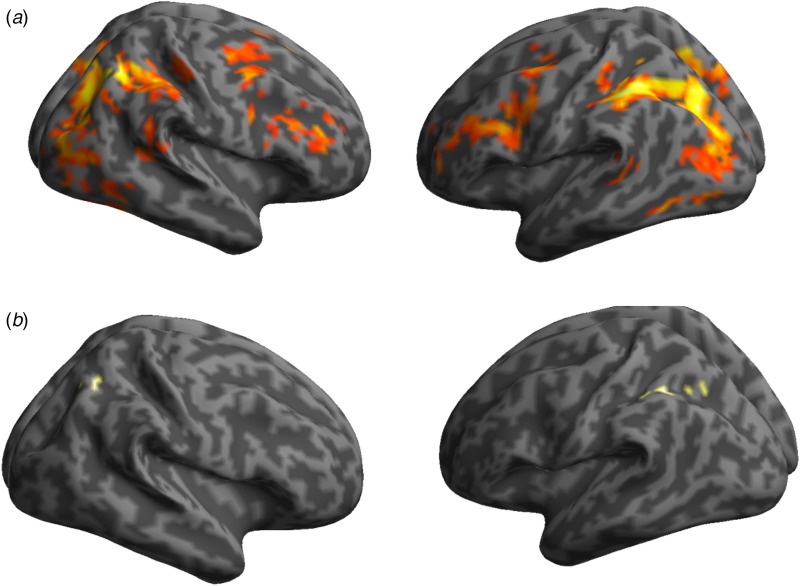
- Shifting: OCD patients showed lower activation than controls in left pre-supplementary motor cortex, right precuneus, occipital cortex bilaterally, and right thalamus (whole-brain FWE-corrected p < 0.05); there was no evidence of increased shifting-related activation in OCD even at uncorrected p < 0.001.
- Stopping: OCD patients showed greater activation than controls in left occipital/cuneus (Z = 4.94) and left caudate (Z = 4.77, p < 0.06 FWE-corrected); there was no evidence of stopping-related hypoactivation in OCD even at uncorrected p < 0.001.
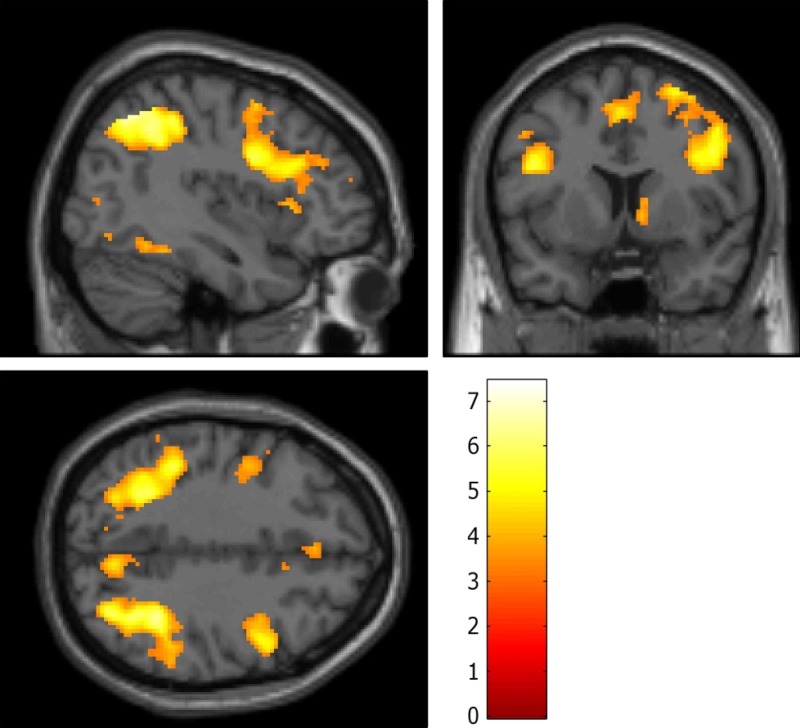
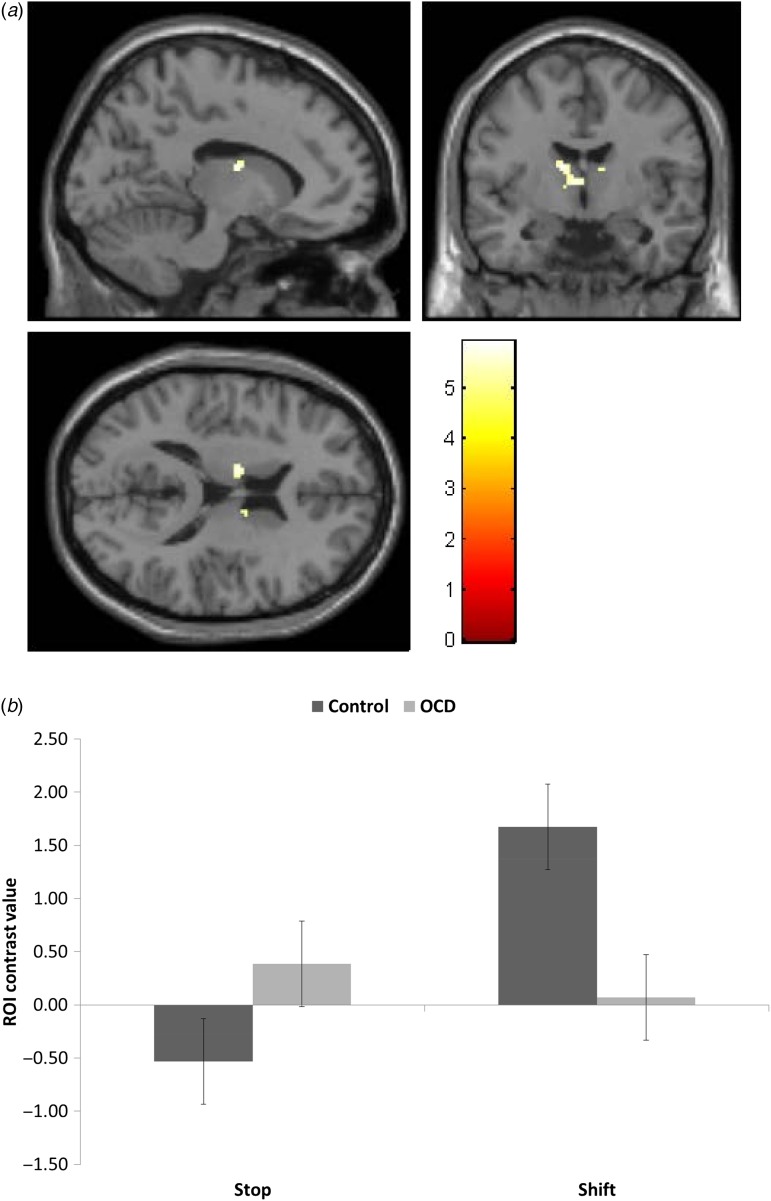
- Interaction: caudate and thalamus bilaterally showed greater activation in OCD for stopping but reduced activation for shifting; caudate ROI group×task interaction F1,36 = 23.73, p < 0.001, with controls > patients for shifting (F1,36 = 13.61, p = 0.001) and patients > controls for stopping (F1,36 = 5.23, p = 0.028). Greater symptom severity was associated with reduced caudate activation during shifting (r = −0.41 and −0.43, p < 0.08).
Methods
- Participants performed a combined shifting go/no-go task with superimposed face/house stimuli; border colour determined the relevant dimension, and simple versus complex blocks manipulated shifting demands.
- fMRI data were acquired on a 3-T Siemens Tim Trio scanner and analysed in SPM8 using a general linear model; second-level analyses compared groups for complex stopping, shifting, and simple stopping, with whole-brain FWE correction at p < 0.05 and secondary uncorrected analyses at p < 0.001.
- Analyses included two-sample t tests, conjunction analyses for common stopping/shifting activation, whole-brain repeated-measures ANOVAs for task×group interactions, and post-hoc anatomical ROI analyses of caudate.
Limitations
- Stated in the paper: the sample size was not sufficiently large to definitively address the role of medication; symptom-dimension analyses were not possible; and the design lacked null events or rest conditions, so group differences in go trials could not be verified.
- Evident from the text: the sample was modest (19 per group), medication status was mixed (13 patients on serotonin reuptake inhibitors and one on a tricyclic antidepressant), and two patients met criteria for generalized anxiety disorder.
- Evident from the text: the task was not designed to be challenging, with considerable practice and clear instructions, so behavioural impairments may not have emerged despite neural group differences.
Model-written summary. Check it against the paper before relying on it.
Integrity signals
Registry
Cites
Statistics
Figures
Verification
Claims the paper makes
0 Valid · 0 Not valid · 37 Not checked · 81 Own results and interpretations
A result the paper reports from its own data — it cites no other source for it, so there is none to check. The quote shows it is in the paper.
In the paper
“Both OCD patients and controls exhibited right inferior frontal cortex activation during stopping, and left inferior parietal cortex activation during shifting.”
§ Divergent subcortical activity for distinct executive functions: stopping and shifting in obsessive compulsive disorder > Abstract > Results
plainstates an association- Asserted: passes — The authors put it forward as true.
- Checkable: passes — It can be checked against evidence.
- Load-bearing: unclear — It is unclear whether the paper’s conclusions depend on it.
- Based: passes — The paper gives a reason why it holds.
A result the paper reports from its own data — it cites no other source for it, so there is none to check. The quote shows it is in the paper.
In the paper
“There was no evidence for increased activations in the OCD group compared to controls even when lowering the threshold to whole-brain uncorrected p < 0.001.”
§ Divergent subcortical activity for distinct executive functions: stopping and shifting in obsessive compulsive disorder > Results > Neuroimaging
plain- Asserted: passes — The authors put it forward as true.
- Checkable: passes — It can be checked against evidence.
- Load-bearing: passes — The paper’s conclusions depend on it.
- Based: passes — The paper gives a reason why it holds.
A result the paper reports from its own data — it cites no other source for it, so there is none to check. The quote shows it is in the paper.
In the paper
“There were more commission errors in the complex (28.26%) compared to the simple (15.05%) tasks, (F1,36 = 46.60, p < 0.001), but no significant group effect (p = 0.629) nor did group interact with difficulty (p = 0.176).”
§ Divergent subcortical activity for distinct executive functions: stopping and shifting in obsessive compulsive disorder > Results > Behavioural measures
plain- Asserted: passes — The authors put it forward as true.
- Checkable: passes — It can be checked against evidence.
- Load-bearing: unclear — It is unclear whether the paper’s conclusions depend on it.
- Based: passes — The paper gives a reason why it holds.
A result the paper reports from its own data — it cites no other source for it, so there is none to check. The quote shows it is in the paper.
In the paper
“There were no significant behavioural differences between OCD patients and controls in any performance indices.”
§ Divergent subcortical activity for distinct executive functions: stopping and shifting in obsessive compulsive disorder > Results > Behavioural measures
plain- Asserted: passes — The authors put it forward as true.
- Checkable: passes — It can be checked against evidence.
- Load-bearing: passes — The paper’s conclusions depend on it.
- Based: passes — The paper gives a reason why it holds.
44 more claims
Create a free account to see all 118 claims and to verify the 63 references still open.
- It may state two separate claims as one. 47
- Probably not a substantial claim. 36
- The quote only partly states this claim. 1
Claims other papers make about this one
Each is checked against this paper’s own text: does it say what the citing paper says it does?
The cited source says what the claim attributes to it.
In the citing paper
“previous studies have reported that response inhibition deficits in OCD patients primarily manifest when the demands for inhibition are heightened.42 ,56 , 57”
From Cognitive Inflexibility Shares Across Schizophrenia and Obsessive-Compulsive Disorder: A Task-Based Functional MRI Study (2025) · cites this paper as [42]
The cited source says what the claim attributes to it.
In the citing paper
“In contrast, the task employed in the present study may not have been challenging enough to elicit these deficits.42”
From Cognitive Inflexibility Shares Across Schizophrenia and Obsessive-Compulsive Disorder: A Task-Based Functional MRI Study (2025) · cites this paper as [42]
The cited source says what the claim attributes to it.
In the citing paper
“Notably, this shifting-related under-activation pattern was consistent with previous findings using the same fMRI paradigm in patients with OCD.”
From Cognitive Inflexibility Shares Across Schizophrenia and Obsessive-Compulsive Disorder: A Task-Based Functional MRI Study (2025) · cites this paper as [42]
The cited source says what the claim attributes to it.
In the citing paper
“The patterns of increased activation aligned with previous findings using the same task to investigate brain activation in this population.42”
From Cognitive Inflexibility Shares Across Schizophrenia and Obsessive-Compulsive Disorder: A Task-Based Functional MRI Study (2025) · cites this paper as [42]
The cited source says what the claim attributes to it.
In the citing paper
“Our use of an unsigned contrast was partly motivated by the fact that existing experiments have reported opposing activation differences between patients with OCD and HC subjects for many of the same regions, and sometimes even for different conditions within the same experiment (e.g., Morein-Zamir et al., 2016).”
From Inhibitory control in obsessive compulsive disorder: a systematic review and activation likelihood estimation meta-analysis of functional magnetic resonance imaging studies (2022) · cites this paper as Morein-Zamir et al., 2016
Citations
Cites
Diagnostic and Statistical Manual of Mental Disorders
Williams, J. B. W., & First, M. (2013) · Encyclopedia of Social Work · doi:10.1093/acrefore/9780199975839.013.104 · Cited by 109,519
(1998) · The Journal of Clinical Psychiatry · Cited by 19,139
Tzourio-Mazoyer, N., Landeau, B., Papathanassiou, D., Crivello, F., Etard, O., Delcroix, N., Mazoyer, B., & Joliot, M. (2002) · NeuroImage · doi:10.1006/nimg.2001.0978 · Cited by 16,319 · cited 2×
“2002), taken from the Automated Anatomical Labeling atlas (Tzourio-Mazoyer et al. 2002).”
MethodMiyake, A., Friedman, N. P., Emerson, M. J., Witzki, A. H., Howerter, A., & Wager, T. D. (2000) · Cognitive Psychology · doi:10.1006/cogp.1999.0734 · Cited by 15,798 · cited 5×
“…the competing interpretations regarding functional abnormalities in OCD, we combined different subconstructs from the Research Domain Criteria framework (www.nimh.nih.gov/research-priorities/ rdoc/index.shtml) found under cognitive control, in a theoretically driven manner (Miyake et al. 2000).”
BackgroundMethodInfluentialA new depression scale designed to be sensitive to change
Montgomery, S. A., & Åsberg, M. (1979) · British Journal of Psychiatry · doi:10.1192/bjp.134.4.382 · Cited by 13,962 · cited 1×
“…al. 1989) and Obsessive Compulsive Inventory – Revised (OCI-R; Foa et al. 2002) assessed OCD severity, the National Adult Reading Test (NART; Nelson, 1982) assessed verbal IQ and the Montgomery–Asberg Depression Rating Scale (MADRS; Montgomery & Asberg, 1979) assessed depressive symptom severity.”
Method(1998) · PubMed · Cited by 10,216
The Yale-Brown Obsessive Compulsive Scale: I. Development, Use, and Reliability
Goodman, W. K. (1989) · Archives of General Psychiatry · doi:10.1001/archpsyc.1989.01810110048007 · Cited by 7,712 · cited 4×
“Nineteen OCD patients with median Yale–Brown Obsessive-Compulsive Scale (YBOCS) score of 20 (range 12–30) were matched for age and gender with 19 healthy controls (14 females in each group).”
BackgroundMethodInfluentialThe mini international neuropsychiatric interview
Lecrubier, Y., Sheehan, D., Hergueta, T., & Weiller, E. (1998) · European Psychiatry · doi:10.1016/s0924-9338(99)80239-9 · Cited by 5,872
Willcutt, E. G., Doyle, A. E., Nigg, J. T., Faraone, S. V., & Pennington, B. F. (2005) · Biological Psychiatry · doi:10.1016/j.biopsych.2005.02.006 · Cited by 3,568 · cited 5×
“Exclusion criteria included substance abuse in the last 3 months and prior diagnosis of schizophrenia, psychotic disorders, bipolar disorder or attention deficit hyperactivity disorder (ADHD).”
BackgroundInfluentialThe Obsessive-Compulsive Inventory: Development and validation of a short version.
Foa, E. B., Huppert, J. D., Leiberg, S., Langner, R., Kichic, R., Hajcak, G., & Salkovskis, P. M. (2002) · Psychological Assessment · doi:10.1037/1040-3590.14.4.485 · Cited by 2,959 · cited 3×
“At testing, the YBOCS (Goodman et al. 1989) and Obsessive Compulsive Inventory – Revised (OCI-R; Foa et al. 2002) assessed OCD severity, the National Adult Reading Test (NART; Nelson, 1982) assessed verbal IQ and the Montgomery–Asberg Depression Rating Scale (MADRS; Montgomery & Asberg, 1979)…”
Method
Research works printed but not linked: 1
- Nelson HE (1982). The National Adult Reading Test Manual. NFER-Nelson: Windsor.
Cited by
Norman, L. J., Taylor, S. F., Liu, Y., Radua, J., Chye, Y., De Wit, S. J., Huyser, C., Karahanoglu, F. I., Luks, T., Manoach, D., et al. (2019) · Biological Psychiatry · doi:10.1016/j.biopsych.2018.11.010 · Cited by 189
Carlisi, C. O., Norman, L. J., Lukito, S. S., Radua, J., Mataix-Cols, D., & Rubia, K. (2017) · Biological Psychiatry · doi:10.1016/j.biopsych.2016.10.006 · Cited by 176
“MoreinZamir 2015 (54) adult Switch GNG 19 (74) 37.”
BackgroundBu, X., Hu, X., Zhang, L., Li, B., Zhou, M., Lu, L., Hu, X., Li, H., Yang, Y., Tang, W., et al. (2019) · Translational Psychiatry · doi:10.1038/s41398-018-0362-9 · Cited by 96
Strang, J. F., Anthony, L. G., Yerys, B. E., Hardy, K. K., Wallace, G. L., Armour, A. C., Dudley, K., & Kenworthy, L. (2017) · Journal of Autism and Developmental Disorders · doi:10.1007/s10803-017-3152-y · Cited by 70
“2015), obsessive–compulsive disorder (Francazio and Flessner 2015; Morein-Zamir et al. 2016; Zhang et al. 2015), Prader-Willi syndrome (Benarroch et al.”
Picó-Pérez, M., Moreira, P. S., de Melo Ferreira, V., Radua, J., Mataix-Cols, D., Sousa, N., Soriano-Mas, C., & Morgado, P. (2020) · Neuroscience & Biobehavioral Reviews · doi:10.1016/j.neubiorev.2020.01.033 · Cited by 68
Bora, E. (2020) · Psychological Medicine · doi:10.1017/s0033291720001634 · Cited by 55
“Set-shifting abnormalities in OCDpt might also be related to underactivation in fronto-parietal networks (Morein-Zamir et al., 2016).”
Gonçalves, Ó. F., Carvalho, S., Leite, J., Fernandes-Gonçalves, A., Carracedo, A., & Sampaio, A. (2016) · Porto Biomedical Journal · doi:10.1016/j.pbj.2016.07.005 · Cited by 55
Carlisi, C. O., Norman, L., Murphy, C. M., Christakou, A., Chantiluke, K., Giampietro, V., Simmons, A., Brammer, M., Murphy, D. G., MRC AIMS consortium, et al. (2017) · Psychological Medicine · doi:10.1017/s0033291717001088 · Cited by 49
“Lastly, It is a common fi nding that brain activation is more sensitive than performance to detect differences between groups in these patient groups (Fitzgerald et al. 2010; Duerden et al. 2013; Ambrosino et al. 2014; Marsh et al. 2014; Chantiluke et al. 2015 b ; Morein-Zamir et al. 2015).”
Cui, G., Ou, Y., Chen, Y., Lv, D., Jia, C., Zhong, Z., Yang, R., Wang, Y., Meng, X., Cui, H., et al. (2020) · Frontiers in Psychiatry · doi:10.3389/fpsyt.2020.00098 · Cited by 47
To Do or Not to Do? Task Control Deficit in Obsessive-Compulsive Disorder
Kalanthroff, E., Henik, A., Simpson, H. B., Todder, D., & Anholt, G. E. (2017) · Behavior Therapy · doi:10.1016/j.beth.2017.01.004 · Cited by 43
Yan, H., Shan, X., Li, H., Liu, F., & Guo, W. (2022) · Journal of Affective Disorders · doi:10.1016/j.jad.2022.04.125 · Cited by 34
Physiological substrates of executive functioning: a systematic review of the literature
Munro, B. A., Weyandt, L. L., Hall, L. E., Oster, D. R., Guðmundsdóttir, B. G., & Kuhar, B. G. (2017) · ADHD Attention Deficit and Hyperactivity Disorders · doi:10.1007/s12402-017-0226-9 · Cited by 37
Carlisi, C. O., Norman, L., Murphy, C. M., Christakou, A., Chantiluke, K., Giampietro, V., Simmons, A., Brammer, M., Murphy, D. G., Mataix-Cols, D., et al. (2017) · Biological Psychiatry: Cognitive Neuroscience and Neuroimaging · doi:10.1016/j.bpsc.2016.12.005 · Cited by 26
Yu, Y., Ren, Z., Ward, J., & Qiu, J. (2020) · Frontiers in Psychology · doi:10.3389/fpsyg.2020.00523 · Cited by 26
Bowen, Z., Changlian, T., Liu, Q., Peng, W., Yang, H., Zhaoxia, L., Feng, L., Liu, J., Xiongzhao, Z., & Mingtian, Z. (2021) · Frontiers in Psychiatry · doi:10.3389/fpsyt.2021.674568 · Cited by 21
Funch Uhre, V., Melissa Larsen, K., Marc Herz, D., Baaré, W., Katrine Pagsberg, A., & Roman Siebner, H. (2022) · NeuroImage: Clinical · doi:10.1016/j.nicl.2022.103268 · Cited by 18
Wu, X., Yu, G., Zhang, K., Feng, J., Zhang, J., Sahakian, B. J., & Robbins, T. W. (2021) · Biological Psychiatry Cognitive Neuroscience and Neuroimaging · doi:10.1016/j.bpsc.2021.06.011 · Cited by 23
Self-citationFunctional Brain Imaging and OCD
Soriano‐Mas, C. (2021) · Current topics in behavioral neurosciences · doi:10.1007/7854_2020_203 · Cited by 26
Real-time functional magnetic resonance imaging in obsessive-compulsive disorder
Gonçalves, Ó. F., Batistuzzo, M. C., & Sato, J. R. (2017) · Neuropsychiatric Disease and Treatment · doi:10.2147/ndt.s121139 · Cited by 17
“27–29”
Altered Functional Connectivity Strength at Rest in Medication-Free Obsessive-Compulsive Disorder
Lv, D., Ou, Y., Wang, Y., Ma, J., Zhan, C., Yang, R., Chen, Y., Shang, T., Jia, C., Sun, L., et al. (2021) · Neural Plasticity · doi:10.1155/2021/3741104 · Cited by 17
“The decreased degree values of the left postcentral gyrus may reduce the efficiency of information transmission within the sensory-motor pathway, therefore contributing to the repetitive and intrusive thoughts and behaviors in patients with OCD [58].”
BackgroundLuo, Q., Liu, W., Jin, L., Chang, C., & Peng, Z. (2021) · Frontiers in Neuroinformatics · doi:10.3389/fninf.2021.676491 · Cited by 17
“Morein-Zamir et al. (2016) reported that the activation from the regions of the brain within the sensorimotor network in the inhibitory control processes may explain the essence of inhibitory control deficits of OCD.”
BackgroundDayan, A., Berger, A., & Anholt, G. E. (2020) · Psychological Medicine · doi:10.1017/s0033291719003866 · Cited by 17
Gait disorder as a predictor of spatial learning and memory impairment in aged mice
Wang, X., Wang, Q. M., Meng, Z., Yin, Z., Luo, X., & Yu, D. (2017) · PeerJ · doi:10.7717/peerj.2854 · Cited by 14
Neural Correlates of Executive Functioning in Anorexia Nervosa and Obsessive–Compulsive Disorder
Thomas, K. S., Birch, R. E., Jones, C. R. G., & Vanderwert, R. E. (2022) · Frontiers in Human Neuroscience · doi:10.3389/fnhum.2022.841633 · Cited by 15
Koithan, E. M., Demeter, D. V., Ali, S. A., Feigelis, M., & Greene, D. J. (2024) · Current Opinion in Behavioral Sciences · doi:10.1016/j.cobeha.2024.101429 · Cited by 16
Shan, H., Liu, Y., Zhao, Q., Wang, Y., Wang, Y.-M., Cheung, E. F. C., Chan, R. C. K., & Wang, Z. (2021) · Australian & New Zealand Journal of Psychiatry · doi:10.1177/00048674211009623 · Cited by 11
“Activation of the inferior parietal gyrus has been shown to correlate with cognitive function, including set-shifting (Morein-Zamir et al., 2016), response inhibition (Zhang et al.”
BackgroundLi, X., Cao, L., Li, H., Cao, L., Liu, J., Gong, Q., Xing, H., & Huang, X. (2022) · Journal of Psychiatric Research · doi:10.1016/j.jpsychires.2022.03.041 · Cited by 8
Cognitive neuroscience of obsessive-compulsive disorder
Bragdon, L. B., Eng, G. K., Recchia, N., Collins, K. A., & Stern, E. R. (2023) · Psychiatric Clinics of North America · doi:10.1016/j.psc.2022.11.001 · Cited by 7
Meda, N., Baggio, M., Collantoni, E., & Sambataro, F. (2025) · European Neuropsychopharmacology · doi:10.1016/j.euroneuro.2025.01.009 · Cited by 9
Wang, Y.-M., Cai, X., Zhang, R., Wang, Y., Madsen, K. H., Sørensen, T. A., Møller, A., Cheung, E. F. C., & Chan, R. C. K. (2019) · Cognitive Neuropsychiatry · doi:10.1080/13546805.2019.1658575 · Cited by 7
“Indeed, previous reviews and meta-analysis have also reported significant dysfunction at the caudate and the insula in OCD patients (Koch, Reeß, Rus, Zimmer, & Zaudig, 2014; Melloni et al., 2012; Morein-Zamir et al., 2016).”
ResultYacou, M. A., Chowdury, A., Easter, P. C., Hanna, G. L., Rosenberg, D. R., & Diwadkar, V. A. (2022) · Frontiers in Psychiatry · doi:10.3389/fpsyt.2022.869106 · Cited by 8
“Task-based fMRI studies have revealed abnormal patterns of hypo- and hyperactivation in domains such as executive functioning, emotional processing, and symptom provocation (59) with commonly implicated brain regions including: the prefrontal cortex (PFC) (54, 60), BG and thalamus (61), orbitofrontal cortex (OFC) (62)…”
BackgroundYan, H., Zhang, Y., Shan, X., Li, H., Liu, F., Xie, G., Li, P., & Guo, W. (2023) · Journal of Neuroscience Research · doi:10.1002/jnr.25272 · Cited by 10
Li, Z., Tong, G., Wang, Y., Ruan, H., Zheng, Z., Cheng, J., & Wang, Z. (2024) · The World Journal of Biological Psychiatry · doi:10.1080/15622975.2023.2251057 · Cited by 4
“Three studies (Kang et al. 2013; Marsh et al. 2014; Morein-Zamir et al. 2016) were considered as low quality with MSS scores lower than 18/22.”
BackgroundKoorenhof, L., & Dommett, E. J. (2019) · Journal of Neuropsychiatry · doi:10.1176/appi.neuropsych.18070166 · Cited by 5
“Previous studies with OCD participants have revealed that there are changes in the inferior frontal cortex for regional blood flow (64, 65), grey matter volume (66) and activation during Go/No-Go tasks (67).”
BackgroundVaghi, M. M. S., Nørgaard, M., Shim, S., Rios, J. A. H., Bissett, P. G., Rodríguez, C. I., & Poldrack, R. A. (2025) · bioRxiv (Cold Spring Harbor Laboratory) · doi:10.1101/2025.05.21.654808 · Cited by 10
“In contrast, a pattern of hypoactivation and reduced connectivity is found in associative cortices during tasks requiring top-down control in OCD patients 46,47,70,71 .”
Chu, M.-Y., Li, S.-B., Zhang, Y., Wang, L.-L., Lv, Q.-Y., Lui, S. S. Y., Wang, Z., Yi, Z.-H., Wang, Y., & Chan, R. C. K. (2025) · Schizophrenia Bulletin · doi:10.1093/schbul/sbaf220 · Cited by 2
N-back task revisited: Comparing the neural correlates of updating and interference control
Hidalgo‐Lopez, E., Noachtar, I. A., & Pletzer, B. A. (2025) · Imaging Neuroscience · doi:10.1162/imag.a.1025 · Cited by 3
“Specifically, the caudate showed a stronger activation or disinhibition during targets compared with lures, consistent with its role in facilitating “go” type responses versus “stop” trials ( Morein-Zamir et al., 2016; O’Reilly & Frank, 2006; Wiecki & Frank, 2013).”
Esfeh, M. A., Jafadideh, A. T., Niyasar, A. R., Rostami, R., & Khosrowabadi, R. (2024) · Psychiatry Research Neuroimaging · doi:10.1016/j.pscychresns.2024.111927 · Cited by 5
“Actor-critic” dichotomous hyperactivation and hypoconnectivity in obsessive–compulsive disorder
Araújo, A. C., Duarte, I. C., Sousa, T., Meneses, S., Pereira, A. T., Robbins, T. W., Macedo, A., & Castelo-Branco, M. S. (2024) · NeuroImage Clinical · doi:10.1016/j.nicl.2024.103729 · Cited by 3
Self-citationAffect is the Evaluative Context for the Brain’s Shifting Goals
LaMotte, A. D. (2025) · Adaptive Behavior · doi:10.1177/10597123251379013 · Cited by 1
“In contrast, in Obsessive-Compulsive Disorder (APA, 2022), it is the affective experience of uncertainty that creates the sense of compulsion for repetitive and life-disrupting behaviors (Moore, Wheaton, Rodriguez, & Raila, 2023; Morein-Zamir et al., 2016; Vazard, 2021).”
Comparación de la respuesta inhibitoria en niños y adolescentes diagnosticados con TOC y TDAH
Maria Cristina Pinto, D., Campos, E. A., Contreras, J. N., Bedoya-Valderrama, L., & Ulzuru, A. (2017) · Universitas Psychologica · doi:10.11144/javeriana.upsy15-5.crin · Cited by 1
Carlisi, C. O. (2017) · Research Portal (King's College London) · Cited by 1
Functional Magnetic Resonance Imaging Studies of Obsessive-Compulsive and Related Disorders
Han, J., & Kwon, J. S. (2018) · Cambridge University Press eBooks · doi:10.1017/9781108164313.010
Agyemang, A. A. (2018) · Springer eBooks · doi:10.1007/978-3-319-57111-9_9177
Agyemang, A. A. (2017) · Springer eBooks · doi:10.1007/978-3-319-56782-2_9177-1
Sullivan, E. (2019) · University of North Texas Digital Library (University of North Texas) · doi:10.12794/metadc1538680
N-back task revisited: Comparing the neural correlates of updating and interference controlPreprint
Hidalgo‐Lopez, E. (2025) · OSF Preprints (OSF Preprints) · doi:10.17605/osf.io/j4cpm
Not-just-right experiences link obsessive-compulsive tendencies and executive dysfunction
Sammel, A., & Bernstein, D. M. (2026) · Journal of Behavioral and Cognitive Therapy · doi:10.1016/j.jbct.2026.100578
Tian, L., Zhang, D., Hu, X., Wang, X., Teng, C., Lu, H., Xu, Y., Li, Z., & Guan, C. (2026) · Psychiatry Research · doi:10.1016/j.psychres.2026.117126
Metadata
- Authors
- Morein-Zamir, S., Voon, V., Dodds, C. M., Sule, A., van Niekerk, J., Sahakian, B. J., & Robbins, T. W.
- Affiliations
- University of Cambridge (GB)
- University of Exeter (GB)
- Venue
- Psychological Medicine
- Publisher
- Cambridge University Press (CUP)
- Published
- 2015-11-06
- Volume
- 46
- Issue
- 4
- Pages
- 829-840
- ISSN
- 0033-2917 (ISSN-L)
- 1469-8978
- PMC
- PMC4754830
- OpenAlex
- W2104995566
- Cited by
- 50
- References
- 58
- Citations by year
- 2026: 2 · 2025: 6 · 2024: 3 · 2023: 2 · 2022: 6 · 2021: 6 · 2020: 5 · 2019: 5 · 2018: 3 · 2017: 10 · 2016: 2
- FWCI
- 6.20
- Type
- journal article
- Language
- en
- Open access
- hybrid
- doi.org
- Locations
- Psychological Medicine (publishedVersion, cc-by)
- Europe PMC (PubMed Central) (publishedVersion, cc-by)
- PubMed Central (publishedVersion, cc-by)
- PubMed (publishedVersion)
- Anglia Ruskin Research Online (Anglia Ruskin University) (submittedVersion)
- Figshare (submittedVersion, cc-by-nc-nd)
- Apollo (University of Cambridge) (submittedVersion, cc-by)
- Funders
- Wellcome Trust (089589/Z/09/Z, 104631/Z/14/Z, 089589, G00001354, 104631, 093875)
- Medical Research Council (G00001354, 089589/Z/09/Z, MR/J012084/1)
- Topics
- Social Sciences › Psychology › Clinical Psychology › Obsessive-Compulsive Spectrum Disorders
- Life Sciences › Neuroscience › Cognitive Neuroscience › Neural and Behavioral Psychology Studies
- Social Sciences › Psychology › Experimental and Cognitive Psychology › Anxiety, Depression, Psychometrics, Treatment, Cognitive Processes
- Keywords
- obsessive-compulsive disorder, executive function, response inhibition, cognitive flexibility, stopping, shifting, subcortical activation, caudate nucleus, thalamus, inferior frontal cortex, inferior parietal cortex, corticostriatal circuits
- MeSH terms
- Adult, Arousal, Brain, Caudate Nucleus, Cognition, Frontal Lobe, Humans, Magnetic Resonance Imaging, Middle Aged, Obsessive-Compulsive Disorder, Parietal Lobe, Task Performance and Analysis, Thalamus, Case-Control Studies, Neostriatum, Executive Function, Functional Neuroimaging
About these checks
Registry, retraction, Cites and statistics results are computed, not judged, with one exception: a printed reference that no index lists is read once by a model before it counts as a citation error. Claims are extracted by a model and kept only when their quote appears verbatim in the text; each cited source is then checked, with a model’s help, for whether it says what the claim relies on. Those verdicts can be wrong — read the claim’s quote and the cited source before relying on one.
A language model drew the claims from the paper on 2026-10-05, under version 3 of the claim definition (model deepseek-v4.1-flash, prompt extract-v3).
A second model labelled each claim on 2026-10-05 (model jev-1.13-20260917, definition revision gold-guideline-v0.2).
Statistics and arithmetic are recomputed, not judged.
Confidence bands are shown only for fields calibrated on our annotated test set. None is calibrated yet, so no band is shown.
What counts as a claim ›How we measure confidence ›How we check this ›
Are you an author, or do you see a problem with this page? Request a review
Data sources
Bibliographic data: Semantic Scholar, OpenAlex, Crossref.
Contains information from the Semantic Scholar Academic Graph Datasets, made available under the ODC Attribution License (ODC-BY 1.0).
Semantic Scholar’s data is described in: Kinney, R., et al. (2023). The Semantic Scholar Open Data Platform. arXiv:2301.10140.
