

The DOI matches its Crossref record; 62 of the 63 references it cites were found in a registry or an index.
Adolescent friendships predict later resilient functioning across psychosocial domains in a healthy community cohort
Open accessAbstract
BACKGROUND: Adolescence is a key time period for the emergence of psychosocial and mental health difficulties. To promote adolescent adaptive ('resilient') psychosocial functioning (PSF), appropriate conceptualisation and quantification of such functioning and its predictors is a crucial first step. Here, we quantify resilient functioning as the degree to which an individual functions better or worse than expected given their self-reported childhood family experiences, and relate this to adolescent family and friendship support. METHOD: We used Principal Component and regression analyses to investigate the relationship between childhood family experiences and PSF (psychiatric symptomatology, personality traits and mental wellbeing) in healthy adolescents (the Neuroscience in Psychiatry Network; N = 2389; ages 14-24). Residuals from the relation between childhood family experiences and PSF reflect resilient functioning; the degree to which an individual is functioning better, or worse, than expected given their childhood family experiences. Next, we relate family and friendship support with resilient functioning both cross-sectionally and 1 year later. RESULTS: Friendship and family support were positive predictors of immediate resilient PSF, with friendship support being the strongest predictor. However, whereas friendship support was a significant positive predictor of later resilient functioning, family support had a negative relationship with later resilient PSF. CONCLUSIONS: We show that friendship support, but not family support, is an important positive predictor of both immediate and later resilient PSF in adolescence and early adulthood. Interventions that promote the skills needed to acquire and sustain adolescent friendships may be crucial in increasing adolescent resilient PSF.
Overview
The claims and statistics of this paper haven’t been checked yet.
Run the check — free, no account needed. It reads the open-access text and checks the sources it cites.
Integrity signals
Registry
Cites
Statistics
Figures
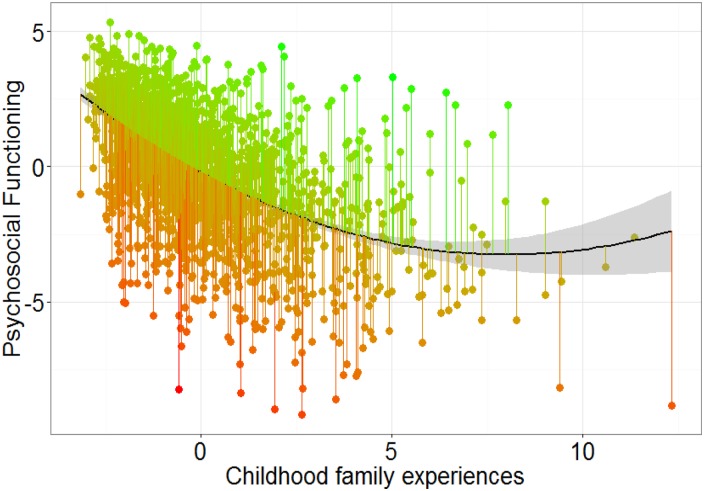
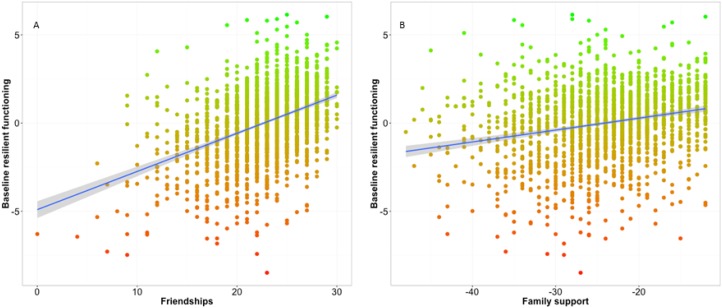
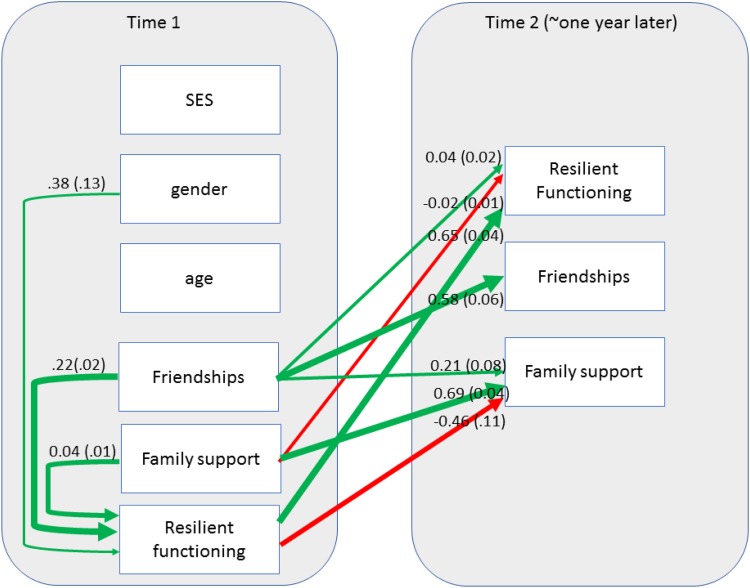
Verification
Claims the paper makes
The claims and statistics of this paper haven’t been checked yet.
Run the check — free, no account needed. It reads the open-access text and checks the sources it cites.
Claims other papers make about this one
Each is checked against this paper’s own text: does it say what the citing paper says it does?
The cited source says what the claim attributes to it.
In the citing paper
“Conversely, high quality peer relationships appear to protect against mental health problems and strengthen adolescent resilience.29”
From The effects of social deprivation on adolescent development and mental health (2020) · cites this paper as [29]
Self-check
Percentages, sums and reported differences re-computed from the paper’s own numbers.
The self-check needs the paper’s full text.
Citations
Cites
Stress, social support, and the buffering hypothesis
Cohen, S., & Wills, T. A. (1985) · Psychological Bulletin · doi:10.1037/0033-2909.98.2.310 · Cited by 18,093
ggplot2: Elegant Graphics for Data Analysis
Wickham, H. (2009) · doi:10.1007/978-0-387-98141-3 · Cited by 14,447
KESSLER, R. C., ANDREWS, G., COLPE, L. J., HIRIPI, E., MROCZEK, D. K., NORMAND, S.-L. T., WALTERS, E. E., & ZASLAVSKY, A. M. (2002) · Psychological Medicine · doi:10.1017/s0033291702006074 · Cited by 10,327
The Construct of Resilience: A Critical Evaluation and Guidelines for Future Work
Luthar, S. S., Cicchetti, D., & Becker, B. (2000) · Child Development · doi:10.1111/1467-8624.00164 · Cited by 9,381
Child abuse: Adolescent records vs. adult recall
Femina, D. D., Yeager, C. A., & Lewis, D. O. (1990) · Child Abuse & Neglect · doi:10.1016/0145-2134(90)90033-p · Cited by 8,820
The Warwick-Edinburgh Mental Well-being Scale (WEMWBS): development and UK validation
Tennant, R., Hiller, L., Fishwick, R., Platt, S., Joseph, S., Weich, S., Parkinson, J., Secker, J., & Stewart-Brown, S. (2007) · Health and Quality of Life Outcomes · doi:10.1186/1477-7525-5-63 · Cited by 5,031 · cited 1×
“Mental wellbeing: the Warwick-Edinburgh Mental Well Being Scale (WEMWBS) (Tennant et al. 2007).”
MethodBurden and consequences of child maltreatment in high-income countries
Gilbert, R., Widom, C. S., Browne, K., Fergusson, D., Webb, E., & Janson, S. (2009) · The Lancet · doi:10.1016/s0140-6736(08)61706-7 · Cited by 3,876
Resilience in the Face of Adversity
Rutter, M. L. (1985) · The British Journal of Psychiatry · doi:10.1192/bjp.147.6.598 · Cited by 3,689
THE McMASTER FAMILY ASSESSMENT DEVICE*
Epstein, N. B., Baldwin, L. M., & Bishop, D. S. (1983) · Journal of Marital and Family Therapy · doi:10.1111/j.1752-0606.1983.tb01497.x · Cited by 3,584
Understanding adolescence as a period of social–affective engagement and goal flexibility
Crone, E. A., & Dahl, R. E. (2012) · Nature Reviews Neuroscience · doi:10.1038/nrn3313 · Cited by 2,507
Cited by
Sorted by citations
The effects of social deprivation on adolescent development and mental health
Orben, A., Tomova, L., & Blakemore, S.-J. (2020) · The Lancet Child & Adolescent Health · doi:10.1016/s2352-4642(20)30186-3 · Cited by 1,383
Arseneault, L. (2018) · Journal of Child Psychology and Psychiatry · doi:10.1111/jcpp.12841 · Cited by 501
Studying individual differences in human adolescent brain development
Foulkes, L., & Blakemore, S.-J. (2018) · Nature Neuroscience · doi:10.1038/s41593-018-0078-4 · Cited by 413
Stress and adolescence: vulnerability and opportunity during a sensitive window of development
Sisk, L. M., & Gee, D. G. (2022) · Current Opinion in Psychology · doi:10.1016/j.copsyc.2021.10.005 · Cited by 374
Fritz, J., de Graaff, A. M., Caisley, H., van Harmelen, A., & Wilkinson, P. O. (2018) · Frontiers in Psychiatry · doi:10.3389/fpsyt.2018.00230 · Cited by 413
Metadata
- Authors
- van Harmelen, A.-L., Kievit, R. A., Ioannidis, K., Neufeld, S., Jones, P. B., Bullmore, E., Dolan, R., The NSPN Consortium, Fonagy, P., & Goodyer, I.
- Affiliations
- Wellcome Centre for Human Neuroimaging (GB)
- University of Cambridge (GB)
- University College London (GB)
- Venue
- Psychological Medicine
- Publisher
- Cambridge University Press (CUP)
- Published
- 2017-04-11
- Volume
- 47
- Issue
- 13
- Pages
- 2312-2322
- ISSN
- 0033-2917 (ISSN-L)
- 1469-8978
- PMC
- PMC5820532
- OpenAlex
- W2607480187
- Cited by
- 284
- References
- 63
- Citations by year
- 2026: 26 · 2025: 39 · 2024: 38 · 2023: 44 · 2022: 47 · 2021: 40 · 2020: 23 · 2019: 14 · 2018: 10 · 2017: 3
- FWCI
- 16.96
- Type
- journal article
- Language
- en
- Open access
- hybrid
- doi.org
- Locations
- Psychological Medicine (publishedVersion, cc-by)
- Europe PMC (PubMed Central) (publishedVersion, cc-by)
- PubMed Central (publishedVersion, cc-by)
- PubMed (publishedVersion)
- Leiden Repository (Leiden University) (submittedVersion, cc-by)
- UCL Discovery (University College London) (submittedVersion)
- Max Planck Digital Library (submittedVersion)
- MPG.PuRe (Max Planck Society) (submittedVersion)
- OSF Preprints (OSF Preprints) (submittedVersion)
- OSF Preprints (OSF Preprints) (submittedVersion, public-domain)
- Apollo (University of Cambridge) (submittedVersion, cc-by)
- Data Archiving and Networked Services (DANS) (submittedVersion, cc-by)
- Apollo (cc-by)
- Funders
- Wellcome Trust (107392/A/15/Z, 095844/Z/11/Z, 098362/Z/12/Z, /Z/11/Z, 107392/Z/15/Z), 095844)
- National Institute for Health and Care Research (NF-SI-0514-10157)
- Royal Society (DH150176)
- University of Cambridge
- University College London (095844/Z/11/Z)
- Nederlandse Organisatie voor Wetenschappelijk Onderzoek (2013/38917/MaGW)
- Topics
- Social Sciences › Psychology › Clinical Psychology › Resilience and Mental Health
- Social Sciences › Psychology › Clinical Psychology › Child and Adolescent Psychosocial and Emotional Development
- Social Sciences › Psychology › Developmental and Educational Psychology › Psychosocial Factors Impacting Youth
- Keywords
- adolescent friendships, psychosocial functioning, family support, psychiatric symptoms, personality traits, psychological well-being, early adulthood, healthy adolescents
- MeSH terms
- Adolescent, Adult, Mental Disorders, Cross-Sectional Studies, Family, Female, Humans, Longitudinal Studies, Male, Personal Satisfaction, Personality, Social Support, Parenting, Friends, Resilience, Psychological, Young Adult
About these checks
Registry, retraction, Cites and statistics results are computed, not judged, with one exception: a printed reference that no index lists is read once by a model before it counts as a citation error. Claims are extracted by a model and kept only when their quote appears verbatim in the text; each cited source is then checked, with a model’s help, for whether it says what the claim relies on. Those verdicts can be wrong — read the claim’s quote and the cited source before relying on one.
Statistics and arithmetic are recomputed, not judged.
Confidence bands are shown only for fields calibrated on our annotated test set. None is calibrated yet, so no band is shown.
What counts as a claim ›How we measure confidence ›How we check this ›
Are you an author, or do you see a problem with this page? Request a review
