

Is self-guided internet-based cognitive behavioural therapy (iCBT) harmful? An individual participant data meta-analysis
Open accessThe DOI matches its Crossref record; 58 of the 61 references it cites were found in a registry or an index.
Abstract
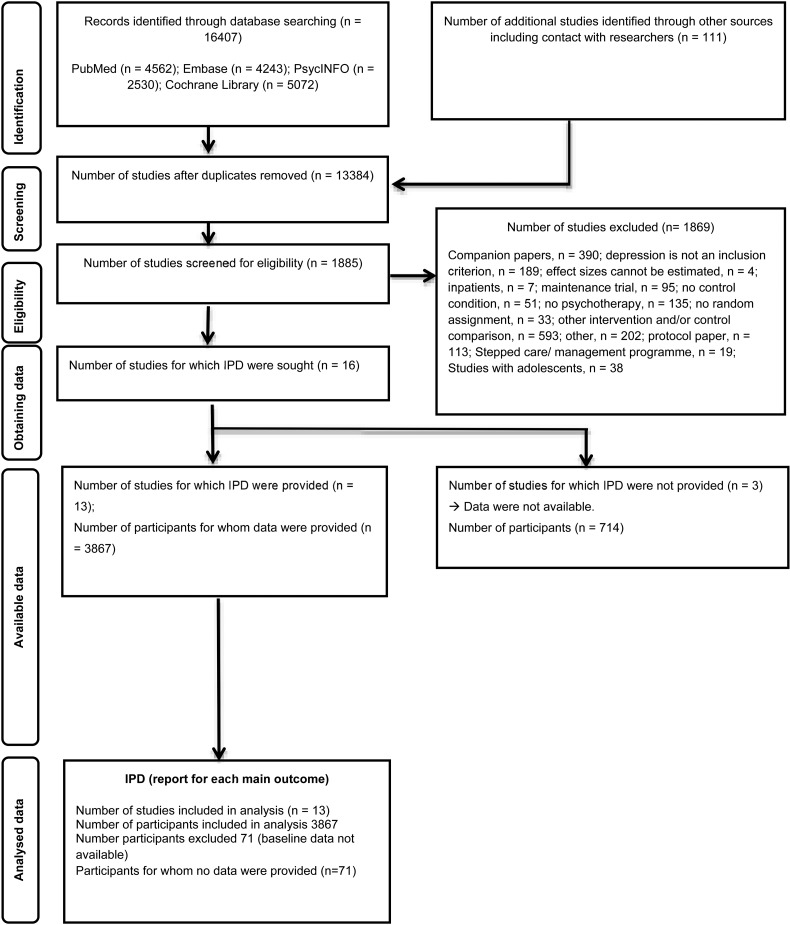
Background: Little is known about potential harmful effects as a consequence of self-guided internet-based cognitive behaviour therapy (iCBT), such as symptom deterioration rates. Thus, safety concerns remain and hamper the implementation of self-guided iCBT into clinical practice. We aimed to conduct an individual participant data (IPD) meta-analysis to determine the prevalence of clinically significant deterioration (symptom worsening) in adults with depressive symptoms who received self-guided iCBT compared with control conditions. Several socio-demographic, clinical and study-level variables were tested as potential moderators of deterioration. Methods: Randomised controlled trials that reported results of self-guided iCBT compared with control conditions in adults with symptoms of depression were selected. Mixed effects models with participants nested within studies were used to examine possible clinically significant deterioration rates. Results: Thirteen out of 16 eligible trials were included in the present IPD meta-analysis. Of the 3805 participants analysed, 7.2% showed clinically significant deterioration (5.8% and 9.1% of participants in the intervention and control groups, respectively). Participants in self-guided iCBT were less likely to deteriorate (OR 0.62, p < 0.001) compared with control conditions. None of the examined participant- and study-level moderators were significantly associated with deterioration rates. Conclusions: Self-guided iCBT has a lower rate of negative outcomes on symptoms than control conditions and could be a first step treatment approach for adult depression as well as an alternative to watchful waiting in general practice.
Overview
The claims and statistics of this paper haven’t been checked yet.
Free: it reads the open-access text and checks the first 5 claims that cite a source we can check. Create a free account to check every claim.
Integrity signals
Registry
Cites
Statistics
Figures
Verification
Claims the paper makes
The claims and statistics of this paper haven’t been checked yet.
Free: it reads the open-access text and checks the first 5 claims that cite a source we can check. Create a free account to check every claim.
Claims other papers make about this one
Each is checked against this paper’s own text: does it say what the citing paper says it does?
The source backs part of the claim, not all of it — or backs it for a different population, condition or comparison.
In the citing paper
“The results obtained so far are consistent and promising, showing that Internet-based interventions are effective in treating depression.”
From Protocol for a randomized controlled dismantling study of an internet-based intervention for depressive symptoms: Exploring the contribution of behavioral activation and positive psychotherapy strategies (2019) · cites this paper as [47]
Experimental — accuracy not yet measuredThe cited source says what the claim attributes to it.
In the citing paper
“No examined moderators were significantly associ ated with the deterioration rate.”
From Internet-delivered psychological treatments: from innovation to implementation (2019) · cites this paper as [80]
The cited source says what the claim attributes to it.
In the citing paper
“Another patientlevel metaanalysis focused on selfguided Internet treatments for depression 80 , and found that, of the 3,805 participants analyzed, 5.8% in the treatment groups and 9.1% in the control groups had deteriorated (odds ratio=0.62,p<0.001).”
From Internet-delivered psychological treatments: from innovation to implementation (2019) · cites this paper as [80]
Self-check
Percentages, sums and reported differences re-computed from the paper’s own numbers.
The self-check needs the paper’s full text.
Citations
Cites
Bias in meta-analysis detected by a simple, graphical test
Egger, M., Smith, G. D., Schneider, M., & Minder, C. (1997) · BMJ · doi:10.1136/bmj.315.7109.629 · Cited by 56,722 · cited 1×
“Publication bias was examined by visually inspecting funnel plots and by using the Duval and Tweedie’s trim and fill method, which yields an estimate of the effect size after adjusting for publication bias (Egger et al. 1997; Duval & Tweedie, 2000).”
MethodThe CES-D Scale: A Self-Report Depression Scale for Research in the General Population
Radloff, L. S. (1977) · Applied Psychological Measurement · doi:10.1177/014662167700100306 · Cited by 53,267
The PHQ-9: Validity of a brief depression severity measure
Kroenke, K., Spitzer, R. L., & Williams, J. B. W. (2001) · Journal of General Internal Medicine · doi:10.1046/j.1525-1497.2001.016009606.x · Cited by 44,910 · cited 2×
“…studies used either the Beck Depression Inventory [BDI-I (Beck et al. 1961) or BDI-II (Beck et al. 1996)], the Centre for Epidemiological Studies Depression Scale [CES-D (Radloff, 1977)] or the Patient Health Questionnaire [PHQ-9 (Kroenke et al. 2001)] as outcome measures of depression severity.”
MethodAn inventory for measuring depression
BECK, A. T. (1961) · Archives of General Psychiatry · doi:10.1001/archpsyc.1961.01710120031004 · Cited by 38,032 · cited 1×
“The included studies used either the Beck Depression Inventory [BDI-I (Beck et al. 1961) or BDI-II (Beck et al. 1996)], the Centre for Epidemiological Studies Depression Scale [CES-D (Radloff, 1977)] or the Patient Health Questionnaire [PHQ-9 (Kroenke et al. 2001)] as outcome measures of depression…”
MethodStatistical Power Analysis for the Behavioral Sciences (2nd ed.).
Lachenbruch, P. A., & Cohen, J. (1989) · Journal of the American Statistical Association · doi:10.2307/2290095 · Cited by 37,395
Multiple Imputation for Nonresponse in Surveys
Rubin, D. B. (1987) · Wiley Series in Probability and Statistics · doi:10.1002/9780470316696 · Cited by 20,701
Duval, S., & Tweedie, R. (2000) · Biometrics · doi:10.1111/j.0006-341x.2000.00455.x · Cited by 14,099 · cited 1×
“Publication bias was examined by visually inspecting funnel plots and by using the Duval and Tweedie’s trim and fill method, which yields an estimate of the effect size after adjusting for publication bias (Egger et al. 1997; Duval & Tweedie, 2000).”
MethodJacobson, N. S., & Truax, P. (1991) · Journal of Consulting and Clinical Psychology · doi:10.1037/0022-006x.59.1.12 · Cited by 7,770 · cited 2×
“We classified ‘clinically significant deterioration’ according to each participant’s reliable change index (RCI) (Jacobson & Truax, 1991), which is the most commonly used method for calculating clinically significant negative effects.”
BackgroundMethodInfluentialBeck, A. T., Steer, R. A., & Brown, G. (2011) · PsycTESTS Dataset · doi:10.1037/t00742-000 · Cited by 7,535
Scoville, W. B. (1949) · Journal of neurosurgery · doi:10.3171/jns.1949.6.1.0065 · Cited by 7,381
Research works printed but not linked: 1
- Higgins J and Green S (2011) Handbook for Systematic Reviews of Interventions. version 5.1. 0 [updated March 2011]. Chichester, UK: John Wiley & Sons, Ltd.
Cited by
Items 101–167 of 167
Özer, Ö., & Köksal, B. (2023) · OSMANGAZİ JOURNAL OF MEDICINE · doi:10.20515/otd.1309551 · Cited by 5
A guide to what works for depression: An evidence-based review
Morgan, A. J., Reavley, N. J., Jorm, A. F., Bassilios, B., Hopwood, M., Allen, N. B., & Purcell, R. (2019) · Cited by 5
Barriers to Implementation of a Technology-Based Mental Health Intervention in a Rural Setting
Antle, B. F., Harris, L. M., Wright, J. H., Eells, T. D., Cappiccie, A., Williams, S. M., Katz, R., Logsdon, A. R., & Owen, J. J. (2021) · Contemporary Rural Social Work Journal · doi:10.61611/2165-4611.1220 · Cited by 3
Lorente-Català, R., Gili, M., del Hoyo, Y. L., Mayoral, F., Pérez‐Aranda, A., Castro, A., Moreno, E. V., Baños, R., Roca, M., Monreal‐Bartolomé, A., et al. (2022) · Internet Interventions · doi:10.1016/j.invent.2022.100581 · Cited by 6
Sander, L., Beisemann, M., Karyotaki, E., van Ballegooijen, W., Cuijpers, P. J., Teismann, T., Doebler, P., Domhardt, M., Baumeister, H., & Büscher, R. (2023) · PLoS ONE · doi:10.1371/journal.pone.0285622 · Cited by 3
Self-citationRomy, R. W., & Nan, X. (2025) · Internet Interventions · doi:10.1016/j.invent.2025.100802 · Cited by 6
“CBT and psychoeducation were already identified as effective tools for addressing mental health symptoms, such as anxiety and depression, through digital platforms (Donker et al., 2013; Karyotaki et al., 2018).”
Peiper, N. C., Pettitt, A., Shah, B., Atwood, O., Sivonen, E., & Pfeffer, J. (2025) · JMIR Formative Research · doi:10.2196/71828 · Cited by 5
Rathbone, A. L., Clarry, L., Prescott, J., & Hanley, T. (2024) · Mental Health and Digital Technologies · doi:10.1108/mhdt-12-2023-0004 · Cited by 4
Depressive Störungen: Major Depression und Persistierende Depressive Störung (Dysthymie)
Beesdo‐Baum, K., & Wïttchen, H. (2020) · Springer eBooks · doi:10.1007/978-3-662-61814-1_46 · Cited by 7
Farrell, D., Fadeeva, A., Zat, Z., Knibbs, L., Miller, P. W., Barron, I., Matthess, H., Mattheß, C., Gazit, N., & Kiernan, M. (2021) · Research Square · doi:10.21203/rs.3.rs-886940/v1
Xu, X., Wang, F., Liao, S., Liu, J., & Xiao, L. (2025) · Journal of Medical Internet Research · doi:10.2196/80476 · Cited by 4
“This low retention rate may be linked to the tendency of self-directed interventions to trigger symptom exacerbation, which increases the risk of loss [58].”
Klein, J. P., Berger, T., Hautzinger, M., Lutz, W., Rose, M., Späth, C., Schröder, J., Hohagen, F., & Moritz, S. (2019) · Fortschritte der Neurologie · Psychiatrie · doi:10.1055/a-0849-9838 · Cited by 5
Self-citationPSYKOTERAPIFORSKNING GENNEM 100 ÅR – HVOR LANGT ER VI NÅET?
Hougaard, E. (2021) · Psyke & Logos · doi:10.7146/pl.v42i1.128765 · Cited by 3
“Psykoterapi har ikke ubehagelige medicinske bivirkninger og antageligt også få skadesvirkninger; selv om 5-10 % ofte har det værre efter end før terapien, gælder dette for flere i kontrolgrupper (Cuijpers, Reijnders, Karyotaki, de Wit, & Ebert, 2018; Karyotaki et al., 2018).”
BackgroundPettitt, A., Nelson, B. W., Forman‐Hoffman, V. L., Goldin, P. R., & Peiper, N. C. (2024) · Psychology and Psychotherapy Theory Research and Practice · doi:10.1111/papt.12517 · Cited by 4
Sürig, S., Dale, R., Herzog, P., Glanert, S., Grave, U., Assmann, N., Zurowski, B., Borgwardt, S., Klein, J. P., & Probst, T. (2025) · Cognitive Behaviour Therapy · doi:10.1080/16506073.2025.2464641 · Cited by 2
“Studies have investigated symptom deterioration rates as a measure of negative effects (Cuijpers et al., 2018; Karyotaki et al., 2018).”
Self-citationFenski, F., Heinrich, M., Schaeuffele, C., Zagorscak, P., Knaevelsrud, C., & Boettcher, J. (2025) · Cognitive Behaviour Therapy · doi:10.1080/16506073.2025.2565674 · Cited by 2
Al-Wahedi, M., Ismail, S., Alkhofani, W., & Azman, A. (2024) · Psychology · doi:10.4236/psych.2024.159087 · Cited by 4
Bücker, L., Berger, T., Bruhns, A., & Westermann, S. (2022) · JMIR Formative Research · doi:10.2196/37287 · Cited by 3
“To address the gap in the treatment of mental disorders [1], in the last decade, numerous internet-based interventions have been developed and investigated with regard to feasibility, acceptance, effectiveness, and side effects [2-4].”
BackgroundSelf-citationRomero, S., Mira, A., Bretón-López, J. M., Díaz‐García, A., Díaz-Sanahuja, L., García‐Palacios, A., & Botella, C. (2019) · Lecture notes of the Institute for Computer Sciences, Social Informatics and Telecommunications Engineering · doi:10.1007/978-3-030-25872-6_10 · Cited by 2
Self-citationSchladitz, K., Luppa, M., Riedel-Heller, S. G., & Löbner, M. (2023) · BMJ Open · doi:10.1136/bmjopen-2022-067930 · Cited by 3
Jeong, H., Yoo, J. H., & Goh, M. (2023) · 2023 IEEE International Conference on Agents (ICA) · doi:10.1109/ica58824.2023.00019 · Cited by 2
“On a similar note, self-guided iCBT empowers patients with the autonomy to spearhead their healing process [13].”
BackgroundPettitt, A., Nelson, B. W., Forman‐Hoffman, V. L., Goldin, P. R., & Peiper, N. C. (2022) · doi:10.31219/osf.io/8jvtd · Cited by 2
Shi, C., Wu, Y. H., Wei, H., Xiao, Y., Lv, X., & Ren, Z. (2024) · Clinical Psychology & Psychotherapy · doi:10.1002/cpp.3064 · Cited by 1
Baumeister, A., Schuurmans, L., Bruhns, A., & Moritz, S. (2025) · JMIR Mental Health · doi:10.2196/71274 · Cited by 2
Self-citationSteele, K. R., Upton, E. L., Holden, M., Regan, A., Coleshill, M. J., Li, S., Joubert, A. E., Mahoney, A., Millard, M., & Newby, J. M. (2025) · Journal of Anxiety Disorders · doi:10.1016/j.janxdis.2025.103073 · Cited by 2
Turner, D. T., Reijnders, M., van der Gaag, M., Karyotaki, E., Valmaggia, L., Moritz, S., Lecomte, T., Turkington, D., Penadés, R., Elkis, H., et al. (2025) · FOCUS The Journal of Lifelong Learning in Psychiatry · doi:10.1176/appi.focus.25023026 · Cited by 2
Self-citationDigital Mental Health Treatments for Depression
Ramos, G., Karyotaki, E., Mohr, D. C., & Schueller, S. M. (2025) · Psychiatric Clinics of North America · doi:10.1016/j.psc.2025.08.023 · Cited by 1
Self-citationLorente-Català, R., Castro, A., Fernández‐Martínez, S., Moreno, E. V., Guerrero-Pertiñez, G., Forteza-Rey, I., Gili, M., del Hoyo, Y. L., Mayoral, F., García‐Campayo, J., et al. (2026) · BMC Public Health · doi:10.1186/s12889-026-27573-0 · Cited by 1
“Meta-analyses consistently show that guided interventions achieve higher adherence, whereas self-guided formats, despite their higher scalability, face persistent challenges related to engagement and adherence [23, 24].”
Čihařová, M., Cuijpers, P. J., Harrer, M., Hirshler, Y., Panagiotopoulou, O.-M., Tong, L., Miguel, C., Frankova, I., Gemmill, A. W., Buntrock, C., et al. (2026) · Internet Interventions · doi:10.1016/j.invent.2026.100993 · Cited by 2
“While no prognostic factors or effect modifiers were observed for deterioration in internet-based interventions in general (Karyotaki et al., 2018b), it is not clear whether certain subgroups of individuals with perinatal depression exist who are particularly vulnerable for deterioration when…”
InfluentialSelf-citationA Serious Game to Battle Depression.
Gómez-Cambronero, Á. (2021) · Annual Symposium on Computer-Human Interaction in Play · doi:10.1145/3450337.3483520 · Cited by 1
“Among them, Internet-based programswere shown to be effective for the treatment of depression [5], yet the full range of possibilities smartphones offer, such as the”
BackgroundTelepsicología: retos y perspectivas una revisión sistemática de literatura
Delgado, Á. G. C., Lozano-Ruiz, A. G., & Jurado, Y. E. P. (2021) · Catálogo editorial · doi:10.15765/poli.v1i145.2829 · Cited by 3
Macroeconomia - capítulo II - o balanço de pagamentos
Simonsen, M. H., & Cysne, R. P. (1985) · LA Referencia (Red Federada de Repositorios Institucionales de Publicaciones Científicas) · Cited by 6
Mamukashvili-Delau, M., Koburger, N., Dietrich, S., & Rummel‐Kluge, C. (2022) · Research Square · doi:10.21203/rs.3.rs-1816188/v1 · Cited by 1
Peiper, N. C., Pettitt, A., Shah, B., Atwood, O., & Pfeffer, J. (2023) · PsyArXiv (OSF Preprints) · doi:10.31234/osf.io/8adpu · Cited by 2
Robles, V. A. G. (2019) · Tesis Doctorals en Xarxa (Consorci de Serveis Universitaris de Catalunya) · doi:10.6035/14109.2019.233592
Digitalisierte Psychotherapie: Die Frage nach dem “Wie”
Baumeister, H., Ebert, D. D., & Moritz, S. (2019) · Verhaltenstherapie · doi:10.1159/000502785
Self-citationTechnological Interventions for Depression
Cuijpers, P. J., Karyotaki, E., & Riper, H. M. (2020) · Elsevier eBooks · doi:10.1016/b978-0-12-818697-8.00027-3
Self-citationSettingspezifische Psychotherapie
Baumeister, H., Bodenmann, G., Domhardt, M., Ebert, D. D., Köllner, V., Kröger, C. B., Kuhn, R., Martin, A., Meßner, E.-M., Spitzer, C., et al. (2021) · Elsevier eBooks · doi:10.1016/b978-3-437-22601-4.00037-1
González-Robles, A., Roca, P., Díaz‐García, A., García‐Palacios, A., & Botella, C. (2022) · doi:10.2196/preprints.40268
Self-citationNegative effects of low intensity interventions in children and young people
Rozental, A. (2022) · Oxford University Press eBooks · doi:10.1093/med-psych/9780198867791.003.0006
Tur, C., & Tur Domenech, C. (2023) · Tesis Doctorals en Xarxa (Consorci de Serveis Universitaris de Catalunya) · doi:10.6035/14109.2023.433029
Weisel, K. K., Baumeister, H., & Ebert, D. D. (2023) · Springer eBooks · doi:10.1007/978-3-662-65816-1_24
Bauereiß, N., Ebert, D. D., & Baumeister, H. (2023) · Springer eBooks · doi:10.1007/978-3-662-65816-1_18
Facilitating Behavioral Activation
Cuijpers, P. J., Karyotaki, E., Harrer, A. M., & Stikkelbroek, Y. A. J. (2023) · Oxford University Press eBooks · doi:10.1093/oso/9780197611012.003.0021
Self-citationLi, S., Gao, S., Shi, X., Guo, Y., & Xu, T. (2023) · Research Square · doi:10.21203/rs.3.rs-3479766/v1
Sextl-Plötz, T., Schulte, C. E., Baumeister, H., Titzler, I., Sander, L., Sachser, C., Steubl, L., & Zarski, A. (2023) · SSRN Electronic Journal · doi:10.2139/ssrn.4620592
Lorente-Català, R., Font-Furnieles, P., Escriva-Sanchis, R., Bertó-García, C., Vera-Albero, P., & García‐Palacios, A. (2024) · Internet Interventions · doi:10.1016/j.invent.2024.100742 · Cited by 3
“According to the literature, the use of validated iCBT is presented as a tool to address the population's mental health needs (Karyotaki et al., 2018).”
MethodGür, F., & Ayan, V. (2024) · Research Square · doi:10.21203/rs.3.rs-4341463/v1 · Cited by 1
Depresyonda Kısa Süreli Rehberli İnternet Temelli Bilişsel Davranışçı Terapi: Olgu Sunumu
Avcil, C. (2025) · Ayna Klinik Psikoloji Dergisi · doi:10.31682/ayna.1463995
Nævdal, R., Vis, C., & Kenter, R. M. F. (2025) · SSRN Electronic Journal · doi:10.2139/ssrn.5375756
Rolvien, L., Sönmez, D., Schuurmans, L., Borgmann, L., Schmüser, A., Moritz, S., & Baumeister, A. (2025) · Internet Interventions · doi:10.1016/j.invent.2025.100893
“Despite the well-established advantages of internet-based interventions (Andersson et al., 2019; Andersson and Cuijpers, 2008; Andersson and Titov, 2014), unwanted effects can also occur (Boettcher et al., 2014; Karyotaki et al., 2018; Rozental et al., 2015).”
InfluentialSelf-citationYou, J. H. S., Luk, S. W. C., Chow, D. Y.-W., Mak, A. D. P., & Mak, W. W. S. (2025) · JMIR Human Factors · doi:10.2196/68167
Liem, A., Garabiles, M. R., Pakingan, K. A., Chen, W., Lam, A. I. F., Burchert, S., & Hall, B. J. (2021) · Figshare · doi:10.6084/m9.figshare.14433437
Liem, A., Garabiles, M. R., Pakingan, K. A., Chen, W., Lam, A. I. F., Burchert, S., & Hall, B. J. (2021) · Figshare · doi:10.6084/m9.figshare.14433434
Loughnan, S. A., Boyle, F. M., Ellwood, D., Crocker, S., Lancaster, A., Astell, C., Dean, J., Horey, D., Callander, E., Jackson, C. L., et al. (2022) · Figshare · doi:10.6084/m9.figshare.20012349
Gatov, E., Strudwick, G., Wiljer, D., Bhattacharyya, O. K., & Kurdyak, P. A. (2026) · Cognitive Behaviour Therapy · doi:10.1080/16506073.2026.2624695 · Cited by 1
Etezad, E., Fiset, J. E., & Hajj, R. A. (2026) · doi:10.2196/preprints.94871
Etezad, E., Fiset, J. E., & Hajj, R. A. (2026) · doi:10.2196/preprints.95845
Amarti, K., Schulte, M. H. J., Kleiboer, A. M., van Genugten, C., Oudega, M. L., Rocha, A., & Riper, H. M. (2026) · JMIR Formative Research · doi:10.2196/83316
Self-citationZainal, N. H. (2024) · OSF Preprints (OSF Preprints)
Prescott, J., Rathbone, A. L., Clarry, L., & Hanley, T. (2025) · University of Law: Publications Repository
Internet CBT for panic disorder - a review
Praško, J., Vaněk, J., Bělohradová, K., Sollár, T., Šlepecký, M., Mikula, M., & Ocisková, M. (2026) · Psychiatrie pro praxi · doi:10.36290/psy.2026.021
Psychoedukation, Selbstmanagement und E-Mental-Health
Härter, M., Klein, J. P., Altiner, A., & Jung‐Sievers, C. (2023) · Elsevier eBooks · doi:10.1016/b978-3-437-15270-2.00003-x
Self-citationInternet-/Online-basierte Psychotherapieverfahren
Zagorscak, P., & Knaevelsrud, C. (2026) · Springer Reference Medizin · doi:10.1007/978-3-642-45028-0_130-1
Settingspezifische Psychotherapie
Rief, W., Schramm, E., & Strauss, B. M. (2026) · Elsevier eBooks · doi:10.1016/b978-3-437-21352-6.00037-7
Metadata
- Authors
- Karyotaki, E., Kemmeren, L., Riper, H., Twisk, J., Hoogendoorn, A., Kleiboer, A., Mira, A., Mackinnon, A., Meyer, B., Botella, C., Littlewood, E., Andersson, G., Christensen, H., Klein, J. P., Schröder, J., Bretón-López, J., Scheider, J., Griffiths, K., Farrer, L., Huibers, M. J. H., Phillips, R., Gilbody, S., Moritz, S., Berger, T., Pop, V., Spek, V., & Cuijpers, P.
- Affiliations
- Vrije Universiteit Amsterdam (NL)
- Amsterdam Public Health (NL)
- Universitat Jaume I (ES)
- The University of Melbourne (AU)
- City, University of London (GB)
- University of York (GB)
- Linköping University (SE)
- Black Dog Institute (AU)
- University of Lübeck (DE)
- University Medical Center Hamburg-Eppendorf (DE)
- University of Nottingham (GB)
- Australian National University (AU)
- King's College London (GB)
- University of Bern (CH)
- Tilburg University (NL)
- Corresponding author
- Karyotaki, Eirini
- ORCID
- Karyotaki, Eirini
- Kemmeren, Lise
- Riper, Heleen
- Twisk, Jos
- Hoogendoorn, Adriaan
- Kleiboer, Annet
- Mira, Adriana
- Mackinnon, Andrew
- Meyer, Björn
- Botella, Cristina
- Littlewood, Elizabeth
- Andersson, Gerhard
- Christensen, Helen
- Klein, Jan P.
- Schröder, Johanna
- Bretón-López, Juana
- Farrer, Louise
- Huibers, Marcus J. H.
- Phillips, Rachel
- Gilbody, Simon
- Moritz, Steffen
- Berger, Thomas
- Spek, Viola
- Cuijpers, Pim
- Venue
- Psychological Medicine
- Publisher
- Cambridge University Press (CUP)
- Published
- 2018-03-15
- Volume
- 48
- Issue
- 15
- Pages
- 2456-2466
- ISSN
- 0033-2917 (ISSN-L)
- 1469-8978
- PMC
- PMC6190066
- OpenAlex
- W2794073751
- Cited by
- 167
- References
- 61
- Citations by year
- 2026: 10 · 2025: 20 · 2024: 19 · 2023: 23 · 2022: 24 · 2021: 23 · 2020: 21 · 2019: 17 · 2018: 8
- FWCI
- 2.34
- Type
- journal article
- Language
- en
- Open access
- hybrid
- doi.org
- Locations
- Psychological Medicine (publishedVersion, cc-by)
- Europe PMC (PubMed Central) (publishedVersion, cc-by)
- PubMed Central (publishedVersion, cc-by)
- PubMed (publishedVersion)
- Pure Amsterdam UMC (publishedVersion, cc-by)
- VU Research Portal (publishedVersion, other-oa)
- White Rose Research Online (University of Leeds, The University of Sheffield, University of York) (submittedVersion)
- Minerva Access (University of Melbourne) (submittedVersion, cc-by)
- Repositori UJI (Universitat Jaume I) (submittedVersion, other-oa)
- Research portal (Tilburg University) (submittedVersion, other-oa)
- Data Archiving and Networked Services (DANS) (submittedVersion, other-oa)
- KTH Publication Database DiVA (KTH Royal Institute of Technology) (submittedVersion, other-oa)
- BORIS (University Library Bern) (submittedVersion, cc-by)
- LA Referencia (Red Federada de Repositorios Institucionales de Publicaciones Científicas) (submittedVersion, cc-by-sa)
- ANU Open Research (Australian National University) (submittedVersion, cc-by)
- Amsterdam UMC (VU Amsterdam) - Institutional Repository (submittedVersion, other-oa)
- Spiral (Imperial College London) (submittedVersion, other-oa)
- Funders
- European Commission (603098)
- Bundesministerium für Gesundheit
- Servier
- Topics
- Social Sciences › Psychology › Applied Psychology › Digital Mental Health Interventions
- Social Sciences › Psychology › Experimental and Cognitive Psychology › Anxiety, Depression, Psychometrics, Treatment, Cognitive Processes
- Health Sciences › Medicine › Psychiatry and Mental health › Mental Health Treatment and Access
- Keywords
- internet-based cognitive behavioral therapy, self-guided treatment, depression, symptom deterioration, treatment safety, adverse effects, adults, expectant management
- MeSH terms
- Depression, Depressive Disorder, Humans, Cognitive Behavioral Therapy, Outcome Assessment, Health Care, Telemedicine, Internet
About these checks
Registry, retraction, Cites and statistics results are computed, not judged, with one exception: a printed reference that no index lists is read once by a model before it counts as a citation error. Claims are extracted by a model and kept only when their quote appears verbatim in the text; each cited source is then checked, with a model’s help, for whether it says what the claim relies on. Those verdicts can be wrong — read the claim’s quote and the cited source before relying on one.
Statistics and arithmetic are recomputed, not judged.
Confidence bands are shown only for fields calibrated on our annotated test set. None is calibrated yet, so no band is shown.
What counts as a claim ›How we measure confidence ›How we check this ›
Are you an author, or do you see a problem with this page? Request a review
Data sources
Bibliographic data: Semantic Scholar, OpenAlex, Crossref.
Contains information from the Semantic Scholar Academic Graph Datasets, made available under the ODC Attribution License (ODC-BY 1.0).
Semantic Scholar’s data is described in: Kinney, R., et al. (2023). The Semantic Scholar Open Data Platform. arXiv:2301.10140.
