

Is self-guided internet-based cognitive behavioural therapy (iCBT) harmful? An individual participant data meta-analysis
Open accessThe DOI matches its Crossref record; 58 of the 61 references it cites were found in a registry or an index.
Abstract
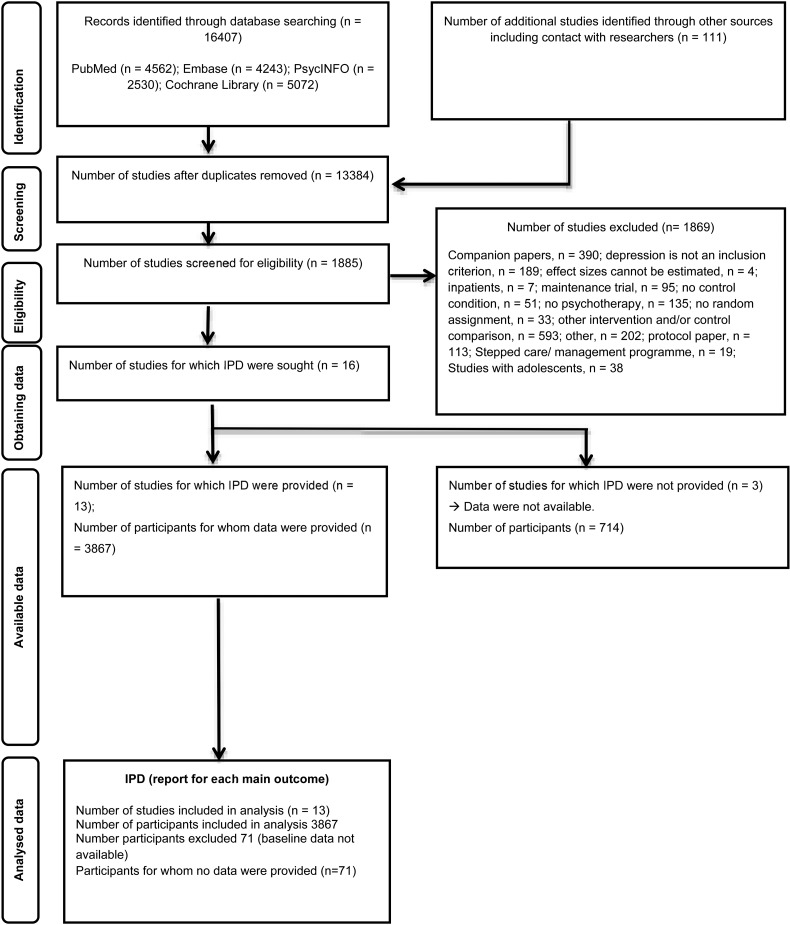
Background: Little is known about potential harmful effects as a consequence of self-guided internet-based cognitive behaviour therapy (iCBT), such as symptom deterioration rates. Thus, safety concerns remain and hamper the implementation of self-guided iCBT into clinical practice. We aimed to conduct an individual participant data (IPD) meta-analysis to determine the prevalence of clinically significant deterioration (symptom worsening) in adults with depressive symptoms who received self-guided iCBT compared with control conditions. Several socio-demographic, clinical and study-level variables were tested as potential moderators of deterioration. Methods: Randomised controlled trials that reported results of self-guided iCBT compared with control conditions in adults with symptoms of depression were selected. Mixed effects models with participants nested within studies were used to examine possible clinically significant deterioration rates. Results: Thirteen out of 16 eligible trials were included in the present IPD meta-analysis. Of the 3805 participants analysed, 7.2% showed clinically significant deterioration (5.8% and 9.1% of participants in the intervention and control groups, respectively). Participants in self-guided iCBT were less likely to deteriorate (OR 0.62, p < 0.001) compared with control conditions. None of the examined participant- and study-level moderators were significantly associated with deterioration rates. Conclusions: Self-guided iCBT has a lower rate of negative outcomes on symptoms than control conditions and could be a first step treatment approach for adult depression as well as an alternative to watchful waiting in general practice.
Overview
The claims and statistics of this paper haven’t been checked yet.
Free: it reads the open-access text and checks the first 5 claims that cite a source we can check. Create a free account to check every claim.
Integrity signals
Registry
Cites
Statistics
Figures
Verification
Claims the paper makes
The claims and statistics of this paper haven’t been checked yet.
Free: it reads the open-access text and checks the first 5 claims that cite a source we can check. Create a free account to check every claim.
Claims other papers make about this one
Each is checked against this paper’s own text: does it say what the citing paper says it does?
The source backs part of the claim, not all of it — or backs it for a different population, condition or comparison.
In the citing paper
“The results obtained so far are consistent and promising, showing that Internet-based interventions are effective in treating depression.”
From Protocol for a randomized controlled dismantling study of an internet-based intervention for depressive symptoms: Exploring the contribution of behavioral activation and positive psychotherapy strategies (2019) · cites this paper as [47]
Experimental — accuracy not yet measuredThe cited source says what the claim attributes to it.
In the citing paper
“No examined moderators were significantly associ ated with the deterioration rate.”
From Internet-delivered psychological treatments: from innovation to implementation (2019) · cites this paper as [80]
The cited source says what the claim attributes to it.
In the citing paper
“Another patientlevel metaanalysis focused on selfguided Internet treatments for depression 80 , and found that, of the 3,805 participants analyzed, 5.8% in the treatment groups and 9.1% in the control groups had deteriorated (odds ratio=0.62,p<0.001).”
From Internet-delivered psychological treatments: from innovation to implementation (2019) · cites this paper as [80]
Self-check
Percentages, sums and reported differences re-computed from the paper’s own numbers.
The self-check needs the paper’s full text.
Citations
Cites
Bias in meta-analysis detected by a simple, graphical test
Egger, M., Smith, G. D., Schneider, M., & Minder, C. (1997) · BMJ · doi:10.1136/bmj.315.7109.629 · Cited by 56,722 · cited 1×
“Publication bias was examined by visually inspecting funnel plots and by using the Duval and Tweedie’s trim and fill method, which yields an estimate of the effect size after adjusting for publication bias (Egger et al. 1997; Duval & Tweedie, 2000).”
MethodThe CES-D Scale: A Self-Report Depression Scale for Research in the General Population
Radloff, L. S. (1977) · Applied Psychological Measurement · doi:10.1177/014662167700100306 · Cited by 53,267
The PHQ-9: Validity of a brief depression severity measure
Kroenke, K., Spitzer, R. L., & Williams, J. B. W. (2001) · Journal of General Internal Medicine · doi:10.1046/j.1525-1497.2001.016009606.x · Cited by 44,910 · cited 2×
“…studies used either the Beck Depression Inventory [BDI-I (Beck et al. 1961) or BDI-II (Beck et al. 1996)], the Centre for Epidemiological Studies Depression Scale [CES-D (Radloff, 1977)] or the Patient Health Questionnaire [PHQ-9 (Kroenke et al. 2001)] as outcome measures of depression severity.”
MethodAn inventory for measuring depression
BECK, A. T. (1961) · Archives of General Psychiatry · doi:10.1001/archpsyc.1961.01710120031004 · Cited by 38,032 · cited 1×
“The included studies used either the Beck Depression Inventory [BDI-I (Beck et al. 1961) or BDI-II (Beck et al. 1996)], the Centre for Epidemiological Studies Depression Scale [CES-D (Radloff, 1977)] or the Patient Health Questionnaire [PHQ-9 (Kroenke et al. 2001)] as outcome measures of depression…”
MethodStatistical Power Analysis for the Behavioral Sciences (2nd ed.).
Lachenbruch, P. A., & Cohen, J. (1989) · Journal of the American Statistical Association · doi:10.2307/2290095 · Cited by 37,395
Multiple Imputation for Nonresponse in Surveys
Rubin, D. B. (1987) · Wiley Series in Probability and Statistics · doi:10.1002/9780470316696 · Cited by 20,701
Duval, S., & Tweedie, R. (2000) · Biometrics · doi:10.1111/j.0006-341x.2000.00455.x · Cited by 14,099 · cited 1×
“Publication bias was examined by visually inspecting funnel plots and by using the Duval and Tweedie’s trim and fill method, which yields an estimate of the effect size after adjusting for publication bias (Egger et al. 1997; Duval & Tweedie, 2000).”
MethodJacobson, N. S., & Truax, P. (1991) · Journal of Consulting and Clinical Psychology · doi:10.1037/0022-006x.59.1.12 · Cited by 7,770 · cited 2×
“We classified ‘clinically significant deterioration’ according to each participant’s reliable change index (RCI) (Jacobson & Truax, 1991), which is the most commonly used method for calculating clinically significant negative effects.”
BackgroundMethodInfluentialBeck, A. T., Steer, R. A., & Brown, G. (2011) · PsycTESTS Dataset · doi:10.1037/t00742-000 · Cited by 7,535
Scoville, W. B. (1949) · Journal of neurosurgery · doi:10.3171/jns.1949.6.1.0065 · Cited by 7,381
Handbook of Psychotherapy and Behavior Change
Garfield, S. L., Bergin, A. E., & Dryden, W. (1987) · Journal of Cognitive Psychotherapy · doi:10.1891/0889-8391.1.4.264a · Cited by 3,997 · cited 1×
“This method aims to ensure that each individual’s deterioration could not attributable to measurement error (Lambert et al. 1993) and thus might warrant clinical intervention in the context of an unsupervised intervention such as iCBT.”
MethodAssessing Risk of Bias in Included Studies
Higgins, J. P., & Altman, D. G. (2008) · Cochrane Handbook for Systematic Reviews of Interventions · doi:10.1002/9780470712184.ch8 · Cited by 3,396 · cited 1×
“Two independent reviewers (EK and PC) assessed the risk of bias in the included studies according to the Cochrane risk of bias assessment tool (Higgins & Altman, 2008; Higgins & Green, Psychological Medicine 2457 2011).”
MethodAnalysing Data and Undertaking Meta‐Analyses
Deeks, J. J., Higgins, J. P., & Altman, D. G. (2008) · Cochrane Handbook for Systematic Reviews of Interventions · doi:10.1002/9780470712184.ch9 · Cited by 1,800
Uncertainty in heterogeneity estimates in meta-analyses
Ioannidis, J. P. A., Patsopoulos, N. A., & Evangelou, E. (2007) · BMJ · doi:10.1136/bmj.39343.408449.80 · Cited by 1,254 · cited 5×
“We calculated the 95% confidence intervals (CI) around I2 using the non-central chi-squared-based approach within the heterogeneity module for Stata (Orsini et al. 2006; Evangelou et al. 2007).”
MethodInfluentialThe increasing burden of depression
Briley, M., & Lépine (2011) · Neuropsychiatric Disease and Treatment · doi:10.2147/ndt.s19617 · Cited by 1,211
Advantages and limitations of Internet-based interventions for common mental disorders
Andersson, G., & Titov, N. (2014) · World Psychiatry · doi:10.1002/wps.20083 · Cited by 1,160 · cited 2×
“Most self-guided interventions are not tailored to the current depressive status of the individual and, accordingly, do not respond to symptom deterioration (Andersson & Titov, 2014).”
BackgroundSelf-citationFoa, E. B., Hembree, E. A., Cahill, S. P., Rauch, S. A. M., Riggs, D. S., Feeny, N. C., & Yadin, E. (2005) · Journal of Consulting and Clinical Psychology · doi:10.1037/0022-006x.73.5.953 · Cited by 931 · cited 2×
“Previous research has shown that some forms of psychotherapy can be hazardous for some patients e.g. prolonged imaginal exposure may result in worsening of symptoms in some patients with posttraumatic stress disorder (Foa et al. 2005).”
BackgroundDelivering interventions for depression by using the internet: randomised controlled trial
Christensen, H. (2004) · BMJ · doi:10.1136/bmj.37945.566632.ee · Cited by 928 · cited 2×
“Data were available from thirteen trials including 3876 participants (Christensen et al. 2004; de Graaf et al. 2009; Berger et al. 2011; Farrer et al. 2011; Gilbody et al. 2015; Karyotaki et al. 2017 accepted, Spek et al. 2007; Meyer et al. 2009; Moritz et al. 2012; Phillips et al. 2014; Kleiboer…”
MethodSelf-citationMeta-analysis of the literature or of individual patient data: is there a difference?
Stewart, L. A., & Parmar, M. K. B. (1993) · The Lancet · doi:10.1016/0140-6736(93)93004-k · Cited by 769 · cited 1×
“A one-stage IPD approach is preferred over a twostage approach because it allows for a more exact likelihood specification (Stewart & Parmar, 1993; Debray et al. 2013; Burke et al. 2016).”
MethodKaryotaki, E., Riper, H., Twisk, J., Hoogendoorn, A., Kleiboer, A., Mira, A., Mackinnon, A., Meyer, B., Botella, C., Littlewood, E., et al. (2017) · JAMA Psychiatry · doi:10.1001/jamapsychiatry.2017.0044 · Cited by 691 · cited 9×
“However, results of a previous analysis showed no difference between the effectiveness of the available and unavailable studies, indicating that the present sample is representative (Karyotaki et al. 2017).”
BackgroundMethodResultInfluentialSelf-citationHedman, E., Ljótsson, B., & Lindefors, N. (2012) · Expert Review of Pharmacoeconomics & Outcomes Research · doi:10.1586/erp.12.67 · Cited by 672 · cited 2×
“cognitive behaviour therapy (iCBT) can increase accessibility and reduce the costs of depression treatment (Hedman et al. 2012; Muñoz et al. 2015).”
BackgroundBurke, D. L., Ensor, J., & Riley, R. D. (2017) · Statistics in Medicine · doi:10.1002/sim.7141 · Cited by 538 · cited 1×
“A one-stage IPD approach is preferred over a twostage approach because it allows for a more exact likelihood specification (Stewart & Parmar, 1993; Debray et al. 2013; Burke et al. 2016).”
MethodPatients' preferences in the treatment of depressive disorder in primary care
van Schaik, D. J. F., Klijn, A. F. J., van Hout, H. P. J., van Marwijk, H. W. J., Beekman, A. T. F., de Haan, M., & van Dyck, R. (2004) · General Hospital Psychiatry · doi:10.1016/j.genhosppsych.2003.12.001 · Cited by 428 · cited 1×
“Although many patients prefer psychotherapy to antidepressants (van Schaik et al. 2004), pharmacotherapy dominates primary and secondary mental healthcare while psychotherapy is offered to a lesser degree.”
BackgroundBeck Depression Inventory (BDI)
Rosner, R. I. (2015) · The Encyclopedia of Clinical Psychology · doi:10.1002/9781118625392.wbecp261 · Cited by 420 · cited 2×
“The included studies used either the Beck Depression Inventory [BDI-I (Beck et al. 1961) or BDI-II (Beck et al.”
MethodGilbody, S., Littlewood, E., Hewitt, C., Brierley, G., Tharmanathan, P., Araya, R., Barkham, M., Bower, P., Cooper, C., Gask, L., et al. (2015) · BMJ · doi:10.1136/bmj.h5627 · Cited by 409
Self-citationWaller, R., & Gilbody, S. (2009) · Psychological Medicine · doi:10.1017/s0033291708004224 · Cited by 393 · cited 1×
“Among the barriers to implementation are concerns regarding safety and effectiveness (Waller & Gilbody, 2009).”
BackgroundSelf-citationDepression: The disorder and the burden
Reddy, M. S. (2010) · Indian Journal of Psychological Medicine · doi:10.4103/0253-7176.70510 · Cited by 392 · cited 2×
“Depression is a common and major health issue that is associated with a considerable personal and societal burden (Reddy, 2010; Lepine & Briley, 2011).”
BackgroundMultiple Imputation for Nonresponse in Surveys.
Kershaw, C. D., & Rubin, D. B. (1989) · Biometrics · doi:10.2307/2532070 · Cited by 388
Berger, T., Hämmerli, K., Gubser, N., Andersson, G., & Caspar, F. (2011) · Cognitive Behaviour Therapy · doi:10.1080/16506073.2011.616531 · Cited by 383 · cited 2×
“Data were available from thirteen trials including 3876 participants (Christensen et al. 2004; de Graaf et al. 2009; Berger et al. 2011; Farrer et al. 2011; Gilbody et al. 2015; Karyotaki et al. 2017 accepted, Spek et al. 2007; Meyer et al. 2009; Moritz et al. 2012; Phillips et al. 2014; Kleiboer…”
MethodSelf-citationClarke, G., Eubanks, D., Reid, E., Kelleher, C., O'Connor, E., DeBar, L. L., Lynch, F., Nunley, S., & Gullion, C. (2005) · Journal of Medical Internet Research · doi:10.2196/jmir.7.2.e16 · Cited by 372 · cited 1×
“Three eligible datasets were excluded from the present IPD meta-analysis as data were unavailable (Clarke et al. 2002; Clarke et al. 2005; Clarke et al. 2009).”
MethodConsensus statement on defining and measuring negative effects of internet interventions
Rozental, A., Andersson, G., Boettcher, J., Ebert, D. D., Cuijpers, P., Knaevelsrud, C., Ljótsson, B., Kaldo, V., Titov, N., & Carlbring, P. (2014) · Internet Interventions · doi:10.1016/j.invent.2014.02.001 · Cited by 371 · cited 3×
“The deterioration rates found in the present IPD meta-analysis are in line with the deterioration rates observed in face-to-face treatment (5–10%) (Rozental et al. 2014) and considerably lower compared with the 12% rate of deterioration reported by a recent meta-analysis examining change under treatment as usual (Kolo…”
BackgroundResultSelf-citationMeyer, B., Berger, T., Caspar, F., Beevers, C. G., Andersson, G., & Weiss, M. (2009) · Journal of Medical Internet Research · doi:10.2196/jmir.1151 · Cited by 363 · cited 2×
“…(Christensen et al. 2004; de Graaf et al. 2009; Berger et al. 2011; Farrer et al. 2011; Gilbody et al. 2015; Karyotaki et al. 2017 accepted, Spek et al. 2007; Meyer et al. 2009; Moritz et al. 2012; Phillips et al. 2014; Kleiboer et al. 2015; Meyer et al. 2015; Klein et al. 2016; Mira et al. 2017).”
BackgroundMethodSelf-citationKaltenthaler, E., Brazier, J., De Nigris, E., Tumur, I., Ferriter, M., Beverley, C., Parry, G., Rooney, G., & Sutcliffe, P. (2006) · Health Technology Assessment · doi:10.3310/hta10330 · Cited by 357 · cited 1×
“Over the past decade, free or commercially provided self-guided iCBT programmes have been made available to individuals with depression (Kaltenthaler et al. 2006).”
BackgroundBower, P., Kontopantelis, E., Sutton, A., Kendrick, T., Richards, D. A., Gilbody, S., Knowles, S., Cuijpers, P., Andersson, G., Christensen, H., et al. (2013) · BMJ · doi:10.1136/bmj.f540 · Cited by 341
Self-citationHow would we know if psychotherapy were harmful?
Dimidjian, S., & Hollon, S. D. (2010) · American Psychologist · doi:10.1037/a0017299 · Cited by 314 · cited 1×
“As with any other potentially effective treatment, iCBT could also result in undesirable outcomes or fail to arrest substantial ongoing deterioration (Dimidjian & Hollon, 2010).”
BackgroundRobinson, T. N. (1998) · JAMA · doi:10.1001/jama.280.14.1264 · Cited by 312 · cited 1×
“Offered as first stage treatment, self-guided iCBT has been criticised as potentially delaying individuals suffering from depression receiving effective clinical services (Robinson et al. 1998; Ybarra & Eaton, 2005).”
MethodSPEK, V., NYKLÍČEK, I., SMITS, N., CUIJPERS, P., RIPER, H., KEYZER, J., & POP, V. (2007) · Psychological Medicine · doi:10.1017/s0033291707000542 · Cited by 307 · cited 1×
“…(Christensen et al. 2004; de Graaf et al. 2009; Berger et al. 2011; Farrer et al. 2011; Gilbody et al. 2015; Karyotaki et al. 2017 accepted, Spek et al. 2007; Meyer et al. 2009; Moritz et al. 2012; Phillips et al. 2014; Kleiboer et al. 2015; Meyer et al. 2015; Klein et al. 2016; Mira et…”
BackgroundSelf-citationClarke, G., Reid, E., Eubanks, D., O'Connor, E., DeBar, L. L., Kelleher, C., Lynch, F., & Nunley, S. (2002) · Journal of Medical Internet Research · doi:10.2196/jmir.4.3.e14 · Cited by 256 · cited 1×
“Three eligible datasets were excluded from the present IPD meta-analysis as data were unavailable (Clarke et al. 2002; Clarke et al. 2005; Clarke et al. 2009).”
MethodPsychological treatment of depression: A meta-analytic database of randomized studies
Cuijpers, P., van Straten, A., Warmerdam, L., & Andersson, G. (2008) · BMC Psychiatry · doi:10.1186/1471-244x-8-36 · Cited by 241 · cited 1×
“To identify eligible studies, we used an existing database of trials focusing on psychological therapies for adults with depression (Cuijpers et al. 2008).”
MethodSelf-citationInternet-Based Mental Health Interventions
Ybarra, M. L., & Eaton, W. W. (2005) · Mental Health Services Research · doi:10.1007/s11020-005-3779-8 · Cited by 241 · cited 1×
“Offered as first stage treatment, self-guided iCBT has been criticised as potentially delaying individuals suffering from depression receiving effective clinical services (Robinson et al. 1998; Ybarra & Eaton, 2005).”
MethodNewman, M. G., Erickson, T., Przeworski, A., & Dzus, E. (2003) · Journal of Clinical Psychology · doi:10.1002/jclp.10128 · Cited by 206 · cited 1×
“Moreover, lack of therapeutic support may jeopardise therapy outcomes as the progress of patients is not monitored (Newman et al. 2003).”
BackgroundIndividual Participant Data Meta-Analysis for a Binary Outcome: One-Stage or Two-Stage?
Debray, T. P. A., Moons, K. G. M., Abo-Zaid, G. M. A., Koffijberg, H., & Riley, R. D. (2013) · PLoS ONE · doi:10.1371/journal.pone.0060650 · Cited by 201 · cited 1×
“A one-stage IPD approach is preferred over a twostage approach because it allows for a more exact likelihood specification (Stewart & Parmar, 1993; Debray et al. 2013; Burke et al. 2016).”
Methodde Graaf, L. E., Gerhards, S. A. H., Arntz, A., Riper, H., Metsemakers, J. F. M., Evers, S. M. A. A., Severens, J. L., Widdershoven, G., & Huibers, M. J. H. (2009) · British Journal of Psychiatry · doi:10.1192/bjp.bp.108.054429 · Cited by 190 · cited 1×
“Data were available from thirteen trials including 3876 participants (Christensen et al. 2004; de Graaf et al. 2009; Berger et al. 2011; Farrer et al. 2011; Gilbody et al. 2015; Karyotaki et al. 2017 accepted, Spek et al. 2007; Meyer et al. 2009; Moritz et al. 2012; Phillips et al. 2014; Kleiboer…”
MethodSelf-citationMeyer, B., Bierbrodt, J., Schröder, J., Berger, T., Beevers, C. G., Weiss, M., Jacob, G., Späth, C., Andersson, G., Lutz, W., et al. (2015) · Internet Interventions · doi:10.1016/j.invent.2014.12.003 · Cited by 188 · cited 2×
“…(Christensen et al. 2004; de Graaf et al. 2009; Berger et al. 2011; Farrer et al. 2011; Gilbody et al. 2015; Karyotaki et al. 2017 accepted, Spek et al. 2007; Meyer et al. 2009; Moritz et al. 2012; Phillips et al. 2014; Kleiboer et al. 2015; Meyer et al. 2015; Klein et al. 2016; Mira et al. 2017).”
BackgroundMethodSelf-citationJonsson, U., Alaie, I., Parling, T., & Arnberg, F. K. (2014) · Contemporary Clinical Trials · doi:10.1016/j.cct.2014.02.005 · Cited by 175 · cited 1×
“In contrast to the vast majority of pharmacological trials, which rigorously measure and report adverse outcomes, only half of psychotherapeutic trials report undesirable outcomes, in particular substantial symptom deterioration (Jonsson et al. 2014; Vaughan et al. 2014).”
BackgroundNewman, M. G. (2000) · Journal of Consulting and Clinical Psychology · doi:10.1037/0022-006x.68.4.549 · Cited by 167 · cited 1×
“With regard to self-guided psychological treatment, it has been argued that it may not be appropriate for all individuals (Newman, 2000).”
BackgroundClarke, G., Kelleher, C., Hornbrook, M., DeBar, L., Dickerson, J., & Gullion, C. (2009) · Cognitive Behaviour Therapy · doi:10.1080/16506070802675353 · Cited by 154 · cited 1×
“Three eligible datasets were excluded from the present IPD meta-analysis as data were unavailable (Clarke et al. 2002; Clarke et al. 2005; Clarke et al. 2009).”
MethodEbert, D. D., Donkin, L., Andersson, G., Andrews, G., Berger, T., Carlbring, P., Rozenthal, A., Choi, I., Laferton, J. A. C., Johansson, R., et al. (2016) · Psychological Medicine · doi:10.1017/s0033291716001562 · Cited by 154 · cited 2×
“The finding that self-guided iCBT shows lower deterioration rates compared with controls is consistent with previous IPD meta-analysis of 2079 participants on guided internet based interventions (Ebert et al. 2016).”
ResultSelf-citationKlein, J. P., Berger, T., Schröder, J., Späth, C., Meyer, B., Caspar, F., Lutz, W., Arndt, A., Greiner, W., Gräfe, V., et al. (2016) · Psychotherapy and Psychosomatics · doi:10.1159/000445355 · Cited by 146 · cited 2×
“…(Christensen et al. 2004; de Graaf et al. 2009; Berger et al. 2011; Farrer et al. 2011; Gilbody et al. 2015; Karyotaki et al. 2017 accepted, Spek et al. 2007; Meyer et al. 2009; Moritz et al. 2012; Phillips et al. 2014; Kleiboer et al. 2015; Meyer et al. 2015; Klein et al. 2016; Mira et al. 2017).”
BackgroundMethodSelf-citationFarrer, L., Christensen, H., Griffiths, K. M., & Mackinnon, A. (2011) · PLoS ONE · doi:10.1371/journal.pone.0028099 · Cited by 140 · cited 2×
“Data were available from thirteen trials including 3876 participants (Christensen et al. 2004; de Graaf et al. 2009; Berger et al. 2011; Farrer et al. 2011; Gilbody et al. 2015; Karyotaki et al. 2017 accepted, Spek et al. 2007; Meyer et al. 2009; Moritz et al. 2012; Phillips et al. 2014; Kleiboer…”
MethodSelf-citationA randomized controlled trial of internet-based therapy in depression
Moritz, S., Schilling, L., Hauschildt, M., Schröder, J., & Treszl, A. (2012) · Behaviour Research and Therapy · doi:10.1016/j.brat.2012.04.006 · Cited by 140 · cited 1×
“…(Christensen et al. 2004; de Graaf et al. 2009; Berger et al. 2011; Farrer et al. 2011; Gilbody et al. 2015; Karyotaki et al. 2017 accepted, Spek et al. 2007; Meyer et al. 2009; Moritz et al. 2012; Phillips et al. 2014; Kleiboer et al. 2015; Meyer et al. 2015; Klein et al. 2016; Mira et al. 2017).”
BackgroundMassive Open Online Interventions: A Novel Model for Delivering Behavioral-Health Services Worldwide
Muñoz, R. F., Bunge, E. L., Chen, K., Schueller, S. M., Bravin, J. I., Shaughnessy, E. A., & Pérez-Stable, E. J. (2016) · Clinical Psychological Science · doi:10.1177/2167702615583840 · Cited by 131
Kleiboer, A. M., Donker, T., Seekles, W., van Straten, A., Riper, H. M., & Cuijpers, P. J. (2015) · Behaviour Research and Therapy · doi:10.1016/j.brat.2015.06.013 · Cited by 127 · cited 1×
“…(Christensen et al. 2004; de Graaf et al. 2009; Berger et al. 2011; Farrer et al. 2011; Gilbody et al. 2015; Karyotaki et al. 2017 accepted, Spek et al. 2007; Meyer et al. 2009; Moritz et al. 2012; Phillips et al. 2014; Kleiboer et al. 2015; Meyer et al. 2015; Klein et al. 2016; Mira et al. 2017).”
BackgroundSelf-citationHETEROGI: Stata module to quantify heterogeneity in a meta-analysis
Orsini, N., Bottai, M., Higgins, J. P. T., & Buchan, I. E. (2005) · RePEc: Research Papers in Economics · Cited by 118
Phillips, R., Schneider, J., Molosankwe, I., Leese, M., Foroushani, P. S., Grime, P., McCrone, P., Morriss, R., & Thornicroft, G. (2014) · Psychological Medicine · doi:10.1017/s0033291713001323 · Cited by 110 · cited 2×
“…(Christensen et al. 2004; de Graaf et al. 2009; Berger et al. 2011; Farrer et al. 2011; Gilbody et al. 2015; Karyotaki et al. 2017 accepted, Spek et al. 2007; Meyer et al. 2009; Moritz et al. 2012; Phillips et al. 2014; Kleiboer et al. 2015; Meyer et al. 2015; Klein et al. 2016; Mira et al. 2017).”
BackgroundMethodSelf-citationThe effect of treatment as usual on major depressive disorder: A meta-analysis
Kolovos, S., van Tulder, M. W., Cuijpers, P., Prigent, A., Chevreul, K., Riper, H., & Bosmans, J. E. (2017) · Journal of Affective Disorders · doi:10.1016/j.jad.2016.12.013 · Cited by 79 · cited 2×
“2014) and considerably lower compared with the 12% rate of deterioration reported by a recent meta-analysis examining change under treatment as usual (Kolovos et al. 2017).”
ResultSelf-citationMira, A., Bretón-López, J., García-Palacios, A., Quero, S., Baños, R. M., & Botella, C. (2017) · Neuropsychiatric Disease and Treatment · doi:10.2147/ndt.s130994 · Cited by 71 · cited 2×
“…(Christensen et al. 2004; de Graaf et al. 2009; Berger et al. 2011; Farrer et al. 2011; Gilbody et al. 2015; Karyotaki et al. 2017 accepted, Spek et al. 2007; Meyer et al. 2009; Moritz et al. 2012; Phillips et al. 2014; Kleiboer et al. 2015; Meyer et al. 2015; Klein et al. 2016; Mira et al. 2017).”
BackgroundMethodSelf-citationIdentification of patients at risk for nonresponse and negative outcome in psychotherapy.
Mohr, D. C., Beutler, L. E., Engle, D., & Shoham-Salomon, V. (1990) · Journal of Consulting and Clinical Psychology · doi:10.1037//0022-006x.58.5.622 · Cited by 67 · cited 1×
“For instance, self-guided interventions may not be intensive enough for individuals with severe symptoms (Mohr et al. 1990).”
BackgroundVaughan, B., Goldstein, M. H., Alikakos, M., Cohen, L. J., & Serby, M. J. (2014) · Comprehensive Psychiatry · doi:10.1016/j.comppsych.2014.01.001 · Cited by 63 · cited 1×
“In contrast to the vast majority of pharmacological trials, which rigorously measure and report adverse outcomes, only half of psychotherapeutic trials report undesirable outcomes, in particular substantial symptom deterioration (Jonsson et al. 2014; Vaughan et al. 2014).”
Background
Research works printed but not linked: 1
- Higgins J and Green S (2011) Handbook for Systematic Reviews of Interventions. version 5.1. 0 [updated March 2011]. Chichester, UK: John Wiley & Sons, Ltd.
Cited by
Internet-delivered psychological treatments: from innovation to implementation
Andersson, G., Titov, N., Dear, B. F., Rozental, A., & Carlbring, P. (2019) · World Psychiatry · doi:10.1002/wps.20610 · Cited by 750
Self-citationDigital interventions for the treatment of depression: a meta-analytic review
Moshe, I., Terhorst, Y., Philippi, P., Domhardt, M., Cuijpers, P., Cristea, I., Pulkki-Råback, L., Baumeister, H., & Sander, L. B. (2021) · Psychological Bulletin · doi:10.1037/bul0000334 · Cited by 390
Self-citationPhilippe, T. J., Sikder, N., Jackson, A., Koblanski, M. E., Liow, E., Pilarinos, A., & Vasarhelyi, K. (2022) · JMIR Mental Health · doi:10.2196/35159 · Cited by 436
Virtual reality exposure therapy for social anxiety disorder: A randomized controlled trial.
Anderson, P. L., Price, M., Edwards, S. M., Obasaju, M. A., Schmertz, S. K., Zimand, E., & Calamaras, M. R. (2013) · Journal of Consulting and Clinical Psychology · doi:10.1037/a0033559 · Cited by 371
Targets and Outcomes of Psychotherapies for Mental Disorders: An Overview
Cuijpers, P. (2019) · World Psychiatry · doi:10.1002/wps.20661 · Cited by 206
Metadata
- Authors
- Karyotaki, E., Kemmeren, L., Riper, H., Twisk, J., Hoogendoorn, A., Kleiboer, A., Mira, A., Mackinnon, A., Meyer, B., Botella, C., Littlewood, E., Andersson, G., Christensen, H., Klein, J. P., Schröder, J., Bretón-López, J., Scheider, J., Griffiths, K., Farrer, L., Huibers, M. J. H., Phillips, R., Gilbody, S., Moritz, S., Berger, T., Pop, V., Spek, V., & Cuijpers, P.
- Affiliations
- Vrije Universiteit Amsterdam (NL)
- Amsterdam Public Health (NL)
- Universitat Jaume I (ES)
- The University of Melbourne (AU)
- City, University of London (GB)
- University of York (GB)
- Linköping University (SE)
- Black Dog Institute (AU)
- University of Lübeck (DE)
- University Medical Center Hamburg-Eppendorf (DE)
- University of Nottingham (GB)
- Australian National University (AU)
- King's College London (GB)
- University of Bern (CH)
- Tilburg University (NL)
- Corresponding author
- Karyotaki, Eirini
- ORCID
- Karyotaki, Eirini
- Kemmeren, Lise
- Riper, Heleen
- Twisk, Jos
- Hoogendoorn, Adriaan
- Kleiboer, Annet
- Mira, Adriana
- Mackinnon, Andrew
- Meyer, Björn
- Botella, Cristina
- Littlewood, Elizabeth
- Andersson, Gerhard
- Christensen, Helen
- Klein, Jan P.
- Schröder, Johanna
- Bretón-López, Juana
- Farrer, Louise
- Huibers, Marcus J. H.
- Phillips, Rachel
- Gilbody, Simon
- Moritz, Steffen
- Berger, Thomas
- Spek, Viola
- Cuijpers, Pim
- Venue
- Psychological Medicine
- Publisher
- Cambridge University Press (CUP)
- Published
- 2018-03-15
- Volume
- 48
- Issue
- 15
- Pages
- 2456-2466
- ISSN
- 0033-2917 (ISSN-L)
- 1469-8978
- PMC
- PMC6190066
- OpenAlex
- W2794073751
- Cited by
- 167
- References
- 61
- Citations by year
- 2026: 10 · 2025: 20 · 2024: 19 · 2023: 23 · 2022: 24 · 2021: 23 · 2020: 21 · 2019: 17 · 2018: 8
- FWCI
- 2.34
- Type
- journal article
- Language
- en
- Open access
- hybrid
- doi.org
- Locations
- Psychological Medicine (publishedVersion, cc-by)
- Europe PMC (PubMed Central) (publishedVersion, cc-by)
- PubMed Central (publishedVersion, cc-by)
- PubMed (publishedVersion)
- Pure Amsterdam UMC (publishedVersion, cc-by)
- VU Research Portal (publishedVersion, other-oa)
- White Rose Research Online (University of Leeds, The University of Sheffield, University of York) (submittedVersion)
- Minerva Access (University of Melbourne) (submittedVersion, cc-by)
- Repositori UJI (Universitat Jaume I) (submittedVersion, other-oa)
- Research portal (Tilburg University) (submittedVersion, other-oa)
- Data Archiving and Networked Services (DANS) (submittedVersion, other-oa)
- KTH Publication Database DiVA (KTH Royal Institute of Technology) (submittedVersion, other-oa)
- BORIS (University Library Bern) (submittedVersion, cc-by)
- LA Referencia (Red Federada de Repositorios Institucionales de Publicaciones Científicas) (submittedVersion, cc-by-sa)
- ANU Open Research (Australian National University) (submittedVersion, cc-by)
- Amsterdam UMC (VU Amsterdam) - Institutional Repository (submittedVersion, other-oa)
- Spiral (Imperial College London) (submittedVersion, other-oa)
- Funders
- European Commission (603098)
- Bundesministerium für Gesundheit
- Servier
- Topics
- Social Sciences › Psychology › Applied Psychology › Digital Mental Health Interventions
- Social Sciences › Psychology › Experimental and Cognitive Psychology › Anxiety, Depression, Psychometrics, Treatment, Cognitive Processes
- Health Sciences › Medicine › Psychiatry and Mental health › Mental Health Treatment and Access
- Keywords
- internet-based cognitive behavioral therapy, self-guided treatment, depression, symptom deterioration, treatment safety, adverse effects, adults, expectant management
- MeSH terms
- Depression, Depressive Disorder, Humans, Cognitive Behavioral Therapy, Outcome Assessment, Health Care, Telemedicine, Internet
About these checks
Registry, retraction, Cites and statistics results are computed, not judged, with one exception: a printed reference that no index lists is read once by a model before it counts as a citation error. Claims are extracted by a model and kept only when their quote appears verbatim in the text; each cited source is then checked, with a model’s help, for whether it says what the claim relies on. Those verdicts can be wrong — read the claim’s quote and the cited source before relying on one.
Statistics and arithmetic are recomputed, not judged.
Confidence bands are shown only for fields calibrated on our annotated test set. None is calibrated yet, so no band is shown.
What counts as a claim ›How we measure confidence ›How we check this ›
Are you an author, or do you see a problem with this page? Request a review
Data sources
Bibliographic data: Semantic Scholar, OpenAlex, Crossref.
Contains information from the Semantic Scholar Academic Graph Datasets, made available under the ODC Attribution License (ODC-BY 1.0).
Semantic Scholar’s data is described in: Kinney, R., et al. (2023). The Semantic Scholar Open Data Platform. arXiv:2301.10140.
