

Targeting excessive worry with internet-based extinction therapy: a randomised controlled trial with mediation analysis and economical evaluation
Open accessThe DOI matches its Crossref record; 43 of the 44 references it cites were found in a registry or an index.
Abstract
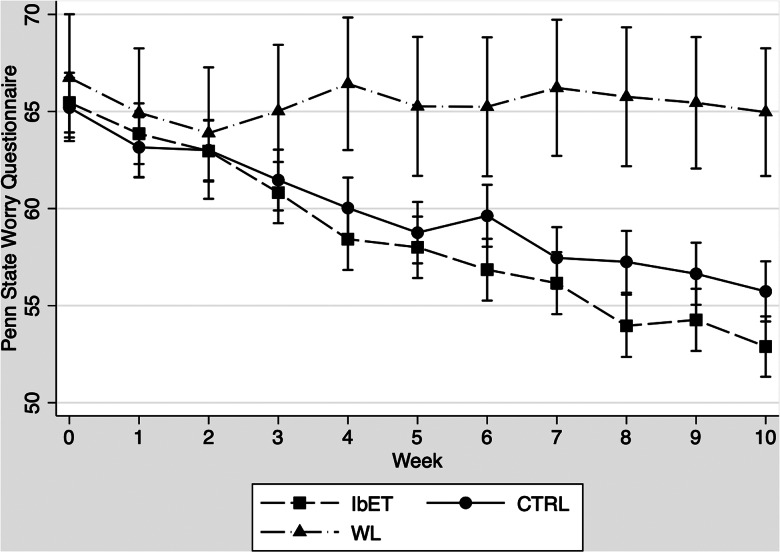
Background: Excessive worry is a common phenomenon. Our research group has previously developed an online intervention for excessive worry based on operant principles of extinction (IbET; internet-based extinction therapy) and tested it against a waiting-list. The aim of this study was to evaluate IbET against an active control comparator (CTRL). Methods: A 10-week parallel participant blind randomised controlled trial with health-economical evaluation and mediation analyses. Participants ( N = 311) were randomised (ratio 4.5:4.5:1) to IbET, to CTRL (an internet-based stress-management training program) or to waiting-list. The nation-wide trial included self-referred adults with excessive worry. The primary outcome was change in worry assessed with the Penn State Worry Questionnaire from baseline to 10 weeks. Results: IbET had greater reductions in worry compared to CTRL [−3.6 point difference, (95% CI −2.4 to −4.9)] and also a significantly larger degree of treatment responders [63% v. 51%; risk ratio = 1.24 (95% CI 1.01–1.53)]. Both IbET and CTRL made large reductions in worry compared to waiting-list and effects were sustained up to 1 year. Treatment credibility, therapist attention, compliance and working alliance were equal between IbET and CTRL. Data attrition was 4% at the primary endpoint. The effects of IbET were mediated by the hypothesized causal mechanism (reduced thought suppression) but not by competing mediators. Health-economical evaluation indicated that IbET had a 99% chance of being cost-effective compared to CTRL given societal willingness to pay of 1000€. Conclusions: IbET is more effective than active comparator to treat excessive worry. Replication and extensions to real-world setting are warranted.
Overview
The claims and statistics of this paper haven’t been checked yet.
Free: it reads the open-access text and checks the first 5 claims that cite a source we can check. Create a free account to check every claim.
Integrity signals
Registry
Cites
Statistics
Figures


Verification
Claims the paper makes
The claims and statistics of this paper haven’t been checked yet.
Free: it reads the open-access text and checks the first 5 claims that cite a source we can check. Create a free account to check every claim.
Claims other papers make about this one
Each is checked against this paper’s own text: does it say what the citing paper says it does?
The cited source says what the claim attributes to it.
In the citing paper
“The results were in line with our previous work showing that internet-based interventions can be efficacious for excessive worry about everyday problems [6,7].”
From Brief Online Cognitive Behavioural Intervention for Dysfunctional Worry Related to the COVID-19 Pandemic: A Randomised Controlled Trial (2021) · cites this paper as [7]
The cited source says what the claim attributes to it.
In the citing paper
“Unlike our previous internet-based worry treatments [6,7], the current intervention was short (3 vs. 10 weeks) and entirely self-guided.”
From Brief Online Cognitive Behavioural Intervention for Dysfunctional Worry Related to the COVID-19 Pandemic: A Randomised Controlled Trial (2021) · cites this paper as [7]
Self-check
Percentages, sums and reported differences re-computed from the paper’s own numbers.
The self-check needs the paper’s full text.
Citations
Cites
Preacher, K. J., & Hayes, A. F. (2008) · Behavior Research Methods · doi:10.3758/brm.40.3.879 · Cited by 34,117
(1998) · The Journal of Clinical Psychiatry · Cited by 19,139
SAUNDERS, J. B., AASLAND, O. G., BABOR, T. F., DE LA FUENTE, J. R., & GRANT, M. (1993) · Addiction · doi:10.1111/j.1360-0443.1993.tb02093.x · Cited by 13,597
(1998) · PubMed · Cited by 10,216
EQ-SD: a measure of health status from the EuroQol Group
Rabin, R., & Charro, F. D. (2001) · Annals of Medicine · doi:10.3109/07853890109002087 · Cited by 5,613
Development and validation of the Penn State Worry Questionnaire
Meyer, T. J., Miller, M. L., Metzger, R. L., & Borkovec, T. D. (1990) · Behaviour Research and Therapy · doi:10.1016/0005-7967(90)90135-6 · Cited by 5,099
Toward the future of psychiatric diagnosis: the seven pillars of RDoC
Cuthbert, B. N., & Insel, T. R. (2013) · BMC Medicine · doi:10.1186/1741-7015-11-126 · Cited by 3,053
Credibility of analogue therapy rationales
Borkovec, T. D., & Nau, S. D. (1972) · Journal of Behavior Therapy and Experimental Psychiatry · doi:10.1016/0005-7916(72)90045-6 · Cited by 1,553
Factor structure of the working alliance inventory
Tracey, T. J., & Kokotovic, A. M. (1989) · Psychological Assessment: A Journal of Consulting and Clinical Psychology · doi:10.1037/1040-3590.1.3.207 · Cited by 1,501
The multidimensional assessment of interoceptive awareness (MAIA)
Mehling, W. E., Price, C., Daubenmier, J. J., Acree, M., Bartmess, E., & Stewart, A. (2012) · PLoS ONE · doi:10.1371/journal.pone.0048230 · Cited by 1,429
Research works printed but not linked: 3
- 2013, Diagnostic and statistical manual of mental disorders: DSM-5
- Hakkaart-van Roijen, L. , & Donker, M. C. H. (2002). Manual/iMTA questionnaire for costs associated with psychiatric illness (TIC-P). Retrieved from http://hdl.handle.net/1765/1337.
- Wadström, 2015, Quit ruminating and brooding: It is easier to do with cognitive behavior therapy (CBT)
Cited by
Wahlund, T., Mataix-Cols, D., Olofsdotter Lauri, K., de Schipper, E., Ljótsson, B., Aspvall, K., & Andersson, E. (2021) · Psychotherapy and Psychosomatics · doi:10.1159/000512843 · Cited by 105
Self-citationPilot randomized trial of self-guided virtual reality exposure therapy for social anxiety disorder
Zainal, N. H., Chan, W. W., Saxena, A. P., Taylor, C. B., & Newman, M. G. (2021) · Behaviour Research and Therapy · doi:10.1016/j.brat.2021.103984 · Cited by 84
Effect of Psychotherapy on Intolerance of Uncertainty: A Systematic Review and Meta‐Analysis
Näsling, J., Åström, E., Jacobsson, L., & Ljungberg, J. K. (2024) · Clinical Psychology & Psychotherapy · doi:10.1002/cpp.3026 · Cited by 12
Wahlund, T., Hesser, H., Perrin, S. G., Johansson, S., Huhn, V., Sörhus, S., Lindskog, S., Serlachius, E., Hedman‐Lagerlöf, E., Ljótsson, B., et al. (2021) · Cognitive Behaviour Therapy · doi:10.1080/16506073.2021.1937695 · Cited by 12
Self-citationAsplund, M., Lenhard, F., Rück, C., Andersson, E., Grimlund, T., Nilsson, M., Sarachu-Nilsson, M., Sundh, L., & Ivanov, V. Z. (2024) · Behavior Therapy · doi:10.1016/j.beth.2024.04.006 · Cited by 12
Self-citation
Metadata
- Authors
- Andersson, E., Ljótsson, B., Hedman-Lagerlöf, M., Nygren, L., Persson, M., Rosengren, K., Gezelius, A., Andersson, L., Sundquist, T., Ivanov, V. Z., Bjureberg, J., & Hedman-Lagerlöf, E.
- Affiliations
- Karolinska Institutet (SE)
- Region Stockholm (SE)
- Corresponding author
- Andersson, Erik
- Andersson, Louise
- Venue
- Psychological Medicine
- Publisher
- Cambridge University Press (CUP)
- Published
- 2020-04-28
- Volume
- 51
- Issue
- 12
- Pages
- 2023-2033
- ISSN
- 0033-2917 (ISSN-L)
- 1469-8978
- PMC
- PMC8426147
- OpenAlex
- W3019846464
- Semantic Scholar
- 3e1523d980792fa02c6eb719270eae984a275346
- Cited by
- 10
- References
- 44
- Citations by year
- 2026: 1 · 2025: 1 · 2024: 3 · 2022: 1 · 2021: 2 · 2020: 2
- FWCI
- 1.13
- Type
- journal article
- Language
- en
- Open access
- hybrid
- doi.org
- Licence
- Locations
- Psychological Medicine (publishedVersion, cc-by-nc-sa)
- Europe PMC (PubMed Central) (publishedVersion, other-oa)
- PubMed Central (publishedVersion, cc-by-nc-sa)
- PubMed (publishedVersion)
- Topics
- Social Sciences › Psychology › Applied Psychology › Digital Mental Health Interventions
- Social Sciences › Psychology › Experimental and Cognitive Psychology › Anxiety, Depression, Psychometrics, Treatment, Cognitive Processes
- Social Sciences › Psychology › Clinical Psychology › Psychological Treatments and Assessments
- Keywords
- excessive worry, extinction therapy, operant conditioning, thought suppression, worry reduction, online psychological intervention, stress management training, cost-effectiveness, mediation analysis, treatment response
- MeSH terms
- Mediation Analysis, Adult, Anxiety, Behavior Therapy, Humans, Cognitive Behavioral Therapy, Internet
About these checks
Registry, retraction, Cites and statistics results are computed, not judged, with one exception: a printed reference that no index lists is read once by a model before it counts as a citation error. Claims are extracted by a model and kept only when their quote appears verbatim in the text; each cited source is then checked, with a model’s help, for whether it says what the claim relies on. Those verdicts can be wrong — read the claim’s quote and the cited source before relying on one.
Statistics and arithmetic are recomputed, not judged.
Confidence bands are shown only for fields calibrated on our annotated test set. None is calibrated yet, so no band is shown.
What counts as a claim ›How we measure confidence ›How we check this ›
Are you an author, or do you see a problem with this page? Request a review
How to cite
Cite CoChat for the checks on this page, and the paper for its own findings.
- This page
- CoChat. (2026). Citation check: Targeting excessive worry with internet-based extinction therapy: a randomised controlled trial with mediation analysis and economical evaluation. https://app.cochat.ai/papers/10.1017/s0033291720000781
- The paper
- Andersson, E., Ljótsson, B., Hedman-Lagerlöf, M., Nygren, L., Persson, M., Rosengren, K., Gezelius, A., Andersson, L., Sundquist, T., Ivanov, V. Z., Bjureberg, J., & Hedman-Lagerlöf, E. (2021). Targeting excessive worry with internet-based extinction therapy: a randomised controlled trial with mediation analysis and economical evaluation. Psychological Medicine. https://doi.org/10.1017/s0033291720000781
Data sources
Bibliographic data: Semantic Scholar, OpenAlex, Crossref.
Contains information from the Semantic Scholar Academic Graph Datasets, made available under the ODC Attribution License (ODC-BY 1.0).
Semantic Scholar’s data is described in: Kinney, R., et al. (2023). The Semantic Scholar Open Data Platform. arXiv:2301.10140.
