

The evidence for cognitive behavioural therapy in any condition, population or context: a meta-review of systematic reviews and panoramic meta-analysis
Open accessThe DOI matches its Crossref record; 18 of the 18 references it cites were found in a registry or an index.
Abstract
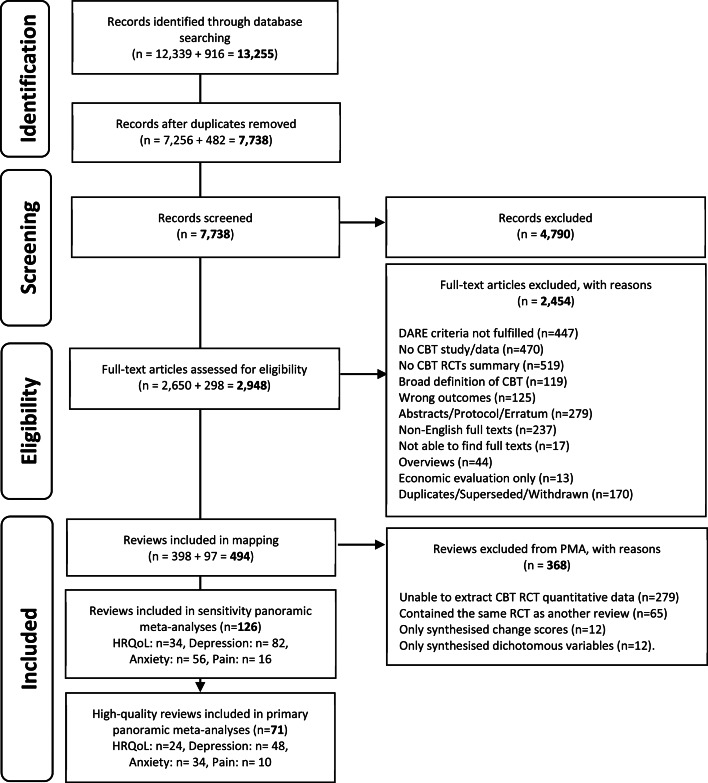
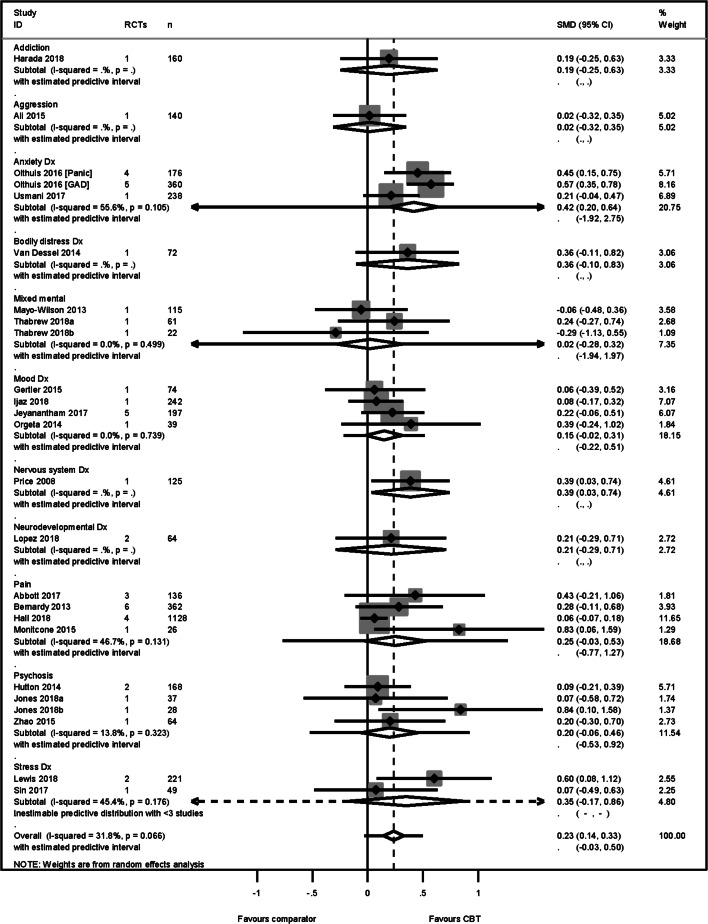
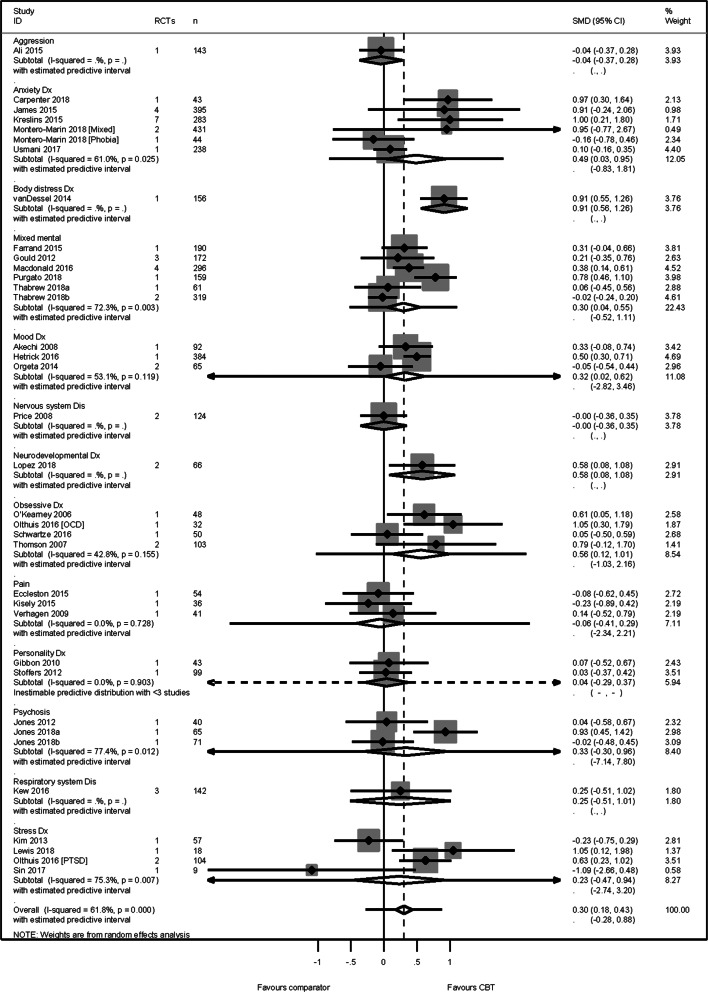
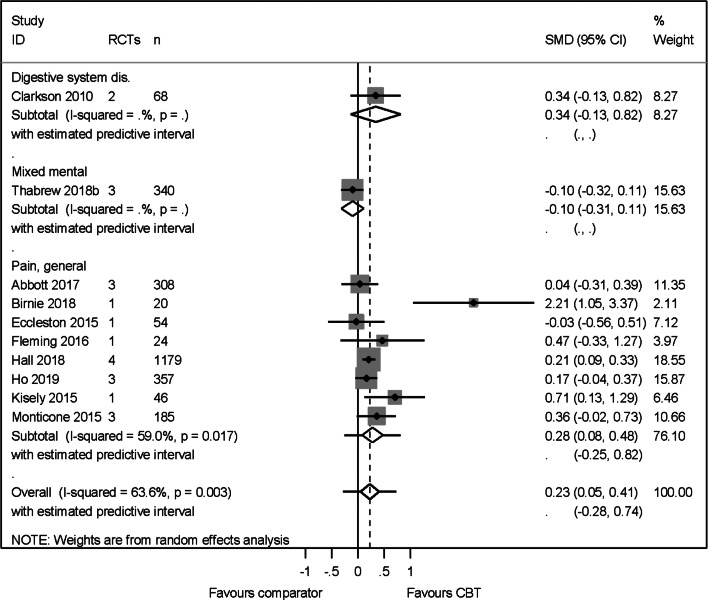
The majority of psychological treatment research is dedicated to investigating the effectiveness of cognitive behavioural therapy (CBT) across different conditions, population and contexts. We aimed to summarise the current systematic review evidence and evaluate the consistency of CBT's effect across different conditions. We included reviews of CBT randomised controlled trials in any: population, condition, format, context, with any type of comparator and published in English. We searched DARE, Cochrane, MEDLINE, EMBASE, PsycINFO, CINAHL, CDAS, and OpenGrey between 1992 and January 2019. Reviews were quality assessed, their data extracted and summarised. The effects upon health-related quality of life (HRQoL) were pooled, within-condition groups. If the across-condition heterogeneity was I2 < 75%, we pooled effects using a random-effect panoramic meta-analysis. We summarised 494 reviews (221 128 participants), representing 14/20 physical and 13/20 mental conditions (World Health Organisation's International Classification of Diseases). Most reviews were lower-quality (351/494), investigated face-to-face CBT (397/494), and in adults (378/494). Few reviews included trials conducted in Asia, South America or Africa (45/494). CBT produced a modest benefit across-conditions on HRQoL (standardised mean difference 0.23; 95% confidence intervals 0.14-0.33, I2 = 32%). The effect's associated prediction interval -0.05 to 0.50 suggested CBT will remain effective in conditions for which we do not currently have available evidence. While there remain some gaps in the completeness of the evidence base, we need to recognise the consistent evidence for the general benefit which CBT offers.
Overview
The claims and statistics of this paper haven’t been checked yet.
Free: it reads the open-access text and checks the first 5 claims that cite a source we can check. Create a free account to check every claim.
Integrity signals
Registry
Cites
Statistics
Figures
Verification
Claims the paper makes
The claims and statistics of this paper haven’t been checked yet.
Free: it reads the open-access text and checks the first 5 claims that cite a source we can check. Create a free account to check every claim.
Claims other papers make about this one
Each is checked against this paper’s own text: does it say what the citing paper says it does?
The cited source says what the claim attributes to it.
In the citing paper
“While the results of this systematic review fit with a wider conclusion that traditional CBT is beneficial for many varied conditions (Fordham et al., 2021), there appears substantial room for improvement.”
From A systematic review of cognitive behavioral therapy-based interventions for comorbid chronic pain and clinically relevant psychological distress (2023) · cites this paper as Fordham et al., 2021
Self-check
Percentages, sums and reported differences re-computed from the paper’s own numbers.
The self-check needs the paper’s full text.
Citations
Cites
1 retracted
Psychotherapy for depression among incurable cancer patients
Akechi, T., Okuyama, T., Onishi, J., Morita, T., & Furukawa, T. A. (2008) · Cochrane Database of Systematic Reviews · doi:10.1002/14651858.cd005537.pub2 · Cited by 198
RetractedPreferred Reporting Items for Systematic Reviews and Meta-Analyses: the PRISMA statement
Moher, D., Liberati, A., Tetzlaff, J., Altman, D. G., & for the PRISMA Group (2009) · BMJ · doi:10.1136/bmj.b2535 · Cited by 83,823
Preferred reporting items for systematic reviews and meta-analyses: the PRISMA Statement.
(2009) · PubMed Central · Cited by 44,859
Meta-analysis in clinical trials
DerSimonian, R., & Laird, N. (1986) · Controlled Clinical Trials · doi:10.1016/0197-2456(86)90046-2 · Cited by 39,552
Shea, B. J., Reeves, B. C., Wells, G., Thuku, M., Hamel, C., Moran, J., Moher, D., Tugwell, P., Welch, V., Kristjansson, E., et al. (2017) · BMJ · doi:10.1136/bmj.j4008 · Cited by 10,636
Huskisson, E. C. (1974) · The Lancet · doi:10.1016/s0140-6736(74)90884-8 · Cited by 4,522 · cited 1×
“The effect translated to a change of 6 mm (95% CI 1–11 mm) on the visual analogue scale [VAS, (Huskisson, 1974)] for pain.”
BackgroundThe Efficacy of Cognitive Behavioral Therapy: A Review of Meta-analyses
Hofmann, S. G., Asnaani, A., Vonk, I. J. J., Sawyer, A. T., & Fang, A. (2012) · Cognitive Therapy and Research · doi:10.1007/s10608-012-9476-1 · Cited by 3,445
Hayes, S. C. (2004) · Behavior Therapy · doi:10.1016/s0005-7894(04)80013-3 · Cited by 2,493
Why Cognitive Behavioral Therapy Is the Current Gold Standard of Psychotherapy
David, D., Cristea, I., & Hofmann, S. G. (2018) · Frontiers in Psychiatry · doi:10.3389/fpsyt.2018.00004 · Cited by 565
Depression in adults: recognition and management
(2017) · Clinical Pharmacist · doi:10.1211/cp.2017.20202439 · Cited by 393
Research works printed but not linked: 4
- Centre for Reviews and Dissemination. (2009). Systematic reviews: CRD's guidance for undertaking reviews in health care. York, UK: University of York.
- Covidence. (Downloaded 2018). Covidence systematic review software Melborne, Australia: http://www.covidence.org.
- Beck, A. T., & Steer, R. A. (1993). Beck anxiety inventory manual. San Antonio, TX: Psychological Corporation.
- Higgins, J. P. T., Thomas, J., Chandler, J., Cumpston, M., Li, T., Page, M. J., & Welch, V. A. (2019). Cochrane Handbook for Systematic Reviews of Interventions version 6.0 (updated July 2019). Retrieved from www.training.cochrane.org/handbook. PMC10284251 31643080
Cited by
Rösner, J., de Andrade, D. C., Davis, K. D., Gustin, S. M., Kramer, J. L. K., Seal, R. P., & Finnerup, N. B. (2023) · Nature Reviews Disease Primers · doi:10.1038/s41572-023-00484-9 · Cited by 174
“Nevertheless, people with CNP often have comorbid mental health disorders, and CBT, an evidence-based treatment for mental health disorders, can be used to treat these conditions and improve health-related quality of life (HRQoL) 156 .”
McCracken, L. M. (2023) · European Journal of Pain · doi:10.1002/ejp.2091 · Cited by 105
“To take a wider perspective, there was a recently conducted study called a ‘meta- review of systematic reviews and panoramic meta- analysis’ (Fordham et al., 2021).”
Sanabria-Mazo, J. P., Colomer-Carbonell, A., Fernández-Vázquez, Ó., Noboa-Rocamora, G., Cardona-Ros, G., McCracken, L. M., Montes-Pérez, A., Castaño-Asins, J. R., Edo, S., Borràs, X., et al. (2023) · Frontiers in Psychology · doi:10.3389/fpsyg.2023.1200685 · Cited by 56
Morris, L., Lovell, K., McEvoy, P., Emsley, R., Carter, L., Edge, D., Bates, R., Wallwork, T., & Mansell, W. (2023) · Cognitive Behaviour Therapy · doi:10.1080/16506073.2022.2143418 · Cited by 55
“Furthermore, a large meta-analytic review of reviews found no difference in effectiveness between using high- and low-intensity CBT (Fordham et al., 2021).”
BackgroundSalkovskis, P. M., Sighvatsson, M. B., & Sigurðsson, J. F. (2023) · Behavioural and Cognitive Psychotherapy · doi:10.1017/s1352465823000590 · Cited by 70
“Although the evidence for the effectiveness of both disorder-specific CBT and transdiagnostic CBT has been established definitively (Fordham et al ., 2021; Newby et al ., 2015), the mechanisms of change remain poorly understood leaving open the question of which interventions are helpful and which…”
Metadata
- Authors
- Fordham, B., Sugavanam, T., Edwards, K., Stallard, P., Howard, R., das Nair, R., Copsey, B., Lee, H., Howick, J., Hemming, K., & Lamb, S. E.
- Affiliations
- University of Oxford (GB)
- University of Liverpool (GB)
- University of Bath (GB)
- University College London (GB)
- University of Leeds (GB)
- University of Birmingham (GB)
- University of Exeter (GB)
- Corresponding author
- Fordham, Beth
- ORCID
- Venue
- Psychological Medicine
- Publisher
- Cambridge University Press (CUP)
- Published
- 2021-01
- Volume
- 51
- Issue
- 1
- Pages
- 21-29
- ISSN
- 0033-2917 (ISSN-L)
- 1469-8978
- PMC
- PMC7856415
- OpenAlex
- W3126058080
- Cited by
- 179
- References
- 18
- Citations by year
- 2026: 35 · 2025: 54 · 2024: 41 · 2023: 26 · 2022: 17 · 2021: 6
- FWCI
- 2.99
- Type
- journal article
- Language
- en
- Open access
- hybrid
- doi.org
- Locations
- Psychological Medicine (publishedVersion, cc-by)
- PubMed Central (publishedVersion, cc-by)
- PubMed (publishedVersion)
- Repository@Nottingham (University of Nottingham) (acceptedVersion, other-oa)
- Repository@Nottingham (University of Nottingham) (submittedVersion, cc-by)
- UCL Discovery (University College London) (submittedVersion)
- Funders
- National Institute for Health and Care Research (15/174/24, HTA/15/174/24)
- University of Oxford
- Topics
- Social Sciences › Psychology › Clinical Psychology › Psychotherapy Techniques and Applications
- Social Sciences › Psychology › Experimental and Cognitive Psychology › Anxiety, Depression, Psychometrics, Treatment, Cognitive Processes
- Social Sciences › Psychology › Applied Psychology › Digital Mental Health Interventions
- Keywords
- cognitive behavioral therapy, treatment effectiveness, health-related quality of life, prediction intervals
- MeSH terms
- Mental Disorders, Humans, Quality of Life, Cognitive Behavioral Therapy, Treatment Outcome
About these checks
Registry, retraction, Cites and statistics results are computed, not judged, with one exception: a printed reference that no index lists is read once by a model before it counts as a citation error. Claims are extracted by a model and kept only when their quote appears verbatim in the text; each cited source is then checked, with a model’s help, for whether it says what the claim relies on. Those verdicts can be wrong — read the claim’s quote and the cited source before relying on one.
Statistics and arithmetic are recomputed, not judged.
Confidence bands are shown only for fields calibrated on our annotated test set. None is calibrated yet, so no band is shown.
What counts as a claim ›How we measure confidence ›How we check this ›
Are you an author, or do you see a problem with this page? Request a review
How to cite
Cite CoChat for the checks on this page, and the paper for its own findings.
- This page
- CoChat. (2026). Citation check: The evidence for cognitive behavioural therapy in any condition, population or context: a meta-review of systematic reviews and panoramic meta-analysis. https://app.cochat.ai/papers/10.1017/s0033291720005292
- The paper
- Fordham, B., Sugavanam, T., Edwards, K., Stallard, P., Howard, R., das Nair, R., Copsey, B., Lee, H., Howick, J., Hemming, K., & Lamb, S. E. (2021). The evidence for cognitive behavioural therapy in any condition, population or context: a meta-review of systematic reviews and panoramic meta-analysis. Psychological Medicine. https://doi.org/10.1017/s0033291720005292
Data sources
Bibliographic data: Semantic Scholar, OpenAlex, Crossref.
Contains information from the Semantic Scholar Academic Graph Datasets, made available under the ODC Attribution License (ODC-BY 1.0).
Semantic Scholar’s data is described in: Kinney, R., et al. (2023). The Semantic Scholar Open Data Platform. arXiv:2301.10140.
