

The evidence for cognitive behavioural therapy in any condition, population or context: a meta-review of systematic reviews and panoramic meta-analysis
Open accessThe DOI matches its Crossref record; 18 of the 18 references it cites were found in a registry or an index.
Abstract
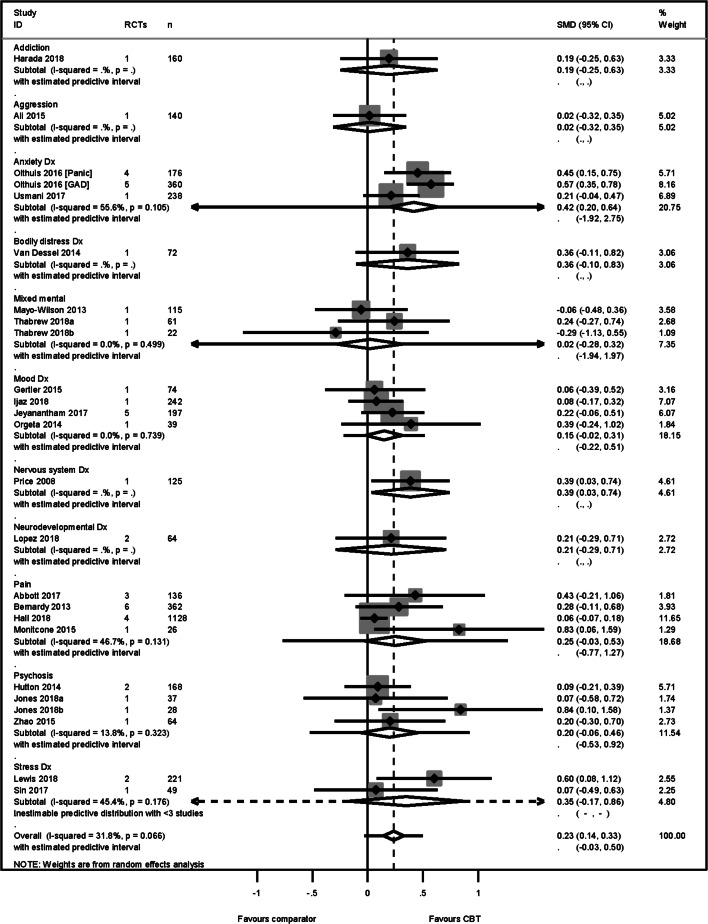
The majority of psychological treatment research is dedicated to investigating the effectiveness of cognitive behavioural therapy (CBT) across different conditions, population and contexts. We aimed to summarise the current systematic review evidence and evaluate the consistency of CBT's effect across different conditions. We included reviews of CBT randomised controlled trials in any: population, condition, format, context, with any type of comparator and published in English. We searched DARE, Cochrane, MEDLINE, EMBASE, PsycINFO, CINAHL, CDAS, and OpenGrey between 1992 and January 2019. Reviews were quality assessed, their data extracted and summarised. The effects upon health-related quality of life (HRQoL) were pooled, within-condition groups. If the across-condition heterogeneity was I2 < 75%, we pooled effects using a random-effect panoramic meta-analysis. We summarised 494 reviews (221 128 participants), representing 14/20 physical and 13/20 mental conditions (World Health Organisation's International Classification of Diseases). Most reviews were lower-quality (351/494), investigated face-to-face CBT (397/494), and in adults (378/494). Few reviews included trials conducted in Asia, South America or Africa (45/494). CBT produced a modest benefit across-conditions on HRQoL (standardised mean difference 0.23; 95% confidence intervals 0.14-0.33, I2 = 32%). The effect's associated prediction interval -0.05 to 0.50 suggested CBT will remain effective in conditions for which we do not currently have available evidence. While there remain some gaps in the completeness of the evidence base, we need to recognise the consistent evidence for the general benefit which CBT offers.
Overview
The claims and statistics of this paper haven’t been checked yet.
Free: it reads the open-access text and checks the first 5 claims that cite a source we can check. Create a free account to check every claim.
Integrity signals
Registry
Cites
Statistics
Figures
Verification
Claims the paper makes
The claims and statistics of this paper haven’t been checked yet.
Free: it reads the open-access text and checks the first 5 claims that cite a source we can check. Create a free account to check every claim.
Claims other papers make about this one
Each is checked against this paper’s own text: does it say what the citing paper says it does?
The cited source says what the claim attributes to it.
In the citing paper
“While the results of this systematic review fit with a wider conclusion that traditional CBT is beneficial for many varied conditions (Fordham et al., 2021), there appears substantial room for improvement.”
From A systematic review of cognitive behavioral therapy-based interventions for comorbid chronic pain and clinically relevant psychological distress (2023) · cites this paper as Fordham et al., 2021
Self-check
Percentages, sums and reported differences re-computed from the paper’s own numbers.
The self-check needs the paper’s full text.
Citations
Cites
1 retracted
Psychotherapy for depression among incurable cancer patients
Akechi, T., Okuyama, T., Onishi, J., Morita, T., & Furukawa, T. A. (2008) · Cochrane Database of Systematic Reviews · doi:10.1002/14651858.cd005537.pub2 · Cited by 198
RetractedPreferred Reporting Items for Systematic Reviews and Meta-Analyses: the PRISMA statement
Moher, D., Liberati, A., Tetzlaff, J., Altman, D. G., & for the PRISMA Group (2009) · BMJ · doi:10.1136/bmj.b2535 · Cited by 83,823
Preferred reporting items for systematic reviews and meta-analyses: the PRISMA Statement.
(2009) · PubMed Central · Cited by 44,859
Meta-analysis in clinical trials
DerSimonian, R., & Laird, N. (1986) · Controlled Clinical Trials · doi:10.1016/0197-2456(86)90046-2 · Cited by 39,552
Shea, B. J., Reeves, B. C., Wells, G., Thuku, M., Hamel, C., Moran, J., Moher, D., Tugwell, P., Welch, V., Kristjansson, E., et al. (2017) · BMJ · doi:10.1136/bmj.j4008 · Cited by 10,636
Huskisson, E. C. (1974) · The Lancet · doi:10.1016/s0140-6736(74)90884-8 · Cited by 4,522 · cited 1×
“The effect translated to a change of 6 mm (95% CI 1–11 mm) on the visual analogue scale [VAS, (Huskisson, 1974)] for pain.”
BackgroundThe Efficacy of Cognitive Behavioral Therapy: A Review of Meta-analyses
Hofmann, S. G., Asnaani, A., Vonk, I. J. J., Sawyer, A. T., & Fang, A. (2012) · Cognitive Therapy and Research · doi:10.1007/s10608-012-9476-1 · Cited by 3,445
Hayes, S. C. (2004) · Behavior Therapy · doi:10.1016/s0005-7894(04)80013-3 · Cited by 2,493
Why Cognitive Behavioral Therapy Is the Current Gold Standard of Psychotherapy
David, D., Cristea, I., & Hofmann, S. G. (2018) · Frontiers in Psychiatry · doi:10.3389/fpsyt.2018.00004 · Cited by 565
Depression in adults: recognition and management
(2017) · Clinical Pharmacist · doi:10.1211/cp.2017.20202439 · Cited by 393
Research works printed but not linked: 4
- Centre for Reviews and Dissemination. (2009). Systematic reviews: CRD's guidance for undertaking reviews in health care. York, UK: University of York.
- Covidence. (Downloaded 2018). Covidence systematic review software Melborne, Australia: http://www.covidence.org.
- Beck, A. T., & Steer, R. A. (1993). Beck anxiety inventory manual. San Antonio, TX: Psychological Corporation.
- Higgins, J. P. T., Thomas, J., Chandler, J., Cumpston, M., Li, T., Page, M. J., & Welch, V. A. (2019). Cochrane Handbook for Systematic Reviews of Interventions version 6.0 (updated July 2019). Retrieved from www.training.cochrane.org/handbook. PMC10284251 31643080
Cited by
Rösner, J., de Andrade, D. C., Davis, K. D., Gustin, S. M., Kramer, J. L. K., Seal, R. P., & Finnerup, N. B. (2023) · Nature Reviews Disease Primers · doi:10.1038/s41572-023-00484-9 · Cited by 174
“Nevertheless, people with CNP often have comorbid mental health disorders, and CBT, an evidence-based treatment for mental health disorders, can be used to treat these conditions and improve health-related quality of life (HRQoL) 156 .”
McCracken, L. M. (2023) · European Journal of Pain · doi:10.1002/ejp.2091 · Cited by 105
“To take a wider perspective, there was a recently conducted study called a ‘meta- review of systematic reviews and panoramic meta- analysis’ (Fordham et al., 2021).”
Sanabria-Mazo, J. P., Colomer-Carbonell, A., Fernández-Vázquez, Ó., Noboa-Rocamora, G., Cardona-Ros, G., McCracken, L. M., Montes-Pérez, A., Castaño-Asins, J. R., Edo, S., Borràs, X., et al. (2023) · Frontiers in Psychology · doi:10.3389/fpsyg.2023.1200685 · Cited by 56
Morris, L., Lovell, K., McEvoy, P., Emsley, R., Carter, L., Edge, D., Bates, R., Wallwork, T., & Mansell, W. (2023) · Cognitive Behaviour Therapy · doi:10.1080/16506073.2022.2143418 · Cited by 55
“Furthermore, a large meta-analytic review of reviews found no difference in effectiveness between using high- and low-intensity CBT (Fordham et al., 2021).”
BackgroundSalkovskis, P. M., Sighvatsson, M. B., & Sigurðsson, J. F. (2023) · Behavioural and Cognitive Psychotherapy · doi:10.1017/s1352465823000590 · Cited by 70
“Although the evidence for the effectiveness of both disorder-specific CBT and transdiagnostic CBT has been established definitively (Fordham et al ., 2021; Newby et al ., 2015), the mechanisms of change remain poorly understood leaving open the question of which interventions are helpful and which…”
Fordham, B., Sugavanam, T., Edwards, K., Hemming, K., Howick, J., Copsey, B. J., Lee, H., Kaidesoja, M., Kirtley, S., Hopewell, S., et al. (2021) · Health Technology Assessment · doi:10.3310/hta25090 · Cited by 69
Cognitive behavioral therapy for eating disorders: A map of the systematic review evidence base
Kaidesoja, M., Cooper, Z., & Fordham, B. (2023) · International Journal of Eating Disorders · doi:10.1002/eat.23831 · Cited by 49
Evidence-based practice in cognitive–behavioural therapy
Stallard, P. (2022) · Archives of Disease in Childhood · doi:10.1136/archdischild-2020-321249 · Cited by 46
Interventions to promote medical student well-being: an overview of systematic reviews
Bennett‐Weston, A., Keshtkar, L., Jones, M., Sanders, C., Lewis, C., Nockels, K., Solomon, J., & Howick, J. (2024) · BMJ Open · doi:10.1136/bmjopen-2023-082910 · Cited by 59
“We included systematic reviews 31–33 of interventions to enhance undergraduate medical student well-being.”
BackgroundPsychological treatments for temporomandibular disorder pain—A systematic review
Christidis, N., Al‐Moraissi, E. A., Al-Ak’hali, M. S., Minarji, N., Zerfu, B., Grigoriadis, A., Schibbye, R., & Christidis, M. (2024) · Journal of Oral Rehabilitation · doi:10.1111/joor.13693 · Cited by 35
Fang, S., & Ding, D. (2023) · Journal of Contextual Behavioral Science · doi:10.1016/j.jcbs.2023.03.015 · Cited by 33
Tibber, M. S., & Silver, E. (2022) · The Cognitive Behaviour Therapist · doi:10.1017/s1754470x22000034 · Cited by 53
“…has a strong evidence base supporting it, and has demonstrated great flexibility in its application to a wide range of mental health difficulties (Fordham et al ., 2021), such that the approach has come to dominate mental health services, including in young people ’ s services in the UK, as well…”
Dils, A. T., O’Keefe, K., Dakka, N., Azar, M., Chen, M., & Zhang, A. (2024) · Cancer Medicine · doi:10.1002/cam4.70063 · Cited by 43
Zhang, A., Wang, K., Blumenstein, K. G., Brose, A., Kemp, C., Meister, D., & Solomon, P. (2022) · Supportive Care in Cancer · doi:10.1007/s00520-022-07337-3 · Cited by 37
Samuelsson, A. U., Larsman, P., & Grill, M. (2023) · Safety Science · doi:10.1016/j.ssci.2023.106245 · Cited by 26
Thompson, B., Moghaddam, N., Evangelou, N., Baufeldt, A., & das Nair, R. (2022) · Multiple Sclerosis and Related Disorders · doi:10.1016/j.msard.2022.103862 · Cited by 25
“Indeed, CBT has consistently been found to have a modest benefit across several conditions on QoL (standardised mean difference 0.23; 95% confidence intervals 0.14–0.33) ( Fordham et al., 2021).”
BackgroundInfluentialJanssen, T. W. P., & van Atteveldt, N. (2022) · British Journal of Educational Psychology · doi:10.1111/bjep.12572 · Cited by 27
“In addition, only the growth mindset intervention included elements from cognitive-behavioural therapy (CBT; Fordham et al., 2021), such as the ABC model (Activating event, Beliefs, Consequences) to challenge fixed mindset beliefs and how they affect feelings, behaviour and their consequences.”
Johnson, E., Corrick, S., Isley, S., Vandermeer, B., Dolgoy, N., Bates, J., Godfrey, E., Soltys, C., Muir, C., Vohra, S., et al. (2024) · PLOS Digital Health · doi:10.1371/journal.pdig.0000435 · Cited by 24
Katakis, P., Schlief, M., Barnett, P., Rains, L. S., Rowe, S. L., Pilling, S., & Johnson, S. (2023) · BMC Psychiatry · doi:10.1186/s12888-022-04483-0 · Cited by 32
“Previous reviews have also found that CBT can effectively treat a wide spectrum of psychiatric conditions [112, 113], including ‘BPD’ symptoms [28].”
BackgroundCreed, T. A., Crane, M. E., Calloway, A. L., Olino, T. M., Kendall, P. C., & Stirman, S. W. (2021) · Implementation Research and Practice · doi:10.1177/26334895211030220 · Cited by 29
“…tcreed@pennmedicine.upenn.edu Despite decades of research developing effective evidence-based practices (EBPs) such as cognitive behavioral therapy (CBT; for example, Beck, 1964; Fordham et al., 2021), EBPs continue to be underutilized in community mental health clinics (Shafran et al., 2009).”
BackgroundPsychosocial interventions to support retirement well-being and adjustment: a systematic review
Cassanet, A., McKenzie, W. A., & McLean, L. A. (2023) · The Educational and Developmental Psychologist · doi:10.1080/20590776.2022.2161360 · Cited by 27
“It is likely CBT was commonly used within interventions due to the wideranging evidence base for this therapy in improving varied well-being outcomes across populations (Fordham et al., 2021).”
BackgroundBody mapping for arts-based inquiry in mental health research: a scoping review
Murray, A., Steffen, M. W., Keiller, E., Turri, M. G., & Lau, J. Y. F. (2023) · The Lancet Psychiatry · doi:10.1016/s2215-0366(23)00224-9 · Cited by 35
Psychedelics and Evidence-based Psychotherapy
Leone, L., McSpadden, B., DeMarco, A., Enten, L., Kline, R., & Fonzo, G. A. (2024) · Psychiatric Clinics of North America · doi:10.1016/j.psc.2024.02.006 · Cited by 19
Duffecy, J. L., Rehman, A., Gorman, S. N., Huang, Y., & Klumpp, H. (2025) · JMIR mhealth and uhealth · doi:10.2196/58204 · Cited by 26
“Such interventions have been shown to improve psychological symptoms associated with health conditions such as insomnia, depression, cancer, chronic pain, and premenstrual syndrome [18-21], but would benefit from additional study in the context of menopause.”
Psychotherapy for problematic pornography use: A comprehensive meta-analysis
López-Pinar, C., Esparza-Reig, J., & Bőthe, B. (2025) · Journal of Behavioral Addictions · doi:10.1556/2006.2025.00018 · Cited by 17
Frontera, J. A., Guekht, A. B., Allegri, R., Ashraf, M., Baykan, B. B., Crivelli, L., Easton, A., García‐Azorín, D., Helbok, R., Joshi, J., et al. (2023) · Journal of the Neurological Sciences · doi:10.1016/j.jns.2023.120827 · Cited by 17
Arthur, T., Meléndez‐Torres, G. J., Harris, D., Robinson, S., Wilson, M., & Vine, S. J. (2025) · Journal of Medical Internet Research · doi:10.2196/58086 · Cited by 22
“More recently, panoramic meta-analyses have also addressed mental health outcomes, such as cognitive behavioral therapy for health-related quality of life [9].”
Abdelaziz, E. M., Alshammari, A. M., Elsharkawy, N. B., Oraby, F. A., & Ramadan, O. M. E. (2025) · BMC Pregnancy and Childbirth · doi:10.1186/s12884-025-07341-5 · Cited by 26
“When applied to tokopho-bia [31, 32], CBT targets irrational fears and maladaptive beliefs about childbirth, fostering resilience and adaptive coping [33].”
Does psychology fail in the face of genocide? Insights about Gaza before and after October 7, 2023
Veronese, G., & Kagee, A. (2024) · International Journal of Human Rights in Healthcare · doi:10.1108/ijhrh-07-2024-0053 · Cited by 25
Friedman, D., Kaskas, M. M., Quittner, A. L., Smith, B. A., & Georgiopoulos, A. M. (2022) · Frontiers in Psychology · doi:10.3389/fpsyg.2022.937189 · Cited by 19
“Cognitive-behavioral therapy has demonstrated efficacy in improving HRQoL and preventing and treating depression and anxiety in general and chronic illness populations (Butler et al., 2006; Fordham et al., 2021).”
BackgroundTreatment of Depression in Huntington’s Disease: A Systematic Review
Zadegan, S. A., Ramirez, F., Reddy, K. S., Sahin, O., Rocha, N. P., Teixeira, A. L., & Furr-Stimming, E. E. (2024) · Journal of Neuropsychiatry · doi:10.1176/appi.neuropsych.20230120 · Cited by 27
Cognitive Behavioral Therapies for Individuals with Cerebral Palsy: A Scoping Review
Silberg, T., Kapil, N., Caven, I., Levac, D., & Fehlings, D. (2023) · Developmental Medicine & Child Neurology · doi:10.1111/dmcn.15507 · Cited by 13
Omylinska‐Thurston, J., Aithal, S., Liverpool, S., Clark, R. D., Moula, Z., Wood, J., Viliardos, L., Rodríguez-Dorans, E., Farish-Edwards, F., Parsons, A. S., et al. (2024) · JMIR Mental Health · doi:10.2196/55500 · Cited by 18
“In addition, we agree with Fordham et al [257] that new research in the treatment of depression and other disorders ought to shift emphasis from investigating the general effectiveness of interventions to understanding how to achieve a greater effect size for specific populations.”
MethodHodge, D. R., Boynton, H. M., Vis, J., Graham, J. R., Coholic, D. A., & Canda, E. R. (2024) · Journal of Social Work · doi:10.1177/14680173241279028 · Cited by 12
“CBT has been referred to as the “ gold standard ” within the evidence-based practice movement (David et al., 2018) due to its demonstrated effectiveness across multiple outcomes (Fordham et al., 2021).”
Becker‐Haimes, E. M., Mandell, D. S., Fishman, J., Williams, N. J., Wolk, C. B., Wislocki, K. E., Reich, D., Schaechter, T., Brady, M., Maples, N. J., et al. (2021) · Implementation Science Communications · doi:10.1186/s43058-021-00245-3 · Cited by 12
“The model aims to predict clinician use of six distinct components of cognitive-behavioral therapy (CBT), a leading psychosocial EBP for psychiatric disorders [12].”
BackgroundHerres, J., Krauthamer Ewing, E. S., Levy, S., Creed, T. A., & Diamond, G. S. (2023) · Frontiers in Psychiatry · doi:10.3389/fpsyt.2023.1096291 · Cited by 11
“Cognitive behavioral therapy (CBT) has been studied more than any other mode of psychotherapy in the treatment of anxiety (13).”
BackgroundWei, Z., Xing, X., Tantai, X., Xiao, C., Yang, Q., Jiang, X., Hao, Y., Liu, N., Wang, Y., & Wang, J. (2022) · Frontiers in Psychology · doi:10.3389/fpsyg.2022.827220 · Cited by 18
Ådnøy, T., Solem, S., Hagen, R., & Havnen, A. (2023) · BMC Psychology · doi:10.1186/s40359-023-01336-7 · Cited by 10
“CBT today has a large evidence base supporting its efficacy across many conditions, populations and contexts [3].”
BackgroundAcevedo, S., Aneja, E., Opler, D. J., Valera, P. A., & Jarmon, E. (2025) · American Journal of Psychotherapy · doi:10.1176/appi.psychotherapy.20240070 · Cited by 13
Redburn, J., & Hayes, B. (2024) · Journal of Clinical Psychology · doi:10.1002/jclp.23653 · Cited by 12
Nabunya, P., Ssewamala, F. M., Kizito, S., Mugisha, J., Brathwaite, R., Neilands, T. B., Migadde, H., Namuwonge, F., Ssentumbwe, V., Najjuuko, C., et al. (2024) · The Journal of Pediatrics · doi:10.1016/j.jpeds.2024.113983 · Cited by 17
Treatment of Psychological Symptoms in Patients with Cystic Fibrosis
Campagna, G., Tagliati, C., Giuseppetti, G. M., & Ripani, P. (2024) · Journal of Clinical Medicine · doi:10.3390/jcm13195806 · Cited by 11
“It has been demonstrated to improve health-related quality of life (HRQoL) [17], promote emotional well-being, and treat depression and anxiety in populations with general and chronic illnesses [18,19].”
BackgroundNicmanis, M., Arcangeli, O., Chur‐Hansen, A., & Oxlad, M. (2025) · Heart Rhythm · doi:10.1016/j.hrthm.2025.02.027 · Cited by 9
Fletcher, K., Wydera, S., Thorpe, N., Radford, K., das Nair, R., Booth, V., & on behalf of the NeRO Programme and Management Team (2023) · Neuropsychological Rehabilitation · doi:10.1080/09602011.2023.2273580 · Cited by 13
“…traction in this domain include CBT, where systematic reviews indicate a positive impact on conditions such as anxiety (e.g., Little et al., 2021), anger (Iruthayarajah et al., 2018), and sleep quality and pain (Li et al., 2021), which is also con fi rmed by meta-reviews (Fordham et al., 2021).”
BackgroundNabunya, P., Migadde, H., Namuwonge, F., Mugisha, J., Kirabo, W., Ssentumbwe, V., Najjuuko, C., Raymond, A., Bahar, O. S., Mwebembezi, A., et al. (2024) · AIDS and Behavior · doi:10.1007/s10461-024-04284-4 · Cited by 10
“Cognitive behavioral therapy (CBT) – whether individual or group based, has effectively treated various disorders among adults and children [ 29], through the core components of psychoeducation, cognitive restructuring, and skill-building to increase adaptive coping mechanisms [30 ].”
Spencer, S. D., Petersen, J. M., Schneider, R. L., Guzick, A. G., & Mcguire, J. F. (2024) · Research on Child and Adolescent Psychopathology · doi:10.1007/s10802-024-01247-0 · Cited by 9
“To that end, CBT principles have demonstrated success for alleviating suffering due to a range of mental health issues (Fordham et al., 2021), and therefore represent an excellent starting point in misophonia intervention development work.”
Ebrahimjee, A., Hodsoll, J. P., Valmaggia, L., Hickling, L. M., & Riches, S. (2024) · The Cognitive Behaviour Therapist · doi:10.1017/s1754470x2400028x · Cited by 10
“…is an established, evidence-based treatment for psychological disorders (Richards et al. , 2017) and when delivered in-person, it is as efficacious in treating mood and anxiety disorders, and increasing the quality of life (David et al ., 2018; Fordham et al ., 2021; Zamiri-Miandoab et al ., 2022).”
Causal AI Recommendation System for Digital Mental Health: Bayesian Decision-Theoretic Analysis
Varidel, M., An, V., Hickie, I. B., Cripps, S., Marchant, R., Scott, J. L., Crouse, J. J., Poulsen, A., O’Dea, B., McKenna, S., et al. (2025) · Journal of Medical Internet Research · doi:10.2196/71305 · Cited by 13
“…could identify and direct individuals from this general population to targeted clinical interventions, such as cognitive behavioral therapies, which have been shown to be efficacious for a range of serious mental illnesses within many contexts [56], including internet-delivered therapies [57,58].”
Larisch, L.-M., Blom, V., Hagströmer, M., Ekblom, M., Ekblom, Ö. B., Nilsson, J., & Kallings, L. (2024) · BMC Public Health · doi:10.1186/s12889-024-17647-2 · Cited by 12
“CBT is an evidence based method for changing health behaviors and improving mental health outcomes [39, 40].”
MethodEnhancing quality of life in severe post-COVID-19 survivors through multidisciplinary care
Cataneo‐Piña, D. J., Castorena-Maldonado, A. R., González‐Islas, D., Galicia-Amor, S., Orea‐Tejeda, A., Peláez-Hernández, V., Gutiérrez-Álvarez, A. D., Rojas‐Serrano, J., Ortiz-Reyes, E., Mendoza-Méndez, A., et al. (2024) · ERJ Open Research · doi:10.1183/23120541.00214-2024 · Cited by 10
“The interventions encompassed psychoeducation, cognitive-behavioural therapy [27] and biofeedback [28], all underpinned by a substantial body of evidence supporting their efficacy.”
Thomas, L. J. (2023) · Frontiers in Virtual Reality · doi:10.3389/frvir.2023.1180165 · Cited by 7
“CBT is the most evidence-based approach (David and Christea, 2018) and effects are demonstrable across diverse conditions and populations (Fordham et al., 2021), making this suitable for astronauts.”
BackgroundDepression: implications for learning and education
Nørby, S. (2024) · Emotional and Behavioural Difficulties · doi:10.1080/13632752.2024.2434982 · Cited by 6
“…widely regarded as one of the most effective treatments for depression, which considers negative thinking to be central to both the onset and maintenance of the disorder and emphasises that altering cognitive processes is crucial for effective treatment (Fordham et al. 2021; Young et al. 2014).”
Schürmann‐Vengels, J., Appelbaum, S., Apel, M.-K., Trimpop, L. F., Muermans, M. M., Ostermann, T., Teismann, T., & Willutzki, U. (2022) · Psychotherapy Research · doi:10.1080/10503307.2022.2146543 · Cited by 7
“As a result, treatments are usually focused on identifying and changing negative experiences and dysfunctional behaviors (Fordham et al., 2021; Grawe, 1997).”
BackgroundEficácia da terapia cognitivo-comportamental no transtorno de ansiedade generalizada
Silva, J. V. S., Peres, A. L. M. V., Teixeira, C. S. B., dos Santos, D. A., Szulczewski, E. F., Miranda, G. F., Parente, I. S. E. S., Neto, J. F. L., Ribeiro, L. M., Freitas, L. S., et al. (2025) · Cuadernos de Educación y Desarrollo · doi:10.55905/cuadv17n2-092 · Cited by 11
Tridimensional model of CBT: a transdiagnostic and transtheoretical pragmatic model
Özdel, K., & Türkçapar, M. H. (2025) · Frontiers in Psychology · doi:10.3389/fpsyg.2025.1555047 · Cited by 8
Mukai, K., Yamanishi, K., Ogino, S., Hosoi, Y., Hayashida, K., & Matsunaga, H. (2025) · Frontiers in Psychiatry · doi:10.3389/fpsyt.2025.1593384 · Cited by 6
Program Evaluation of Cognitive Behavioral Therapy in Burn Survivors
Rothbauer, M. J., Pasek, Z., Dalrymple, K. A., Wewerka, S. S., & Adams, N. R. (2024) · Journal of Burn Care & Research · doi:10.1093/jbcr/irae077 · Cited by 6
Affordances, mental health and psychiatry
Manning, N. (2024) · SSM - Mental Health · doi:10.1016/j.ssmmh.2024.100376 · Cited by 7
Obohwemu, K. O., Yakpir, G. M., Simran, K., Ndioho, I. F., Owusuaa-Asante, M. A., Nourhan, A., Jamila, A., Karen, H., MSC IBIC Change, L., Omoregie, J., et al. (2024) · The American Journal of Social Science and Education Innovations · doi:10.37547/tajssei/volume06issue12-07 · Cited by 10
Watts, J. R., Kim, J., & Warwick, L. (2025) · Journal of Counseling & Development · doi:10.1002/jcad.12561 · Cited by 6
Bennion, M., Lovell, K., Blakemore, A., Vicary, E., & Bee, P. (2024) · Cognitive Behaviour Therapy · doi:10.1080/16506073.2024.2369939 · Cited by 11
“The search for primary studies used keywords and MeSH terms related to concepts of BSW and CBT. CBT terms built upon those used in a previous review (Fordham et al., 2021).”
Wrede, N., Hillebrand, M. C., Risch, A. K., Alpers, G. W., Bartholdy, S., Brakemeier, E., Bräscher, A., Brockmeyer, T., Christiansen, H., Equit, M., et al. (2025) · Journal of Affective Disorders · doi:10.1016/j.jad.2025.01.145 · Cited by 7
Mental health and treatment challenges in older adults
Laidlaw, K., Charlesworth, G. M., & Bhar, S. S. (2025) · Nature Reviews Psychology · doi:10.1038/s44159-025-00500-7 · Cited by 5
Cotter, R. J., Burns, J., Kaufman, K. P., Kudla, A., Ehrlich‐Jones, L., Wafford, Q. E., & Heinemann, A. W. (2024) · Archives of Physical Medicine and Rehabilitation · doi:10.1016/j.apmr.2024.01.004 · Cited by 4
Exploring Virtual Reality in Exposure Therapy for Sensory Food Aversion
Marques, G., Nóbrega, R., & Madeira, R. N. (2024) · international conference on 3D web technology · doi:10.1145/3665318.3677166 · Cited by 5
“Behavioral therapy is a broad term that encompasses various techniques designed to modify maladaptive behaviours [Fordham et al. 2021].”
Holmes, L., Fenta, T. B., Haile, A., Lith, L. M. V., Burgess, S., Vandermark, J., Babalola, S. O., Amare, H., Tilahun, A., Shattuck, D. C., et al. (2025) · Studies in Family Planning · doi:10.1111/sifp.70000 · Cited by 4
PRO: CBT-I for insomnia treatment can be delivered by a range of healthcare providers
Espie, C. A., Grandner, M. A., & Drake, C. L. (2025) · SLEEP · doi:10.1093/sleep/zsaf124 · Cited by 5
Salzano, S., Zappullo, I., Baiano, C., & Conson, M. (2023) · Journal of Cognitive Psychotherapy · doi:10.1891/jcp-2021-0020 · Cited by 5
Further validation of the Cognitive Biases Questionnaire for psychosis
Samson, C., Achim, A. M., Sicard, V., Gilker, A., Francoeur, A., Franck, N., Cloutier, B., Giguère, C., Jean-Baptiste, F., & Lecomte, T. (2022) · BMC Psychiatry · doi:10.1186/s12888-022-04203-8 · Cited by 4
“Cognitive behavioral therapy (CBT) is an evidencebased therapy [21, 22] that focuses on the relationship between cognitions, emotions, and behavior.”
BackgroundEkelund, R., Holmström, S., & Stenling, A. (2025) · International Journal of Sport and Exercise Psychology · doi:10.1080/1612197x.2025.2563323 · Cited by 6
Kunorubwe, T. (2025) · The Cognitive Behaviour Therapist · doi:10.1017/s1754470x25100263 · Cited by 4
“Cognitive behavioural therapy (CBT) is a widely endorsed psychological therapy, recognised for its efficacy in treating a variety of mental health disorders across a range of groups, from young to elderly adults (Fordham et al ., 2021; Hofmann et al ., 2012).”
Herriman, Z., Roberts, R., Taylor, A. M., & Slater, A. (2024) · Journal of Behavioral and Cognitive Therapy · doi:10.1016/j.jbct.2024.100494 · Cited by 5
Roshanghalb, A., Hansen, B., Rudoler, D., & Best, M. W. (2024) · BMC Psychiatry · doi:10.1186/s12888-024-05817-w · Cited by 5
“The research literature has established the effectiveness of several CBT delivery methods, including individual, group, and internet-based therapy with coaching [1–4].”
BackgroundEklund, M., Parsonage-Harrison, J., & Argentzell, E. (2024) · British Journal of Occupational Therapy · doi:10.1177/03080226241228750 · Cited by 5
“Cognitive Behavioural Therapy (CBT) has a strong evidence base and is widely advocated across health areas (Fordham et al., 2021), as is Behavioural Activation (BA), which is a behavioural approach to bring about behaviour change in those experiencing depression or anxiety (Uphoff et al., 2020).”
Neurodynamics and Adaptive Behaviour
Gillett, G. R., & Glannon, W. (2023) · New Directions in Philosophy and Cognitive Science · doi:10.1007/978-3-031-44951-2_2 · Cited by 2
A Comparison of Scalable Routine Clinical Materials and Observer Ratings to Assess CBT Fidelity
Calloway, A. L., Creed, T. A., Gumport, N., Gutner, C. A., Marques, L. M., Hernandez, S., Song, J., Johnson, C. M., Youn, S. J., Elhusseini, S. A., et al. (2024) · Behaviour Research and Therapy · doi:10.1016/j.brat.2024.104655 · Cited by 2
Byun, S., Lee, Y., & Jeon, L. (2025) · The Asia-Pacific Education Researcher · doi:10.1007/s40299-025-00972-4 · Cited by 4
“Cognitive behavioral therapy, which has broad cross-cultural applicability, can be another effective approach to promote healthy emotion regulation (Fordham et al., 2021).”
Marwat, A. R., Rizvi, S., Ip, V., Rodak, T., Saleem, H., Liang, R., Khan, M. A., Husain, N., Hankir, A. K., Farooq, S., et al. (2025) · International Journal of Cognitive Behavioral Therapy · doi:10.1007/s41811-025-00251-6 · Cited by 4
“The number of psychiatric facilities within the Middle East ranges from one to five per nation, in stark contrast to the USA, which has 648 psychiatric facilities.”
Xu, X., Wang, F., Liao, S., Liu, J., & Xiao, L. (2025) · Journal of Medical Internet Research · doi:10.2196/80476 · Cited by 4
“By disrupting the negative “cognition-emotion-behav-ior” cycle, CBT achieves bidirectional regulation of thinking and behavior patterns, ultimately ameliorating psychological outcomes [14].”
López-Pinar, C., Selaskowski, B., Schulze, M., Oscarsson, M., Fenollar-Cortés, J., Sibley, M. H., Philipsen, A., & Hirvikoski, T. (2026) · Behaviour Research and Therapy · doi:10.1016/j.brat.2026.105026 · Cited by 4
Rowland, H. (2026) · Transactional Analysis Journal · doi:10.1080/03621537.2026.2677312 · Cited by 2
“…of meta-analyses and systematic reviews over the last 15 years, there appears to be a compelling case for the efficacy and superiority of cBt such that it is named as the “gold standard” of therapeutic intervention (carpenter et al., 2018; Fordham et al., 2021; Hofmann et al., 2012; tolin, 2010).”
Rakitzi, S. (2023) · Springer eBooks · doi:10.1007/978-3-031-27837-2_2 · Cited by 3
Whybrow, D., Jones, B. E., Temeng, E., Dale, C., Bundy, C., & Watts, T. E. (2024) · Journal of Advanced Nursing · doi:10.1111/jan.16160 · Cited by 2
“CBT is an effective intervention for a wide range of mental and physical health concerns that can lead to an improvement in quality of life (Fordham et al., 2021 ).”
Pietrabissa, G., Marchesi, G., Semonella, M., Andersson, G., & Castelnuovo, G. (2024) · Lecture notes of the Institute for Computer Sciences, Social Informatics and Telecommunications Engineering · doi:10.1007/978-3-031-59717-6_30 · Cited by 3
Fonseca, A. A., Martínez-Soto, J., González, Ó. U. R., Luna, B. S. C., Beltrán, I. L., & Ojeda, D. P. A. (2022) · Nova Scientia · doi:10.21640/ns.v14i29.3091 · Cited by 2
Mental Health Treatment Online
Bauman, S. A., & Rivers, I. (2023) · Springer eBooks · doi:10.1007/978-3-031-32122-1_3 · Cited by 2
Melnyk, B. M., Amaya, M., Hsieh, A. P., Momany, R., Winn, J., & Forbes, L. J. (2021) · Building Healthy Academic Communities Journal · doi:10.18061/bhac.v5i2.8335 · Cited by 1
“…skills are rooted in cognitive behavioral therapy (the gold standard evidence-based treatment for depression and anxiety treatment) which focuses on how thoughts impact feelings and behaviors (i.e., the thinking/feeling/behaving triangle; David, Cristea, & Hoffman 2018; Fordham et al., 2021).”
BackgroundMcGuire, S., Safi, M. H., & Daniels, J. (2022) · The Cognitive Behaviour Therapist · doi:10.1017/s1754470x22000472 · Cited by 3
“Efficacy of CBT for presentations seen in community and out-patient settings is unequivocal (Fordham et al., 2021; Hofmann et al., 2012), therefore it is plausible, particularly in light of current findings, to suggest that CBT and other psychological interventions in the ED could prove beneficial and cost-effective.”
BackgroundToward a Neurocounseling Paradigm: The Science Behind Step One in Addiction Recovery
Ashton, C., & Duffie, D. (2025) · Global Journal of Medical Research · doi:10.34257/gjmravol25is1pg17 · Cited by 2
“Counseling modalities have embraced the scientific method for both developing and assessing the effectiveness of its various modalities (Fordham, B. et al, 2021).”
Grös, D. F., Hart, S. L., Pompei, M., & Acierno, R. E. (2025) · Behavioral Sciences · doi:10.3390/bs15091287 · Cited by 1
“…conditions (e.g., Problem-Solving Therapy), or specific emotional disorders (e.g., Brief Behavioral Activation for Depression), and have been used successfully to address the symptoms of emotional disorders for many years (Fordham et al., 2021; Funderburk et al., 2021; Lorenzo-Luaces et al., 2021).”
Predictors of skill trajectories in the implementation of cognitive behavioral therapy
Kuo, P. B., Calloway, A. L., Halvorson, M. A., & Creed, T. A. (2025) · Implementation Science Communications · doi:10.1186/s43058-025-00774-1 · Cited by 1
“While evidence-based practices (EBPs) such as cognitive behavioral therapy (CBT) are effective in treating a wide range of mental health disorders [1], they continue to be underutilized in community settings.”
Wang, B., Shen, S., Lok, K. Y. W., Lin, J., & Smith, R. D. (2025) · BMC Psychiatry · doi:10.1186/s12888-025-07459-y · Cited by 3
“Several studies also indicated modest yet consistent benefits of CBT across a range of conditions [39, 40].”
An, H., & Kim, Y. (2025) · Asia-Pacific Journal of Oncology Nursing · doi:10.1016/j.apjon.2025.100826 · Cited by 4
“41 Third, given evidence that multi-component CBT combined with hypnosis provides consistent benefits, 24,29 research should explore adapting these approaches to digital and virtual platforms.”
InfluentialBelli, S. R., Hoekstra, R. H. A., Pilling, S., Saunders, R., Stott, J. C. H., Suh, J. W., Ebrahimi, O. V., & O’Driscoll, C. (2025) · Journal of Affective Disorders · doi:10.1016/j.jad.2025.120937 · Cited by 3
Wysocka, A. P. (2026) · Psychiatria i Psychologia Kliniczna · doi:10.15557/pipk.2025.0030 · Cited by 1
Schaffer, K. M., Evans, W. S., Dutcher, C. D., Philburn, C., Wauters, L., Young, M. M., & Henry, M. L. (2026) · International Journal of Language & Communication Disorders · doi:10.1111/1460-6984.70200 · Cited by 1
Balogun, J. A., & Balogun, O. I. (2026) · Springer eBooks · doi:10.1007/978-3-031-86558-9_35 · Cited by 2
Crăescu, M., Pantiș, C., Niculeț, E., Soponaru, C., Bobeică, C., Vicol, C., Gurău, G., Tatu, A. L., Deacu, S., Nechifor, A., et al. (2026) · Electronic Journal of General Medicine · doi:10.29333/ejgm/18078 · Cited by 1
“…intervention have been shown to improve coping strategies and reduce anxiety in individuals with chronic health conditions (such as chronic obstructive pulmonary disease, arthritis, epilepsy, irritable bowel syndrome, fatigue, tinnitus, brain injury, migraines, circulatory diseases, etc.) [43].”
The integration of cognitive behavioural therapy in undergraduate nurse education: a scoping review
Kelly, E., Barr, O. G., Gorman, C., & Hasson, F. (2026) · Nurse Education Today · doi:10.1016/j.nedt.2026.107168 · Cited by 1
Fordham, B., Quarmby, L. M., Costa, M. L., Painton, R., Draper, K., Knight, R., Achten, J., Appelbe, D., Merrill, J., Franssen, M., et al. (2026) · The Bone & Joint Journal · doi:10.1302/0301-620x.108b6.bjj-2025-1309.r1 · Cited by 1
Metadata
- Authors
- Fordham, B., Sugavanam, T., Edwards, K., Stallard, P., Howard, R., das Nair, R., Copsey, B., Lee, H., Howick, J., Hemming, K., & Lamb, S. E.
- Affiliations
- University of Oxford (GB)
- University of Liverpool (GB)
- University of Bath (GB)
- University College London (GB)
- University of Leeds (GB)
- University of Birmingham (GB)
- University of Exeter (GB)
- Corresponding author
- Fordham, Beth
- ORCID
- Venue
- Psychological Medicine
- Publisher
- Cambridge University Press (CUP)
- Published
- 2021-01
- Volume
- 51
- Issue
- 1
- Pages
- 21-29
- ISSN
- 0033-2917 (ISSN-L)
- 1469-8978
- PMC
- PMC7856415
- OpenAlex
- W3126058080
- Cited by
- 179
- References
- 18
- Citations by year
- 2026: 35 · 2025: 54 · 2024: 41 · 2023: 26 · 2022: 17 · 2021: 6
- FWCI
- 2.99
- Type
- journal article
- Language
- en
- Open access
- hybrid
- doi.org
- Locations
- Psychological Medicine (publishedVersion, cc-by)
- PubMed Central (publishedVersion, cc-by)
- PubMed (publishedVersion)
- Repository@Nottingham (University of Nottingham) (acceptedVersion, other-oa)
- Repository@Nottingham (University of Nottingham) (submittedVersion, cc-by)
- UCL Discovery (University College London) (submittedVersion)
- Funders
- National Institute for Health and Care Research (15/174/24, HTA/15/174/24)
- University of Oxford
- Topics
- Social Sciences › Psychology › Clinical Psychology › Psychotherapy Techniques and Applications
- Social Sciences › Psychology › Experimental and Cognitive Psychology › Anxiety, Depression, Psychometrics, Treatment, Cognitive Processes
- Social Sciences › Psychology › Applied Psychology › Digital Mental Health Interventions
- Keywords
- cognitive behavioral therapy, treatment effectiveness, health-related quality of life, prediction intervals
- MeSH terms
- Mental Disorders, Humans, Quality of Life, Cognitive Behavioral Therapy, Treatment Outcome
About these checks
Registry, retraction, Cites and statistics results are computed, not judged, with one exception: a printed reference that no index lists is read once by a model before it counts as a citation error. Claims are extracted by a model and kept only when their quote appears verbatim in the text; each cited source is then checked, with a model’s help, for whether it says what the claim relies on. Those verdicts can be wrong — read the claim’s quote and the cited source before relying on one.
Statistics and arithmetic are recomputed, not judged.
Confidence bands are shown only for fields calibrated on our annotated test set. None is calibrated yet, so no band is shown.
What counts as a claim ›How we measure confidence ›How we check this ›
Are you an author, or do you see a problem with this page? Request a review
Data sources
Bibliographic data: Semantic Scholar, OpenAlex, Crossref.
Contains information from the Semantic Scholar Academic Graph Datasets, made available under the ODC Attribution License (ODC-BY 1.0).
Semantic Scholar’s data is described in: Kinney, R., et al. (2023). The Semantic Scholar Open Data Platform. arXiv:2301.10140.
