

The evidence for cognitive behavioural therapy in any condition, population or context: a meta-review of systematic reviews and panoramic meta-analysis
Open accessThe DOI matches its Crossref record; 18 of the 18 references it cites were found in a registry or an index.
Abstract
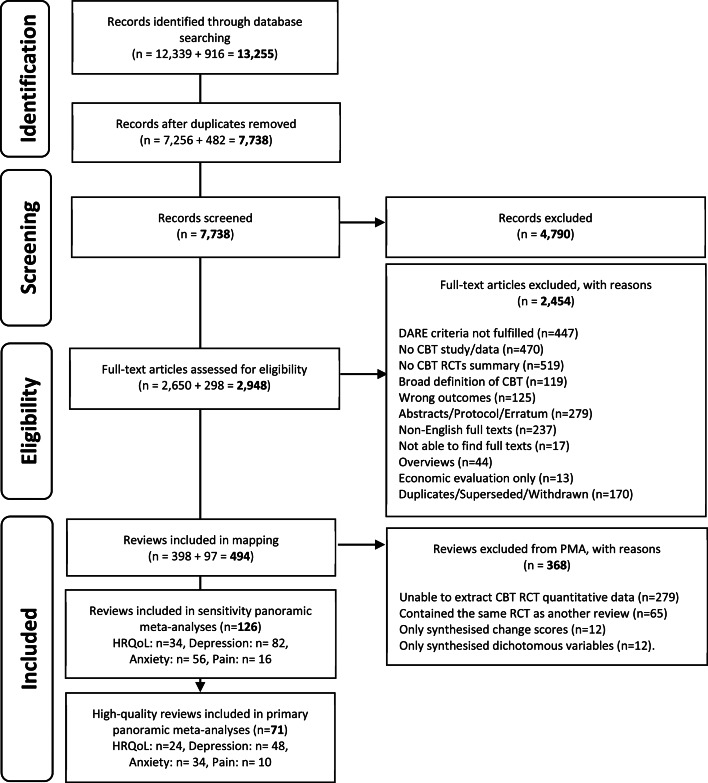
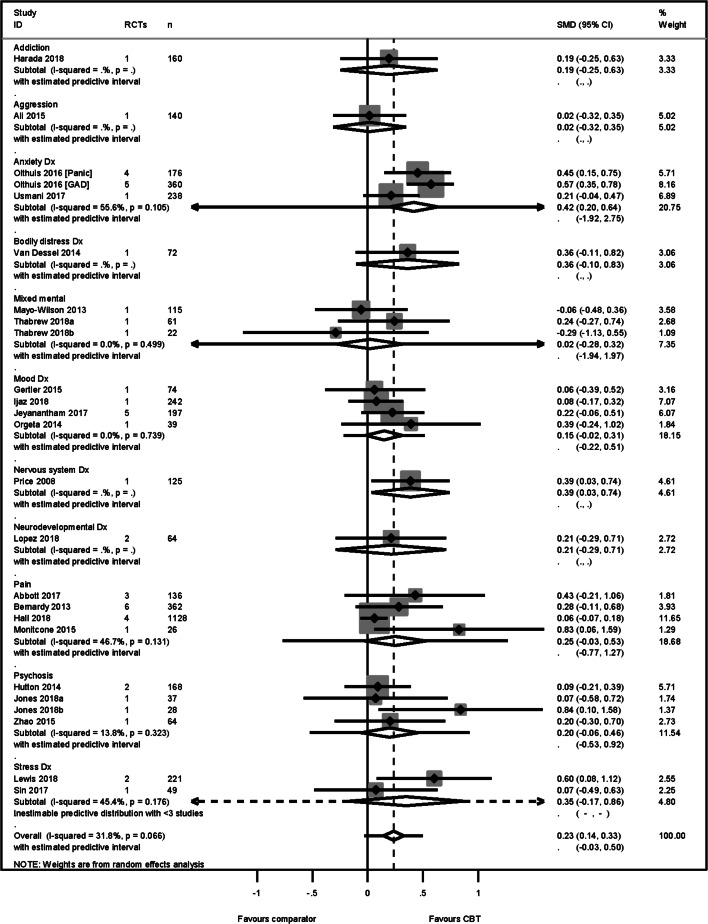
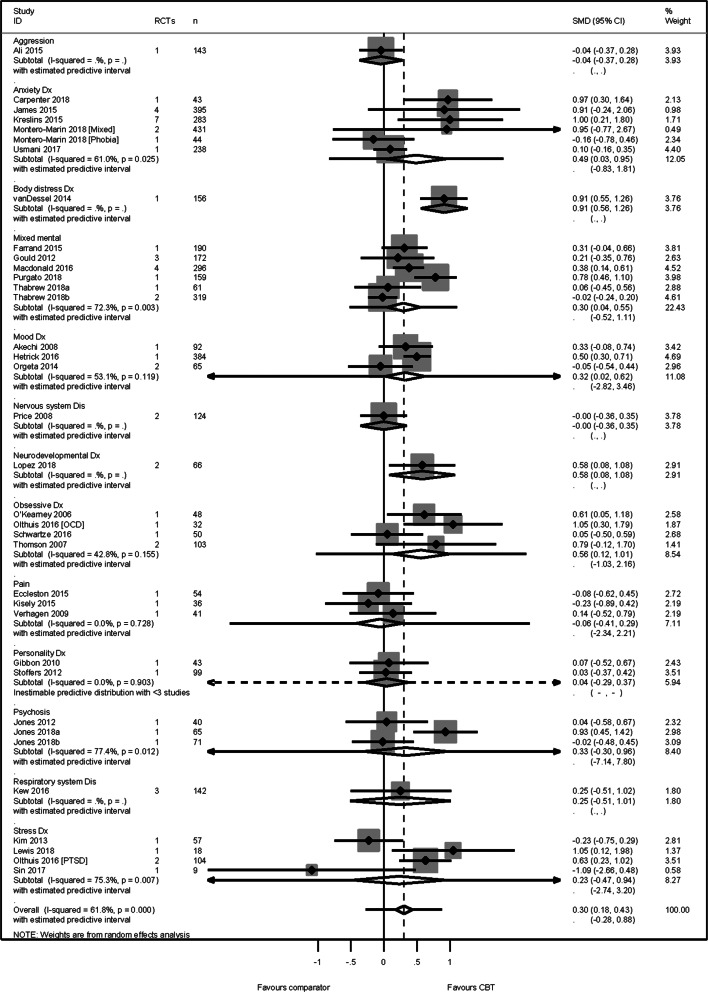
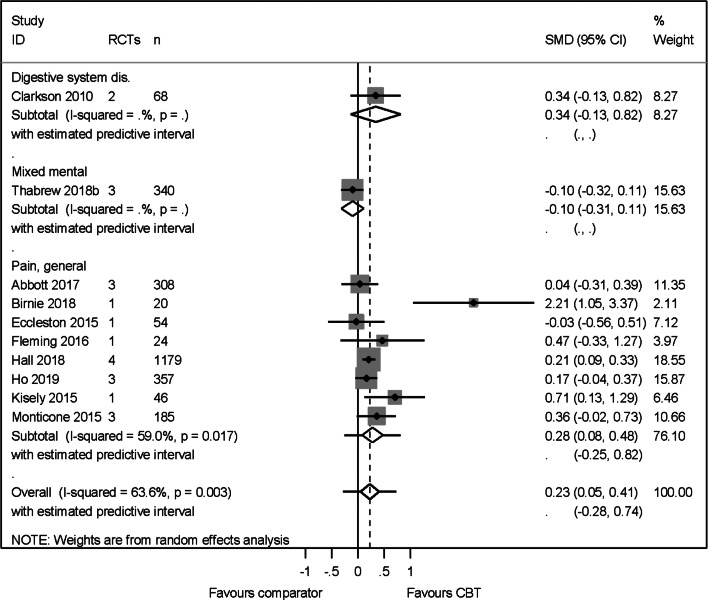
The majority of psychological treatment research is dedicated to investigating the effectiveness of cognitive behavioural therapy (CBT) across different conditions, population and contexts. We aimed to summarise the current systematic review evidence and evaluate the consistency of CBT's effect across different conditions. We included reviews of CBT randomised controlled trials in any: population, condition, format, context, with any type of comparator and published in English. We searched DARE, Cochrane, MEDLINE, EMBASE, PsycINFO, CINAHL, CDAS, and OpenGrey between 1992 and January 2019. Reviews were quality assessed, their data extracted and summarised. The effects upon health-related quality of life (HRQoL) were pooled, within-condition groups. If the across-condition heterogeneity was I2 < 75%, we pooled effects using a random-effect panoramic meta-analysis. We summarised 494 reviews (221 128 participants), representing 14/20 physical and 13/20 mental conditions (World Health Organisation's International Classification of Diseases). Most reviews were lower-quality (351/494), investigated face-to-face CBT (397/494), and in adults (378/494). Few reviews included trials conducted in Asia, South America or Africa (45/494). CBT produced a modest benefit across-conditions on HRQoL (standardised mean difference 0.23; 95% confidence intervals 0.14-0.33, I2 = 32%). The effect's associated prediction interval -0.05 to 0.50 suggested CBT will remain effective in conditions for which we do not currently have available evidence. While there remain some gaps in the completeness of the evidence base, we need to recognise the consistent evidence for the general benefit which CBT offers.
Overview
The claims and statistics of this paper haven’t been checked yet.
Free: it reads the open-access text and checks the first 5 claims that cite a source we can check. Create a free account to check every claim.
Integrity signals
Registry
Cites
Statistics
Figures
Verification
Claims the paper makes
The claims and statistics of this paper haven’t been checked yet.
Free: it reads the open-access text and checks the first 5 claims that cite a source we can check. Create a free account to check every claim.
Claims other papers make about this one
Each is checked against this paper’s own text: does it say what the citing paper says it does?
The cited source says what the claim attributes to it.
In the citing paper
“While the results of this systematic review fit with a wider conclusion that traditional CBT is beneficial for many varied conditions (Fordham et al., 2021), there appears substantial room for improvement.”
From A systematic review of cognitive behavioral therapy-based interventions for comorbid chronic pain and clinically relevant psychological distress (2023) · cites this paper as Fordham et al., 2021
Self-check
Percentages, sums and reported differences re-computed from the paper’s own numbers.
The self-check needs the paper’s full text.
Citations
Cites
1 retracted
Psychotherapy for depression among incurable cancer patients
Akechi, T., Okuyama, T., Onishi, J., Morita, T., & Furukawa, T. A. (2008) · Cochrane Database of Systematic Reviews · doi:10.1002/14651858.cd005537.pub2 · Cited by 198
RetractedPreferred Reporting Items for Systematic Reviews and Meta-Analyses: the PRISMA statement
Moher, D., Liberati, A., Tetzlaff, J., Altman, D. G., & for the PRISMA Group (2009) · BMJ · doi:10.1136/bmj.b2535 · Cited by 83,823
Preferred reporting items for systematic reviews and meta-analyses: the PRISMA Statement.
(2009) · PubMed Central · Cited by 44,859
Meta-analysis in clinical trials
DerSimonian, R., & Laird, N. (1986) · Controlled Clinical Trials · doi:10.1016/0197-2456(86)90046-2 · Cited by 39,552
Shea, B. J., Reeves, B. C., Wells, G., Thuku, M., Hamel, C., Moran, J., Moher, D., Tugwell, P., Welch, V., Kristjansson, E., et al. (2017) · BMJ · doi:10.1136/bmj.j4008 · Cited by 10,636
Huskisson, E. C. (1974) · The Lancet · doi:10.1016/s0140-6736(74)90884-8 · Cited by 4,522 · cited 1×
“The effect translated to a change of 6 mm (95% CI 1–11 mm) on the visual analogue scale [VAS, (Huskisson, 1974)] for pain.”
BackgroundThe Efficacy of Cognitive Behavioral Therapy: A Review of Meta-analyses
Hofmann, S. G., Asnaani, A., Vonk, I. J. J., Sawyer, A. T., & Fang, A. (2012) · Cognitive Therapy and Research · doi:10.1007/s10608-012-9476-1 · Cited by 3,445
Hayes, S. C. (2004) · Behavior Therapy · doi:10.1016/s0005-7894(04)80013-3 · Cited by 2,493
Why Cognitive Behavioral Therapy Is the Current Gold Standard of Psychotherapy
David, D., Cristea, I., & Hofmann, S. G. (2018) · Frontiers in Psychiatry · doi:10.3389/fpsyt.2018.00004 · Cited by 565
Depression in adults: recognition and management
(2017) · Clinical Pharmacist · doi:10.1211/cp.2017.20202439 · Cited by 393
Research works printed but not linked: 4
- Centre for Reviews and Dissemination. (2009). Systematic reviews: CRD's guidance for undertaking reviews in health care. York, UK: University of York.
- Covidence. (Downloaded 2018). Covidence systematic review software Melborne, Australia: http://www.covidence.org.
- Beck, A. T., & Steer, R. A. (1993). Beck anxiety inventory manual. San Antonio, TX: Psychological Corporation.
- Higgins, J. P. T., Thomas, J., Chandler, J., Cumpston, M., Li, T., Page, M. J., & Welch, V. A. (2019). Cochrane Handbook for Systematic Reviews of Interventions version 6.0 (updated July 2019). Retrieved from www.training.cochrane.org/handbook. PMC10284251 31643080
Cited by
Items 101–179 of 179
Jiménez-Rivagorza, L., Olvera-Lucio, E., Irigoyen-Ruíz, M., & Rafful, C. M. (2026) · Salud Mental · doi:10.17711/sm.0185-3325.2026.31 · Cited by 1
La teoría de los modos de Beck: una revisión de alcance
Neufeld, C. B., Filho, N. C. D. A., & Rebessi, I. P. (2023) · Revista Brasileira de Terapias Cognitivas · doi:10.5935/1808-5687.20230027-es · Cited by 1
“Tampoco existen evidencias significativas sobre si el origen étnico de los individuos o el país en el que viven moderan la eficacia de la TCC, ya que se han realizado pocos estudios en países de África, Asia o Sudamérica, por ejemplo (Fordham et al., 2021).”
BackgroundInfluentialRedburn, J., & Hayes, B. (2025) · School Psychology International · doi:10.1177/01430343241310445 · Cited by 2
“Cognitive behavioral therapy (CBT) is a therapeutic approach to exploring thoughts, feelings, and behaviors (Beck, 1970; Fordham et al., 2021).”
Singha, R., & Sathyamoorthy, Y. K. (2025) · Advances in social networking and online communities book series · doi:10.4018/979-8-3693-4191-9.ch001 · Cited by 1
Young, D. K. W., Carlbring, P., Ng, S., Cheng, D., Petrus Yat-nam, N. G., Chen, Q.-R. J., Tam, H.-L., & Yeung, J. W. K. (2025) · Clinical Social Work Journal · doi:10.1007/s10615-025-00990-1 · Cited by 1
“Research studies have consistently supported the efficacy and effectiveness of cognitive behavioural therapy (CBT) in reducing stress, depression, and anxiety in Western, Asian, and Chinese societies (Fordham et al., 2021; Ng & Wong, 2018; Young & Ng, 2022).”
Singha, R. (2025) · IGI Global eBooks · doi:10.4018/979-8-3693-5464-3.ch010 · Cited by 1
Vink, M., & Partyka-Vink, K. (2025) · Life · doi:10.3390/life15040584 · Cited by 2
“…on the outcome of a study was highlighted by a systematic review of CBT for many different conditions, including ME/CFS. Fordham et al. concluded that the effect size was 0.31 if the studies used a non-active comparator control group and 0.09 when an active comparator control group was used [160].”
InfluentialLindenbach, D., Wang, E. Y., Scammell, J., O’Neill, T., Bennett, S., Mohammadi, F., Ehrenreich, J. T., Arnold, P. D., & Dimitropoulos, G. (2025) · Child Protection and Practice · doi:10.1016/j.chipro.2025.100152 · Cited by 1
Singha, R. (2025) · Advances in human and social aspects of technology book series · doi:10.4018/979-8-3693-8804-4.ch006 · Cited by 1
Grös, D. F., & Allan, N. P. (2025) · Behavior Therapy · doi:10.1016/j.beth.2025.09.012 · Cited by 1
Pine, R. (2022) · Open Access Victoria University of Wellington | Te Herenga Waka (Figshare) · doi:10.26686/wgtn.20104103 · Cited by 1
Olsson, T. M., Schwarz, U. V. T., Hasson, H., Vira, E. G., & Sundell, K. (2022) · Research Square · doi:10.21203/rs.3.rs-2184012/v1 · Cited by 1
Mukherjee, A., Mukherjee, T., & Roy, M. M. (2025) · Wiley eBooks · doi:10.1002/9781394234073.ch2 · Cited by 3
An Overview of Group Cognitive Behavioral Therapy: Science and Practice
Nowakowski, M. E., & Bieling, P. (2021) · Elsevier eBooks · doi:10.1016/b978-0-12-818697-8.00205-3 · Cited by 1
Internet-based treatment of depression and anxiety among migrants and refugees in Sweden
Lindegaard, T. (2022) · Linköping studies in behavioural science · doi:10.3384/9789179291402 · Cited by 2
Experiences of Lifelong Learners in Clinical Psychology
Washburn, J. J., Teachman, B. A., Davison, G. C., Gaudiano, B. A., Hollon, S. D., Penberthy, J. K., & Peris, T. S. (2022) · Springer eBooks · doi:10.1007/978-3-031-14332-8_21
Edelman, S. (2022) · Springer eBooks · doi:10.1007/978-3-031-24012-6_6
Subclinical hypothyroidism: Let the evidence be your guide
LeFevre, N. M., & Zweig, A. (2023) · The Journal of Family Practice · doi:10.12788/jfp.0593 · Cited by 3
Physician wellness: Managing stress and preventing burnout
SMITH, M. H. D., Crowley, M., & Liese, B. S. (2023) · The Journal of Family Practice · doi:10.12788/jfp.0592 · Cited by 2
Kassymova, G. (2023) · Linköping University medical dissertations · doi:10.3384/9789180752268 · Cited by 1
Beck's theory of modes: a scoping review
Neufeld, C. B., Filho, N. C. D. A., & Rebessi, I. P. (2023) · Revista Brasileira de Terapias Cognitivas · doi:10.5935/1808-5687.20230027-en · Cited by 7
Teoria dos modos de Beck: uma revisão de escopo
Neufeld, C. B., Filho, N. C. D. A., & Rebessi, I. P. (2023) · Revista Brasileira de Terapias Cognitivas · doi:10.5935/1808-5687.20230027-pt · Cited by 2
Strategies to Mitigate Young Cancer Survivors with Depression
Brandon, R., & Zhang, A. (2024) · Springer eBooks · doi:10.1007/978-3-031-32046-0_69-1
Suggerimenti di buona pratica clinica per i Disturbi dell'Alimentazione e della Nutrizione
Fioravanti, G., Canestri, L., & Reda, M. A. (2024) · QUADERNI DI PSICOTERAPIA COGNITIVA · doi:10.3280/qpc54-2024oa18659
Singha, R., & Sathyamoorthy, Y. K. (2024) · Advances in human and social aspects of technology book series · doi:10.4018/979-8-3693-6190-0.ch006 · Cited by 1
The Role of Systematic Reviews in the EBP Process
Garcia, A. R., & Corcoran, J. (2024) · Oxford University Press eBooks · doi:10.1093/oso/9780197579848.003.0005 · Cited by 1
Grundlagen der Diagnostik und Therapie
(2024) · Elsevier eBooks · doi:10.1016/b978-3-437-22487-4.16001-0
Tutlam, N. T., Nabunya, P., Kizito, S., Migadde, H., Ssentumbwe, V., Namuwonge, F., Najjuuko, C., Mugisha, J., Bahar, O. S., Mwebembezi, A., et al. (2025) · Journal of Child and Family Studies · doi:10.1007/s10826-025-03015-0
“…effective in improving emotional and behavioral dif fi culties among adolescents in different contexts (Du et al., 2010) as well as treating a number of disorders among children and adults (Fordham, Sugavanam, Edwards, Hem-ming, et al., 2021; Fordham, Sugavanam, Edwards, Stallard, et al., 2021).”
Kinzett, S. (2025) · Open Access Victoria University of Wellington | Te Herenga Waka (Figshare) · doi:10.26686/wgtn.29094197
Young, D. K. W., Carlbring, P., Petrus Yat-nam, N. G., Tam, H.-L., & Yeung, J. W. K. (2025) · Research on Social Work Practice · doi:10.1177/10497315251342971
“Research studies have consistently supported the effectiveness of cognitive behavioral therapy (CBT) in reducing perceived stress and improving mental health in Western and Chinese societies (Fordham et al., 2021; Young & Ng, 2022).”
Murphy, R. (2025) · Wiley eBooks · doi:10.1002/9781394329007.ch9
Murphy, R. (2025) · Wiley eBooks · doi:10.1002/9781394329007.refs
Efficacy of Cognitive Behavioral Group for Left-behind Older Parents With Depression
Young, D. K. W., Carlbring, P., & Li, K. (2025) · Research on Social Work Practice · doi:10.1177/10497315251367348
“…therapy (CBT) has been shown to be effective in reducing social isolation, loneliness, and depression in older adults Bilbrey et al., 2022; Fordham et al., 2021; Hoang et al., 2022; Jarvis et al., 2019; Käll et al., 2020), but, to our knowledge, no study has yet been conducted to evaluate…”
Becker‐Haimes, E. M., Mandell, D. S., Kuo, P. B., Lynch, K. G., Brady, M., Young, S., & Creed, T. A. (2025) · JMIR Research Protocols · doi:10.2196/76035
Exploring support systems for young people with climate anxiety: Suggestions from Brazil
Frota, M. A., Cardoso, M. C. V., Fernandes, M. N., Schor, M., Clayton, S., & Surkan, P. J. (2025) · Annals of the New York Academy of Sciences · doi:10.1111/nyas.70047 · Cited by 1
“21,22 CBT consists of causing a changeinthealteredwayofperceivingandreasoningaboutone’senvi-ronmentandspecificallyaboutwhatcausesanxiety(cognitivetherapy) and changes in anxious behavior (behavioral therapy).”
Strategies to Mitigate Young Cancer Survivors with Depression
Brandon, R., & Zhang, A. (2025) · Springer eBooks · doi:10.1007/978-3-031-73363-5_69
Lerner, R., Gonçalves, B. P., Dias, C. M., Gerotto, J. B., Rufino, T. A. T., Aragão, Y. M., & de Arantes, I. L. (2025) · Frontiers in Psychiatry · doi:10.3389/fpsyt.2025.1664393 · Cited by 1
Blakey, S. M., Vandermaas-Peeler, J. R., Counts, J., Croxford, J. A., Olmsted, K. R., Gant, P., Elbogen, E. B., & Asman, K. (2025) · Contemporary Clinical Trials · doi:10.1016/j.cct.2025.108100
Adaptations of the Original Model of Cognitive Behavioural Therapy
Davies, J., Salkovskis, P., Laidlaw, K., & Beck, J. S. (2025) · Cambridge University Press eBooks · doi:10.1017/9781009090940.010
Efficacy of CBT: A Brief Outline and Review
Davies, J., Salkovskis, P., Laidlaw, K., & Beck, J. S. (2025) · Cambridge University Press eBooks · doi:10.1017/9781009090940.004
Roshanghalb, A., Hansen, B., Rudoler, D., & Best, M. W. (2024) · Figshare · doi:10.6084/m9.figshare.26724611
Roshanghalb, A., Hansen, B., Rudoler, D., & Best, M. W. (2024) · Figshare · doi:10.6084/m9.figshare.26724614
Roshanghalb, A., Hansen, B., Rudoler, D., & Best, M. W. (2024) · Figshare · doi:10.6084/m9.figshare.26724620
Additional file 1 of Further validation of the Cognitive Biases Questionnaire for psychosis
Samson, C., Achim, A. M., Sicard, V., Gilker, A., Francoeur, A., Franck, N., Cloutier, B., Giguère, C., Jean-Baptiste, F., & Lecomte, T. (2022) · Figshare · doi:10.6084/m9.figshare.20521069
Larisch, L.-M., Blom, V., Hagströmer, M., Ekblom, M., Ekblom, Ö., Nilsson, J., & Kallings, L. (2024) · Figshare · doi:10.6084/m9.figshare.26665783
Larisch, L.-M., Blom, V., Hagströmer, M., Ekblom, M., Ekblom, Ö., Nilsson, J., & Kallings, L. (2024) · Figshare · doi:10.6084/m9.figshare.26665786
Roshanghalb, A., Hansen, B., Rudoler, D., & Best, M. W. (2024) · Figshare · doi:10.6084/m9.figshare.26724617
Kozáková, R., Bužgová, R., Bobčíková, K., & Zeleníková, R. (2025) · Journal of Rational-Emotive & Cognitive-Behavior Therapy · doi:10.1007/s10942-025-00613-1
“The significant overview of Fordham et al. (2021) focused on the effect of group CBT on quality of life, anxiety, and depression in all age groups brings significant results.”
Ran, S., Peng, Y., Wang, S., Li, Y., & Liu, B. (2025) · Advances in Gerontology · doi:10.1134/s2079057025600430
“Additionally, we calculated the I2 statistic to assess heterogeneity for each outcome from different data sources, with I2 values categorized as <25%, 25–75%, and >75% indicating low, moderate, and high heterogeneity, respectively [73, 74].”
Rola psychoterapeutów w szpitalach psychiatrycznych
Dąbrowa, N. (2025) · Kwartalnik Prawa Publicznego · doi:10.21697/2023.21.4.01
The Historical Context of Cognitive-Behavioral Therapy with Black Americans
Gregory, V. L. (2025) · Springer eBooks · doi:10.1007/978-3-032-01666-9_1
Habit Creation and Dissolution: Applying Hume’s Philosophy of Human Nature for Addiction Recovery
Gongqing, L., Mensah, E. T., Sabjan, M. A., Ntim, S. Y., & Mohamad, N. I. (2025) · Philosophia · doi:10.1007/s11406-025-00953-3 · Cited by 1
Furman, M., Gradowska, A., Bliźniewska-Kowalska, K. M., Kunikowska, J., & Gałecka, M. (2026) · Journal of Clinical Medicine · doi:10.3390/jcm15041583 · Cited by 1
“This finding is consistent with the literature indicating that therapeutic interventions—particularly those based on the cognitive-behavioral approach— are effective in reducing symptoms of situational anxiety [22].”
Depression as inferential rigidity: a meta-abductive account
Sun, J., & Jin, L. (2026) · Frontiers in Psychology · doi:10.3389/fpsyg.2026.1776494
Vink, M., & Vink-Niese, F. (2026) · Frontiers in Psychiatry · doi:10.3389/fpsyt.2025.1746712 · Cited by 1
“Moreover, a systematic review by Fordham et al. (25), which concluded that CBT is effective for a range of diseases, including ME/CFS, also noted that if studies use an active instead of a passive control group, then the effect size is trivial (0.09).”
InfluentialCarroll, H. A., Guevara, T., Gamarra, P., Mukunta, C., Dorsey, S., Gelaye, B., Henderson, D. C., Bird, M., & Freier, L. F. (2026) · medRxiv · doi:10.64898/2026.03.19.26348265
“COMPASS offers a flexible, transdiagnostic framework that incorporates evidence-based strategies which have demonstrated efficacy across various populations, conditions, formats, and contexts 41 to tackle a variety of mental health challenges, including depression, anxiety, and PTSD.”
Bernstein, D. A. (2026) · Current Opinion in Psychology · doi:10.1016/j.copsyc.2026.102310
Extending the Reach of Interventions to Treat Mental Disorders
Kazdin, A. E. (2026) · Psychiatry International · doi:10.3390/psychiatryint7020078
“In the past 50 years, there has been great progress in identifying effective treatments, including various forms of evidence-based psychotherapy and medication [27–29].”
Carroll, H. A., Guevara, T., Gamarra, P., Mukunta, C., Dorsey, S., Gelaye, B., Henderson, D. C., Bird, M., & Freier, L. F. (2026) · PLoS ONE · doi:10.1371/journal.pone.0345837
“COMPASS offers a flexible, transdiagnostic framework that incorporates evidence-based strategies which have demonstrated efficacy across various populations, conditions, formats, and contexts [41] to tackle a variety of mental health challenges, including depression, anxiety, and PTSD.”
Impacts of Post-Covid Condition (PCC) in Sweden: a cross-sectional observational survey study
Jovicic, F., McCracken, L. M., Rozental, A., & Buhrman, M. (2026) · BMC Public Health · doi:10.1186/s12889-026-27720-7
“The latter could be useful to support the wellbeing and daily functioning of those living with the condition, at the very least, given that such benefits are demonstrated across an exceptionally wide range of physical health conditions [12].”
Almulhem, M. M., & Siraj, R. A. (2026) · Journal of Clinical Medicine · doi:10.3390/jcm15103953
“…coping skills, and supports emotional regulation, making it well-suited to the chronic and treatment-intensive context of CF. Evidence from chronic disease populations consistently demonstrates its benefit for emotional well-being, health-related quality of life, and symptom reduction [44,45].”
Hamdoyo, A., Antonio, F., & Tengor, J. R. S. (2026) · International Journal of Environmental Research and Public Health · doi:10.3390/ijerph23060718
“This strategy aligns with meta-analytic evidence demonstrating that CBT produces reliable benefits in quality of life and mental health across diverse populations [121].”
Salie, M., van der Poll, R., & Coetzee, B. (2026) · The Cognitive Behaviour Therapist · doi:10.1017/s1754470x26100622
“…therapy (CBT) is a well-established and evidence-based psychological treatment that is widely recommended as an adaptable and effective intervention across a range of mental health conditions (MHCs), with a substantial and solid body of evidence (Fordham et al ., 2021; Kazantzis et al ., 2018).”
Fordham, B., Tutton, E., Painton, R., Gould, J., Achten, J., Costa, M. L., & Keene, D. J. (2026) · Bone & Joint Open · doi:10.1302/2633-1462.76.bjo-2025-0395.r1 · Cited by 1
Cognitive Restructuring Within Cognitive Behavioral Therapy With Youth With Internalizing Disorders
Everson, K., & Terjesen, M. D. (2026) · Elsevier eBooks · doi:10.1016/b978-0-443-29009-1.00074-3
Sun, F., Li, Y. Z., & Liu, F. (2026) · Journal of Stroke and Cerebrovascular Diseases · doi:10.1016/j.jstrokecerebrovasdis.2026.108697
Settimo, C., Aeo, D. C., Facciale, A. L., Turriziani, L., Tripodi, E., Impallomeni, C., Quartarone, A., Calabrò, R. S., & Cucinotta, F. (2026) · Frontiers in Psychiatry · doi:10.3389/fpsyt.2026.1888297
Okawa, Y. (2026) · Tobacco Induced Diseases · doi:10.18332/tid/225228
“Previous reviews have provided important summaries of behavioral interventions for tobacco cessation, but many have focused on specific populations or have combined CBT with other behavioral approaches, making it difficult to isolate the contribution of CBT 6-8 .”
Gower, T., Styler, Z. R., & Litz, B. T. (2026) · Clinical Psychology Review · doi:10.1016/j.cpr.2026.102786 · Cited by 2
Jaskuła, J., & Jaskula, K. (2026) · Emergency Medical Service · doi:10.36740/emems202602106
Anderson, B. M., Vause, T. C., Neil, N. M., & Davis, S. (2026) · Behavior Analysis in Practice · doi:10.1007/s40617-026-01231-8
Tranquil Talk–a Chatbot for Mental Health
Arun, K., Sangem, H., Chowdary, N. S., Thanvi, P. S., & Soma, K. (2026) · Smart innovation, systems and technologies · doi:10.1007/978-981-95-9097-1_21
Elson, E., Morey, A., Kwong, J. H. T., Walo, L., Payne, M., Hare, E., Cooper, K., & Russell, A. (2026) · The Cognitive Behaviour Therapist · doi:10.1017/s1754470x2610083x
“CBT has an extensive evidence base, spanning various psychological difficulties and patient groups (for a review, see Fordham et al ., 2021); however, adaptations are often recommended, including for children, neurodivergent individuals with conditions including attention deficit hyperactivity…”
Dallio, M., Romeo, M., Nardo, F. D., Napolitano, C., Coppola, A., Mazzarella, C., Vaia, P., Basile, C., & Federico, A. (2026) · Clinical Nutrition · doi:10.1016/j.clnu.2026.106800
Zheng, Z., Wang, L., Cheng, X., & Luo, X. (2026) · Frontiers in Psychiatry · doi:10.3389/fpsyt.2026.1941336
Interventions for eco-anxiety: A systematic review of design, implementation and effectiveness
Vargas, C., Mammone, C., Coffey, Y., & Allender, S. (2026) · Cambridge Prisms Global Mental Health · doi:10.1017/gmh.2026.10313
“Therapeutic approaches such as CBT-, ACT-and mindfulness-informed programmes were more often associated with improvements in distress-related outcomes, suggesting that some forms of eco-anxiety may benefit from structured psychological support (World Health Organization, 2019; Fordham et al., 2021).”
Remskar, M., Greaves, C. J., Chew-Graham, C., Stathi, A., Andersson, G., Kingstone, T., Hayhoe, S., & Lambert, J. D. (2026) · PLoS ONE · doi:10.1371/journal.pone.0355366
“Several psychological approaches have strong evidence of efficacy in populations with a single LTC: Cognitive-behavioural therapy (CBT) is considered the gold standard approach for individuals with depression [12] and has shown effectiveness for individuals with physical LTCs [13].”
Murray, A. L., Zhu, X., Li, X., Xiao, Z., & Yang, Y. (2026) · Research Square · doi:10.21203/rs.3.rs-11145135/v1
Metadata
- Authors
- Fordham, B., Sugavanam, T., Edwards, K., Stallard, P., Howard, R., das Nair, R., Copsey, B., Lee, H., Howick, J., Hemming, K., & Lamb, S. E.
- Affiliations
- University of Oxford (GB)
- University of Liverpool (GB)
- University of Bath (GB)
- University College London (GB)
- University of Leeds (GB)
- University of Birmingham (GB)
- University of Exeter (GB)
- Corresponding author
- Fordham, Beth
- ORCID
- Venue
- Psychological Medicine
- Publisher
- Cambridge University Press (CUP)
- Published
- 2021-01
- Volume
- 51
- Issue
- 1
- Pages
- 21-29
- ISSN
- 0033-2917 (ISSN-L)
- 1469-8978
- PMC
- PMC7856415
- OpenAlex
- W3126058080
- Cited by
- 179
- References
- 18
- Citations by year
- 2026: 35 · 2025: 54 · 2024: 41 · 2023: 26 · 2022: 17 · 2021: 6
- FWCI
- 2.99
- Type
- journal article
- Language
- en
- Open access
- hybrid
- doi.org
- Locations
- Psychological Medicine (publishedVersion, cc-by)
- PubMed Central (publishedVersion, cc-by)
- PubMed (publishedVersion)
- Repository@Nottingham (University of Nottingham) (acceptedVersion, other-oa)
- Repository@Nottingham (University of Nottingham) (submittedVersion, cc-by)
- UCL Discovery (University College London) (submittedVersion)
- Funders
- National Institute for Health and Care Research (15/174/24, HTA/15/174/24)
- University of Oxford
- Topics
- Social Sciences › Psychology › Clinical Psychology › Psychotherapy Techniques and Applications
- Social Sciences › Psychology › Experimental and Cognitive Psychology › Anxiety, Depression, Psychometrics, Treatment, Cognitive Processes
- Social Sciences › Psychology › Applied Psychology › Digital Mental Health Interventions
- Keywords
- cognitive behavioral therapy, treatment effectiveness, health-related quality of life, prediction intervals
- MeSH terms
- Mental Disorders, Humans, Quality of Life, Cognitive Behavioral Therapy, Treatment Outcome
About these checks
Registry, retraction, Cites and statistics results are computed, not judged, with one exception: a printed reference that no index lists is read once by a model before it counts as a citation error. Claims are extracted by a model and kept only when their quote appears verbatim in the text; each cited source is then checked, with a model’s help, for whether it says what the claim relies on. Those verdicts can be wrong — read the claim’s quote and the cited source before relying on one.
Statistics and arithmetic are recomputed, not judged.
Confidence bands are shown only for fields calibrated on our annotated test set. None is calibrated yet, so no band is shown.
What counts as a claim ›How we measure confidence ›How we check this ›
Are you an author, or do you see a problem with this page? Request a review
Data sources
Bibliographic data: Semantic Scholar, OpenAlex, Crossref.
Contains information from the Semantic Scholar Academic Graph Datasets, made available under the ODC Attribution License (ODC-BY 1.0).
Semantic Scholar’s data is described in: Kinney, R., et al. (2023). The Semantic Scholar Open Data Platform. arXiv:2301.10140.
