

It was all planned … now what? Claiming agency in later life in reforming China
Open accessThe DOI matches its Crossref record; 40 of the 40 references it cites were found in a registry or an index.
Abstract
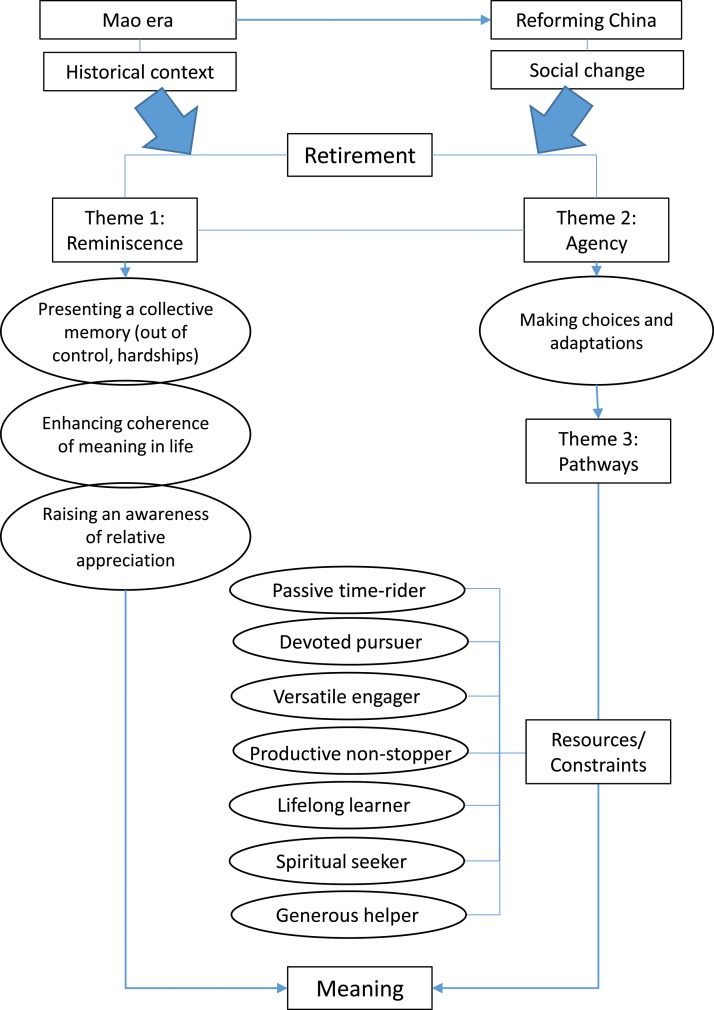
This study explores the social construction of agency and wellbeing among 20 Chinese urban retirees aged between 50 and 82 years old (averaging 67), with a special focus on the impact of earlier life experiences in shaping later-life pathways. Today's retirees in urban China have experienced the communist collectivist ideology during the Mao era as well as the changes to everyday life brought about by the economic transformation from centrally planned socialism to a market-orientated economy. Thereby, life in retirement for Chinese elders becomes more than just an issue of dealing with increases in discretionary time after exit from full-time work, but also one of making sense of their earlier life experiences in the midst of dramatic social changes. A grounded theory approach with semi-structured, in-depth, face-to-face interviews was used for data collection and analysis. Three interrelated themes emerged: (a) reminiscence as a mechanism of meaning-making, (b) discovery and exercise of agency in later life in contrast to a rigidly structured earlier life, and (c) varying pathways to constructing the life-stage of retirement. The findings have refuted gerontological literature and public discourse that often portray Chinese elders as passive care recipients or helpless dependants. Further, the present study has practical implications for developing policies, designing programmes and providing services to improve the quality of life for today's older Chinese people.
Overview
The claims and statistics of this paper haven’t been checked yet.
Free: it reads the open-access text and checks the first 5 claims that cite a source we can check. Create a free account to check every claim.
Integrity signals
Registry
Cites
Statistics
Figures
Verification
Claims the paper makes
The claims and statistics of this paper haven’t been checked yet.
Free: it reads the open-access text and checks the first 5 claims that cite a source we can check. Create a free account to check every claim.
Claims other papers make about this one
Each is checked against this paper’s own text: does it say what the citing paper says it does?
The cited source doesn’t support the claim as written.
In the citing paper
“According to Liang and Luo (2017), most of the older adults in their study faced difficulties in adapting to changes and consistently stuck to their past practices and values, which were often considered out of date.”
From Policy Initiatives to Address the Challenges of an Older Population in the Workforce (2023) · cites this paper as Liang and Luo (2017)
Checked by a reasoning model — may be wrong.
Experimental — accuracy not yet measured
Self-check
Percentages, sums and reported differences re-computed from the paper’s own numbers.
The self-check needs the paper’s full text.
Citations
Cites
Self-efficacy: The exercise of control
Bandura, A., Freeman, W. H., & Lightsey, R. (1999) · Journal of Cognitive Psychotherapy · doi:10.1891/0889-8391.13.2.158 · Cited by 46,835
(1998) · Sage eBooks · Cited by 38,631
Handbook of Qualitative Research
Crozier, G., Denzin, N., & Lincoln, Y. (1994) · British Journal of Educational Studies · doi:10.2307/3121684 · Cited by 26,666
Self-efficacy: the exercise of control
(1997) · Choice Reviews Online · doi:10.5860/choice.35-1826 · Cited by 24,281
The life course as developmental theory
Elder, G. H. (1998) · Child Development · doi:10.1111/j.1467-8624.1998.tb06128.x · Cited by 3,513
Time, Human Agency, and Social Change: Perspectives on the Life Course
Jr., G. H. E. (1994) · Social Psychology Quarterly · doi:10.2307/2786971 · Cited by 2,852
Choose Your Method: A Comparison of Phenomenology, Discourse Analysis, and Grounded Theory
Starks, H., & Brown Trinidad, S. (2007) · Qualitative Health Research · doi:10.1177/1049732307307031 · Cited by 2,528
Handbook of Interview Research
Gubrium, J., & Holstein, J. (2001) · Sage eBooks · doi:10.4135/9781412973588 · Cited by 1,647
Handbook of Interview Research: Context and Method
Gubrium, J. F., & Holstein, J. A. (2001) · Medical Entomology and Zoology · Cited by 1,515
Handbook of Interview Research. Context and Method
Guillemette, F. (2003) · Loisir et Société / Society and Leisure · doi:10.1080/07053436.2003.10707615 · Cited by 1,459
Bengtson, V. L., Settersten, R. A., Kennedy, B. K., Morrow-Howell, N., & Smith, J. (2016) · Springer Publishing Company eBooks · doi:10.1891/9780826129437 · Cited by 818
Handbook of the Life Course: Volume II
(2016) · Handbooks of Sociology and Social Research · doi:10.1007/978-3-319-20880-0 · Cited by 761
O'Rand, A. M. (1996) · The Gerontologist · doi:10.1093/geront/36.2.230 · Cited by 645
Cultures of Ageing: Self, Citizen and the Body
Gilleard, C. J., & HIGGS, P. F. D. (2001) · UCL Discovery (University College London) · Cited by 555
The Structured Dependency of the Elderly: A Creation of Social Policy in the Twentieth Century
Townsend, P. (1981) · Ageing and Society · doi:10.1017/s0144686x81000020 · Cited by 452
The Personal Experience of Aging, Individual Resources, and Subjective Well-Being
Steverink, N., Westerhof, G. J., Bode, C., & Dittmann-Kohli, F. (2001) · The Journals of Gerontology Series B: Psychological Sciences and Social Sciences · doi:10.1093/geronb/56.6.p364 · Cited by 428
The effects of reminiscence on psychological well-being in older adults: A meta-analysis
Bohlmeijer, E., Roemer, M., Cuijpers, P., & Smit, F. (2007) · Aging & Mental Health · doi:10.1080/13607860600963547 · Cited by 390
Urban Spaces in Contemporary China: The Potential For Autonomy And Community In Post-Mao China
Davis, D. (1995) · Cited by 276
Children of the Cultural Revolution: The State and the Life Course in the People's Republic of China
Zhou, X., & Hou, L. (1999) · American Sociological Review · doi:10.1177/000312249906400103 · Cited by 254
Rosow, I. (1974) · University of California Press eBooks · doi:10.1525/9780520378520 · Cited by 244
Activity and Aging: Staying Involved in Later Life
Kelly, J. R. (1993) · Medical Entomology and Zoology · Cited by 232
Cultural Aging: Life Course, Lifestyle, and Senior Worlds
Katz, S. (2005) · University of Toronto Press eBooks · doi:10.3138/9781442602083 · Cited by 229
Chen, F., Yang, Y., & Liu, G. (2010) · American Sociological Review · doi:10.1177/0003122409359165 · Cited by 215
Barstow, D. G. (2000) · Journal of Psychosocial Nursing and Mental Health Services · doi:10.3928/0279-3695-20000301-17 · Cited by 207
Long Lives: Chinese Elderly and the Communist Revolution.
Cherry, R. L., & Davis-Friedmann, D. (1984) · Contemporary Sociology · doi:10.2307/2067562 · Cited by 177
Missing Links: The Case for a Social Psychology of the Life Course
George, L. K. (1996) · The Gerontologist · doi:10.1093/geront/36.2.248 · Cited by 98
Davis-Friedmann, D. (1991) · Stanford University Press eBooks · doi:10.1515/9781503620988 · Cited by 97
China's Zhiqing Generation: Nostalgia, Identity, and Cultural Resistance in the 1990s
Yang, G. (2003) · Modern China · doi:10.1177/0097700403029003001 · Cited by 96
THE USES OF REMINISCENCE IN OLDER ADULTHOOD
Merriam, S. B. (1993) · Educational Gerontology · doi:10.1080/0360127930190507 · Cited by 70
Left-behind and Vulnerable? Conceptualising Development and Older Women’s Agency in Rural China
Jacka, T. (2014) · Asian Studies Review · doi:10.1080/10357823.2014.891566 · Cited by 66
China's Post-Socialist Inequality
Whyte, M. K. (2012) · Current History · doi:10.1525/curh.2012.111.746.229 · Cited by 58
Active Ageing, Active Learning: Issues and Challenges
Boulton‐Lewis, G. M., & Tam, M. (2011) · Springer eBooks · doi:10.1007/978-94-007-2111-1 · Cited by 55
Economic Reform and Social Change in China: Past, Present, and Future of the Economic State
Chen, S. (2002) · International Journal of Politics Culture and Society · doi:10.1023/a:1015319920054 · Cited by 51
Westerhof, G. J. (2009) · Journal of Aging Studies · doi:10.1016/j.jaging.2008.09.001 · Cited by 29
Liang, J. (2011) · Journal of Cross-Cultural Gerontology · doi:10.1007/s10823-011-9149-7 · Cited by 27
Self-citationNeighbourhood-Reminiscence: Integrating Generations and Cultures in the Netherlands
Mercken, C. (2003) · Journal of Intergenerational Relationships · doi:10.1300/j194v01n01_08 · Cited by 18
Chapter 8: Exemplars of Retirement: Identity and Agency Between Lifestyle and Social Movement
Katz, S., & Rudman, D. L. (2005) · University of Toronto Press eBooks · doi:10.3138/9781442602083-010 · Cited by 17
China’s Religious Danwei: Institutionalising Religion in the People’s Republic
Palmer, D. A. (2009) · China Perspectives · doi:10.4000/chinaperspectives.4918 · Cited by 11
Senior volunteer service in urban communities: a study in Jinan
Li, Q. (2010) · China Journal of Social Work · doi:10.1080/17525098.2010.492652 · Cited by 10
Revolutionary narratives of self-compassion among older women in post-Mao Beijing
Shea, J. L. (2014) · Anthropology and Medicine · doi:10.1080/13648470.2014.880871 · Cited by 9
Research works printed but not linked: 5
- Elder G. H. Jr., Johnson M. K. and Crosnoe R. 2004 The emergence and development of the life course theory In Mortimer J. T. and Shanahan M. J. (eds), Handbook of the Life Course. Springer, New York, 3– 19.
- Alwin D. F. and McCammon R. J. 2004 Generations, cohorts, and social change In Mortimer J. T. and Shanahan M. J. (eds), Handbook of the Life Course. Springer, New York, 23– 49.
- Yang T. 2014 Exploring home and community-based long-term care social policies. Study and Practice, 6, 82– 91. (In Chinese)
- Gecas V. 2004 Self-agency and the life course In Mortimer J. T. and Shanahan M. J. (eds), Handbook of the Life Course. Springer, New York, 369–88.
- Dannefer D. 2004 Toward a global geography of the life course In Mortimer J. T. and Shanahan M. J. (eds), Handbook of the Life Course. Springer, New York, 647–59.
Cited by
Understanding Health and Social Challenges for Aging and Long-Term Care in China
Yang, W. Y. L., Wu, B., Tan, S. Y., Li, B., LOU, V. W. Q., Chen, Z., Chen, X., Fletcher, J. R., Carrino, L., Hu, B., et al. (2020) · Research on Aging · doi:10.1177/0164027520938764 · Cited by 94
“…earlyand mid-life and health outcomes in the context of China is rather limited, with exceptions of several qualitative studies that have examined how historical contexts and social changes could affect people’s perceptions and choices and thus health in the life course (Liang & Luo, 2012, 2017).”
BackgroundPolicy Initiatives to Address the Challenges of an Older Population in the Workforce
Nagarajan, N. R., & Sixsmith, A. (2023) · Ageing International · doi:10.1007/s12126-021-09442-w · Cited by 75
Critical, connected and caring: older adults’ agency during the COVID-19 pandemic
Mandache, L., & Ivan, L. (2024) · Journal of global ageing. · doi:10.1332/29767202y2024d000000007 · Cited by 7
Temporality and the aging self. How subjective time is folding over its linear progression
Nadobnik, H., Durczak, K., & Ławrynowicz, M. (2021) · Journal of Aging Studies · doi:10.1016/j.jaging.2021.100933 · Cited by 7
Kang, M., Park, J., Le, C. N., & Kang-Le, S. (2024) · American Behavioral Scientist · doi:10.1177/00027642241242750 · Cited by 6
“Liang and Luo (2017) use “clay rice bowls” to describe the increasing fragility of the “iron rice bowl” system.”
Metadata
- Authors
- LIANG, J., & LUO, B.
- Affiliations
- University of Louisiana at Monroe (US)
- Western Washington University (US)
- Corresponding author
- LIANG, JIAYIN
- ORCID
- LUO, BAOZHEN
- Venue
- Ageing and Society
- Publisher
- Cambridge University Press (CUP)
- Published
- 2016-08-12
- Volume
- 37
- Issue
- 10
- Pages
- 2074-2102
- ISSN
- 0144-686X (ISSN-L)
- 1469-1779
- PMC
- PMC5647664
- OpenAlex
- W2512509980
- Cited by
- 8
- References
- 40
- Citations by year
- 2026: 1 · 2025: 1 · 2024: 2 · 2022: 1 · 2021: 2 · 2020: 1
- FWCI
- 0.00
- Type
- journal article
- Language
- en
- Open access
- hybrid
- doi.org
- Locations
- Ageing and Society (publishedVersion, cc-by)
- Europe PMC (PubMed Central) (publishedVersion, cc-by)
- PubMed Central (publishedVersion, cc-by)
- PubMed (publishedVersion)
- Western CEDAR (Western Washington University) (submittedVersion)
- Funders
- Centre de Recherche et d’Expertise en Gérontologie Sociale
- Concordia University
- Topics
- Social Sciences › Life-span and Life-course Studies › Aging, Elder Care, and Social Issues
- Social Sciences › Demography › Retirement, Disability, and Employment
- Social Sciences › Psychology › Developmental and Educational Psychology › Aging and Gerontology Research
- Keywords
- urban elderly, reminiscence, meaning-making, retirement, economic reform
About these checks
Registry, retraction, Cites and statistics results are computed, not judged, with one exception: a printed reference that no index lists is read once by a model before it counts as a citation error. Claims are extracted by a model and kept only when their quote appears verbatim in the text; each cited source is then checked, with a model’s help, for whether it says what the claim relies on. Those verdicts can be wrong — read the claim’s quote and the cited source before relying on one.
Statistics and arithmetic are recomputed, not judged.
Confidence bands are shown only for fields calibrated on our annotated test set. None is calibrated yet, so no band is shown.
What counts as a claim ›How we measure confidence ›How we check this ›
Are you an author, or do you see a problem with this page? Request a review
Data sources
Bibliographic data: Semantic Scholar, OpenAlex, Crossref.
Contains information from the Semantic Scholar Academic Graph Datasets, made available under the ODC Attribution License (ODC-BY 1.0).
Semantic Scholar’s data is described in: Kinney, R., et al. (2023). The Semantic Scholar Open Data Platform. arXiv:2301.10140.
