

A Three-Body Problem: The effects of foreign language anxiety, enjoyment, and boredom on academic achievement
Open accessThe DOI matches its Crossref record; 52 of the 53 references it cites were found in a registry or an index; 5 of the 39 sources its claims cite were checked for support.
Abstract
This study is part of a growing wave of interest in foreign language (FL) learners’ emotions, their sources, and their effects. Previous studies have confirmed that there is a clear relationship between the emotions of foreign language enjoyment (FLE), foreign language classroom anxiety (FLCA), foreign language boredom (FLB), and foreign language performance. However, the relative importance of each emotion as a predictor of FL performance has yet to be examined, and as different teaching and learning strategies can elicit different emotions, it is difficult to determine whether FL teachers and learners should prioritize a specific emotion in course design and study. We, therefore, utilized structural equation modeling and latent dominance analysis on a sample of 502 Moroccan EFL learners in order to examine the relative importance of each emotion in predicting FL performance. We argue that it is crucial to use sophisticated statistical analyses and to collect samples from outside Western, educated, industrialized, rich, and democratic (WEIRD) countries. The latent dominance analysis revealed that FLCA had the strongest (negative) effect on English test scores. FLB had a significant—but slightly weaker—negative effect and FLE had a significant—but weaker still—positive effect. As such, it is vital that FL teachers and learners not underestimate the impact of anxiety on language learning.
Overview
CoChat Summary
TL;DR
Using data from 502 Moroccan EFL learners, the paper finds that all three emotions significantly predict academic achievement, but foreign language classroom anxiety (FLCA) is the strongest predictor. In the latent dominance analysis, FLCA outranks boredom (FLB) and enjoyment (FLE), suggesting anxiety is the dominant emotional factor in this context.
Key findings
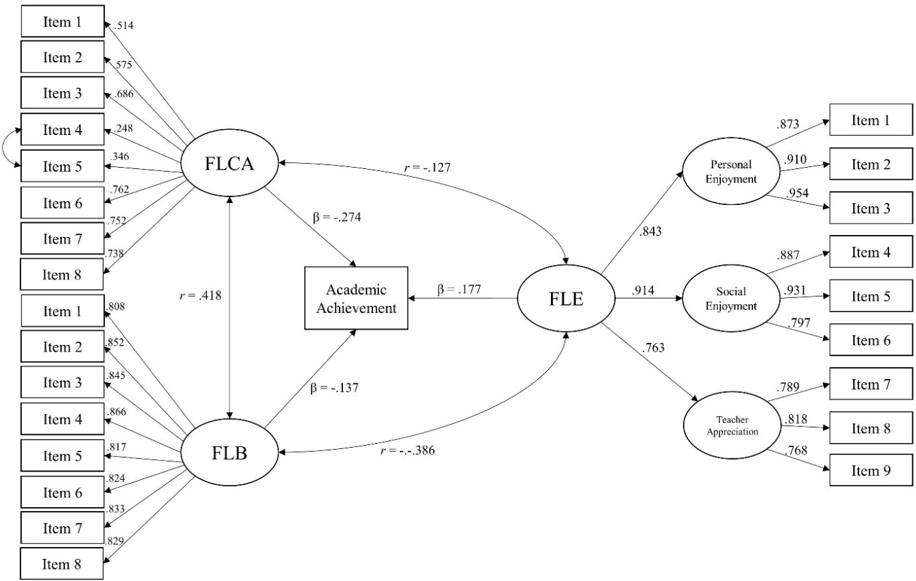
- In the structural equation model, all three emotions significantly predicted EFL academic achievement: FLCA (β = -.274), FLE (β = .177), and FLB (β = -.137), all p < .01.
- The latent dominance analysis gave the largest dominance estimate to FLCA (d = .092, SE = .028, p < .001), followed by FLB (d = .056, SE = .020, p < .01) and FLE (d = .036, SE = .020, p < .05).
- Bayes factor ordering supported the ranking FLCA > FLB > FLE: H1 vs Ha = 2.879, H2 vs Ha = 1.378, H3 vs Ha = 0.271; H1 was 2.089 times more supported than H2, and H1 was favored over H3 with BF = 10.636.
- Descriptively, participants reported mean scores of FLCA = 2.546, FLB = 1.903, FLE = 3.924, and academic achievement M = 75.398% (SD = 16.238).
Methods
- Cross-sectional survey study of 502 Moroccan EFL learners from secondary schools, universities, and language centers; data were collected online in June 2022 with snowball sampling.
- Measures: short-form FLCA scale, short-form FLE scale, FLB scale, and a single self-reported item for academic achievement (last exam mark in percentage).
- Analysis: descriptive statistics, correlations, reliability coefficients, structural equation modeling in lavaan, and latent dominance analysis with 5,000 bootstrap samples and Bayes factors.
Limitations
- The paper states that the SEM assumes emotions predict academic achievement, but spiral effects and nonlinear relationships cannot be excluded; this could not be tested because the dataset was cross-sectional.
- Academic achievement was measured with self-reported grades/test results rather than standardized achievement, and some participants reported grade averages while others reported test scores, which the authors say created measurement error.
- The authors say the results may not generalize beyond this relatively homogeneous Moroccan non-WEIRD sample; they also note that measurement invariance testing across WEIRD and non-WEIRD samples is needed.
Model-written summary. Check it against the paper before relying on it.
Integrity signals
Registry
Cites
Statistics
Figures
Verification
Claims the paper makes
4 Valid · 3 Not valid · 25 Not checked · 38 Own results and interpretations
The cited sources support only part of this claim — read each source’s verdict below.
In the paper
“These patterns correspond to the ones uncovered in previous research on both WEIRD and non-WEIRD populations (Dewaele, Botes, et al., 2023; Dewaele, Albakistani, et al., 2022; Li, 2022; Li & Han, 2022; Li et al., 2022).”
What the sources say
- Partly supportedcites Dewaele, Botes, et al., 2023 matched to “Sources and effects of foreign language enjoyment, anxiety, and boredom: A structural equation modeling approach” (2023) sourceExperimental — accuracy not yet measured
The Discussion (page not provided) reports the same pattern of relations among the three emotions and says the negative FLE–FLCA relationship confirms findings in different foreign-language populations. The Participants and Discussion sections describe a diverse sample but do not establish that these patterns were found separately in both WEIRD and non-WEIRD populations; the paper says it could not demonstrate context-specific effects. (LLM, conf=0.82)
- Not matchedcites Dewaele, Albakistani, et al., 2022
An author–year citation the paper’s reference list doesn’t settle. We don’t search these by name.
- Not matchedcites Li, 2022
This doesn’t read as a citation we can look up.
plainstates an association- Asserted: passes — The authors put it forward as true.
- Checkable: passes — It can be checked against evidence.
- Load-bearing: unclear — It is unclear whether the paper’s conclusions depend on it.
- Based: passes — The paper gives a reason why it holds.
- Partly supported
The cited sources that could be checked couldn’t confirm or dispute this claim.
In the paper
“Indeed, none of the descriptions of enjoyable episodes in Dewaele and MacIntyre (2014) included mentions of test or exam performance.”
What the sources say
- Could not verifycites Dewaele and MacIntyre (2014) matched to “The two faces of Janus? Anxiety and enjoyment in the foreign language classroom” (2014) sourceExperimental — accuracy not yet measured
Section 3.2 describes enjoyable episodes involving good performance and high marks on pieces of work, but does not identify these as test or exam results. The paper reports themes and selected descriptions rather than all responses, so our copy cannot establish that none of the episodes mentioned test or exam performance (searched: exam, test). (LLM, conf=0.70)
plain- Asserted: passes — The authors put it forward as true.
- Checkable: passes — It can be checked against evidence.
- Load-bearing: passes — The paper’s conclusions depend on it.
- Based: passes — The paper gives a reason why it holds.
- Could not verify
A result the paper reports from its own data — it cites no other source for it, so there is none to check. The quote shows it is in the paper.
In the paper
“Overall, the model indicated that all three emotions significantly predicted EFL Academic achievement (FLCA: β = -.274; FLE: β = .177; FLB: β = -.137; p < .01)”
hedgedstates a cause- Asserted: passes — The authors put it forward as true.
- Checkable: passes — It can be checked against evidence.
- Load-bearing: passes — The paper’s conclusions depend on it.
- Based: passes — The paper gives a reason why it holds.
- Rests on an assumption not shown here.
A result the paper reports from its own data — it cites no other source for it, so there is none to check. The quote shows it is in the paper.
In the paper
“As such, the analysis showed that FLCA had the largest general dominance estimate of all predictors, and the most important predictors of EFL Academic achievement in order was FLCA, followed by FLB, and lastly, FLE.”
- Also stated in: § Discussion · plain
“FLCA turned out to be the emotion that had the strongest effect on the English Academic achievement of Moroccan EFL learners, followed by FLB and FLE.”
- Also stated in: § Conclusion · hedged
“Our findings suggest that while all three emotions exert an influence on Academic achievement, FLCA dominates, followed by FLB, and finally by FLE.”
plainstates an association- Asserted: passes — The authors put it forward as true.
- Checkable: passes — It can be checked against evidence.
- Load-bearing: passes — The paper’s conclusions depend on it.
- Based: passes — The paper gives a reason why it holds.
- Rests on an assumption not shown here.
- Also stated in: § Discussion · plain
A result the paper reports from its own data — it cites no other source for it, so there is none to check. The quote shows it is in the paper.
In the paper
“In the comparisons between the hypotheses, the support for H1 was 2.089 times larger than the support for H2.”
plain- Asserted: passes — The authors put it forward as true.
- Checkable: passes — It can be checked against evidence.
- Load-bearing: passes — The paper’s conclusions depend on it.
- Based: passes — The paper gives a reason why it holds.
21 more claims
Create a free account to see all 70 claims and to verify the 1 reference still open.
- It may state two separate claims as one. 29
- Probably not a substantial claim. 21
- The quote only partly states this claim. 6
Statistics recomputed
Every reported test result, recomputed from its test statistic and degrees of freedom. A result shows as not adding up only once an independent check has confirmed it.
- Consistentχ²(290) = 896.97reported p < .001 · recomputed p < .001
“χ2 (290) = 896.97, p < .001”
Self-check
Percentages, sums and reported differences re-computed from the paper’s own numbers.
Self-check results appear here once an independent check has confirmed them.
Citations
Cites
Principles and Practice of Structural Equation Modeling
Tabri, N., & Elliott, C. M. (2012) · Canadian Graduate Journal of Sociology and Criminology · doi:10.15353/cgjsc-rcessc.v1i1.25 · Cited by 38,891
lavaan : An R Package for Structural Equation Modeling
Rosseel, Y. (2012) · Journal of Statistical Software · doi:10.18637/jss.v048.i02 · Cited by 27,955
The weirdest people in the world?
Henrich, J., Heine, S. J., & Norenzayan, A. (2010) · Behavioral and Brain Sciences · doi:10.1017/s0140525x0999152x · Cited by 12,641
Kass, R. E., & Raftery, A. E. (1995) · Journal of the American Statistical Association · doi:10.1080/01621459.1995.10476572 · Cited by 12,558
Positive psychology: An introduction.
Seligman, M. E. P., & Csikszentmihalyi, M. (2000) · American Psychologist · doi:10.1037/0003-066x.55.1.5 · Cited by 11,351 · cited 1×
“(Seligman & Csikszentmihalyi, 2000, p. 7) However, Ciarrochi et al. (2016) have complained that PP, and more specifically PP interventions in education, “is guilty of a […] pernicious set of errors” (p. 11).”
BackgroundForeign Language Classroom Anxiety
HORWITZ, E. K., HORWITZ, M. B., & COPE, J. (1986) · The Modern Language Journal · doi:10.1111/j.1540-4781.1986.tb05256.x · Cited by 9,773
(1985) · Cited by 4,527
2. The L2 Motivational Self System
Dörnyei, Z. (2009) · Motivation, Language Identity and the L2 Self · doi:10.21832/9781847691293-003 · Cited by 2,636
MACINTYRE, P. D., CLÉMENT, R., DÖRNYEI, Z., & NOELS, K. A. (1998) · The Modern Language Journal · doi:10.1111/j.1540-4781.1998.tb05543.x · Cited by 2,171 · cited 1×
“…between FLE and willingness to communicate (WTC), defined as the “readiness to enter into discourse at a particular time with a specific person or persons, using an L2” (MacIntyre et al., 1998, p. 547) and a moderate positive relationship emerged between FLE and FL academic achievement (r = .30).”
The Subtle Effects of Language Anxiety on Cognitive Processing in the Second Language
MacIntyre, P. D., & Gardner, R. C. (1994) · Language Learning · doi:10.1111/j.1467-1770.1994.tb01103.x · Cited by 1,823
Research works printed but not linked: 1
- Cixin, 2008, The three-body problem
Cited by
Liu, H., Li, X., & Yan, Y. (2023) · Journal of Multilingual and Multicultural Development · doi:10.1080/01434632.2023.2223171 · Cited by 113
“In addition to traditional psychological variables, such as FLA (Dewaele, Botes, and Meftah 2023; 2019; Teimouri, Goetze, and Plonsky 2019) receiving continuing attention, positive psychological factors, like L2 grit, flow, and resilience, have caught researchers’ attention (Liu and Han 2022; Liu…”
Kohnke, L., & Moorhouse, B. L. (2025) · Computers in Human Behavior · doi:10.1016/j.chb.2025.108600 · Cited by 75
Li, C., Feng, E., Zhao, X., & Dewaele, J. (2024) · Studies in Second Language Acquisition · doi:10.1017/s0272263124000366 · Cited by 75
“Datasets 1 and 2 were used in prior studies by Li, Dewaele et al. (2023), and Zhao and Wang (2023), and the other two are novel ones.”
InfluentialSelf-citationZhao, X., & Wang, D. (2023) · Journal of Multilingual and Multicultural Development · doi:10.1080/01434632.2023.2194872 · Cited by 69
“Against this backdrop, there has been a burgeoning body of research focusing on foreign language enjoyment (FLE) in conjunction with anxiety (FLA) (Dewaele, Botes, and Meftah 2023).”
InfluentialDewaele, J., Guedat‐Bittighoffer, D., & Dat, M. (2024) · International Journal of Applied Linguistics · doi:10.1111/ijal.12607 · Cited by 73
Self-citationLi, C. (2024) · Studies in Second Language Learning and Teaching · doi:10.14746/ssllt.43371 · Cited by 62
Domain-Specific L2 Grit, Anxiety, Boredom, and Enjoyment in Online Chinese Learning
Zhao, X., & Wang, D. (2023) · The Asia-Pacific Education Researcher · doi:10.1007/s40299-023-00777-3 · Cited by 66
“…theory (Fredrick-son, 2001), the investigation of both positive and negative emotions such as FLE, FLLB, and FLA has gradually shed light on their facilitating or hindering effects on L2 learning across different contexts (Dewaele et al., 2023a, 2023b; Li et al., 2023; Shao et al., 2023).”
InfluentialWang, X., & Hui, L. (2024) · System · doi:10.1016/j.system.2024.103418 · Cited by 58
Xiao, Y., Zhang, T., & He, J. (2024) · Heliyon · doi:10.1016/j.heliyon.2024.e37238 · Cited by 64
“For instance, the Foreign Language Classroom Anxiety Scale and Foreign Language Boredom Scale [43] can be adapted to assess learners ’ anxiety and boredom when interacting with chatbots.”
BackgroundRetractedZou, M., Noughabi, M. A., & Peng, C. (2025) · System · doi:10.1016/j.system.2025.103679 · Cited by 50
Bielak, J., & Mystkowska‐Wiertelak, A. (2024) · Modern Language Journal · doi:10.1111/modl.12950 · Cited by 52
Dewaele, J., & Meftah, R. (2024) · Learning and Motivation · doi:10.1016/j.lmot.2024.101962 · Cited by 51
Self-citationDewaele, J., & Meftah, R. (2023) · Journal of the European Second Language Association · doi:10.22599/jesla.94 · Cited by 38
Self-citationBoredom and achievement in L2 learning: a meta-analysis
Li, C., Feng, E., & Li, S. (2025) · Applied Linguistics Review · doi:10.1515/applirev-2024-0266 · Cited by 43
“Dewaele et al. (2023b) observed smaller negative predictive e ff ects among Moroccan English learners at di ff erent educational levels ( β = − 0.14, p < 0.01).”
InfluentialL2 grit: A structured approach to preliminary biblio-systematic review
Demir, Y. (2024) · System · doi:10.1016/j.system.2024.103353 · Cited by 33
Dewaele, J., & Botes, E. (2025) · International Journal of Applied Linguistics · doi:10.1111/ijal.12749 · Cited by 38
Self-citationExamining Chinese university students’ English speaking enjoyment: Scale development and validation
Jin, Y., & Qin, L. (2024) · System · doi:10.1016/j.system.2024.103382 · Cited by 34
Tang, L., Zhang, C., & Cui, Y. H. (2024) · Language Teaching Research · doi:10.1177/13621688241265211 · Cited by 33
Solhi, M., Shirvan, M. E., & Benlioğlu, B. (2024) · System · doi:10.1016/j.system.2024.103493 · Cited by 35
Zhao, X., Hossain, M. K., & Sun, P. P. (2026) · Journal of Computer Assisted Learning · doi:10.1002/jcal.70181 · Cited by 33
Fattahi, N., Ebn-Abbasi, F., Botes, E., & Nushi, M. (2023) · Language Teaching Research · doi:10.1177/13621688231194286 · Cited by 36
“The research questions investigated in this study aimed to examine, (1) the extent to which FLB and FLE are predictors of L2 WTC, (2) which predictor (FLB or FLE) was the relatively most important, (3) whether an indirect effect was present with FLE mediating the relationship between FLB and L2 WTC, and (4) to what ex…”
InfluentialSelf-citationZhou, M., & Wang, X. (2024) · PLoS ONE · doi:10.1371/journal.pone.0310281 · Cited by 34
Pawlak, M., Kruk, M., Csizér, K., & Zawodniak, J. (2023) · Applied Linguistics Review · doi:10.1515/applirev-2022-0150 · Cited by 23
(L2) grit, emotions, and motivated learning behavior: The case of English majors in Hungary
Csizér, K., Pawlak, M., Albert, Á., & Kruk, M. (2024) · Language Teaching Research · doi:10.1177/13621688241296857 · Cited by 29
Zou, M., Noughabi, M. A., Sabouri, M., & Zhou, L. (2025) · Journal of Multilingual and Multicultural Development · doi:10.1080/01434632.2025.2490076 · Cited by 25
“Dewaele, Botes, and Meftah (2023) emphasised the importance of undertaking studies on both positive and negative emotions of learners in non-WEIRD countries (WEIRD stands for western, educated, industrialised, rich, and democratic).”
InfluentialDoes multilingualism affect foreign language classroom anxiety and foreign language enjoyment?
Dewaele, J., Ferrer, M. S., Ahmed, I. K., & Albakistani, A. (2024) · Porta Linguarum Revista Interuniversitaria de Didáctica de las Lenguas Extranjeras · doi:10.30827/portalin.viix.29895 · Cited by 26
Self-citationThe dynamics of L2 teacher boredom and their link to creativity: A ban or boon for boredom
Shirvan, M. E., Taherian, T., Pawlak, M., & Kruk, M. (2024) · International Journal of Applied Linguistics · doi:10.1111/ijal.12595 · Cited by 19
Ismail, S. M., Wang, C., & Jamalyar, R. (2023) · Asian-Pacific Journal of Second and Foreign Language Education · doi:10.1186/s40862-023-00216-2 · Cited by 60
“It refers to the experience of tension and unease specifically linked to L2 contexts (Dewaele et al., 2023; MacIntyre & Gardner, 1994).”
BackgroundTsang, A., & Davis, C. (2024) · The Asia-Pacific Education Researcher · doi:10.1007/s40299-024-00828-3 · Cited by 32
“Conversely, negative emotions, including boredom, can act as obstacles to learning, impeding progress and generating aversion to language acquisition (Dewaele & Alfawzan, 2018; Dewaele et al., 2022, 2023; Horwitz, 1995).”
Exploring the Relationship Between Emotions and FLL Achievement: A Meta-Analysis
He, N., Cao, R., & Mou, C. (2024) · The Asia-Pacific Education Researcher · doi:10.1007/s40299-024-00850-5 · Cited by 22
“Additionally, this study focused on a relatively homogeneous non-Western, Educated, Industrialized, Rich, and Democratic (non-WEIRD) population (Dewaele et al., 2023, p. 7), specifically EFL learners in Morocco.”
InfluentialLiu, S., Yüce, E., Solhi, M., Şahin, K., & Noughabi, M. A. (2024) · Journal of Multilingual and Multicultural Development · doi:10.1080/01434632.2024.2382886 · Cited by 21
“Studies on EFL teachers’ enjoyment are still young compared to the proliferation of studies on EFL learners’ enjoyment (Azari Noughabi, Yang, et al., 2024; Dewaele, Botes, and Meftah 2023).”
A latent profiling approach to foreign language enjoyment and L2 achievement
Gao, M. (2024) · Journal of Multilingual and Multicultural Development · doi:10.1080/01434632.2024.2380391 · Cited by 22
“Subsequent studies have consistently demonstrated a positive association between FLE and academic achievements (Botes, Dewaele, and Greiff 2023; Dewaele and Alfawzan 2018; Guo 2021; Liu, Wang, and Bai 2022; Tsang and Lee 2023; Zhao and Wang 2023a; 2023b).”
Dong, S., Wang, H., & Dong, J. (2025) · System · doi:10.1016/j.system.2025.103900 · Cited by 24
The relationship between boredom and second language achievement: A multilevel meta-analysis
Huang, F., & Zhang, H. (2025) · Studies in Second Language Acquisition · doi:10.1017/s0272263125000142 · Cited by 22
“A growing body of research has investigated the relationship between FLB and language learning achievement, consistently revealing a negative correlation (Li & Wei, 2023; Tsang & Dewaele, 2023; Zhao & Wang, 2023).”
InfluentialZhao, X., Liu, G., Liu, E., & Shirvan, M. E. (2025) · Journal of Multilingual and Multicultural Development · doi:10.1080/01434632.2025.2539922 · Cited by 21
“In recent years, enjoyment has been considered the most sought-after positive emotion in SLA, driven by developments in the field of positive psychology (Alrabai and Alamer 2022; Dewaele, Botes, and Meftah 2023; Ding and Zhao 2020; Zhao and Wang 2023).”
The role of positive and negative emotions in foreign language learning: A research agenda
Resnik, P., Dewaele, J., Li, C., & Botes, E. (2025) · Language Teaching · doi:10.1017/s0261444825101031 · Cited by 27
“More recently, a diversification of the type of emotions studied has been observed, with research into FL boredom being on the rise (e.g. Dewaele et al., 2023; Kruk, 2016; Li et al., 2023; Pawlak et al., 2020a).”
InfluentialSelf-citationBadiei, G., Noughabi, M. A., & Amirian, S. K. (2023) · English Teaching & Learning · doi:10.1007/s42321-023-00163-8 · Cited by 20
“Dewaele et al. (2023) suggested conducting research on language learners’ emotions and analyzing samples from out of WEIRD (western, educated, industrialized, rich, and democratic) countries.”
Emotions in English language classrooms among Chinese top university students
Liu, M., Wu, X., & Yang, F. (2024) · Scientific Reports · doi:10.1038/s41598-024-67880-3 · Cited by 20
Tsang, A., & Yeung, S. S. (2024) · Language Teaching Research · doi:10.1177/13621688241275733 · Cited by 16
Dewaele, J., Meftah, R., & Zhou, L. (2024) · International Journal of Applied Positive Psychology · doi:10.1007/s41042-023-00141-2 · Cited by 17
“This indicates that the Moroccan group most appreciated the aspect of FLE that taps into intellectual stimulation and is a strong predictor of the experience of flow in the FL classroom (Dewaele et al., 2023b).”
InfluentialSelf-citationMa, L., Liu, L., & Liu, J. (2024) · Innovation in Language Learning and Teaching · doi:10.1080/17501229.2024.2418353 · Cited by 13
Man, D., Du, G., Fu, A., & Liu, L. (2024) · Journal of Multilingual and Multicultural Development · doi:10.1080/01434632.2024.2385048 · Cited by 16
“The most widely investigated emotional cost is anxiety (see e.g. Dewaele, Botes, and Meftah 2023; Liu, Li, and Yan 2023; Peng and Wang 2022).”
Shirvan, M. E., Taherian, T., Kruk, M., & Pawlak, M. (2024) · Journal of Multilingual and Multicultural Development · doi:10.1080/01434632.2024.2396054 · Cited by 13
“There are growing arguments about how positive emotions like enjoyment can mitigate the adverse effects of negative emotions such as boredom in language learning (e.g. Dewaele, Botes, and Meftah 2023; Elahi Shirvan and Taherian 2020; Kruk et al. 2022a, 2022b; Li et al. 2024).”
InfluentialYeşilçınar, S., Dewaele, J., & Erdemir, N. (2025) · Perceptual and Motor Skills · doi:10.1177/00315125241280333 · Cited by 11
“Meta-analyses have con fi rmed that FLCA is debilitative (Botes, Dewaele, & Greiff, 2022; Teimouri et al., 2019) and that its effect on performance can be stronger than students ’ boredom and enjoyment (Dewaele et al., 2023b).”
InfluentialSelf-citationDevelopment and validation of the Short-Form Foreign Language Classroom Boredom Scale (S-FLCBS)
Pawlak, M., Botes, E., Kruk, M., & Stempfer, L. (2025) · Language Teaching Research · doi:10.1177/13621688251368647 · Cited by 12
Self-citationLiu, M. (2024) · Sustainability · doi:10.3390/su16135395 · Cited by 12
Unveiling the English proficiency of Chinese older adults through a national survey
Fan, L., & Chiang, J. (2024) · Educational Gerontology · doi:10.1080/03601277.2024.2395471 · Cited by 11
“As an illustration, Dewaele et al. (2023) explored links among foreign language enjoyment (FLE), foreign language classroom anxiety (FLCA), boredom (FLB), and performance among 502 Moroccan EFL by using structural equation modeling and latent dominance analysis.”
Chen, N., Li, Y. M., & Hui, A. N. N. (2024) · Research Methods in Applied Linguistics · doi:10.1016/j.rmal.2024.100158 · Cited by 14
Shao, K., Jiang, A. L., Kutuk, G., & Parkinson, B. (2025) · Studies in Second Language Learning and Teaching · doi:10.14746/ssllt.40352 · Cited by 14
Derakhshan, A., & Alrabai, F. (2025) · Journal of Multilingual and Multicultural Development · doi:10.1080/01434632.2025.2503413 · Cited by 9
“Learners who experience high levels of enjoyment are more likely to approach tasks with curiosity and enthusiasm (Zare and Derakhshan 2024), resulting in deeper cognitive processing and improved learning outcomes (Dewaele, Botes, and Meftah 2023).”
The Impact of Game‐Based Metaverse on Language Learning Motivation, Anxiety, and Vocabulary
Çelık, F. (2025) · International Journal of Applied Linguistics · doi:10.1111/ijal.12858 · Cited by 21
Wang, Y., & Wang, S. (2025) · Innovation in Language Learning and Teaching · doi:10.1080/17501229.2025.2450667 · Cited by 8
“…positive psychological variables that have recently been taken into scrutiny in SLA studies, can stimulate learners’ engagement and motivation, leading to better language acquisition (Dai and Wang 2024; Derakhshan and Azari Noughabi 2024; Dewaele, Botes, and Meftah 2023; Jiang and Dewaele 2019).”
Beyond aptitudes and experiences: The unique role of mindsets in emotions in language classrooms
Lou, N. M., Chaffee, K. E., & Noels, K. A. (2025) · Learning and Individual Differences · doi:10.1016/j.lindif.2025.102688 · Cited by 14
Chen, X., Alruwaili, A. R., Noughabi, M. A., Ghasemi, A., & Zhen, C. (2025) · Frontiers in Psychology · doi:10.3389/fpsyg.2025.1621340 · Cited by 11
Enferad, R., Amirian, S. M. R., Noughabi, M. A., MacIntyre, P. D., & Ringeisen, T. (2025) · Language Teaching Research · doi:10.1177/13621688251352279 · Cited by 16
Kirkpatrick, R., Derakhshan, A., Wang, Y., Taghizadeh, M. S., & Almuhanna, M. A. (2025) · Applied Linguistics Review · doi:10.1515/applirev-2025-0313 · Cited by 16
Li, C., & Sun, P. P. (2026) · Language Teaching Research · doi:10.1177/13621688251411484 · Cited by 10
Xiao, J., & Zhang, Y. (2024) · International Journal of English Language Studies · doi:10.32996/ijels.2024.6.2.7 · Cited by 10
“For example, Dewaele et al. (2023) conducted a survey among FL learners across the globe studying a wide array of foreign languages.”
BackgroundInfluentialThe emotional profiles of self-perceived ‘good’ foreign language learners
Dewaele, J., & Meftah, R. (2025) · Innovation in Language Learning and Teaching · doi:10.1080/17501229.2025.2508809 · Cited by 9
Self-citationLi, J., & Zhang, L. J. (2025) · Assessing Writing · doi:10.1016/j.asw.2025.101009 · Cited by 9
Liu, H., Chen, X., & Chen, B. (2026) · Research Papers in Education · doi:10.1080/02671522.2026.2731331 · Cited by 17
Liu, M., & Li, T. (2024) · Journal of language and Education · doi:10.17323/jle.2024.16906 · Cited by 10
Pawlak, M., Shirvan, M. E., Taherian, T., & Kruk, M. (2025) · Innovation in Language Learning and Teaching · doi:10.1080/17501229.2025.2531037 · Cited by 6
What is Most and Least Enjoyable in the EFL Classroom? A Large-scale Inductive Qualitative Study
Tsang, A., & Lee, K. F. K. (2024) · RELC Journal · doi:10.1177/00336882241292090 · Cited by 9
“With regard to teacher instruction, the teacher ’ s frequent use of the FL and novelty in activity design contribute to higher FLE (Dewaele et al., 2023b).”
Lam, A. L.-K., & Tsang, A. (2025) · Computer Assisted Language Learning · doi:10.1080/09588221.2025.2486148 · Cited by 6
Mapping the research on foreign language boredom: A systematic literature review
Zhang, J., & Li, R. (2025) · Acta Psychologica · doi:10.1016/j.actpsy.2025.105387 · Cited by 10
A meta-analysis of the impact of boredom on language achievement
Li, S., & Yang, L. (2025) · Language Teaching Research · doi:10.1177/13621688251352288 · Cited by 8
Assessing multilingual identity of Chinese university students: scale development and validation
Shi, J., & Xu, J. (2025) · Journal of Multilingual and Multicultural Development · doi:10.1080/01434632.2025.2555529 · Cited by 5
“Anxiety, often triggered by fear of mistakes and performance pressure, reduces students ’ agency in learning languages and may lead to a disconnection from their emerging identities (Dewaele, Botes, and Meftah 2023).”
InfluentialPawlak, M., Kruk, M., & Botes, E. (2026) · Language Teaching Research · doi:10.1177/13621688251412206 · Cited by 10
Self-citationHu, P., Gao, B., Fan, J., & Li, K. (2024) · Journal of Multilingual and Multicultural Development · doi:10.1080/01434632.2024.2362365 · Cited by 7
“Overall, existing foreign language studies have yielded inconclusive findings, possibly due to differences in study designs, the nature of dependent variables, and their operationalisation (Dewaele, Botes, and Meftah 2023).”
InfluentialHan, S.-M., & Liu, E. (2024) · The Asia-Pacific Education Researcher · doi:10.1007/s40299-024-00959-7 · Cited by 14
“These results contrast with previous studies, which identified enjoyment as having a facilitating effect and anxiety and boredom as having a detrimental effect on achievement (e.g., Dewaele et al., 2023b; Jin & Zhang, 2021; Li & Wei, 2022; Liu & Wang, 2021; Liu et al., 2022; Zhao & Wang, 2023).”
Trebits, A. (2025) · Language Awareness · doi:10.1080/09658416.2025.2504513 · Cited by 5
“…used as outcome measures in the study of foreign language emotions, and it may explain the differential results reported by Dewaele and Alfawzan (2018), who reported that FLE had a larger effect on learners’ L2 achievement than FLCA, and Dewaele et al. (2023) who showed the opposite pattern.”
InfluentialChen, B., Li, Y., & Liu, H. (2024) · European Journal of English Language Studies · doi:10.12973/ejels.4.2.89 · Cited by 8
Ma, L., Li, B., & Liu, J. (2025) · International Journal of Educational Research · doi:10.1016/j.ijer.2025.102581 · Cited by 6
Yin, K., & Zhou, L. (2025) · BMC Psychology · doi:10.1186/s40359-025-02676-2 · Cited by 9
“These approaches, however, lack the parsimony and robustness characteristic of structural equation modeling (SEM) approaches, with a single exception [37].”
Liu, E., Dewaele, J., & Wang, J. (2026) · Applied Linguistics Review · doi:10.1515/applirev-2023-0176 · Cited by 5
“Other research demonstrated that FLB is negatively related to FLE (e.g., Dewaele and Li 2021; Li 2022; Zhao and Wang 2023) and positively linked to FLA (e.g., Dewaele et al. 2022a, 2023; Li and Wei 2022; Liu and Wang 2023).”
InfluentialSelf-citationYang, F., & Yang, X. (2024) · Language Teaching Research · doi:10.1177/13621688241284379 · Cited by 5
Jiang, A. L., Ke, S., Liang, J., Jin, Y., & Zhang, S. (2025) · Perceptual and Motor Skills · doi:10.1177/00315125251325588 · Cited by 7
“In the SLA domain, enjoyment, anxiety, and boredom are widely recognized as the most prototypical emotions experienced by students in classroom settings (Dewaele et al., 2023).”
Yuan, H., Lv, M., & Wang, W. (2025) · System · doi:10.1016/j.system.2025.103714 · Cited by 9
Dewaele, J., Guedat‐Bittighoffer, D., Botes, E., & Dat, M. (2024) · Canadian Modern Language Review/ La Revue canadienne des langues vivantes · doi:10.3138/cmlr-2023-0012 · Cited by 8
Self-citationAn activity theory perspective on foreign language teaching enjoyment
Derakhshan, A., Noughabi, M. A., & Ghasemi, A. (2025) · Language Teaching Research · doi:10.1177/13621688251320738 · Cited by 7
THREE ENTANGLED FOREIGN LANGUAGE LEARNER EMOTIONS ANXIETY, ENJOYMENT AND BOREDOM.
Dewale, J.-M., & Ferrer, M. S. (2022) · Elia · doi:10.12795/elia.2022.i22.08 · Cited by 7
Pan, H., & Wang, S. (2025) · Cogent Education · doi:10.1080/2331186x.2025.2529075 · Cited by 6
“Related studies have shown a negative correlation between L2 anxiety and language performance among foreign language learners (Dewaele et al., 2023).”
Jiang, C. (2025) · BMC Psychology · doi:10.1186/s40359-025-03616-w · Cited by 6
Liang, J., Jiang, A. L., & Jin, Y. (2025) · BMC Psychology · doi:10.1186/s40359-025-03653-5 · Cited by 8
Jia, F., Li, Y., Yang, Z., Wang, S., & Mao, Y. (2026) · BMC Psychology · doi:10.1186/s40359-026-04256-4 · Cited by 5
“Furthermore, compared to other emotions associated with SLA (e.g., boredom), FLCA has a more pronounced adverse effect on academic achievement [31, 32].”
Yang, C., Shao, J., Zhang, M., & Xu, H. (2026) · International Journal of Applied Linguistics · doi:10.1111/ijal.70201 · Cited by 3
Shirvan, M. E., Solhi, M., Taherian, T., & Thumvichit, A. (2026) · Acta Psychologica · doi:10.1016/j.actpsy.2026.106887 · Cited by 4
Li, C., Sun, P. P., & Wolpert, M. (2026) · Language Teaching · doi:10.1017/s0261444826101311 · Cited by 4
Enjoyment and second/foreign language learning: a three-level meta-analysis
Chen, X., Dewaele, J., & Zhou, Z. (2026) · Innovation in Language Learning and Teaching · doi:10.1080/17501229.2026.2699419 · Cited by 4
Self-citationHow teacher characteristics shape Chinese undergraduate EFL learners’ enjoyment and anxiety
Wu, H. (2024) · Asia Pacific Journal of Education · doi:10.1080/02188791.2024.2385842 · Cited by 7
“Enjoyment in language learning is found to directly impact the acquisition and achievement of target languages (Dewaele et al., 2023), and according to previous research, teachers are a frequent cause of learners’ enjoyment (Dewaele & MacIntyre, 2019).”
Li, B., Zeng, Y., & Pawlak, M. (2025) · Language Learning Journal · doi:10.1080/09571736.2024.2445252 · Cited by 8
“They have also been shown to play distinct roles in learners’ emotional well-being, engagement and achievement in traditional and online EFL learning settings (Dewaele and Li 2021; Dewaele, Botes, and Meftah 2023; Kruk et al. 2022a; Pawlak, Zawodniak, and Kruk 2020).”
Su-qin, W., Pang, M., & Sun, X. (2025) · Asia Pacific Journal of Education · doi:10.1080/02188791.2024.2448144 · Cited by 6
Fawaid, A., Abdullah, I., Baharun, H., Aimah, S., Faishol, R., & Hidayati, N. (2024) · International Conference on Decision Aid Sciences and Applications (DASA) · doi:10.1109/dasa63652.2024.10836301 · Cited by 3
“Recent studies confirm that high cognitive anxiety correlates with lower academic performance, particularly in language subjects [6], [7], [8], [9].”
Tsang, A., Lam, W., & Moorhouse, B. L. (2025) · International Journal of Applied Linguistics · doi:10.1111/ijal.12769 · Cited by 4
Alenazi, S., & Bensalem, E. (2024) · Vigo International Journal of Applied Linguistics · doi:10.35869/vial.v0i21.4491 · Cited by 11
Gong, Y. F., Chen, M., & An, Z.-Y. (2024) · IRAL - International Review of Applied Linguistics in Language Teaching · doi:10.1515/iral-2023-0328 · Cited by 7
Dewaele, J., Botes, E., Resnik, P., MacIntyre, P. D., & Greiff, S. (2025) · Studies in Second Language Learning and Teaching · doi:10.14746/ssllt.48993 · Cited by 5
Self-citationChunyan, H., & Liao, Y. (2024) · Frontiers in Psychology · doi:10.3389/fpsyg.2024.1351313 · Cited by 8
Zhang, H., & Yang, S. (2025) · International Journal of Applied Linguistics · doi:10.1111/ijal.12750 · Cited by 4
Metadata
- Authors
- Dewaele, J.-M., Botes, E., & Meftah, R.
- Affiliations
- Birkbeck, University of London (GB)
- University of Vienna (AT)
- Corresponding author
- Dewaele, Jean-Marc
- Venue
- Annual Review of Applied Linguistics
- Publisher
- Cambridge University Press (CUP)
- Published
- 2023-03
- Volume
- 43
- Pages
- 7-22
- ISSN
- 0267-1905 (ISSN-L)
- 1471-6356
- OpenAlex
- W4380047113
- Semantic Scholar
- c6679b687082b28dcf71a04561305573e3f2603b
- Cited by
- 207
- References
- 53
- Citations by year
- 2026: 69 · 2025: 71 · 2024: 51 · 2023: 15
- FWCI
- 132.62
- Type
- journal article
- Language
- en
- Open access
- bronze
- doi.org
- Locations
- Annual Review of Applied Linguistics (publishedVersion)
- BIROn (Birkbeck, University of London) (acceptedVersion)
- Open Repository and Bibliography (University of Luxembourg) (submittedVersion, other-oa)
- Topics
- Social Sciences › Arts and Humanities › Language and Linguistics › EFL/ESL Teaching and Learning
- Social Sciences › Psychology › Developmental and Educational Psychology › Education, Achievement, and Giftedness
- Social Sciences › Psychology › Developmental and Educational Psychology › Second Language Acquisition and Learning
- Keywords
- foreign language anxiety, foreign language enjoyment, academic performance, EFL learners, Moroccan students
About these checks
Registry, retraction, Cites and statistics results are computed, not judged, with one exception: a printed reference that no index lists is read once by a model before it counts as a citation error. Claims are extracted by a model and kept only when their quote appears verbatim in the text; each cited source is then checked, with a model’s help, for whether it says what the claim relies on. Those verdicts can be wrong — read the claim’s quote and the cited source before relying on one.
The claim verdicts this report counts are experimental: their accuracy is not yet measured.
A language model drew the claims from the paper on 2026-10-10, under version 3 of the claim definition (model deepseek-v4.1-flash, prompt extract-v3).
A second model labelled each claim on 2026-10-10 (model jev-1.13-20260917, definition revision gold-guideline-v0.2).
Cited sources are checked with a language model’s help (gpt-6-sol).
Statistics and arithmetic are recomputed, not judged.
Confidence bands are shown only for fields calibrated on our annotated test set. None is calibrated yet, so no band is shown.
What counts as a claim ›How we measure confidence ›How we check this ›
Are you an author, or do you see a problem with this page? Request a review
Data sources
Bibliographic data: Semantic Scholar, OpenAlex, Crossref.
Contains information from the Semantic Scholar Academic Graph Datasets, made available under the ODC Attribution License (ODC-BY 1.0).
Semantic Scholar’s data is described in: Kinney, R., et al. (2023). The Semantic Scholar Open Data Platform. arXiv:2301.10140.
