

A Three-Body Problem: The effects of foreign language anxiety, enjoyment, and boredom on academic achievement
Open accessThe DOI matches its Crossref record; 52 of the 53 references it cites were found in a registry or an index; 5 of the 39 sources its claims cite were checked for support.
Abstract
This study is part of a growing wave of interest in foreign language (FL) learners’ emotions, their sources, and their effects. Previous studies have confirmed that there is a clear relationship between the emotions of foreign language enjoyment (FLE), foreign language classroom anxiety (FLCA), foreign language boredom (FLB), and foreign language performance. However, the relative importance of each emotion as a predictor of FL performance has yet to be examined, and as different teaching and learning strategies can elicit different emotions, it is difficult to determine whether FL teachers and learners should prioritize a specific emotion in course design and study. We, therefore, utilized structural equation modeling and latent dominance analysis on a sample of 502 Moroccan EFL learners in order to examine the relative importance of each emotion in predicting FL performance. We argue that it is crucial to use sophisticated statistical analyses and to collect samples from outside Western, educated, industrialized, rich, and democratic (WEIRD) countries. The latent dominance analysis revealed that FLCA had the strongest (negative) effect on English test scores. FLB had a significant—but slightly weaker—negative effect and FLE had a significant—but weaker still—positive effect. As such, it is vital that FL teachers and learners not underestimate the impact of anxiety on language learning.
Overview
CoChat Summary
TL;DR
Using data from 502 Moroccan EFL learners, the paper finds that all three emotions significantly predict academic achievement, but foreign language classroom anxiety (FLCA) is the strongest predictor. In the latent dominance analysis, FLCA outranks boredom (FLB) and enjoyment (FLE), suggesting anxiety is the dominant emotional factor in this context.
Key findings
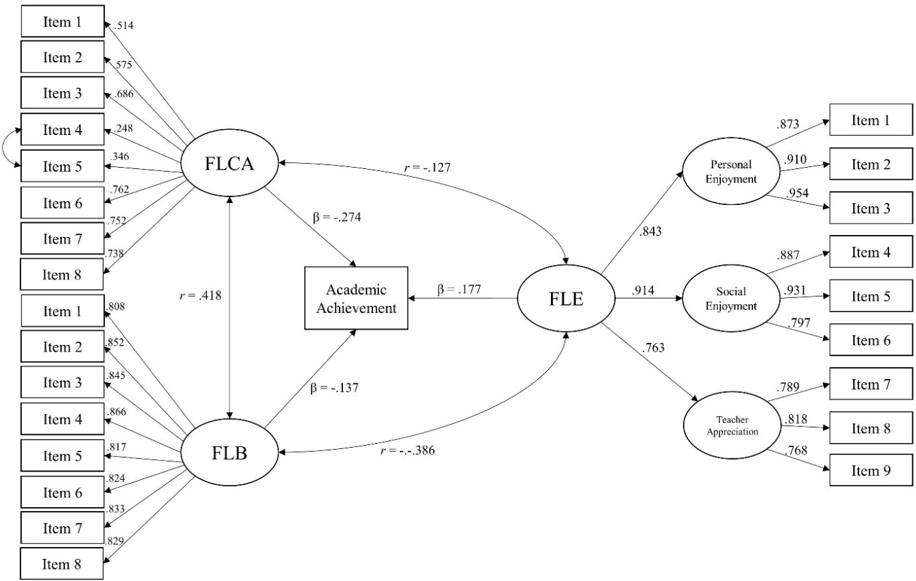
- In the structural equation model, all three emotions significantly predicted EFL academic achievement: FLCA (β = -.274), FLE (β = .177), and FLB (β = -.137), all p < .01.
- The latent dominance analysis gave the largest dominance estimate to FLCA (d = .092, SE = .028, p < .001), followed by FLB (d = .056, SE = .020, p < .01) and FLE (d = .036, SE = .020, p < .05).
- Bayes factor ordering supported the ranking FLCA > FLB > FLE: H1 vs Ha = 2.879, H2 vs Ha = 1.378, H3 vs Ha = 0.271; H1 was 2.089 times more supported than H2, and H1 was favored over H3 with BF = 10.636.
- Descriptively, participants reported mean scores of FLCA = 2.546, FLB = 1.903, FLE = 3.924, and academic achievement M = 75.398% (SD = 16.238).
Methods
- Cross-sectional survey study of 502 Moroccan EFL learners from secondary schools, universities, and language centers; data were collected online in June 2022 with snowball sampling.
- Measures: short-form FLCA scale, short-form FLE scale, FLB scale, and a single self-reported item for academic achievement (last exam mark in percentage).
- Analysis: descriptive statistics, correlations, reliability coefficients, structural equation modeling in lavaan, and latent dominance analysis with 5,000 bootstrap samples and Bayes factors.
Limitations
- The paper states that the SEM assumes emotions predict academic achievement, but spiral effects and nonlinear relationships cannot be excluded; this could not be tested because the dataset was cross-sectional.
- Academic achievement was measured with self-reported grades/test results rather than standardized achievement, and some participants reported grade averages while others reported test scores, which the authors say created measurement error.
- The authors say the results may not generalize beyond this relatively homogeneous Moroccan non-WEIRD sample; they also note that measurement invariance testing across WEIRD and non-WEIRD samples is needed.
Model-written summary. Check it against the paper before relying on it.
Integrity signals
Registry
Cites
Statistics
Figures
Verification
Claims the paper makes
4 Valid · 3 Not valid · 25 Not checked · 38 Own results and interpretations
The cited sources support only part of this claim — read each source’s verdict below.
In the paper
“These patterns correspond to the ones uncovered in previous research on both WEIRD and non-WEIRD populations (Dewaele, Botes, et al., 2023; Dewaele, Albakistani, et al., 2022; Li, 2022; Li & Han, 2022; Li et al., 2022).”
What the sources say
- Partly supportedcites Dewaele, Botes, et al., 2023 matched to “Sources and effects of foreign language enjoyment, anxiety, and boredom: A structural equation modeling approach” (2023) sourceExperimental — accuracy not yet measured
The Discussion (page not provided) reports the same pattern of relations among the three emotions and says the negative FLE–FLCA relationship confirms findings in different foreign-language populations. The Participants and Discussion sections describe a diverse sample but do not establish that these patterns were found separately in both WEIRD and non-WEIRD populations; the paper says it could not demonstrate context-specific effects. (LLM, conf=0.82)
- Not matchedcites Dewaele, Albakistani, et al., 2022
An author–year citation the paper’s reference list doesn’t settle. We don’t search these by name.
- Not matchedcites Li, 2022
This doesn’t read as a citation we can look up.
plainstates an association- Asserted: passes — The authors put it forward as true.
- Checkable: passes — It can be checked against evidence.
- Load-bearing: unclear — It is unclear whether the paper’s conclusions depend on it.
- Based: passes — The paper gives a reason why it holds.
- Partly supported
The cited sources that could be checked couldn’t confirm or dispute this claim.
In the paper
“Indeed, none of the descriptions of enjoyable episodes in Dewaele and MacIntyre (2014) included mentions of test or exam performance.”
What the sources say
- Could not verifycites Dewaele and MacIntyre (2014) matched to “The two faces of Janus? Anxiety and enjoyment in the foreign language classroom” (2014) sourceExperimental — accuracy not yet measured
Section 3.2 describes enjoyable episodes involving good performance and high marks on pieces of work, but does not identify these as test or exam results. The paper reports themes and selected descriptions rather than all responses, so our copy cannot establish that none of the episodes mentioned test or exam performance (searched: exam, test). (LLM, conf=0.70)
plain- Asserted: passes — The authors put it forward as true.
- Checkable: passes — It can be checked against evidence.
- Load-bearing: passes — The paper’s conclusions depend on it.
- Based: passes — The paper gives a reason why it holds.
- Could not verify
A result the paper reports from its own data — it cites no other source for it, so there is none to check. The quote shows it is in the paper.
In the paper
“Overall, the model indicated that all three emotions significantly predicted EFL Academic achievement (FLCA: β = -.274; FLE: β = .177; FLB: β = -.137; p < .01)”
hedgedstates a cause- Asserted: passes — The authors put it forward as true.
- Checkable: passes — It can be checked against evidence.
- Load-bearing: passes — The paper’s conclusions depend on it.
- Based: passes — The paper gives a reason why it holds.
- Rests on an assumption not shown here.
A result the paper reports from its own data — it cites no other source for it, so there is none to check. The quote shows it is in the paper.
In the paper
“As such, the analysis showed that FLCA had the largest general dominance estimate of all predictors, and the most important predictors of EFL Academic achievement in order was FLCA, followed by FLB, and lastly, FLE.”
- Also stated in: § Discussion · plain
“FLCA turned out to be the emotion that had the strongest effect on the English Academic achievement of Moroccan EFL learners, followed by FLB and FLE.”
- Also stated in: § Conclusion · hedged
“Our findings suggest that while all three emotions exert an influence on Academic achievement, FLCA dominates, followed by FLB, and finally by FLE.”
plainstates an association- Asserted: passes — The authors put it forward as true.
- Checkable: passes — It can be checked against evidence.
- Load-bearing: passes — The paper’s conclusions depend on it.
- Based: passes — The paper gives a reason why it holds.
- Rests on an assumption not shown here.
- Also stated in: § Discussion · plain
A result the paper reports from its own data — it cites no other source for it, so there is none to check. The quote shows it is in the paper.
In the paper
“In the comparisons between the hypotheses, the support for H1 was 2.089 times larger than the support for H2.”
plain- Asserted: passes — The authors put it forward as true.
- Checkable: passes — It can be checked against evidence.
- Load-bearing: passes — The paper’s conclusions depend on it.
- Based: passes — The paper gives a reason why it holds.
21 more claims
Create a free account to see all 70 claims and to verify the 1 reference still open.
- It may state two separate claims as one. 29
- Probably not a substantial claim. 21
- The quote only partly states this claim. 6
Statistics recomputed
Every reported test result, recomputed from its test statistic and degrees of freedom. A result shows as not adding up only once an independent check has confirmed it.
- Consistentχ²(290) = 896.97reported p < .001 · recomputed p < .001
“χ2 (290) = 896.97, p < .001”
Self-check
Percentages, sums and reported differences re-computed from the paper’s own numbers.
Self-check results appear here once an independent check has confirmed them.
Citations
Cites
Principles and Practice of Structural Equation Modeling
Tabri, N., & Elliott, C. M. (2012) · Canadian Graduate Journal of Sociology and Criminology · doi:10.15353/cgjsc-rcessc.v1i1.25 · Cited by 38,891
lavaan : An R Package for Structural Equation Modeling
Rosseel, Y. (2012) · Journal of Statistical Software · doi:10.18637/jss.v048.i02 · Cited by 27,955
The weirdest people in the world?
Henrich, J., Heine, S. J., & Norenzayan, A. (2010) · Behavioral and Brain Sciences · doi:10.1017/s0140525x0999152x · Cited by 12,641
Kass, R. E., & Raftery, A. E. (1995) · Journal of the American Statistical Association · doi:10.1080/01621459.1995.10476572 · Cited by 12,558
Positive psychology: An introduction.
Seligman, M. E. P., & Csikszentmihalyi, M. (2000) · American Psychologist · doi:10.1037/0003-066x.55.1.5 · Cited by 11,351 · cited 1×
“(Seligman & Csikszentmihalyi, 2000, p. 7) However, Ciarrochi et al. (2016) have complained that PP, and more specifically PP interventions in education, “is guilty of a […] pernicious set of errors” (p. 11).”
BackgroundForeign Language Classroom Anxiety
HORWITZ, E. K., HORWITZ, M. B., & COPE, J. (1986) · The Modern Language Journal · doi:10.1111/j.1540-4781.1986.tb05256.x · Cited by 9,773
(1985) · Cited by 4,527
2. The L2 Motivational Self System
Dörnyei, Z. (2009) · Motivation, Language Identity and the L2 Self · doi:10.21832/9781847691293-003 · Cited by 2,636
MACINTYRE, P. D., CLÉMENT, R., DÖRNYEI, Z., & NOELS, K. A. (1998) · The Modern Language Journal · doi:10.1111/j.1540-4781.1998.tb05543.x · Cited by 2,171 · cited 1×
“…between FLE and willingness to communicate (WTC), defined as the “readiness to enter into discourse at a particular time with a specific person or persons, using an L2” (MacIntyre et al., 1998, p. 547) and a moderate positive relationship emerged between FLE and FL academic achievement (r = .30).”
The Subtle Effects of Language Anxiety on Cognitive Processing in the Second Language
MacIntyre, P. D., & Gardner, R. C. (1994) · Language Learning · doi:10.1111/j.1467-1770.1994.tb01103.x · Cited by 1,823
Research works printed but not linked: 1
- Cixin, 2008, The three-body problem
Cited by
Items 101–169 of 169
Fu, L. (., Thomas, N., & Thomas, N. (2025) · Language Learning Journal · doi:10.1080/09571736.2025.2578720 · Cited by 5
Luo-Zhichun (2025) · Acta Psychologica · doi:10.1016/j.actpsy.2025.105920 · Cited by 3
Language Anxiety Identification in Social Media Using BERT
Zahra, R. A., & Lhaksmana, K. M. (2025) · International Conference on Intelligent Cybernetics Technology & Applications (ICICyTA) · doi:10.1109/icicyta68677.2025.11362538 · Cited by 2
“Previous studies have shown that language anxiety negatively affects academic performance, causing learners to avoid classroom activities, experience greater difficulty during examinations, and show reduced motivation and learning progress [4], [5].”
Zhao, X., Wang, S., Zhang, Y., & Liu, G. (2026) · Studies in Second Language Learning and Teaching · doi:10.14746/ssllt.53127 · Cited by 5
Jie, B., Sulaiman, N. A., & Shukor, S. S. (2024) · International Journal of Learning Teaching and Educational Research · doi:10.26803/ijlter.23.7.2 · Cited by 4
Pre-Service English Teachers’ Anxiety in Speaking English: A Case from an Indonesian Islamic College
Ashari, A., Hamiddin, H., Ainiyah, I., Khalidah, N. D., Ubaidillah, M. F., & Donald, K. M. (2023) · Jurnal Ilmu Pendidikan · doi:10.17977/um048v29i1p25-31 · Cited by 6
Botes, E., Dewaele, J., & Greiff, S. (2025) · Studies in Second Language Learning and Teaching · doi:10.14746/ssllt.50363 · Cited by 4
Self-citationThe Performance Assessment of Chinese Students in College and the Role of English Language
Bai, F. (2024) · Journal of Higher Education Theory and Practice · doi:10.33423/jhetp.v24i4.6945 · Cited by 1
Pan, L., Li, X., He, X., Luo, H., & Gu, Q. (2025) · Frontiers in Psychology · doi:10.3389/fpsyg.2025.1573713 · Cited by 6
“Dewaele et al. (2023) found that Moroccan EFL learners’ FLB had a significant negative effect on their English achievement and stated that it was the second most important emotional factor after FLA. Li (2022) and Zhao and Wang (2023b) found that the FLB of Chinese EFL learners can significantly…”
InfluentialExploring Chinese ethnic minority high school students’ boredom as they learn English in classroom
Zeng, J., Huang, Z., Chen, H., & Xu, L. (2025) · Asia Pacific Journal of Education · doi:10.1080/02188791.2025.2537389 · Cited by 1
The effect of learners’ psychological factors on motivational intensity in English language learning
Choi, E. (2025) · Social Sciences & Humanities Open · doi:10.1016/j.ssaho.2025.102047 · Cited by 2
Huang, Y., Li, D., Ma, J., Hou, Y., & Feng, Y. (2026) · International Journal of Applied Linguistics · doi:10.1111/ijal.70109 · Cited by 1
Unveiling the relationship between boredom and academic achievement: A three-level meta-analysis
Shui, J., & Zhu, Y. (2026) · Social Psychology of Education · doi:10.1007/s11218-026-10192-3 · Cited by 1
Zhang, X., Yang, L., & Cui, Y. (2026) · Innovation in Language Learning and Teaching · doi:10.1080/17501229.2026.2648082 · Cited by 2
When AI support shapes affect in L2 writing: Task-specific emotions across genre-based writing tasks
Jiang, Z., Huang, Z., & Yang, N. (2026) · System · doi:10.1016/j.system.2026.104041 · Cited by 3
Liu, H., & Yao, Y. (2026) · European Journal of Education · doi:10.1111/ejed.70632 · Cited by 1
Liu, F. (2026) · Frontiers in Psychology · doi:10.3389/fpsyg.2026.1795301 · Cited by 4
Wang, P., Ganushchak, L. Y., Welie, C., & van Steensel, R. (2026) · Educational Psychology Review · doi:10.1007/s10648-026-10141-8 · Cited by 4
Alrashidi, O., & Alenezy, F. S. (2026) · Frontiers in Education · doi:10.3389/feduc.2026.1797618 · Cited by 5
Incorporating digital multimodal composing into game-enhanced language learning
Le, K., Peterson, M., & Fan, Q. (2026) · Language learning & technology · doi:10.64152/10125/73686 · Cited by 2
“To this end, this study focused on how enjoyment and boredom, two key emotions identified as highly influential in learning (Dewaele et al., 2023), unfold in game-enhanced DMC and interact with learners’ DMC performance.”
Sun, W., & Pan, F. (2026) · Language Teaching · doi:10.1017/s0261444826101396 · Cited by 1
Exploring Foreign Language Anxiety in the Chinese EFL Classroom: A Case Study
Fu, F., Sidhu, G. K., Shamida, A., & Juan, L. (2023) · Environment-Behaviour Proceedings Journal · doi:10.21834/e-bpj.v8i25.4853 · Cited by 4
“Among the internal factors, language anxiety has received much attention (Dewaele et al., 2023).”
BackgroundErlina, M., & Okfalisa, O. (2023) · IT JOURNAL RESEARCH AND DEVELOPMENT · doi:10.25299/itjrd.2023.13562 · Cited by 1
Enjoyment and oral English proficiency in future teachers
Ayala, M. J. G., Navarro, E. R., Gómez, E. L. D., Lucana, A. F., Catacora, M. A. D. P. C., Onofre, E. V., & Checa, E. C. (2024) · Frontiers in Education · doi:10.3389/feduc.2024.1306080 · Cited by 10
Sources of geography class enjoyment and boredom among bhutanese secondary school students
Rigdel, K. S., & Kezang, Y. (2024) · i-manager’s Journal on Educational Psychology · doi:10.26634/jpsy.17.3.20380 · Cited by 3
Menegale, M., & Spricigo, L. (2024) · Studies in Self-Access Learning Journal · doi:10.37237/150205 · Cited by 2
Psychology of Language Learning
Dewaele, J., & Botes, E. (2025) · Elsevier eBooks · doi:10.1016/b978-0-323-95504-1.00523-8 · Cited by 2
Self-citationHao, Y., & Sun, J. (2025) · Research Square · doi:10.21203/rs.3.rs-7750527/v1 · Cited by 1
Li, X. (2023) · Lecture Notes in Education Psychology and Public Media · doi:10.54254/2753-7048/31/20231404 · Cited by 1
Acemioğlu, R. (2025) · Uluslararası Anadolu Sosyal Bilimler Dergisi · doi:10.47525/ulasbid.1604123
Peer Tutors’ Agency and Emotions in Tertiary English Language Education in Vietnam
Pham, C. H., & Ngo, N. T. D. (2025) · JEELS (Journal of English Education and Linguistics Studies) · doi:10.30762/jeels.v12i1.4608
“This finding is in line with contemporary research suggesting that positive emotions such as enjoyment could mitigate anxiety and boredom, leading to a more productive learning environment (Dewaele et al., 2023; MacIntyre & Gregersen, 2012; MacIntyre & Vincze, 2017; Richards, 2020).”
InfluentialValidating the Japanese Version of the Short-Form Foreign Language Enjoyment ScalePreprint
Xethakis, L. J., Rupp, M., Edwards, O. E., et al. (2025) · SSRN Electronic Journal · doi:10.2139/ssrn.5349560
The Effect of Learners’ Psychological Factors on Motivational Intensity in English Language LearningPreprint
Choi, E. (2025) · SSRN Electronic Journal · doi:10.2139/ssrn.5385256
Positive and Negative Emotions of Chinese as a Second Language Learners and the Influencing Factors
Li, J., & Tsung, L. (2025) · SAGE Open · doi:10.1177/21582440251367146 · Cited by 3
“To date, anxiety, enjoyment and boredom have been identified as a ‘three-body problem’ in emotion research due to their prominent effect on learners’ language learning performance (J.-M. Dewaele et al., 2023).”
InfluentialProxy variables in measuring L2 proficiency: The price of convenience
Botes, E., Przybył, J., Meftah, R., & Brady, I. K. (2026) · Research Methods in Applied Linguistics · doi:10.1016/j.rmal.2026.100341
Self-citationAmini, F., Amirian, Z., & Tavakoli, M. (2025) · Research Square · doi:10.21203/rs.3.rs-8058746/v1 · Cited by 1
Bassetti, B. (2025) · The Encyclopedia of Applied Linguistics · doi:10.1002/9781405198431.wbeal20235
The Effects of Negative Emotions and Negative Personality Traits on Academic Achievement
Erdem, C., Kaya, M., & Polat, M. (2025) · Buca eğitim fakültesi dergisi (Online)/Buca Eğitim Fakültesi dergisi · doi:10.53444/deubefd.1551806 · Cited by 1
Jurikova, I. (2025) · East European Journal of Psycholinguistics · doi:10.29038/jur · Cited by 7
Kong, Q.-Q., & Baharum, H. I. (2026) · Frontiers in Psychology · doi:10.3389/fpsyg.2025.1701352
Marton, A. Š. (2026) · Acta Universitatis Sapientiae Philologica · doi:10.47745/ausp-2025-0023
Jin, Y., Yan, J., & Wei, Q. (2026) · European Journal of Education · doi:10.1111/ejed.70572 · Cited by 2
Strategies-Based Instruction Targeting Grammar Learning Strategies and Individual Differences
Pawlak, M., Kruk, M., & Zawodniak, J. (2026) · Second language learning and teaching · doi:10.1007/978-3-032-18663-8_3
외국어 학습 애플리케이션을 활용한 문법 수업, 학습 동기 및 흥미도가 영어 문법 학습 성취도에 미치는 영향
Jung, Y., & Lee, N. (2026) · Modern English Education · doi:10.18095/meeso.2026.27.1.123
The associations between L2 emotions and willingness to communicate: A meta-analysis
Man, D., & Gu, H. (2026) · Educational Research Review · doi:10.1016/j.edurev.2026.100806 · Cited by 1
Hu, L., & Zhang, X. (2026) · Frontiers in Psychology · doi:10.3389/fpsyg.2026.1830536
“This finding resonates with evidence that positive emotions fuel agentic involvement (Feng and Hong, 2022; Dewaele et al., 2023; Lin and Wang, 2025) and aligns with the broaden-and-build framework (Fredrickson, 2004).”
Wong, W. L., & Cheung, S. H. (2026) · Educational Psychology · doi:10.1080/01443410.2026.2685750
Xu, J. (2026) · European Journal of Education · doi:10.1111/ejed.70720 · Cited by 1
Zhang, P. (2026) · Acta Psychologica · doi:10.1016/j.actpsy.2026.107239
Luo, H. (2026) · Language Teaching · doi:10.1017/s0261444826101360 · Cited by 6
Yan, Y., & Yang, G. (2026) · International Journal of Applied Linguistics · doi:10.1111/ijal.70288
Body image and language anxiety: a mixed-methods study of affective factors
Ünsal, F., & KASAP, S. (2026) · Current Psychology · doi:10.1007/s12144-026-09771-6
“…schol - arship increasingly argues that FLA should not be under - stood solely in terms of performance outcomes but rather as a phenomenon embedded within broader cognitive, affective, social, intercultural, communicative, and identity-related contexts of language learning (Dewaele et al., 2023).”
Kashimura, Y., & Nakamura, H. (2026) · Research Synthesis in Applied Linguistics · doi:10.1080/29984475.2026.2701736
Syakur, A., & Slamet, J. (2026) · Journal of Applied Research in Higher Education · doi:10.1108/jarhe-04-2026-0726 · Cited by 1
Alleviating the Burden of Anxiety: Enjoyment as a Shield for Foreign Language Self-Efficacy
Ölmez-Çağlar, F., & Ölmez, G. N. (2026) · Sakarya University Journal of Education · doi:10.19126/suje.1891637
Qu, G., Lyu, Z., & Yang, Q. (2026) · Journal of Computer Assisted Learning · doi:10.1002/jcal.70293 · Cited by 3
Tsang, A., & Kam Tai, K. W. A. N. (2026) · TESOL Quarterly · doi:10.1002/tesq.70201
Dewaele, J., & González, J. O. (2026) · Second language learning and teaching · doi:10.1007/978-3-032-30199-4_6 · Cited by 1
Self-citationLi, C., & Sun, P. P. (2026) · Innovation in Language Learning and Teaching · doi:10.1080/17501229.2026.2709149
Kruk, M., & Pawlak, M. (2026) · International Journal of Applied Linguistics · doi:10.1111/ijal.70336
Liu, X., & Lou, B. (2026) · European Journal of Education · doi:10.1111/ejed.70857
Hong, L., & Zhan, Q. (2026) · Frontiers in Psychology · doi:10.3389/fpsyg.2026.1895962 · Cited by 3
“…in SLA, catalyzed by the introduction of Positive Psychology, has expanded the field’s horizon to encompass a wider spectrum of emotions (Dewaele and Li, 2020 enjoyment, anxiety, and boredom as the “three stars orbiting each other in an unstable three-body system” (Dewaele et al., 2023, p. 7).”
Wang, R., Jiang, S., Liu, Y., & Wang, R. (2026) · Frontiers in Psychology · doi:10.3389/fpsyg.2026.1887486
Baleghizadeh, S., & Ahmadi, P. (2026) · Discover Education · doi:10.1007/s44217-026-02084-7
“Research on EFL teachers’ enjoyment is still emerging compared with the abundance of studies focused on EFL learners’ enjoyment [15, 21, 23].”
Puerto, G. D., de Alda, J. A. G. O., Nieto, C. M., & Burns, L. V. F. (2026) · Research Square · doi:10.21203/rs.3.rs-11160449/v1
The effects of trait mindfulness on Chinese EFL learners’ public speaking anxiety
Fu, L. (2026) · Discover Education · doi:10.1007/s44217-026-02189-z
“Focusing on positive personal experiences, for example, a sharp increase in number of FLA research has focused on FLA, together with positive emotions such as enjoyment, and negative emotions such as boredom, providing a holistic view to better understand FLA [23, 24, 88, 97].”
Foreign language speaking anxiety and discourse markers in face-to-face and online classes
Efeoğlu, G., & Yurdagül, B. (2026) · Discover Education · doi:10.1007/s44217-026-02220-3
“Dewaele et al. [13] states that “their [emotions] particular combinations in the classroom can silence and freeze learners or excite and warm them, which will affect the trajectory of their language-learning journey.”
Metadata
- Authors
- Dewaele, J.-M., Botes, E., & Meftah, R.
- Affiliations
- Birkbeck, University of London (GB)
- University of Vienna (AT)
- Corresponding author
- Dewaele, Jean-Marc
- Venue
- Annual Review of Applied Linguistics
- Publisher
- Cambridge University Press (CUP)
- Published
- 2023-03
- Volume
- 43
- Pages
- 7-22
- ISSN
- 0267-1905 (ISSN-L)
- 1471-6356
- OpenAlex
- W4380047113
- Semantic Scholar
- c6679b687082b28dcf71a04561305573e3f2603b
- Cited by
- 207
- References
- 53
- Citations by year
- 2026: 69 · 2025: 71 · 2024: 51 · 2023: 15
- FWCI
- 132.62
- Type
- journal article
- Language
- en
- Open access
- bronze
- doi.org
- Locations
- Annual Review of Applied Linguistics (publishedVersion)
- BIROn (Birkbeck, University of London) (acceptedVersion)
- Open Repository and Bibliography (University of Luxembourg) (submittedVersion, other-oa)
- Topics
- Social Sciences › Arts and Humanities › Language and Linguistics › EFL/ESL Teaching and Learning
- Social Sciences › Psychology › Developmental and Educational Psychology › Education, Achievement, and Giftedness
- Social Sciences › Psychology › Developmental and Educational Psychology › Second Language Acquisition and Learning
- Keywords
- foreign language anxiety, foreign language enjoyment, academic performance, EFL learners, Moroccan students
About these checks
Registry, retraction, Cites and statistics results are computed, not judged, with one exception: a printed reference that no index lists is read once by a model before it counts as a citation error. Claims are extracted by a model and kept only when their quote appears verbatim in the text; each cited source is then checked, with a model’s help, for whether it says what the claim relies on. Those verdicts can be wrong — read the claim’s quote and the cited source before relying on one.
The claim verdicts this report counts are experimental: their accuracy is not yet measured.
A language model drew the claims from the paper on 2026-10-10, under version 3 of the claim definition (model deepseek-v4.1-flash, prompt extract-v3).
A second model labelled each claim on 2026-10-10 (model jev-1.13-20260917, definition revision gold-guideline-v0.2).
Cited sources are checked with a language model’s help (gpt-6-sol).
Statistics and arithmetic are recomputed, not judged.
Confidence bands are shown only for fields calibrated on our annotated test set. None is calibrated yet, so no band is shown.
What counts as a claim ›How we measure confidence ›How we check this ›
Are you an author, or do you see a problem with this page? Request a review
Data sources
Bibliographic data: Semantic Scholar, OpenAlex, Crossref.
Contains information from the Semantic Scholar Academic Graph Datasets, made available under the ODC Attribution License (ODC-BY 1.0).
Semantic Scholar’s data is described in: Kinney, R., et al. (2023). The Semantic Scholar Open Data Platform. arXiv:2301.10140.
