

Childhood adversities and adolescent depression: A matter of both risk and resilience
Open accessThe DOI matches its Crossref record; 50 of the 50 references it cites were found in a registry or an index; 4 of the 15 sources its claims cite were checked for support.
Abstract
Childhood adversities have been proposed to modify later stress sensitivity and risk of depressive disorder in several ways: by stress sensitization, stress amplification, and stress inoculation. Combining these models, we hypothesized that childhood adversities would increase risk of early, but not later, onsets of depression (Hypothesis 1). In those without an early onset, childhood adversities were hypothesized to predict a relatively low risk of depression in high-stress conditions (Hypothesis 2a) and a relatively high risk of depression in low-stress conditions (Hypothesis 2b), compared to no childhood adversities. These hypotheses were tested in 1,584 participants of the Tracking Adolescents' Individual Lives Survey, a prospective cohort study of adolescents. Childhood adversities were assessed retrospectively at ages 11 and 13.5, using self-reports and parent reports. Lifetime DSM-IV major depressive episodes were assessed at age 19, by means of the Composite International Diagnostic Interview. Stressful life events during adolescence were established using interview-based contextual ratings of personal and network events. The results provided support for all hypotheses, regardless of the informant and timeframe used to assess childhood adversities and regardless of the nature (personal vs. network, dependent vs. independent) of recent stressful events. These findings suggest that age at first onset of depression may be an effective marker to distinguish between various types of reaction patterns.
Overview
CoChat Summary
TL;DR
Childhood adversities in this TRAILS cohort strongly predicted early depression onset, with the effect waning with age, and among adolescents without early onset they predicted lower depression risk under high recent stress but higher risk under low recent stress. The authors conclude age at first onset may mark distinct risk/resilience patterns.
Key findings
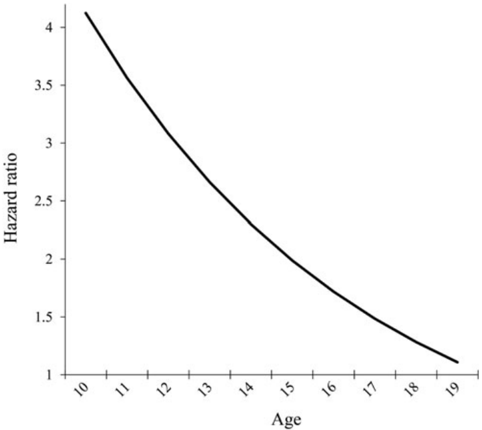
- Of 1,584 adolescents, 17% had a lifetime major depressive episode (MDE). Childhood adversity factor score increased early depression onset (main effect: B = 2.88, SE = 0.20, p < .001, hazard ratio = 17.8), and the effect decreased with age (adversity × age: B = −0.15, SE = 0.01, p < .001, hazard ratio = 0.9).
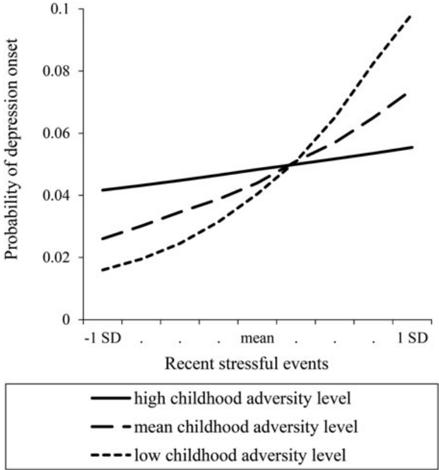
- In 801 adolescents without depression onset before T3, recent life events predicted MDE onset (B = 0.55, SE = 0.14, p < .001, relative risk = 1.7), childhood adversities had no significant main effect (B = 0.09, SE = 0.16, p = .57, relative risk = 1.1), and the adversity × recent events interaction was negative (B = −0.40, SE = 0.15, p = .006, relative risk = 0.7).
- Regions of significance showed childhood adversity had a significant positive effect on depression probability below −0.76 SD recent stress and a significant negative effect above +1.55 SD. Simple slopes: recent events predicted onset at low (B = 0.95, SE = 0.20, p < .001) and mean (B = 0.55, SE = 0.14, p < .001) childhood adversity, but not high childhood adversity (B = 0.14, SE = 0.20, p = .48).
- In 74 adolescents with remitted early onset, 28 developed an episode between T3 and T4; the interaction was near zero (B = −0.01, SE = 0.21, p = .96, odds ratio = 1.0), suggesting the modifying effect did not pertain to the early-onset group. Findings were reported as robust across informant, timeframe, and event nature.
Methods
- Prospective TRAILS cohort of Dutch adolescents with four waves: T1 mean age 11.1, T2 13.6, T3 16.3, T4 19.1. At T4, 1,584 agreed to diagnostic interview; the life events interview was administered to 957, with adolescents with a psychiatric diagnosis oversampled.
- Childhood adversities were assessed at T2 via parent and self reports of overall stressfulness at ages 0–5 and 6–11, combined into a factor score. Lifetime DSM-IV MDE was assessed at T4 with the Composite International Diagnostic Interview (CIDI 3.0); recent stressful events between T3 and T4 were assessed with Kendler’s Life Stress Interview using contextual interviewer ratings.
- Cox proportional hazards regression tested age of first MDE onset with childhood adversity and adversity × age; logistic regression tested MDE onset with childhood adversities, recent stressful events, and their interaction, with gender as covariate. Hypothesis 2 was tested in 801 adolescents without onset before T3 and repeated in 74 with remitted early onset.
Limitations
- Stated: childhood adversities were assessed retrospectively as overall stressfulness, so respondents’ depressive symptoms may have influenced ratings; CIDI onset ages in years limited temporal precision and could include events after onset; childhood/early adolescent life events measures were too inaccurate to test early-onset stress sensitivity; analyses focused on depressive disorder only and ignored co-occurring conditions.
- Stated: gene–environment correlations could partly explain associations, though the authors argue the complex and heterogeneous associations argue against this as the sole reason.
- Evident: the life events interview was not administered to the full T4 sample and oversampled those with past-year psychiatric diagnosis; interviewed participants were more often female, younger, and reported more depressive symptoms than non-interviewed participants; the recurrence subsample was small (74), so statistical comparison with the no-early-onset group was prohibited.
Model-written summary. Check it against the paper before relying on it.
Integrity signals
Registry
Cites
Statistics
Figures
Verification
Claims the paper makes
3 Valid · 1 Not valid · 4 Not checked · 28 Own results and interpretations
At least one cited source doesn’t support this claim or points to a different paper, and none confirmed it — see the verdicts below.
In the paper
“A higher depression risk of exposed individuals in favorable, low-stress conditions may be the price that has to be paid because the acquired insensitivity is not necessarily restricted to negative experiences, but could also involve experiences that can enhance positive affect”
What the sources say
- Not checked — no full text of the sourcecites Ellis, Boyce, Belsky, Bakermans-Kranenburg, & van IJzendoorn, 2011 matched to “Differential susceptibility to the environment: an evolutionary--neurodevelopmental theory” (2011) source
- Not checked — no full text of the sourcecites Fergusson, Horwood, & Shannon, 1984 matched to “Relationship of family life events, maternal depression, and child-rearing problems” (1984) source
- Disputedcites Hankin et al., 2011 matched to “Differential susceptibility in youth: evidence that 5-HTTLPR x positive parenting is associated with positive affect ‘for better and worse’” (2011) sourceExperimental — accuracy not yet measured
Split into 2 atoms — 0 confirmed, 1 partially supported, 1 disputed, 0 misattributed, 0 unverifiable. Expand the claim to see per-atom verdicts.
Checked by a reasoning model — may be wrong.
hedgedstates a possible cause- Asserted: passes — The authors put it forward as true.
- Checkable: passes — It can be checked against evidence.
- Load-bearing: passes — The paper’s conclusions depend on it.
- Based: passes — The paper gives a reason why it holds.
- Rests on an assumption not shown here.
The sources with a verdict support this claim; the rest weren’t checked yet, have no full text we could read, or their verdicts aren’t rated yet.
In the paper
“We postulate that children who are able to manage the challenges well can gain toughness and mastery to cope with future stressors”
What the sources say
- Not checked — no full text of the sourcecites Koolhaas et al., 2011 matched to “Stress revisited: a critical evaluation of the stress concept” (2011) source
- Supportedcites Seery et al., 2010 matched to “Whatever does not kill us: cumulative lifetime adversity, vulnerability, and resilience” (2010) source
The Role of Adversity in Fostering Subsequent Resilience (p. 3) says manageable, low-to-moderate adversity can promote toughness and mastery that help with later stressors. The same section discusses children with moderate early-life adversity, so the citing sentence’s hedged proposal about children is consistent with the paper, though the mechanism is presented as a possibility rather than a demonstrated causal finding. (LLM, conf=0.88)
plainstates a cause- Asserted: passes — The authors put it forward as true.
- Checkable: passes — It can be checked against evidence.
- Load-bearing: passes — The paper’s conclusions depend on it.
- Based: passes — The paper gives a reason why it holds.
A result the paper reports from its own data — it cites no other source for it, so there is none to check. The quote shows it is in the paper.
In the paper
“Of the 1,584 adolescents included in this study, 17% had a lifetime diagnosis of MDE.”
plain- Asserted: passes — The authors put it forward as true.
- Checkable: passes — It can be checked against evidence.
- Load-bearing: unclear — It is unclear whether the paper’s conclusions depend on it.
- Based: passes — The paper gives a reason why it holds.
A result the paper reports from its own data — it cites no other source for it, so there is none to check. The quote shows it is in the paper.
In the paper
“The results provided support for all hypotheses”
plainn = 1,584- Asserted: passes — The authors put it forward as true.
- Checkable: passes — It can be checked against evidence.
- Load-bearing: passes — The paper’s conclusions depend on it.
- Based: passes — The paper gives a reason why it holds.
A result the paper reports from its own data — it cites no other source for it, so there is none to check. The quote shows it is in the paper.
In the paper
“Forty-three adolescents developed a first onset of depression between T3 and T4.”
plain- Asserted: passes — The authors put it forward as true.
- Checkable: passes — It can be checked against evidence.
- Load-bearing: passes — The paper’s conclusions depend on it.
- Based: passes — The paper gives a reason why it holds.
17 more claims
Create a free account to see all 36 claims and to verify the 3 references still open.
- Probably not a substantial claim. 8
- It may state two separate claims as one. 10
- The quote only partly states this claim. 1
Claims other papers make about this one
Each is checked against this paper’s own text: does it say what the citing paper says it does?
The source backs part of the claim, not all of it — or backs it for a different population, condition or comparison.
In the citing paper
“individuals with an ELS history are more prone to developing an MDE under less amounts of recent life stress than those without an ELS history (54,55).”
From The Impact of Stress and Major Depressive Disorder on Hippocampal and Medial Prefrontal Cortex Morphology (2019) · cites this paper as [55]
Experimental — accuracy not yet measured
Self-check
Percentages, sums and reported differences re-computed from the paper’s own numbers.
Each contradiction between two passages listed here was confirmed by an independent check.
Rated minor: it would not touch a result — a value no result rests on, a p-value that stays on the same side of the significance level, or a conflict that is clerical, resolved elsewhere in the paper, or outside its own findings.
In the paper
§ Abstract · p. 4
“a follow-up period of over 10 years”
§ Discussion · p. 8
“a follow-up period of almost 10 years”
Rated minor: it would not touch a result — a value no result rests on, a p-value that stays on the same side of the significance level, or a conflict that is clerical, resolved elsewhere in the paper, or outside its own findings.
In the paper
“At T1, 2,230 (pre)adolescents were enrolled in the study (response rate 76%, mean age ¼ 11.1, SD ¼ 0.6, 51% girls; De Winter et al., 2005), of whom 96% ( N ¼ 2,149, mean age ¼ 13.6, SD ¼ 0.5, 51% girls) participated at T2. The response rates at T3 and T4 were, respectively, 81% ( N ¼ 1,816, mean age ¼ 16.3, SD ¼ 0.7, 52% girls) and 83% ( N ¼ 1,881, mean age ¼ 19.1, SD ¼ 0.6, 52% girls).”
Reported 83 · recomputed 84.349776
Rated minor: it would not touch a result — a value no result rests on, a p-value that stays on the same side of the significance level, or a conflict that is clerical, resolved elsewhere in the paper, or outside its own findings.
In the paper
§ Discussion · p. 7
“as evidenced by a lower probability of depression onset in current high-stress, and a lower probability in current low-stress conditions.”
§ Childhood adversities and onset of depression · p. 6
“As hypothesized, at recent low-stress conditions, the probability of depression onset was higher for adolescents exposed to many childhood adversities than for those exposed to few adversities, while at recent high-stress conditions, their probability was lower.”
Rated minor: it would not touch a result — a value no result rests on, a p-value that stays on the same side of the significance level, or a conflict that is clerical, resolved elsewhere in the paper, or outside its own findings.
In the paper
§ Abstract · p. 2
“Childhood adversities were assessed retrospectively at ages 11 and 13.5, using self-reports and parent reports.”
§ Measures · p. 4
“Exposure to childhood adversities was assessed at T2, by means of parent- and self-reported ratings of overall stressfulness of the child's life between ages 0-5 and 6-11, respectively.”
Citations
Cites
Kessler, R. C., & Üstün, T. B. (2004) · International Journal of Methods in Psychiatric Research · doi:10.1002/mpr.168 · Cited by 4,771
Why do many psychiatric disorders emerge during adolescence?
Paus, T., Keshavan, M., & Giedd, J. N. (2008) · Nature Reviews Neuroscience · doi:10.1038/nrn2513 · Cited by 3,123
Hankin, B. L., Abramson, L. Y., Moffitt, T. E., Silva, P. A., McGee, R., & Angell, K. E. (1998) · Journal of Abnormal Psychology · doi:10.1037/0021-843x.107.1.128 · Cited by 2,333 · cited 1×
“Adolescence is a particularly informative life phase to investigate consequences of childhood adversities on depression, because it is characterized by a high incidence of major depression (Hankin et al., 1998; Oldehinkel, Wittchen, & Schuster, 1999) and many potentially stressful challenges (Nelson, Leibenluft, McClu…”
BackgroundBOYCE, W. T., & ELLIS, B. J. (2005) · Development and Psychopathology · doi:10.1017/s0954579405050145 · Cited by 2,078
Implications of resilience concepts for scientific understanding
RUTTER, M. (2006) · Annals of the New York Academy of Sciences · doi:10.1196/annals.1376.002 · Cited by 1,648 · cited 1×
“The SI model starts from a completely different premise: that childhood adversities may protect against the effects of later life stress (Andrews, Page, & Neilson, 1993), because of “steeling” effects (Lyons & Parker, 2007; Rutter, 2006).”
BackgroundStress revisited: a critical evaluation of the stress concept
Koolhaas, J. M., Bartolomucci, A., Buwalda, B., de Boer, S. F., Flügge, G., Korte, S. M., Meerlo, P., Murison, R., Olivier, B., Palanza, P., et al. (2011) · Neuroscience & Biobehavioral Reviews · doi:10.1016/j.neubiorev.2011.02.003 · Cited by 1,626
Differential susceptibility to the environment: an evolutionary--neurodevelopmental theory
Ellis, B. J., Boyce, W. T., Belsky, J., Bakermans-Kranenburg, M. J., & van Ijzendoorn, M. H. (2011) · Development and Psychopathology · doi:10.1017/s0954579410000611 · Cited by 1,564 · cited 1×
“Rather, they seem to be optimally adapted to stressful environments, which they can stand better than can adolescents not exposed to childhood adversities (Del Giudice, Ellis, & Shirtcliffe, 2011; Ellis et al., 2011).”
BackgroundFor Better and For Worse: Differential Susceptibility to Environmental Influences
Belsky, J., Bakermans-Kranenburg, M. J., & van IJzendoorn, M. H. (2007) · Current Directions in Psychological Science · doi:10.1111/j.1467-8721.2007.00525.x · Cited by 1,515
The Adaptive Calibration Model of stress responsivity
Del Giudice, M., Ellis, B. J., & Shirtcliff, E. A. (2011) · Neuroscience & Biobehavioral Reviews · doi:10.1016/j.neubiorev.2010.11.007 · Cited by 1,373
Hankin, B. L., & Abramson, L. Y. (2001) · Psychological Bulletin · doi:10.1037/0033-2909.127.6.773 · Cited by 1,343
Research works printed but not linked: 2
- Achenbach, T. M., & Rescorla, L. A. (2003). Manual for the ASEBA adult forms & profiles . Burlington, VT: University of Vermont, Department of Psychiatry.
- American Psychiatric Association. (2000). Diagnostic and statistical manual of mental disorders (4th ed., text rev.). Arlington, VA: Author.
Cited by
for the ENIGMA-Major Depressive Disorder Working Group, Schmaal, L., Veltman, D. J., van Erp, T. G. M., Sämann, P. G., Frodl, T., Jahanshad, N., Loehrer, E., Tiemeier, H., Hofman, A., et al. (2016) · Molecular Psychiatry · doi:10.1038/mp.2015.69 · Cited by 1,172
Malhi, G. S., Bassett, D., Boyce, P., Bryant, R., Fitzgerald, P. B., Fritz, K., Hopwood, M., Lyndon, B., Mulder, R., Murray, G., et al. (2015) · Australian & New Zealand Journal of Psychiatry · doi:10.1177/0004867415617657 · Cited by 842
“…from stress (Southwick and Charney, 2012) and is not simply the absence of vulnerability: There is evidence that resilience plays an independent (mitigating) role across the three stages of mood disorder (Davydov et al., 2010; Friedman et al., 2014; Oldehinkel et al., 2014; Rutten et al., 2013).”
BackgroundBelleau, E. L., Treadway, M. T., & Pizzagalli, D. A. (2019) · Biological Psychiatry · doi:10.1016/j.biopsych.2018.09.031 · Cited by 550
“Consistent with the stress sensitization model, longitudinal research examining relationships among ELS, recent life stressors, and development of MDEs has shown that individuals with an ELS history are more prone to developing an MDE under less amounts of recent life stress than those without an ELS history (54,55).”
Dunn, E. C., Nishimi, K., Powers, A., & Bradley, B. (2017) · Journal of Psychiatric Research · doi:10.1016/j.jpsychires.2016.09.004 · Cited by 275
“Three prospective studies (English et al., 2005; Jaffee and MaikovichFong, 2011; Oldehinkel et al., 2014) and two retrospective studies (Manly et al.”
BackgroundCohort Profile Update: The TRacking Adolescents' Individual Lives Survey (TRAILS)
Oldehinkel, A. J., Rosmalen, J. G., Buitelaar, J. K., Hoek, H. W., Ormel, J., Raven, D., Reijneveld, S. A., Veenstra, R., Verhulst, F. C., Vollebergh, W. A., et al. (2015) · International Journal of Epidemiology · doi:10.1093/ije/dyu225 · Cited by 212
Self-citationThe complex neurobiology of resilient functioning after childhood maltreatment
Ioannidis, K., Askelund, A. D., Kievit, R. A., & van Harmelen, A.-L. (2020) · BMC Medicine · doi:10.1186/s12916-020-1490-7 · Cited by 162
Hankin, B. L. (2015) · Current Opinion in Psychology · doi:10.1016/j.copsyc.2015.01.003 · Cited by 142
The Long-Term Impact of Parental Mental Health on Children’s Distress Trajectories in Adulthood
Kamis, C. (2020) · Society and Mental Health · doi:10.1177/2156869320912520 · Cited by 182
“Finally, research suggests that childhood stressors may only be relevant for children’s health early in the life course and that the impact of childhood stressors wanes as individuals age (Oldehinkel et al. 2014; Schaan 2014; Schafer and Ferraro 2013).”
BackgroundRecognizing the role of the vagus nerve in depression from microbiota-gut brain axis
Tan, C., Yan, Q., Ma, Y., Fang, J., & Yang, Y. (2022) · Frontiers in Neurology · doi:10.3389/fneur.2022.1015175 · Cited by 130
“However, some indicated that those suffered childhood adversities without an early onset, seemed to gain benefit from childhood adversities, showing resilience to depression in high-stress, which suggests that it may be effective to distinguish between various types of reaction patterns based on the age at first onset…”
BackgroundMalhi, G. S., Outhred, T., Hamilton, A., Boyce, P. M., Bryant, R., Fitzgerald, P. B., Lyndon, B., Mulder, R., Murray, G., Porter, R. J., et al. (2018) · Medical Journal of Australia · doi:10.5694/mja17.00659 · Cited by 92
Ellis, B. J., Oldehinkel, A. J., & Nederhof, E. (2017) · Development and Psychopathology · doi:10.1017/s0954579416000985 · Cited by 90
Self-citationAdvance in Stress for Depressive Disorder
Ding, Y., & Dai, J. (2019) · Advances in experimental medicine and biology · doi:10.1007/978-981-32-9271-0_8 · Cited by 98
Scarf, D., Moradi, S., McGaw, K., Hewitt, J., Hayhurst, J. G., Boyes, M., Ruffman, T., & Hunter, J. A. (2016) · British Journal of Social Psychology · doi:10.1111/bjso.12151 · Cited by 77
Dunn, E. C., Nishimi, K. M., Neumann, A., Renaud, A., Cecil, C. A. M., Susser, E., & Tiemeier, H. W. (2019) · Journal of the American Academy of Child & Adolescent Psychiatry · doi:10.1016/j.jaac.2019.02.022 · Cited by 83
The Timing Effect of Childhood Maltreatment in Depression: A Systematic Review and meta-Analysis
Li, M., Gao, T., Su, Y., Zhang, Y., Yang, G., D’Arcy, C., & Meng, X. (2022) · Trauma Violence & Abuse · doi:10.1177/15248380221102558 · Cited by 68
“However, other studies, both prospective (Jaffee & Maikovich-Fong, 2011; Oldehinkel et al., 2014) and retrospective (Dunn, Wang et al.”
BackgroundA longitudinal perspective on childhood adversities and onset risk of various psychiatric disorders
Oldehinkel, A. J., & Ormel, J. (2014) · European Child & Adolescent Psychiatry · doi:10.1007/s00787-014-0540-0 · Cited by 62
Self-citationStarr, L. R., Dienes, K., Stroud, C. B., Shaw, Z. A., Li, Y. I., Mlawer, F., & Huang, M. (2017) · Development and Psychopathology · doi:10.1017/s0954579417001468 · Cited by 38
Selous, C., Kelly-Irving, M., Maughan, B., Eyre, O., Rice, F., & Collishaw, S. (2020) · Psychological Medicine · doi:10.1017/s003329171900271x · Cited by 34
“The few population cohort studies that have tested associations between prospectively assessed cumulative indices of child adversity and depression show strong associations in adolescence (Oldehinkel et al., 2014; Newbury et al., 2018) and early-to-middle adulthood (Clark et al.”
BackgroundJohnson, E. I., Arditti, J. A., & McGregor, C. M. (2018) · Journal of Child and Family Studies · doi:10.1007/s10826-018-1045-0 · Cited by 41
Yehuda, R., & Meaney, M. J. (2018) · Biological Psychiatry · doi:10.1016/j.biopsych.2017.10.027 · Cited by 30
“A parallel is found in longitudinal studies showing that adolescents exposed to high levels of childhood adversity may be at decreased risk for depression in high-stress environments, suggesting protective adaption (10).”
ResultSchuler, K. L., Ruggero, C. J., Goldstein, B. L., Perlman, G., Klein, D. N., & Kotov, R. (2017) · Journal of Adolescent Health · doi:10.1016/j.jadohealth.2017.06.005 · Cited by 30
Wei, X., & Lu, W. D. (2023) · Journal of Adolescence · doi:10.1002/jad.12150 · Cited by 37
Dunn, E. C., Wang, Y., Tse, J., McLaughlin, K. A., Fitzmaurice, G. M., Gilman, S. E., & Susser, E. (2017) · The British Journal of Psychiatry · doi:10.1192/bjp.bp.117.208397 · Cited by 33
Davies, P. T., Thompson, M. J., Martin, M. J., & Cummings, E. M. (2021) · Child Development · doi:10.1111/cdev.13451 · Cited by 27
Donovan, A., Assari, S., Grella, C. E., Shaheen, M. A., Richter, L., & Friedman, T. C. (2024) · Frontiers in Neuroendocrinology · doi:10.1016/j.yfrne.2024.101121 · Cited by 27
“In a longitudinal study of adolescents, Oldehinkel et al. (2014) examined the effect of ELS across the first 11 years of life on later depression onset after recent stressful life events.”
BackgroundLecarie, E. K., Doane, L. D., Stroud, C. B., Walter, D. A., Davis, M. C., Grimm, K. J., & Lemery‐Chalfant, K. (2022) · Developmental Psychology · doi:10.1037/dev0001400 · Cited by 21
The long-term consequences of school suspension and expulsion on depressive symptoms
Angton, A., Niño, M., Tsuchiya, K., & Morimoto, S. A. (2024) · Advances in Life Course Research · doi:10.1016/j.alcr.2024.100631 · Cited by 18
Inoue, Y., Stickley, A., Yazawa, A., Aida, J., Koyanagi, A., & Kondo, N. (2021) · Aging & Mental Health · doi:10.1080/13607863.2021.1875190 · Cited by 20
“Our findings in relation to the interaction between earlyand late-life stressful events are in line with the stressinoculation model (Cabrera et al., 2007; Inoue et al., 2019; Oldehinkel et al., 2014).”
Resultvan Harmelen, A. (2016) · OSF Preprints (OSF Preprints) · doi:10.31219/osf.io/ysd7p · Cited by 16
The Long-Term Impact of Childhood Disability on Mental Health Trajectories in Mid- to Late-Life
West, J. S., & Kamis, C. (2021) · Journal of Aging and Health · doi:10.1177/08982643211066184 · Cited by 16
“Finally, stressors experienced in early life may be impactful for health early in the life course, but wane in importance with age (Oldehinkel et al., 2014; Schaan, 2014; Schafer & Ferraro, 2013).”
BackgroundResultChen, M. A., & Fagundes, C. P. (2022) · Child Abuse & Neglect · doi:10.1016/j.chiabu.2022.105618 · Cited by 19
Trajectories of resilience among young children involved with child protective services
Sattler, K. M. P., Yoon, S., & Lutolli, A. (2023) · Development and Psychopathology · doi:10.1017/s095457942200133x · Cited by 15
Steinhoff, A., Johnson‐Ferguson, L., Bechtiger, L., Murray, A. L., Hepp, U., Ribeaud, D., Eisner, M., & Shanahan, L. (2023) · The Journal of Early Adolescence · doi:10.1177/02724316231181660 · Cited by 16
Cheng, Y., Zhang, X., Wang, Y., Mao, F., & Cao, F. (2024) · Journal of Affective Disorders · doi:10.1016/j.jad.2023.12.090 · Cited by 13
Wolf, I. A.-C., Gilles, M., Peus, V., Scharnholz, B., Seibert, J., Jennen-Steinmetz, C., Krumm, B., Deuschle, M., & Laucht, M. (2017) · Journal of Neural Transmission · doi:10.1007/s00702-017-1770-3 · Cited by 12
Wright, L., & Kutcher, S. (2016) · Colloquium Series on The Developing Brain · doi:10.4199/c00133ed1v01y201602dbr012 · Cited by 16
Childhood maltreatment, subjective social status, and health disparities in bereavement
Chen, M. A., Brown, R. L., Chen, J. Y., de Dios, M. A., Green, C. E., Heijnen, C. J., & Fagundes, C. P. (2021) · Psychoneuroendocrinology · doi:10.1016/j.psyneuen.2021.105595 · Cited by 10
Chen, M. A., Suchting, R., Thayer, J. F., & Fagundes, C. P. (2023) · Psychology and Aging · doi:10.1037/pag0000738 · Cited by 9
Impact of prenatal stress on mother-infant dyadic behavior during the still-face paradigm
Wolf, I. A.-C., Gilles, M., Peus, V., Scharnholz, B., Seibert, J., Jennen-Steinmetz, C., Krumm, B., Rietschel, M., Deuschle, M., & Laucht, M. (2018) · Borderline Personality Disorder and Emotion Dysregulation · doi:10.1186/s40479-018-0078-8 · Cited by 11
“Following the assumption, better survival in stressful and dangerous environments might come at the cost of a shorter lifespan and vulnerability to disorders and diseases later on [82].”
BackgroundScott, B. G., Fike, E. A., & McCullen, J. R. (2020) · Developmental Psychobiology · doi:10.1002/dev.22056 · Cited by 7
Sun, K., & Cao, C. (2024) · Development and Psychopathology · doi:10.1017/s0954579424000269 · Cited by 6
Voss, S., Frenzel, S., Klinger-König, J., Janowitz, D., Wittfeld, K., Bülow, R., Völzke, H., & Grabe, H. J. (2022) · European Archives of Psychiatry and Clinical Neuroscience · doi:10.1007/s00406-022-01387-8 · Cited by 5
“Consequently, cerebral structures can be prone to future stressful influences [66, 67].”
BackgroundLazić, M., Jovanović, V., & Gavrilov‐Jerković, V. (2021) · Current Psychology · doi:10.1007/s12144-021-01418-y · Cited by 4
Bio-Psychosocial Impact on the Development of Depression in Adolescents
Chukwuere, P. C. (2021) · International Journal of Criminology and Sociology · doi:10.6000/1929-4409.2021.10.166 · Cited by 5
“However, children who were not emotionally traumatized during their developmental stage have a low risk of developing depression compared to the traumatized ones, even in the presence of childhood adversities (Oldehinkel et al ., 2014).”
BackgroundKlein, D. N., Goldstein, B. L., & Finsaas, M. C. (2017) · Wiley eBooks · doi:10.1002/9781394258932.ch18 · Cited by 7
Resilience Thinking for Peacebuilders
Johansson, P. (2018) · Cited by 3
Stroud, C. B., Chen, F. R., Dunning, E. E., Cheng, J., Marr, C., & Vrshek‐Schallhorn, S. (2021) · Development and Psychopathology · doi:10.1017/s0954579421001176 · Cited by 5
Response to Dr Fried & Dr Kievit, and Dr Malhi et al.
for the ENIGMA-Major Depressive Disorder Working Group, Schmaal, L., Veltman, D. J., van Erp, T. G. M., Sämann, P. G., Frodl, T., Jahanshad, N., Loehrer, E. A., Vernooij, M. W., Niessen, W. J., et al. (2016) · Molecular Psychiatry · doi:10.1038/mp.2016.9 · Cited by 4
“10 Stressors include multiple episodes of depression, early-life stress and a family history of depression, which are all linked to early-onset depression, 11–13 higher risk for recurrent depression, 14–16 an overactive hypothalamic – pituitary – adrenal axis 17,18 and smaller hippocampal volume.”
From syndromes to symptoms: Advancing our understanding of mental disorders
Clack, S. (2020) · Open Access Victoria University of Wellington | Te Herenga Waka (Figshare) · doi:10.26686/wgtn.17151110.v1 · Cited by 4
The complex neurobiology of resilient functioning after child maltreatmentPreprint
Ioannidis, K., Askelund, A. D., Kievit, R., & van Harmelen, A. (2016) · OSF Preprints (OSF Preprints) · doi:10.31219/osf.io/3vfqb · Cited by 3
Li, X., Long, J., Weng, J., Tang, Y., & Jiang, S. (2026) · Aggressive Behavior · doi:10.1002/ab.70059 · Cited by 2
Boudabous, J., Ayadi, H., & Moalla, Y. (2023) · Neuropsychiatrie de l Enfance et de l Adolescence · doi:10.1016/j.neurenf.2023.05.009 · Cited by 5
Developmental Risk Relationships between ADHD and Depressive Disorders in Childhood
LeGris, J., Boylan, K., Stead, V. E., Beyfuss, K. A., & Chan, A. (2016) · Current Developmental Disorders Reports · doi:10.1007/s40474-016-0075-9 · Cited by 2
“emotional or sexual) perpetrated by a parent increases rates of depression in adolescence by two- to fivefold [51, 60].”
BackgroundOuthoff, K. (2017) · South African Family Practice · doi:10.4102/safp.v59i4.4710 · Cited by 1
Comella, S. (2020) · University of North Florida Digital Commons (University of North Florida) · Cited by 1
Early Adversity, Fetal Programming, and Getting Under the Skin
Young, G. R. (2016) · Springer eBooks · doi:10.1007/978-3-319-24094-7_14
Phenotypic programming as a distal cause of resilience
Nederhof, E. (2015) · Behavioral and Brain Sciences · doi:10.1017/s0140525x14001654 · Cited by 1
Self-citationThe relationship between addiction and depression, spouse abuse, and addicts' personality types
Sadeghzadeh, M., & Sedaghat, M. (2020) · Assessment and research in counseling and psychology · doi:10.52547/jarcp.2.2.85
Straub, R. H. (2022) · Springer eBooks · doi:10.1007/978-3-662-65238-1_4
Chronic Immune System Activation
Straub, R. H. (2023) · Springer eBooks · doi:10.1007/978-3-662-66751-4_4
Sung, S. C., Ang, F. J. L., Liu, X., Chakraborty, B., Wong, J. C. M., Fung, D. S. S., Ong, S. H., Tian, C. S., Kom, D. M. Y., Fee, V. H. F., et al. (2025) · Psychiatry Research · doi:10.1016/j.psychres.2025.116487
Self-citationAdversity is Differentially Related to Anger and Sadness Regulation in Newcomer Refugee Children
Song, J., Peplak, J., & Malti, T. (2025) · International Journal of Psychology · doi:10.1002/ijop.70101
Fang, K., Wen, B., Liu, L., Tian, Y. Q., Yang, H., Han, S., Niu, L., & Sun, X. (2026) · Journal of Affective Disorders · doi:10.1016/j.jad.2026.121222
Metadata
- Authors
- Oldehinkel, A. J., Ormel, J., Verhulst, F. C., & Nederhof, E.
- Affiliations
- University Medical Center Groningen (NL)
- Erasmus MC (NL)
- Corresponding author
- Oldehinkel, Albertine J.
- Venue
- Development and Psychopathology
- Publisher
- Cambridge University Press (CUP)
- Published
- 2014-06-16
- Volume
- 26
- Issue
- 4pt1
- Pages
- 1067-1075
- ISSN
- 0954-5794 (ISSN-L)
- 1469-2198
- OpenAlex
- W2127404793
- Cited by
- 70
- References
- 47
- Citations by year
- 2026: 2 · 2025: 2 · 2024: 4 · 2023: 6 · 2022: 6 · 2021: 6 · 2020: 8 · 2019: 5 · 2018: 7 · 2017: 7 · 2016: 11 · 2015: 4 · 2014: 2
- FWCI
- 8.43
- Type
- journal article
- Language
- en
- Open access
- green
- research.rug.nl
- Licence
- Locations
- Development and Psychopathology (publishedVersion)
- PubMed (publishedVersion)
- University of Groningen research database (University of Groningen / Centre for Information Technology) (submittedVersion, other-oa)
- EUR Research Repository (Erasmus University Rotterdam) (submittedVersion)
- Topics
- Social Sciences › Psychology › Clinical Psychology › Child Abuse and Trauma
- Social Sciences › Psychology › Clinical Psychology › Child and Adolescent Psychosocial and Emotional Development
- Social Sciences › Psychology › Clinical Psychology › Resilience and Mental Health
- Keywords
- childhood adversity, adolescent depression, early-onset depression, late-onset depression, stress sensitivity, stress sensitization, stress amplification, stress inoculation training, resilience, life events, major depressive episode
- MeSH terms
- Adolescent, Child, Major Depressive Disorder, Female, Humans, Interview, Psychological, Life Change Events, Male, Prospective Studies, Risk Factors, Stress, Psychological, Resilience, Psychological, Young Adult
About these checks
Registry, retraction, Cites and statistics results are computed, not judged, with one exception: a printed reference that no index lists is read once by a model before it counts as a citation error. Claims are extracted by a model and kept only when their quote appears verbatim in the text; each cited source is then checked, with a model’s help, for whether it says what the claim relies on. Those verdicts can be wrong — read the claim’s quote and the cited source before relying on one.
The claim verdicts this report counts are experimental: their accuracy is not yet measured.
A language model drew the claims from the paper on 2026-10-20, under version 3 of the claim definition (model deepseek-v4.1-flash, prompt extract-v3).
A second model labelled each claim on 2026-10-20 (model jev-1.13-20260917, definition revision gold-guideline-v0.2).
Cited sources are checked with a language model’s help (gpt-6-sol).
Statistics and arithmetic are recomputed, not judged.
Confidence bands are shown only for fields calibrated on our annotated test set. None is calibrated yet, so no band is shown.
What counts as a claim ›How we measure confidence ›How we check this ›
Are you an author, or do you see a problem with this page? Request a review
Data sources
Bibliographic data: Semantic Scholar, OpenAlex, Crossref.
Contains information from the Semantic Scholar Academic Graph Datasets, made available under the ODC Attribution License (ODC-BY 1.0).
Semantic Scholar’s data is described in: Kinney, R., et al. (2023). The Semantic Scholar Open Data Platform. arXiv:2301.10140.
