

DREAMS-START (Dementia RElAted Manual for Sleep; STrAtegies for RelaTives) for people with dementia and sleep disturbances: a single-blind feasibility and acceptability randomized controlled trial
Open accessThe DOI matches its Crossref record; 37 of the 38 references it cites were found in a registry or an index.
Abstract
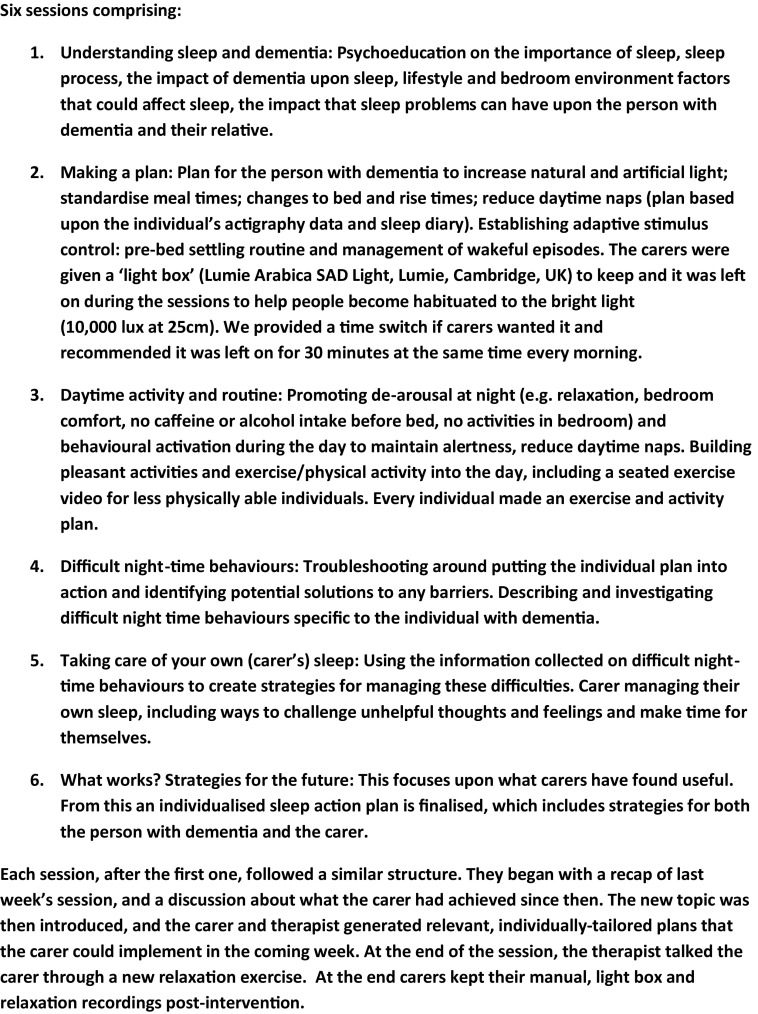
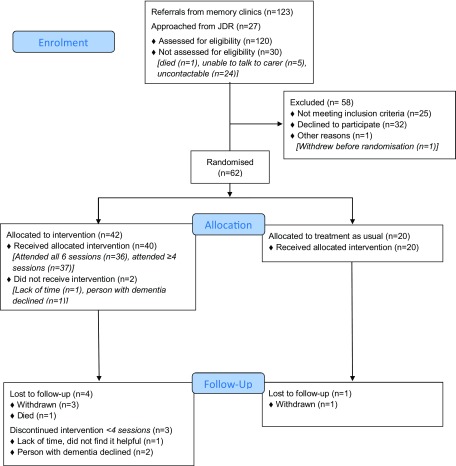
ABSTRACTBackground:40% of people with dementia have disturbed sleep but there are currently no known effective treatments. Studies of sleep hygiene and light therapy have not been powered to indicate feasibility and acceptability and have shown 40-50% retention. We tested the feasibility and acceptability of a six-session manualized evidence-based non-pharmacological therapy; Dementia RElAted Manual for Sleep; STrAtegies for RelaTives (DREAMS-START) for sleep disturbance in people with dementia. METHODS: We conducted a parallel, two-armed, single-blind randomized trial and randomized 2:1 to intervention: Treatment as Usual. Eligible participants had dementia and sleep disturbances (scoring ≥4 on one Sleep Disorders Inventory item) and a family carer and were recruited from two London memory services and Join Dementia Research. Participants wore an actiwatch for two weeks pre-randomization. Trained, clinically supervised psychology graduates delivered DREAMS-START to carers randomized to intervention; covering Understanding sleep and dementia; Making a plan (incorporating actiwatch information, light exposure using a light box); Daytime activity and routine; Difficult night-time behaviors; Taking care of your own (carer's) sleep; and What works? Strategies for the future. Carers kept their manual, light box, and relaxation recordings post-intervention. Outcome assessment was masked to allocation. The co-primary outcomes were feasibility (≥50% eligible people consenting to the study) and acceptability (≥75% of intervention group attending ≥4 intervention sessions). RESULTS: In total, 63out of 95 (66%; 95% CI: 56-76%) eligible referrals consented between 04/08/2016 and 24/03/2017; 62 (65%; 95% CI: 55-75%) were randomized, and 37 out of 42 (88%; 95% CI: 75-96%) adhered to the intervention. CONCLUSIONS: DREAM-START for sleep disorders in dementia is feasible and acceptable.
Overview
The claims and statistics of this paper haven’t been checked yet.
Free: it reads the open-access text and checks the first 5 claims that cite a source we can check. Create a free account to check every claim.
Integrity signals
Registry
Cites
Statistics
Figures
Verification
Claims the paper makes
The claims and statistics of this paper haven’t been checked yet.
Free: it reads the open-access text and checks the first 5 claims that cite a source we can check. Create a free account to check every claim.
Claims other papers make about this one
Each is checked against this paper’s own text: does it say what the citing paper says it does?
The check wasn’t confident either way, so it gives no verdict — never disputed.
In the citing paper
“There was low-quality evidence that, in general, discontinuation might make little or no difference to overall neuropsychiatric symptoms, adverse events, quality of life or cognitive function.226”
From Dementia prevention, intervention, and care: 2020 report of the Lancet Commission (2020) · cites this paper as [226]
Experimental — accuracy not yet measured
Self-check
Percentages, sums and reported differences re-computed from the paper’s own numbers.
The self-check needs the paper’s full text.
Citations
Cites
The Pittsburgh Sleep Quality Index: a new instrument for psychiatric practice and research
Buysse, D. J., Reynolds, C. F., Monk, T. H., Berman, S. R., & Kupfer, D. J. (1989) · Psychiatry Research · doi:10.1016/0165-1781(89)90047-4 · Cited by 35,234 · cited 4×
“At baseline, the NPI, PSQI, SCI, and HSQ were completed for 61/62 (98.4%).”
MethodInfluentialThe validity of the Hospital Anxiety and Depression Scale
Bjelland, I., Dahl, A. A., Haug, T. T., & Neckelmann, D. (2002) · Journal of Psychosomatic Research · doi:10.1016/s0022-3999(01)00296-3 · Cited by 9,779 · cited 3×
“Mood was measured using the validated, reliable Hospital Anxiety and Depression Scale (HADS) (Bjelland et al., 2002; Snaith, 2003), and subjective burden using the validated Zarit Burden Interview (ZBI) (Zarit et al.”
MethodOsterberg, L., & Blaschke, T. (2005) · New England Journal of Medicine · doi:10.1056/nejmra050100 · Cited by 7,974 · cited 1×
“One measure of acceptability is the adherence rates to the intervention, and a good adherence rate is a matter of judgment, with clinical trials of medication for people being treated for chronic illnesses reporting rates of 43–78% (Osterberg and Blaschke, 2005).”
BackgroundThe Neuropsychiatric Inventory: Comprehensive assessment of psychopathology in dementia
Cummings, J. L., Mega, M., Gray, K., Rosenberg-Thompson, S., Carusi, D. A., & Gornbein, J. (1994) · Neurology · doi:10.1212/wnl.44.12.2308 · Cited by 7,568 · cited 2×
“At baseline, the NPI, PSQI, SCI, and HSQ were completed for 61/62 (98.4%).”
MethodInfluentialA New Clinical Scale for the Staging of Dementia
Hughes, C. P., Berg, L., Danziger, W., Coben, L. A., & Martin, R. L. (1982) · British Journal of Psychiatry · doi:10.1192/bjp.140.6.566 · Cited by 7,056 · cited 1×
“The baseline measures included socio-demographic details and dementia severity through the Clinical Dementia Rating (CDR), a reliable and valid instrument for classifying clinically diagnosed dementia (Hughes et al., 1982; Morris, 1997) as very mild (0.5), mild (1), moderate (2) or severe (3).”
MethodInfluentialDementia prevention, intervention, and care
Livingston, G., Sommerlad, A., Orgeta, V., Costafreda, S. G., Huntley, J., Ames, D., Ballard, C., Banerjee, S., Burns, A., Cohen-Mansfield, J., et al. (2017) · The Lancet · doi:10.1016/s0140-6736(17)31363-6 · Cited by 6,072 · cited 3×
“However, the instruments are validated, and in other studies carers have frequently reported no beneficial effect on these measures (Livingston et al., 2017).”
BackgroundSelf-citationRelatives of the Impaired Elderly: Correlates of Feelings of Burden
Zarit, S. H., Reever, K. E., & Bach-Peterson, J. (1980) · The Gerontologist · doi:10.1093/geront/20.6.649 · Cited by 5,810 · cited 4×
“, 2002; Snaith, 2003), and subjective burden using the validated Zarit Burden Interview (ZBI) (Zarit et al., 1980).”
MethodInfluentialThe Hospital Anxiety And Depression Scale.
(2003) · Health and Quality of Life Outcomes · doi:10.1186/1477-7525-1-29 · Cited by 2,391 · cited 1×
“Mood was measured using the validated, reliable Hospital Anxiety and Depression Scale (HADS) (Bjelland et al., 2002; Snaith, 2003), and subjective burden using the validated Zarit Burden Interview (ZBI) (Zarit et al., 1980).”
(2015) · HAL · Cited by 2,238
Morris, J. C. (1997) · International Psychogeriatrics · doi:10.1017/s1041610297004870 · Cited by 1,641 · cited 2×
“The baseline measures included socio-demographic details and dementia severity through the Clinical Dementia Rating (CDR), a reliable and valid instrument for classifying clinically diagnosed dementia (Hughes et al., 1982; Morris, 1997) as very mild (0.5), mild (1), moderate (2) or severe (3).”
MethodInfluential
Research works printed but not linked: 1
- (NICE/SCIE) (2006). NIfCEaSCIfE. Dementia: Supporting People with Dementia and Their Carers in Health and Social Care. London: The British Psychological Society and Gaskell. 21834193
Cited by
Dementia prevention, intervention, and care: 2020 report of the Lancet Commission
Livingston, G., Huntley, J., Sommerlad, A., Ames, D., Ballard, C., Banerjee, S., Brayne, C., Burns, A., Cohen-Mansfield, J., Cooper, C., et al. (2020) · The Lancet · doi:10.1016/s0140-6736(20)30367-6 · Cited by 10,430
Self-citationRetractedWebster, L., Costafreda Gonzalez, S., Stringer, A., Lineham, A., Budgett, J., Kyle, S., Barber, J., & Livingston, G. (2020) · Sleep · doi:10.1093/sleep/zsz251 · Cited by 77
“There is no consensus on the best way to measure sleep disturbances in people with dementia, with previous studies comparing both methods in community-dwelling people with dementia and finding differing results [14, 15].”
ResultSelf-citationFarina, N., Sherlock, G., Thomas, S., Lowry, R. G., & Banerjee, S. (2019) · International Journal of Geriatric Psychiatry · doi:10.1002/gps.5064 · Cited by 65
“The ability for the majority of people with dementia to wear the device for the duration of the study supports recent findings from the DREAMS‐ START study, which found that only 1/62 were unable to wear an actigraph device for more than 7 days at baseline.(30) From the qualitative interviews, four key themes were fou…”
ResultJames, T., Mukadam, N., Sommerlad, A., Guerra Ceballos, S., & Livingston, G. (2021) · The Lancet Healthy Longevity · doi:10.1016/s2666-7568(21)00001-5 · Cited by 59
Self-citationNon-pharmacological interventions for sleep disturbances in people with dementia
Wilfling, D., Calo, S., Dichter, M. N., Meyer, G., Möhler, R., & Köpke, S. (2023) · Cochrane Database of Systematic Reviews · doi:10.1002/14651858.cd011881.pub2 · Cited by 59
Tan, J., Cheng, L. J., Chan, E., Lau, Y., & Lau, S. T. (2022) · Sleep Medicine · doi:10.1016/j.sleep.2022.01.013 · Cited by 57
Co-designing complex interventions with people living with dementia and their supporters
Lord, K., Kelleher, D., Ogden, M., Mason, C., Rapaport, P., Burton, A., Leverton, M., DOWNS, M. G., Souris, H., Jackson, J., et al. (2021) · Dementia · doi:10.1177/14713012211042466 · Cited by 46
“…et al., 2020; Rapaport et al., 2020a) and systematic reviews undertaken earlier in the NIDUS programme (Lord et al., 2020; Scott et al., 2019), existing interventions (Hassan et al., 2018; Kales et al., 2014; Livingston et al., 2019b, 2019c; Rockwood, 2010) and group members’ expertise.”
BackgroundSelf-citationCooper, C., Vickerstaff, V., Barber, J., Phillips, R., Ogden, M., Walters, K. R., Lang, I., Rapaport, P., Orgeta, V., Rockwood, K. J., et al. (2024) · The Lancet Healthy Longevity · doi:10.1016/s2666-7568(23)00262-3 · Cited by 44
“NIDUS-Family modules drew on behavioural management techniques (DICE approach 15 ), enablement strategies, communication strategies, carer support strategies, and psychoeducation strategies, with material developed from existing interventions 11,16–18 and created by the co-production group.”
Self-citationCooper, C., Mansour, H., Carter, C., Rapaport, P., Morgan‐Trimmer, S., Marchant, N. L., Poppe, M., HIGGS, P. F. D., Brierley, J., Solomon, N., et al. (2021) · Dementia · doi:10.1177/14713012211014382 · Cited by 34
“We used the groups’ expertise, informed by current evidence and existing interventions (Hassan et al., 2018; Livingston et al., 2019) to produce participant workbooks and facilitator manuals to guide the planned, structured sessions.”
MethodSelf-citationRegier, N. G., Hodgson, N. A., & Gitlin, L. N. (2020) · International Journal of Geriatric Psychiatry · doi:10.1002/gps.5323 · Cited by 33
Participatory research with carers: A systematic review and narrative synthesis
Bowness, B., Henderson, C., Akhter‐Khan, S. C., Akiba, M., & Lawrence, V. C. (2023) · Health Expectations · doi:10.1111/hex.13940 · Cited by 35
Rapaport, P., Webster, L., Horsley, R., Kyle, S. D., Kinnunen, K. M., Hallam, B., Pickett, J., Cooper, C., Espie, C. A., & Livingston, G. (2018) · Dementia · doi:10.1177/1471301218789559 · Cited by 32
Self-citationZang, L., Liu, X., Li, Y., Liu, J., Lu, Q., Zhang, Y., & Meng, Q. (2023) · PLoS ONE · doi:10.1371/journal.pone.0293977 · Cited by 35
“Nine studies [31–33, 35, 38– 42 IS.”
BackgroundMethodInfluentialAini, N., Chen, R., Chu, H., Chang, C., Lin, H., Jen, H., Liu, D., Lee, T., & Chou, K. (2023) · American Journal of Geriatric Psychiatry · doi:10.1016/j.jagp.2023.12.010 · Cited by 29
Flaxer, J. M., Heyer, A., & Francois, D. (2020) · American Journal of Geriatric Psychiatry · doi:10.1016/j.jagp.2020.10.011 · Cited by 23
Interventions to improve sleep in caregivers: A systematic review and meta-analysis
Cooper, C. J., Owen, P. J., Sprajcer, M., Crowther, M. E., Craige, E. A., Ferguson, S. A., Gupta, C. C., Gibson, R. H., & Vincent, G. E. (2022) · Sleep Medicine Reviews · doi:10.1016/j.smrv.2022.101658 · Cited by 24
Self-citationBurton, A., Rapaport, P., Palomo, M., Lord, K., Budgett, J., Barber, J., Hunter, R. M., Butler, L. T., Vickerstaff, V., Rockwood, K. J., et al. (2021) · Trials · doi:10.1186/s13063-021-05851-z · Cited by 22
Self-citationRapaport, P., Amador, S., Adeleke, M., Barber, J., Banerjee, S., Charlesworth, G. M., Clarke, C., Espie, C. A., Gonzalez, L., Horsley, R., et al. (2024) · The Lancet Healthy Longevity · doi:10.1016/j.lanhl.2024.08.004 · Cited by 24
Self-citationRichardson, K., Savva, G. M., Boyd, P. J., Aldus, C. F., Maidment, I., Pakpahan, E., Loke, Y. K., Arthur, A. J., Steel, N., Ballard, C. G., et al. (2021) · Health Technology Assessment · doi:10.3310/hta25010 · Cited by 21
Rapaport, P., Burton, A., Palomo, M., Griffiths, J., Kelleher, D., Leverton, M., Vickerstaff, V., Barber, J., Bird, M. O., Budgett, J., et al. (2020) · Aging & Mental Health · doi:10.1080/13607863.2020.1845299 · Cited by 22
“…groups understand independence for people living with dementia (Herat-Gunaratne et al., 2020; Rapaport et al., 2020), existing interventions (Hassan et al., 2018; Kales, 2015; Livingston et al.,2013, 2019; Orgeta et al., 2019) and lived experiences and expertise (Burton, Ogden, & Cooper, 2019).”
BackgroundResultSelf-citationLUXTON, D. E. A., Thorpe, N., Crane, E., Warne, M., Cornwall, O., El-Dalil, D., Matthews, J., & Rajkumar, A. P. (2025) · The British Journal of Psychiatry · doi:10.1192/bjp.2025.11 · Cited by 24
“59 A small RCT investigated a tailored activity programme matching activities to the cognitive and functional capabilities, previous roles, habits and interests of the PwD. 65 Caregivers reported statistically significant improvement in QoL of the PwD after 4 months follow-up.”
Webster, L., Costafreda, S. G., Powell, K., & Livingston, G. (2022) · PLoS ONE · doi:10.1371/journal.pone.0272814 · Cited by 18
Self-citationAnieto, E. M., Dall, P., Abaraogu, U. O., CHASTIN, S. F. M., Anieto, I. B., Longworth, G. R., Adandom, I. I., Onyeso, O. K., Iwuagwu, A. O., Smith, N., et al. (2025) · Public Health · doi:10.1016/j.puhe.2025.105929 · Cited by 17
Differentiating between dementia, delirium and depression in older people
Dening, K. H. (2019) · Nursing Standard · doi:10.7748/ns.2019.e11361 · Cited by 14
Webster, L., Martin, A., & Livingston, G. (2020) · International Journal of Geriatric Psychiatry · doi:10.1002/gps.5384 · Cited by 12
“DREAMS START was a randomised control trial of the feasibility and acceptability of a multicomponent intervention for people with dementia and sleep disturbances.(21,22) The trial was approved by the London Queen Square Research Ethics Committee (reference number 16/LO/0670).”
MethodSelf-citationBartfay, E., Stewart, P., Bartfay, W. J., & Papaconstantinou, E. A. (2019) · Healthcare · doi:10.3390/healthcare7010006 · Cited by 17
“Livingston and colleagues [11] estimated that 40% of PWD experienced disturbed sleep, and we are yet to find a safe and effective form of treatment for this problem.”
BackgroundAryankhesal, A., Blake, J., Wong, G., Megson, M., Briscoe, S., Allan, L. M., Broomfield, N. M., Eastwood, Z., Greene, L., Hilton, A., et al. (2023) · British Journal of General Practice · doi:10.3399/bjgp.2023.0171 · Cited by 10
Self-citationSpiers, G., Tan, M. M. C., Astbury, J. L., Hall, A., Ahmed, N., Lanyi, K., Williams, O., Beyer, F. R., Craig, D., & Hanratty, B. (2024) · BMC Geriatrics · doi:10.1186/s12877-024-04897-3 · Cited by 11
Rapaport, P., Amador, S., Adeleke, M., Banerjee, S., Barber, J., Charlesworth, G. M., Clarke, C., Connell, C., Espie, C. A., Gonzalez, L., et al. (2024) · BMJ Open · doi:10.1136/bmjopen-2023-075273 · Cited by 9
Self-citationCrowley, P., O’Donovan, M. R., Leahy, P., Flanagan, E., & Ó’Caoimh, R. (2025) · International Journal of Environmental Research and Public Health · doi:10.3390/ijerph22060956 · Cited by 12
“Of the remaining six trials that did not achieve any significant improvement in night-time sleep [95–100], four did produce significant improvements in daytime sleep/sleepiness/time in bed [95,96,98,99].”
Amador, S., Livingston, G., Adeleke, M., Barber, J., Webster, L., Yuan, H., Banerjee, S., Bhojwani, A., Charlesworth, G. M., Clarke, C., et al. (2025) · Age and Ageing · doi:10.1093/ageing/afaf053 · Cited by 7
“DREAMS-START is a feasible and acceptable six-session co-produced multimodal manual-based intervention, delivered to family or friend carers of people with dementia, who implement strategies targeting sleep disturbances [11, 12] (see intervention components, Appendix S1).”
InfluentialSelf-citationLight Therapy for Older People with Depressive Symptoms: Systematic Review and Meta-Analysis
Seok, J., & Kim, J.-D. (2024) · Journal of Clinical Medicine · doi:10.3390/jcm13226982 · Cited by 15
Chen, Y., Huang, W.-Y., Lee, T., Chu, H., Chiang, K., Jen, H., Liu, D., Chen, R., Kang, X. L., Lai, Y.-J., et al. (2023) · Gerontology · doi:10.1159/000531968 · Cited by 7
“Considering poor adherence to the intervention, death or withdrawal of informed consent, follow-up of dementia, we referred to the sample size of a study done by Livingston et al. [36].”
MethodGao, R., Greiner, C., Ryuno, H., & Zhang, X. (2024) · BMC Complementary Medicine and Therapies · doi:10.1186/s12906-024-04705-w · Cited by 14
Murphy, C. L., Laine, C., Macaulay, M., Avery, M., & Fader, M. J. (2021) · Age and Ageing · doi:10.1093/ageing/afab221 · Cited by 7
“manualised, tailorable interventions to tackle sleep problems for PLWD living at home [7]).”
Woolf, C., Kaplan, L., Norrie, L. M., Burke, D., Cunich, M. M., Mowszowski, L., & Naismith, S. L. (2024) · BMC Psychiatry · doi:10.1186/s12888-023-05391-7 · Cited by 10
“Again, these expectations were based on a similar feasibility study with older adults [54].”
BackgroundPark, H. G., Perumean‐Chaney, S. E., & Bartolucci, A. A. (2022) · Dementia and Neurocognitive Disorders · doi:10.12779/dnd.2022.21.1.1 · Cited by 7
Verma, S., Varma, P., Brown, A., Bei, B., Gibson, R. H., Valenta, T., Pietsch, A., Cavuoto, M. G., Woodward, M., McCurry, S. M., et al. (2023) · PeerJ · doi:10.7717/peerj.16543 · Cited by 4
“Some studies have adopted a multi-modal approach to treating sleep disturbance in people living with dementia (see Poon (2022) for a review of these interventions and evidence of their efficacy) ( Sidani et al., 2022 ; Livingston et al., 2019 ).”
BackgroundGonzalez, L., Rapaport, P., Livingston, G., Amador, S., Adeleke, M., Barber, J., Banerjee, S., Charlesworth, G. M., Clarke, C., Espie, C. A., et al. (2025) · The Lancet Healthy Longevity · doi:10.1016/j.lanhl.2025.100708 · Cited by 4
Self-citationLong-term health conditions and their impact on people with sleep disturbances and dementia
Rapaport, P., Bhojwani, A., Webster, L., Amador, S., Muralidhar, M., & Livingston, G. (2025) · BMC Geriatrics · doi:10.1186/s12877-025-06045-x · Cited by 7
“Building on our earlier successful feasibility RCT [3], we recently completed randomised controlled trial (RCT) of DREAMS START (Dementia Related Manual: Strategies for Relatives), a multi-component non-pharmacological intervention aimed at improving sleep disturbances in people with dementia…”
Self-citationKashimura, M., Rapaport, P., Nomura, T., Ishiwata, A., Tateno, A., Nogami, A., Yamashita, M., 川西智也, Kawashima, Y., Kitamura, S., et al. (2020) · Dementia · doi:10.1177/1471301220919938 · Cited by 5
Self-citationWebster, L., Costafreda, S. G., Barber, J., Kyle, S. D., & Livingston, G. (2022) · Alzheimer s & Dementia Translational Research & Clinical Interventions · doi:10.1002/trc2.12251 · Cited by 2
Self-citationJu, E., Burton, C. W., Kim, J. J., Guo, Y., Park, J. I., Qu, A., Gibbs, L., & Lee, J. (2023) · Geriatric Nursing · doi:10.1016/j.gerinurse.2023.10.028 · Cited by 4
Mehta, V., Rapaport, P., & Livingston, G. (2025) · medRxiv · doi:10.1101/2025.10.29.25339056 · Cited by 1
Self-citationDesigning meaningful dementia care
Budgett, J., & Cooper, C. (2021) · International Psychogeriatrics · doi:10.1017/s1041610220001696
Self-citationPharmacological interventions in dementia
Qazi, A., Kiss, I. M., Oyekan, S., & Parveen, S. (2019) · FPOP Bulletin Psychology of Older People · doi:10.53841/bpsfpop.2019.1.148.26
Sleep Disorders in the Elderly
Amidi, A., Ancoli‐Israel, S., Maglione, J. E., & Wu, L. M. (2025) · Oxford University Press eBooks · doi:10.1093/oxfordhb/9780197602751.013.27
Rapaport, P., Amador, S., Adeleke, M., Barber, J., Banerjee, S., Bhojwani, A., Charlesworth, G. M., Clarke, C., Espie, C. A., Gonzalez, L., et al. (2026) · Health Technology Assessment · doi:10.3310/gjpr2620
Self-citationvan Horik, J. O., Allan, L. M., Aryankhesal, A., Broomfield, N. M., Greenstreet, P., Hilton, A., Killett, A., Khondoker, M. R., Livingston, G., Loke, Y. K., et al. (2026) · Pilot and Feasibility Studies · doi:10.1186/s40814-026-01791-0
“Although a recent study involving a multicomponent intervention has shown improvements in the sleep of PLWD in their home, which remained beyond intervention delivery and can be implemented with minimal clinical training [60, 61].”
Self-citationRapaport, P., Adeleke, M., Barber, J., Gonzalez, L., Hunter, R. M., Manela, M., Amador, S., Banerjee, S., Charlesworth, G. M., Clarke, C., et al. (2026) · Alzheimer s & Dementia · doi:10.1002/alz.71274
“…took steps to mitigate against the impact of researchers becoming unblinded to allocation status by the person facilitating the intervention being different were meaningful and important outcomes for them, 19 and inconsistencies between questionnaire and actigraphy data reported in other studies.”
Self-citationAlyafei, A. A., Hussein, A. M., & Abdulla, S. T. A. (2026) · Cureus · doi:10.7759/cureus.105457
“Heterogeneity was modest (I² = 48%), and while some studies reported wide confidence intervals (e.g., Livingston et al. [25]), the combined effect suggests that personalized digital interventions have beneficial effects on daily functioning and life satisfaction.”
Venkatesan, S., Livingston, G., Vaitheswaran, S., Nagarajan, G., Srinivasan, N., Ramanujam, V., Sargunan, S., Fisher, E., Rapaport, P., & Spector, A. E. (2026) · Aging & Mental Health · doi:10.1080/13607863.2026.2631447
“…the COVID-19 pandemic (b) retention rate of at least 75% of participants to follow up, based on the team’s experience and previous literature (Livingston et al., 2019) The operationalised parameters for the intervention’s acceptability were: (a) the overall attendance rate amongst caregivers…”
Self-citationWang, S. G., Luo, Y., Xiong, J., Xia, Y., Leung, S. H. I., & Davidson, P. M. (2026) · The Gerontologist · doi:10.1093/geront/gnag081
Xie, Q., Shi, J., Guo, Y., Hu, M., Chen, X., Chen, Y., Dong, Y., Wei, Z., & Feng, H. (2026) · Frontiers in Medicine · doi:10.3389/fmed.2026.1913461
“CBT-I is a first-line strategy for chronic insomnia, but in MCI/early dementia it often requires simplification and adaptation to cognitive capacity and may depend on caregiver-facilitated delivery (45, 87, 88).”
Flisar, A., Bossche, M. J. A. V. D., Coppens, E., Audenhove, C. V., & Dezutter, J. (2026) · BMC Geriatrics · doi:10.1186/s12877-026-08150-x
Metadata
- Authors
- Livingston, G., Barber, J. A., Kinnunen, K. M., Webster, L., Kyle, S. D., Cooper, C., Espie, C. A., Hallam, B., Horsley, R., Pickett, J., & Rapaport, P.
- Affiliations
- University College London (GB)
- University of Oxford (GB)
- Alzheimer's Society (GB)
- Corresponding author
- Livingston, Gill
- ORCID
- Venue
- International Psychogeriatrics
- Publisher
- Elsevier BV
- Published
- 2019-02
- Volume
- 31
- Issue
- 2
- Pages
- 251-265
- ISSN
- 1041-6102 (ISSN-L)
- PMC
- PMC6474714
- OpenAlex
- W2892064948
- Semantic Scholar
- 66b3fb7c81b29ee146ccf244131d415861d43b73
- Cited by
- 55
- References
- 38
- Citations by year
- 2026: 7 · 2025: 9 · 2024: 7 · 2023: 8 · 2022: 5 · 2021: 7 · 2020: 6 · 2019: 5
- FWCI
- 6.22
- Type
- journal article
- Language
- en
- Open access
- gold
- doi.org
- Licence
- cc-by
- www.elsevier.com/tdm/userlicense/1.0/ (tdm)
- www.elsevier.com/legal/tdmrep-license (tdm)
- creativecommons.org/licenses/by/4.0 (vor)
- Locations
- International Psychogeriatrics (publishedVersion, cc-by)
- Europe PMC (PubMed Central) (publishedVersion, cc-by)
- PubMed Central (publishedVersion, cc-by)
- PubMed (publishedVersion)
- Kent Academic Repository (University of Kent) (submittedVersion)
- UCL Discovery (University College London) (submittedVersion)
- Funders
- Collaboration for Leadership in Applied Health Research and Care - Greater Manchester
- Arthritis Research UK
- Health Technology Assessment Programme (14/220/06)
- National Institute for Health and Care Research
- Education Endowment Foundation
- Wellcome Trust
- NIHR Oxford Biomedical Research Centre
- Economic and Social Research Council
- National Institute on Handicapped Research
- Dr Mortimer and Theresa Sackler Foundation
- Alzheimer's Society
- Topics
- Social Sciences › Psychology › Experimental and Cognitive Psychology › Sleep and related disorders
- Health Sciences › Medicine › Psychiatry and Mental health › Dementia and Cognitive Impairment Research
- Health Sciences › Nursing › Research and Theory › Nursing care and research
- Keywords
- dementia, sleep disorders, non-pharmacological treatment, family caregivers, caregiver education, phototherapy, sleep hygiene, feasibility, acceptability, actigraphy, diurnal activity, relaxation
- MeSH terms
- Aged, Aged, 80 and over, Cost-Benefit Analysis, Dementia, Feasibility Studies, Female, United Kingdom, Humans, Male, Surveys and Questionnaires, Sleep Wake Disorders, Exercise, Cognitive Behavioral Therapy, Single-Blind Method, Treatment Outcome, Caregivers
About these checks
Registry, retraction, Cites and statistics results are computed, not judged, with one exception: a printed reference that no index lists is read once by a model before it counts as a citation error. Claims are extracted by a model and kept only when their quote appears verbatim in the text; each cited source is then checked, with a model’s help, for whether it says what the claim relies on. Those verdicts can be wrong — read the claim’s quote and the cited source before relying on one.
Statistics and arithmetic are recomputed, not judged.
Confidence bands are shown only for fields calibrated on our annotated test set. None is calibrated yet, so no band is shown.
What counts as a claim ›How we measure confidence ›How we check this ›
Are you an author, or do you see a problem with this page? Request a review
Data sources
Bibliographic data: Semantic Scholar, OpenAlex, Crossref.
Contains information from the Semantic Scholar Academic Graph Datasets, made available under the ODC Attribution License (ODC-BY 1.0).
Semantic Scholar’s data is described in: Kinney, R., et al. (2023). The Semantic Scholar Open Data Platform. arXiv:2301.10140.
