

DREAMS-START (Dementia RElAted Manual for Sleep; STrAtegies for RelaTives) for people with dementia and sleep disturbances: a single-blind feasibility and acceptability randomized controlled trial
Open accessThe DOI matches its Crossref record; 37 of the 38 references it cites were found in a registry or an index.
Abstract
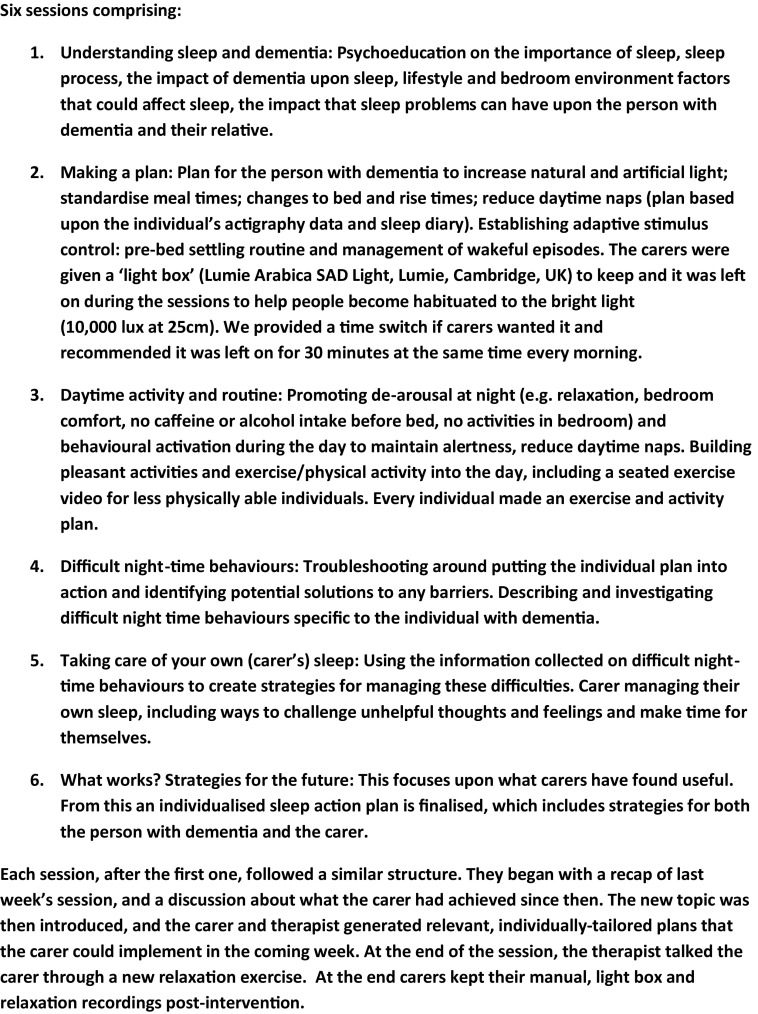
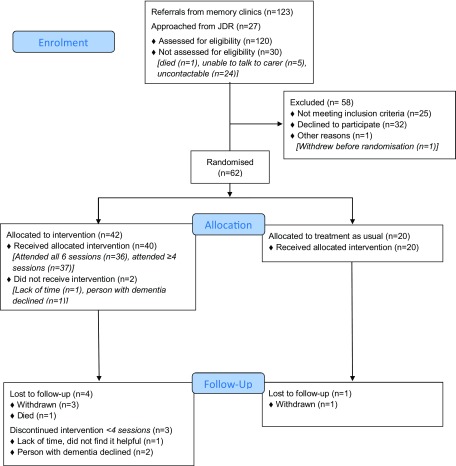
ABSTRACTBackground:40% of people with dementia have disturbed sleep but there are currently no known effective treatments. Studies of sleep hygiene and light therapy have not been powered to indicate feasibility and acceptability and have shown 40-50% retention. We tested the feasibility and acceptability of a six-session manualized evidence-based non-pharmacological therapy; Dementia RElAted Manual for Sleep; STrAtegies for RelaTives (DREAMS-START) for sleep disturbance in people with dementia. METHODS: We conducted a parallel, two-armed, single-blind randomized trial and randomized 2:1 to intervention: Treatment as Usual. Eligible participants had dementia and sleep disturbances (scoring ≥4 on one Sleep Disorders Inventory item) and a family carer and were recruited from two London memory services and Join Dementia Research. Participants wore an actiwatch for two weeks pre-randomization. Trained, clinically supervised psychology graduates delivered DREAMS-START to carers randomized to intervention; covering Understanding sleep and dementia; Making a plan (incorporating actiwatch information, light exposure using a light box); Daytime activity and routine; Difficult night-time behaviors; Taking care of your own (carer's) sleep; and What works? Strategies for the future. Carers kept their manual, light box, and relaxation recordings post-intervention. Outcome assessment was masked to allocation. The co-primary outcomes were feasibility (≥50% eligible people consenting to the study) and acceptability (≥75% of intervention group attending ≥4 intervention sessions). RESULTS: In total, 63out of 95 (66%; 95% CI: 56-76%) eligible referrals consented between 04/08/2016 and 24/03/2017; 62 (65%; 95% CI: 55-75%) were randomized, and 37 out of 42 (88%; 95% CI: 75-96%) adhered to the intervention. CONCLUSIONS: DREAM-START for sleep disorders in dementia is feasible and acceptable.
Overview
The claims and statistics of this paper haven’t been checked yet.
Free: it reads the open-access text and checks the first 5 claims that cite a source we can check. Create a free account to check every claim.
Integrity signals
Registry
Cites
Statistics
Figures
Verification
Claims the paper makes
The claims and statistics of this paper haven’t been checked yet.
Free: it reads the open-access text and checks the first 5 claims that cite a source we can check. Create a free account to check every claim.
Claims other papers make about this one
Each is checked against this paper’s own text: does it say what the citing paper says it does?
The check wasn’t confident either way, so it gives no verdict — never disputed.
In the citing paper
“There was low-quality evidence that, in general, discontinuation might make little or no difference to overall neuropsychiatric symptoms, adverse events, quality of life or cognitive function.226”
From Dementia prevention, intervention, and care: 2020 report of the Lancet Commission (2020) · cites this paper as [226]
Experimental — accuracy not yet measured
Self-check
Percentages, sums and reported differences re-computed from the paper’s own numbers.
The self-check needs the paper’s full text.
Citations
Cites
The Pittsburgh Sleep Quality Index: a new instrument for psychiatric practice and research
Buysse, D. J., Reynolds, C. F., Monk, T. H., Berman, S. R., & Kupfer, D. J. (1989) · Psychiatry Research · doi:10.1016/0165-1781(89)90047-4 · Cited by 35,234 · cited 4×
“At baseline, the NPI, PSQI, SCI, and HSQ were completed for 61/62 (98.4%).”
MethodInfluentialThe validity of the Hospital Anxiety and Depression Scale
Bjelland, I., Dahl, A. A., Haug, T. T., & Neckelmann, D. (2002) · Journal of Psychosomatic Research · doi:10.1016/s0022-3999(01)00296-3 · Cited by 9,779 · cited 3×
“Mood was measured using the validated, reliable Hospital Anxiety and Depression Scale (HADS) (Bjelland et al., 2002; Snaith, 2003), and subjective burden using the validated Zarit Burden Interview (ZBI) (Zarit et al.”
MethodOsterberg, L., & Blaschke, T. (2005) · New England Journal of Medicine · doi:10.1056/nejmra050100 · Cited by 7,974 · cited 1×
“One measure of acceptability is the adherence rates to the intervention, and a good adherence rate is a matter of judgment, with clinical trials of medication for people being treated for chronic illnesses reporting rates of 43–78% (Osterberg and Blaschke, 2005).”
BackgroundThe Neuropsychiatric Inventory: Comprehensive assessment of psychopathology in dementia
Cummings, J. L., Mega, M., Gray, K., Rosenberg-Thompson, S., Carusi, D. A., & Gornbein, J. (1994) · Neurology · doi:10.1212/wnl.44.12.2308 · Cited by 7,568 · cited 2×
“At baseline, the NPI, PSQI, SCI, and HSQ were completed for 61/62 (98.4%).”
MethodInfluentialA New Clinical Scale for the Staging of Dementia
Hughes, C. P., Berg, L., Danziger, W., Coben, L. A., & Martin, R. L. (1982) · British Journal of Psychiatry · doi:10.1192/bjp.140.6.566 · Cited by 7,056 · cited 1×
“The baseline measures included socio-demographic details and dementia severity through the Clinical Dementia Rating (CDR), a reliable and valid instrument for classifying clinically diagnosed dementia (Hughes et al., 1982; Morris, 1997) as very mild (0.5), mild (1), moderate (2) or severe (3).”
MethodInfluentialDementia prevention, intervention, and care
Livingston, G., Sommerlad, A., Orgeta, V., Costafreda, S. G., Huntley, J., Ames, D., Ballard, C., Banerjee, S., Burns, A., Cohen-Mansfield, J., et al. (2017) · The Lancet · doi:10.1016/s0140-6736(17)31363-6 · Cited by 6,072 · cited 3×
“However, the instruments are validated, and in other studies carers have frequently reported no beneficial effect on these measures (Livingston et al., 2017).”
BackgroundSelf-citationRelatives of the Impaired Elderly: Correlates of Feelings of Burden
Zarit, S. H., Reever, K. E., & Bach-Peterson, J. (1980) · The Gerontologist · doi:10.1093/geront/20.6.649 · Cited by 5,810 · cited 4×
“, 2002; Snaith, 2003), and subjective burden using the validated Zarit Burden Interview (ZBI) (Zarit et al., 1980).”
MethodInfluentialThe Hospital Anxiety And Depression Scale.
(2003) · Health and Quality of Life Outcomes · doi:10.1186/1477-7525-1-29 · Cited by 2,391 · cited 1×
“Mood was measured using the validated, reliable Hospital Anxiety and Depression Scale (HADS) (Bjelland et al., 2002; Snaith, 2003), and subjective burden using the validated Zarit Burden Interview (ZBI) (Zarit et al., 1980).”
(2015) · HAL · Cited by 2,238
Morris, J. C. (1997) · International Psychogeriatrics · doi:10.1017/s1041610297004870 · Cited by 1,641 · cited 2×
“The baseline measures included socio-demographic details and dementia severity through the Clinical Dementia Rating (CDR), a reliable and valid instrument for classifying clinically diagnosed dementia (Hughes et al., 1982; Morris, 1997) as very mild (0.5), mild (1), moderate (2) or severe (3).”
MethodInfluentialMarino, M., Li, Y., Rueschman, M. N., Winkelman, J. W., Ellenbogen, J. M., Solet, J. M., Dulin, H., Berkman, L. F., & Buxton, O. M. (2013) · Sleep · doi:10.5665/sleep.3142 · Cited by 1,056 · cited 1×
“Validity worsened with increasing age (Marino et al., 2013).”
Sleep and Alzheimer disease pathology--a bidirectional relationship
Ju, Y.-E. S., Lucey, B. P., & Holtzman, D. M. (2014) · Nature Reviews Neurology · doi:10.1038/nrneurol.2013.269 · Cited by 996
Zhao, Q.-F., Tan, L., Wang, H.-F., Jiang, T., Tan, M.-S., Tan, L., Xu, W., Li, J.-Q., Wang, J., Lai, T.-J., et al. (2016) · Journal of Affective Disorders · doi:10.1016/j.jad.2015.09.069 · Cited by 916 · cited 1×
“Sleep disturbances are common in dementia, for example, occurring in around 40% of people with Alzheimer’s disease (AD) (Moran et al., 2005; Dauvilliers, 2007; Zhao, 2016).”
BackgroundSleepiness in Different Situations Measured by the Epworth Sleepiness Scale
Johns, M. W. (1994) · Sleep · doi:10.1093/sleep/17.8.703 · Cited by 734 · cited 2×
“After adjusting for site and baseline score, statistically significant improvements due to intervention are evident for ESS, DEMQOL-Proxy, and ZBI.”
MethodThe Sleep Condition Indicator: a clinical screening tool to evaluate insomnia disorder
Espie, C. A., Kyle, S. D., Hames, P., Gardani, M., Fleming, L., & Cape, J. (2014) · BMJ Open · doi:10.1136/bmjopen-2013-004183 · Cited by 517
Self-citationSleep disturbance in mild to moderate Alzheimer’s disease
MORAN, M., LYNCH, C., WALSH, C., COEN, R., COAKLEY, D., & LAWLOR, B. (2005) · Sleep Medicine · doi:10.1016/j.sleep.2004.12.005 · Cited by 346 · cited 1×
“Sleep disturbances are common in dementia, for example, occurring in around 40% of people with Alzheimer’s disease (AD) (Moran et al., 2005; Dauvilliers, 2007; Zhao, 2016).”
BackgroundSpira, A. P., Beaudreau, S. A., Stone, K. L., Kezirian, E. J., Lui, L.-Y., Redline, S., Ancoli-Israel, S., Ensrud, K., Stewart, A., & Study, F. T. O. F. I. M. (2012) · The Journals of Gerontology Series A: Biological Sciences and Medical Sciences · doi:10.1093/gerona/glr172 · Cited by 316
Nighttime Insomnia Treatment and Education for Alzheimer's Disease: A Randomized, Controlled Trial
McCurry, S. M., Gibbons, L. E., Logsdon, R. G., Vitiello, M. V., & Teri, L. (2005) · Journal of the American Geriatrics Society · doi:10.1111/j.1532-5415.2005.53252.x · Cited by 315 · cited 1×
“Actigraphy estimates sleep and wakefulness from movement and time, and has been used previously in a small trial to improve sleep for people with dementia (McCurry et al., 2005).”
MethodDevelopment of a new measure of health-related quality of life for people with dementia: DEMQOL
SMITH, S. C., LAMPING, D. L., BANERJEE, S., HARWOOD, R. H., FOLEY, B., SMITH, P., COOK, J. C., MURRAY, J., PRINCE, M., LEVIN, E., et al. (2007) · Psychological Medicine · doi:10.1017/s0033291706009469 · Cited by 285 · cited 2×
“After adjusting for site and baseline score, statistically significant improvements due to intervention are evident for ESS, DEMQOL-Proxy, and ZBI.”
MethodLivingston, G., Barber, J., Rapaport, P., Knapp, M., Griffin, M., King, D., Livingston, D., Mummery, C., Walker, Z., Hoe, J., et al. (2013) · BMJ · doi:10.1136/bmj.f6276 · Cited by 233 · cited 1×
“We incorporated prior evidence, some existing materials and used the START manual structure (Livingston et al., 2013; Livingston et al., 2014).”
MethodSelf-citationCognitive behavioural interventions for sleep problems in adults aged 60+
Montgomery, P., & Dennis, J. A. (2003) · Cochrane Database of Systematic Reviews · doi:10.1002/14651858.cd003161 · Cited by 231 · cited 1×
“Cognitive behavioral techniques for sleep management have been effective in older adults without dementia and in family carers of people with dementia (Montgomery and Dennis, 2003; Sivertsen and Nordhus, 2007).”
BackgroundForbes, D., Blake, C. M., Thiessen, E. J., Peacock, S., & Hawranik, P. (2014) · Cochrane Database of Systematic Reviews · doi:10.1002/14651858.cd003946.pub4 · Cited by 194 · cited 1×
“Other studies incorporating sleep hygiene and light therapy have been too small for definitive results (McCurry et al., 2009; Forbes et al., 2014; Kinnunen et al., 2017).”
Kyle, S. D., Espie, C. A., & Morgan, K. (2010) · Behavioral Sleep Medicine · doi:10.1080/15402002.2010.487450 · Cited by 193 · cited 1×
“Sleep disruption reduces everyday function and quality of life (Kyle et al., 2010).”
BackgroundSelf-citationTractenberg, R. E., Singer, C. M., Cummings, J. L., & Thal, L. J. (2003) · Journal of Sleep Research · doi:10.1046/j.0962-1105.2003.00374.x · Cited by 174 · cited 3×
“Eligible patients from the trusts lived in their own home, had a clinical diagnosis of dementia and a sleep disorders inventory (SDI) item score ≥4 (Tractenberg et al., 2003), judged as problematic by the person with dementia or their family, and had a primary family carer who provided support at least weekly.”
BackgroundInfluentialInsomnia in patients with neurodegenerative conditions
Dauvilliers, Y. (2007) · Sleep Medicine · doi:10.1016/s1389-9457(08)70006-6 · Cited by 167 · cited 1×
“Sleep disturbances are common in dementia, for example, occurring in around 40% of people with Alzheimer’s disease (AD) (Moran et al., 2005; Dauvilliers, 2007; Zhao, 2016).”
BackgroundValidation and normative data of health status measures in older people: the Islington study
Pettit, T., Livingston, G., Manela, M., Kitchen, G., Katona, C., & Bowling, A. (2001) · International Journal of Geriatric Psychiatry · doi:10.1002/gps.479 · Cited by 130 · cited 1×
“Carer’s quality of life was measured on the Health Status Questionnaire-12 (HSQ-12), a 12-item scale (Pettit et al., 2001; Barry et al., 2007).”
MethodSelf-citationPharmacotherapies for sleep disturbances in Alzheimer's disease
McCleery, J., Cohen, D. A., & Sharpley, A. L. (2014) · Cochrane Database of Systematic Reviews · doi:10.1002/14651858.cd009178.pub2 · Cited by 113
Sleep dysfunction in Alzheimer’s disease and other dementias
McCurry, S. M., & Ancoli‐Israel, S. (2003) · Current Treatment Options in Neurology · doi:10.1007/s11940-003-0017-9 · Cited by 109
Livingston, G., Barber, J., Rapaport, P., Knapp, M., Griffin, M., King, D., Romeo, R., Livingston, D., Mummery, C., Walker, Z., et al. (2014) · The Lancet Psychiatry · doi:10.1016/s2215-0366(14)00073-x · Cited by 98 · cited 1×
“We incorporated prior evidence, some existing materials and used the START manual structure (Livingston et al., 2013; Livingston et al., 2014).”
MethodSelf-citationBuchanan, D. T., Landis, C. A., & Vitiello, M. V. (2013) · Journal of Clinical Sleep Medicine · doi:10.5664/jcsm.2482 · Cited by 76 · cited 1×
“In older women without dementia (mean age 69 years) actigraphy results were unacceptable for those with low sleep efficiency (Taibi et al., 2013).”
BackgroundInsomnia in Caregivers of Persons with Dementia: Who is at Risk and What Can be Done About It?
McCurry, S. M., Gibbons, L. E., Logsdon, R. G., Vitiello, M. V., & Teri, L. (2009) · Sleep Medicine Clinics · doi:10.1016/j.jsmc.2009.07.005 · Cited by 57 · cited 1×
“Other studies incorporating sleep hygiene and light therapy have been too small for definitive results (McCurry et al., 2009; Forbes et al., 2014; Kinnunen et al., 2017).”
The management of sleep disorders in dementia: an update
Kinnunen, K. M., Vikhanova, A., & Livingston, G. (2017) · Current Opinion in Psychiatry · doi:10.1097/yco.0000000000000370 · Cited by 50 · cited 2×
“This iterative coproduction is reported in detail elsewhere (Kinnunen et al., 2017).”
MethodSelf-citationMulhern, B. J., Smith, S. C., Rowen, D., Brazier, J. E., Knapp, M. R. J., Lamping, D. L., Loftus, V., Young, T. A., Howard, R. J., & Banerjee, S. (2011) · Value in Health · doi:10.1016/j.jval.2011.09.006 · Cited by 43 · cited 1×
“Quality of life was measured using the DEMQOL-Proxy (Smith et al., 2007), a 31-item interviewer-administered valid and reliable instrument for dementia, which can be used with the Client Service Receipt Inventory to calculate cost-effectiveness (Mulhern et al., 2012).”
MethodMcCrae, C. S., Dzierzewski, J. M., McNamara, J. P. H., Vatthauer, K. E., Roth, A. J., & Rowe, M. A. (2016) · The Journals of Gerontology Series B: Psychological Sciences and Social Sciences · doi:10.1093/geronb/gbu162 · Cited by 40 · cited 1×
“It also increases family carer burden, predicts depressive symptoms, and leads to care home admissions, thus increasing individual, societal, and economic costs associated with dementia (McCrae et al., 2016; Livingston et al., 2017).”
BackgroundReliability, Validity, and Scoring of the Health Status Questionnaire-12 Version 2.0
Barry, T. L., Kaiser, K. L., & Atwood, J. R. (2007) · Journal of Nursing Measurement · doi:10.1891/106137407780851778 · Cited by 37 · cited 1×
“Carer’s quality of life was measured on the Health Status Questionnaire-12 (HSQ-12), a 12-item scale (Pettit et al., 2001; Barry et al., 2007).”
MethodManagement of insomnia in older adults
Sivertsen, B., & Nordhus, I. H. (2007) · The British Journal of Psychiatry · doi:10.1192/bjp.bp.106.031278 · Cited by 27 · cited 1×
“Cognitive behavioral techniques for sleep management have been effective in older adults without dementia and in family carers of people with dementia (Montgomery and Dennis, 2003; Sivertsen and Nordhus, 2007).”
BackgroundPharmacotherapies for sleep disturbances in Alzheimer's disease
McCleery, J. M., Cohen, D. A., & Sharpley, A. L. (2015) · BJPsych Advances · doi:10.1192/apt.21.4.218 · Cited by 23
Research works printed but not linked: 1
- (NICE/SCIE) (2006). NIfCEaSCIfE. Dementia: Supporting People with Dementia and Their Carers in Health and Social Care. London: The British Psychological Society and Gaskell. 21834193
Cited by
Dementia prevention, intervention, and care: 2020 report of the Lancet Commission
Livingston, G., Huntley, J., Sommerlad, A., Ames, D., Ballard, C., Banerjee, S., Brayne, C., Burns, A., Cohen-Mansfield, J., Cooper, C., et al. (2020) · The Lancet · doi:10.1016/s0140-6736(20)30367-6 · Cited by 10,430
Self-citationRetractedWebster, L., Costafreda Gonzalez, S., Stringer, A., Lineham, A., Budgett, J., Kyle, S., Barber, J., & Livingston, G. (2020) · Sleep · doi:10.1093/sleep/zsz251 · Cited by 77
“There is no consensus on the best way to measure sleep disturbances in people with dementia, with previous studies comparing both methods in community-dwelling people with dementia and finding differing results [14, 15].”
ResultSelf-citationFarina, N., Sherlock, G., Thomas, S., Lowry, R. G., & Banerjee, S. (2019) · International Journal of Geriatric Psychiatry · doi:10.1002/gps.5064 · Cited by 65
“The ability for the majority of people with dementia to wear the device for the duration of the study supports recent findings from the DREAMS‐ START study, which found that only 1/62 were unable to wear an actigraph device for more than 7 days at baseline.(30) From the qualitative interviews, four key themes were fou…”
ResultJames, T., Mukadam, N., Sommerlad, A., Guerra Ceballos, S., & Livingston, G. (2021) · The Lancet Healthy Longevity · doi:10.1016/s2666-7568(21)00001-5 · Cited by 59
Self-citationNon-pharmacological interventions for sleep disturbances in people with dementia
Wilfling, D., Calo, S., Dichter, M. N., Meyer, G., Möhler, R., & Köpke, S. (2023) · Cochrane Database of Systematic Reviews · doi:10.1002/14651858.cd011881.pub2 · Cited by 59
Metadata
- Authors
- Livingston, G., Barber, J. A., Kinnunen, K. M., Webster, L., Kyle, S. D., Cooper, C., Espie, C. A., Hallam, B., Horsley, R., Pickett, J., & Rapaport, P.
- Affiliations
- University College London (GB)
- University of Oxford (GB)
- Alzheimer's Society (GB)
- Corresponding author
- Livingston, Gill
- ORCID
- Venue
- International Psychogeriatrics
- Publisher
- Elsevier BV
- Published
- 2019-02
- Volume
- 31
- Issue
- 2
- Pages
- 251-265
- ISSN
- 1041-6102 (ISSN-L)
- PMC
- PMC6474714
- OpenAlex
- W2892064948
- Cited by
- 55
- References
- 38
- Citations by year
- 2026: 7 · 2025: 9 · 2024: 7 · 2023: 8 · 2022: 5 · 2021: 7 · 2020: 6 · 2019: 5
- FWCI
- 6.22
- Type
- journal article
- Language
- en
- Open access
- gold
- doi.org
- Licence
- cc-by
- www.elsevier.com/tdm/userlicense/1.0/ (tdm)
- www.elsevier.com/legal/tdmrep-license (tdm)
- creativecommons.org/licenses/by/4.0 (vor)
- Locations
- International Psychogeriatrics (publishedVersion, cc-by)
- Europe PMC (PubMed Central) (publishedVersion, cc-by)
- PubMed Central (publishedVersion, cc-by)
- PubMed (publishedVersion)
- Kent Academic Repository (University of Kent) (submittedVersion)
- UCL Discovery (University College London) (submittedVersion)
- Funders
- Collaboration for Leadership in Applied Health Research and Care - Greater Manchester
- Arthritis Research UK
- Health Technology Assessment Programme (14/220/06)
- National Institute for Health and Care Research
- Education Endowment Foundation
- Wellcome Trust
- NIHR Oxford Biomedical Research Centre
- Economic and Social Research Council
- National Institute on Handicapped Research
- Dr Mortimer and Theresa Sackler Foundation
- Alzheimer's Society
- Topics
- Social Sciences › Psychology › Experimental and Cognitive Psychology › Sleep and related disorders
- Health Sciences › Medicine › Psychiatry and Mental health › Dementia and Cognitive Impairment Research
- Health Sciences › Nursing › Research and Theory › Nursing care and research
- Keywords
- dementia, sleep disorders, non-pharmacological treatment, family caregivers, caregiver education, phototherapy, sleep hygiene, feasibility, acceptability, actigraphy, diurnal activity, relaxation
- MeSH terms
- Aged, Aged, 80 and over, Cost-Benefit Analysis, Dementia, Feasibility Studies, Female, United Kingdom, Humans, Male, Surveys and Questionnaires, Sleep Wake Disorders, Exercise, Cognitive Behavioral Therapy, Single-Blind Method, Treatment Outcome, Caregivers
About these checks
Registry, retraction, Cites and statistics results are computed, not judged, with one exception: a printed reference that no index lists is read once by a model before it counts as a citation error. Claims are extracted by a model and kept only when their quote appears verbatim in the text; each cited source is then checked, with a model’s help, for whether it says what the claim relies on. Those verdicts can be wrong — read the claim’s quote and the cited source before relying on one.
Statistics and arithmetic are recomputed, not judged.
Confidence bands are shown only for fields calibrated on our annotated test set. None is calibrated yet, so no band is shown.
What counts as a claim ›How we measure confidence ›How we check this ›
Are you an author, or do you see a problem with this page? Request a review
Data sources
Bibliographic data: Semantic Scholar, OpenAlex, Crossref.
Contains information from the Semantic Scholar Academic Graph Datasets, made available under the ODC Attribution License (ODC-BY 1.0).
Semantic Scholar’s data is described in: Kinney, R., et al. (2023). The Semantic Scholar Open Data Platform. arXiv:2301.10140.
