

From tomb-keeper to tomb-occupant: the changing conceptualisation of dogs in early China
Open accessThe DOI matches its Crossref record; 20 of the 20 references it cites were found in a registry or an index; none of the 47 sources its claims cite is checked for support yet.
Abstract
Dogs have played a vital and varied role in the social history of early China. Whether used as a source of food, a hunting-aid, or a sacrificial victim, dogs were intimately connected with human life and death. The placement and significance of dismembered and slaughtered dogs in human tombs have been a source of scholarly interest across the twentieth and twenty-first centuries. However, less attention has been paid to sources which present us with a spectrum of concerns surrounding the treatment of dogs after their death. Should they be consumed, discarded, or buried? Which dogs were deserving of burial, and how were such burials viewed by human commentators? By analysing textual, archaeological, and material sources, this article explores the changing conceptualisation of dogs in life and in death through the medium of the tomb, showing how the transition from tomb-keeper to tomb-occupant reflects an increasingly anthropomorphic view of canine potential and moral fibre by the early medieval period.
Overview
CoChat Summary
TL;DR
The article traces how dogs in early China moved from ritual accessories in human tombs to occupants of their own tombs, arguing this shift reflects an increasingly anthropomorphic view of canine moral potential by the early medieval period. It divides this changing conceptualisation into three phases spanning Shang, Zhou, Han, and post-Han sources.
Key findings
- The paper proposes three phases: Phase I placed dogs as ritual accessories in Shang and Western Zhou burials; Phase II replaced physical dogs with ceramic figurines and redefined physical dog burial in human tombs as prestige; Phase III saw extravagant dog-occupied burials and heroic dog tales. For Shang tombs, approximately 50% of dogs were placed in waist-pits, 30% in related ceremonial pits or tomb fill, and only 20% on ledges in smaller burials; half of the waist-pits at Anyang were empty, a feature occurring in 60% of tombs.
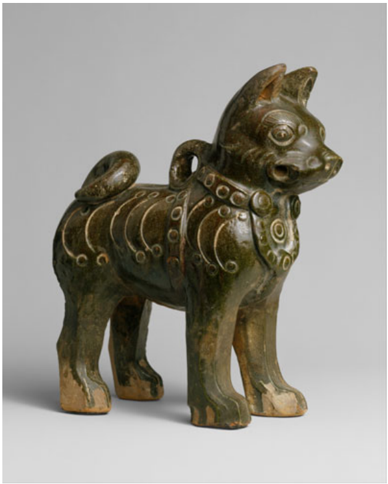
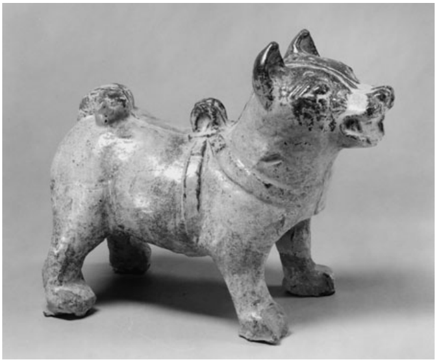
- Ceramic dog figurines from the late Western Han and Eastern Han, especially from Henan and Shaanxi, are often harnessed, snarling, or barking; nearly all known examples date to the first century CE onwards, and they were placed in domestic scenes to guard the deceased’s property rather than the ritual space of the tomb.
- The earliest known dog-occupied tomb appears to be the Xin (9–23 CE) burial of a small dog at Yueyangcheng, Yanliang, with 31 small figurines placed in the tomb.
- Post-Han zhiguai from the third to fifth centuries depict dogs performing heroic, filial-loyal acts; Huang’er was buried 200 steps from its owner’s home, while Heilong was buried with an inner and outer coffin in a burial mound over ten zhang tall.
Methods
- Qualitative historical analysis of textual, archaeological, and material sources from the Shang, Zhou, Han, and post-Han periods, including oracle bones, tomb excavations, ceramic figurines, ritual and philosophical texts, and zhiguai anomaly tales.
- The article organises the dog’s role in relation to the tomb into three phases and compares placement and significance across human-occupied and dog-occupied tombs.
- The main analysis is interpretive and synthetic rather than quantitative, drawing on primary sources and secondary scholarship.
Limitations
- The paper states that its three-phase divisions remain cursory at best because of the lack of archaeological findings from certain periods, especially the Han and post-Han period, and continued interregional differences.
- The paper states that much of Phase III is based on texts rather than archaeological evidence and could be enriched or even disproved by relevant excavations; it also notes that it is not clear exactly where many ceramic figurines were discovered in the tomb chamber.
- Evident from the text: reliance on later edited or translated texts and museum objects without full excavation context limits claims about actual burial practices, and the paper acknowledges scant archaeological material for further dog-occupied tombs.
Model-written summary. Check it against the paper before relying on it.
Integrity signals
Registry
Cites
Statistics
Figures
Verification
Claims the paper makes
0 Valid · 9 Not valid · 49 Not checked · 80 Own results and interpretations
A result the paper reports from its own data — it cites no other source for it, so there is none to check. The quote shows it is in the paper.
In the paper
“Turning to tombs, dogs are most often found in waist-pits in many types of tomb across the Shang period.”
plainstates an association- Asserted: passes — The authors put it forward as true.
- Checkable: passes — It can be checked against evidence.
- Load-bearing: passes — The paper’s conclusions depend on it.
- Based: passes — The paper gives a reason why it holds.
The paper states this without a source or data behind it here, so there is nothing to check it against. The quote shows it is in the paper.
In the paper
“Archaeological evidence from the Shang period in particular largely presents fragmentary, slaughtered, or dismembered dog remains in three contexts: in waste deposits, in ritual pits, and in relation to human-occupied tombs.”
plain- Asserted: passes — The authors put it forward as true.
- Checkable: passes — It can be checked against evidence.
- Load-bearing: passes — The paper’s conclusions depend on it.
- Based: unclear — It is unclear why the paper says it holds.
In the paper
“The argument for the dogs being companions in death is challenged by the findings of Li and Campbell, wherein many Shang dogs interred at Anyang were puppies, which is especially notable when compared with midden deposits in other sites that attest to the use of adult dogs as a food source.”
What the sources say
- Not matchedcites Li and Campbell
This doesn’t read as a citation we can look up.
plain- Asserted: passes — The authors put it forward as true.
- Checkable: passes — It can be checked against evidence.
- Load-bearing: passes — The paper’s conclusions depend on it.
- Based: passes — The paper gives a reason why it holds.
- Not matched
In the paper
“However, in line with the increased range of domestic buildings seen in late Western Han and Eastern Han graves, several architectural ceramics from this time period feature a guard-dog prone in front of an entrance, a very different placement to general livestock, which were positioned at the rear of such buildings.”
What the sources say
- Not matchedcites [43]
We don’t have this paper’s reference list.
plainstates an association- Asserted: passes — The authors put it forward as true.
- Checkable: passes — It can be checked against evidence.
- Load-bearing: passes — The paper’s conclusions depend on it.
- Based: passes — The paper gives a reason why it holds.
- Not matched
The paper states this without a source or data behind it here, so there is nothing to check it against. The quote shows it is in the paper.
In the paper
“It would seem that a variety of dogs could be involved in the hunt; Han art certainly shows clear distinctions between different ' breeds ' or roles of dogs within the hunt, whether sight-hounds or scent-hounds, pointers or sprinters.”
boosted- Asserted: passes — The authors put it forward as true.
- Checkable: passes — It can be checked against evidence.
- Load-bearing: unclear — It is unclear whether the paper’s conclusions depend on it.
- Based: unclear — It is unclear why the paper says it holds.
61 more claims
Create a free account to see all 138 claims and every source verdict.
- It may state two separate claims as one. 58
- Probably not a substantial claim. 21
Citations
Cites
Genetic Evidence for an East Asian Origin of Domestic Dogs
Savolainen, P., Zhang, Y.-P., Luo, J., Lundeberg, J., & Leitner, T. (2002) · Science · doi:10.1126/science.1073906 · Cited by 960
Rethinking Dog Domestication by Integrating Genetics, Archeology, and Biogeography
Larson, G., Karlsson, E. K., Perri, A., Webster, M. T., Ho, S. Y. W., Peters, J., Stahl, P. W., Piper, P. J., Lingaas, F., Fredholm, M., et al. (2012) · Proceedings of the National Academy of Sciences · doi:10.1073/pnas.1203005109 · Cited by 540
Genomic and archaeological evidence suggest a dual origin of domestic dogs
Frantz, L. A. F., Mullin, V. E., Pionnier-Capitan, M., Lebrasseur, O., Ollivier, M., Perri, A., Linderholm, A., Mattiangeli, V., Teasdale, M. D., Dimopoulos, E. A., et al. (2016) · Science · doi:10.1126/science.aaf3161 · Cited by 430
Germonpré, M., Sablin, M. V., Stevens, R. E., Hedges, R. E. M., Hofreiter, M., Stiller, M., & Després, V. R. (2009) · Journal of Archaeological Science · doi:10.1016/j.jas.2008.09.033 · Cited by 392
New zooarchaeological evidence for changes in Shang Dynasty animal sacrifice
Yuan, J., & Flad, R. K. (2005) · Journal of Anthropological Archaeology · doi:10.1016/j.jaa.2005.03.001 · Cited by 106
Pre-Neolithic evidence for dog-assisted hunting strategies in Arabia
Guagnin, M., Perri, A. R., & Petraglia, M. D. (2017) · Journal of Anthropological Archaeology · doi:10.1016/j.jaa.2017.10.003 · Cited by 100
Sacred killing: the archaeology of sacrifice in the ancient Near East
Porter, A., & Schwartz, G. M. (2012) · Cited by 73
Dog Burials in the Greek World
Day, L. P. (1984) · American Journal of Archaeology · doi:10.2307/504595 · Cited by 51
Violence, Kinship and the Early Chinese State: The Shang and their World
Campbell, R. (2018) · Cambridge University Press eBooks · doi:10.1017/9781108178563 · Cited by 35
Animals through Chinese History: Earliest Times to 1911
Kuo, C. P. (2020) · East Asian Science Technology and Society An International Journal · doi:10.1215/18752160-8772154 · Cited by 26
Research works printed but not linked: 13
- Schindler, 1924, On the travel, wayside and wind offerings in Ancient China, Asia Major, 1, 624
- Jin, 2011, Qianyi Shijiahe wenhua taosu yishu, Huaxia kaogu, 4, 55
- Sterckx, 1998, Debating the strange: records of animal anomalies in early China, Working Papers in Chinese Studies, 1
- Kuwayama, 1987, The Quest for Eternity: Chinese Ceramic Sculptures from the People's Republic of China
- Fudge, 2002, Representing Animals
- Selbitschka, 2017, Über den Alltag hinaus: Festschrift für Thomas O. Höllmann zum 65. Geburtstag
- Legge, 1865, The Chinese Classics
- Fiskesjö, 2001, Rising from blood-stained fields: royal hunting and state formation in Shang China, Bulletin of the Museum of Far Eastern Antiquities, 73
- Waley, 1958, The Way and its Power: A Study of the Tao Tê Ching and its Place in Chinese Thought
- Bielenstein, 1979, The restoration of the Han Dynasty: vol. IV: the government, Bulletin of the Museum of Far Eastern Antiquities, 51, 146
- Bingquan, 1968, Jisi bu cizhong de xisheng, Zhongyang yanjiuyuan lishi yuyan yanjiusuo jikan, 38, 181
- Chavannes, 1913, Mission Archéologique dans la Chine Septentrionale. Vol. I: La Sculpture à l’ Époque des Han
- Yang, 2013, Qianxi jiaguwen zhong de quansheng, Zhengzhou shifan jiaoyu, 1, 57
Cited by
Russell, N. (2026) · Cambridge University Press eBooks · doi:10.1017/9781009321563 · Cited by 2
Inuit–Qimmiit Kinship: Co-Travel in Life and Afterlife
Ginn, C. W. C., Kilabuk, T., & Ginn, C. (2026) · Religions · doi:10.3390/rel17030349
Metadata
- Authors
- Granger, K.
- Affiliations
- Ludwig-Maximilians-Universität München (DE)
- Corresponding author
- Granger, Kelsey
- ORCID
- Granger, Kelsey
- Venue
- Journal of the Royal Asiatic Society
- Publisher
- Cambridge University Press (CUP)
- Published
- 2023-02-27
- Volume
- 33
- Issue
- 3
- Pages
- 685-701
- ISSN
- 1356-1863 (ISSN-L)
- 1474-0591
- OpenAlex
- W4322500494
- Cited by
- 2
- References
- 18
- Citations by year
- 2026: 2
- FWCI
- 6.70
- Type
- journal article
- Language
- en
- Open access
- hybrid
- dx.doi.org
- Locations
- Journal of the Royal Asiatic Society (publishedVersion, cc-by)
- Open access LMU (Ludwid Maxmilian's Universitat Munchen) (submittedVersion, cc-by)
- Topics
- Social Sciences › Arts and Humanities › History › Chinese history and philosophy
- Social Sciences › Anthropology › Death, Funerary Practices, and Mourning
- Social Sciences › Geography, Planning and Development › Geographies of human-animal interactions
- Keywords
- dogs, ancient China, animal burials, human-animal relations, anthropomorphism of animals, hunting dogs, food-producing animals, early Middle Ages
About these checks
Registry, retraction, Cites and statistics results are computed, not judged, with one exception: a printed reference that no index lists is read once by a model before it counts as a citation error. Claims are extracted by a model and kept only when their quote appears verbatim in the text; each cited source is then checked, with a model’s help, for whether it says what the claim relies on. Those verdicts can be wrong — read the claim’s quote and the cited source before relying on one.
A language model drew the claims from the paper on 2026-10-04, under version 3 of the claim definition (model deepseek-v4.1-flash, prompt extract-v3).
A second model labelled each claim on 2026-10-04 (model jev-1.13-20260917, definition revision gold-guideline-v0.2).
Statistics and arithmetic are recomputed, not judged.
Confidence bands are shown only for fields calibrated on our annotated test set. None is calibrated yet, so no band is shown.
What counts as a claim ›How we measure confidence ›How we check this ›
Are you an author, or do you see a problem with this page? Request a review
How to cite
Cite CoChat for the checks on this page, and the paper for its own findings.
- This page
- CoChat. (2026). Citation check: From tomb-keeper to tomb-occupant: the changing conceptualisation of dogs in early China. https://app.cochat.ai/papers/10.1017/s1356186322000529
- The paper
- Granger, K. (2023). From tomb-keeper to tomb-occupant: the changing conceptualisation of dogs in early China. Journal of the Royal Asiatic Society. https://doi.org/10.1017/s1356186322000529
Data sources
Bibliographic data: Semantic Scholar, OpenAlex, Crossref.
Contains information from the Semantic Scholar Academic Graph Datasets, made available under the ODC Attribution License (ODC-BY 1.0).
Semantic Scholar’s data is described in: Kinney, R., et al. (2023). The Semantic Scholar Open Data Platform. arXiv:2301.10140.
