

Antipsychotic augmentation of serotonin reuptake inhibitors in treatment-resistant obsessive-compulsive disorder: a meta-analysis of double-blind, randomized, placebo-controlled trials
Open accessThe DOI matches its Crossref record; 87 of the 87 references it cites were found in a registry or an index.
Abstract
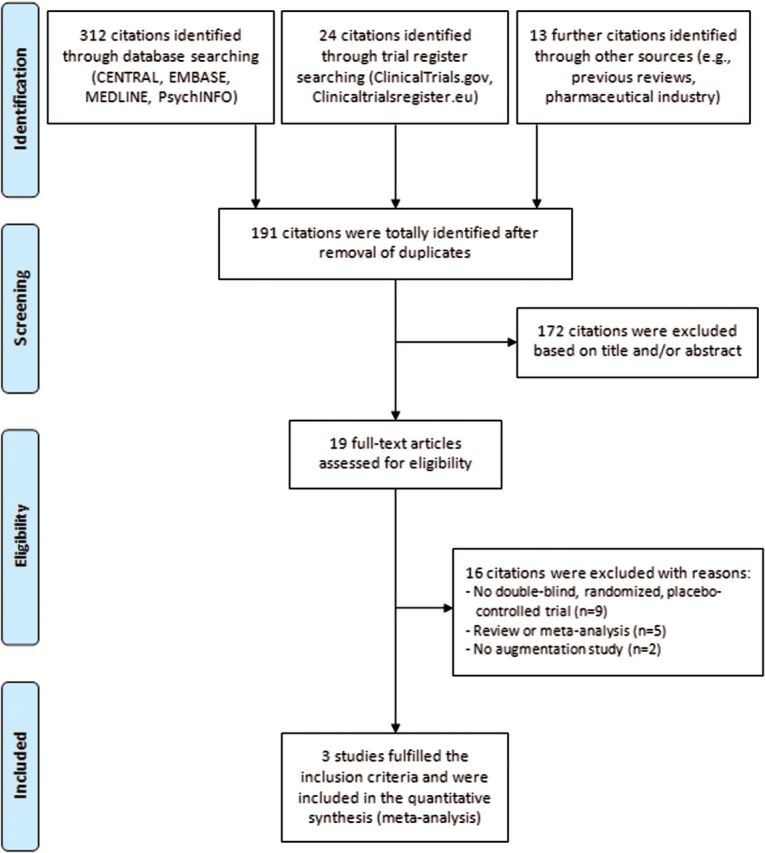
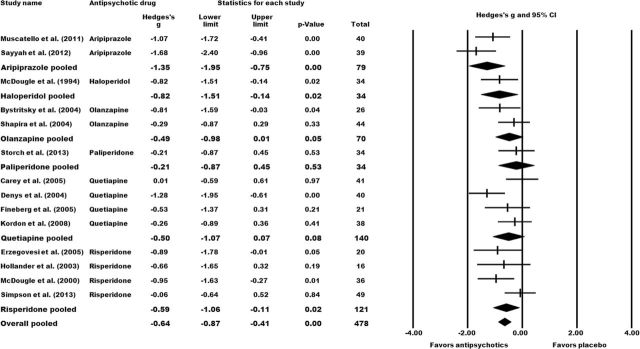
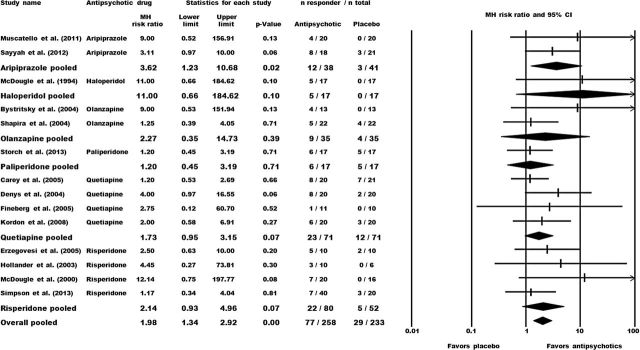
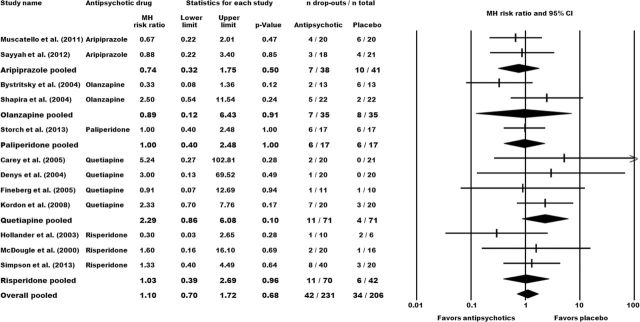
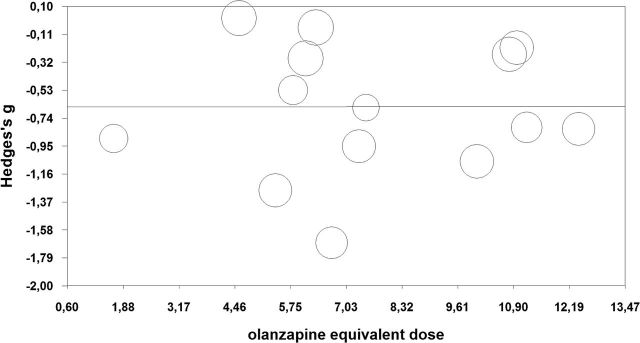
Because of the high number of patients with obsessive–compulsive disorder (OCD) not responding satisfactorily to initial monotherapy with serotonin reuptake inhibitors (SRIs), the evaluation of additional treatment options is highly relevant. To examine efficacy of add-on pharmacotherapy with antipsychotics, a systematic literature search was applied to identify all double-blind, randomized, placebo-controlled trials (DB-PC-RCTs) determining the efficacy of antipsychotic augmentation of SRIs in treatment-resistant OCD. The primary outcome of the pooled meta-analytic data analysis was response to the adjunctive antipsychotic treatment measured by both the rates of participants achieving response [defined as ⩾35% reduction in Yale–Brown Obsessive–Compulsive Scale (YBOCS)] and mean changes in YBOCS total score. Twelve DB-PC-RCTs investigating quetiapine (N = 5), risperidone (N = 3), olanzapine (N = 2), aripiprazole (N = 1) and haloperidol (N = 1) with a total of 394 subjects were included. Significantly more patients responded to augmentation with antipsychotics than with placebo [relative risk = 2.10, 95% confidence intervals (CI) 1.16–3.80]. Additionally, the mean reduction of the YBOCS total score revealed an efficacy in favour of the antipsychotic medication [standardized mean difference (SMD) = 0.54, 95% CI 0.15–0.93]. Significant efficacy was identifiable only for risperidone, but not for quetiapine and olanzapine. The results regarding aripiprazole and haloperidol were inconsistent. Overall, about one-third of SRI-resistant OCD patients benefited from an augmentation strategy with antipsychotics. Based on the favourable risk:benefit ratio, risperidone can be considered as the agent of first choice and should be preferred to quetiapine and olanzapine. Further trials, mainly with higher antipsychotic doses, are required to optimize pharmacological treatment recommendations for SRI-refractory OCD.
Overview
The claims and statistics of this paper haven’t been checked yet.
Free: it reads the open-access text and checks the first 5 claims that cite a source we can check. Create a free account to check every claim.
Integrity signals
Registry
Cites
Statistics
Figures
Verification
Claims the paper makes
The claims and statistics of this paper haven’t been checked yet.
Free: it reads the open-access text and checks the first 5 claims that cite a source we can check. Create a free account to check every claim.
Claims other papers make about this one
Each is checked against this paper’s own text: does it say what the citing paper says it does?
The source backs part of the claim, not all of it — or backs it for a different population, condition or comparison.
In the citing paper
“Meta- analysis [26] found that the add-on strategy with antipsychotics was providing benefits to approximately one- third of patients and risperidone was confirmed as a potential first choice augmenting agent.”
From Clinical Advances in Treatment Strategies for Obsessive-compulsive Disorder in Adults (2023) · cites this paper as [26]
Experimental — accuracy not yet measuredThe cited source says what the claim attributes to it.
In the citing paper
“Studies have shown that other antipsychotics, such as quetiapine, olanzapine, and paliperidone, are less effective than aripiprazole [26,30].”
From Clinical Advances in Treatment Strategies for Obsessive-compulsive Disorder in Adults (2023) · cites this paper as [26]
Self-check
Percentages, sums and reported differences re-computed from the paper’s own numbers.
The self-check needs the paper’s full text.
Citations
Cites
Preferred Reporting Items for Systematic Reviews and Meta-Analyses: the PRISMA statement
Moher, D., Liberati, A., Tetzlaff, J., Altman, D. G., & for the PRISMA Group (2009) · BMJ · doi:10.1136/bmj.b2535 · Cited by 83,823
Bias in meta-analysis detected by a simple, graphical test
Egger, M., Smith, G. D., Schneider, M., & Minder, C. (1997) · BMJ · doi:10.1136/bmj.315.7109.629 · Cited by 56,722
Preferred reporting items for systematic reviews and meta-analyses: the PRISMA Statement.
(2009) · PubMed Central · Cited by 44,859
Meta-analysis in clinical trials
DerSimonian, R., & Laird, N. (1986) · Controlled Clinical Trials · doi:10.1016/0197-2456(86)90046-2 · Cited by 39,552
Cochrane Handbook for Systematic Reviews of Interventions: Cochrane Book Series
(2008) · doi:10.1002/9780470712184 · Cited by 25,048
Preferred Reporting Items for Systematic Reviews and Meta-Analyses: The PRISMA Statement
Moher, D., Liberati, A., Tetzlaff, J., & Altman, D. G. (2009) · Journal of Clinical Epidemiology · doi:10.1016/j.jclinepi.2009.06.005 · Cited by 19,575
The Yale-Brown Obsessive Compulsive Scale: I. Development, Use, and Reliability
Goodman, W. K. (1989) · Archives of General Psychiatry · doi:10.1001/archpsyc.1989.01810110048007 · Cited by 7,712
Cochrane Handbook for Systematic Reviews of Interventions Version 5.0.1. The Cochrane Collaboration
Higgins, J. P. T., Green, S. R., & Higgins, J. P. T. (2008) · Cited by 7,261
Effectiveness of Antipsychotic Drugs in Patients with Chronic Schizophrenia
Lieberman, J. A., Stroup, T. S., McEvoy, J. P., Swartz, M. S., Rosenheck, R. A., Perkins, D. O., Keefe, R. S. E., Davis, S. M., Davis, C. E., Lebowitz, B. D., et al. (2005) · New England Journal of Medicine · doi:10.1056/nejmoa051688 · Cited by 5,892
A Fail-Safe N for Effect Size in Meta-Analysis
Orwin, R. G. (1983) · Journal of Educational Statistics · doi:10.2307/1164923 · Cited by 2,064
Research works printed but not linked: 6
- APA, 2007, American Psychiatric Association: Practice Guideline for the Treatment of Patients with Obsessive-Compulsive Disorder
- Borenstein M Hedges LV Higgins JPT Rothstein H (2006) Comprehensive meta-analysis, version 2. Englewood, New York: Biostat.
- 1969, Statistical Power analysis for the Behavioural Sciences
- National Institute for Clinical Excellence, 2006, Obsessive Compulsive Disorder: Core Interventions in the Treatment of Obsessive Compulsive Disorder and Body Dysmorphic Disorder
- The Cochrane Collaboration (2014) Review Manager (RevMan) [Computer program]. Version 5.3. Copenhagen: The Nordic Cochrane Centre.
- The Cochrance Collaboration, 2011, Software Review Manager (RevMan), Version 5.1.4
Cited by
Items 101–200 of 210
Commonly asked questions in the treatment of obsessive-compulsive disorder
Arumugham, S. S., & Reddy, Y. C. J. (2013) · Expert Review of Neurotherapeutics · doi:10.1586/14737175.2014.874287 · Cited by 16
“Among antipsychotics, risperidone has the best evidence followed by aripiprazole and haloperidol [5,80].”
BackgroundTalaeı, A., Hosseini, F. F., Aghili, Z., Akhondzadeh, S., Asadpour, E., Mehramiz, N. J., & Forouzanfar, F. (2020) · Canadian Journal of Physiology and Pharmacology · doi:10.1139/cjpp-2019-0381 · Cited by 17
The serotonergic system in obsessive-compulsive disorder
Derksen, M., Feenstra, M. G. P., Willuhn, I., & Denys, D. A. J. P. (2020) · Handbook of behavioral neuroscience · doi:10.1016/b978-0-444-64125-0.00044-x · Cited by 17
Wootton, B. M., & Tolin, D. F. (2015) · Elsevier eBooks · doi:10.1016/b978-0-12-397045-9.00090-2 · Cited by 14
Psilocybin in pharmacotherapy of obsessive-compulsive disorder
Owe-Larsson, M., Kamińska, K., Buchalska, B., Mirowska-Guzel, D. M., & Cudnoch‐Jędrzejewska, A. (2024) · Pharmacological Reports · doi:10.1007/s43440-024-00633-1 · Cited by 15
A pilot study of magnetic seizure therapy for treatment‐resistant obsessive–compulsive disorder
Tang, V. M., Blumberger, D. M., Weissman, C. R., Dimitrova, J., Throop, A., McClintock, S. M., Voineskos, D., Rajji, T. K., Downar, J. H., Knyahnytska, Y., et al. (2020) · Depression and Anxiety · doi:10.1002/da.23097 · Cited by 14
“The most well‐established option for treatment‐ resistant OCD is the augmentation of an SRI with an antipsychotic; however, only approximately one‐third of patients prescribed this combination will respond (Dold et al., 2015).”
BackgroundSachs, G., & Erfurth, A. (2017) · The International Journal of Neuropsychopharmacology · doi:10.1093/ijnp/pyx101 · Cited by 13
Sijercic, I., Whitfield, K. M., Cassin, S. E., & Antony, M. M. (2020) · Journal of Obsessive-Compulsive and Related Disorders · doi:10.1016/j.jocrd.2020.100532 · Cited by 12
Obsessive-Compulsive Syndromes in Schizophrenia: A Case for Polypharmacy?
Schirmbeck, F. N., & Zink, M. (2012) · Springer eBooks · doi:10.1007/978-94-007-5799-8_12 · Cited by 14
Shared genetic loci and causal relations between schizophrenia and obsessive-compulsive disorder
Chen, Y., Guo, H., & Yue, W. (2023) · Schizophrenia · doi:10.1038/s41537-023-00348-x · Cited by 13
Martiadis, V., Pessina, E., Cattaneo, C. I., Martini, A., Raffone, F., Prodi, T., Olivola, M., Berardis, D. D., Benatti, B., & Dell’Osso, B. M. (2025) · Frontiers in Psychiatry · doi:10.3389/fpsyt.2025.1617345 · Cited by 12
Mattina, G. F., Samaan, Z., Hall, G. B., & Steiner, M. S. (2020) · Journal of Affective Disorders · doi:10.1016/j.jad.2020.06.016 · Cited by 17
Kishi, T., Sakuma, K., & Iwata, N. (2022) · Translational Psychiatry · doi:10.1038/s41398-022-02026-5 · Cited by 13
Hegde, A., Kalyani, B. G., Arumugham, S. S., Narayanaswamy, J. C., Math, S. B., & Reddy, Y. C. J. (2016) · International Journal of Psychiatry in Clinical Practice · doi:10.1080/13651501.2016.1225098 · Cited by 12
“While some studies suggested at least moderate doses of antipsychotics (Dold et al. 2013), others either recommend lower doses (Veale et al. 2014) or failed to report a definite association between dose and response (Dold et al. 2015).”
BackgroundResultde Brouwer, G., Harvey, B. H., & Wolmarans, D. W. (2019) · Behavioural Pharmacology · doi:10.1097/fbp.0000000000000536 · Cited by 13
“Such therapy is often augmented with low-dose dopamine antagonists in refractory cases (Dold et al., 2013; Fineberg et al., 2013; Veale et al., 2014).”
BackgroundEffects of Antipsychotic Treatment on Obsessive-Compulsive Symptoms
Schirmbeck, F. N., & Zink, M. (2015) · Springer eBooks · doi:10.1007/978-3-319-12952-5_10 · Cited by 12
Ameringen, M. V., Fineberg, N. A., Ravindran, A. V., Arnold, P. D., Beaulieu, S., Brakoulias, V., Brietzke, E. M., Dowlati, Y., Drummond, L. M., Ferretti, C. J., et al. (2026) · Journal of Psychiatric Research · doi:10.1016/j.jpsychires.2025.12.039 · Cited by 15
Brožka, H., Radostová, D., Pištíková, A., Valeš, K., & Stuchlík, A. (2016) · Behavioural Brain Research · doi:10.1016/j.bbr.2016.09.042 · Cited by 10
Gupta, R., Mehan, S., Chhabra, S., Giri, A., & Sherawat, K. (2022) · Neurotoxicity Research · doi:10.1007/s12640-022-00586-4 · Cited by 10
“In recent clinical studies, non-responders to SSRI medication were also treated with antipsychotics (Dold et al. 2013).”
BackgroundBiological treatments for obsessive-compulsive and related disorders
Borue, X., Sharma, M., & Hudak, R. (2015) · Journal of Obsessive-Compulsive and Related Disorders · doi:10.1016/j.jocrd.2015.03.003 · Cited by 12
Lai, J., Lu, Q., Zhang, P., Xu, T., Xu, Y., & Hu, S. (2016) · Neuropsychiatric Disease and Treatment · doi:10.2147/ndt.s122316 · Cited by 9
Dold, M., Bartova, L., Souery, D., Mendlewicz, J., Porcelli, S., Serretti, A., Zohar, J., Montgomery, S., & Kasper, S. F. (2017) · Journal of Affective Disorders · doi:10.1016/j.jad.2017.10.033 · Cited by 10
Self-citationBruno, A., Pandolfo, G., Cedro, C., Gallo, G., Felice, M. D., Zoccali, R. A., & Muscatello, M. R. A. (2016) · Clinical Neuropharmacology · doi:10.1097/wnf.0000000000000123 · Cited by 10
“Results of available studies provide evidence that augmentationwith atypical antipsychotics appears to be a useful treatment strategy.(11,12) Antipsychotics have been proposed as add-on therapy to SSRIs in 4 OCD subtypes: OCDwith poor insight; refractory OCD, where the definition of refractoriness requires 3 months of…”
BackgroundStubbing, J., & Tolin, D. F. (2023) · Elsevier eBooks · doi:10.1016/b978-0-323-91497-0.00260-5 · Cited by 9
Mazzoleni, A., Bhatia, S., Bantounou, M. A., Kumar, N. S., Dzalto, M., & Soiza, R. L. (2023) · BJPsych Open · doi:10.1192/bjo.2023.539 · Cited by 11
Amerio, A., Odone, A., & Ghaemi, S. N. (2019) · Journal of Affective Disorders · doi:10.1016/j.jad.2019.02.024 · Cited by 9
Why have early investigational therapies of obsessive–compulsive disorder failed to materialise?
Marazziti, D., & Dell’Osso, L. (2015) · Expert Opinion on Investigational Drugs · doi:10.1517/13543784.2015.1005735 · Cited by 8
Hou, Y., & Lai, C. (2014) · Journal of Neuropsychiatry · doi:10.1176/appi.neuropsych.13050103 · Cited by 7
The Serotonergic System in Obsessive-Compulsive Disorder
van Dijk, A., Klompmakers, A. A., & Denys, D. A. J. P. (2010) · Handbook of behavioral neuroscience · doi:10.1016/s1569-7339(10)70100-4 · Cited by 9
Skarphéðinsson, G., & Ivarsson, T. (2015) · Current Behavioral Neuroscience Reports · doi:10.1007/s40473-015-0047-0 · Cited by 8
“, [60]), aripiprazole, quetiapine, olanzapine, and haloperidol, which is a typical or first generation antipsychotic [11, 61].”
BackgroundManning, E. E., Wang, A. Y., Saikali, L. M., Winner, A. S., & Ahmari, S. E. (2019) · bioRxiv (Cold Spring Harbor Laboratory) · doi:10.1101/694935 · Cited by 8
Moving beyond first-line treatment options for OCD
Paxos, C. (2022) · Mental Health Clinician · doi:10.9740/mhc.2022.10.300 · Cited by 7
Pediatric Obsessive–Compulsive Disorder: A Review for Nursing Professionals
Jacob, M. L., & Storch, E. A. (2013) · Journal of Child and Adolescent Psychiatric Nursing · doi:10.1111/jcap.12029 · Cited by 12
Hegde, A., Kalyani, B. G., Arumugham, S. S., Narayanaswamy, J. C., Math, S. B., & Reddy, Y. C. J. (2016) · Journal of Clinical Psychopharmacology · doi:10.1097/jcp.0000000000000515 · Cited by 6
“The proportion of responders to risperidone augmentation is similar to that seen in a recent meta-analysis, which found 28% to 30% of patients responding to antipsychotic augmentation.(9,10) Although modest, these results are encouraging considering the fact that only 40% to 60% of patients respond to the first SRI tr…”
ResultObsessive–Compulsive Disorders
Wewetzer, C., & Walitza, S. (2014) · Springer eBooks · doi:10.1007/978-3-7091-1501-5_21 · Cited by 7
Wewetzer, C., & Walitza, S. (2016) · Springer eBooks · doi:10.1007/978-3-662-48624-5_27 · Cited by 6
Prazosin addition to fluvoxamine: A preclinical study and open clinical trial in OCD
Feenstra, M. G. P., Klompmakers, A. A., Figee, M., Fluitman, S. B. A. H. A., Vulink, N. C. C., Westenberg, H. G. M., & Denys, D. A. J. P. (2015) · European Neuropsychopharmacology · doi:10.1016/j.euroneuro.2015.12.008 · Cited by 5
“To test its efficacy in a clinical population, we secondly initiated a small open-label trial of prazosin addition to on-going SRI treatment in 10 patients with SRI-refractory obsessive-compulsive disorder (OCD).”
BackgroundResultInfluentialPatterson, B. A., & Ameringen, M. V. (2017) · FOCUS The Journal of Lifelong Learning in Psychiatry · doi:10.1176/appi.focus.15205 · Cited by 5
Treatment of Obsessive-Compulsive and Related Disorders
Löchner, C., & Stein, D. J. (2014) · Current Treatment Options in Psychiatry · doi:10.1007/s40501-014-0021-6 · Cited by 6
Are current pharmacotherapeutic strategies effective in treating OCD?
Reddy, Y. C. J., & Arumugham, S. S. (2020) · Expert Opinion on Pharmacotherapy · doi:10.1080/14656566.2020.1735355 · Cited by 5
Ghobadian, A., Mokhtari, S., Shariati, B., Kamalzadeh, L., Shati, M., Ardebili, M. E., Yarahmadi, M., & Shalbafan, M. (2022) · BMC Pharmacology and Toxicology · doi:10.1186/s40360-022-00610-5 · Cited by 5
“The efficacy of dopamine antagonists in the treatment of OCD, which has been shown in previous studies, supports this hypothesis as well[39, 40].”
ResultPatterns, predictors, and effectiveness of TMS for treatment-resistant OCD: A naturalistic study
Breiger, M., Baldi, S., Perlo, S., Brennan, B. P., Brown, J. C., Siddiqi, S., & Razafsha, M. (2025) · Transcranial magnetic stimulation . · doi:10.1016/j.transm.2025.100096 · Cited by 6
Overcoming barriers in the pharmacological treatment of anxiety disorders
Baldwin, D. S., Rafiq, R., & Talat, B. (2013) · Neuropsychiatry · doi:10.2217/npy.12.73 · Cited by 4
Obsessive–Compulsive Disorder in Sports–Beyond Superstitions
Edwards, C. D., & Aron, C. M. (2023) · Advances in Psychiatry and Behavioral Health · doi:10.1016/j.ypsc.2023.03.002 · Cited by 7
Marazziti, D., Mucci, F., Avella, M. T., Dell’Oste, V., Baroni, S., & Dell’Osso, L. (2019) · Expert Opinion on Drug Metabolism & Toxicology · doi:10.1080/17425255.2019.1640211 · Cited by 6
Chiou, Y., Lin, P., & Lee, Y. (2015) · Clinical Neuropharmacology · doi:10.1097/wnf.0000000000000079 · Cited by 4
Obsessive‐compulsive disorder: current management options
Harris, P. G., Drummond, L. M., & Fineberg, N. A. (2019) · Prescriber · doi:10.1002/psb.1793 · Cited by 5
Pharmacotherapy of Obsessive-Compulsive Disorder During Breastfeeding
Uğuz, F. (2016) · American Journal of Therapeutics · doi:10.1097/mjt.0000000000000500 · Cited by 4
“Studies examining quetiapine are greater in number than olanzapine.(52,54,58) Additionally, a meta-analysis by Fineberg et al(58) based on changes from baseline in total Yale-Brown ObsessiveCompulsive Scale indicated efficacy for augmentation with quetiapine.”
BackgroundAntipsychotics and OCD: Boon or Bane?
Naguy, A. (2017) · Indian Journal of Psychological Medicine · doi:10.4103/ijpsym.ijpsym_236_17 · Cited by 4
“Of the AAPs, best available evidence is for risperidone as shown in a meta-analysis by Dold et al.([1]) and also aripiprazole as demonstrated by Ducasse et al.”
BackgroundEnglisch, S., & Zink, M. (2015) · Springer eBooks · doi:10.1007/978-3-319-12952-5_11 · Cited by 5
Arnold, P. D., & Kronenberg, S. (2017) · Wiley eBooks · doi:10.1002/9781118890233.ch60 · Cited by 4
Medication Management of Childhood OCD
Ivarsson, T., Skarphéðinsson, G., & Weidle, B. (2018) · Elsevier eBooks · doi:10.1016/b978-0-12-811427-8.00009-5 · Cited by 3
Comorbidities in Schizophrenia: Challenges for Researchers and Clinicians
Opler, L. A., Hwang, M. Y., & Opler, M. G. A. (2013) · Psychiatric Annals · doi:10.3928/00485713-20131003-03 · Cited by 5
Gebelik ve Postpartum Dönemde Obsesif Kompulsif Bozukluk
Demirkol, M. E., Şimşek, L., Yılmaz, H., & Tamam, L. (2018) · Psikiyatride Guncel Yaklasimlar - Current Approaches in Psychiatry · doi:10.18863/pgy.336626 · Cited by 4
(2008) · PsycEXTRA Dataset · doi:10.1037/e532162011-001 · Cited by 3
Metabolic and toxicological considerations for obsessive–compulsive disorder drug therapy
Sayyah, M., Majzoob, S., & Sayyah, M. (2013) · Expert Opinion on Drug Metabolism & Toxicology · doi:10.1517/17425255.2013.783011 · Cited by 3
Treatment-Resistant Obsessive-Compulsive Disorder (OCD): Focus on Antipsychotic Augmentation to SRIs
Albert, U., Cori, D. D., Bogetto, F., & Maina, G. (2014) · ArTS Archivio della ricerca di Trieste (University of Trieste https://www.units.it/) · Cited by 4
Treatment Approaches Based on Neuroscientific Data in Patients With Obsessive-Compulsive Disorder
Asl, M. A., Asgari, P., & Bakhti, S. Z. (2021) · International Clinical Neuroscience Journal · doi:10.34172/icnj.2021.24 · Cited by 3
Vloet, T. D., Herpertz‐Dahlmann, B., & Simons, M. (2016) · Zeitschrift für Kinder- und Jugendpsychiatrie und Psychotherapie · doi:10.1024/1422-4917/a000445 · Cited by 6
Shafti, S. S., & Kaviani, H. (2019) · Psychiatry and Clinical Psychopharmacology · doi:10.1080/24750573.2019.1597584 · Cited by 3
Combination Psychotropic Regimens in Community Practice
Olfson, M. (2014) · Journal of the American Academy of Child & Adolescent Psychiatry · doi:10.1016/j.jaac.2014.05.018 · Cited by 3
“Adding some low-dose second-generation antipsychotics to antidepressants also is helpful for adults with treatmentresistant major depressive disorder(10,11) or obsessive-compulsive disorder.(12) Unfortunately, less clinical research is available to guide the use of adjunctive antipsychotic medications for young people…”
BackgroundShahtou, A., Omara, H. R., Qari, S. A., Alqahtani, R. S., Alnasyan, Z. S., Alotaibi, A. E., Ali, A. A., Alabdulrahim, J. M., Naser, S. A., Asad, N., et al. (2026) · Cureus · doi:10.7759/cureus.108358 · Cited by 1
“Among the available next-step pharmacological approaches, the augmentation of ongoing serotonin reuptake inhibitor (SRI) therapy with antipsychotic medications is the most validated and widely prescribed intervention [15-17].”
Mohammad, A., Ibrahim, M., Khan, A. M., Pervaiz, U., Aijaz, S., Nasrullah, M. H., & JAMİL, H. (2026) · European Journal of Clinical Pharmacology · doi:10.1007/s00228-026-04085-9 · Cited by 1
OBSESINIS-KOMPULSINIS SUTRIKIMAS: APIBRĖŽTIS, KLINIKINIAI BRUOŽAI, DIAGNOSTIKA IR GYDYMAS
Zajankauskas, V., & Musneckis, A. (2023) · Health Sciences · doi:10.35988/sm-hs.2023.106 · Cited by 3
“pacientų nerodo pakankamo klinikinio efekto, gydytojai praktikoje dažnai turi atsižvelgti į šias mažiau nusistovėjusias gydymo strategijas [21].”
BackgroundGagnreynd meðferð við áráttu- og þráhyggjuröskun hjá börnum og unglingum: Yfirlitsgrein
Skarphéðinsson, G., Lauth, B., Njarðvík, U., & Ivarsson, T. (2016) · Læknablaðið · doi:10.17992/lbl.2016.04.75 · Cited by 3
Regen, F., & Benkert, O. (2016) · Springer eBooks · doi:10.1007/978-3-662-50333-1_1 · Cited by 2
Benkert, O. (2014) · Springer eBooks · doi:10.1007/978-3-642-54769-0_1 · Cited by 1
Sachdev, R. A., Ruparelia, R., Reid, J. E., Mpavenda, D., Cinosi, E., & Fineberg, N. A. (2018) · Cambridge University Press eBooks · doi:10.1017/9781108164313.016 · Cited by 2
Uğuz, F. (2019) · Springer eBooks · doi:10.1007/978-3-319-92919-4_16 · Cited by 1
Tourette- und Tic-Störungen in Kindheit und Jugend
Döpfner, M., & Roessner, V. (2021) · Springer Reference Medizin · doi:10.1007/978-3-662-49289-5_122-1 · Cited by 1
Voderholzer, U. (2017) · Springer eBooks · doi:10.1007/978-3-662-49295-6_70 · Cited by 1
Psychedelic therapy for body dysmorphic disorder
Johnson, S., & Letheby, C. (2022) · Journal of Psychedelic Studies · doi:10.1556/2054.2022.00200 · Cited by 1
“While controlled, clinical trials are still required, another line of preliminary evidence pertains to obsessive-compulsive disorder (OCD), whose phenotype overlaps with that of BDD.”
BackgroundInfluentialBiological Models and Treatments for OCD in Adults
Stewart, S. E., & Loh, A. S. (2017) · Wiley eBooks · doi:10.1002/9781118890233.ch14 · Cited by 1
Biological Models and Treatments for Obsessive‐Compulsive Related Disorders for Adults
Hudak, R., Borue, X., & Sharma, M. (2017) · Wiley eBooks · doi:10.1002/9781118890233.ch59 · Cited by 2
Bation, R. (2018) · theses.fr (ABES) · doi:10.70675/3c89240bzc242z45f4z9247z73969c8af558 · Cited by 1
Obsessive–Compulsive and Related Disorders: Obsessive–Compulsive Disorder and Hoarding Disorder
Pato, M. T., Steketee, G. S., Eisen, J. L., Yip, A. G., & Phillips, K. A. (2015) · Wiley eBooks · doi:10.1002/9781118753378.ch57
Castaldelli-Maia, J. M. (2015) · Elsevier eBooks · doi:10.1016/b978-0-08-097086-8.27044-x
de Alvarenga, P. G. (2014) · Digital Library of Theses and Dissertations (Universidade de São Paulo) · doi:10.11606/t.5.2014.tde-04082014-084337 · Cited by 1
Enhancing cognitive-behavior therapy in the treatment of obsessive-compulsive disorder
Andersson, E. (2014) · Figshare
Integrative Therapie der Zwangsstörungen
Voderholzer, U. (2016) · Springer eBooks · doi:10.1007/978-3-642-45028-0_70-1
Obsessive-Compulsive Disorder: Overview and Standard Treatment Strategies
Seibell, P. J., Hamblin, R. J., & Hollander, E. (2015) · Psychiatric Annals · doi:10.3928/00485713-20150602-04 · Cited by 1
Angststörungen, Reaktionen auf (schwere) Belastungen, Zwangsstörung
Plag, J., Scheel, M., Gallinat, J., & Ströhle, A. (2017) · Elsevier eBooks · doi:10.1016/b978-3-437-23421-7.00009-0
Obsessive-Compulsive and Related Disorders in Older Age
Suo, S., & Chadha, P. (2017) · Springer eBooks · doi:10.1007/978-3-319-67555-8_13 · Cited by 1
Quantitatives EEG und Neurofeedback in der Diagnostik und Behandlung der Zwangserkrankung
Siedek, D., Kuderer, M., Hack, R., & Aigner, M. (2018) · psychopraxis neuropraxis · doi:10.1007/s00739-018-0467-1
Self-citationDrug Augmentation Strategies for Treatment-Resistant Obsessive-Compulsive and Related Disorders
Shavitt, R. G., & Diniz, J. B. (2018) · Cambridge University Press eBooks · doi:10.1017/9781108164313.019
Stovezky, Y. R., Gershkovich, M., Kayser, R. R., & Simpson, H. B. (2018) · Cambridge University Press eBooks · doi:10.1017/9781108164313.020
Pharmacologic-Augmented Treatments
Schneider, S. C., & Storch, E. A. (2019) · Cambridge University Press eBooks · doi:10.1017/9781108235655.020
Third Generation Antipsychotic as add-on therapy inIntractable Obsessive-Compulsive Disorder
Shafti, S. S. (2019) · Biomedical Journal of Scientific & Technical Research · doi:10.26717/bjstr.2019.17.003016
Multidimensional Approaches for A Case of Severe Adult Obsessive - Compulsive Disorder.
Shi, Z., Mei, X., Zhu, Y., Shuai, Y., Chen, Y.-P., Wu, Y., & Shen, Y. (2017) · PubMed Central · doi:10.11919/j.issn.1002-0829.217019 · Cited by 1
身体症状症および関連症群 (身体表現性障害) の薬物療法はどこまで可能になったのか
名越, 泰. (2019) · 心身医学 · doi:10.15064/jjpm.59.6_554 · Cited by 1
Troubles obsessionnels compulsifs
Millet, B., Vanelle, J., & Benyaya, J. (2014) · Elsevier eBooks · doi:10.1016/b978-2-294-74176-0.00017-9
Nonpsychiatric indications for antidepressants and antipsychotics
Samel, S. (2022) · Current Psychiatry · doi:10.12788/cp.0222
Bibliography: Obsessive-Compulsive and Related Disorders
(2015) · FOCUS The Journal of Lifelong Learning in Psychiatry · doi:10.1176/appi.focus.130214
(2019) · American Psychiatric Association Publishing eBooks · doi:10.1176/appi.books.9781615372997.as04
(2014) · FOCUS The Journal of Lifelong Learning in Psychiatry · doi:10.1176/appi.focus.12.2.172
(2019) · American Psychiatric Association Publishing eBooks · doi:10.1176/appi.books.9781615372997.as06
(2019) · American Psychiatric Association Publishing eBooks · doi:10.1176/appi.books.9781615372300.as04
(2019) · American Psychiatric Association Publishing eBooks · doi:10.1176/appi.books.9781615372300.as06
Biological Approaches to Obsessive-Compulsive Disorder: Psychiatric Neurosurgery and Neuromodulation
Barrios-Anderson, A., McLaughlin, N. C. R., & Greenberg, B. D. (2023) · Oxford University Press eBooks · doi:10.1093/oxfordhb/9780190068752.013.18
Metadata
- Authors
- Dold, M., Aigner, M., Lanzenberger, R., & Kasper, S.
- Affiliations
- Medical University of Vienna (AT)
- Corresponding author
- Kasper, Siegfried
- Venue
- International Journal of Neuropsychopharmacology
- Publisher
- Oxford University Press (OUP)
- Published
- 2013-04-01
- Volume
- 16
- Issue
- 3
- Pages
- 557-574
- ISSN
- 1461-1457 (ISSN-L)
- 1469-5111
- PMC
- PMC4576518
- OpenAlex
- W2171064051
- Semantic Scholar
- 346eb13e5d744f9e9521baf62b5b240e1de1d881
- Cited by
- 211
- References
- 87
- Citations by year
- 2026: 6 · 2025: 5 · 2024: 9 · 2023: 10 · 2022: 11 · 2021: 11 · 2020: 13 · 2019: 28 · 2018: 18 · 2017: 21 · 2016: 22 · 2015: 22 · 2014: 22 · 2013: 10
- FWCI
- 2.61
- Type
- journal article
- Language
- en
- Open access
- bronze
- doi.org
- Locations
- The International Journal of Neuropsychopharmacology (publishedVersion)
- Europe PMC (PubMed Central) (publishedVersion, cc-by-nc)
- PubMed (publishedVersion)
- mediaTUM (Technical University of Munich) (submittedVersion)
- Topics
- Social Sciences › Psychology › Clinical Psychology › Obsessive-Compulsive Spectrum Disorders
- Health Sciences › Medicine › Psychiatry and Mental health › Schizophrenia research and treatment
- Social Sciences › Psychology › Clinical Psychology › Psychoanalysis and Psychopathology Research
- Keywords
- obsessive-compulsive disorder, treatment-resistant OCD, antipsychotic augmentation, serotonin reuptake inhibitors, quetiapine, risperidone, aripiprazole, olanzapine, paliperidone, haloperidol, Yale-Brown Obsessive Compulsive Scale, obsessions and compulsions, treatment response, attrition rates, effect size
- MeSH terms
- Double-Blind Method, Drug Resistance, Drug Synergism, Drug Therapy, Combination, Humans, Obsessive-Compulsive Disorder, Antipsychotic Agents, Randomized Controlled Trials as Topic, Treatment Outcome, Selective Serotonin Reuptake Inhibitors
About these checks
Registry, retraction, Cites and statistics results are computed, not judged, with one exception: a printed reference that no index lists is read once by a model before it counts as a citation error. Claims are extracted by a model and kept only when their quote appears verbatim in the text; each cited source is then checked, with a model’s help, for whether it says what the claim relies on. Those verdicts can be wrong — read the claim’s quote and the cited source before relying on one.
Statistics and arithmetic are recomputed, not judged.
Confidence bands are shown only for fields calibrated on our annotated test set. None is calibrated yet, so no band is shown.
What counts as a claim ›How we measure confidence ›How we check this ›
Are you an author, or do you see a problem with this page? Request a review
Data sources
Bibliographic data: Semantic Scholar, OpenAlex, Crossref.
Contains information from the Semantic Scholar Academic Graph Datasets, made available under the ODC Attribution License (ODC-BY 1.0).
Semantic Scholar’s data is described in: Kinney, R., et al. (2023). The Semantic Scholar Open Data Platform. arXiv:2301.10140.
