

Antipsychotic augmentation of serotonin reuptake inhibitors in treatment-resistant obsessive-compulsive disorder: a meta-analysis of double-blind, randomized, placebo-controlled trials
Open accessThe DOI matches its Crossref record; 87 of the 87 references it cites were found in a registry or an index.
Abstract
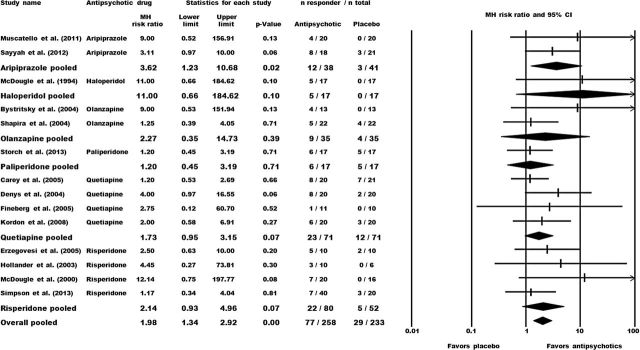
Because of the high number of patients with obsessive–compulsive disorder (OCD) not responding satisfactorily to initial monotherapy with serotonin reuptake inhibitors (SRIs), the evaluation of additional treatment options is highly relevant. To examine efficacy of add-on pharmacotherapy with antipsychotics, a systematic literature search was applied to identify all double-blind, randomized, placebo-controlled trials (DB-PC-RCTs) determining the efficacy of antipsychotic augmentation of SRIs in treatment-resistant OCD. The primary outcome of the pooled meta-analytic data analysis was response to the adjunctive antipsychotic treatment measured by both the rates of participants achieving response [defined as ⩾35% reduction in Yale–Brown Obsessive–Compulsive Scale (YBOCS)] and mean changes in YBOCS total score. Twelve DB-PC-RCTs investigating quetiapine (N = 5), risperidone (N = 3), olanzapine (N = 2), aripiprazole (N = 1) and haloperidol (N = 1) with a total of 394 subjects were included. Significantly more patients responded to augmentation with antipsychotics than with placebo [relative risk = 2.10, 95% confidence intervals (CI) 1.16–3.80]. Additionally, the mean reduction of the YBOCS total score revealed an efficacy in favour of the antipsychotic medication [standardized mean difference (SMD) = 0.54, 95% CI 0.15–0.93]. Significant efficacy was identifiable only for risperidone, but not for quetiapine and olanzapine. The results regarding aripiprazole and haloperidol were inconsistent. Overall, about one-third of SRI-resistant OCD patients benefited from an augmentation strategy with antipsychotics. Based on the favourable risk:benefit ratio, risperidone can be considered as the agent of first choice and should be preferred to quetiapine and olanzapine. Further trials, mainly with higher antipsychotic doses, are required to optimize pharmacological treatment recommendations for SRI-refractory OCD.
Overview
The claims and statistics of this paper haven’t been checked yet.
Free: it reads the open-access text and checks the first 5 claims that cite a source we can check. Create a free account to check every claim.
Integrity signals
Registry
Cites
Statistics
Figures
Verification
Claims the paper makes
The claims and statistics of this paper haven’t been checked yet.
Free: it reads the open-access text and checks the first 5 claims that cite a source we can check. Create a free account to check every claim.
Claims other papers make about this one
Each is checked against this paper’s own text: does it say what the citing paper says it does?
The source backs part of the claim, not all of it — or backs it for a different population, condition or comparison.
In the citing paper
“Meta- analysis [26] found that the add-on strategy with antipsychotics was providing benefits to approximately one- third of patients and risperidone was confirmed as a potential first choice augmenting agent.”
From Clinical Advances in Treatment Strategies for Obsessive-compulsive Disorder in Adults (2023) · cites this paper as [26]
Experimental — accuracy not yet measuredThe cited source says what the claim attributes to it.
In the citing paper
“Studies have shown that other antipsychotics, such as quetiapine, olanzapine, and paliperidone, are less effective than aripiprazole [26,30].”
From Clinical Advances in Treatment Strategies for Obsessive-compulsive Disorder in Adults (2023) · cites this paper as [26]
Self-check
Percentages, sums and reported differences re-computed from the paper’s own numbers.
The self-check needs the paper’s full text.
Citations
Cites
Preferred Reporting Items for Systematic Reviews and Meta-Analyses: the PRISMA statement
Moher, D., Liberati, A., Tetzlaff, J., Altman, D. G., & for the PRISMA Group (2009) · BMJ · doi:10.1136/bmj.b2535 · Cited by 83,823
Bias in meta-analysis detected by a simple, graphical test
Egger, M., Smith, G. D., Schneider, M., & Minder, C. (1997) · BMJ · doi:10.1136/bmj.315.7109.629 · Cited by 56,722
Preferred reporting items for systematic reviews and meta-analyses: the PRISMA Statement.
(2009) · PubMed Central · Cited by 44,859
Meta-analysis in clinical trials
DerSimonian, R., & Laird, N. (1986) · Controlled Clinical Trials · doi:10.1016/0197-2456(86)90046-2 · Cited by 39,552
Cochrane Handbook for Systematic Reviews of Interventions: Cochrane Book Series
(2008) · doi:10.1002/9780470712184 · Cited by 25,048
Preferred Reporting Items for Systematic Reviews and Meta-Analyses: The PRISMA Statement
Moher, D., Liberati, A., Tetzlaff, J., & Altman, D. G. (2009) · Journal of Clinical Epidemiology · doi:10.1016/j.jclinepi.2009.06.005 · Cited by 19,575
The Yale-Brown Obsessive Compulsive Scale: I. Development, Use, and Reliability
Goodman, W. K. (1989) · Archives of General Psychiatry · doi:10.1001/archpsyc.1989.01810110048007 · Cited by 7,712
Cochrane Handbook for Systematic Reviews of Interventions Version 5.0.1. The Cochrane Collaboration
Higgins, J. P. T., Green, S. R., & Higgins, J. P. T. (2008) · Cited by 7,247
Effectiveness of Antipsychotic Drugs in Patients with Chronic Schizophrenia
Lieberman, J. A., Stroup, T. S., McEvoy, J. P., Swartz, M. S., Rosenheck, R. A., Perkins, D. O., Keefe, R. S. E., Davis, S. M., Davis, C. E., Lebowitz, B. D., et al. (2005) · New England Journal of Medicine · doi:10.1056/nejmoa051688 · Cited by 5,892
A Fail-Safe N for Effect Size in Meta-Analysis
Orwin, R. G. (1983) · Journal of Educational Statistics · doi:10.2307/1164923 · Cited by 2,064
Research works printed but not linked: 6
- APA, 2007, American Psychiatric Association: Practice Guideline for the Treatment of Patients with Obsessive-Compulsive Disorder
- Borenstein M Hedges LV Higgins JPT Rothstein H (2006) Comprehensive meta-analysis, version 2. Englewood, New York: Biostat.
- 1969, Statistical Power analysis for the Behavioural Sciences
- National Institute for Clinical Excellence, 2006, Obsessive Compulsive Disorder: Core Interventions in the Treatment of Obsessive Compulsive Disorder and Body Dysmorphic Disorder
- The Cochrane Collaboration (2014) Review Manager (RevMan) [Computer program]. Version 5.3. Copenhagen: The Nordic Cochrane Centre.
- The Cochrance Collaboration, 2011, Software Review Manager (RevMan), Version 5.1.4
Cited by
Stein, D. J., Costa, D. L. C., Lochner, C., Miguel, E. C., Reddy, Y. C. J., Shavitt, R. G., van den Heuvel, O. A., & Simpson, H. B. (2019) · Nature Reviews Disease Primers · doi:10.1038/s41572-019-0102-3 · Cited by 895
Obsessive-Compulsive Disorder: Advances in Diagnosis and Treatment
Hirschtritt, M. E., Bloch, M. H., & Mathews, C. A. (2017) · JAMA · doi:10.1001/jama.2017.2200 · Cited by 493
The Roles of Serotonin in Neuropsychiatric Disorders
Pourhamzeh, M., Moravej, F. G., Arabi, M., Shahriari, E., Mehrabi, S., Ward, R., Ahadi, R., & Joghataei, M. T. (2022) · Cellular and Molecular Neurobiology · doi:10.1007/s10571-021-01064-9 · Cited by 366
Hudak, R., & Gannon, J. M. (2022) · Current Clinical Practice · doi:10.1007/978-3-030-98709-1_5 · Cited by 306
Harmonizing the Neurobiology and Treatment of Obsessive-Compulsive Disorder
Goodman, W. K., Storch, E. A., & Sheth, S. A. (2021) · American Journal of Psychiatry · doi:10.1176/appi.ajp.2020.20111601 · Cited by 250
Simpson, H. B., Foa, E. B., Liebowitz, M. R., Huppert, J. D., Cahill, S., Maher, M. J., McLean, C. P., Bender, J., Marcus, S. M., Williams, M. T., et al. (2013) · JAMA Psychiatry · doi:10.1001/jamapsychiatry.2013.1932 · Cited by 248
Psychopharmacological Treatment of Obsessive-Compulsive Disorder (OCD)
Del Casale, A., Sorice, S., Padovano, A., Simmaco, M., Ferracuti, S., Lamis, D. A., Rapinesi, C., Sani, G., Girardi, P., Kotzalidis, G. D., et al. (2019) · Current Neuropharmacology · doi:10.2174/1570159x16666180813155017 · Cited by 223
Pharmacological Treatment of Obsessive-Compulsive Disorder
Pittenger, C., & Bloch, M. H. (2014) · Psychiatric Clinics of North America · doi:10.1016/j.psc.2014.05.006 · Cited by 222
“A recent metaanalysis of 9 double-blind, placebo controlled trials of augmentation with typical or atypical antipsychotics demonstrated their efficacy compared to placebo [22, 23].”
BackgroundBerlim, M. T., Neufeld, N. H., & Van den Eynde, F. (2013) · Journal of Psychiatric Research · doi:10.1016/j.jpsychires.2013.03.022 · Cited by 219
“For example, a recent meta-analysis on resistant OCD (Dold et al., 2012) has shown that the augmentation of SSRIs with antipsychotics for 4e16 weeks resulted in a Standardized Mean Difference in pre-post YBOCS scores of 0.54 (95% CI ¼ 0.15 to 0.93; n ¼ 392).”
ResultInfluentialFineberg, N. A., Hollander, E., Pallanti, S., Walitza, S., Grünblatt, E., Dell’Osso, B. M., Albert, U., Geller, D. A., Brakoulias, V., Janardhan Reddy, Y. C., et al. (2020) · International Clinical Psychopharmacology · doi:10.1097/yic.0000000000000314 · Cited by 161
Clinical practice guidelines for Obsessive-Compulsive Disorder
Janardhan Reddy, Y., Sundar, A., Narayanaswamy, J., & Math, S. (2017) · Indian Journal of Psychiatry · doi:10.4103/0019-5545.196976 · Cited by 156
Treatment-refractory anxiety; definition, risk factors, and treatment challenges
Roy-Byrne, P. (2015) · Dialogues in Clinical Neuroscience · doi:10.31887/dcns.2015.17.2/proybyrne · Cited by 147
Fineberg, N. A., Reghunandanan, S., Simpson, H. B., Phillips, K. A., Richter, M. A., Matthews, K., Stein, D. J., Sareen, J., Brown, A., & Sookman, D. (2015) · Psychiatry Research · doi:10.1016/j.psychres.2014.12.003 · Cited by 150
“There is little evidence to discriminate between antipsychotics, although at least one metaanalysis suggests a greater effect size may be achieved with risperidone (Dold et al., 2013).”
BackgroundDold, M., Aigner, M., Lanzenberger, R., & Kasper, S. (2015) · International Journal of Neuropsychopharmacology · doi:10.1093/ijnp/pyv047 · Cited by 134
“In our previous metaanalysis on this topic (Dold et al., 2013), we concluded that risperidone can be considered as the augmenting drug of first choice and should be preferred to olanzapine and quetiapine.”
BackgroundMethodInfluentialSelf-citationDougherty, D. D., Brennan, B. P., Stewart, S. E., Wilhelm, S., Widge, A. S., & Rauch, S. L. (2018) · JAMA Psychiatry · doi:10.1001/jamapsychiatry.2018.0930 · Cited by 131
Kim, S. J., Roh, D., Jung, H. H., Chang, W. S., Kim, C.-H., & Chang, J. W. (2018) · Journal of Psychiatry and Neuroscience · doi:10.1503/jpn.170188 · Cited by 121
Clinically relevant interactions between newer antidepressants and second-generation antipsychotics
Spina, E., & de León, J. (2014) · Expert Opinion on Drug Metabolism & Toxicology · doi:10.1517/17425255.2014.885504 · Cited by 136
“5-HT: Serotonin receptor; a: a adrenergic receptor; H: Histamine receptor; MT: Melatonin receptors; OCD: Obsessive-compulsive disorder; RCT: Randomized clinical trial; SSRI: Selective serotonin reuptake inhibitor.”
BackgroundInfluentialObsessive-compulsive disorder in children and adolescents: epidemiology, diagnosis and management
Nazeer, A., Latif, F., Mondal, A., Azeem, M. W., & Greydanus, D. E. (2020) · Translational Pediatrics · doi:10.21037/tp.2019.10.02 · Cited by 130
Association of rigid-compulsive behavior with functional constipation in autism spectrum disorder
Marler, S., Ferguson, B. J., Lee, E. B., Peters, B., Williams, K. C., McDonnell, E., Macklin, E. A., Levitt, P., Margolis, K. G., Beversdorf, D. Q., et al. (2017) · Journal of Autism and Developmental Disorders · doi:10.1007/s10803-017-3084-6 · Cited by 94
“We also do not have data on the target symptoms for which these medications were prescribed, which could include rigid-compulsive behavior as a logical treatment target based upon randomized controlled trials in both ASD and OCD (Dold et al.”
BackgroundInfluentialHawken, E., Dilkov, D., Kaludiev, E., Simek, S., Zhang, F., & Milev, R. (2016) · International Journal of Molecular Sciences · doi:10.3390/ijms17030420 · Cited by 94
“, antipsychotics [37]), suggesting that perhaps the optimum protocol for OCD has not yet been identified [12].”
BackgroundFonseka, T. M., Richter, M. A., & Müller, D. J. (2014) · Current Psychiatry Reports · doi:10.1007/s11920-014-0510-8 · Cited by 93
Albert, U., Marazziti, D., Di Salvo, G., Solia, F., Rosso, G., & Maina, G. (2019) · Current Medicinal Chemistry · doi:10.2174/0929867325666171222163645 · Cited by 90
Treatment-resistant OCD: Pharmacotherapies in adults
van Roessel, P. J., Grassi, G., Aboujaoude, E. N., Menchón, J. M., Van Ameringen, M., & Rodríguez, C. I. (2023) · Comprehensive Psychiatry · doi:10.1016/j.comppsych.2022.152352 · Cited by 86
Obsessive–compulsive disorder comorbid with schizophrenia and bipolar disorder
Reddy, Y. C. J., & Sharma, L. (2019) · Indian Journal of Psychiatry · doi:10.4103/psychiatry.indianjpsychiatry_527_18 · Cited by 84
Swierkosz-Lenart, K., Santos, J. F. A. D., Elowe, J., Clair, A.-H., Bally, J. F., Riquier, F., Bloch, J., Draganski, B., Clerc, M.-T., Moyano, B. P., et al. (2023) · Frontiers in Psychiatry · doi:10.3389/fpsyt.2023.1065812 · Cited by 80
Schizo-obsessive spectrum disorders: an update
Scotti-Muzzi, E., & Saide, O. L. (2017) · CNS Spectrums · doi:10.1017/s1092852916000390 · Cited by 65
“Based on the risk– benefit ratio, risperidone was suggested as the agent of first choice over quetiapine and olanzapine.(132) No conclusions regarding aripiprazole and haloperidol could be made due to methodological issues.”
BackgroundA 2012 evidence-based algorithm for the pharmacotherapy for obsessive-compulsive disorder
Stein, D. J., Koen, N., Fineberg, N., Fontenelle, L. F., Matsunaga, H., Osser, D., & Simpson, H. B. (2012) · Current Psychiatry Reports · doi:10.1007/s11920-012-0268-9 · Cited by 65
Lissemore, J. I., Sookman, D., Gravel, P., Berney, A., Barsoum, A., Diksic, M., Nordahl, T. E., Pinard, G., Sibon, I., Cottraux, J., et al. (2018) · Translational Psychiatry · doi:10.1038/s41398-018-0128-4 · Cited by 60
Ducasse, D., Boyer, L., Michel, P., Loundou, A., Macgregor, A., Micoulaud‐Franchi, J., Courtet, P., Abbar, M., Leboyer, M., & Fond, G. B. (2014) · Psychopharmacology · doi:10.1007/s00213-014-3516-3 · Cited by 63
Emamzadehfard, S., Kamaloo, A., Paydary, K., Ahmadipour, A., Zeinoddini, A., Ghaleiha, A., Mohammadinejad, P., Zeinoddini, A., & Akhondzadeh, S. (2016) · Psychiatry and Clinical Neurosciences · doi:10.1111/pcn.12394 · Cited by 55
Yun, J., Jang, J. H., Kim, S. N., Jung, W. H., & Kwon, J. S. (2015) · Progress in Neuro-Psychopharmacology and Biological Psychiatry · doi:10.1016/j.pnpbp.2015.06.009 · Cited by 57
Murray, G. K., Knolle, F., Ersche, K. D., Craig, K. J., Abbott, S., Shabbir, S. S., Fineberg, N. A., Suckling, J., Sahakian, B. J., Bullmore, E. T., et al. (2019) · Psychopharmacology · doi:10.1007/s00213-019-05292-2 · Cited by 53
Pharmacotherapeutic Strategies and New Targets in OCD
Pittenger, C. (2021) · Current topics in behavioral neurosciences · doi:10.1007/7854_2020_204 · Cited by 59
Jahanbakhsh, S. P., Manteghi, A. A., Emami, S. A., Mahyari, S., Gholampour, B., Mohammadpour, A. H., & Sahebkar, A. (2016) · Complementary Therapies in Medicine · doi:10.1016/j.ctim.2016.03.018 · Cited by 57
Zai, G., Brandl, E. J., Müller, D. J., Richter, M. A., & Kennedy, J. L. (2014) · Pharmacogenomics · doi:10.2217/pgs.14.83 · Cited by 49
Laroche, D. G., & Gaillard, A. (2016) · Psychiatry Research · doi:10.1016/j.psychres.2016.09.031 · Cited by 53
Gerasch, S., Kanaan, A. S., Jakubovski, E., & Müller‐Vahl, K. (2016) · Frontiers in Neuroscience · doi:10.3389/fnins.2016.00416 · Cited by 48
Pharmacological Augmentations of SRIs for Obsessive Compulsive Disorder
Leppink, E. W., & Grant, J. E. (2017) · Wiley eBooks · doi:10.1002/9781118890233.ch16 · Cited by 43
The Role of Serotonin in Orbitofrontal Function and Obsessive-Compulsive Disorder
Maia, T. V., & Cano-Colino, M. (2015) · Clinical Psychological Science · doi:10.1177/2167702614566809 · Cited by 42
Zhou, D., Zhou, X., Li, Y., Zhang, K.-F., Lv, Z., Chen, X., Wan, L.-Y., Wang, W., Wang, G.-M., Li, D., et al. (2018) · Progress in Neuro-Psychopharmacology and Biological Psychiatry · doi:10.1016/j.pnpbp.2018.12.009 · Cited by 48
Mulders, A. E. P., Plantinga, B. R., Schruers, K. R. J., Duits, A., Janssen, M. L. F., Ackermans, L. P. C. M., Leentjens, A. F. G., Jahanshahi, A., & Temel, Y. (2016) · European Neuropsychopharmacology · doi:10.1016/j.euroneuro.2016.10.011 · Cited by 49
The Psychopharmacology of Obsessive-Compulsive Disorder: A Preclinical Roadmap
Szechtman, H., Harvey, B. H., Woody, E. Z., & Hoffman, K. L. (2019) · Pharmacological Reviews · doi:10.1124/pr.119.017772 · Cited by 41
Pardossi, S., Cuomo, A., & Fagiolini, A. M. (2024) · Journal of Clinical Medicine · doi:10.3390/jcm13164739 · Cited by 52
Afshar, H., Akuchekian, S., Mahaky, B., & Zarean, E. (2014) · PubMed Central · Cited by 52
Psychopharmacotherapy of Obsessive-Compulsive Symptoms within the Framework of Tourette Syndrome
Rothenberger, A., & Roessner, V. (2018) · Current Neuropharmacology · doi:10.2174/1570159x16666180828095131 · Cited by 41
Kim, M., Kwak, S., Yoon, Y. B., Kwak, Y. B., Kim, T., Cho, K. I. K., Lee, T. Y., & Kwon, J. S. (2019) · Neuropsychopharmacology · doi:10.1038/s41386-019-0436-2 · Cited by 37
A randomized controlled study of brief family-based intervention in obsessive compulsive disorder
Baruah, U., Pandian, R. D., Narayanaswamy, J. C., Math, S. B., Thennarasu, K., & Reddy, Y. C. J. (2017) · Journal of Affective Disorders · doi:10.1016/j.jad.2017.08.014 · Cited by 45
Kim, D., Ryba, N., Kalabalik, J., & Westrich, L. (2018) · Drugs in R&D · doi:10.1007/s40268-018-0246-8 · Cited by 38
“Aripiprazole and haloperidol were then each supported by a single trial and, thus, were not classified as having strong evidence [121].”
BackgroundZhou, D.-D., Zhou, X.-X., Lv, Z., Chen, X.-R., Wang, W., Wang, G.-M., Liu, C., Li, D.-Q., & Kuang, L. (2019) · Journal of Psychiatric Research · doi:10.1016/j.jpsychires.2019.01.014 · Cited by 37
McLaughlin, N. C. R., Lauro, P. M., Patrick, M. T., Pucci, F. G., Barrios-Anderson, A., Greenberg, B. D., Rasmussen, S. A., & Asaad, W. F. (2021) · Neurosurgery · doi:10.1093/neuros/nyab050 · Cited by 39
Khalkhali, M., Aram, S., Zarrabi, H., Kafie, M., & Heidarzadeh, A. (2016) · PubMed Central · Cited by 46
Pallanti, S., Marras, A., Salerno, L., Makris, N., & Hollander, E. (2016) · Journal of Psychopharmacology · doi:10.1177/0269881116628427 · Cited by 36
“Risperidone, which is considered in recent meta-analyses (Dold et al., 2013) the only effective augmentation treatment for SSRI-refractory OCD, has been reported declining its effect on long-term observation (Matsunaga et al., 2009).”
BackgroundThe Endocannabinoid System: A New Treatment Target for Obsessive Compulsive Disorder?
Kayser, R. R., Snorrason, I., Haney, M., Lee, F. S., & Simpson, H. B. (2019) · Cannabis and Cannabinoid Research · doi:10.1089/can.2018.0049 · Cited by 35
Shalbafan, M., Malekpour, F., Najafabadi, B. T., Ghamari, K., Dastgheib, S. A., Mowla, A., Shirazi, E., Ardebili, M. E., Ghazizadeh‐Hashemi, M., & Akhondzadeh, S. (2019) · Journal of Psychopharmacology · doi:10.1177/0269881119878177 · Cited by 37
Foa, E. B., Simpson, H. B., Rosenfield, D., Liebowitz, M. R., Cahill, S. P., Huppert, J. D., Bender Jr, J., McLean, C. P., Maher, M. J., Campeas, R., et al. (2015) · The Journal of Clinical Psychiatry · doi:10.4088/jcp.14m09044 · Cited by 34
Patterson, B. A., & Ameringen, M. V. (2016) · Depression and Anxiety · doi:10.1002/da.22525 · Cited by 41
“recent meta-analysis of OCD,[34] the difference in results between our study and the paper by Ipser et al.”
ResultInfluentialAntipsychotic augmentation in the treatment of obsessive-compulsive disorder
Jaisoorya, T. S., & Thamby, A. (2019) · Indian Journal of Psychiatry · doi:10.4103/psychiatry.indianjpsychiatry_519_18 · Cited by 39
“There are six meta-analyses to date, all of which have included double-blind, randomized, placebo-controlled trials comparing augmentation of SSRIs with antipsychotics to placebo supplementation in treatment-resistant OCD.”
BackgroundInfluentialObsessive-Compulsive and Related Disorders
Leigh, H. (2014) · Springer eBooks · doi:10.1007/978-3-319-11005-9_24 · Cited by 32
New perspectives in the treatment of body dysmorphic disorder
Hong, K., Nezgovorova, V., & Hollander, E. (2018) · F1000Research · doi:10.12688/f1000research.13700.1 · Cited by 31
“Such augmentation medications can include second-generation antipsychotics, including olanzapine, quetiapine, and risperidone; among these, risperidone has the best demonstrated efficacy 55 .”
BackgroundTrichotillomania is more related to Tourette disorder than to obsessive-compulsive disorder
Lamothe, H., Baleyte, J., Mallet, L., & Pélissolo, A. (2020) · Brazilian Journal of Psychiatry · doi:10.1590/1516-4446-2019-0471 · Cited by 37
The Place of Antipsychotics in the Therapy of Anxiety Disorders and Obsessive-Compulsive Disorders
Pignon, B., du Montcel, C. T., Carton, L., & Pélissolo, A. (2017) · Current Psychiatry Reports · doi:10.1007/s11920-017-0847-x · Cited by 35
Ablative neurosurgery and deep brain stimulation for obsessive-compulsive disorder
Arumugham, S. S., Balachander, S., & Srinivas, D. (2019) · Indian Journal of Psychiatry · doi:10.4103/psychiatry.indianjpsychiatry_523_18 · Cited by 31
Rational site-directed pharmacotherapy for major depressive disorder
Blier, P. (2014) · The International Journal of Neuropsychopharmacology · doi:10.1017/s1461145713000400 · Cited by 29
“This strategy would be a first choice if a patient also has treatment-resistant obsessive–compulsive disorder since there are several positive augmentation studies with risperidone in this disorder (Dold et al., 2012).”
BackgroundFrías, Á., Palma, C., Farriols, N., Becerra, C., Álvarez, A., & Cañete, J. (2014) · Psychiatry Research · doi:10.1016/j.psychres.2014.10.003 · Cited by 31
Obsessive–Compulsive Disorder in Autism Spectrum Disorder Across the Lifespan
Pazuniak, M., & Pekrul, S. R. (2020) · Child and Adolescent Psychiatric Clinics of North America · doi:10.1016/j.chc.2019.12.003 · Cited by 63
Suhas, S., Malo, P. K., Kumar, V., Issac, T. G., Chithra, N. K., Bhaskarapillai, B., Reddy, Y. C. J., & Rao, N. P. (2022) · The World Journal of Biological Psychiatry · doi:10.1080/15622975.2022.2082525 · Cited by 34
Management of Treatment-Resistant Obsessive-Compulsive Disorder
Gershkovich, M., Wheaton, M. G., & Simpson, H. B. (2017) · Current Treatment Options in Psychiatry · doi:10.1007/s40501-017-0127-8 · Cited by 32
Clozapine-induced obsessive–compulsive symptoms: mechanisms and treatment
Kim, D. D., Barr, A. M., White, R. F., Honer, W. G., & Procyshyn, R. M. (2018) · Journal of Psychiatry and Neuroscience · doi:10.1503/jpn.180087 · Cited by 28
Lennertz, L., Wagner, M., Grabe, H. J., Franke, P. E., Guttenthaler, V., Rampacher, F., Schulze‐Rauschenbach, S., Vogeley, A., Benninghoff, J., Ruhrmann, S., et al. (2013) · European Neuropsychopharmacology · doi:10.1016/j.euroneuro.2013.07.003 · Cited by 31
Biria, M., Cantonas, L.-M., & Banca, P. (2021) · Current topics in behavioral neurosciences · doi:10.1007/7854_2020_201 · Cited by 27
Wheaton, M. G., Rosenfield, D., Foa, E. B., & Simpson, H. B. (2015) · Journal of Consulting and Clinical Psychology · doi:10.1037/ccp0000025 · Cited by 24
“About one-third of adults with OCD respond to an antipsychotic (Bloch et al., 2006, Dold et al., 2013; Skapinakis, Papatheodorou, & Mavreas, 2007), but what predicts response is less clear.”
BackgroundKetamine induces immediate and delayed alterations of OCD-like behavior
Thompson, S. L., Welch, A. C., Iourinets, J., & Dulawa, S. C. (2020) · Psychopharmacology · doi:10.1007/s00213-019-05397-8 · Cited by 24
Olbrich, H., Jahn, I., Stengler, K., Seifritz, E., & Colla, M. (2022) · Clinical Neurophysiology · doi:10.1016/j.clinph.2022.02.029 · Cited by 31
Kwak, S., Kim, M., Kim, T., Kwak, Y., Oh, S., Lho, S. K., Moon, S.-Y., Lee, T. Y., & Kwon, J. S. (2020) · Translational Psychiatry · doi:10.1038/s41398-020-01045-4 · Cited by 22
Pharmacologic treatment of obsessive-compulsive disorder comorbidity
Pallanti, S., & Grassi, G. (2014) · Expert Opinion on Pharmacotherapy · doi:10.1517/14656566.2014.964208 · Cited by 25
“Thus, our recommendation is to prefer antipsychotics with an established effectiveness for OCD (haloperidol, risperidone, aripiprazole) [27,28,30] when treating psychotic symptoms in these patients.”
BackgroundResultThe Black Book of Psychotropic Dosing and Monitoring
DeBattista, C., & Schatzberg, A. F. (2025) · Psychopharmacology Bulletin · doi:10.64719/pb.4493 · Cited by 25
Andrade, C. (2013) · The Journal of Clinical Psychiatry · doi:10.4088/jcp.13f08883 · Cited by 24
New treatment models for compulsive disorders
Grant, J. E., Fineberg, N. A., Ameringen, M. V., Cath, D. C., Visser, H. A. D., Carmi, L., Pallanti, S., Hollander, E., & van Balkom, A. J. L. M. (2015) · European Neuropsychopharmacology · doi:10.1016/j.euroneuro.2015.11.008 · Cited by 26
The Neuronal Glutamate Transporter EAAT3 in Obsessive-Compulsive Disorder
Escobar, A. P., Wendland, J. R., Chávez, A. E., & Moya, P. R. (2019) · Frontiers in Pharmacology · doi:10.3389/fphar.2019.01362 · Cited by 30
Pittenger, C., Brennan, B. P., Koran, L. M., Mathews, C. A., Nestadt, G., Pato, M. T., Phillips, K. A., Rodríguez, C. I., Simpson, H. B., Skapinakis, P., et al. (2021) · Psychiatry Research · doi:10.1016/j.psychres.2021.113853 · Cited by 24
McLean, C. P., Zandberg, L. J., Meter, P. E. V., Carpenter, J. K., Simpson, H. B., & Foa, E. B. (2015) · The Journal of Clinical Psychiatry · doi:10.4088/jcp.14m09513 · Cited by 25
Sahraian, A., Ehsaei, Z., & Mowla, A. (2018) · Progress in Neuro-Psychopharmacology and Biological Psychiatry · doi:10.1016/j.pnpbp.2018.03.014 · Cited by 26
Clinical Advances in Treatment Strategies for Obsessive-compulsive Disorder in Adults
Roh, D., Jang, K. W., & Kim, C.-H. (2023) · Clinical Psychopharmacology and Neuroscience · doi:10.9758/cpn.23.1075 · Cited by 20
“Studies have shown that other antipsychotics, such as quetiapine, olanzapine, and paliperidone, are less effective than aripiprazole [26,30].”
BackgroundPharmacotherapy of obsessive-compulsive disorder during pregnancy: a clinical approach
Uğuz, F. (2015) · Brazilian Journal of Psychiatry · doi:10.1590/1516-4446-2015-1673 · Cited by 20
Treatment Resistance in Obsessive-Compulsive Disorder
Middleton, R., Wheaton, M. G., Kayser, R., & Simpson, H. B. (2019) · Treatment Resistance in Psychiatry · doi:10.1007/978-981-10-4358-1_11 · Cited by 19
Burk, B. G., DiGiacomo, T., Polancich, S., Pruett, B. S., Sivaraman, S., & Birur, B. (2023) · Acta Psychiatrica Scandinavica · doi:10.1111/acps.13567 · Cited by 27
“As it relates to schizophrenia, when OCD/OCS have been reported, they occur in 40% of patients preceding and in another 40% following psychosis onset, with the remaining 20% reported concurrently.16 Additionally, meta-analyses reveal that up to 12%–14% of schizophrenia patients meet DSM-5 criteria for OCD.16 Multiple…”
BackgroundInfluentialObsessive-Compulsive Disorder: Diagnosis, Epidemiology, Etiology, and Treatment
Sassano-Higgins, S. A., & Pato, M. T. (2015) · FOCUS The Journal of Lifelong Learning in Psychiatry · doi:10.1176/appi.focus.130211 · Cited by 29
A closer look to neural pathways and psychopharmacology of obsessive compulsive disorder
Gargano, S. P., Santos, M. G., Taylor, S. M., & Pastis, I. (2023) · Frontiers in Behavioral Neuroscience · doi:10.3389/fnbeh.2023.1282246 · Cited by 18
Pharmacogenetics of Obsessive-Compulsive Disorder: An Evidence-Update
Zai, G. C. (2021) · Current topics in behavioral neurosciences · doi:10.1007/7854_2020_205 · Cited by 19
Egashira, N., Kubota, N., Goto, Y., Watanabe, T., Kubota, K., Katsurabayashi, S., & Iwasaki, K. (2017) · Pharmacology Biochemistry and Behavior · doi:10.1016/j.pbb.2017.12.006 · Cited by 20
“Therefore, many studies have assessed the effectiveness of antipsychotic augmentation for refractory OCD (Dold et al., 2013).”
Poppe, C., Müller, S. T., Greil, W., Walder, A., Grohmann, R., & Stübner, S. (2016) · Journal of Affective Disorders · doi:10.1016/j.jad.2016.04.035 · Cited by 19
Yin, L., Yu, Y., Han, F., & Wang, Q. (2024) · Cerebral Cortex · doi:10.1093/cercor/bhae258 · Cited by 18
Woody, E. Z., Hoffman, K. L., & Szechtman, H. (2019) · Advances in pharmacology · doi:10.1016/bs.apha.2019.04.003 · Cited by 17
Akbari, M., Jamshidi, S., Sheikhi, S., Alijani, F., Kafshchi, P., & Taylor, D. M. (2024) · Psychopharmacology · doi:10.1007/s00213-024-06529-5 · Cited by 18
Dell’Osso, B. M., Vismara, M. E. M., Benatti, B., Cirnigliaro, G., Grancini, B. M., Fineberg, N. A., Ameringen, M. V., Hollander, E., Stein, D. J., Menchón, J. M., et al. (2019) · CNS Spectrums · doi:10.1017/s1092852919001068 · Cited by 17
Poyurovsky, M., Braverman, L., & Weizman, A. (2020) · International Clinical Psychopharmacology · doi:10.1097/yic.0000000000000325 · Cited by 16
Zhu, R., Dong, X., Zhang, D., Liu, X., Ye, Y., & Jiang, Y. (2020) · Journal of Analytical Toxicology · doi:10.1093/jat/bkaa085 · Cited by 16
Martiadis, V., Pessina, E., Martini, A., Raffone, F., Cattaneo, C. I., Berardis, D. D., & Pampaloni, I. (2024) · CNS Spectrums · doi:10.1017/s1092852924000348 · Cited by 19
“…been examined, although the results are inconsistent and multiple meta-analyses have been unable to demonstrate their superiority versus placebo 5,9 – 11 ; paliperidone has been studied in treatment-resistant OCD patients in one randomized, placebo-controlled trial of 8 weeks showing…”
Treatment-resistant OCD – A psychopharmacological ‘touche d’art’
Naguy, A., & Alamiri, B. (2018) · Asian Journal of Psychiatry · doi:10.1016/j.ajp.2018.04.025 · Cited by 14
Baig, M. R., Wilson, J. L., Lemmer, J. A., Beck, R. D., Peterson, A. L., & Roache, J. D. (2019) · Psychiatric Quarterly · doi:10.1007/s11126-019-09638-z · Cited by 16
Metadata
- Authors
- Dold, M., Aigner, M., Lanzenberger, R., & Kasper, S.
- Affiliations
- Medical University of Vienna (AT)
- Corresponding author
- Kasper, Siegfried
- Venue
- International Journal of Neuropsychopharmacology
- Publisher
- Oxford University Press (OUP)
- Published
- 2013-04-01
- Volume
- 16
- Issue
- 3
- Pages
- 557-574
- ISSN
- 1461-1457 (ISSN-L)
- 1469-5111
- PMC
- PMC4576518
- OpenAlex
- W2171064051
- Cited by
- 211
- References
- 87
- Citations by year
- 2026: 6 · 2025: 5 · 2024: 9 · 2023: 10 · 2022: 11 · 2021: 11 · 2020: 13 · 2019: 28 · 2018: 18 · 2017: 21 · 2016: 22 · 2015: 22 · 2014: 22 · 2013: 10
- FWCI
- 2.61
- Type
- journal article
- Language
- en
- Open access
- bronze
- doi.org
- Locations
- The International Journal of Neuropsychopharmacology (publishedVersion)
- Europe PMC (PubMed Central) (publishedVersion, cc-by-nc)
- PubMed (publishedVersion)
- mediaTUM (Technical University of Munich) (submittedVersion)
- Topics
- Social Sciences › Psychology › Clinical Psychology › Obsessive-Compulsive Spectrum Disorders
- Health Sciences › Medicine › Psychiatry and Mental health › Schizophrenia research and treatment
- Social Sciences › Psychology › Clinical Psychology › Psychoanalysis and Psychopathology Research
- Keywords
- obsessive-compulsive disorder, treatment-resistant OCD, antipsychotic augmentation, serotonin reuptake inhibitors, quetiapine, risperidone, aripiprazole, olanzapine, paliperidone, haloperidol, Yale-Brown Obsessive Compulsive Scale, obsessions and compulsions, treatment response, attrition rates, effect size
- MeSH terms
- Double-Blind Method, Drug Resistance, Drug Synergism, Drug Therapy, Combination, Humans, Obsessive-Compulsive Disorder, Antipsychotic Agents, Randomized Controlled Trials as Topic, Treatment Outcome, Selective Serotonin Reuptake Inhibitors
About these checks
Registry, retraction, Cites and statistics results are computed, not judged, with one exception: a printed reference that no index lists is read once by a model before it counts as a citation error. Claims are extracted by a model and kept only when their quote appears verbatim in the text; each cited source is then checked, with a model’s help, for whether it says what the claim relies on. Those verdicts can be wrong — read the claim’s quote and the cited source before relying on one.
Statistics and arithmetic are recomputed, not judged.
Confidence bands are shown only for fields calibrated on our annotated test set. None is calibrated yet, so no band is shown.
What counts as a claim ›How we measure confidence ›How we check this ›
Are you an author, or do you see a problem with this page? Request a review
Data sources
Bibliographic data: Semantic Scholar, OpenAlex, Crossref.
Contains information from the Semantic Scholar Academic Graph Datasets, made available under the ODC Attribution License (ODC-BY 1.0).
Semantic Scholar’s data is described in: Kinney, R., et al. (2023). The Semantic Scholar Open Data Platform. arXiv:2301.10140.
