

Antipsychotic augmentation of serotonin reuptake inhibitors in treatment-resistant obsessive-compulsive disorder: a meta-analysis of double-blind, randomized, placebo-controlled trials
Open accessThe DOI matches its Crossref record; 87 of the 87 references it cites were found in a registry or an index.
Abstract
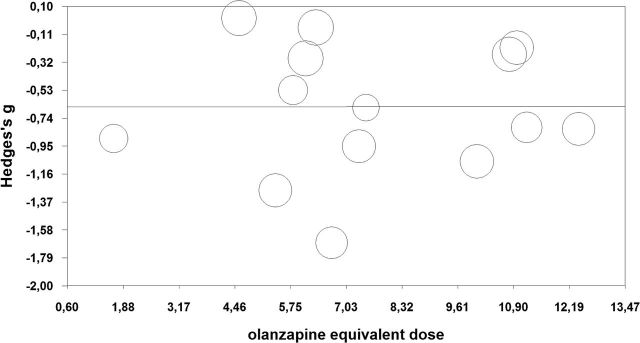
Because of the high number of patients with obsessive–compulsive disorder (OCD) not responding satisfactorily to initial monotherapy with serotonin reuptake inhibitors (SRIs), the evaluation of additional treatment options is highly relevant. To examine efficacy of add-on pharmacotherapy with antipsychotics, a systematic literature search was applied to identify all double-blind, randomized, placebo-controlled trials (DB-PC-RCTs) determining the efficacy of antipsychotic augmentation of SRIs in treatment-resistant OCD. The primary outcome of the pooled meta-analytic data analysis was response to the adjunctive antipsychotic treatment measured by both the rates of participants achieving response [defined as ⩾35% reduction in Yale–Brown Obsessive–Compulsive Scale (YBOCS)] and mean changes in YBOCS total score. Twelve DB-PC-RCTs investigating quetiapine (N = 5), risperidone (N = 3), olanzapine (N = 2), aripiprazole (N = 1) and haloperidol (N = 1) with a total of 394 subjects were included. Significantly more patients responded to augmentation with antipsychotics than with placebo [relative risk = 2.10, 95% confidence intervals (CI) 1.16–3.80]. Additionally, the mean reduction of the YBOCS total score revealed an efficacy in favour of the antipsychotic medication [standardized mean difference (SMD) = 0.54, 95% CI 0.15–0.93]. Significant efficacy was identifiable only for risperidone, but not for quetiapine and olanzapine. The results regarding aripiprazole and haloperidol were inconsistent. Overall, about one-third of SRI-resistant OCD patients benefited from an augmentation strategy with antipsychotics. Based on the favourable risk:benefit ratio, risperidone can be considered as the agent of first choice and should be preferred to quetiapine and olanzapine. Further trials, mainly with higher antipsychotic doses, are required to optimize pharmacological treatment recommendations for SRI-refractory OCD.
Overview
The claims and statistics of this paper haven’t been checked yet.
Free: it reads the open-access text and checks the first 5 claims that cite a source we can check. Create a free account to check every claim.
Integrity signals
Registry
Cites
Statistics
Figures
Verification
Claims the paper makes
The claims and statistics of this paper haven’t been checked yet.
Free: it reads the open-access text and checks the first 5 claims that cite a source we can check. Create a free account to check every claim.
Claims other papers make about this one
Each is checked against this paper’s own text: does it say what the citing paper says it does?
The source backs part of the claim, not all of it — or backs it for a different population, condition or comparison.
In the citing paper
“Meta- analysis [26] found that the add-on strategy with antipsychotics was providing benefits to approximately one- third of patients and risperidone was confirmed as a potential first choice augmenting agent.”
From Clinical Advances in Treatment Strategies for Obsessive-compulsive Disorder in Adults (2023) · cites this paper as [26]
Experimental — accuracy not yet measuredThe cited source says what the claim attributes to it.
In the citing paper
“Studies have shown that other antipsychotics, such as quetiapine, olanzapine, and paliperidone, are less effective than aripiprazole [26,30].”
From Clinical Advances in Treatment Strategies for Obsessive-compulsive Disorder in Adults (2023) · cites this paper as [26]
Self-check
Percentages, sums and reported differences re-computed from the paper’s own numbers.
The self-check needs the paper’s full text.
Citations
Cites
Preferred Reporting Items for Systematic Reviews and Meta-Analyses: the PRISMA statement
Moher, D., Liberati, A., Tetzlaff, J., Altman, D. G., & for the PRISMA Group (2009) · BMJ · doi:10.1136/bmj.b2535 · Cited by 83,823
Bias in meta-analysis detected by a simple, graphical test
Egger, M., Smith, G. D., Schneider, M., & Minder, C. (1997) · BMJ · doi:10.1136/bmj.315.7109.629 · Cited by 56,722
Preferred reporting items for systematic reviews and meta-analyses: the PRISMA Statement.
(2009) · PubMed Central · Cited by 44,859
Meta-analysis in clinical trials
DerSimonian, R., & Laird, N. (1986) · Controlled Clinical Trials · doi:10.1016/0197-2456(86)90046-2 · Cited by 39,552
Cochrane Handbook for Systematic Reviews of Interventions: Cochrane Book Series
(2008) · doi:10.1002/9780470712184 · Cited by 25,048
Preferred Reporting Items for Systematic Reviews and Meta-Analyses: The PRISMA Statement
Moher, D., Liberati, A., Tetzlaff, J., & Altman, D. G. (2009) · Journal of Clinical Epidemiology · doi:10.1016/j.jclinepi.2009.06.005 · Cited by 19,575
The Yale-Brown Obsessive Compulsive Scale: I. Development, Use, and Reliability
Goodman, W. K. (1989) · Archives of General Psychiatry · doi:10.1001/archpsyc.1989.01810110048007 · Cited by 7,712
Cochrane Handbook for Systematic Reviews of Interventions Version 5.0.1. The Cochrane Collaboration
Higgins, J. P. T., Green, S. R., & Higgins, J. P. T. (2008) · Cited by 7,259
Effectiveness of Antipsychotic Drugs in Patients with Chronic Schizophrenia
Lieberman, J. A., Stroup, T. S., McEvoy, J. P., Swartz, M. S., Rosenheck, R. A., Perkins, D. O., Keefe, R. S. E., Davis, S. M., Davis, C. E., Lebowitz, B. D., et al. (2005) · New England Journal of Medicine · doi:10.1056/nejmoa051688 · Cited by 5,892
A Fail-Safe N for Effect Size in Meta-Analysis
Orwin, R. G. (1983) · Journal of Educational Statistics · doi:10.2307/1164923 · Cited by 2,064
International Consensus Study of Antipsychotic Dosing
Gardner, D. M., Murphy, A. L., O'Donnell, H., Centorrino, F., & Baldessarini, R. J. (2010) · American Journal of Psychiatry · doi:10.1176/appi.ajp.2009.09060802 · Cited by 1,301
Kahn, R. S., Fleischhacker, W. W., Boter, H., Davidson, M., Vergouwe, Y., Keet, I. P., Gheorghe, M. D., Rybakowski, J. K., Galderisi, S., Libiger, J., et al. (2008) · The Lancet · doi:10.1016/s0140-6736(08)60486-9 · Cited by 1,088
Practice Guideline for the Treatment of Patients With Obsessive-Compulsive Disorder
(2008) · APA Practice Guidelines for the Treatment of Psychiatric Disorders: Comprehensive Guidelines and Guideline Watches · doi:10.1176/appi.books.9780890423363.149114 · Cited by 1,028
Bandelow, B., Zohar, J., Hollander, E., Kasper, S., Möller, H.-J., WFSBP TASK FORCE ON TREATMENT GUIDE, Bandelow, B., Zohar, J., Hollander, E., Kasper, S., et al. (2008) · The World Journal of Biological Psychiatry · doi:10.1080/15622970802465807 · Cited by 854
Self-citationBaldwin, D. S., Anderson, I. M., Nutt, D. J., Allgulander, C., Bandelow, B., den Boer, J. A., Christmas, D. M., Davies, S., Fineberg, N., Lidbetter, N., et al. (2014) · Journal of Psychopharmacology · doi:10.1177/0269881114525674 · Cited by 676
Bloch, M. H., Landeros-Weisenberger, A., Kelmendi, B., Coric, V, Bracken, M. B., & Leckman, J. F. (2006) · Molecular Psychiatry · doi:10.1038/sj.mp.4001823 · Cited by 635
McDougle, C. J., Epperson, C. N., Pelton, G. H., Wasylink, S., & Price, L. H. (2000) · Archives of General Psychiatry · doi:10.1001/archpsyc.57.8.794 · Cited by 571
McDougle, C. J. (1994) · Archives of General Psychiatry · doi:10.1001/archpsyc.1994.03950040046006 · Cited by 570
Eddy, K. T., Dutra, L., Bradley, R., & Westen, D. (2004) · Clinical Psychology Review · doi:10.1016/j.cpr.2004.08.004 · Cited by 475
Leucht, S., Hierl, S., Kissling, W., Dold, M., & Davis, J. M. (2012) · British Journal of Psychiatry · doi:10.1192/bjp.bp.111.096594 · Cited by 451
Self-citationBandelow, B., Sher, L., Bunevicius, R., Hollander, E., Kasper, S., Zohar, J., Möller, H.-J., WFSBP Task Force on Mental Disorders in Primary Care, & WFSBP Task Force on Anxiety Disorders, O. A. P. (2012) · International Journal of Psychiatry in Clinical Practice · doi:10.3109/13651501.2012.667114 · Cited by 428
Self-citationPallanti, S., & Quercioli, L. (2006) · Progress in Neuro-Psychopharmacology and Biological Psychiatry · doi:10.1016/j.pnpbp.2005.11.028 · Cited by 408
Zohar, J. (1987) · Archives of General Psychiatry · doi:10.1001/archpsyc.1987.01800230026006 · Cited by 370
Soomro, G. M., Altman, D. G., Rajagopal, S., & Oakley Browne, M. (2008) · Cochrane Database of Systematic Reviews · doi:10.1002/14651858.cd001765.pub3 · Cited by 342
Evidence-based pharmacotherapy of obsessive-compulsive disorder
Fineberg, N. A., Brown, A., Reghunandanan, S., & Pampaloni, I. (2012) · The International Journal of Neuropsychopharmacology · doi:10.1017/s1461145711001829 · Cited by 336
Falkai, P., Wobrock, T., Lieberman, J., Glenthoj, B., Gattaz, W. F., Möller, H.-J., WFSBP Task Force on Treatment Guide, Falkai, P., Wobrock, T., Lieberman, J., et al. (2006) · The World Journal of Biological Psychiatry · doi:10.1080/15622970500483177 · Cited by 331
Riluzole augmentation in treatment-resistant obsessive-compulsive disorder: An open-label trial
Coric, V., Taskiran, S., Pittenger, C., Wasylink, S., Mathalon, D. H., Valentine, G., Saksa, J., Wu, Y.-T., Gueorguieva, R., Sanacora, G., et al. (2005) · Biological Psychiatry · doi:10.1016/j.biopsych.2005.04.043 · Cited by 314
(2004) · PubMed · Cited by 279
Denys, D., de Geus, F., van Megen, H. J. G. M., & Westenberg, H. G. M. (2004) · The Journal of Clinical Psychiatry · doi:10.4088/jcp.v65n0803 · Cited by 248
Simpson, H. B., Foa, E. B., Liebowitz, M. R., Huppert, J. D., Cahill, S., Maher, M. J., McLean, C. P., Bender, J., Marcus, S. M., Williams, M. T., et al. (2013) · JAMA Psychiatry · doi:10.1001/jamapsychiatry.2013.1932 · Cited by 248
Ninan, P. T., Koran, L. M., Kiev, A., Davidson, J. R. T., Rasmussen, S. A., Zajecka, J. M., Robinson, D. G., Crits-Christoph, P., Mandel, F. S., & Austin, C. (2006) · The Journal of Clinical Psychiatry · doi:10.4088/jcp.v67n0103 · Cited by 245
Bystritsky, A., Ackerman, D. L., Rosen, R. M., Vapnik, T., Gorbis, E., Maidment, K. M., & Saxena, S. (2004) · The Journal of Clinical Psychiatry · doi:10.4088/jcp.v65n0418 · Cited by 220
Structural and functional brain changes in posttraumatic stress disorder.
Nutt, D., & Malizia, A. L. (2004) · PubMed · Cited by 215
Evidence-based pharmacotherapy of obsessive–compulsive disorder
Fineberg, N. A., & Gale, T. M. (2005) · The International Journal of Neuropsychopharmacology · doi:10.1017/s1461145704004675 · Cited by 211
Hollander, E., Rossi, N. B., Sood, E., & Pallanti, S. (2003) · The International Journal of Neuropsychopharmacology · doi:10.1017/s1461145703003730 · Cited by 197
Evidence-based pharmacological treatment of generalized anxiety disorder
Baldwin, D. S., Waldman, S., & Allgulander, C. (2011) · The International Journal of Neuropsychopharmacology · doi:10.1017/s1461145710001434 · Cited by 168
A Single-Blinded Case-Control Study of Memantine in Severe Obsessive-Compulsive Disorder
Stewart, S. E., Jenike, E. A., Hezel, D. M., Stack, D. E., Dodman, N. H., Shuster, L., & Jenike, M. A. (2010) · Journal of Clinical Psychopharmacology · doi:10.1097/jcp.0b013e3181c856de · Cited by 158
Shapira, N. A., Ward, H. E., MANDOKI, M. W., Murphy, T. K., Yang, M. C. K., Blier, P., & Goodman, W. K. (2004) · Biological Psychiatry · doi:10.1016/j.biopsych.2003.11.010 · Cited by 154
A Double-Blind Switch Study of Paroxetine and Venlafaxine in Obsessive-Compulsive Disorder
Denys, D., van Megen, H. J. G. M., van der Wee, N., & Westenberg, H. G. M. (2004) · The Journal of Clinical Psychiatry · doi:10.4088/jcp.v65n0106 · Cited by 144
Erzegovesi, S., Guglielmo, E., Siliprandi, F., & Bellodi, L. (2004) · European Neuropsychopharmacology · doi:10.1016/j.euroneuro.2004.04.004 · Cited by 138
Skapinakis, P., Papatheodorou, T., & Mavreas, V. G. (2006) · European Neuropsychopharmacology · doi:10.1016/j.euroneuro.2006.07.002 · Cited by 136
Stein, D. J., Wreford Andersen, E., Tonnoir, B., & Fineberg, N. (2007) · Current Medical Research and Opinion · doi:10.1185/030079907x178838 · Cited by 134
Carey, P. D., Vythilingum, B., Seedat, S., Muller, J. E., van Ameringen, M., & Stein, D. J. (2005) · BMC Psychiatry · doi:10.1186/1471-244x-5-5 · Cited by 133
Berlin, H. A., Koran, L. M., Jenike, M. A., Shapira, N. A., Chaplin, W., Pallanti, S., & Hollander, E. (2011) · The Journal of Clinical Psychiatry · doi:10.4088/jcp.09m05266gre · Cited by 131
Clozapine-Induced Obsessive-Compulsive Symptoms in Schizophrenia: A Critical Review
Schirmbeck, F., & Zink, M. (2012) · Current Neuropharmacology · doi:10.2174/157015912799362724 · Cited by 123
Muscatello, M. R. A., Bruno, A., Pandolfo, G., Micò, U., Scimeca, G., Romeo, V. M., Santoro, V., Settineri, S., Spina, E., & Zoccali, R. A. (2011) · Journal of Clinical Psychopharmacology · doi:10.1097/jcp.0b013e31820e3db6 · Cited by 122
Pharmacotherapy of obsessive–compulsive disorder: evidence-based treatment and beyond
Fineberg, N. A., Reghunandanan, S., Brown, A., & Pampaloni, I. (2013) · Australian & New Zealand Journal of Psychiatry · doi:10.1177/0004867412461958 · Cited by 122
Risks versus benefits of different types of long-acting injectable antipsychotics.
McEvoy, J. P. (2006) · PubMed · Cited by 117
Serotoninergic mechanisms in the treatment of obsessive–compulsive disorder
Goddard, A. W., Shekhar, A., Whiteman, A. F., & McDougle, C. J. (2008) · Drug Discovery Today · doi:10.1016/j.drudis.2007.12.009 · Cited by 112
Li, X., May, R. S., Tolbert, L. C., Jackson, W. T., Flournoy, J. M., & Baxter, L. R. (2005) · The Journal of Clinical Psychiatry · doi:10.4088/jcp.v66n0610 · Cited by 110
Matsunaga, H., Nagata, T., Hayashida, K., Ohya, K., Kiriike, N., & Stein, D. J. (2009) · The Journal of Clinical Psychiatry · doi:10.4088/jcp.08m04369 · Cited by 110
Sayyah, M., Sayyah, M., Boostani, H., Ghaffari, S. M., & Hoseini, A. (2012) · Depression and Anxiety · doi:10.1002/da.21996 · Cited by 105
Fineberg, N. A., Sivakumaran, T., Roberts, A., & Gale, T. (2005) · International Clinical Psychopharmacology · doi:10.1097/00004850-200507000-00005 · Cited by 105
Bergman, J., Roof, R. A., Furman, C. A., Conroy, J., Mello, N. K., Sibley, D. R., & Skolnick, P. (2012) · The International Journal of Neuropsychopharmacology · doi:10.1017/s1461145712000661 · Cited by 103
Maina, G., Pessina, E., Albert, U., & Bogetto, F. (2008) · European Neuropsychopharmacology · doi:10.1016/j.euroneuro.2008.01.001 · Cited by 101
Second-generation antipsychotics for obsessive compulsive disorder
Komossa, K., Depping, A. M., Meyer, M., Kissling, W., & Leucht, S. (2010) · Cochrane Database of Systematic Reviews · doi:10.1002/14651858.cd008141.pub2 · Cited by 96
Escitalopram prevents relapse of obsessive-compulsive disorder
Fineberg, N. A., Tonnoir, B., Lemming, O. M., & Stein, D. J. (2007) · European Neuropsychopharmacology · doi:10.1016/j.euroneuro.2006.11.005 · Cited by 95
Recent advances in Tourette syndrome
Bloch, M., State, M., & Pittenger, C. (2011) · Current Opinion in Neurology · doi:10.1097/wco.0b013e328344648c · Cited by 91
National Trends in the Antipsychotic Treatment of Psychiatric Outpatients With Anxiety Disorders
Comer, J. S., Mojtabai, R., & Olfson, M. (2011) · American Journal of Psychiatry · doi:10.1176/appi.ajp.2011.11010087 · Cited by 86
Citalopram intravenous infusion in resistant obsessive-compulsive disorder: an open trial.
Pallanti, S., Quercioli, L., & Koran, L. M. (2002) · PubMed · Cited by 81
Pittenger, C., Kelmendi, B., Wasylink, S., Bloch, M. H., & Coric, V. (2008) · Journal of Clinical Psychopharmacology · doi:10.1097/jcp.0b013e3181727548 · Cited by 81
Topiramate Augmentation in Resistant OCD: A Double-Blind Placebo-Controlled Clinical Trial
Mowla, A., Khajeian, A. M., Sahraian, A., Chohedri, A. H., & Kashkoli, F. (2010) · CNS Spectrums · doi:10.1017/s1092852912000065 · Cited by 79
Soltani, F., Sayyah, M., Feizy, F., Malayeri, A., Siahpoosh, A., & Motlagh, I. (2010) · Human Psychopharmacology: Clinical and Experimental · doi:10.1002/hup.1145 · Cited by 78
Kordon, A., Wahl, K., Koch, N., Zurowski, B., Anlauf, M., Vielhaber, K., Kahl, K. G., Broocks, A., Voderholzer, U., & Hohagen, F. (2008) · Journal of Clinical Psychopharmacology · doi:10.1097/jcp.0b013e318185e735 · Cited by 78
Schirmbeck, F., Rausch, F., Englisch, S., Eifler, S., Esslinger, C., Meyer-Lindenberg, A., & Zink, M. (2013) · Schizophrenia Bulletin · doi:10.1093/schbul/sbs123 · Cited by 77
Vulink, N. C. C., Denys, D., Fluitman, S. B. A. H. A., Meinardi, J. C. M., & Westenberg, H. G. M. (2009) · The Journal of Clinical Psychiatry · doi:10.4088/jcp.08m04269 · Cited by 75
Pallanti, S., Bernardi, S., Antonini, S., Singh, N., & Hollander, E. (2009) · CNS Drugs · doi:10.2165/11530240-000000000-00000 · Cited by 74
Diniz, J. B., Shavitt, R. G., Fossaluza, V., Koran, L., Pereira, C. A. D. B., & Miguel, E. C. (2011) · Journal of Clinical Psychopharmacology · doi:10.1097/jcp.0b013e3182367aee · Cited by 73
Amisulpiride augmentation in treatment resistant obsessive–compulsive disorder: an open trial
Metin, Ö., Yazici, K., Tot, S., & Yazici, A. E. (2003) · Human Psychopharmacology: Clinical and Experimental · doi:10.1002/hup.512 · Cited by 68
Evidence-based pharmacotherapy of panic disorder: an update
Batelaan, N. M., Van Balkom, A. J. L. M., & Stein, D. J. (2012) · The International Journal of Neuropsychopharmacology · doi:10.1017/s1461145711000800 · Cited by 67
Van Ameringen, M., Simpson, W., Patterson, B., Dell’Osso, B., Fineberg, N., Hollander, E., Hranov, L., Hranov, G., Lochner, C., Karamustafalioglu, O., et al. (2014) · Journal of Psychopharmacology · doi:10.1177/0269881113517955 · Cited by 65
Selvi, Y., Atli, A., Aydin, A., Besiroglu, L., Ozdemir, P., & Ozdemir, O. (2011) · Human Psychopharmacology: Clinical and Experimental · doi:10.1002/hup.1169 · Cited by 64
Ducasse, D., Boyer, L., Michel, P., Loundou, A., Macgregor, A., Micoulaud‐Franchi, J., Courtet, P., Abbar, M., Leboyer, M., & Fond, G. B. (2014) · Psychopharmacology · doi:10.1007/s00213-014-3516-3 · Cited by 63
Citalopram Treatment of Compulsive Shopping: An Open-Label Study
Pallanti, S., Quercioli, L., & Koran, L. M. (2002) · The Journal of Clinical Psychiatry · doi:10.4088/jcp.v63n0908 · Cited by 62
A critical review of pharmacotherapy for major depressive disorder.
Dupuy, J. M., Ostacher, M. J., Huffman, J., Perlis, R. H., & Nierenberg, A. A. (2011) · The International Journal of Neuropsychopharmacology · doi:10.1017/s1461145711000083 · Cited by 61
Combining Pharmacotherapy with Cognitive‐Behavioral Interventions for Obsessive‐Compulsive Disorder
Cottraux, J., Bouvard, M. A., & Milliery, M. (2005) · Cognitive Behaviour Therapy · doi:10.1080/16506070510043750 · Cited by 60
Zink, M., Schirmbeck, F., Rausch, F., Eifler, S., Elkin, H., Solojenkina, X., Englisch, S., Wagner, M., Maier, W., Lautenschlager, M., et al. (2014) · Acta Psychiatrica Scandinavica · doi:10.1111/acps.12258 · Cited by 52
Sesia, T., Bizup, B., & Grace, A. A. (2013) · International Journal of Neuropsychopharmacology · doi:10.1017/s146114571200154x · Cited by 49
The Medical Treatment of Obsessive-Compulsive Disorder and Anxiety
Bandelow, B. (2008) · CNS Spectrums · doi:10.1017/s1092852900026924 · Cited by 49
Meta-analysis: Fact or fiction? How to interpret meta-analyses
Huf, W., Kalcher, K., Pail, G., Friedrich, M.-E., Filzmoser, P., & Kasper, S. (2011) · The World Journal of Biological Psychiatry · doi:10.3109/15622975.2010.551544 · Cited by 48
Self-citationReview of atypical antipsychotics in anxiety
Vulink, N. C. C., Figee, M., & Denys, D. A. J. P. (2011) · European Neuropsychopharmacology · doi:10.1016/j.euroneuro.2010.12.007 · Cited by 47
Storch, E. A., Goddard, A. W., Grant, J. E., De Nadai, A. S., Goodman, W. K., Mutch, P. J., Medlock, C., Odlaug, B., McDougle, C. J., & Murphy, T. K. (2013) · The Journal of Clinical Psychiatry · doi:10.4088/jcp.12m08278 · Cited by 45
Denys, D. A. J. P., Fineberg, N. A., Carey, P. D., & Stein, D. J. (2007) · Biological Psychiatry · doi:10.1016/j.biopsych.2006.12.014 · Cited by 44
Fornaro, M. (2011) · Annals of General Psychiatry · doi:10.1186/1744-859x-10-5 · Cited by 42
Dold, M., Aigner, M., Lanzenberger, R. R., & Kasper, S. F. (2011) · Fortschritte der Neurologie · Psychiatrie · doi:10.1055/s-0031-1273397 · Cited by 21
Self-citationPallanti, S., & Hollander, E. (2014) · CNS Spectrums · doi:10.1017/s1092852913000618 · Cited by 20
Miodownik, C., Bergman, J., Lerner, P. P., Kreinin, A., & Lerner, V. (2015) · Clinical Neuropharmacology · doi:10.1097/wnf.0000000000000065 · Cited by 19
Research works printed but not linked: 6
- APA, 2007, American Psychiatric Association: Practice Guideline for the Treatment of Patients with Obsessive-Compulsive Disorder
- Borenstein M Hedges LV Higgins JPT Rothstein H (2006) Comprehensive meta-analysis, version 2. Englewood, New York: Biostat.
- 1969, Statistical Power analysis for the Behavioural Sciences
- National Institute for Clinical Excellence, 2006, Obsessive Compulsive Disorder: Core Interventions in the Treatment of Obsessive Compulsive Disorder and Body Dysmorphic Disorder
- The Cochrane Collaboration (2014) Review Manager (RevMan) [Computer program]. Version 5.3. Copenhagen: The Nordic Cochrane Centre.
- The Cochrance Collaboration, 2011, Software Review Manager (RevMan), Version 5.1.4
Cited by
Stein, D. J., Costa, D. L. C., Lochner, C., Miguel, E. C., Reddy, Y. C. J., Shavitt, R. G., van den Heuvel, O. A., & Simpson, H. B. (2019) · Nature Reviews Disease Primers · doi:10.1038/s41572-019-0102-3 · Cited by 895
Obsessive-Compulsive Disorder: Advances in Diagnosis and Treatment
Hirschtritt, M. E., Bloch, M. H., & Mathews, C. A. (2017) · JAMA · doi:10.1001/jama.2017.2200 · Cited by 493
The Roles of Serotonin in Neuropsychiatric Disorders
Pourhamzeh, M., Moravej, F. G., Arabi, M., Shahriari, E., Mehrabi, S., Ward, R., Ahadi, R., & Joghataei, M. T. (2022) · Cellular and Molecular Neurobiology · doi:10.1007/s10571-021-01064-9 · Cited by 366
Hudak, R., & Gannon, J. M. (2022) · Current Clinical Practice · doi:10.1007/978-3-030-98709-1_5 · Cited by 306
Harmonizing the Neurobiology and Treatment of Obsessive-Compulsive Disorder
Goodman, W. K., Storch, E. A., & Sheth, S. A. (2021) · American Journal of Psychiatry · doi:10.1176/appi.ajp.2020.20111601 · Cited by 250
Metadata
- Authors
- Dold, M., Aigner, M., Lanzenberger, R., & Kasper, S.
- Affiliations
- Medical University of Vienna (AT)
- Corresponding author
- Kasper, Siegfried
- Venue
- International Journal of Neuropsychopharmacology
- Publisher
- Oxford University Press (OUP)
- Published
- 2013-04-01
- Volume
- 16
- Issue
- 3
- Pages
- 557-574
- ISSN
- 1461-1457 (ISSN-L)
- 1469-5111
- PMC
- PMC4576518
- OpenAlex
- W2171064051
- Cited by
- 211
- References
- 87
- Citations by year
- 2026: 6 · 2025: 5 · 2024: 9 · 2023: 10 · 2022: 11 · 2021: 11 · 2020: 13 · 2019: 28 · 2018: 18 · 2017: 21 · 2016: 22 · 2015: 22 · 2014: 22 · 2013: 10
- FWCI
- 2.61
- Type
- journal article
- Language
- en
- Open access
- bronze
- doi.org
- Locations
- The International Journal of Neuropsychopharmacology (publishedVersion)
- Europe PMC (PubMed Central) (publishedVersion, cc-by-nc)
- PubMed (publishedVersion)
- mediaTUM (Technical University of Munich) (submittedVersion)
- Topics
- Social Sciences › Psychology › Clinical Psychology › Obsessive-Compulsive Spectrum Disorders
- Health Sciences › Medicine › Psychiatry and Mental health › Schizophrenia research and treatment
- Social Sciences › Psychology › Clinical Psychology › Psychoanalysis and Psychopathology Research
- Keywords
- obsessive-compulsive disorder, treatment-resistant OCD, antipsychotic augmentation, serotonin reuptake inhibitors, quetiapine, risperidone, aripiprazole, olanzapine, paliperidone, haloperidol, Yale-Brown Obsessive Compulsive Scale, obsessions and compulsions, treatment response, attrition rates, effect size
- MeSH terms
- Double-Blind Method, Drug Resistance, Drug Synergism, Drug Therapy, Combination, Humans, Obsessive-Compulsive Disorder, Antipsychotic Agents, Randomized Controlled Trials as Topic, Treatment Outcome, Selective Serotonin Reuptake Inhibitors
About these checks
Registry, retraction, Cites and statistics results are computed, not judged, with one exception: a printed reference that no index lists is read once by a model before it counts as a citation error. Claims are extracted by a model and kept only when their quote appears verbatim in the text; each cited source is then checked, with a model’s help, for whether it says what the claim relies on. Those verdicts can be wrong — read the claim’s quote and the cited source before relying on one.
Statistics and arithmetic are recomputed, not judged.
Confidence bands are shown only for fields calibrated on our annotated test set. None is calibrated yet, so no band is shown.
What counts as a claim ›How we measure confidence ›How we check this ›
Are you an author, or do you see a problem with this page? Request a review
Data sources
Bibliographic data: Semantic Scholar, OpenAlex, Crossref.
Contains information from the Semantic Scholar Academic Graph Datasets, made available under the ODC Attribution License (ODC-BY 1.0).
Semantic Scholar’s data is described in: Kinney, R., et al. (2023). The Semantic Scholar Open Data Platform. arXiv:2301.10140.
