

Acceptance and commitment therapy (ACT) for post-stroke adjustment difficulties via telerehabilitation in a working-age man
Open accessThe DOI matches its Crossref record; 57 of the 59 references it cites were found in a registry or an index; 6 of the 26 sources its claims cite were checked for support.
Abstract
Adjustment difficulties following a stroke are common and associated with poorer outcomes. Current systematic reviews suggest insufficient evidence for the efficacy of psychological interventions for post-stroke anxiety and/or depression. However, a recent randomised controlled trial (Majumdar and Morris, 2019) of group-based acceptance and commitment therapy (ACT) showed promise in reducing depression and increasing hopefulness and perceived health status in stroke survivors. The present case study describes the assessment, formulation, treatment and outcomes of post-stroke adjustment difficulties in a working-aged man using ACT delivered via telerehabilitation. At the end of treatment (six sessions over 2 months), the client no longer met clinical cut-off for psychological distress and depression. Furthermore, reported levels of psychological flexibility were comparable to non-clinical norms. These gains were maintained at 3- and 6-month follow-up. Outcomes from this case study support emerging evidence indicating that ACT may be an efficacious intervention for post-stroke adjustment difficulties, even when delivered via telerehabilitation. Further research investigating the mediating and moderating effects of different cognitive behavioural processes such as values and acceptance on psychological adjustment to stroke is recommended. Key learning aims (1) Current evidence on the efficacy of psychological interventions for stroke survivors is limited. (2) This case study describes the assessment, treatment and outcomes of post-stroke adjustment difficulties in a working-aged man using an ACT approach. (3) Following six sessions of ACT delivered via telerehabilitation, the client no longer met clinical cut-off for psychological distress and depression. Moreover, his levels of psychological flexibility were comparable to non-clinical norms. (4) Further exploration of psychological processes that facilitate post-stroke adjustment difficulties is recommended. © The Author(s), 2023. Published by Cambridge University Press on behalf of British Association for Behavioural and Cognitive Psychotherapies.
Overview
CoChat Summary
TL;DR
This case study reports that six sessions of ACT delivered by telephone telerehabilitation helped a working-age man after stroke reduce psychological distress and depression and increase psychological flexibility. Gains were maintained at 3- and 6-month follow-up.
Key findings
- At baseline, John’s CORE-10 score was 22, above the depression cutoff; by end of treatment and at 6 months, his distress scores were in the non-clinical range (<11) and the reduction from baseline to end of therapy (22 to 4) and to 6 months (22 to 3) exceeded the paper’s 95% RCI of 8.
- His CompACT score increased from 56 at baseline to 108 at session 6 and 123 at 6 months; the paper reports reliable change with a 95% RCI of 17 and notes his baseline score was at the 7th percentile versus a UK non-clinical sample, rising to the 85th and 96th percentiles.
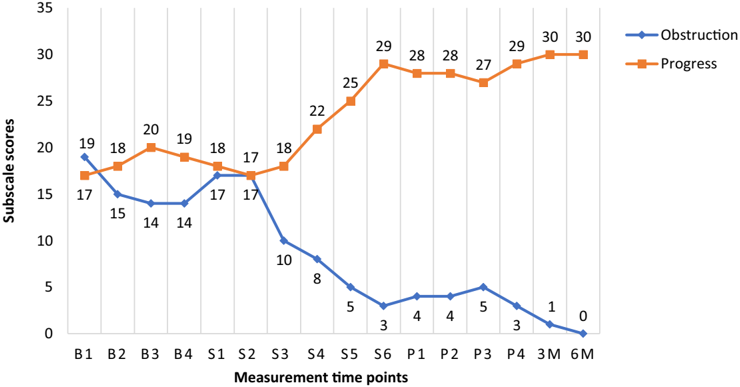
- On the VQ, Progress moved from 17 at baseline to 29 at session 6 and 30 at 6 months, with the paper stating these were in the non-clinical range and that the 6-month scores were at the 97th and 98th percentiles versus the non-clinical sample.
- On the VQ Obstruction scale, scores fell from 19 at baseline to 3 at session 6 and 0 at 6 months, moving from the clinical range to the non-clinical range; however, the paper says the reduction from baseline to end of treatment (16 points) was slightly below the reliable change threshold (95% RCI = 19).
Methods
- Single-case study with a case-controls design, comparing John’s scores on distress and ACT-process measures with normative non-clinical data at multiple time points.
- Participant: John, a man in his early 40s with post-stroke adjustment difficulties after a partial anterior cerebral circulation stroke (PACS); he received routine early supported discharge care.
- Intervention: six individual ACT sessions over 2 months, delivered via telephone telerehabilitation; outcomes were assessed with CORE-10, CompACT, and VQ at baseline, during therapy, post-therapy, and at 3- and 6-month follow-up, with statistical comparison to control samples using Singlims_ES.exe.
Limitations
- The paper states that the statistical comparisons assume the normative samples’ scores are normally distributed, but the cited papers did not report skewness or kurtosis; the authors therefore say the values should be interpreted with caution.
- The paper states the outcome measures were a narrow range focused on distress and ACT processes; it recommends examining broader outcomes such as fatigue, confidence, quality of life, activities of daily living, and illness perceptions.
- Evident from the text: this is a single case study, so the findings have limited generalisability beyond John.
Model-written summary. Check it against the paper before relying on it.
Integrity signals
Registry
Cites
Statistics
Figures
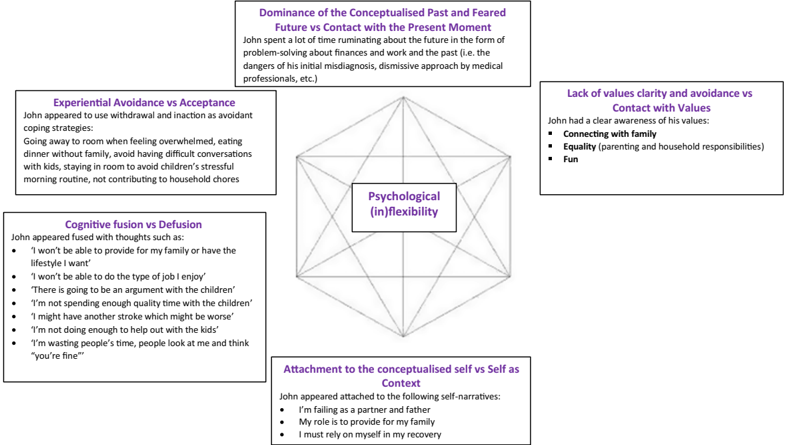
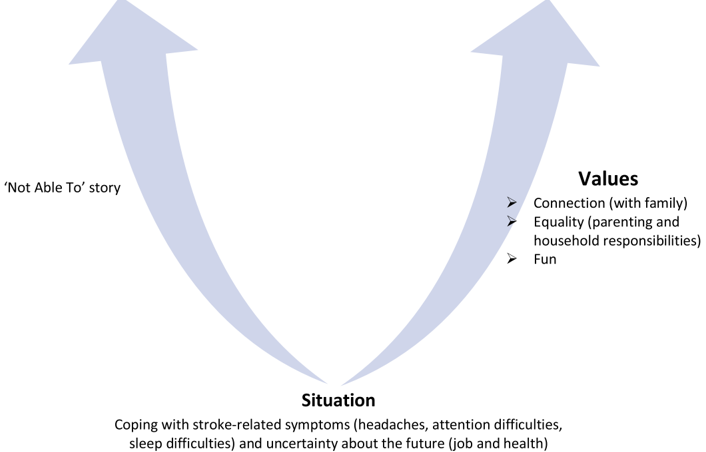
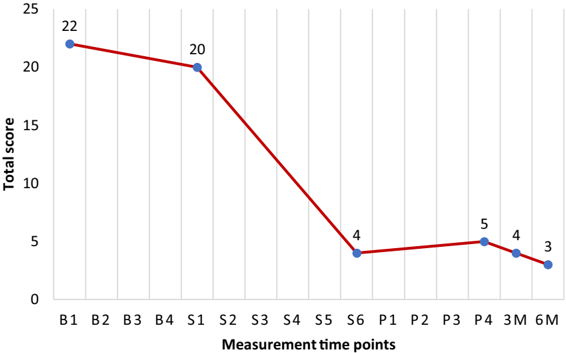
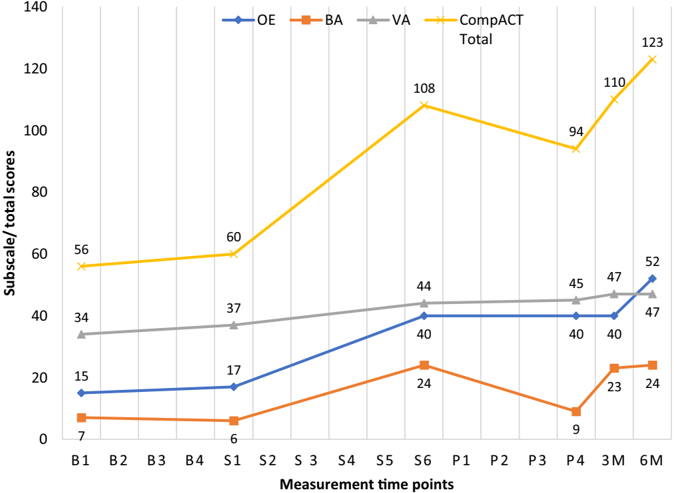
Verification
Claims the paper makes
5 Valid · 0 Not valid · 18 Not checked · 76 Own results and interpretations
Every source the paper cites for this claim was checked and supports it.
In the paper
“a recent randomised controlled trial (Majumdar and Morris, 2019) of group-based acceptance and commitment therapy (ACT) showed promise in reducing depression and increasing hopefulness and perceived health status in stroke survivors.”
- Also stated in: § Introduction · boosted
“a recent randomised controlled trial demonstrated that group-based ACT was efficacious in reducing depression, improving self-report health status and increasing hopefulness in stroke survivors (Majumdar and Morris, 2019).”
What the sources say
- Supportedcites Majumdar and Morris, 2019 source
The Participants and procedure section says participants were randomly allocated in a parallel-group study. The Discussion reports reduced depression and increased hopefulness and self-reported health status in stroke survivors compared with treatment as usual. The claim’s cautious phrase “showed promise” is consistent with the Discussion’s warning that the effects cannot be attributed specifically to ACT without additional controls. The indexed passages provide no page numbers. (LLM, conf=0.94)
boostedstates a cause- Asserted: passes — The authors put it forward as true.
- Checkable: passes — It can be checked against evidence.
- Load-bearing: passes — The paper’s conclusions depend on it.
- Based: passes — The paper gives a reason why it holds.
- Also stated in: § Introduction · boosted
A result the paper reports from its own data — it cites no other source for it, so there is none to check. The quote shows it is in the paper.
In the paper
“However, at S6, 3M and 6M, John ' s scores reduced to the non-clinical range (i.e. 3, 1 and 0, respectively).”
plainstates a causeSingle case- Asserted: passes — The authors put it forward as true.
- Checkable: passes — It can be checked against evidence.
- Load-bearing: passes — The paper’s conclusions depend on it.
- Based: passes — The paper gives a reason why it holds.
A result the paper reports from its own data — it cites no other source for it, so there is none to check. The quote shows it is in the paper.
In the paper
“Baseline VQ Progress scale measurements (i.e. B1 to S1) were all above the cut-off score of 15 and therefore in the non-clinical range.”
plainSingle case- Asserted: passes — The authors put it forward as true.
- Checkable: passes — It can be checked against evidence.
- Load-bearing: unclear — It is unclear whether the paper’s conclusions depend on it.
- Based: passes — The paper gives a reason why it holds.
In the paper
“When compared with a non-clinical sample ( n = 535, 49.8% female, M = 4.70, SD = 4.80) (Connell and Barkham, 2007), this baseline score was estimated to be at the 99th percentile.”
What the sources say
- Not matchedcites Connell and Barkham, 2007
Couldn’t be matched to a paper in Crossref, so it can’t be checked.
hedgedSingle case- Asserted: passes — The authors put it forward as true.
- Checkable: passes — It can be checked against evidence.
- Load-bearing: unclear — It is unclear whether the paper’s conclusions depend on it.
- Based: passes — The paper gives a reason why it holds.
- Not matched
A result the paper reports from its own data — it cites no other source for it, so there is none to check. The quote shows it is in the paper.
In the paper
“In contrast, John reported better levels of engagement in meaningful activities (VA: 39th percentile).”
plainSingle case- Asserted: passes — The authors put it forward as true.
- Checkable: passes — It can be checked against evidence.
- Load-bearing: unclear — It is unclear whether the paper’s conclusions depend on it.
- Based: passes — The paper gives a reason why it holds.
33 more claims
Create a free account to see all 99 claims and every source verdict.
- Probably not a substantial claim. 22
- It may state two separate claims as one. 47
- The quote only partly states this claim. 1
Citations
Cites
Jacobson, N. S., & Truax, P. (1991) · Journal of Consulting and Clinical Psychology · doi:10.1037/0022-006x.59.1.12 · Cited by 7,770
Acceptance and commitment therapy: model, processes and outcomes
Hayes, S. C., Luoma, J. B., Bond, F. W., Masuda, A., & Lillis, J. (2006) · Behaviour Research and Therapy · doi:10.1016/j.brat.2005.06.006 · Cited by 6,587 · cited 2×
“…to reduce distress by getting rid of it, rather by helping the client make contact with unwanted experiences without excessive or rigid attempts to transform the experiences, when doing this is in the service of moving the client towards a life they value (Hayes et al ., 2006; Luoma et al ., 2017).”
BackgroundMethodComparing an Individual's Test Score Against Norms Derived from Small Samples
Crawford, J. R., & Howell, D. C. (1998) · The Clinical Neuropsychologist · doi:10.1076/clin.12.4.482.7241 · Cited by 1,264 · cited 1×
“To overcome this, we sought sample sizes of a least 50 or more (Crawford and Howell, 1998).”
MethodHackett, M. L., & Pickles, K. (2014) · International Journal of Stroke · doi:10.1111/ijs.12357 · Cited by 1,140 · cited 1×
“For instance, approximately 31% of stroke survivors experience depression (Hackett and Pickles, 2014) and 20 – 25% experience anxiety disorders/symptoms at any time (Burton et al ., 2013).”
BackgroundWenzlaff, R. M., & Wegner, D. M. (2000) · Annual Review of Psychology · doi:10.1146/annurev.psych.51.1.59 · Cited by 1,063
Ayerbe, L., Ayis, S., Wolfe, C. D. A., & Rudd, A. G. (2013) · British Journal of Psychiatry · doi:10.1192/bjp.bp.111.107664 · Cited by 980 · cited 1×
“…difficulties which have been shown to be predictors of increased post-stroke distress including communication, cognitive or physical difficulties and a serious history of mental health difficulties prior to his stroke (Ayerbe et al ., 2013; Mitchell et al ., 2017; Thomas and Lincoln, 2006, 2008).”
BackgroundThe Future of Intervention Science: Process-Based Therapy
Hofmann, S. G., & Hayes, S. C. (2019) · Clinical Psychological Science · doi:10.1177/2167702618772296 · Cited by 888 · cited 1×
“Although further research exploring psychological therapies such as ACT after stroke are warranted, we also encourage development of a process-based therapy approach to further research (Hayes and Hofmann, 2018; Hayes et al ., 2020; Hofmann and Hayes, 2019).”
MethodNormative data for the HADS from a large non-clinical sample
Crawford, J. R., Henry, J. D., Crombie, C., & Taylor, E. P. (2001) · British Journal of Clinical Psychology · doi:10.1348/014466501163904 · Cited by 815 · cited 1×
“However, even in very large non-clinical samples, the distribution of scores on common mood questionnaires can still be positively skewed (Crawford et al ., 2001).”
Background(2009) · Cited by 655
Acceptance and Commitment Therapy (ACT) for Chronic Pain: A Systematic Review and Meta-Analyses
Hughes, L. S., Clark, J., Colclough, J. A., Dale, E., & McMillan, D. (2017) · The Clinical Journal of Pain · doi:10.1097/ajp.0000000000000425 · Cited by 611
Research works printed but not linked: 10
- Hayes, 2018, Process-Based CBT: The Science and Core Clinical Competencies of Cognitive Behavioral Therapy
- Gillham, 2012, Psychological care after stroke: economic modelling of a clinical psychology led team approach
- McKenna, 2009, Rookwood Driving Battery
- Hayes, 2005, Get Out of Your Mind and Into Your Life: The New Acceptance and Commitment Therapy
- Luoma, 2017, Learning ACT: An Acceptance and Commitment Therapy Skills-Training Manual for Therapists
- 10.1111/bjc.12198 · DOI · Paper page
- 10.1016/j.cpr.2020.101908 · DOI · Paper page
- 2007, The National Stroke Strategy
- Ciarrochi, 2015, The Weight Escape: Stop Fad Dieting, Start Losing Weight and Reshape Your Life Using Cutting-Edge Psychology
- 10.1016/j.jstrokecerebrovasdis.2021.106225 · DOI · Paper page
Cited by
Post-stroke emotionalism: Diagnosis, pathophysiology, and treatment
Broomfield, N. M., Blake, J., Gracey, F., & Steverson, T. (2024) · International Journal of Stroke · doi:10.1177/17474930241242952 · Cited by 15
“8,56 Although not experimentally confirmed, qualitative studies have suggested that acceptance-based approaches have been helpful for some.”
BackgroundSelf-citationOoi, J., & Steverson, T. (2024) · The Cognitive Behaviour Therapist · doi:10.1017/s1754470x23000351
Self-citation
Metadata
- Authors
- Ooi, J., & Steverson, T.
- Affiliations
- University of East Anglia (GB)
- Corresponding author
- Ooi, Jinnie
- Venue
- The Cognitive Behaviour Therapist
- Publisher
- Cambridge University Press (CUP)
- Published
- 2023
- Volume
- 16
- ISSN
- 1754-470X (ISSN-L)
- OpenAlex
- W4388468079
- Semantic Scholar
- 7b534c32f997b105f68bc1efac45dd4ea36ef02c
- Cited by
- 2
- References
- 59
- Citations by year
- 2024: 2
- FWCI
- 0.58
- Type
- journal article
- Language
- en
- Open access
- hybrid
- dx.doi.org
- Locations
- The Cognitive Behaviour Therapist (publishedVersion, cc-by)
- UEA Digital Repository (University of East Anglia) (acceptedVersion)
- Topics
- Social Sciences › Psychology › Clinical Psychology › Mindfulness and Compassion Interventions
- Health Sciences › Medicine › Rehabilitation › Stroke Rehabilitation and Recovery
- Health Sciences › Medicine › Oncology › Cancer survivorship and care
- Keywords
- acceptance and commitment therapy, telerehabilitation, stroke survivors, psychological flexibility, depression, psychological distress, psychological adjustment, working-age men
About these checks
Registry, retraction, Cites and statistics results are computed, not judged, with one exception: a printed reference that no index lists is read once by a model before it counts as a citation error. Claims are extracted by a model and kept only when their quote appears verbatim in the text; each cited source is then checked, with a model’s help, for whether it says what the claim relies on. Those verdicts can be wrong — read the claim’s quote and the cited source before relying on one.
The claim verdicts this report counts are experimental: their accuracy is not yet measured.
A language model drew the claims from the paper on 2026-10-11, under version 3 of the claim definition (model deepseek-v4.1-flash, prompt extract-v3).
A second model labelled each claim on 2026-10-11 (model jev-1.13-20260917, definition revision gold-guideline-v0.2).
Cited sources are checked with a language model’s help (gpt-6-sol).
Statistics and arithmetic are recomputed, not judged.
Confidence bands are shown only for fields calibrated on our annotated test set. None is calibrated yet, so no band is shown.
What counts as a claim ›How we measure confidence ›How we check this ›
Are you an author, or do you see a problem with this page? Request a review
How to cite
Cite CoChat for the checks on this page, and the paper for its own findings.
- This page
- CoChat. (2026). Citation check: Acceptance and commitment therapy (ACT) for post-stroke adjustment difficulties via telerehabilitation in a working-age man. https://app.cochat.ai/papers/10.1017/s1754470x23000260
- The paper
- Ooi, J., & Steverson, T. (2023). Acceptance and commitment therapy (ACT) for post-stroke adjustment difficulties via telerehabilitation in a working-age man. The Cognitive Behaviour Therapist. https://doi.org/10.1017/s1754470x23000260
Data sources
Bibliographic data: Semantic Scholar, OpenAlex, Crossref.
Contains information from the Semantic Scholar Academic Graph Datasets, made available under the ODC Attribution License (ODC-BY 1.0).
Semantic Scholar’s data is described in: Kinney, R., et al. (2023). The Semantic Scholar Open Data Platform. arXiv:2301.10140.
