

Reducing mental health-related stigma among medical and nursing students in low- and middle-income countries: a systematic review
Open accessThe DOI matches its Crossref record; 43 of the 43 references it cites were found in a registry or an index; none of the 46 sources its claims cite is checked for support yet.
Abstract
Aims: This systematic review compiled evidence on interventions to reduce mental health-related stigma among medical and nursing students in low- and middle-income countries (LMICs). Primary outcomes were stigmatising attitudes and discriminatory behaviours. Methods: Data collection included two strategies. First, previous systematic reviews were searched for studies that met the inclusion criteria of the current review. Second, a new search was done, covering the time since the previous reviews, i.e. January 2013 to May 2017. Five search concepts were combined in order to capture relevant literature: stigma, mental health, intervention, professional students in medicine and nursing, and LMICs. A qualitative analysis of all included full texts was done with the software MAXQDA. Full texts were analysed with regard to the content of interventions, didactic methods, mental disorders, cultural adaptation, type of outcome measure and primary outcomes. Furthermore, a methodological quality assessment was undertaken. Results: A total of nine studies from six countries (Brazil, China, Malaysia, Nigeria, Somaliland and Turkey) were included. All studies reported significant results in at least one outcome measure. However, from the available literature, it is difficult to draw conclusions on the most effective interventions. No meta-analysis could be calculated due to the large heterogeneity of intervention content, evaluation design and outcome measures. Studies with contact interventions (either face-to-face or video) demonstrated attitudinal change. There was a clear lack of studies focusing on discriminatory behaviours. Accordingly, training of specific communication and clinical skills was lacking in most studies, with the exception of one study that showed a positive effect of training interview skills on attitudes. Methods for cultural adaptation of interventions were rarely documented. The methodological quality of most studies was relatively low, with the exception of two studies. Conclusions: There is an increase in studies on anti-stigma interventions among professional students in LMICs. Some of these studies used contact interventions and showed positive effects. A stronger focus on clinical and communication skills and behaviour-related outcomes is needed in future studies.
Overview
CoChat Summary
TL;DR
This systematic review compiled nine studies from six low- and middle-income countries on anti-stigma interventions for medical and nursing students; all reported significant improvement in at least one outcome, but heterogeneity and low methodological quality limited conclusions. Contact interventions showed attitudinal change, while behavioural outcomes and communication/clinical skills training were largely lacking.
Key findings
- Nine studies from Brazil, China, Malaysia, Nigeria, Somaliland and Turkey were included; participants were medical students (k = 5), nursing students (k = 3), or both (k = 1), with sample sizes ranging from 44 to 205 and five studies having N > 100.
- All studies reported significant results in at least one outcome measure, but no meta-analysis could be calculated due to large heterogeneity of intervention content, evaluation design and outcome measures.
- Contact interventions (face-to-face or video) demonstrated attitudinal change; one RCT found a significant main effect of time on the OMS-HC total score (p < 0.001, partial η² = 0.49) but no significant difference between video and face-to-face contact.
- There was a clear lack of studies focusing on discriminatory behaviours; most studies lacked communication and clinical skills training, except one study showing a positive effect of interview skills training on anxiety (p = 0.001). Methodological quality was low in five studies, moderate in two and high in two.
Methods
- Systematic review registered in PROSPERO (CRD42017065436); data collection combined searching previous systematic reviews and a new search covering January 2013 to May 2017 in PsycINFO, MEDLINE (Ovid), CINAHL, Social Sciences Citation Index and Cochrane (Trials).
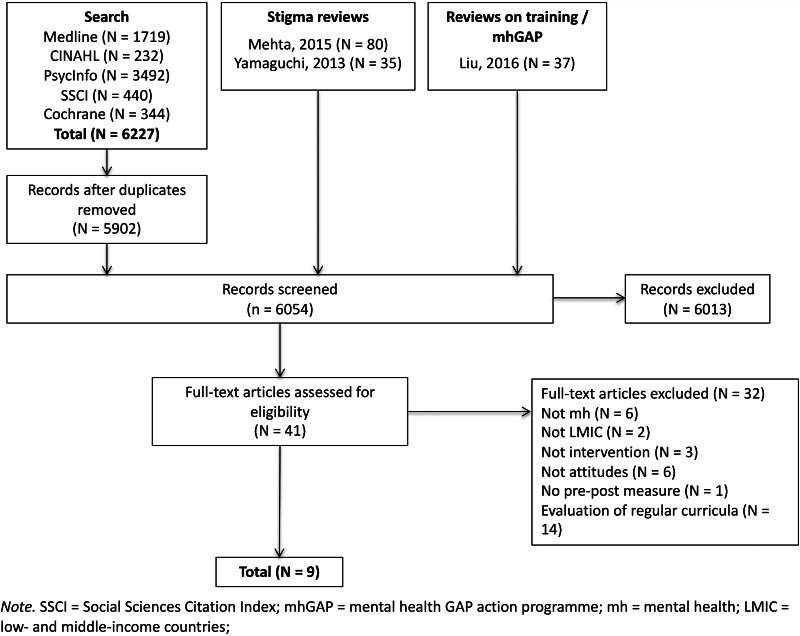
- Of 6054 titles and abstracts screened, 6013 were excluded; inclusion required medical or nursing students in LMICs, a specific anti-stigma intervention, and a pre-training assessment, with qualitative and quantitative studies eligible and no comparator required.
- Included full texts were coded in MAXQDA by two independent raters across categories including intervention content, didactic methods, mental disorder, cultural adaptation, outcome measure type and primary outcomes; quality was appraised on control group, randomisation, random sequence generation and handling of incomplete data.
Limitations
- Stated by the authors: reliance on previous reviews for the period before 2013; inclusion of only papers published in English or with an English abstract, with no non-English search engines or grey literature; exclusion of knowledge outcomes; and likely publication bias.
- Evident from the text: no meta-analysis was possible due to heterogeneity; most included studies had low methodological quality; outcome measures mostly assessed attitudes rather than discriminatory behaviour; and cultural adaptation of interventions was rarely documented.
Model-written summary. Check it against the paper before relying on it.
Integrity signals
Registry
Cites
Statistics
Figures
Verification
Claims the paper makes
0 Valid · 0 Not valid · 42 Not checked · 70 Own results and interpretations
A result the paper states — it cites no source for it, so there is none to check. The quote shows it is in the paper.
In the paper
“The methodological quality of most studies was relatively low, with the exception of two studies.”
§ Reducing mental health-related stigma among medical and nursing students in low- and middle-income countries: a systematic review > Abstract > Results
plain- Asserted: passes — The authors put it forward as true.
- Checkable: passes — It can be checked against evidence.
- Load-bearing: passes — The paper’s conclusions depend on it.
- Based: passes — The paper gives a reason why it holds.
A result the paper reports from its own data — it cites no other source for it, so there is none to check. The quote shows it is in the paper.
In the paper
“None of the studies used statistical measures for handling missing data.”
§ Reducing mental health-related stigma among medical and nursing students in low- and middle-income countries: a systematic review > Data collection, extraction and analysis
plain- Asserted: passes — The authors put it forward as true.
- Checkable: passes — It can be checked against evidence.
- Load-bearing: unclear — It is unclear whether the paper’s conclusions depend on it.
- Based: passes — The paper gives a reason why it holds.
In the paper
“Statistically significant changes in attitudes (p < 0.001) were reported for both groups.”
§ Reducing mental health-related stigma among medical and nursing students in low- and middle-income countries: a systematic review > Results > Outcomes
What the sources say
- Not checked yetcites Junqueira et al. (2015)
plain- Asserted: passes — The authors put it forward as true.
- Checkable: passes — It can be checked against evidence.
- Load-bearing: unclear — It is unclear whether the paper’s conclusions depend on it.
- Based: passes — The paper gives a reason why it holds.
A result the paper reports from its own data — it cites no other source for it, so there is none to check. The quote shows it is in the paper.
In the paper
“All studies reported significant results in at least one outcome measure.”
§ Reducing mental health-related stigma among medical and nursing students in low- and middle-income countries: a systematic review > Abstract > Results
plain- Asserted: passes — The authors put it forward as true.
- Checkable: passes — It can be checked against evidence.
- Load-bearing: unclear — It is unclear whether the paper’s conclusions depend on it.
- Based: passes — The paper gives a reason why it holds.
A result the paper reports from its own data — it cites no other source for it, so there is none to check. The quote shows it is in the paper.
In the paper
“There was a clear lack of studies focusing on discriminatory behaviours.”
§ Reducing mental health-related stigma among medical and nursing students in low- and middle-income countries: a systematic review > Abstract > Results
boosted- Asserted: passes — The authors put it forward as true.
- Checkable: passes — It can be checked against evidence.
- Load-bearing: passes — The paper’s conclusions depend on it.
- Based: passes — The paper gives a reason why it holds.
54 more claims
Create a free account to see all 112 claims and to verify the 46 references still open.
- Probably not a substantial claim. 27
- It may state two separate claims as one. 37
- The quote only partly states this claim. 1
Claims other papers make about this one
Each is checked against this paper’s own text: does it say what the citing paper says it does?
The source backs part of the claim, not all of it — or backs it for a different population, condition or comparison.
In the citing paper
“Another recommendation was that the evidence for improving attitudes was greater among students treating patients with less severe conditions, from which recovery could be seen.160”
From The Lancet Commission on ending stigma and discrimination in mental health (2022) · cites this paper as [160]
Experimental — accuracy not yet measured
Citations
Cites
How does intergroup contact reduce prejudice? Meta‐analytic tests of three mediators
Pettigrew, T. F., & Tropp, L. R. (2008) · European Journal of Social Psychology · doi:10.1002/ejsp.504 · Cited by 2,539 · cited 1×
“Meta-analytic evidence from other fields of research shows that interventions are more effective if they increase empathy and reduce anxiety (Pettigrew and Tropp, 2008).”
Culture and stigma: Adding moral experience to stigma theory
Yang, L. H., Kleinman, A., Link, B. G., Phelan, J. C., Lee, S., & Good, B. (2007) · Social Science & Medicine · doi:10.1016/j.socscimed.2006.11.013 · Cited by 1,339 · cited 1×
“Mental health-related stigma is shaped by culture (Yang et al., 2007), and hence there might be cultural differences in the effectiveness of anti-stigma interventions.”
Thornicroft, G., Brohan, E., Rose, D., Sartorius, N., & Leese, M. (2009) · The Lancet · doi:10.1016/s0140-6736(08)61817-6 · Cited by 1,189 · cited 1×
“Evidence shows that in most regions of the world, people with mental illness are confronted with mental health-related stigma (e.g. Thornicroft et al., 2009; Lasalvia et al., 2013).”
Self-citationUndertreatment of people with major depressive disorder in 21 countries
Thornicroft, G., Chatterji, S., Evans-Lacko, S., Gruber, M., Sampson, N., Aguilar-Gaxiola, S., Al-Hamzawi, A., Alonso, J., Andrade, L., Borges, G., et al. (2017) · British Journal of Psychiatry · doi:10.1192/bjp.bp.116.188078 · Cited by 1,121 · cited 1×
“Introduction In low- and middle-income countries (LMICs), the lack of financial and human resources to meet the needs of people with mental disorders has led to an alarming ‘treatment gap’, which in some countries is up to 90% (Degenhardt et al., 2017; Thornicroft et al., 2017; Alonso et al., 2018).”
Self-citationLiu, N. H., Daumit, G. L., Dua, T., Aquila, R., Charlson, F., Cuijpers, P., Druss, B., Dudek, K., Freeman, M., Fujii, C., et al. (2017) · World Psychiatry · doi:10.1002/wps.20384 · Cited by 865 · cited 1×
“…been shown also to be prevalent among health professionals worldwide (Henderson et al., 2014; Vistorte et al., 2018), with negative consequences for people with mental disorders, such as limited access to health care (Thornicroft, 2008) and increased mortality (Thornicroft, 2011; Liu et al., 2017).”
Self-citationScaling Community Attitudes Toward the Mentally Ill
Taylor, S. M., & Dear, M. J. (1981) · Schizophrenia Bulletin · doi:10.1093/schbul/7.2.225 · Cited by 854
Lempp, H., & Seale, C. (2004) · BMJ · doi:10.1136/bmj.329.7469.770 · Cited by 846 · cited 1×
“Students are likely to have negative experiences due to the environment they encounter, the severity of illness they witness, and the negative attitudes they observe in other health personnel, which is also known as the ‘hidden curriculum’ in medical training (Lempp and Seale, 2004).”
Stigma: ignorance, prejudice or discrimination?
Thornicroft, G., Rose, D., Kassam, A., & Sartorius, N. (2007) · British Journal of Psychiatry · doi:10.1192/bjp.bp.106.025791 · Cited by 826 · cited 3×
“Mental health-related stigma is defined as lack of knowledge about mental health, as well as negative attitudes and discriminatory behaviours towards people with mental disorders (Thornicroft et al., 2007).”
InfluentialSelf-citationMental health-related stigma in health care and mental health-care settings
Henderson, C., Noblett, J., Parke, H., Clement, S., Caffrey, A., Gale-Grant, O., Schulze, B., Druss, B., & Thornicroft, G. (2014) · The Lancet Psychiatry · doi:10.1016/s2215-0366(14)00023-6 · Cited by 761 · cited 4×
“Mental health-related stigma is not limited to the general population but has been shown also to be prevalent among health professionals worldwide (Henderson et al., 2014; Vistorte et al., 2018), with negative consequences for people with mental disorders, such as limited access to health care (Thornicroft, 2008) and…”
InfluentialSelf-citationAlonso, J., Liu, Z., Evans-Lacko, S., Sadikova, E., Sampson, N., Chatterji, S., Abdulmalik, J., Aguilar-Gaxiola, S., Al-Hamzawi, A., Andrade, L. H., et al. (2018) · Depression and Anxiety · doi:10.1002/da.22711 · Cited by 716 · cited 1×
“Introduction In low- and middle-income countries (LMICs), the lack of financial and human resources to meet the needs of people with mental disorders has led to an alarming ‘treatment gap’, which in some countries is up to 90% (Degenhardt et al., 2017; Thornicroft et al., 2017; Alonso et al., 2018).”
Self-citation
Research works printed but not linked: 1
- Seaman J and Mannello T (1978) Nurses’ Attitudes Toward Alcohol and Alcoholism. The Seaman-Mannello Scale. Arlington, VA: National Institute on Alcohol Abuse and Alcoholism.
Cited by
Time for united action on depression: a Lancet–World Psychiatric Association Commission
Herrman, H., Patel, V., Kieling, C., Berk, M., Buchweitz, C., Cuijpers, P., Furukawa, T. A., Kessler, R. C., Kohrt, B. A., Maj, M., et al. (2022) · The Lancet · doi:10.1016/s0140-6736(21)02141-3 · Cited by 1,104
Self-citationThe Lancet Commission on ending stigma and discrimination in mental health
Thornicroft, G., Sunkel, C., Alikhon Aliev, A., Baker, S., Brohan, E., el Chammay, R., Davies, K., Demissie, M., Duncan, J., Fekadu, W., et al. (2022) · The Lancet · doi:10.1016/s0140-6736(22)01470-2 · Cited by 748
Self-citationClay, J., Eaton, J., Gronholm, P. C., Semrau, M., & Votruba, N. (2020) · Epidemiology and Psychiatric Sciences · doi:10.1017/s2045796020000797 · Cited by 103
“The results of this systematic review reiterate some main findings from other recent stigma-related reviews (Thornicroft et al., 2016; Heim et al., 2018; Mehta et al., 2018; Morgan et al., 2018; Heim et al., 2019).”
ResultKohrt, B. A., Jordans, M. J. D., Turner, E. L., Rai, S., Gurung, D., Dhakal, M., Bhardwaj, A., Lamichhane, J., Singla, D. R., Lund, C., et al. (2021) · JAMA Network Open · doi:10.1001/jamanetworkopen.2021.31475 · Cited by 87
Self-citationGronholm, P. C., Nosè, M., van Brakel, W. H., Eaton, J., Ebenso, B., Fiekert, K., Milenova, M., Sunkel, C., Barbui, C., & Thornicroft, G. (2021) · Epidemiology and Psychiatric Sciences · doi:10.1017/s2045796021000056 · Cited by 83
Self-citationAbayneh, S., Lempp, H., Alem, A., Kohrt, B. A., Fekadu, A., & Hanlon, C. (2020) · International Journal of Mental Health Systems · doi:10.1186/s13033-020-00383-6 · Cited by 67
Self-citationKoschorke, M., Oexle, N., Ouali, U., Cherian, A. V., Deepika, V., Mendon, G. B., Gurung, D., Kondrátová, L., Müller, M., Lanfredi, M., et al. (2021) · PLoS ONE · doi:10.1371/journal.pone.0258729 · Cited by 93
Self-citationGronholm, P. C., Bakolis, I., Cherian, A. V., Davies, K., Evans-Lacko, S. E., Girma, E., Gurung, D., Hanlon, C., Hanna, F., Henderson, C., et al. (2023) · International Journal of Mental Health Systems · doi:10.1186/s13033-022-00564-5 · Cited by 66
Self-citationInterventions to Reduce Mental Health Stigma in Young People: A Systematic Review and Meta-Analysis
Crockett, M. A., Núñez, D., Martínez, P., Borghero, F., Campos, S., Langer, A. I., Madariaga, J. C., & Martínez, V. (2025) · JAMA Network Open · doi:10.1001/jamanetworkopen.2024.54730 · Cited by 90
The Storytelling Brain: How Neuroscience Stories Help Bridge the Gap between Research and Society
Martínez‐Conde, S., Alexander, R. G., Blum, D., Britton, N., Lipska, B. K., Quirk, G. J., Swiss, J. I., Willems, R. M., & Macknik, S. L. (2019) · Journal of Neuroscience · doi:10.1523/jneurosci.1180-19.2019 · Cited by 89
“These difficulties contribute to, and are compounded by, the association of mental illness with societal stigma (Carrara et al., 2019; Charette-Dussault and Corbière, 2019; Heim et al., 2019).”
BackgroundTergesen, C., Gurung, D., Dhungana, S., Risal, A., Basel, P. L., Tamrakar, D., Amatya, A., Park, L. P., & Kohrt, B. A. (2021) · International Journal of Environmental Research and Public Health · doi:10.3390/ijerph18042143 · Cited by 58
“A recent systematic review of interventions to reduce mental health-related stigma among medical and nursing students in LMICs identified 9 studies from 6 countries [23].”
BackgroundSelf-citationCrespo-González, C., Dineen‐Griffin, S., Rae, J., & Hill, R. A. (2022) · Research in Social and Administrative Pharmacy · doi:10.1016/j.sapharm.2022.06.006 · Cited by 63
Page, A., Charteris, J., & Berman, J. (2020) · International Journal of Social Robotics · doi:10.1007/s12369-020-00714-0 · Cited by 64
Potts, L. C., Bakolis, I., Deb, T., Lempp, H. K., Vince, T., Benbow, Y., Waugh, W. L., Kim, S., Raza, S. A., Henderson, C., et al. (2022) · Social Psychiatry and Psychiatric Epidemiology · doi:10.1007/s00127-022-02284-0 · Cited by 48
“The content, delivery, and evaluation of READ were informed by: (i) studies of patients’ experiences of discrimination [29]; (ii) research on stigma and discrimination among health-care professionals [10, 30, 31]; (iii) the literature on contact-based education to reduce stigma in health-care professionals [11, 32, 33…”
MethodSelf-citationFischer, R. D., Bailey, Y., Shankar, M., Safaeinili, N., Karl, J. A., Daly, A., Johnson, F. N., Winter, T. J., Arahanga‐Doyle, H., Fox, R., et al. (2024) · Clinical Psychology Review · doi:10.1016/j.cpr.2024.102425 · Cited by 50
Martin, A., Krause, R., Chilton, J. A., Jacobs, A., & Amsalem, D. (2019) · Journal of Psychiatric and Mental Health Nursing · doi:10.1111/jpm.12580 · Cited by 40
“At a global level, nurses and general practitioners increasingly provide first-contact care for the detection and management of mental health problems (Heim et al., 2019).”
BackgroundPederson, A. B., Burnett‐Zeigler, I., Fokuo, J. K., Wisner, K. L., Zumpf, K. B., & Oshodi, Y. (2020) · Pan African Medical Journal · doi:10.11604/pamj.2020.37.5.24898 · Cited by 49
Mental health related stigma in Romania: systematic review and narrative synthesis
Manescu, E. A., Henderson, C., Paroiu, C. R., & Mihai, A. (2023) · BMC Psychiatry · doi:10.1186/s12888-023-05147-3 · Cited by 42
“A recent review of stigma in LMICs raised similar points as a priority for future research [58].”
BackgroundSelf-citationResposta a necessidades em saúde mental de estudantes universitários: uma revisão rápida
Gaiotto, E. M. G., Trapé, C. A., Campos, C. M. S., Fujimori, E., Carrer, F. C. D. A., Nichiata, L. Y. I., Cordeiro, L., de Bortoli, M. C., Yonekura, T., Toma, T. S., et al. (2021) · Revista de Saúde Pública · doi:10.11606/s1518-8787.2021055003363 · Cited by 81
Social Stigma Towards Mental Health Problems in Spain: A Systematic Review
Zamorano, S., Sáez-Alonso, M., González‐Sanguino, C., & Muñoz, M. (2023) · Clínica y Salud · doi:10.5093/clysa2023a5 · Cited by 45
Happell, B., Waks, S., Horgan, A. M., Greaney, S., Manning, F., Goodwin, J., Bocking, J., Scholz, B., Hals, E., Granerud, A., et al. (2020) · Perspectives In Psychiatric Care · doi:10.1111/ppc.12496 · Cited by 42
Günaydın, N., & Çoban, S. A. (2021) · Nurse Education in Practice · doi:10.1016/j.nepr.2021.103113 · Cited by 35
Brick, K., Cooper, J. L., Mason, L., Faeflen, S., Monmia, J., & Dubinsky, J. M. (2021) · Frontiers in Human Neuroscience · doi:10.3389/fnhum.2021.653069 · Cited by 43
“Fully successful anti-stigma training programs are rare and should be culturally appropriate (Heim et al., 2019).”
BackgroundAn Anti-Stigma Course for Occupational Therapy Students in Taiwan: Development and Pilot Testing
Ma, H., & Hsieh, C.-E. (2020) · International Journal of Environmental Research and Public Health · doi:10.3390/ijerph17155599 · Cited by 25
Breaking the Stigma in Mental Health Nursing through High-Fidelity Simulation Training
Simonelli‐Muñoz, A. J., Jiménez‐Rodríguez, D., Arrogante, Ó., del Pino, F. J. P., & Gallego‐Gómez, J. I. (2023) · Nursing Reports · doi:10.3390/nursrep13040132 · Cited by 32
“However, discriminatory and negative attitudes can be addressed in specific anti-stigma interventions and ideally incorporated into mental health nursing education among undergraduate nursing students from the beginning of professional training [10].”
BackgroundHenderson, C., Kotera, Y., Lloyd‐Evans, B., Jordan, G., Gorner, M., Salla, A., Kalha, J., Coventry, P. A., Bojke, L., Hinde, S., et al. (2026) · World Psychiatry · doi:10.1002/wps.70031 · Cited by 39
Self-citationStigma towards Mental Disorders among Nursing Students and Professionals: A Bibliometric Analysis
Martínez‐Martínez, C., Claramunt, F. E., Prieto-Callejero, B., & Ramos‐Pichardo, J. D. (2022) · International Journal of Environmental Research and Public Health · doi:10.3390/ijerph19031839 · Cited by 33
“These results are in line with those obtained by Heim et al. (2019) [46], who also observed an increase in intervention studies in recent years.”
ResultStigma about mental disease in Portuguese medical students: a cross-sectional study
Moreira, A.-R., Oura, M.-J., & Santos, P. (2021) · BMC Medical Education · doi:10.1186/s12909-021-02714-8 · Cited by 27
“mental problems to reduce the stigma of mental illness [35, 51].”
BackgroundRezvanifar, F., Shariat, S. V., Shalbafan, M., Salehian, R., & Rasoulian, M. (2022) · Frontiers in Psychiatry · doi:10.3389/fpsyt.2022.860117 · Cited by 26
“(32), communicating with people directly or visually was associated with improved students’ attitudes toward people.”
BackgroundNaal, H., Whaibeh, E. R., & Mahmoud, H. (2020) · International Review of Psychiatry · doi:10.1080/09540261.2020.1766867 · Cited by 20
“However, these guidelines may apply to other LMICs that share similar development or cultural landscapes.”
BackgroundInfluentialAbayneh, S., Lempp, H. K., Rai, S., Girma, E., Getachew, M., Alem, A., Kohrt, B. A., & Hanlon, C. (2022) · BMC Health Services Research · doi:10.1186/s12913-022-08290-x · Cited by 28
“This ‘social contact’ aspect of PhotoVoice in challenging stigma is likely to be crucial in overcoming the main barrier that service users face to meaningful civic participation and steers away from the past systemic disadvantages in most facets of their daily lives in LMICs [42, 43].”
BackgroundSelf-citationPederson, A. B., Fokuo, J. K., Thornicroft, G., Bamgbose, O. O., Ogunnubi, O. P., Ogunsola, K., & Oshodi, Y. (2022) · Transcultural Psychiatry · doi:10.1177/13634615211055007 · Cited by 20
Self-citationRichards, S. J., O’Connell, K. A., & Dickinson, J. K. (2023) · Issues in Mental Health Nursing · doi:10.1080/01612840.2023.2229438 · Cited by 18
“Furthermore, just like professional nurses, nursing students have also shown negative attitudes toward those living with a mental illness (Foster et al., 2019; Heim et al., 2019).”
Patel, A., Alsaffar, A. M., Sharma, M., Masiak, A., & Zdrojewski, Z. (2021) · Reumatologia/Rheumatology · doi:10.5114/reum.2021.106908 · Cited by 18
“There is also a need to develop a safe, supportive and nonthreatening environment within the framework of medical universities by eliminating mental health stigma, promoting mentoring programs (via academic advisors and peers), psychological counselling and en couraging student–tutor interaction to identify, fix and…”
BackgroundPerspectives of Black Immigrant Women on Mental Health: The Role of Stigma
Pederson, A. B., Waldron, E. M., & Fokuo, J. K. (2022) · Women s Health Reports · doi:10.1089/whr.2021.0071 · Cited by 29
“Storytelling is a widely accepted method of transmitting information and important in many African countries.(51,53) It is crucial that stigma reducing interventions take into account the unique cultural belief systems among African immigrants.”
MethodNursing students' attitudes towards mental illness: A multi‐national comparison
Moxham, L. J., Tapsell, A., Perlman, D., Mutair, A. S. A., AL‐Sagarat, A. Y., Alsaraireh, F. A., Chung, M., Jose, T. T., Kuo, S., Liu, M. F., et al. (2024) · Journal of Psychiatric and Mental Health Nursing · doi:10.1111/jpm.13048 · Cited by 21
Mental health literacy: A focus on daily life context for population health measurement
Chua, K., Hahn, J. S., Farrell, S., Jolly, A., Khangura, R. K., & Henderson, C. (2022) · SSM - Mental Health · doi:10.1016/j.ssmmh.2022.100118 · Cited by 20
Self-citationJesus, T. S., Monteiro, P., Ledgerd, R., von Zweck, C., & World Federation of Occupational Therapists (2025) · BMC Health Services Research · doi:10.1186/s12913-025-12996-z · Cited by 19
“For example, if findings are due to the interaction of compromised working, safety, and service conditions (within the context of cultural, stigma, educational, and other socio-ecological determinants [56, 59]), tailored strategies can be designed accordingly to address the identified issues.”
Rayan, A. (2024) · BMC Nursing · doi:10.1186/s12912-024-02616-2 · Cited by 12
Hayaki, J., Conti, M. T., Bailey, G. L., Herman, D. S., Anderson, B. J., & Stein, M. D. (2021) · Journal of Substance Abuse Treatment · doi:10.1016/j.jsat.2021.108309 · Cited by 15
Roach, A., & Tadesse, R. T. (2023) · Issues in Mental Health Nursing · doi:10.1080/01612840.2023.2265470 · Cited by 15
“While much has been written about mental health stigma in undergraduate nursing students, efforts to combat mental health stigma in nursing education are not clear in the literature (Heim et al., 2019).”
BackgroundAbayneh, S., Lempp, H. K., Rai, S., Girma, E., Getachew, M., Alem, A., Kohrt, B. A., & Hanlon, C. (2022) · Research Square · doi:10.21203/rs.3.rs-1525525/v1 · Cited by 11
Self-citationMünir, K., Öner, Ö., Kerala, C., Rustamov, I., Boztas, H., Juszkiewicz, K. T., Włoszczak-Szubzda, A., Kalmatayeva, Z., Iskandarova, A., Zeynalli, S., et al. (2022) · Psychiatry Research · doi:10.1016/j.psychres.2022.114409 · Cited by 11
Li, X., Wong, Y.-L. I., Wu, Q., Ran, M., & Zhang, T. (2024) · Healthcare · doi:10.3390/healthcare12171715 · Cited by 9
“Expanding knowledge and insights into the stigma of mental illness among college students will contribute to opening new avenues for developing and implementing anti-stigma interventions, ultimately building more inclusive societies [31,32].”
BackgroundLi, L., Ma, X., Wu, Z., Xie, C., & Li, Y. (2025) · BMC Psychology · doi:10.1186/s40359-025-02519-0 · Cited by 13
“…have shown that medical and nursing students, like the general public, also have a strong sense of mental health stigma and social distance towards patients with mental disorders [7, 8], and healthcare professionals also have a large negative attitude towards patients with mental disorders [9].”
İnan, F. Ş., Günüşen, N. P., İnce, S. Ç., & Duman, Z. Ç. (2021) · Perspectives In Psychiatric Care · doi:10.1111/ppc.12748 · Cited by 13
McAllister, A., Dickson, K., Rangi, M., Griffiths, L., Dimov, S., Reavley, N. J., & Knaak, S. J. (2023) · BMC Medical Education · doi:10.1186/s12909-023-04512-w · Cited by 11
“Many patients report experiences of interpersonal stigma amongst health practitioners [1, 9–13].”
BackgroundZonoobi, M., Tabatabaee, M., & Amini, H. (2024) · BMC Medical Education · doi:10.1186/s12909-024-06189-1 · Cited by 15
“In the study by Heim et al. (2019), it was mentioned that following the interventions, individuals’ awareness initially increased and their attitudes changed, but discriminatory behaviors against patients were observed to change in subsequent stages [15].”
BackgroundAl‐Ma'ani, M., & Hamdan‐Mansour, A. M. (2020) · Open Journal of Nursing · doi:10.4236/ojn.2020.103018 · Cited by 10
“It is important to carefully assess the attitudes and behaviors of nursing students towards people with mental illness and to correct negative ones before their first contact in psychiatric training to ensure that students have more positive experiences [23].”
BackgroundMethodResultInfluentialPredicting Mental Health Quality of Life in Policing: Officers and Civilians
Short, J. L. (2020) · Journal of Police and Criminal Psychology · doi:10.1007/s11896-020-09415-w · Cited by 10
Werner, P., Gur, A., Porat, A., Zubedat, M., & Shinan‐Altman, S. (2020) · Educational Gerontology · doi:10.1080/03601277.2020.1747153 · Cited by 9
Al‐Ma'ani, M., Hamaideh, S. H., & Hamdan‐Mansour, A. M. (2022) · Health Science Reports · doi:10.1002/hsr2.954 · Cited by 9
“These attitudes might contribute to lower quality of nursing care and adversely affecting patient outcomes.(5,6) This would”
BackgroundDaily experiences of non‐psychiatric nurses in acute psychiatric wards
Rangwaneni, M. E., Raliphaswa, N. S., Maluleke, M., & Masutha, T. C. (2024) · Nursing Open · doi:10.1002/nop2.2174 · Cited by 6
Hamed, W. E., Babegi, A. S., Elamin, H. A. M., Kamel, N. A., Escolano-Castillo, A. M., Dailah, H. G., & El-Etreby, R. R. (2025) · BMC Nursing · doi:10.1186/s12912-025-02926-z · Cited by 13
“Often, these vulnerable individuals encounter stigmatizing attitudes and discrimination not only from the general public but also from healthcare professionals, in particular, Psychiatric and Mental Health Nurses (PMHNs) [2–5].”
Liang, C., Zhang, X., & Chen, Y. (2026) · Frontiers in Psychology · doi:10.3389/fpsyg.2025.1700220 · Cited by 17
Sanguineti, M. C. D., Fonseca, L., Burgess, R. A., Concha, N., González, M., Juan, N. V. S., Carreño, M., Palacio, K. J., Sotto, M. F., & Jovchelovitch, S. (2024) · SSM - Mental Health · doi:10.1016/j.ssmmh.2024.100385 · Cited by 8
Grandón, P., Gutiérrez, D. A. V., Vielma-Aguilera, A., Bustos, C., Contreras, Y., Castillo, G., Cid, P., Araya, C., & Flores, R. (2023) · Psychiatry Research · doi:10.1016/j.psychres.2023.115428 · Cited by 8
Kadhim, A. A., & Jabur, A. A. A.-H. (2024) · Journal of University of Babylon for Pure and Applied Sciences · doi:10.29196/152vnr62 · Cited by 6
“This research suggests that educating the public and breaking down barriers to understanding mental illness are important steps in eliminating stigma [ 18 ]”
BackgroundKitay, B. M., Walde, T., Robertson, D., Cohen, T., Duvivier, R. J., & Martin, A. (2020) · Journal of the American Psychiatric Nurses Association · doi:10.1177/1078390320945778 · Cited by 10
“(Day & Moser, 1938) Despite such lofty promise, and notwithstanding the long track record of ECT as a safe and effective treatment modality (Janicak et al., 1985; UK ECT Review Group, 2003), general nursing students are at best likely to be unfamiliar with the practice—and to have outdated and…”
BackgroundSpagnolo, J., Vasiliadis, H., Berbiche, D., Champagne, F., Leduc, N., Melki, W., Saeed, K., & Charfi, F. (2020) · BJPsych Open · doi:10.1192/bjo.2020.115 · Cited by 9
“28 – 31 These broader changes in mental health policy and legislation occurring in parallel with building non-specialists ’ mental health capacities and implementing organisational supports are essential ingredients to inform mental healthcare delivery in non-specialised settings in Tunisia, and…”
Stigma of mental illness among health professions and non-health professions students in China
Li, X., Meng, X., Deng, S.-Y., Zhang, T., Wang, Y., Huang, C., He, X., Chen, H., Huang, Y., & Ran, M. (2024) · Current Psychology · doi:10.1007/s12144-024-06009-1 · Cited by 4
“…before clinical placements in order to prevent the occurrence of worsen attitudes towards PMI, it is thus necessary to ascertain the difference regarding stigma between HP and NHP students for providing certain educational cur-riculums and contact training (Heim et al., 2019; Nguyen et al., 2012).”
Community Mental Health Services in Developing Countries, Time to Think Outside the Box
Muzammil, S., & Georgina, L. (2020) · Journal of Family Medicine and Disease Prevention · doi:10.23937/2469-5793/1510117 · Cited by 4
Nakanishi, E., Tamachi, M., & Hashimoto, T. (2022) · International Journal of Environmental Research and Public Health · doi:10.3390/ijerph192114333 · Cited by 5
“Several interventions have been employed to tackle stigma toward psychiatric illness, including education through lectures and case sessions, and the use of contact-based interventions that involved either direct contact or lmed contact [11,12].”
BackgroundSuicide prevention curriculum development for health and social care students: A scoping review
Brien, C. O., Gallagher, K., O’Driscoll, M., Dhálaigh, D. N., Corcoran, P. E., Jensen, M. V., & Griffin, E. (2025) · PLoS ONE · doi:10.1371/journal.pone.0328776 · Cited by 6
“However, educational engagement with the topic was found to contribute to a reduction in stigmatising attitudes [56,102,103], echoing broader mental health education literature that supports the role of structured learning in shifting beliefs and promoting attitudinal change [104,105].”
Poverty in Malaysia Region: A Bibliometric Analysis
Mohamad, A. H. H., Rosli, S. N. F. A., Ab-Rahim, R., Rashid, N. K. A., & Esa, M. S. M. (2024) · International Journal of Academic Research in Business and Social Sciences · doi:10.6007/ijarbss/v14-i8/22537 · Cited by 6
Romero, J. D. L. H. (2020) · Psychology Society & Education · doi:10.25115/psye.v12i3.3458 · Cited by 5
Mexican Psychiatric Trainees’ Attitudes Towards People with Mental Illness: A Qualitative Study
Lagunes-Córdoba, E., Lagunes-Córdoba, R., Fresán, A., Gonzalez-Olvera, J. J., Jarrett, M., Thornicroft, G., & Henderson, C. (2021) · Community Mental Health Journal · doi:10.1007/s10597-021-00907-5 · Cited by 6
Self-citationBamgbose, O. O., Pederson, A. B., & Okocha, A. A. G. (2023) · International Journal for the Advancement of Counselling · doi:10.1007/s10447-023-09525-0 · Cited by 3
“Stigma reinforces stigma-tizing attitudes in the public and health trainees (Tungchama et al., 2019) and results in less than optimal care (Heim et al., 2019; James et al., 2012).”
BackgroundWang, W., Chen, X., Liu, M., Zou, P., Ye, J., & Shuid, A. N. (2026) · Frontiers in Psychiatry · doi:10.3389/fpsyt.2026.1831406 · Cited by 3
Alharbi, R. B. (2023) · European Journal of Medical and Health Sciences · doi:10.24018/ejmed.2023.5.1.1648 · Cited by 4
Nasirpour, N., Esmailzadehha, N., Hajebi, A., Savari, E., Ghanbari, B., & Motevalian, S. A. (2023) · BMC Psychiatry · doi:10.1186/s12888-023-05438-9 · Cited by 2
“…such as inhibition, apathy, lack of motivation, cognitive deficits, reduced awareness of risks, sleep dysregulation, habitual inactivity [9], neglect of self-protection [10], impairment in evaluating health information and obtaining preventive behaviors [32], stigma, and accessing health care [33].”
BackgroundQutishat, M. (2025) · Teaching and learning in nursing · doi:10.1016/j.teln.2025.03.015 · Cited by 2
An examination of the effect of feedback on meta-ignorance of mental illness public stigma
Li, X.-M., Lindsay, B. L., Szeto, A. C. H., & Dobson, K. S. (2022) · Metacognition and Learning · doi:10.1007/s11409-022-09325-8 · Cited by 3
Tay, J. L., Goh, Y. S., Tay, Y. F., & Klainin‐Yobas, P. (2023) · International Journal of Nursing Practice · doi:10.1111/ijn.70160 · Cited by 1
Vieux, M., Poulet, E., & Leaune, É. (2025) · Annales Médico-psychologiques revue psychiatrique · doi:10.1016/j.amp.2024.11.019 · Cited by 1
Özçalık, C. K., & Çakal, E. (2025) · Arel Üniversitesi Sağlık Bilimleri Dergisi · doi:10.71230/arsagbil.1569370 · Cited by 1
Useful strategies for reducing mental health stigma in healthcare settings: a Delphi study
Chávez, L., Zamorano, S., González‐Sanguino, C., & Muñoz, M. (2025) · Psychology Society & Education · doi:10.21071/pse.v17i2.17269 · Cited by 1
“Regarding these types of interventions (Heim et al., 2019), it is stated that stigma reduction programs have a lack of training in specific communication skills, empathy, and clinical skills for professionals.”
InfluentialRikhari, P., Sinha, V., Kumar, G., Bisht, A., Kapoor, A., & Rikhari, P. (2025) · Journal of Education and Health Promotion · doi:10.4103/jehp.jehp_1289_24 · Cited by 1
“[32] It is likely that as students gain knowledge about mental illness and establish caring relationships with mentally ill patients the unfounded stigmatizing attitudes disappear.”
A holistic approach in the nursing care of persons with depression
Zubac, D., Dimoski, Z., Jugovic, K. P., Mitrović, D., & Jovanović, V. (2024) · Zdravstvena zastita · doi:10.5937/zdravzast53-51928 · Cited by 1
“Kroz ho-listički pristup pronalazi se veza depresije sa broj-91 reduced (15).”
Fortes, D. C. S., da Silva, M. R. S., Fonseca, K. S. G., & da Silva, A. S. B. (2021) · Research Society and Development · doi:10.33448/rsd-v10i4.14329 · Cited by 4
Bioethics Education and Nonideal Theory
Liebow, N., & Cratsley, K. (2021) · Philosophy and medicine · doi:10.1007/978-3-030-72503-7_6 · Cited by 1
Farooq, S., Parpio, Y. N., Sattar, S., Ali, Z., Rahim, S., & Peerwani, G. (2021) · Research Square · doi:10.21203/rs.3.rs-710107/v1 · Cited by 2
Nakanishi, E., Tamachi, M., & Hashimoto, T. (2022) · Research Square · doi:10.21203/rs.3.rs-1571370/v1 · Cited by 1
Soh, K. C. (2020) · Scholarly Journal of Psychology and Behavioral Sciences · doi:10.32474/sjpbs.2020.04.000189
“Though focused on low- and middle-income countries, a recent systematic review had difficulty in pinpointing the most effective anti-stigma intervention [18].”
BackgroundLi, R., Zhou, W., & Wu, J. (2020) · doi:10.21203/rs.3.rs-39742/v1
“It is well known that psychological health has a positive impact on sustainable competitiveness, and is negatively correlated with study burnout [5].”
BackgroundNakanishi, E., Tamachi, M., & Hashimoto, T. (2022) · Research Square · doi:10.21203/rs.3.rs-1571370/v2
Stuart, H. L., & Sartorius, N. (2022) · Oxford University Press eBooks · doi:10.1093/med/9780197555804.005.0001
Nakanishi, E., Tamachi, M., & Hashimoto, T. (2022) · Research Square · doi:10.21203/rs.3.rs-1571370/v3
Nakanishi, E., Tamachi, M., & Hashimoto, T. (2022) · Research Square · doi:10.21203/rs.3.rs-1571370/v4
Nasirpour, N., Esmailzadehha, N., Hajebi, A., Savari, E., & Motevalian, S. A. (2023) · Research Square · doi:10.21203/rs.3.rs-2628291/v1
Atitudes dos Estudantes de Enfermagem Perante a Pessoa com Doença Mental
Ponte, D. T. C., Tavares, C. S., Alves, P. M. M., Quesado, P. A., Ferreira, A., & Quesado, A. (2023) · Revista de Investigação & Inovação em Saúde · doi:10.37914/riis.v6.227
Akanni, O. O., Eboreime-Oikeh, I. O., Oderinde, K. O., & Olashore, A. A. (2024) · Journal of Medical Education and Curricular Development · doi:10.1177/23821205241275420
“33 The present study did not fi nd signi fi cant predictive effects of any of the socio-demographics on the SR or CMHI attitudes during regression.”
Background‘We are working in specialty units’—An exploratory qualitative study
Rangwaneni, M. E., Raliphaswa, N. S., Maluleke, M., Letlalo, V. P., Masutha, T. C., Manyuma, D., Makhado, L. C., & Rikhotso, T. N. (2024) · Nursing Open · doi:10.1002/nop2.70041
Reducing stigma and discriminatory behaviour
Gronholm, P. C., Gurung, D., Parry, S., Mehta, N., & Thornicroft, G. (2025) · Oxford University Press eBooks · doi:10.1093/med/9780198898818.003.0031
Self-citationBiondo, J., Barth, A., Mitchell, C., & Wycoff, K. (2025) · Research Square · doi:10.21203/rs.3.rs-6675567/v1
Manescu, E. A., Henderson, C., Paroiu, C. R., & Mihai, A. (2024) · Figshare · doi:10.6084/m9.figshare.26615809
Self-citationNasirpour, N., Esmailzadehha, N., Hajebi, A., Savari, E., Ghanbari, B., & Motevalian, S. A. (2023) · Figshare · doi:10.6084/m9.figshare.24804350
Manescu, E. A., Henderson, C., Paroiu, C. R., & Mihai, A. (2024) · Figshare · doi:10.6084/m9.figshare.26615812
Self-citationManescu, E. A., Henderson, C., Paroiu, C. R., & Mihai, A. (2024) · Figshare · doi:10.6084/m9.figshare.26615806
Self-citationMoreira, A.-R., Oura, M.-J., & Santos, P. (2021) · Figshare · doi:10.6084/m9.figshare.14570402
Metadata
- Authors
- Heim, E., Henderson, C., Kohrt, B. A., Koschorke, M., Milenova, M., & Thornicroft, G.
- Affiliations
- University of Zurich (CH)
- King's College London (GB)
- George Washington University (US)
- Corresponding author
- Heim, E.
- Venue
- Epidemiology and Psychiatric Sciences
- Publisher
- Cambridge University Press (CUP)
- Published
- 2019-04-01
- Volume
- 29
- Pages
- e28-e28
- ISSN
- 2045-7960 (ISSN-L)
- 2045-7979
- PMC
- PMC6848770
- OpenAlex
- W2930760197
- Semantic Scholar
- 1653ec76aede0f8cd351c27f868663c169aa53b4
- Cited by
- 104
- References
- 43
- Citations by year
- 2026: 6 · 2025: 12 · 2024: 17 · 2023: 15 · 2022: 20 · 2021: 16 · 2020: 16 · 2019: 2
- FWCI
- 2.13
- Type
- journal article
- Language
- en
- Open access
- hybrid
- doi.org
- Licence
- Locations
- Epidemiology and Psychiatric Sciences (publishedVersion, cc-by)
- PubMed Central (publishedVersion, cc-by)
- PubMed (publishedVersion)
- Zurich Open Repository and Archive (University of Zurich) (acceptedVersion, other-oa)
- Research Portal (King's College London) (submittedVersion)
- SERVAL (Université de Lausanne) (submittedVersion)
- Zurich Open Repository and Archive (University of Zurich) (submittedVersion, other-oa)
- Zurich Open Repository and Archive (University of Zurich)
- Funders
- South London and Maudsley NHS Foundation Trust
- King's College Hospital NHS Foundation Trust
- National Institute for Health and Care Research (FP7/2007–2013)
- King's College London
- European Commission (2007–2013, FP7 2007-2013, FP7/2007)
- National Institutes of Health (R023697, S001255, FP7/2007-2013, MR/S001255/1, MR/R023697/1)
- Medical Research Council (FP7/20072013, MR/R023697/1, MR/S001255/1)
- National Institute of Mental Health (K01MH104310, R01MH100470, R21MH111280)
- Topics
- Health Sciences › Medicine › Psychiatry and Mental health › Mental Health Treatment and Access
- Health Sciences › Health Professions › General Health Professions › Healthcare professionals’ stress and burnout
- Health Sciences › Medicine › Public Health, Environmental and Occupational Health › Cultural Competency in Health Care
- Keywords
- mental health stigma, stigma reduction interventions, medical students, nursing students, professional students, low- and middle-income countries, stigmatizing attitudes, discriminatory behavior, contact interventions, culturally tailored interventions, communication skills training, clinical skills training
- MeSH terms
- Attitude of Health Personnel, Mental Disorders, Brazil, China, Developing Countries, Humans, Malaysia, Nigeria, Poverty, Students, Medical, Students, Nursing, Turkey, Djibouti, Social Stigma
About these checks
Registry, retraction, Cites and statistics results are computed, not judged, with one exception: a printed reference that no index lists is read once by a model before it counts as a citation error. Claims are extracted by a model and kept only when their quote appears verbatim in the text; each cited source is then checked, with a model’s help, for whether it says what the claim relies on. Those verdicts can be wrong — read the claim’s quote and the cited source before relying on one.
A language model drew the claims from the paper on 2026-10-07, under version 3 of the claim definition (model deepseek-v4.1-flash, prompt extract-v3).
A second model labelled each claim on 2026-10-07 (model jev-1.13-20260917, definition revision gold-guideline-v0.2).
Statistics and arithmetic are recomputed, not judged.
Confidence bands are shown only for fields calibrated on our annotated test set. None is calibrated yet, so no band is shown.
What counts as a claim ›How we measure confidence ›How we check this ›
Are you an author, or do you see a problem with this page? Request a review
Data sources
Bibliographic data: Semantic Scholar, OpenAlex, Crossref.
Contains information from the Semantic Scholar Academic Graph Datasets, made available under the ODC Attribution License (ODC-BY 1.0).
Semantic Scholar’s data is described in: Kinney, R., et al. (2023). The Semantic Scholar Open Data Platform. arXiv:2301.10140.
