

The DOI matches its Crossref record; 40 of the 41 references it cites were found in a registry or an index.
A growing need for youth mental health services in Canada: examining trends in youth mental health from 2011 to 2018
Open accessAbstract
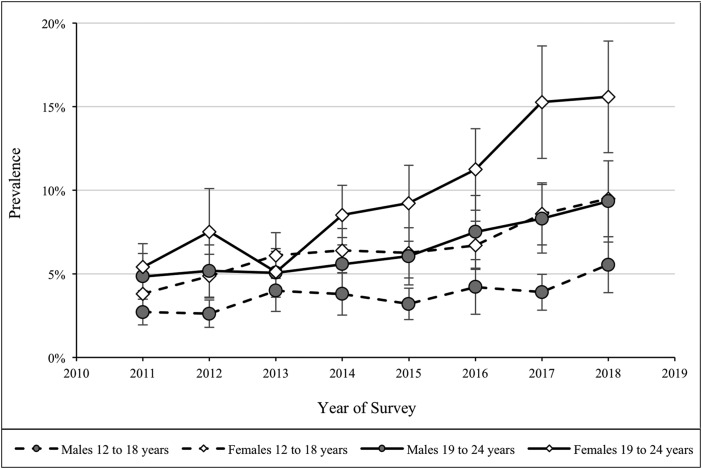
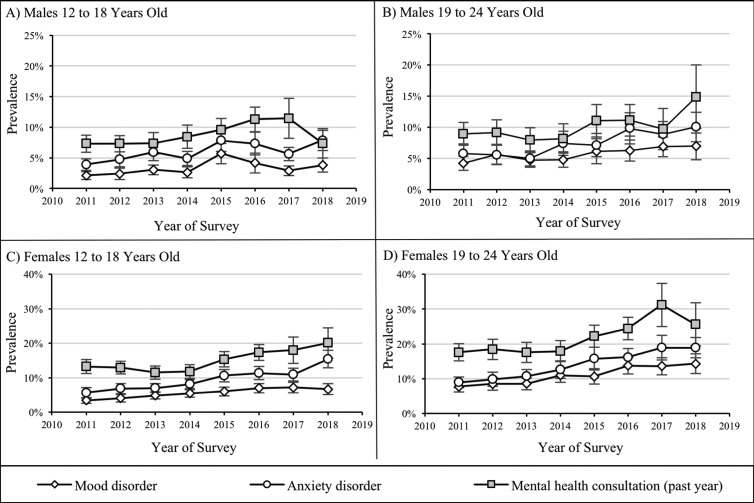
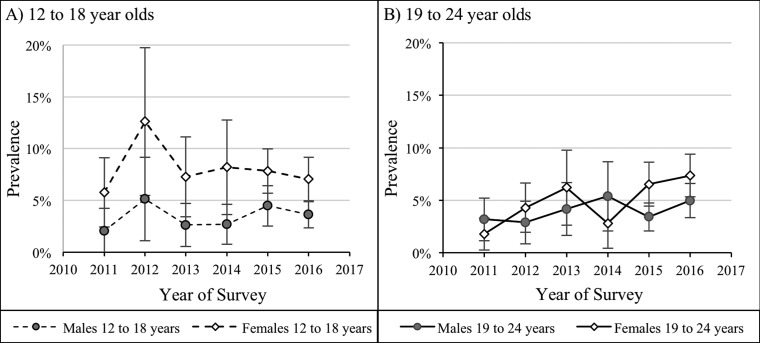
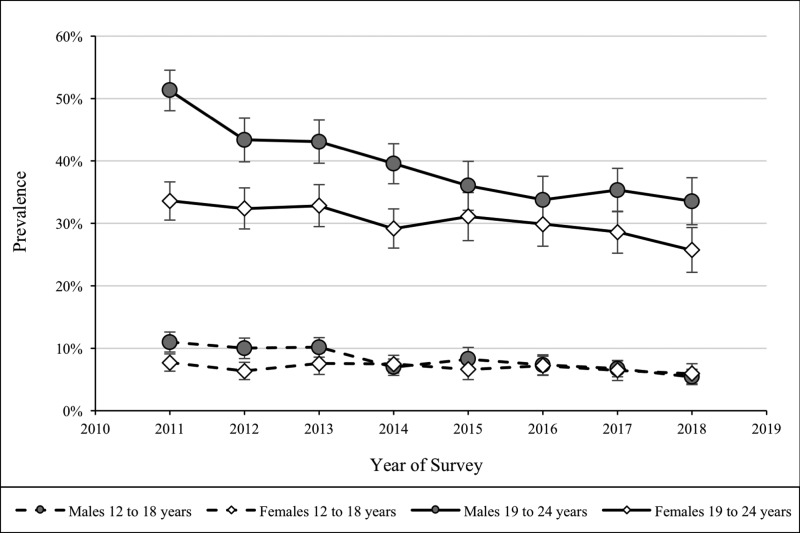
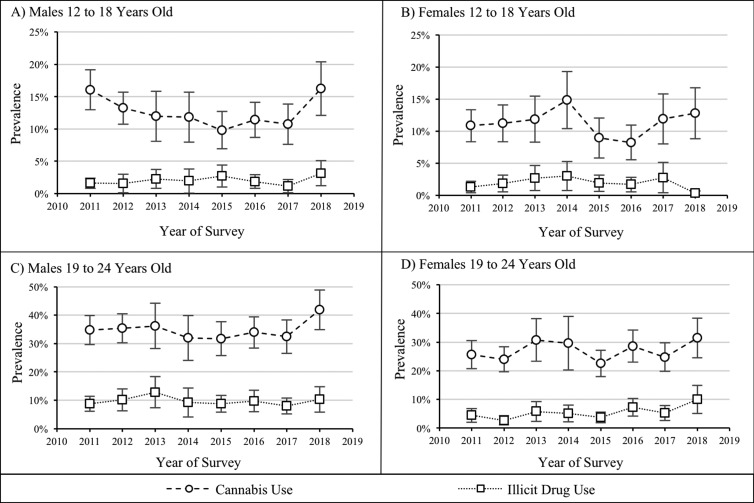
Aims: The mental health of youth is continually changing and requires reliable monitoring to ensure that adequate social and economic resources are allocated. This study assessed trends in mental health among Canadian youth, 12–24 years old. Specifically, we examined the prevalence of poor/fair perceived mental health, diagnosis of mood and anxiety disorders, suicidality, perceived stress and sleep problems, substance use, and mental health consultations. Methods: Data were collected from eight cycles of the annual Canadian Community Health Survey (2011–2018). Prevalence of mental health outcomes was calculated from each survey, and meta-regression was used to assess trends over time. In the absence of a significant trend over time, the eight cycles were pooled together using meta-analysis techniques to gain precision. Trends in prevalence were assessed for the overall sample of youth (12–24 years) and separately for male and female adolescents (12–18 years) and young adults (19–24 years). Results: The prevalence of poor/fair perceived mental health, diagnosed mood and anxiety disorders, and past-year mental health consultations increased from 2011 to 2018, most strongly among young adult females. Past-year suicidality increased among young adult females but did not change for other age and sex groups. Notably, the prevalence of binge drinking decreased by 2.4% per year for young adult males, 1.0% for young adult females and 0.7% per year for adolescent males, while staying relatively stable for adolescent females. Prevalence of cannabis use declined among adolescents before legalisation (2011–2017); however, this trend did not persist in 2018. Instead, the 2018 prevalence was 5.6% higher than the 2017 prevalence (16.3 v . 10.7%). The combined prevalence of other illicit drug use was stable at 4.6%; however, cocaine use and hallucinogens increased by approximately 0.2% per year. Conclusions: Our findings highlight a growing need for youth mental health services, as indicated by a rise in the prevalence of diagnosed mood and anxiety disorders and past-year mental health consultations. The reason for these observed increases is less apparent – it may represent a true rise in the prevalence of mental illness, or be an artefact of change in diagnostic practices, mental health literacy or diminishing stigma. Nonetheless, the findings indicate a need for the health care system to respond to the rising demand for mental health services among youth.
Overview
The claims and statistics of this paper haven’t been checked yet.
Run the check — free, no account needed. It reads the open-access text and checks the sources it cites.
Integrity signals
Registry
Cites
Statistics
Figures
Verification
Claims the paper makes
The claims and statistics of this paper haven’t been checked yet.
Run the check — free, no account needed. It reads the open-access text and checks the sources it cites.
Claims other papers make about this one
Each is checked against this paper’s own text: does it say what the citing paper says it does?
The cited source says what the claim attributes to it.
In the citing paper
“The demand for youth mental health care has increased, 230,380-382 and workforce and skills shortages are a major challenge globally, particularly in low-resource settings.”
From The Lancet Psychiatry Commission on youth mental health (2024) · cites this paper as [381]
Self-check
Percentages, sums and reported differences re-computed from the paper’s own numbers.
The self-check needs the paper’s full text.
Citations
Cites
Kessler, R. C., Berglund, P., Demler, O., Jin, R., Merikangas, K. R., & Walters, E. E. (2005) · Archives of General Psychiatry · doi:10.1001/archpsyc.62.6.593 · Cited by 20,391
James, S. L., Abate, D., Abate, K. H., Abay, S. M., Abbafati, C., Abbasi, N., Abbastabar, H., Abd-Allah, F., Abdela, J., Abdelalim, A., et al. (2018) · The Lancet · doi:10.1016/s0140-6736(18)32279-7 · Cited by 13,867
Vos, T., Abajobir, A. A., Abate, K. H., Abbafati, C., Abbas, K. M., Abd-Allah, F., Abdulkader, R. S., Abdulle, A. M., Abebo, T. A., Abera, S. F., et al. (2017) · The Lancet · doi:10.1016/s0140-6736(17)32154-2 · Cited by 13,220
Self-citationMerikangas, K. R., He, J.-P., Burstein, M., Swanson, S. A., Avenevoli, S., Cui, L., Benjet, C., Georgiades, K., & Swendsen, J. (2010) · Journal of the American Academy of Child & Adolescent Psychiatry · doi:10.1016/j.jaac.2010.05.017 · Cited by 6,278
Whiteford, H. A., Degenhardt, L., Rehm, J., Baxter, A. J., Ferrari, A. J., Erskine, H. E., Charlson, F. J., Norman, R. E., Flaxman, A. D., Johns, N., et al. (2013) · The Lancet · doi:10.1016/s0140-6736(13)61611-6 · Cited by 6,006
Twenge, J. M., Cooper, A. B., Joiner, T. E., Duffy, M. E., & Binau, S. G. (2019) · Journal of Abnormal Psychology · doi:10.1037/abn0000410 · Cited by 1,469
Sex differences in anxiety and depression clinical perspectives
Altemus, M., Sarvaiya, N., & Neill Epperson, C. (2014) · Frontiers in Neuroendocrinology · doi:10.1016/j.yfrne.2014.05.004 · Cited by 1,413 · cited 2×
“Young adult females exhibited the highest prevalence of depression and anxiety, as expected, given that sex differences typically emerge during the transition from adolescence to adulthood (Altemus et al., 2014).”
Sex Differences in Psychiatric Help-Seeking: Evidence from Four Large-Scale Surveys
Kessler, R. C., Brown, R., & Broman, C. L. (1981) · Journal of Health and Social Behavior · doi:10.2307/2136367 · Cited by 616
Becker, S. P., Jarrett, M. A., Luebbe, A. M., Garner, A. A., Burns, G. L., & Kofler, M. J. (2018) · Sleep Health · doi:10.1016/j.sleh.2018.01.001 · Cited by 602 · cited 1×
“The inability to handle these stressors can contribute to unhealthy behaviours, including poor sleeping habits, limited physical activity and inadequate diet (Becker et al., 2018; Jao et al., 2018; Murphy et al., 2018; Wattick et al., 2018).”
Jorm, A. F., Patten, S. B., Brugha, T. S., & Mojtabai, R. (2017) · World Psychiatry · doi:10.1002/wps.20388 · Cited by 556
Self-citationFerrari, A. J., Norman, R. E., Freedman, G., Baxter, A. J., Pirkis, J. E., Harris, M. G., Page, A., Carnahan, E., Degenhardt, L., Vos, T., et al. (2014) · PLoS ONE · doi:10.1371/journal.pone.0091936 · Cited by 480
Recent increases in depressive symptoms among US adolescents: trends from 1991 to 2018
Keyes, K. M., Gary, D., O’Malley, P. M., Hamilton, A., & Schulenberg, J. (2019) · Social Psychiatry and Psychiatric Epidemiology · doi:10.1007/s00127-019-01697-8 · Cited by 465 · cited 2×
“Recently, the use of repeated cross-sectional survey data has improved the ability to analyse trends in youth mental health (Thorisdottir et al., 2017; Wiens et al., 2017; Han et al., 2018; Pitchforth et al., 2018; Keyes et al., 2019; Twenge et al., 2019); however, there remains a paucity of research that examines sev…”
College life is stressful today – Emerging stressors and depressive symptoms in college students
Acharya, L., Jin, L., & Collins, W. (2018) · Journal of American College Health · doi:10.1080/07448481.2018.1451869 · Cited by 410
Trends in Mental Health Care among Children and Adolescents
Olfson, M., Druss, B. G., & Marcus, S. C. (2015) · New England Journal of Medicine · doi:10.1056/nejmsa1413512 · Cited by 408 · cited 1×
“The proportion of youth 12 – 17 years old who used outpatient mental health services in the USA increased from 9.0% (1996 – 1998) to 14.0% (2010 – 2012) (Olfson et al ., 2015).”
InfluentialMcLuckie, A., Kutcher, S., Wei, Y., & Weaver, C. (2014) · BMC Psychiatry · doi:10.1186/s12888-014-0379-4 · Cited by 242
Pitchforth, J., Fahy, K., Ford, T., Wolpert, M., Viner, R. M., & Hargreaves, D. S. (2019) · Psychological Medicine · doi:10.1017/s0033291718001757 · Cited by 227
Past 15-year trends in adolescent marijuana use: Differences by race/ethnicity and sex
Johnson, R. M., Fairman, B. J., Gilreath, T. D., Xuan, Z., Rothman, E. F., Parnham, T., & Furr-Holden, D. (2015) · Drug and Alcohol Dependence · doi:10.1016/j.drugalcdep.2015.08.025 · Cited by 200
Relationship between Diet and Mental Health in a Young Adult Appalachian College Population
Wattick, R. A., Hagedorn, R. L., & Olfert, M. D. (2018) · Nutrients · doi:10.3390/nu10080957 · Cited by 146
Mental Health Service Use Among Children and Youth in Ontario: Population-Based Trends Over Time
Gandhi, S., Chiu, M., Lam, K., Cairney, J., Guttmann, A., & Kurdyak, P. A. (2016) · The Canadian Journal of Psychiatry · doi:10.1177/0706743715621254 · Cited by 135
Lowry, R., Crosby, A. E., Brener, N. D., & Kann, L. K. (2013) · Journal of Adolescent Health · doi:10.1016/j.jadohealth.2013.07.024 · Cited by 133
Unhealthy behavior clustering and mental health status in United States college students
Jao, N. C., Robinson, L. D., Kelly, P. J., Ciecierski, C. C., & Hitsman, B. L. (2018) · Journal of American College Health · doi:10.1080/07448481.2018.1515744 · Cited by 123
Analysis of trends in the prevalence of cannabis use and related metrics in Canada
Rotermann, M. (2019) · PubMed · doi:10.25318/82-003-x201900600001-eng · Cited by 123
MURPHY, M. H., Carlin, A., Woods, C. B., Nevill, A. M., MacDonncha, C., Ferguson, K., & Murphy, N. M. (2018) · Journal of Physical Activity and Health · doi:10.1123/jpah.2017-0432 · Cited by 108
Han, B., Compton, W. M., Blanco, C., Colpe, L. J., Huang, L. N., & McKeon, R. (2017) · Journal of the American Academy of Child & Adolescent Psychiatry · doi:10.1016/j.jaac.2017.10.013 · Cited by 95
Sawyer, M. G., Reece, C. E., Sawyer, A. C. P., Johnson, S. E., & Lawrence, D. M. (2018) · Journal of the American Academy of Child & Adolescent Psychiatry · doi:10.1016/j.jaac.2018.02.012 · Cited by 82
Comeau, J., Georgiades, K., Duncan, L., Wang, L., Boyle, M. H., & 2014 Ontario Child Health Study Team (2019) · The Canadian Journal of Psychiatry · doi:10.1177/0706743719830035 · Cited by 80
Fat, L. N., Shelton, N. J., & Cable, N. (2018) · BMC Public Health · doi:10.1186/s12889-018-5995-3 · Cited by 78
The Burden of Mental Illness and Addiction in Ontario
Ratnasingham, S., Cairney, J., Manson, H. E., Rehm, J. T., Lin, E. H. B., & Kurdyak, P. A. (2013) · The Canadian Journal of Psychiatry · doi:10.1177/070674371305800908 · Cited by 69
Thorisdottir, I. E., Asgeirsdottir, B. B., Sigurvinsdottir, R., Allegrante, J. P., & Sigfusdottir, I. D. (2017) · European Journal of Public Health · doi:10.1093/eurpub/ckx111 · Cited by 68
Gardner, W. P., PAJER, K. A., Cloutier, P., Zemek, R. L., Currie, L. M., Hatcher, S., Colman, I., Bell, D., Gray, C., Cappelli, M., et al. (2019) · The Canadian Journal of Psychiatry · doi:10.1177/0706743719854070 · Cited by 59
Longitudinal outcomes of patients with pseudodementia: a systematic review
Connors, M. H., Quinto, L. R., & Brodaty, H. (2018) · Psychological Medicine · doi:10.1017/s0033291718002829 · Cited by 52
Time trends in symptoms of mental illness in children and adolescents in Canada
McMartin, S. E., Kingsbury, M. K., Dykxhoorn, J. L., & Colman, I. (2014) · Canadian Medical Association Journal · doi:10.1503/cmaj.140064 · Cited by 50
Wiens, K., Williams, J. V. A., Lavorato, D. H., Duffy, A. C., Pringsheim, T. M., Sajobi, T. T., & Patten, S. B. (2016) · Journal of Affective Disorders · doi:10.1016/j.jad.2016.11.018 · Cited by 50
Self-citationMajor Depression in Canada: What Has Changed over the Past 10 Years?
Patten, S. B., Williams, J. V. A., Lavorato, D. H., Wang, J., McDonald, K. C., & Bulloch, A. G. M. (2016) · The Canadian Journal of Psychiatry · doi:10.1177/0706743715625940 · Cited by 49
Self-citationGrucza, R. A., Krueger, R. F., Arpana Agrawal, A., Plunk, A. D., Krauss, M. J., Bongu, J., Cavazos‐Rehg, P. A., & Bierut, L. J. (2017) · Psychological Medicine · doi:10.1017/s0033291717002999 · Cited by 46
Mishina, K. E., Tiiri, E., Lempinen, L., Sillanmäki, L. H., Kronström, K., & Sourander, A. (2018) · European Child & Adolescent Psychiatry · doi:10.1007/s00787-018-1158-4 · Cited by 44
Zuckermann, A. M. E., Battista, K., de Groh, M., Jiang, Y., & Leatherdale, S. T. (2019) · BMJ Open · doi:10.1136/bmjopen-2018-026515 · Cited by 40
Bjørnsen, H. N., Ringdal, R., Espnes, G., Eilertsen, M., & Moksnes, U. (2018) · BMC Health Services Research · doi:10.1186/s12913-018-3829-8 · Cited by 37
Cannabis and the developing brain: What does the evidence say?
Jacobus, J., Courtney, K. E., Hodgdon, E. A., & Baca, R. E. (2019) · Birth Defects Research · doi:10.1002/bdr2.1572 · Cited by 37
Trends in cannabis use over time among Canadian youth: 2004–2014
Leos‐Toro, C., Rynard, V. L., Murnaghan, D., MacDonald, J.-A., & Hammond, D. G. (2018) · Preventive Medicine · doi:10.1016/j.ypmed.2018.10.002 · Cited by 28
Research works printed but not linked: 2
- 2017, Stata Statistical Software: Release 15
- 10.1177/070674371305800809 · DOI
Cited by
Sorted by citations
The social determinants of mental health and disorder: evidence, prevention and recommendations
Kirkbride, J. B., Anglin, D. M., Colman, I., Dykxhoorn, J. L., Jones, P. B., Patalay, P., Pitman, A., Soneson, E., Steare, T., Wright, T., et al. (2024) · World Psychiatry · doi:10.1002/wps.21160 · Cited by 1,619
The Lancet Psychiatry Commission on youth mental health
McGorry, P. D., Mei, C., Dalal, N., Alvarez-Jimenez, M., Blakemore, S.-J., Browne, V., Dooley, B., Hickie, I. B., Jones, P. B., McDaid, D., et al. (2024) · The Lancet Psychiatry · doi:10.1016/s2215-0366(24)00163-9 · Cited by 663
Designing and scaling up integrated youth mental health care
McGorry, P. D., Mei, C., Chanen, A., Hodges, C., Alvarez‐Jimenez, M., & Killackey, E. (2022) · World Psychiatry · doi:10.1002/wps.20938 · Cited by 546
Tang, S., Werner-Seidler, A., Torok, M., Mackinnon, A. J., & Christensen, H. (2021) · Clinical Psychology Review · doi:10.1016/j.cpr.2021.102021 · Cited by 284
The youth mental health crisis: analysis and solutions
McGorry, P. D., Gunasiri, H., Mei, C., Rice, S., & Gao, C. X. (2025) · Frontiers in Psychiatry · doi:10.3389/fpsyt.2024.1517533 · Cited by 261
Metadata
- Authors
- Wiens, K., Bhattarai, A., Pedram, P., Dores, A., Williams, J., Bulloch, A., & Patten, S.
- Affiliations
- University of Calgary (CA)
- Corresponding author
- Wiens, K.
- Venue
- Epidemiology and Psychiatric Sciences
- Publisher
- Cambridge University Press (CUP)
- Published
- 2020
- Volume
- 29
- Pages
- e115-e115
- ISSN
- 2045-7960 (ISSN-L)
- 2045-7979
- PMC
- PMC7214527
- OpenAlex
- W3016794806
- Cited by
- 285
- References
- 41
- Citations by year
- 2026: 33 · 2025: 68 · 2024: 69 · 2023: 53 · 2022: 34 · 2021: 26 · 2020: 2
- FWCI
- 31.43
- Type
- journal article
- Language
- en
- Open access
- gold
- doi.org
- Licence
- Locations
- Epidemiology and Psychiatric Sciences (publishedVersion, cc-by-nc-nd)
- PubMed Central (publishedVersion, cc-by-nc-nd)
- PubMed (publishedVersion)
- Funders
- Canadian Institutes of Health Research
- Social Sciences and Humanities Research Council of Canada
- Topics
- Health Sciences › Medicine › Psychiatry and Mental health › Mental Health Treatment and Access
- Social Sciences › Psychology › Clinical Psychology › Child and Adolescent Psychosocial and Emotional Development
- Health Sciences › Medicine › Epidemiology › Substance Abuse Treatment and Outcomes
- Keywords
- youth mental health, mental health trends, mood disorders, anxiety disorders, suicidality, perceived stress, sleep disorders, substance use, binge drinking, cannabis use, illicit drug use, mental health consultation, adolescents, young adults, sex differences, mental health services, Canadian Community Health Survey, diagnostic practices, mental health literacy, stigma, cannabis legalization, cocaine use, hallucinogens, Canada
- MeSH terms
- Adolescent, Anxiety Disorders, Mental Disorders, Canada, Child, Cross-Sectional Studies, Depression, Female, Health Surveys, Humans, Male, Mental Health, Mental Health Services, Population Surveillance, Suicide, Prevalence, Age Distribution, Sex Distribution, Substance-Related Disorders, Young Adult
About these checks
Registry, retraction, Cites and statistics results are computed, not judged, with one exception: a printed reference that no index lists is read once by a model before it counts as a citation error. Claims are extracted by a model and kept only when their quote appears verbatim in the text; each cited source is then checked, with a model’s help, for whether it says what the claim relies on. Those verdicts can be wrong — read the claim’s quote and the cited source before relying on one.
Statistics and arithmetic are recomputed, not judged.
Confidence bands are shown only for fields calibrated on our annotated test set. None is calibrated yet, so no band is shown.
What counts as a claim ›How we measure confidence ›How we check this ›
Are you an author, or do you see a problem with this page? Request a review
