

Association between intimate partner violence and leukocyte telomere length: a retrospective cohort study of 144 049 UK Biobank participants.
Open accessThe DOI matches its Crossref record; 45 of the 45 references it cites were found in a registry or an index.
Abstract
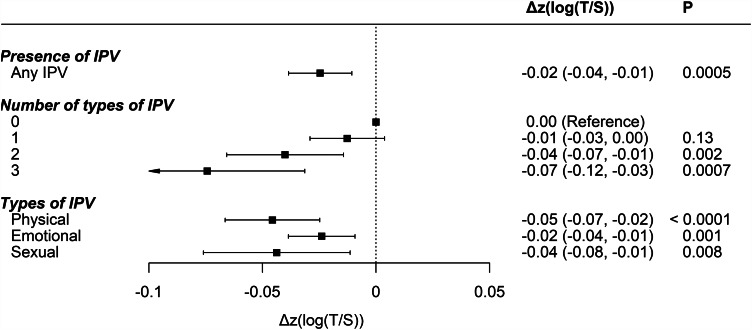
Aims: Intimate partner violence (IPV) is a public health challenge negatively affecting victims’ health. Telomere length (TL), a marker for biological ageing, might be reflective of the mechanisms through which IPV leads to adverse health outcomes. The objective of the current study was to explore the association between IPV and leucocyte TL. Methods: We conducted an analysis using a subset of the UK Biobank (N = 144 049). Physical, sexual and emotional IPV were reported by the participants. DNA was extracted from peripheral blood leukocytes. TL was assayed by quantitative polymerase chain reaction. We used multivariable linear regressions to test the associations between IPV and TL adjusted for age, sex, ethnicity, deprivation, education, as well as symptoms of depression and post-traumatic stress disorder in a sensitivity analysis. Results: After adjusting for sociodemographic factors, any IPV was associated with 0.02-s.d. shorter TL (β = −0.02, 95% CI −0.04 to −0.01). Of the three types of IPV, physical violence had a marginally stronger association (β = −0.05, 95% CI −0.07 to −0.02) than the other two types. The associations of numbers of IPV and TL showed a dose–response pattern whereby those who experienced all three types of IPV types had the shortest TL (β = −0.07, 95% CI −0.12 to −0.03), followed by those who experienced two types (β = −0.04, 95% CI −0.07 to −0.01). Following additional adjustment for symptoms of depression and PTSD, the associations were slightly attenuated but the general trend by number of IPVs remained. Conclusions: Victims of IPV, particularly those exposed to multiple types of IPVs, had shorter TL indicative of accelerated biological ageing. Given that all three types of IPV are linked to TL, clinical practitioners need to comprehensively identify all types of IPV and those who received multiple types. Further studies should explore the association of violence with changes in TL over time, as well as to which extent biological ageing is a mechanistic factor.
Overview
The claims and statistics of this paper haven’t been checked yet.
Free: it reads the open-access text and checks the first 5 claims that cite a source we can check. Create a free account to check every claim.
Integrity signals
Registry
Cites
Statistics
Figures
Verification
Claims the paper makes
The claims and statistics of this paper haven’t been checked yet.
Free: it reads the open-access text and checks the first 5 claims that cite a source we can check. Create a free account to check every claim.
Claims other papers make about this one
Each is checked against this paper’s own text: does it say what the citing paper says it does?
The source backs part of the claim, not all of it — or backs it for a different population, condition or comparison.
In the citing paper
“Studies have demonstrated associations between intimate partner violence and accelerated telomere shortening, suggesting that chronic emotional abuse may contribute to premature biological aging (Slevin and Tero-Vescan, 2025; Chan et al., 2023).”
From From use to abuse: psychological, neurobiological, and spiritual pathways in relational harm and recovery (2026) · cites this paper as Chan et al., 2023
Experimental — accuracy not yet measuredThe cited source says what the claim attributes to it.
In the citing paper
“Studies have demonstrated associations between intimate partner violence and accelerated telomere shortening, suggesting that chronic emotional abuse may contribute to premature biological aging (Slevin and Tero-Vescan, 2025; Chan et al., 2023).”
From From use to abuse: psychological, neurobiological, and spiritual pathways in relational harm and recovery (2026) · cites this paper as Chan et al., 2023
Self-check
Percentages, sums and reported differences re-computed from the paper’s own numbers.
The self-check needs the paper’s full text.
Citations
Cites
Sudlow, C., Gallacher, J., Allen, N., Beral, V., Burton, P., Danesh, J., Downey, P., Elliott, P., Green, J., Landray, M., et al. (2015) · PLOS Medicine · doi:10.1371/journal.pmed.1001779 · Cited by 12,728 · cited 1×
“The details of the study design and protocols of UK Biobank are provided elsewhere (Sudlow et al., 2015).”
BackgroundSelf-citationAdverse childhood experiences, allostasis, allostatic load and age-related disease
Danese, A., & McEwen, B. S. (2012) · Physiology & Behavior · doi:10.1016/j.physbeh.2011.08.019 · Cited by 2,140 · cited 1×
“This finding echoes the allostatic load model that highlights the cumulative impact of multiple sources of stress (Danese and McEwen, 2012).”
BackgroundDannefer, D. (2003) · The Journals of Gerontology Series B: Psychological Sciences and Social Sciences · doi:10.1093/geronb/58.6.s327 · Cited by 2,091 · cited 1×
“Cumulative disadvantage theory states that adverse events over the lifespan could produce greater health risks in later life (Dannefer, 2003; Ferraro and Shippee, 2009).”
BackgroundBlackburn, E. H., Epel, E. S., & Lin, J. (2015) · Science · doi:10.1126/science.aab3389 · Cited by 1,596 · cited 1×
“The DNA component, comprising (TTAGGG)n, is a biomarker of ageing and adverse health outcomes that shortens in somatic cells as they replicate (Blackburn et al., 2015; Wang et al., 2018).”
BackgroundAging and Cumulative Inequality: How Does Inequality Get Under the Skin?
Ferraro, K. F., & Shippee, T. P. (2009) · The Gerontologist · doi:10.1093/geront/gnp034 · Cited by 998 · cited 1×
“Cumulative disadvantage theory states that adverse events over the lifespan could produce greater health risks in later life (Dannefer, 2003; Ferraro and Shippee, 2009).”
BackgroundThe Social Stratification of Aging and Health
House, J. S., Lepkowski, J. M., Kinney, A. M., Mero, R. P., Kessler, R. C., & Herzog, A. R. (1994) · Journal of Health and Social Behavior · doi:10.2307/2137277 · Cited by 950 · cited 1×
“Conversely, the age-as-leveller theory argues that inequalities in health reduce across the lifespan (House et al., 1994; Lauderdale, 2001).”
BackgroundWilkins, K. C., Lang, A. J., & Norman, S. B. (2011) · Depression and Anxiety · doi:10.1002/da.20837 · Cited by 946 · cited 1×
“PCL-S consists of five items that map onto the DSM-IV criteria (Wilkins et al., 2011).”
MethodBatty, G. D., Gale, C. R., Kivimäki, M., Deary, I. J., & Bell, S. (2020) · BMJ · doi:10.1136/bmj.m131 · Cited by 635 · cited 1×
“Previous analysis has shown that the association estimates from the UK Biobank are comparable to that from population-representative cohorts (Batty et al., 2020).”
ResultLagdon, S., Armour, C., & Stringer, M. (2014) · European Journal of Psychotraumatology · doi:10.3402/ejpt.v5.24794 · Cited by 590 · cited 3×
“, 2021), such as more than one type of IPV (Lagdon et al., 2014), can increase the severity of mental health outcomes, studies on TL require greater granularity in their measurement of the types and dosage of IPV.”
BackgroundThe Telomeres Mendelian Randomization Collaboration, Haycock, P. C., Burgess, S., Nounu, A., Zheng, J., Okoli, G. N., Bowden, J., Wade, K. H., Timpson, N. J., Evans, D. M., et al. (2017) · JAMA Oncology · doi:10.1001/jamaoncol.2016.5945 · Cited by 513
Shalev, I., Moffitt, T. E., Sugden, K., Williams, B., Houts, R. M., Danese, A., Mill, J., Arseneault, L., & Caspi, A. (2013) · Molecular Psychiatry · doi:10.1038/mp.2012.32 · Cited by 489 · cited 1×
“This notion was also evidenced in the influence of stressful childhood events on TL, with a relatively consistent result showing a critical role of cumulative childhood stress on TL (Shalev et al., 2013; Puterman et al., 2016).”
ResultBacchus, L. J., Ranganathan, M., Watts, C., & Devries, K. (2018) · BMJ Open · doi:10.1136/bmjopen-2017-019995 · Cited by 464 · cited 12×
“Following additional adjustment for symptoms of depression and PTSD, the associations were slightly attenuated but the general trend by number of IPVs remained.”
BackgroundInfluentialElovainio, M., Hakulinen, C., Pulkki-Råback, L., Virtanen, M., Josefsson, K., Jokela, M., Vahtera, J., & Kivimäki, M. (2017) · The Lancet Public Health · doi:10.1016/s2468-2667(17)30075-0 · Cited by 411 · cited 1×
“…age, ethnicity, highest educational level and Townsend Deprivation Index; a composite area-based measure derived from unemployment, car ownership, household overcrowding and owner occupation, with higher scores indicating higher levels of deprivation (Elovainio et al., 2017; Howe et al., 2020).”
BackgroundTelomere Length and All-Cause Mortality: A Meta-analysis
Wang, Q., Zhan, Y., Pedersen, N. L., Fang, F., & Hägg, S. (2018) · Ageing Research Reviews · doi:10.1016/j.arr.2018.09.002 · Cited by 318 · cited 1×
“The DNA component, comprising (TTAGGG)n, is a biomarker of ageing and adverse health outcomes that shortens in somatic cells as they replicate (Blackburn et al., 2015; Wang et al., 2018).”
BackgroundEarly life adversity and telomere length: a meta-analysis
Ridout, K. K., Levandowski, M., Ridout, S. J., Gantz, L., Goonan, K., Palermo, D., Price, L. H., & Tyrka, A. R. (2018) · Molecular Psychiatry · doi:10.1038/mp.2017.26 · Cited by 273
Codd, V., Denniff, M., Swinfield, C., Warner, S. C., Papakonstantinou, M., Sheth, S., Nanus, D. E., Budgeon, C. A., Musicha, C., Bountziouka, V., et al. (2022) · Nature Aging · doi:10.1038/s43587-021-00166-9 · Cited by 247 · cited 2×
“Over 23 000 measurements had undergone a reproducibility check which resulted in good coefficient of variation (median 5.53, interquartile range 2.67–9.68) (Codd et al., 2022).”
BackgroundInfluentialFood as medicine: targeting the uraemic phenotype in chronic kidney disease
Mafra, D., Borges, N. A., Lindholm, B., Shiels, P. G., Evenepoel, P., & Stenvinkel, P. (2021) · Nature Reviews Nephrology · doi:10.1038/s41581-020-00345-8 · Cited by 238 · cited 1×
“This, however, seems counterintuitive as TL shortening is reflective of an accumulation of ‘wear and tear’ from a range of exposome features that act both cumulatively, synergistically and independently (Dai et al., 2021; Mafra et al., 2021).”
BackgroundSelf-citationGender differences in self-reports of intimate partner violence: A review
Chan, K. L. (2011) · Aggression and Violent Behavior · doi:10.1016/j.avb.2011.02.008 · Cited by 211 · cited 2×
“Previous research reported mixed findings on gender and IPV victimisation (Chan, 2011), which may be related to gender-specific factors and cultural-specific gender roles (Chan, 2011; Laskey et al.”
BackgroundSelf-citationHaycock, P. C., Hemani, G., & Aviv, A. (2017) · JAMA Oncology · doi:10.1001/jamaoncol.2017.2316 · Cited by 209 · cited 2×
“…with various major illnesses, within the ‘diseasome of ageing’ (Shiels et al., 2017, 2021), including cardiovascular disease, chronic kidney disease, cancer and Alzheimer’s disease (Haycock et al., 2017), TL could reflect a biological mechanism on the burden of physiological ‘wear and tear’.”
BackgroundLaskey, P., Bates, E. A., & Taylor, J. C. (2019) · Aggression and Violent Behavior · doi:10.1016/j.avb.2019.02.014 · Cited by 199 · cited 3×
“The gender differences in IPV prevalence observed in our study may result from different coping strategies (Laskey et al., 2019), such that male victims are less likely to report even if they experience similar victimisation.”
BackgroundTelomere Length, Current Perceived Stress, and Urinary Stress Hormones in Women
Parks, C. G., Miller, D. B., McCanlies, E. C., Cawthon, R. M., Andrew, M. E., DeRoo, L. A., & Sandler, D. P. (2009) · Cancer Epidemiology, Biomarkers & Prevention · doi:10.1158/1055-9965.epi-08-0614 · Cited by 176 · cited 1×
“Indeed, a cohort of women aged 35–74 years who had a sister with breast cancer found an association between perceived stress and shorter TL only among women aged 55 years and older (Parks et al., 2009).”
BackgroundEducation and survival: Birth cohort, period, and age effects
Lauderdale, D. S. (2001) · Demography · doi:10.1353/dem.2001.0035 · Cited by 167 · cited 1×
“Conversely, the age-as-leveller theory argues that inequalities in health reduce across the lifespan (House et al., 1994; Lauderdale, 2001).”
BackgroundPuterman, E., Gemmill, A., Karasek, D., Weir, D., Adler, N. E., Prather, A. A., & Epel, E. S. (2016) · Proceedings of the National Academy of Sciences · doi:10.1073/pnas.1525602113 · Cited by 165 · cited 1×
“This notion was also evidenced in the influence of stressful childhood events on TL, with a relatively consistent result showing a critical role of cumulative childhood stress on TL (Shalev et al., 2013; Puterman et al., 2016).”
ResultHamberger, L. K., Rhodes, K. V., & Brown, J. (2014) · Journal of Women s Health · doi:10.1089/jwh.2014.4861 · Cited by 130 · cited 1×
“Our current findings suggest that identifying victims with multiple types of IPV might be beneficial if system-level interventions are in place (Hamberger et al., 2015).”
BackgroundChan, K. L., Chen, Q., & Chen, M. (2021) · Trauma, Violence, & Abuse · doi:10.1177/1524838019841601 · Cited by 120 · cited 2×
“Regardless, given the evidence on the association between IPV and TL both among the victims (as shown in this study) and among the offspring (Chan et al., 2019), future studies should look into whether TL is a mechanistic factor leading to health outcomes, or whether TL can be a marker to help risk…”
BackgroundSelf-citationMartín-Fernández, M., Gracia, E., & Lila, M. (2018) · Psychosocial Intervention · doi:10.5093/pi2018a18 · Cited by 117 · cited 1×
“The traditional gendered (or feminist) perspective suggests that the perpetrator of IPV is male and the victim is female (Martín-Fernández et al., 2018).”
BackgroundThe role of epigenetics in renal ageing
Shiels, P. G., McGuinness, D., Eriksson, M., Kooman, J. P., & Stenvinkel, P. (2017) · Nature Reviews Nephrology · doi:10.1038/nrneph.2017.78 · Cited by 114 · cited 1×
“Given that shorter TL is associated with various major illnesses, within the ‘diseasome of ageing’ (Shiels et al., 2017, 2021), including cardiovascular disease, chronic kidney disease, cancer and Alzheimer’s disease (Haycock et al., 2017), TL could reflect a biological mechanism on the burden of…”
BackgroundSelf-citationKuo, C., Pilling, L. C., Kuchel, G. A., Ferrucci, L., & Melzer, D. (2019) · Aging Cell · doi:10.1111/acel.13017 · Cited by 107 · cited 1×
“Multiple Mendelian randomisation studies have shown the potential causal effect of telomere shortening and a number of health outcomes, such as cancer and cardiovascular disease (Haycock et al., 2017; Kuo et al., 2019).”
BackgroundKhalifeh, H., Oram, S., Trevillion, K., Johnson, S., & Howard, L. M. (2015) · British Journal of Psychiatry · doi:10.1192/bjp.bp.114.144899 · Cited by 104 · cited 1×
“The items were adapted from the British Crime Survey (Khalifeh et al., 2015).”
MethodTelomere shortening in formerly abused and never abused women.
Humphreys, J., Epel, E. S., Cooper, B. A., Lin, J., Blackburn, E. H., & Lee, K. A. (2012) · Biological Research For Nursing · doi:10.1177/1099800411398479 · Cited by 97 · cited 1×
“Existing studies on the relationship between IPV and TL found inconsistent results (Humphreys et al., 2012; Jodczyk et al., 2014), and very few further investigated the associations of different and multiple types of IPV with TL.”
ResultTelomeres and Age-Related Diseases
Gruber, H.-J., Semeraro, M. D., Renner, W., & Herrmann, M. (2021) · Biomedicines · doi:10.3390/biomedicines9101335 · Cited by 94 · cited 1×
“Older adults may be more likely to report age-related diseases such as cardiovascular diseases (Gruber et al., 2021) that are associated with TL shortening.”
BackgroundThe relationship between childhood psychosocial stressor level and telomere length: a meta-analysis
M. Hanssen, L., S. Schutte, N., M. Malouff, J., & S. Epel, E. (2017) · Health Psychology Research · doi:10.4081/hpr.2017.6378 · Cited by 93 · cited 1×
“The existing literature on the relationship between traumatic events and TL has mainly focused on early life (Hanssen et al., 2017; Ridout et al., 2018).”
BackgroundKandola, A. A., Osborn, D., Stubbs, B., Choi, K. W., & Hayes, J. (2020) · BMC Medicine · doi:10.1186/s12916-020-01782-9 · Cited by 90 · cited 1×
“Previous work has demonstrated the validity and reliability of using this scale in UK Biobank (Kandola et al., 2020).”
BackgroundChild maltreatment and cardiovascular disease: quantifying mediation pathways using UK Biobank
Ho, F. K. W., Celis-Morales, C. A., Gray, S. R., Petermann-Rocha, F. E., Lyall, D. M., Mackay, D., Sattar, N. A., Minnis, H., & Pell, J. P. (2020) · BMC Medicine · doi:10.1186/s12916-020-01603-z · Cited by 84 · cited 1×
“Last but not least, UK Biobank is not representative of the general UK population with a healthy volunteer bias, particularly among those who completed the online mental health survey (Ho et al., 2020).”
BackgroundSelf-citationThe Association of Early and Recent Psychosocial Life Stress With Leukocyte Telomere Length
Verhoeven, J. E., van Oppen, P., Puterman, E., Elzinga, B., & Penninx, B. W. J. H. (2015) · Psychosomatic Medicine · doi:10.1097/psy.0000000000000226 · Cited by 81 · cited 1×
“Researchers of adulthood stress also call for investigations on cumulative stressors (van Ockenburg et al., 2015; Verhoeven et al., 2015).”
BackgroundHowe, L. D., Kanayalal, R., Harrison, S., Beaumont, R. N., Davies, A. R., Frayling, T. M., Davies, N. M., Hughes, A., Jones, S. E., Sassi, F., et al. (2019) · International Journal of Epidemiology · doi:10.1093/ije/dyz240 · Cited by 66 · cited 1×
“Demographic information was collected, including sex, age, ethnicity, highest educational level and Townsend Deprivation Index; a composite area-based measure derived from unemployment, car ownership, household overcrowding and owner occupation, with higher scores indicating higher levels of deprivation (Elovainio et…”
BackgroundNo association between mean telomere length and life stress observed in a 30 year birth cohort
Jodczyk, S., Fergusson, D. M., Horwood, L. J., Pearson, J. F., & Kennedy, M. A. (2014) · PLoS ONE · doi:10.1371/journal.pone.0097102 · Cited by 62 · cited 2×
“Existing studies on the relationship between IPV and TL found inconsistent results (Humphreys et al., 2012; Jodczyk et al., 2014), and very few further investigated the associations of different and multiple types of IPV with TL.”
BackgroundResultVincent, J., Hovatta, I., Frissa, S., Goodwin, L., Hotopf, M., Hatch, S. L., Breen, G., & Powell, T. R. (2017) · Journal of Affective Disorders · doi:10.1016/j.jad.2017.01.031 · Cited by 55 · cited 1×
“Vincent et al. (2017) found no associations between physical/sexual/emotional violence and TL from a UK sample (ages 20–84).”
BackgroundEarly and recent psychosocial stress and telomere length in older adults
Schaakxs, R., Wielaard, I., Verhoeven, J. E., Beekman, A. T. F., Penninx, B. W. J. H., & Comijs, H. C. (2016) · International Psychogeriatrics · doi:10.1017/s1041610215001155 · Cited by 43 · cited 2×
“These diseases may cover up the independent influence of psychosocial stressors (Schaakxs et al., 2016).”
BackgroundManipulating the exposome to enable better ageing
Shiels, P. G., Painer, J., Natterson-Horowitz, B., Johnson, R. J., Miranda, J. J., & Stenvinkel, P. (2021) · Biochemical Journal · doi:10.1042/bcj20200958 · Cited by 42 · cited 3×
“Interindividual variation in TL at any given chronological age remains substantial and is often a complicating factor in such studies, as are exposome features (i.e. biotic and abiotic life course exposures) (Shiels et al., 2021).”
BackgroundSelf-citationMason, S. M., Prescott, J., Tworoger, S. S., DeVivo, I., & Rich-Edwards, J. W. (2015) · PLOS ONE · doi:10.1371/journal.pone.0124493 · Cited by 40 · cited 1×
“However, a study of 1135 women (Mason et al., 2015) has found stronger evidence of an association between physical violence and TL than sexual violence, consistent with our findings.”
Resultvan Ockenburg, S. L., Bos, E. H., de Jonge, P., van der Harst, P., Gans, R. O. B., & Rosmalen, J. G. M. (2015) · Psychological Medicine · doi:10.1017/s0033291715000914 · Cited by 38 · cited 1×
“Researchers of adulthood stress also call for investigations on cumulative stressors (van Ockenburg et al., 2015; Verhoeven et al., 2015).”
BackgroundThe association between intimate partner violence against women and newborn telomere length
Chan, K. L., Lo, C. K. M., Ho, F. K. W., Leung, W. C., Yee, B. K., & Ip, P. (2019) · Translational Psychiatry · doi:10.1038/s41398-019-0575-6 · Cited by 19 · cited 1×
“Regardless, given the evidence on the association between IPV and TL both among the victims (as shown in this study) and among the offspring (Chan et al., 2019), future studies should look into whether TL is a mechanistic factor leading to health outcomes, or whether TL can be a marker to help risk…”
BackgroundSelf-citationStressful life events in early life and leukocyte telomere length in adulthood
McFarland, M. J., Taylor, J. D., Hill, T. D., & Friedman, K. L. (2017) · Advances in Life Course Research · doi:10.1016/j.alcr.2017.12.002 · Cited by 16 · cited 1×
“Studies support the age-as-leveller position that stressful life events were inversely associated with TL in adults aged 22–44 but not in adults aged 45–69 (McFarland et al., 2018).”
BackgroundDai, L., Schurgers, L., Shiels, P. G., & Stenvinkel, P. (2021) · Clinical Science · doi:10.1042/cs20201452 · Cited by 11 · cited 1×
“This, however, seems counterintuitive as TL shortening is reflective of an accumulation of ‘wear and tear’ from a range of exposome features that act both cumulatively, synergistically and independently (Dai et al., 2021; Mafra et al., 2021).”
BackgroundSelf-citation
Research works printed but not linked: 1
- World Health Organization (2018) Global, Regional and National Prevalence Estimates for Intimate Partner Violence Against Women and Global and Regional Prevalence Estimates for non-Partner Sexual Violence Against Women. Geneva: World Health Organization.
Cited by
Wang, L., Chen, J., Wu, Y., Duan, Y., Weng, Y., Wu, F., Huang, Q., Cai, T., & Yuan, C. (2025) · Public Health · doi:10.1016/j.puhe.2025.105863 · Cited by 5
Bhardwaj, S., Ali, A., & Paul, F. A. (2026) · Frontiers in Behavioral Neuroscience · doi:10.3389/fnbeh.2026.1805594 · Cited by 1
“Studies have demonstrated associations between intimate partner violence and accelerated telomere shortening, suggesting that chronic emotional abuse may contribute to premature biological aging (Slevin and Tero-Vescan, 2025; Chan et al., 2023).”
Rodrigues, M., Wood, E. P., Green, N., Prout, L., Caldas, J. J., Rodriguez, J., Loureiro, S., Solomon, H., & Cook, S. (2026) · Journal of Family Violence · doi:10.1007/s10896-026-01144-8
Metadata
- Authors
- Chan, K. L., Lo, C. K. M., Chen, X.-Y., Ip, P., Leung, W. C., Shiels, P. G., Pell, J. P., Minnis, H., & Ho, F. K.
- Affiliations
- Hong Kong Polytechnic University (HK)
- Hong Kong Children's Hospital (HK)
- Kwong Wah Hospital (CN)
- University of Glasgow (GB)
- Corresponding author
- Ho, Frederick K.
- ORCID
- Venue
- Epidemiology and Psychiatric Sciences
- Publisher
- Cambridge University Press (CUP)
- Published
- 2023
- Volume
- 32
- ISSN
- 2045-7960 (ISSN-L)
- 2045-7979
- PMC
- PMC10130734
- OpenAlex
- W4366963370
- Cited by
- 3
- References
- 44
- Citations by year
- 2026: 2 · 2025: 1
- FWCI
- 0.81
- Type
- journal article
- Language
- en
- Open access
- gold
- doi.org
- Locations
- Epidemiology and Psychiatric Sciences (publishedVersion, cc-by)
- PubMed Central (publishedVersion, cc-by)
- ENLIGHTEN (Jurnal Bimbingan dan Konseling Islam) (acceptedVersion, other-oa)
- PolyU Institutional Research Archive (Hong Kong Polytechnic University) (submittedVersion, cc-by)
- DOAJ (DOAJ: Directory of Open Access Journals) (submittedVersion, cc-by-sa)
- Funders
- Glasgow Children’s Hospital Charity (GCHC/SPG/2021/05)
- Hong Kong Polytechnic University (1-ZE1R)
- Medical Research Council
- Research Grants Council, University Grants Committee (PolyU 15602419)
- Wellcome Trust
- Topics
- Social Sciences › Health › Intimate Partner and Family Violence
- Life Sciences › Biochemistry, Genetics and Molecular Biology › Cell Biology › Telomeres, Telomerase, and Senescence
- Social Sciences › Psychology › Clinical Psychology › Child Abuse and Trauma
- Keywords
- intimate partner violence, leukocyte telomere length, biological aging, physical violence, sexual violence, emotional abuse, depression, post-traumatic stress disorder, dose-response relationship, UK Biobank
About these checks
Registry, retraction, Cites and statistics results are computed, not judged, with one exception: a printed reference that no index lists is read once by a model before it counts as a citation error. Claims are extracted by a model and kept only when their quote appears verbatim in the text; each cited source is then checked, with a model’s help, for whether it says what the claim relies on. Those verdicts can be wrong — read the claim’s quote and the cited source before relying on one.
Statistics and arithmetic are recomputed, not judged.
Confidence bands are shown only for fields calibrated on our annotated test set. None is calibrated yet, so no band is shown.
What counts as a claim ›How we measure confidence ›How we check this ›
Are you an author, or do you see a problem with this page? Request a review
Data sources
Bibliographic data: Semantic Scholar, OpenAlex, Crossref.
Contains information from the Semantic Scholar Academic Graph Datasets, made available under the ODC Attribution License (ODC-BY 1.0).
Semantic Scholar’s data is described in: Kinney, R., et al. (2023). The Semantic Scholar Open Data Platform. arXiv:2301.10140.
