

Computational Modeling of Magnesium Hydroxide Precipitation and Kinetics Parameters Identification
Open accessThe DOI matches its Crossref record; 34 of the 35 references it cites were found in a registry or an index; 4 of the 23 sources its claims cite were checked for support.
Abstract
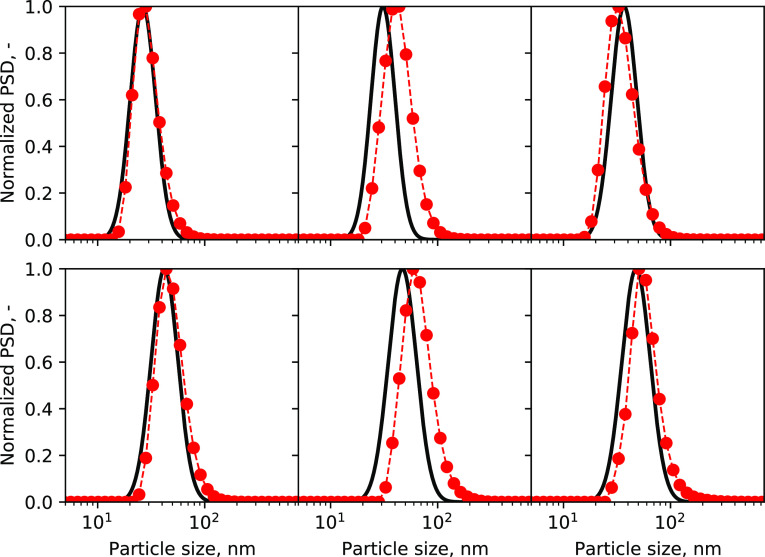
High Resolution Image Download MS PowerPoint Slide Magnesium is a critical raw material and its recovery as Mg(OH) 2 from saltwork brines can be realized via precipitation. The effective design, optimization, and scale-up of such a process require the development of a computational model accounting for the effect of fluid dynamics, homogeneous and heterogeneous nucleation, molecular growth, and aggregation. The unknown kinetics parameters are inferred and validated in this work by using experimental data produced with a T 2mm -mixer and a T 3mm -mixer, guaranteeing fast and efficient mixing. The flow field in the T-mixers is fully characterized by using the k - ε turbulence model implemented in the computational fluid dynamics (CFD) code OpenFOAM. The model is based on a simplified plug flow reactor model, instructed by detailed CFD simulations. It incorporates Bromley’s activity coefficient correction and a micro-mixing model for the calculation of the supersaturation ratio. The population balance equation is solved by exploiting the quadrature method of moments, and mass balances are used for updating the reactive ions concentrations, accounting for the precipitated solid. To avoid unphysical results, global constrained optimization is used for kinetics parameters identification, exploiting experimentally measured particle size distribution (PSD). The inferred kinetics set is validated by comparing PSDs at different operative conditions both in the T 2mm -mixer and the T 3mm -mixer. The developed computational model, including the kinetics parameters estimated for the first time in this work, will be used for the design of a prototype for the industrial precipitation of Mg(OH) 2 from saltwork brines in an industrial environment.
Overview
CoChat Summary
TL;DR
The paper develops and tunes a computational model for Mg(OH)2 precipitation in T-mixers that combines CFD-informed mixing, activity coefficients, micro-mixing, and a population balance equation to infer kinetic parameters. Using 8 experiments, the authors fit 5 cases and validate on 3 others, concluding that micro-mixing is critical and that aggregation and primary nucleation dominate under their conditions.
Key findings
- The experimental dataset was split into 5 tuning cases (#1–5) and 3 validation cases (#6–8); the model was tuned using 20 experimental samples derived from 4 moment ratios across the 5 tuning concentrations.
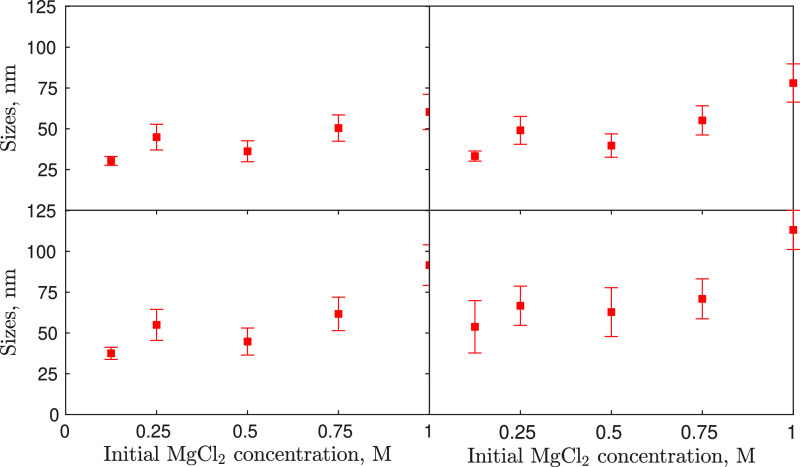
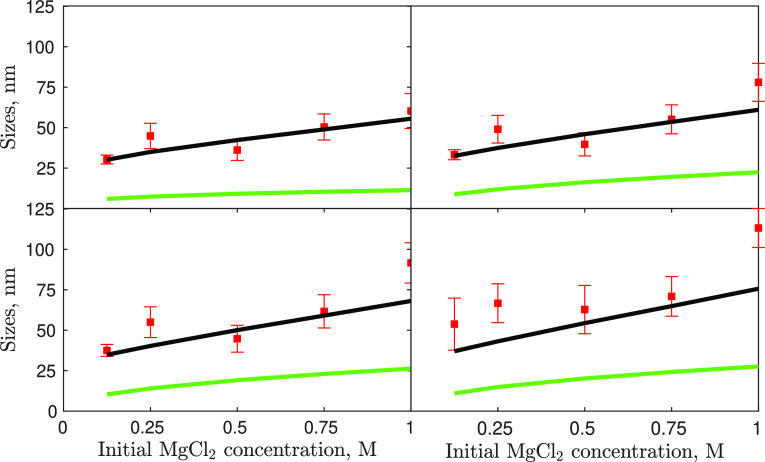
- The final parameter set fit the tuning data well: only 2 of 20 points were slightly outside the standard deviations, and the validation dataset was also described as showing good agreement.
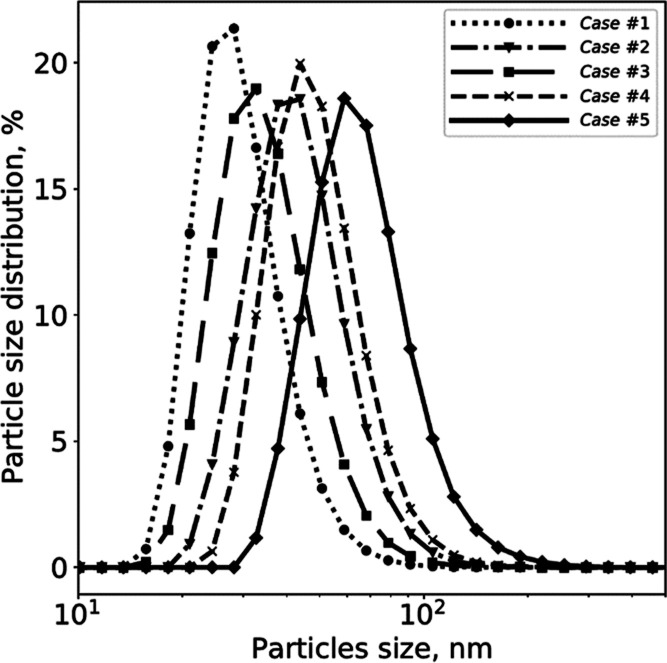
- Measured PSDs increased in particle size as initial reactant concentration increased, except for case #3; the paper notes all tests had measurement errors/uncertainties, especially for nanometric particles and delayed analysis (within 2 h).
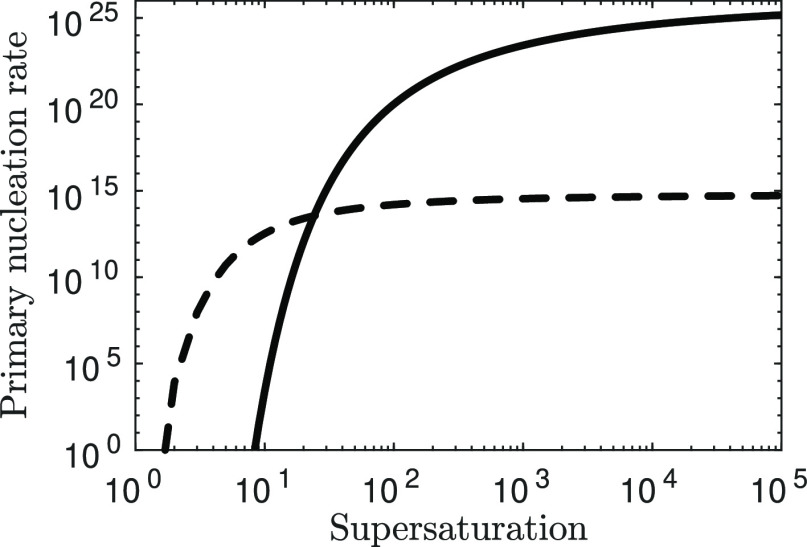
- The authors report that without the micro-mixing model, predictions were “significantly inaccurate and unphysical,” and conclude that primary nucleation and aggregation were the dominant precipitation phenomena under their fast-mixing conditions.
Methods
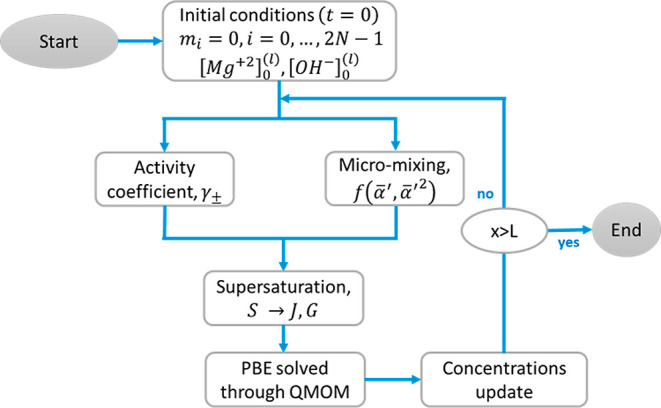
- Built a simplified 1D plug-flow-reactor-style model for T-mixers that integrates chemical reaction, non-ideality (Bromley activity coefficients), particulate processes, and micro-mixing; the PBE was solved with QMOM using 3 nodes (tracking the first 6 moments).
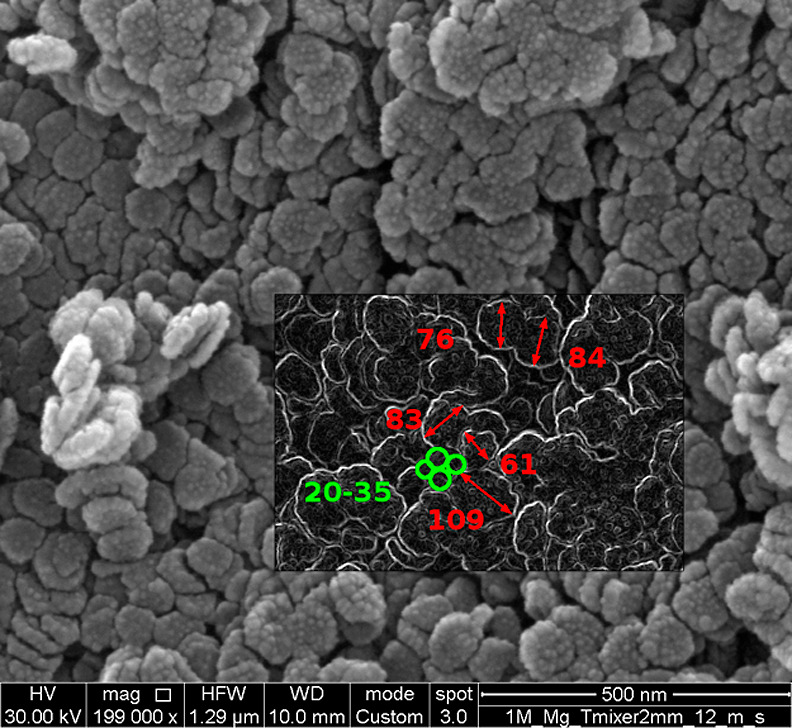
- Generated experimental data from 8 Mg(OH)2 precipitation tests in T2mm- and T3mm-mixers, varying concentration, flow rate, and geometry; PSDs were measured by DLS after sample dilution, dispersant addition, and 5 min ultrasonication, and SEM was used for morphology on cases #1 and #5.
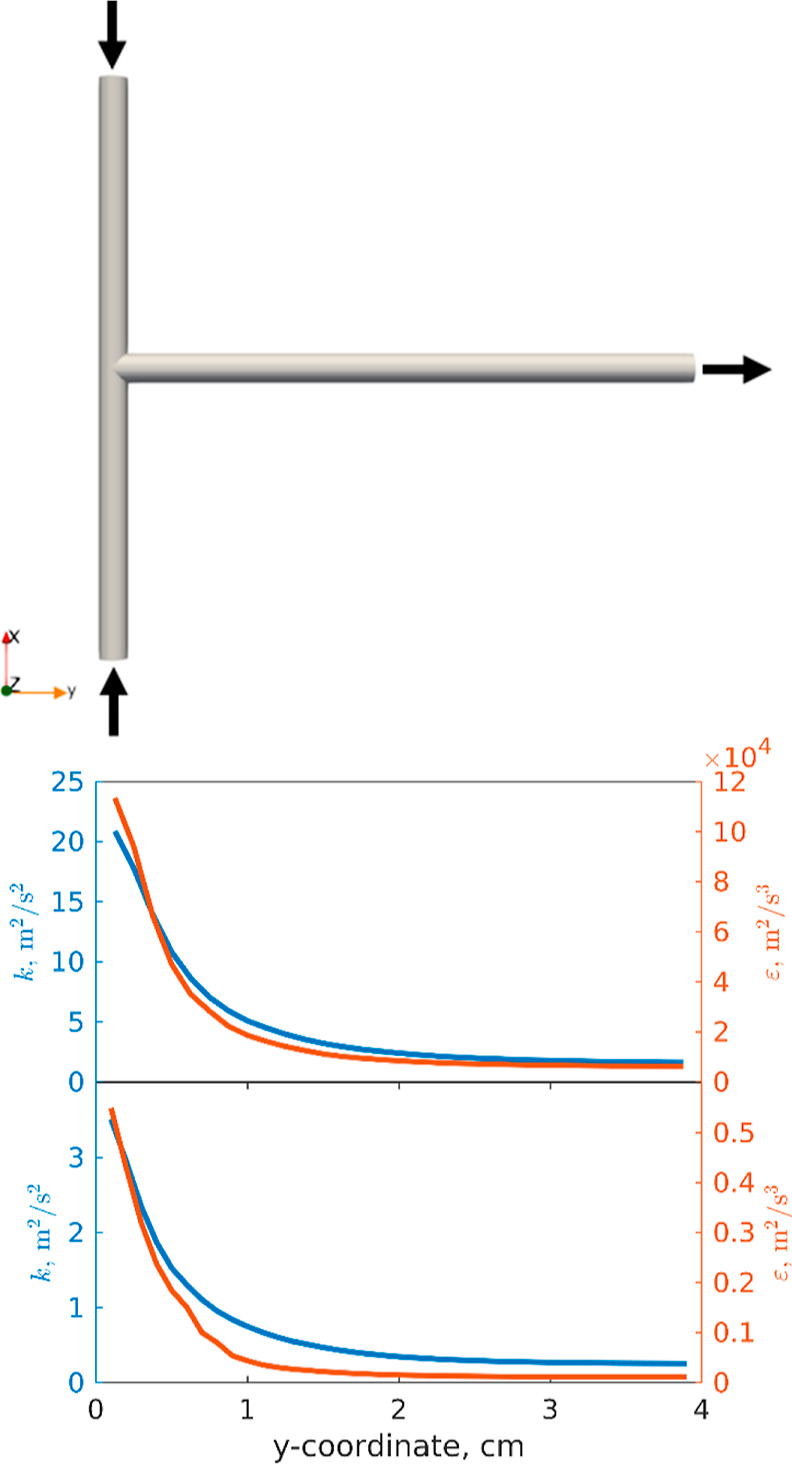
- Used CFD in OpenFOAM (RANS, PIMPLE, k-ε turbulence model) on about 130,000 cells to extract turbulent profiles for the 1D model; kinetics parameters were identified by constrained multivariate optimization in MATLAB with `fmincon`.
Limitations
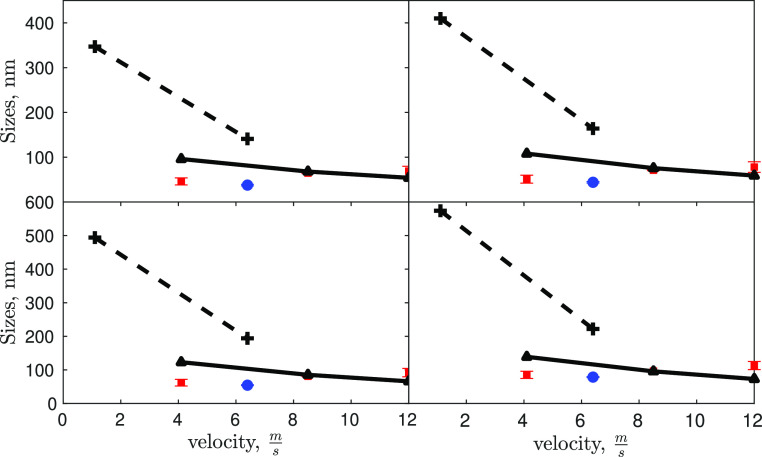
- The paper states that the 1D model cannot perfectly predict changes in operating conditions: it cannot accurately predict data when flow rate changes within the same T-mixer or when a larger-diameter T3mm-mixer is used; this is explicitly attributed to model and experimental uncertainty.
- The text says the model underestimates d43 and that this may be due to the simplified 1D framework, which does not capture radial dispersion or wall effects; this is an evident model limitation from the text.
- The authors note that secondary nucleation was not considered because it was deemed irrelevant for the T-mixer system, and they say it will need future study; this is a stated scope limitation.
Model-written summary. Check it against the paper before relying on it.
Integrity signals
Registry
Cites
Statistics
Figures
Verification
Claims the paper makes
4 Valid · 1 Not valid · 19 Not checked · 54 Own results and interpretations
Every source the paper cites for this claim was checked and supports it.
In the paper
“For these operative conditions, Battaglia et al.17 provided an estimated mixing time of about 2 ms.”
§ Computational Modeling of Magnesium Hydroxide Precipitation and Kinetics Parameters Identification > Experimental Section > Materials and Methods
What the sources say
- Supportedcites [17] Battaglia G.; Romano S.; Raponi A.; Marchisio D.; Ciofalo M.; Tamburini A.; Cipollina A.; Micale G. Analysis of Particles Size Distributions in Mg(OH)2 Precipitation from Highly Concentrated MgCl2 Solutions. Powder Technol. 2022, 398, 117106 10.1016/j.powtec.2021.117106. source
Table 1 (Geometrical and operating conditions of experimental tests) lists for Case #7 (2 mm T-mixer, 2320 ± 2% mL/min, v = 12 ± 2% m/s, Re = 27,250) an 'Estimated mixing time (ms)' of 2.0, and Section 3.1.2 states that 'a mixing time of at most 2 ms (Cases #7 and #8) must be achieved inside the reactor' for the 1 M MgCl2 / 2 M NaOH conditions studied. The estimate is Battaglia et al.'s own calculation from Eq. (2) (t_m = 12D/v, after Roelands et al.), so attributing the ~2 ms value at the chosen flow rate to them is supported. (LLM, conf=0.88)
hedged- Asserted: passes — The authors put it forward as true.
- Checkable: passes — It can be checked against evidence.
- Load-bearing: passes — The paper’s conclusions depend on it.
- Based: passes — The paper gives a reason why it holds.
- Supported
The cited sources support only part of this claim — read each source’s verdict below.
In the paper
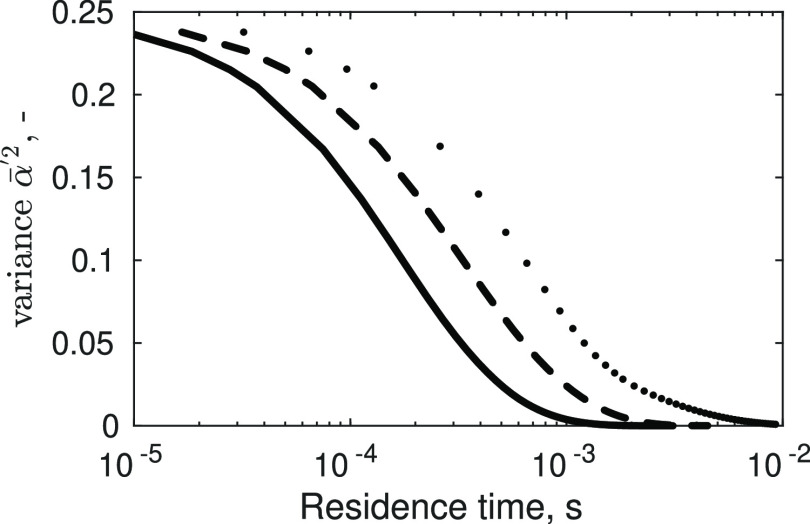
“All the variance profiles suggest that ions available for the precipitation are micro-mixed within a short period, and this is in accordance with the T-mixers theory.14”
§ Computational Modeling of Magnesium Hydroxide Precipitation and Kinetics Parameters Identification > Computational Modeling > Micro-mixing Model and Chemical Reaction
What the sources say
- Partly supportedcites [14] Schikarski T.; Trzenschiok H.; Peukert W.; Avila M. Inflow Boundary Conditions Determine T-Mixer Efficiency. React. Chem. Eng. 2019, 4, 559– 568. 10.1039/c8re00208h. sourceExperimental — accuracy not yet measured
The 'short period / T-mixer theory' half is in our copy: Section 4 (p. 8) states the common assumption of IEM/EDD/incorporation micromixing models that 'within the lifetime of a small eddy ... micromixing is completed', and the paper's T-mixer mixing times are sub-second (Sec. S5.2, p. 18: mixing times identified between 0.1 and 0.001 s; Fig. 1(b), p. 1). What our copy does not support is the specific subject of the claim — ions available for precipitation: the study is a water-water mixture characterized by the Villermaux-Dushman competitive-parallel test reaction, and precipitation appears only as a motivating application (Introduction, p. 1: 'fast precipitation of inorganic and organic compounds'; Conclusion, p. 9: predicting 'mixing-sensitive chemical reactions or precipitation processes'), not as a measured system. (LLM, conf=0.72)
hedged- Asserted: passes — The authors put it forward as true.
- Checkable: passes — It can be checked against evidence.
- Load-bearing: passes — The paper’s conclusions depend on it.
- Based: passes — The paper gives a reason why it holds.
- Rests on an assumption not shown here.
- Partly supported
A result the paper reports from its own data — it cites no other source for it, so there is none to check. The quote shows it is in the paper.
In the paper
“The inferred kinetics set is validated by comparing PSDs at different operative conditions both in the T2mm-mixer and the T3mm-mixer.”
§ Computational Modeling of Magnesium Hydroxide Precipitation and Kinetics Parameters Identification > Abstract
plain- Asserted: passes — The authors put it forward as true.
- Checkable: passes — It can be checked against evidence.
- Load-bearing: passes — The paper’s conclusions depend on it.
- Based: passes — The paper gives a reason why it holds.
- Rests on an assumption not shown here.
The paper states this without a source or data behind it here, so there is nothing to check it against. The quote shows it is in the paper.
In the paper
“including the kinetics parameters estimated for the first time in this work”
§ Computational Modeling of Magnesium Hydroxide Precipitation and Kinetics Parameters Identification > Abstract
plain- Asserted: passes — The authors put it forward as true.
- Checkable: passes — It can be checked against evidence.
- Load-bearing: passes — The paper’s conclusions depend on it.
- Based: unclear — It is unclear why the paper says it holds.
A result the paper reports from its own data — it cites no other source for it, so there is none to check. The quote shows it is in the paper.
In the paper
“The unknown kinetics parameters are inferred and validated in this work by using experimental data produced with a T2mm-mixer and a T3mm-mixer, guaranteeing fast and efficient mixing.”
§ Computational Modeling of Magnesium Hydroxide Precipitation and Kinetics Parameters Identification > Abstract
plainstates a cause- Asserted: passes — The authors put it forward as true.
- Checkable: passes — It can be checked against evidence.
- Load-bearing: passes — The paper’s conclusions depend on it.
- Based: passes — The paper gives a reason why it holds.
- Rests on an assumption not shown here.
36 more claims
Create a free account to see all 78 claims and to verify the 5 references still open.
- Probably not a substantial claim. 21
- It may state two separate claims as one. 22
- The quote only partly states this claim. 1
Citations
Cites
Pope, S. B. (2000) · Cambridge University Press eBooks · doi:10.1017/cbo9780511840531 · Cited by 8,477
On the collision of drops in turbulent clouds
Saffman, P. G., & Turner, J. S. (1956) · Journal of Fluid Mechanics · doi:10.1017/s0022112056000020 · Cited by 1,462
Reference Module in Chemistry, Molecular Sciences and Chemical Engineering
(2014) · Choice Reviews Online · doi:10.5860/choice.51-6506 · Cited by 1,348
Thermodynamic properties of strong electrolytes in aqueous solutions
Bromley, L. A. (1973) · AIChE Journal · doi:10.1002/aic.690190216 · Cited by 915 · cited 2×
“This model was implemented for the multicomponent solution because parameters are available in the literature 25 and each of the presented operative conditions is below 6 M in terms of ionic strength (upper validity limit for Bromley’s theory). where A 1 , B 1 , A 2 , and B 2 are determined by…”
Quadrature method of moments for aggregation-breakage processes
Marchisio, D. L., Vigil, R. D., & Fox, R. O. (2003) · Journal of Colloid and Interface Science · doi:10.1016/s0021-9797(02)00054-1 · Cited by 524
Self-citationQuadrature method of moments for population-balance equations
Marchisio, D. L., Pikturna, J. T., Fox, R. O., Vigil, R. D., & Barresi, A. A. (2003) · AIChE Journal · doi:10.1002/aic.690490517 · Cited by 461
Self-citationNear-wall behavior of RANS turbulence models and implications for wall functions
Kalitzin, G., Medic, G., Iaccarino, G., & Durbin, P. (2005) · Journal of Computational Physics · doi:10.1016/j.jcp.2004.10.018 · Cited by 445
Wilemski, G. (1976) · Journal of Statistical Physics · doi:10.1007/bf01011764 · Cited by 237
Techniques for the reconstruction of a distribution from a finite number of its moments
John, V., Angelov, I., Öncül, A. A., & Thévenin, D. (2007) · Chemical Engineering Science · doi:10.1016/j.ces.2007.02.041 · Cited by 199
Structure and properties of polypropylene composites filled with magnesium hydroxide
Chen, X., Yu, J., & Guo, S. (2006) · Journal of Applied Polymer Science · doi:10.1002/app.24938 · Cited by 142
Béarat, H., McKelvy, M. J., Chizmeshya, A. V. G., Sharma, R., & Carpenter, R. W. (2002) · Journal of the American Ceramic Society · doi:10.1111/j.1151-2916.2002.tb00166.x · Cited by 133
Kinetics of magnesium hydroxide precipitation from sea bittern
Alamdari, A., Rahimpour, M. R., Esfandiari, N., & Nourafkan, E. (2008) · Chemical Engineering and Processing: Process Intensification · doi:10.1016/j.cep.2007.02.012 · Cited by 113
Mg(OH)2 Complex Nanostructures with Superhydrophobicity and Flame Retardant Effects
Cao, H., He, Z., Yin, J., Lu, Y., Wu, S., Wu, X., & Li, B. (2010) · The Journal of Physical Chemistry C · doi:10.1021/jp107216z · Cited by 103
Removal of nickel ions from wastewater by Mg(OH)2/MgO nanostructures embedded in Al2O3 membranes
Zhang, S., Cheng, F., Tao, Z., Gao, F., & Chen, J. (2006) · Journal of Alloys and Compounds · doi:10.1016/j.jallcom.2006.01.095 · Cited by 93
Flame retardant synergism of rubber and Mg(OH)2 in EVA composites
Gui, H., Zhang, X., Dong, W., Wang, Q., Gao, J., Song, Z., Lai, J., Liu, Y., Huang, F., & Qiao, J. (2007) · Polymer · doi:10.1016/j.polymer.2007.03.019 · Cited by 81
Sierra-Fernández, A., Gomez-Villalba, L. S., Milošević, O. B., González, R. F., & Rabanal, M. E. (2014) · Ceramics International · doi:10.1016/j.ceramint.2014.04.073 · Cited by 75
Study of the synthesis and crystallization kinetics of magnesium hydroxide
Yuan, Q., Lu, Z., Zhang, P., Luo, X., Ren, X., & Golden, T. D. (2015) · Materials Chemistry and Physics · doi:10.1016/j.matchemphys.2015.06.048 · Cited by 57
Some hydrodynamic aspects of precipitation
Bałdyga, J., & Orciuch, W. (2001) · Powder Technology · doi:10.1016/s0032-5910(01)00368-0 · Cited by 54
Rodil, E., & Vera, J. H. (2001) · Fluid Phase Equilibria · doi:10.1016/s0378-3812(01)00523-4 · Cited by 54
Inflow boundary conditions determine T-mixer efficiency
Schikarski, T., Trzenschiok, H., Peukert, W., & Avila, M. (2019) · Reaction Chemistry & Engineering · doi:10.1039/c8re00208h · Cited by 52
Battaglia, G., Romano, S., Raponi, A., Marchisio, D., Ciofalo, M., Tamburini, A., Cipollina, A., & Micale, G. (2022) · Powder Technology · doi:10.1016/j.powtec.2021.117106 · Cited by 49
Self-citationStudies on the impact fracture behaviour of flame retardant polymeric material
Tai, C. M., & Li, R. K. Y. (2001) · Materials & Design (1980-2015) · doi:10.1016/s0261-3069(00)00029-7 · Cited by 38
Song, X., Tong, K., Sun, S., Sun, Z., & Yu, J. (2013) · Frontiers of Chemical Science and Engineering · doi:10.1007/s11705-013-1332-7 · Cited by 35
Karpinski, P. H., & Bałdyga, J. (2019) · Cambridge University Press eBooks · doi:10.1017/9781139026949.008 · Cited by 29
Gas Absorption in Slurries of Fine Particles: SO2−Mg(OH)2−MgSO3 System
Kakaraniya, S., Kari, C., Verma, R., & Mehra, A. (2007) · Industrial & Engineering Chemistry Research · doi:10.1021/ie061461h · Cited by 29
Studies in rapid precipitation of hydroxides of calcium and magnesium
Bhandarkar, S. D., Brown, R., & Estrin, J. (1989) · Journal of Crystal Growth · doi:10.1016/0022-0248(89)90222-4 · Cited by 21
Reactive Crystallization Kinetics of Magnesium Hydroxide in the Mg(NO3)2 –NaOH System
Lu, L.-J., Hua, Q., Tang, J.-W., Liu, Y., Liu, L., & Wang, B. (2018) · Crystal Research and Technology · doi:10.1002/crat.201700130 · Cited by 19
Packter, A. (1985) · Crystal Research and Technology · doi:10.1002/crat.2170200307 · Cited by 17
Seeding and Optimization of Batch Reactive Crystallization
(2015) · doi:10.1021/acs.iecr.5b00185 · Cited by 15
Shen, H., Liu, Y., & Song, B. (2016) · Journal of Chemical Engineering of Japan · doi:10.1252/jcej.15we093 · Cited by 14
Modeling of Mixing‐Precipitation Processes: Agglomeration
Orlewski, P. M., & Mazzotti, M. (2020) · Chemical Engineering & Technology · doi:10.1002/ceat.201900551 · Cited by 14 · cited 1×
“Orlewski and Mazzotti (2020), for instance, used a Y-mixer reactor, to investigate the well-known precipitation process of barium sulfate, both experimentally and computationally.”
Aggregation Efficiency of Amorphous Silica Nanoparticles
Bałdyga, J., Tyl, G., & Bouaifi, M. (2019) · Chemical Engineering & Technology · doi:10.1002/ceat.201900091 · Cited by 8
Reacting Flows and the Interaction between Turbulence and Chemistry
Marchisio, D. L., & Fox, R. O. (2016) · Elsevier eBooks · doi:10.1016/b978-0-12-409547-2.11526-4 · Cited by 8
Self-citation(2021) · Chemical engineering transactions · doi:10.3303/cet2186195 · Cited by 6
Self-citation
Research works printed but not linked: 1
- Dos Santos C. M. F.; Andrade A. F. B.; Rocha S. D. F. The Effect of Caustic Magnesia Natural Impurities on Magnesium Oxide Hydroxylation. SDRP J. Nanotechnol. Mater. Sci. 2017, 1, 1.
Cited by
Numerical methods for multiphase flows
García‐Villalba, M., Colonius, T., Desjardins, O., Lucas, D., Mani, A. R., Marchisio, D. L., Matar, O. K., Picano, F., & Zaleski, S. (2025) · International Journal of Multiphase Flow · doi:10.1016/j.ijmultiphaseflow.2025.105285 · Cited by 85
Self-citationRaponi, A., Achermann, R., Romano, S., Trespi, S., Mazzotti, M., Cipollina, A., Buffo, A., Vanni, M., & Marchisio, D. L. (2023) · Chemical Engineering Journal · doi:10.1016/j.cej.2023.146540 · Cited by 22
Self-citationExperimental exploring of Ti3C2Tx MXene for efficient and deep removal of magnesium in water sample
Nezami, S., Ghaemi, A., & Yousefi, T. (2024) · Scientific Reports · doi:10.1038/s41598-024-78942-x · Cited by 20
Battaglia, G., Romano, S., Raponi, A., Volpe, F., Bellanca, L., Ciofalo, M., Marchisio, D. L., Cipollina, A., Micale, G., & Tamburini, A. (2023) · Process Safety and Environmental Protection · doi:10.1016/j.cherd.2023.11.056 · Cited by 17
Self-citation
Metadata
- Authors
- Raponi, A., Romano, S., Battaglia, G., Buffo, A., Vanni, M., Cipollina, A., & Marchisio, D.
- Affiliations
- Politecnico di Torino (IT)
- University of Palermo (IT)
- Corresponding author
- Raponi, Antonello
- ORCID
- Venue
- Crystal Growth & Design
- Publisher
- American Chemical Society (ACS)
- Published
- 2023-06-23
- Volume
- 23
- Issue
- 7
- Pages
- 4748-4759
- ISSN
- 1528-7483 (ISSN-L)
- 1528-7505
- PMC
- PMC10327471
- OpenAlex
- W4381741384
- Cited by
- 36
- References
- 34
- Citations by year
- 2026: 17 · 2025: 8 · 2024: 7 · 2023: 4
- FWCI
- 2.65
- Type
- journal article
- Language
- en
- Open access
- hybrid
- doi.org
- Licence
- Locations
- Crystal Growth & Design (publishedVersion, cc-by)
- PubMed Central (publishedVersion, cc-by)
- PubMed (publishedVersion)
- PORTO@Iris (submittedVersion, cc-by)
- IRIS UniPA (University of Palermo) (submittedVersion, other-oa)
- Zenodo (CERN European Organization for Nuclear Research) (cc-by)
- Funders
- H2020 Environment (869467)
- Topics
- Physical Sciences › Materials Science › Materials Chemistry › Crystallization and Solubility Studies
- Physical Sciences › Materials Science › Materials Chemistry › Magnesium Oxide Properties and Applications
- Physical Sciences › Materials Science › Biomaterials › Calcium Carbonate Crystallization and Inhibition
- Keywords
- magnesium hydroxide precipitation, precipitation kinetics, kinetic parameter estimation, population balance equation, quadrature method of moments, T-mixer, tubular reactor, supersaturation, micromixing, homogeneous nucleation, heterogeneous nucleation, particle size distribution, magnesium recovery
About these checks
Registry, retraction, Cites and statistics results are computed, not judged, with one exception: a printed reference that no index lists is read once by a model before it counts as a citation error. Claims are extracted by a model and kept only when their quote appears verbatim in the text; each cited source is then checked, with a model’s help, for whether it says what the claim relies on. Those verdicts can be wrong — read the claim’s quote and the cited source before relying on one.
The claim verdicts this report counts are experimental: their accuracy is not yet measured.
A language model drew the claims from the paper on 2026-10-10, under version 3 of the claim definition (model deepseek-v4.1-flash, prompt extract-v3).
A second model labelled each claim on 2026-10-10 (model jev-1.13-20260917, definition revision gold-guideline-v0.2).
Cited sources are checked with a language model’s help (qwen3.8-omni-flash).
Statistics and arithmetic are recomputed, not judged.
Confidence bands are shown only for fields calibrated on our annotated test set. None is calibrated yet, so no band is shown.
What counts as a claim ›How we measure confidence ›How we check this ›
Are you an author, or do you see a problem with this page? Request a review
Data sources
Bibliographic data: Semantic Scholar, OpenAlex, Crossref.
Contains information from the Semantic Scholar Academic Graph Datasets, made available under the ODC Attribution License (ODC-BY 1.0).
Semantic Scholar’s data is described in: Kinney, R., et al. (2023). The Semantic Scholar Open Data Platform. arXiv:2301.10140.
