

The DOI matches its Crossref record; 28 of the 28 references it cites were found in a registry or an index; 7 of the 25 sources its claims cite were checked for support.
Artificial Intelligence Driving Materials Discovery? Perspective on the Article: Scaling Deep Learning for Materials Discovery
Open accessAbstract
The discovery of new crystalline inorganic compounds-novel compositions of matter within known structure types, or even compounds with completely new crystal structures-constitutes an important goal of solid-state and materials chemistry. Some fractions of new compounds can eventually lead to new structural and functional materials that enhance the efficiency of existing technologies or even enable completely new technologies. Materials researchers eagerly welcome new approaches to the discovery of new compounds, especially those that offer the promise of accelerated success. The recent report from a group of scientists at Google who employ a combination of existing data sets, high-throughput density functional theory calculations of structural stability, and the tools of artificial intelligence and machine learning (AI/ML) to propose new compounds is an exciting advance. We examine the claims of this work here, unfortunately finding scant evidence for compounds that fulfill the trifecta of novelty, credibility, and utility. While the methods adopted in this work appear to hold promise, there is clearly a great need to incorporate domain expertise in materials synthesis and crystallography.
Overview
AI snapshot
Written from the paper’s full text.
TL;DR
This perspective scrutinizes the Google/Merchant et al. GNoME claims for AI-driven materials discovery, arguing that the predicted compounds largely fail the trifecta of novelty, credibility, and utility. The authors find scant evidence for genuinely new materials and call for greater incorporation of solid-state chemistry and crystallography domain expertise.
Key findings
- In the GNoME Explorer archive, the authors examined the first 250 of 2047 entries and found recurring problems: unconventional composition formatting, improbable oxidation states, structures with F₂ molecules or unlikely rare-earth ordering, and many obvious analogues of known compounds.
- In a random sample of 10 compounds from the 384,870-entry Stable Structure database, all 10 structures could be identified in the ICSD, usually with higher symmetry; only one had the same space group.
- Space-group statistics differ sharply from the ICSD: the top four space groups in the Stable Structure database are all non-centrosymmetric and account for ∼34% of structures, whereas in the ICSD only one non-centrosymmetric space group is in the top 24 and accounts for only 1%. Pnma is ranked 16th in the Stable Structure database at 1.56%, and P21/c is found in only 0.7%, versus ∼8% each in the ICSD.
- The database includes many impractical radioactive-element compounds: 18,138 compounds of Pm, Ac, and Pa in the large Stable Structure database, plus 23,529 entries containing Tc, Np, and Pu; 27 actinium compounds appear in GNoME and approximately 6754 in the Stable Structure database. The authors “have yet to find any strikingly novel compounds” in the GNoME and Stable Structure listings.
Methods
- Perspective/commentary by experimental materials chemists, evaluating the Merchant et al. Nature 2023 article and its associated GNoME Explorer and Stable Structure databases.
- The authors examined the first 250 entries in the 2047-entry GNoME Explorer archive, then randomly selected 10 compounds from the 384,870-entry Stable Structure database for comparison with ICSD entries.
- They analyzed space-group statistics of the 384,870 Stable Structure entries and compared them with ICSD distributions reported by Urusov and Nadezhina, using ICSD search tools to identify structural analogues.
Limitations
- The paper states its GNoME Explorer scrutiny was not comprehensive and was limited to the first 250 entries; the Stable Structure analysis used only 10 randomly selected compounds.
- The authors note that the computational tools to treat disorder and finite-temperature behavior exist but are computationally intensive and not scalable in the Merchant et al. approach.
- Evident from the text: the analysis is a perspective based on database inspection and ICSD comparison, not experimental synthesis or direct testing of the predicted compounds; the authors also acknowledge that some novel compounds likely exist among the 384,870 compositions even though they did not find striking examples.
Model-written summary. Check it against the paper before relying on it.
Integrity signals
Registry
Cites
Statistics
Figures
Verification
Claims the paper makes
20 No basis given · 13 No full text of the sources · 10 Own interpretation · 5 Own result · 4 Supported · 2 Partly supported · 2 Sources not found · 1 Not supported · accuracy not yet measured
Every source the paper cites for this claim was checked and supports it.
In the paper
“One of the lessons from that study was that most breakthroughs are not achieved by design or serendipity, but by exploring opportunities in the extensive repository of compounds that are already known.”
§ Artificial Intelligence Driving Materials Discovery? Perspective on the Article: Scaling Deep Learning for Materials Discovery > Introduction
What the sources say
- Supportedcites [5] source
The Abstract says breakthroughs based on design principles occur in a small number of cases, serendipitous breakthroughs are rare, and most commonly a breakthrough repurposes an already-known compound. The Outlook describes the extensive repository of known compositions and structures that materials scientists can explore for new functionalities. (LLM, conf=0.94)
plaindirect- Asserted: passes — The authors put it forward as true.
- Checkable: passes — It can be checked against evidence.
- Load-bearing: passes — The paper’s conclusions depend on it.
- Based: passes — The paper gives a reason why it holds.
- Supported
Every source the paper cites for this claim was checked and supports it.
In the paper
“the predictions in the contribution of Merchant et al.1 are solely of crystalline inorganic compounds”
§ Artificial Intelligence Driving Materials Discovery? Perspective on the Article: Scaling Deep Learning for Materials Discovery > Introduction
What the sources say
- Supportedcites [1] source
The Main section defines the discovery target as inorganic crystals, and the Discovered stable crystals section describes the predicted structures as crystals. The paper’s additional ionic-conductivity predictions concern inorganic bulk crystals and solid-state electrolytes (Scaling up learned interatomic potentials > Screening solid-state ionic conductors). Our copy identifies no predictions of non-crystalline or organic compounds. (LLM, conf=0.90)
plain- Asserted: passes — The authors put it forward as true.
- Checkable: passes — It can be checked against evidence.
- Load-bearing: passes — The paper’s conclusions depend on it.
- Based: passes — The paper gives a reason why it holds.
- Supported
The paper states this without a source or data behind it here, so there is nothing to check it against. The quote shows it is in the paper.
In the paper
“many of the entries are based upon the ordering of metal ions that are unlikely to be ordered in the real world.”
§ Artificial Intelligence Driving Materials Discovery? Perspective on the Article: Scaling Deep Learning for Materials Discovery > General Comments about the GNoME Explorer Database
plain- Asserted: passes — The authors put it forward as true.
- Checkable: passes — It can be checked against evidence.
- Load-bearing: passes — The paper’s conclusions depend on it.
- Based: passes — The paper gives a reason why it holds.
The paper states this without a source or data behind it here, so there is nothing to check it against. The quote shows it is in the paper.
In the paper
“The above comments about cation ordering in inorganic compounds also apply to a very large number of the intermetallic phases, leading to many other examples of unlikely predictions.”
§ Artificial Intelligence Driving Materials Discovery? Perspective on the Article: Scaling Deep Learning for Materials Discovery > General Comments about the GNoME Explorer Database
plaindirect- Asserted: passes — The authors put it forward as true.
- Checkable: passes — It can be checked against evidence.
- Load-bearing: unclear — It is unclear whether the paper’s conclusions depend on it.
- Based: passes — The paper gives a reason why it holds.
In the paper
“We have found that the space groups of the predicted compounds (Table 1) have a distribution that is strikingly different from those in the Inorganic Crystal Structure Database (ICSD),15”
§ Artificial Intelligence Driving Materials Discovery? Perspective on the Article: Scaling Deep Learning for Materials Discovery > Space Group Analysis
What the sources say
- Not checked — no full text of the sourcecites [15] source
boostedcorrelational- Asserted: passes — The authors put it forward as true.
- Checkable: passes — It can be checked against evidence.
- Load-bearing: passes — The paper’s conclusions depend on it.
- Based: passes — The paper gives a reason why it holds.
The paper states this without a source or data behind it here, so there is nothing to check it against. The quote shows it is in the paper.
In the paper
“We examine the claims of this work here, unfortunately finding scant evidence for compounds that fulfill the trifecta of novelty, credibility, and utility.”
§ Artificial Intelligence Driving Materials Discovery? Perspective on the Article: Scaling Deep Learning for Materials Discovery > Abstract
plain- Asserted: passes — The authors put it forward as true.
- Checkable: passes — It can be checked against evidence.
- Load-bearing: passes — The paper’s conclusions depend on it.
- Based: passes — The paper gives a reason why it holds.
The paper states this without a source or data behind it here, so there is nothing to check it against. The quote shows it is in the paper.
In the paper
“In fact, there are 18,138 compounds of such radioactive elements in the large Stable Structure database, including those of Pm, Ac, and Pa.”
§ Artificial Intelligence Driving Materials Discovery? Perspective on the Article: Scaling Deep Learning for Materials Discovery > General Comments about the GNoME Explorer Database
plain- Asserted: passes — The authors put it forward as true.
- Checkable: passes — It can be checked against evidence.
- Load-bearing: unclear — It is unclear whether the paper’s conclusions depend on it.
- Based: passes — The paper gives a reason why it holds.
The paper states this without a source or data behind it here, so there is nothing to check it against. The quote shows it is in the paper.
In the paper
“It also must be recognized that a large fraction of the 384,870 compositions adopt structures that are already known and can be found in the ICSD database.”
§ Artificial Intelligence Driving Materials Discovery? Perspective on the Article: Scaling Deep Learning for Materials Discovery > Conclusions
plain- Asserted: passes — The authors put it forward as true.
- Checkable: passes — It can be checked against evidence.
- Load-bearing: passes — The paper’s conclusions depend on it.
- Based: passes — The paper gives a reason why it holds.
The paper states this without a source or data behind it here, so there is nothing to check it against. The quote shows it is in the paper.
In the paper
“several of the Stable Structure entries involve unit cell parameters that are incompatible with the stated space groups, i.e., display pseudosymmetry.”
§ Artificial Intelligence Driving Materials Discovery? Perspective on the Article: Scaling Deep Learning for Materials Discovery > Randomly Selected Examples from the Stable Structure Database
plaincorrelational- Asserted: passes — The authors put it forward as true.
- Checkable: passes — It can be checked against evidence.
- Load-bearing: unclear — It is unclear whether the paper’s conclusions depend on it.
- Based: passes — The paper gives a reason why it holds.
The paper states this without a source or data behind it here, so there is nothing to check it against. The quote shows it is in the paper.
In the paper
“We were able to identify the structure of every one of the 10 Stable Structure entries in the ICSD database, albeit usually with a space group of higher symmetry than that in the AI database.”
§ Artificial Intelligence Driving Materials Discovery? Perspective on the Article: Scaling Deep Learning for Materials Discovery > Randomly Selected Examples from the Stable Structure Database
plain- Asserted: passes — The authors put it forward as true.
- Checkable: passes — It can be checked against evidence.
- Load-bearing: unclear — It is unclear whether the paper’s conclusions depend on it.
- Based: passes — The paper gives a reason why it holds.
- It may state two separate claims as one. 27
- Probably not a substantial claim. 13
- The quote only partly states this claim. 2
At least one cited source doesn’t support this claim or points to a different paper, and none confirmed it — see the verdicts below.
In the paper
“We would respectfully suggest that the work by Merchant et al.1 does not report any new materials but reports a list of proposed compounds.”
§ Artificial Intelligence Driving Materials Discovery? Perspective on the Article: Scaling Deep Learning for Materials Discovery > Conclusions
What the sources say
- Disputedcites [1] sourceExperimental — accuracy not yet measured
The paper’s “Discovered stable crystals” section explicitly reports 381,000 entries on its updated computational stability hull as “newly discovered materials,” contrary to the claim that it reports no new materials. These are computational discoveries, not materials newly synthesized by the authors; the validation section says 736 structures matched crystals independently created by other researchers. (LLM, conf=0.86)
Checked by a reasoning model — may be wrong.
hedged- Asserted: passes — The authors put it forward as true.
- Checkable: passes — It can be checked against evidence.
- Load-bearing: passes — The paper’s conclusions depend on it.
- Based: passes — The paper gives a reason why it holds.
It may state two separate claims as one.
- Disputed
Every source the paper cites for this claim was checked and supports it.
In the paper
“Such hexaborides are well-known and are found for a wide range of elements, such as the alkaline earths and rare earths.”
§ Artificial Intelligence Driving Materials Discovery? Perspective on the Article: Scaling Deep Learning for Materials Discovery > General Comments about the GNoME Explorer Database
What the sources say
- Supportedcites [6] source
The section on three-dimensional boron frameworks (p. 10) describes numerous isomorphous borides of the CaB6 type. Table 9 (p. 11) lists hexaborides of the alkaline earths Ba, Sr and Ca and the rare earths Yb, La, Ce and Nd, supporting the stated range of elements. (LLM, conf=0.93)
boosted- Asserted: passes — The authors put it forward as true.
- Checkable: passes — It can be checked against evidence.
- Load-bearing: fails — The paper’s conclusions may not depend on it.
- Based: passes — The paper gives a reason why it holds.
Probably not a substantial claim. The paper’s conclusions may not depend on it. It may state two separate claims as one.
- Supported
The cited sources support only part of this claim — read each source’s verdict below.
In the paper
“while further structural details of more than 2000 of these new compounds have been placed in the GNoME Explorer archive3 within the Materials Project.4”
§ Artificial Intelligence Driving Materials Discovery? Perspective on the Article: Scaling Deep Learning for Materials Discovery > Introduction
What the sources say
- Not matchedcites [3] https://next-gen.materialsproject.org/materials/gnome (accessed November 29, 2023).
Couldn’t be matched to a paper in Crossref, so it can’t be checked.
- Supportedcites [4] source
Citation 4 identifies the Materials Project as the platform; the GNoME Explorer archive is separately cited as reference 3. Section III (page not provided) describes the Materials Project’s web applications for accessing materials data, supporting the platform identification. The count and GNoME deposit are not attributed to citation 4. (LLM, conf=0.88)
plain- Asserted: passes — The authors put it forward as true.
- Checkable: passes — It can be checked against evidence.
- Load-bearing: fails — The paper’s conclusions may not depend on it.
- Based: passes — The paper gives a reason why it holds.
Probably not a substantial claim. The paper’s conclusions may not depend on it.
- Not matched
The cited sources support only part of this claim — read each source’s verdict below.
In the paper
“This enabled us to find an obvious analogue of Ga2Nb20Os8 in the ICSD by searching for structures in space group P42/mnm with lattice parameters close to a = 9.9 Å and c = 5.1 Å, pointing us to Ge3.9Nb20.4Rh5.9, which is one of the well-known Frank–Kasper sigma (σ) phases.20,21”
§ Artificial Intelligence Driving Materials Discovery? Perspective on the Article: Scaling Deep Learning for Materials Discovery > Randomly Selected Examples from the Stable Structure Database
What the sources say
- Partly supportedcites [20] sourceExperimental — accuracy not yet measured
The Introduction identifies σ phases as Frank–Kasper structures, and the Results and discussion reports a Nb–Rh–Ge σ phase in P42/mnm with lattice parameters close to those cited. But the paper gives its composition as Nb20.4Rh5.7Ge3.9, not Ge3.9Nb20.4Rh5.9; it also does not establish the citing authors’ ICSD search or comparison with Ga2Nb20Os8. (LLM, conf=0.88)
- Not checked — no full text of the sourcecites [21] source
boostedcorrelationalSingle case- Asserted: passes — The authors put it forward as true.
- Checkable: passes — It can be checked against evidence.
- Load-bearing: unclear — It is unclear whether the paper’s conclusions depend on it.
- Based: passes — The paper gives a reason why it holds.
It may state two separate claims as one.
- Partly supported
Every source the paper cites for this claim was checked and supports it.
In the paper
“In the case of Ac4P8S28Tl8, the similarity to the structure of La2P4S14Rb424 is not immediately apparent from the unit cells. However, we would expect Ac compounds would be isomorphous with their La analogues. Tl1+ and Rb1+ are also close in size and identical in their charge states. The similarity of the structures then becomes evident.”
§ Artificial Intelligence Driving Materials Discovery? Perspective on the Article: Scaling Deep Learning for Materials Discovery > Randomly Selected Examples from the Stable Structure Database
What the sources say
- Supportedcites [24] source
Split into 2 atoms — 2 confirmed, 0 partially supported, 0 disputed, 0 misattributed, 0 unverifiable. Expand the claim to see per-atom verdicts.
hedgeddirectSingle case- Asserted: passes — The authors put it forward as true.
- Checkable: passes — It can be checked against evidence.
- Load-bearing: unclear — It is unclear whether the paper’s conclusions depend on it.
- Based: passes — The paper gives a reason why it holds.
It may state two separate claims as one.
- Rests on an assumption: Ac compounds would be isomorphous with their La analogues.
- Rests on an assumption: Tl1+ and Rb1+ are close in size and identical in their charge states.
- Supported
The paper states this without a source or data behind it here, so there is nothing to check it against. The quote shows it is in the paper.
In the paper
“Another common claim among the database entries is the prediction of new compounds based upon radioactive elements that do not occur in usable quantities in nature.”
§ Artificial Intelligence Driving Materials Discovery? Perspective on the Article: Scaling Deep Learning for Materials Discovery > General Comments about the GNoME Explorer Database
plain- Asserted: passes — The authors put it forward as true.
- Checkable: passes — It can be checked against evidence.
- Load-bearing: fails — The paper’s conclusions may not depend on it.
- Based: passes — The paper gives a reason why it holds.
Probably not a substantial claim. The paper’s conclusions may not depend on it.
A result the paper reports from its own data — it cites no other source for it, so there is none to check. The quote shows it is in the paper.
In the paper
“Oxidation states are often inconsistent with known materials, or structural features are obscure or entirely unprecedented in known materials.”
§ Artificial Intelligence Driving Materials Discovery? Perspective on the Article: Scaling Deep Learning for Materials Discovery > General Comments about the GNoME Explorer Database
plain- Asserted: passes — The authors put it forward as true.
- Checkable: passes — It can be checked against evidence.
- Load-bearing: unclear — It is unclear whether the paper’s conclusions depend on it.
- Based: passes — The paper gives a reason why it holds.
It may state two separate claims as one.
A result the paper reports from its own data — it cites no other source for it, so there is none to check. The quote shows it is in the paper.
In the paper
“TbSmF30 (mp-3170019) defies all the usual rules of valence and contains an improbable ordering of Tb3+ and Sm3+ (see below). Further inspection of the structure reveals that it contains large numbers of F2 molecules, some isolated and others acting as linkers between LnF9 polyhedra (where Ln is the lanthanide cation). Neither of these features is found in the literature on known fluoride compounds”
§ Artificial Intelligence Driving Materials Discovery? Perspective on the Article: Scaling Deep Learning for Materials Discovery > General Comments about the GNoME Explorer Database
plainSingle case- Asserted: passes — The authors put it forward as true.
- Checkable: passes — It can be checked against evidence.
- Load-bearing: unclear — It is unclear whether the paper’s conclusions depend on it.
- Based: passes — The paper gives a reason why it holds.
It may state two separate claims as one.
A claim is checked only against the cited paper’s full text, never its abstract, and none is available for its sources.
In the paper
“For example, the top two space groups in the ICSD are centrosymmetric Pnma and P21/c, accounting for approximately 16% of all structures, with ∼8% in each case. By contrast, Pnma is ranked 16th in Stable Structure database with 1.56% of the structures, while P21/c is found in only 0.7% of the structures, which is an order of magnitude lower than in the ICSD.”
§ Artificial Intelligence Driving Materials Discovery? Perspective on the Article: Scaling Deep Learning for Materials Discovery > Space Group Analysis
What the sources say
plain- Asserted: passes — The authors put it forward as true.
- Checkable: passes — It can be checked against evidence.
- Load-bearing: passes — The paper’s conclusions depend on it.
- Based: passes — The paper gives a reason why it holds.
It may state two separate claims as one.
The paper states this without a source or data behind it here, so there is nothing to check it against. The quote shows it is in the paper.
In the paper
“There are a further 23,529 entries for compounds containing the highly radioactive elements Tc, Np, and Pu.”
§ Artificial Intelligence Driving Materials Discovery? Perspective on the Article: Scaling Deep Learning for Materials Discovery > General Comments about the GNoME Explorer Database
plain- Asserted: passes — The authors put it forward as true.
- Checkable: passes — It can be checked against evidence.
- Load-bearing: fails — The paper’s conclusions may not depend on it.
- Based: passes — The paper gives a reason why it holds.
Probably not a substantial claim. The paper’s conclusions may not depend on it.
In the paper
“TbHo2Tm9Co4 (mp-3170547) is an even more striking example among the intermetallics. This proposed alloy between three smaller rare earths and cobalt is predicted to be monoclinic and non-centrosymmetric, space group Pm, with a = 6.14 Å, b = 9.23 Å, c = 6.89 Å, and β = 90.1°.”
§ Artificial Intelligence Driving Materials Discovery? Perspective on the Article: Scaling Deep Learning for Materials Discovery > General Comments about the GNoME Explorer Database
What the sources say
- Not checked — no full text of the sourcecites [12] source
plain- Asserted: passes — The authors put it forward as true.
- Checkable: passes — It can be checked against evidence.
- Load-bearing: passes — The paper’s conclusions depend on it.
- Based: passes — The paper gives a reason why it holds.
It may state two separate claims as one. The quote only partly states this claim.
In the paper
“in TbSmSeO2 (mp-3169970), the Tb3+ and Sm3+ cations are predicted to be on separate crystallographic sites, even though their charges are the same and their 6-coordinate ionic radii are very similar (0.92 and 0.96 Å, respectively). Because of the ordering, the compound is proposed to be non-centrosymmetric in space group P3m1 with a ≈ 3.91 Å and c ≈ 6.92 Å.”
- Also stated in: § General Comments about the GNoME Explorer Database · hedged
“the disordered structure of (Tb/Sm)SeO2 would be isomorphous with the known centrosymmetric P3̅m1 structure of La2SeO2, which has a ≈ 4.09 Å and a ≈ 7.16 Å.9”
§ Artificial Intelligence Driving Materials Discovery? Perspective on the Article: Scaling Deep Learning for Materials Discovery > General Comments about the GNoME Explorer Database
What the sources say
- Not checked — no full text of the sourcecites [9] source
hedgeddirect- Asserted: passes — The authors put it forward as true.
- Checkable: passes — It can be checked against evidence.
- Load-bearing: passes — The paper’s conclusions depend on it.
- Based: passes — The paper gives a reason why it holds.
It may state two separate claims as one.
- Also stated in: § General Comments about the GNoME Explorer Database · hedged
A result the paper reports from its own data — it cites no other source for it, so there is none to check. The quote shows it is in the paper.
In the paper
“In fact, the top four space groups in the Stable Structure database are all non-centrosymmetric and account for ∼34% of all the structures. By contrast, in the ICSD there is only one non-centrosymmetric space group in the top 24 and it accounts for only 1% of all structures.”
§ Artificial Intelligence Driving Materials Discovery? Perspective on the Article: Scaling Deep Learning for Materials Discovery > Space Group Analysis
plain- Asserted: passes — The authors put it forward as true.
- Checkable: passes — It can be checked against evidence.
- Load-bearing: passes — The paper’s conclusions depend on it.
- Based: passes — The paper gives a reason why it holds.
It may state two separate claims as one.
A result the paper reports from its own data — it cites no other source for it, so there is none to check. The quote shows it is in the paper.
In the paper
“Several of the proposed new structures have obvious analogues, which somewhat undermines the impact of their prediction.”
§ Artificial Intelligence Driving Materials Discovery? Perspective on the Article: Scaling Deep Learning for Materials Discovery > General Comments about the GNoME Explorer Database
plainconditional- Asserted: passes — The authors put it forward as true.
- Checkable: passes — It can be checked against evidence.
- Load-bearing: unclear — It is unclear whether the paper’s conclusions depend on it.
- Based: passes — The paper gives a reason why it holds.
It may state two separate claims as one.
In the paper
“In the case of the proposed actinium (Ac3+) compounds, of which there are 27 (and approximately 6754 in the larger Stable Structure database), it should be noted that all isotopes of actinium are intensely radioactive with half-lives ranging from days to a few years.14”
§ Artificial Intelligence Driving Materials Discovery? Perspective on the Article: Scaling Deep Learning for Materials Discovery > General Comments about the GNoME Explorer Database
What the sources say
- Not checked — no full text of the sourcecites [14] Kirby H. W., 2008 source
plain- Asserted: passes — The authors put it forward as true.
- Checkable: passes — It can be checked against evidence.
- Load-bearing: unclear — It is unclear whether the paper’s conclusions depend on it.
- Based: passes — The paper gives a reason why it holds.
It may state two separate claims as one.
The paper states this without a source or data behind it here, so there is nothing to check it against. The quote shows it is in the paper.
In the paper
“AcEr3(B6)4 is predicted to be tetragonal with a ≈ 4.1 Å and c ≈ 16.5 Å, revealing that a proposed ordering of Ac3+ and Er3+ (which may or may not be experimentally viable) leads to a 4× superstructure along c and lowers the symmetry of the parent LaB6 structure from cubic to tetragonal.”
§ Artificial Intelligence Driving Materials Discovery? Perspective on the Article: Scaling Deep Learning for Materials Discovery > General Comments about the GNoME Explorer Database
hedgeddirect- Asserted: passes — The authors put it forward as true.
- Checkable: passes — It can be checked against evidence.
- Load-bearing: fails — The paper’s conclusions may not depend on it.
- Based: passes — The paper gives a reason why it holds.
Probably not a substantial claim. The paper’s conclusions may not depend on it. It may state two separate claims as one.
The paper states this without a source or data behind it here, so there is nothing to check it against. The quote shows it is in the paper.
In the paper
“There are other examples of apparently novel and complex borides that are based upon the LaB6 structure, e.g., K2SmLuB24 (mp-3170680)”
§ Artificial Intelligence Driving Materials Discovery? Perspective on the Article: Scaling Deep Learning for Materials Discovery > General Comments about the GNoME Explorer Database
hedged- Asserted: passes — The authors put it forward as true.
- Checkable: passes — It can be checked against evidence.
- Load-bearing: fails — The paper’s conclusions may not depend on it.
- Based: passes — The paper gives a reason why it holds.
Probably not a substantial claim. The paper’s conclusions may not depend on it.
The paper states this without a source or data behind it here, so there is nothing to check it against. The quote shows it is in the paper.
In the paper
“The compositions are often not presented in a manner that an experimental materials chemist would find appropriate or helpful, nor are the usual rules of chemical nomenclature followed”
§ Artificial Intelligence Driving Materials Discovery? Perspective on the Article: Scaling Deep Learning for Materials Discovery > General Comments about the GNoME Explorer Database
plain- Asserted: passes — The authors put it forward as true.
- Checkable: passes — It can be checked against evidence.
- Load-bearing: fails — The paper’s conclusions may not depend on it.
- Based: passes — The paper gives a reason why it holds.
Probably not a substantial claim. The paper’s conclusions may not depend on it. It may state two separate claims as one.
In the paper
“K3Nd(AsO4)2 (mp-3196061) is a good example. It is predicted to be monoclinic, in space group P21, with a = 9.8 Å, b = 5.8 Å, c = 7.6 Å, and β = 91.87°. Since arsenates are often isostructural with phosphates, it is possible to recognize that the analogous phosphate, K3Nd(PO4)2, is known with a monoclinic P21/m structure (a = 9.5 Å, b = 5.6 Å, c = 7.4 Å, β = 90.95°).8”
§ Artificial Intelligence Driving Materials Discovery? Perspective on the Article: Scaling Deep Learning for Materials Discovery > General Comments about the GNoME Explorer Database
What the sources say
- Not checked — no full text of the sourcecites [8] source
hedged- Asserted: passes — The authors put it forward as true.
- Checkable: passes — It can be checked against evidence.
- Load-bearing: passes — The paper’s conclusions depend on it.
- Based: passes — The paper gives a reason why it holds.
It may state two separate claims as one.
In the paper
“Tb16Ho(ErIr4)3 (mp-3170203) could be more usefully written as Tb16HoEr3Ir12. It is predicted to be tetragonal, P4̅ (non-centrosymmetric), with a = 10.92 Å and c = 6.38 Å. If we assume that very similar rare earths would be disordered, as discussed above, it can then be written as Ln20Ir12 or Ln5Ir3.”
§ Artificial Intelligence Driving Materials Discovery? Perspective on the Article: Scaling Deep Learning for Materials Discovery > General Comments about the GNoME Explorer Database
What the sources say
- Not checked — no full text of the sourcecites [13] source
hedgedconditional- Asserted: passes — The authors put it forward as true.
- Checkable: passes — It can be checked against evidence.
- Load-bearing: unclear — It is unclear whether the paper’s conclusions depend on it.
- Based: passes — The paper gives a reason why it holds.
It may state two separate claims as one.
- The authors state this as an assumption: Very similar rare earths would be disordered in the proposed structures.
The paper states this without a source or data behind it here, so there is nothing to check it against. The quote shows it is in the paper.
In the paper
“The final step is to recognize that the pseudo-rhombohedral cell from the Stable Structure database with α = 59.7° is also nearly pseudocubic, thus accounting for the 4× discrepancy in the cell volume.”
§ Artificial Intelligence Driving Materials Discovery? Perspective on the Article: Scaling Deep Learning for Materials Discovery > Randomly Selected Examples from the Stable Structure Database
plaindirect- Asserted: passes — The authors put it forward as true.
- Checkable: passes — It can be checked against evidence.
- Load-bearing: unclear — It is unclear whether the paper’s conclusions depend on it.
- Based: passes — The paper gives a reason why it holds.
It may state two separate claims as one.
A result the paper reports from its own data — it cites no other source for it, so there is none to check. The quote shows it is in the paper.
In the paper
“In only one case was the space group the same.”
§ Artificial Intelligence Driving Materials Discovery? Perspective on the Article: Scaling Deep Learning for Materials Discovery > Randomly Selected Examples from the Stable Structure Database
plainn = 10- Asserted: passes — The authors put it forward as true.
- Checkable: passes — It can be checked against evidence.
- Load-bearing: unclear — It is unclear whether the paper’s conclusions depend on it.
- Based: passes — The paper gives a reason why it holds.
The quote only partly states this claim.
In the paper
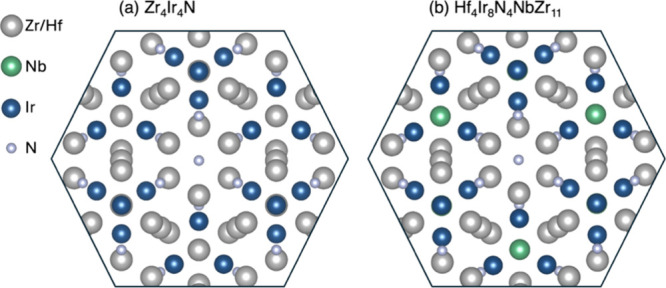
“A search in the ICSD for compounds containing Zr, Ir, and N then quickly led us to Zr4Ir2N,23 whose cubic unit cell is 4× larger than the cell of Hf4Ir8N4NbZr11 in the database.”
§ Artificial Intelligence Driving Materials Discovery? Perspective on the Article: Scaling Deep Learning for Materials Discovery > Randomly Selected Examples from the Stable Structure Database
What the sources say
- Not checked — no full text of the sourcecites [23] source
plaindirect- Asserted: passes — The authors put it forward as true.
- Checkable: passes — It can be checked against evidence.
- Load-bearing: unclear — It is unclear whether the paper’s conclusions depend on it.
- Based: passes — The paper gives a reason why it holds.
It may state two separate claims as one.
The paper states this without a source or data behind it here, so there is nothing to check it against. The quote shows it is in the paper.
In the paper
“For example, in addition to the hexaborides, there are many examples in the GNoME list that are clearly diborides, which is another important stoichiometry in the boride area.”
§ Artificial Intelligence Driving Materials Discovery? Perspective on the Article: Scaling Deep Learning for Materials Discovery > Conclusions
boosted- Asserted: passes — The authors put it forward as true.
- Checkable: passes — It can be checked against evidence.
- Load-bearing: fails — The paper’s conclusions may not depend on it.
- Based: fails — The paper may give no reason why it holds.
Probably not a substantial claim. The paper’s conclusions may not depend on it. The paper may give no reason why it holds.
In the paper
“For example, Cu8P4SrTm was identified as having the same structure as CaCu4P2,22 noting that the lattice parameters were switched between the two entries and that the predicted compound was pseudo-tetragonal.”
§ Artificial Intelligence Driving Materials Discovery? Perspective on the Article: Scaling Deep Learning for Materials Discovery > Randomly Selected Examples from the Stable Structure Database
What the sources say
- Not checked — no full text of the sourcecites [22] source
plainSingle case- Asserted: passes — The authors put it forward as true.
- Checkable: passes — It can be checked against evidence.
- Load-bearing: unclear — It is unclear whether the paper’s conclusions depend on it.
- Based: passes — The paper gives a reason why it holds.
It may state two separate claims as one.
The paper states this without a source or data behind it here, so there is nothing to check it against. The quote shows it is in the paper.
In the paper
“In fact, we have yet to find any strikingly novel compounds in the GNoME and Stable Structure listings, although we anticipate that there must be some among the 384,870 compositions.”
§ Artificial Intelligence Driving Materials Discovery? Perspective on the Article: Scaling Deep Learning for Materials Discovery > Conclusions
plain- Asserted: passes — The authors put it forward as true.
- Checkable: passes — It can be checked against evidence.
- Load-bearing: passes — The paper’s conclusions depend on it.
- Based: passes — The paper gives a reason why it holds.
It may state two separate claims as one.
A conclusion the paper draws from its own results — it cites no other source for it, so there is none to check. The quote shows it is in the paper.
In the paper
“The “discoveries” of new actinium compounds, such as AcPO3 (mp-3170055), are therefore impractical and not very novel.”
§ Artificial Intelligence Driving Materials Discovery? Perspective on the Article: Scaling Deep Learning for Materials Discovery > General Comments about the GNoME Explorer Database
plain- Asserted: passes — The authors put it forward as true.
- Checkable: passes — It can be checked against evidence.
- Load-bearing: unclear — It is unclear whether the paper’s conclusions depend on it.
- Based: passes — The paper gives a reason why it holds.
It may state two separate claims as one.
- Rests on an assumption: The few known actinium compounds are isomorphous with their stable lanthanum analogues.
- Rests on an assumption: Ionic actinium compounds have no industrial applications.
In the paper
“Each of the 2047 entries in the GNoME Explorer compilation has been presented with chemical composition, space group, atomic coordinates, formation energy, and, where appropriate, tentative assignments of oxidation states.”
§ Artificial Intelligence Driving Materials Discovery? Perspective on the Article: Scaling Deep Learning for Materials Discovery > General Comments about the GNoME Explorer Database
What the sources say
- Not matchedcites [3] https://next-gen.materialsproject.org/materials/gnome (accessed November 29, 2023).
Couldn’t be matched to a paper in Crossref, so it can’t be checked.
plain- Asserted: passes — The authors put it forward as true.
- Checkable: passes — It can be checked against evidence.
- Load-bearing: fails — The paper’s conclusions may not depend on it.
- Based: passes — The paper gives a reason why it holds.
Probably not a substantial claim. The paper’s conclusions may not depend on it.
- Not matched
In the paper
“Almost 400,000 of the structures are deemed to be stable and have been listed in a Stable Structure database,2”
§ Artificial Intelligence Driving Materials Discovery? Perspective on the Article: Scaling Deep Learning for Materials Discovery > Introduction
What the sources say
- Not matchedcites [2] https://github.com/google-deepmind/materials_discovery (accessed January 27, 2024).
Couldn’t be matched to a paper in Crossref, so it can’t be checked.
plain- Asserted: passes — The authors put it forward as true.
- Checkable: passes — It can be checked against evidence.
- Load-bearing: fails — The paper’s conclusions may not depend on it.
- Based: passes — The paper gives a reason why it holds.
Probably not a substantial claim. The paper’s conclusions may not depend on it.
- Not matched
A conclusion the paper draws from its own results — it cites no other source for it, so there is none to check. The quote shows it is in the paper.
In the paper
“Predictions of ordering usually lead to lower symmetry structures and in some cases to superstructures, as illustrated above.”
§ Artificial Intelligence Driving Materials Discovery? Perspective on the Article: Scaling Deep Learning for Materials Discovery > Space Group Analysis
plaindirect- Asserted: passes — The authors put it forward as true.
- Checkable: passes — It can be checked against evidence.
- Load-bearing: unclear — It is unclear whether the paper’s conclusions depend on it.
- Based: passes — The paper gives a reason why it holds.
It may state two separate claims as one.
The paper states this without a source or data behind it here, so there is nothing to check it against. The quote shows it is in the paper.
In the paper
“In addition, many compounds undergo phase transitions to lower symmetry structures on cooling to low temperatures, although we have no evidence of this from the GNoME entries that we have examined.”
§ Artificial Intelligence Driving Materials Discovery? Perspective on the Article: Scaling Deep Learning for Materials Discovery > Space Group Analysis
plain- Asserted: passes — The authors put it forward as true.
- Checkable: passes — It can be checked against evidence.
- Load-bearing: fails — The paper’s conclusions may not depend on it.
- Based: fails — The paper may give no reason why it holds.
Probably not a substantial claim. The paper’s conclusions may not depend on it. The paper may give no reason why it holds. It may state two separate claims as one.
A conclusion the paper draws from its own results — it cites no other source for it, so there is none to check. The quote shows it is in the paper.
In the paper
“It is questionable whether Sr and Tm would order on distinct crystallographic sites. If Tm were to substitute as the expected Tm3+, this would require electron-doping a Cu1+ compound, which is unlikely.”
§ Artificial Intelligence Driving Materials Discovery? Perspective on the Article: Scaling Deep Learning for Materials Discovery > Randomly Selected Examples from the Stable Structure Database
hedgedconditional- Asserted: passes — The authors put it forward as true.
- Checkable: passes — It can be checked against evidence.
- Load-bearing: unclear — It is unclear whether the paper’s conclusions depend on it.
- Based: passes — The paper gives a reason why it holds.
It may state two separate claims as one.
A conclusion the paper draws from its own results — it cites no other source for it, so there is none to check. The quote shows it is in the paper.
In the paper
“Since no functionality has been demonstrated for the 384,870 compositions in the Stable Structure database, they cannot yet be regarded as materials.”
§ Artificial Intelligence Driving Materials Discovery? Perspective on the Article: Scaling Deep Learning for Materials Discovery > Conclusions
plaindirect- Asserted: passes — The authors put it forward as true.
- Checkable: fails — It may be too vague to check against evidence.
- Load-bearing: passes — The paper’s conclusions depend on it.
- Based: passes — The paper gives a reason why it holds.
Probably not a substantial claim. It may be too vague to check against evidence.
- Rests on an assumption: Chemical compounds become materials when they demonstrate some utility.
The paper states this without a source or data behind it here, so there is nothing to check it against. The quote shows it is in the paper.
In the paper
“This is not surprising to an experimental materials chemist, because it is quite rare to find an entirely new structure type in the inorganic world.”
§ Artificial Intelligence Driving Materials Discovery? Perspective on the Article: Scaling Deep Learning for Materials Discovery > Conclusions
plain- Asserted: passes — The authors put it forward as true.
- Checkable: passes — It can be checked against evidence.
- Load-bearing: passes — The paper’s conclusions depend on it.
- Based: passes — The paper gives a reason why it holds.
Probably not a substantial claim.
In the paper
“This points to an interesting contraindication in materials design: soft anions such as Te2– and I– readily permit cation transport but do not possess the requisite electrochemical (redox) stability for use as solid electrolytes. Conversely, hard anions such as O2– and F– are redox-stable, but they bind cations strongly, and the resulting materials usually display limited ionic conductivity.”
§ Artificial Intelligence Driving Materials Discovery? Perspective on the Article: Scaling Deep Learning for Materials Discovery > Conclusions
What the sources say
- Not checked — no full text of the sourcecites [29] source
plaindirect- Asserted: passes — The authors put it forward as true.
- Checkable: passes — It can be checked against evidence.
- Load-bearing: passes — The paper’s conclusions depend on it.
- Based: passes — The paper gives a reason why it holds.
It may state two separate claims as one.
A conclusion the paper draws from its own results — it cites no other source for it, so there is none to check. The quote shows it is in the paper.
In the paper
“in Hf4Ir8N4NbZr11 our starting point was to recognize that Hf and Zr are two of the most similar elements in the periodic table and are almost certain to be disordered on the same sites (pointing us toward Zr11Ir8N4Nb). Furthermore, in a metal-rich compound, Nb and Zr/Hf are also likely to alloy on the same crystallographic site.”
§ Artificial Intelligence Driving Materials Discovery? Perspective on the Article: Scaling Deep Learning for Materials Discovery > Randomly Selected Examples from the Stable Structure Database
hedged- Asserted: passes — The authors put it forward as true.
- Checkable: passes — It can be checked against evidence.
- Load-bearing: passes — The paper’s conclusions depend on it.
- Based: passes — The paper gives a reason why it holds.
It may state two separate claims as one.
- Rests on an assumption: Hf and Zr are almost certain to be disordered on the same sites, and Nb and Zr/Hf are likely to alloy on the same crystallographic site.
A conclusion the paper draws from its own results — it cites no other source for it, so there is none to check. The quote shows it is in the paper.
In the paper
“while many of the new compositions are trivial adaptations of known materials, the computational approach delivers credible overall compositions, which gives us confidence that the underlying approach is sound.”
§ Artificial Intelligence Driving Materials Discovery? Perspective on the Article: Scaling Deep Learning for Materials Discovery > Conclusions
plaindirect- Asserted: passes — The authors put it forward as true.
- Checkable: unclear — It is unclear whether it could be checked against evidence.
- Load-bearing: passes — The paper’s conclusions depend on it.
- Based: passes — The paper gives a reason why it holds.
It may state two separate claims as one.
The paper relies on this without support.
Chemical compounds become materials when they demonstrate some utility.
“it is the usual practice in the field that chemical compounds become materials when they demonstrate some utility.”
The authors state this as an assumption.
Very similar rare earths would be disordered in the proposed structures.
“If we assume that very similar rare earths would be disordered, as discussed above”
The paper relies on this without support.
Ac compounds would be isomorphous with their La analogues.
“However, we would expect Ac compounds would be isomorphous with their La analogues.”
The paper relies on this without support.
Tl1+ and Rb1+ are close in size and identical in their charge states.
“Tl1+ and Rb1+ are also close in size and identical in their charge states.”
The paper relies on this without support.
Hf and Zr are almost certain to be disordered on the same sites, and Nb and Zr/Hf are likely to alloy on the same crystallographic site.
“Hf and Zr are two of the most similar elements in the periodic table and are almost certain to be disordered on the same sites”
“Nb and Zr/Hf are also likely to alloy on the same crystallographic site.”
The paper relies on this without support.
The 14 rare-earth elements and yttrium have very similar chemistries, and zirconium and hafnium have virtually identical chemistries.
“the recognition that the 14 rare-earth elements and yttrium have very similar chemistries could be incorporated as well as the recognition that zirconium and hafnium, among other important metal pairs, have virtually identical chemistries.”
The paper relies on this without support.
The few known actinium compounds are isomorphous with their stable lanthanum analogues.
“the few that are known are isomorphous with their stable lanthanum analogues (e.g., AcPO4 and LaPO4).”
The paper relies on this without support.
Ionic actinium compounds have no industrial applications.
“ionic actinium compounds, which always contain Ac3+, have no industrial applications.”
Self-check
Percentages, sums and reported differences re-computed from the paper’s own numbers.
Each contradiction between two passages listed here was confirmed by an independent check.
Rated minor: it would not touch a result — a value no result rests on, a p-value that stays on the same side of the significance level, or a conflict that is clerical, resolved elsewhere in the paper, or outside its own findings.
In the paper
§ Artificial Intelligence Driving Materials Discovery? Perspective on the Article: Scaling Deep Learning for Materials Discovery > Randomly Selected Examples from the Stable Structure Database
“A search in the ICSD for compounds containing Zr, Ir, and N then quickly led us to Zr4Ir2N,23”
§ Artificial Intelligence Driving Materials Discovery? Perspective on the Article: Scaling Deep Learning for Materials Discovery > Randomly Selected Examples from the Stable Structure Database
“Figure: Figure 1 Views of the crystal structures of (a) known Zr4Ir4N (ICSD 640826)”
Rated minor: it would not touch a result — a value no result rests on, a p-value that stays on the same side of the significance level, or a conflict that is clerical, resolved elsewhere in the paper, or outside its own findings.
In the paper
“the top four space groups in the Stable Structure database are all non-centrosymmetric and account for ∼34% of all the structures.”
§ Artificial Intelligence Driving Materials Discovery? Perspective on the Article: Scaling Deep Learning for Materials Discovery > Space Group Analysis
Reported 34 · recomputed 34.95
Rated minor: it would not touch a result — a value no result rests on, a p-value that stays on the same side of the significance level, or a conflict that is clerical, resolved elsewhere in the paper, or outside its own findings.
In the paper
§ Artificial Intelligence Driving Materials Discovery? Perspective on the Article: Scaling Deep Learning for Materials Discovery > General Comments about the GNoME Explorer Database
“La2SeO2, which has a ≈ 4.09 Å”
§ Artificial Intelligence Driving Materials Discovery? Perspective on the Article: Scaling Deep Learning for Materials Discovery > General Comments about the GNoME Explorer Database
“and a ≈ 7.16 Å.”
Citations
Cites
Commentary: The Materials Project: A materials genome approach to accelerating materials innovation
Jain, A., Ong, S. P., Hautier, G., Chen, W., Richards, W. D., Dacek, S., Cholia, S., Gunter, D., Skinner, D., Ceder, G., et al. (2013) · APL Materials · doi:10.1063/1.4812323 · Cited by 13,094
George, E. P., Raabe, D., & Ritchie, R. O. (2019) · Nature Reviews Materials · doi:10.1038/s41578-019-0121-4 · Cited by 5,047
Oxidation energies of transition metal oxides within the GGA + U framework
Wang, L., Maxisch, T., & Ceder, G. (2006) · Physical Review B · doi:10.1103/physrevb.73.195107 · Cited by 2,785
THE PRINCIPLES DETERMINING THE STRUCTURE OF COMPLEX IONIC CRYSTALS
Pauling, L. (1929) · Journal of the American Chemical Society · doi:10.1021/ja01379a006 · Cited by 2,025
Interface Stability in Solid-State Batteries
Richards, W. D., Miara, L. J., Wang, Y., Kim, J. C., & Ceder, G. (2016) · Chemistry of Materials · doi:10.1021/acs.chemmater.5b04082 · Cited by 1,652
Scaling deep learning for materials discovery
Merchant, A., Batzner, S., Schoenholz, S. S., Aykol, M., Cheon, G., & Cubuk, E. D. (2023) · Nature · doi:10.1038/s41586-023-06735-9 · Cited by 1,527
STRUCTURE TIDY – a computer program to standardize crystal structure data
Gelato, L., & Parthé, E. (1987) · Journal of Applied Crystallography · doi:10.1107/s0021889887086965 · Cited by 1,352
checkCIF validation ALERTS: what they mean and how to respond
Spek, A. L. (2019) · Acta Crystallographica Section E Crystallographic Communications · doi:10.1107/s2056989019016244 · Cited by 1,228
An autonomous laboratory for the accelerated synthesis of inorganic materials
Szymanski, N. J., Rendy, B., Fei, Y., Kumar, R. E., He, T., Milsted, D., McDermott, M. J., Gallant, M., Cubuk, E. D., Merchant, A., et al. (2023) · Nature · doi:10.1038/s41586-023-06734-w · Cited by 1,041
The Inorganic Crystal Structure Database (ICSD)—Present and Future
Hellenbrandt, M. (2004) · Crystallography Reviews · doi:10.1080/08893110410001664882 · Cited by 684
Cited by
Sorted by citations
A framework to evaluate machine learning crystal stability predictions
Riebesell, J., Goodall, R. E. A., Benner, P., Chiang, Y., Deng, B., Ceder, G., Asta, M., Lee, A. A., Jain, A., & Persson, K. A. (2025) · Nature Machine Intelligence · doi:10.1038/s42256-025-01055-1 · Cited by 367
Chen, C., Nguyen, D. T., Lee, S., Baker, N., Karakoti, A. S., Lauw, L., Owen, C., Mueller, K. T., Bilodeau, B. A., Murugesan, V., et al. (2024) · Journal of the American Chemical Society · doi:10.1021/jacs.4c03849 · Cited by 171
Improving machine-learning models in materials science through large datasets
Schmidt, J., Cerqueira, T. F. T., Romero, A. H., Loew, A., Jäger, F., Wang, H., Botti, S., & Marques, M. A. L. (2024) · Materials Today Physics · doi:10.1016/j.mtphys.2024.101560 · Cited by 157
Developing machine learning for heterogeneous catalysis with experimental and computational data
Bozal‐Ginesta, C., Pablo‐García, S., Choi, C., Tarancón, A., & Aspuru‐Guzik, A. (2025) · Nature Reviews Chemistry · doi:10.1038/s41570-025-00740-4 · Cited by 116
Autonomous ‘self-driving’ laboratories: a review of technology and policy implications
Tobias, A. V., & Wahab, A. (2025) · Royal Society Open Science · doi:10.1098/rsos.250646 · Cited by 106
Has generative artificial intelligence solved inverse materials design?
Park, H., Li, Z., & Walsh, A. (2024) · Matter · doi:10.1016/j.matt.2024.05.017 · Cited by 111
Advancing materials discovery through artificial intelligence
Otyepka, M., Pykal, M., & Otyepka, M. (2025) · Applied Materials Today · doi:10.1016/j.apmt.2025.102981 · Cited by 81
Space group informed transformer for crystalline materials generation
Cao, Z., Luo, X., Lv, J., & Wang, L. (2025) · 中国科学通报:英文版 · doi:10.1016/j.scib.2025.09.035 · Cited by 81
Interpretable Machine Learning Applications: A Promising Prospect of AI for Materials
Jiang, X. F., Fu, H., Bai, Y., Jiang, L., Zhang, H., Wang, W., Yun, P., He, J., Xue, D., Lookman, T., et al. (2025) · Advanced Functional Materials · doi:10.1002/adfm.202507734 · Cited by 76
Machine Learning-Based Process Optimization in Biopolymer Manufacturing: A Review
Malashin, I. P., Martysyuk, D., Тынченко, В. С., Gantimurov, A., Семиколенов, А. В., Nelyub, V., & Бородулин, А. С. (2024) · Polymers · doi:10.3390/polym16233368 · Cited by 71
Exploiting chemical bonding principles to design high-performance thermoelectric materials
Powell, A. V., Vaqueiro, P., Tippireddy, S., & Prado‐Gonjal, J. (2025) · Nature Reviews Chemistry · doi:10.1038/s41570-025-00695-6 · Cited by 69
Machine learning applied to the design and optimization of polymeric materials: A review
Pai, S. M., Shah, K. A., Sunder, S., Albuquerque, R. Q., Brütting, C., & Ruckdäschel, H. (2024) · Next Materials · doi:10.1016/j.nxmate.2024.100449 · Cited by 62
A prospective on machine learning challenges, progress, and potential in polymer science
Struble, D. C., Lamb, B. G., & Ma, B. (2024) · MRS Communications · doi:10.1557/s43579-024-00587-8 · Cited by 43
Stable acidic oxygen-evolving catalyst discovery through mixed accelerations
Bai, Y., Li, K., Han, N., Kim, J., Zhang, R., Mahesh, S., Zeraati, A. S., Sutherland, B. R., Chow, K., Liang, Y., et al. (2026) · Nature Catalysis · doi:10.1038/s41929-025-01463-x · Cited by 41
Basic concepts and tools of artificial intelligence in polymer science
Ferji, K. (2025) · Polymer Chemistry · doi:10.1039/d5py00148j · Cited by 40
Machine Learning-Based Methods for Materials Inverse Design: A Review
Liu, Y., Cui, Y., Zhou, H., Shen, T., Lei, S., Yuan, H., & Yin, J. (2025) · Computers, materials & continua/Computers, materials & continua (Print) · doi:10.32604/cmc.2025.060109 · Cited by 39
Ab initio structure solutions from nanocrystalline powder diffraction data via diffusion models
Guo, G., Saidi, T. L., Terban, M. W., Valsecchi, M., Billinge, S. J. L., & Lipson, H. (2025) · Nature Materials · doi:10.1038/s41563-025-02220-y · Cited by 40
Crystal Structure Determination from Powder Diffraction Patterns with Generative Machine Learning
Riesel, E. A., Mackey, T., Nilforoshan, H., Xu, M., Badding, C. K., Altman, A. B., Leskovec, J., & Freedman, D. E. (2024) · Journal of the American Chemical Society · doi:10.1021/jacs.4c10244 · Cited by 36
Explainable Synthesizability Prediction of Inorganic Crystal Polymorphs Using Large Language Models
Kim, S.-M., Schrier, J., & Jung, Y. (2025) · Angewandte Chemie International Edition · doi:10.1002/anie.202423950 · Cited by 32
Nair, A. S., Foppa, L., & Scheffler, M. (2025) · npj Computational Materials · doi:10.1038/s41524-025-01596-4 · Cited by 31
Prussian Blue Analogues as Anode Materials for Battery Applications: Complexities and Horizons
Palacios‐Corella, M., Echevarría, I., Santos, C. S., Schuhmann, W. W., Ventosa, E., & Ibáñez, M. (2025) · Chemistry of Materials · doi:10.1021/acs.chemmater.5c00213 · Cited by 29
Reinforcement fine-tuning for materials design
Cao, Z., & Wang, L. (2025) · Physical review. B./Physical review. B · doi:10.1103/45zh-44bg · Cited by 30
Engineering artificial intelligence: framework, challenges, and future direction
Lee, J., Su, H., Ji, D.-Y., & Minami, T. (2025) · Machine Learning Engineering · doi:10.1088/3049-4761/adce0d · Cited by 28
WyckoffDiff -- A Generative Diffusion Model for Crystal SymmetryPreprint
Kelvinius, F. E., Andersson, O. B., Parackal, A. S., Qian, D., Armiento, R., & Lindsten, F. (2025) · arXiv (Cornell University) · doi:10.48550/arxiv.2502.06485 · Cited by 26
Generative AI for crystal structures: A review
De Breuck, P.-P., Wang, H.-C., Rignanese, G.-M., Botti, S., & Marques, M. A. L. (2025) · npj Computational Materials · doi:10.1038/s41524-025-01881-2 · Cited by 24
Recognition of near-duplicate periodic patterns by continuous metrics with approximation guarantees
Anosova, O. D., Widdowson, D. E., & Kurlin, V. A. (2025) · Pattern Recognition · doi:10.1016/j.patcog.2025.112108 · Cited by 22
Coudert, F. (2025) · Coordination Chemistry Reviews · doi:10.1016/j.ccr.2025.216760 · Cited by 22
Strategic engineering of structural complexity in metal–organic frameworks
Park, J. H., Lim, J., & Moon, H. R. (2025) · Trends in Chemistry · doi:10.1016/j.trechm.2025.08.006 · Cited by 19
Discovery of highly anisotropic dielectric crystals with equivariant graph neural networks
Lou, Y., & Ganose, A. M. (2024) · Faraday Discussions · doi:10.1039/d4fd00096j · Cited by 18
The importance of definitions in crystallography
Anosova, O. D., Kurlin, V. A., & Senechal, M. (2024) · IUCrJ · doi:10.1107/s2052252524004056 · Cited by 17
Learning Crystallographic Disorder: Bridging Prediction and Experiment in Materials Discovery
Jakob, K. S., Walsh, A., Reuter, K., & Margraf, J. T. (2025) · Advanced Materials · doi:10.1002/adma.202514226 · Cited by 16
Lessons from the trenches on evaluating machine learning systems in materials science
Alampara, N., Schilling-Wilhelmi, M., & Jablonka, K. M. (2025) · Computational Materials Science · doi:10.1016/j.commatsci.2025.114041 · Cited by 16
Trinquet, V., Evans, M. L., & Rignanese, G. (2025) · Journal of Materials Chemistry C · doi:10.1039/d5tc01335f · Cited by 15
Ponis, J. D., Hariyani, S., Agbeworvi, G., Chakraborty, S., Balcorta, V. H., Pérez-Vázquez, J., Rogers, B. L., Chiang, Y.-H., Jessel, A. M., Brown, T. D., et al. (2025) · Chemical Reviews · doi:10.1021/acs.chemrev.5c00413 · Cited by 15
Wide-ranging predictions of new stable compounds powered by recommendation engines
Griesemer, S. D., Baldassarri, B., Zhu, R., Shen, J., Pal, K., Park, C. W., & Wolverton, C. M. (2025) · Science Advances · doi:10.1126/sciadv.adq1431 · Cited by 15
30 years of AI for electrocatalysis: Where we are and what’s next?
Chen, H., Kätelhön, E., Lu, Y., Cheng, J., Tian, Z., & Compton, R. G. (2025) · eScience · doi:10.1016/j.esci.2025.100515 · Cited by 15
Johansen, F. L., Friis-Jensen, U., Dam, E. B., Jensen, K. M. Ø., Mercado, R., & Selvan, R. (2025) · Research at the University of Copenhagen (University of Copenhagen) · doi:10.48550/arxiv.2502.02189 · Cited by 14
Geographic-style maps with a local novelty distance help navigate in the materials space
Widdowson, D., & Kurlin, V. A. (2025) · Scientific Reports · doi:10.1038/s41598-025-10672-0 · Cited by 13
Bercx, M., Poncé, S., Zhang, Y., Trezza, G., Ghezeljehmeidan, A. G., Bastonero, L., Qiao, J., von Rohr, F. O., Pizzi, G., Chiavazzo, E., et al. (2025) · PRX Energy · doi:10.1103/sb28-fjc9 · Cited by 13
A survey of AI-supported materials informatics
Chakraborty, S., Björk, J., Dahlqvist, M., Rosen, J., & Heintz, F. (2025) · Computer Science Review · doi:10.1016/j.cosrev.2025.100845 · Cited by 14
AI-driven identification of a novel malate structure from recycled lithium-ion batteries
Zanoletti, A., Cornelio, A., Galli, E., Scaglia, M., Bonometti, A., Zacco, A., Depero, L. E., Gianoncelli, A., & Bontempi, E. (2024) · Environmental Research · doi:10.1016/j.envres.2024.120709 · Cited by 12
Artificial Intelligence in Accelerating Materials Discovery: Opportunities and Challenges
Yadav, A. K. (2026) · ChemistrySelect · doi:10.1002/slct.202507191 · Cited by 13
Optical materials discovery and design with federated databases and machine learning
Trinquet, V., Evans, M. L., Hargreaves, C. J., Breuck, P.-P. D., & Rignanese, G. (2024) · Faraday Discussions · doi:10.1039/d4fd00092g · Cited by 10
A call to elevate the role of processing in AI-driven materials design
Raguraman, S., Griebel, A. J., Priyadarshini, M. S., Clancy, P., & Weihs, T. P. (2025) · Nature Reviews Materials · doi:10.1038/s41578-025-00846-7 · Cited by 10
Continuous Invariant-Based Maps of the Cambridge Structural Database
Widdowson, D. E., & Kurlin, V. A. (2024) · Crystal Growth & Design · doi:10.1021/acs.cgd.4c00410 · Cited by 10
Barua, N. K., Lee, S., Oliynyk, A. O., & Kleinke, H. (2025) · Journal of Physics Energy · doi:10.1088/2515-7655/adba87 · Cited by 10
Predicting High‐Performance Thermoelectric Materials With StarryData2
Parse, N., Recatala‐Gomez, J., Zhu, R., Low, A. K. Y., Hippalgaonkar, K., Tomoya, M. A. T. O., Katsura, Y., & Pinitsoontorn, S. (2024) · Advanced Theory and Simulations · doi:10.1002/adts.202400308 · Cited by 9
Quotient Complex (QC)-Based Machine Learning for 2D Hybrid Perovskite Design
Hu, C.-S., Mayengbam, R., Xia, K., & Sum, T. C. (2025) · Journal of Chemical Information and Modeling · doi:10.1021/acs.jcim.4c02033 · Cited by 8
Real AI advances require collaboration
Krishnan, N. M. A., & Jablonka, K. M. (2025) · Nature Reviews Chemistry · doi:10.1038/s41570-025-00750-2 · Cited by 8
AI is dreaming up millions of new materials. Are they any good?
Peplow, M. (2025) · Nature · doi:10.1038/d41586-025-03147-9 · Cited by 8
AI-assisted rapid crystal structure generation towards a target local environment
Ridwan, O. G., Pitié, S., Raj, M. S., Dai, D., Frapper, G., Xue, H., & Zhu, Q. (2026) · npj Computational Materials · doi:10.1038/s41524-025-01931-9 · Cited by 8
Hellman, A. (2024) · Current Opinion in Electrochemistry · doi:10.1016/j.coelec.2024.101629 · Cited by 10
Choi, H., Hong, Y., & Kim, N. (2025) · Engineering Applications of Artificial Intelligence · doi:10.1016/j.engappai.2025.111011 · Cited by 8
Machine learning in electrocatalysis–Living up to the hype?
Höskuldsson, Á. B. (2025) · Current Opinion in Electrochemistry · doi:10.1016/j.coelec.2025.101649 · Cited by 7
Lithium Iron Phosphate at the Conquest of the Battery World
Zhang, H., Carrasco, J., & Armand, M. B. (2025) · Journal of Chemical Education · doi:10.1021/acs.jchemed.5c00740 · Cited by 7
Design and Electrochemical Performance of One-Dimensional Polyaniline Anode Materials: A Review
Lu, G., Zhang, H., & Cao, G. (2025) · Coatings · doi:10.3390/coatings15111283 · Cited by 7
The data-only illusion in materials discovery
Smit, B., & Garcia, S. (2026) · Nature Materials · doi:10.1038/s41563-026-02578-7 · Cited by 7
Towards sustainable exploration of chemical spaces with machine learning
Sandonas, L. M., Balcells, D., Barnowsky, T., Bochkarev, A. S., Cole, J., Deringer, V. L., Dobrautz, W., Ehrenhofer, A., Frank, T., Friederich, P., et al. (2026) · Digital Discovery · doi:10.1039/d6dd00157b · Cited by 7
From Data‐Driven to Intelligence‐Driven: Innovating Research Paradigms of Perovskite Solar Cells
Li, A., & Yi, C. (2025) · Solar RRL · doi:10.1002/solr.202500681 · Cited by 6
Machine learning for materials microstructures: A survey of applications and methodologies
Barmak, K., & Rickman, J. M. (2026) · Acta Materialia · doi:10.1016/j.actamat.2026.122041 · Cited by 6
Discovery of chemically modified higher tungsten boride by means of hybrid GNN/DFT approach
Matsokin, N. A., Eremin, R. A., Kuznetsova, A. A., Humonen, I. S., Krautsou, A. V., Lazarev, V. D., Vassilyeva, Y. Z., Pak, A. Y., Budennyy, S., Kvashnin, A. G., et al. (2025) · npj Computational Materials · doi:10.1038/s41524-025-01628-z · Cited by 6
Compositional Design Guides Property Control in A 2 M 2+ x Ti 1–( x /4) Q 4 Semiconductors
Viti, M. A., Li, Z., Laing, C. C., Wolverton, C. M., & Kanatzidis, M. G. (2025) · Journal of the American Chemical Society · doi:10.1021/jacs.5c04520 · Cited by 6
Complete and Continuous Invariants of 1-Periodic Sequences in Polynomial Time
Kurlin, V. A. (2025) · SIAM Journal on Mathematics of Data Science · doi:10.1137/25m1733574 · Cited by 6
Marlton, F. P., Yang, F. Z. T., Everett, M. S., Neuefeind, J. C., & Schmid, S. (2024) · Journal of Power Sources · doi:10.1016/j.jpowsour.2024.235154 · Cited by 6
Pentz, H. K., Warford, T., Timokhin, I., Zhou, H., Yang, Q., Bhattacharya, A., & Mishchenko, A. (2025) · Communications Physics · doi:10.1038/s42005-025-01936-2 · Cited by 6
Discovery of Crystalline Inorganic Solids in the Digital Age
Antypov, D., Vasylenko, A., Collins, C. M., Daniels, L. M., Darling, G. R., Dyer, M. S., Claridge, J. B., & Rosseinsky, M. J. (2025) · Accounts of Chemical Research · doi:10.1021/acs.accounts.4c00694 · Cited by 5
Low, D. Y. S., Shaw, K. M., & Balan, P. (2025) · Sustainable Development · doi:10.1002/sd.70446 · Cited by 5
Xin, H., Kitchin, J. R., López, N., Schweitzer, N. M., Abolhasani, M., Artrith, N., Árnadóttir, L., Choudhary, K., (423236), R. D., Frenkel, A. I., et al. (2026) · Chem Catalysis · doi:10.1016/j.checat.2026.101755 · Cited by 5
AI for Accelerated Materials Discovery: From Generative Design to Autonomous Realization
Choi, J., Kim, S., Park, J., Choi, J., An, S., & Jung, Y. (2026) · Chemical Reviews · doi:10.1021/acs.chemrev.6c00154 · Cited by 5
Habeeb, M., Vengateswaran, H. T., Suseela, P., Grace, X., & Rani, T. S. (2025) · doi:10.70593/978-93-7185-515-0 · Cited by 4
Xin, Y., Liu, P., Xie, Z., Mi, W., Gao, P., Zhao, H. J., Lv, J., Wang, Y., & Ma, Y. (2026) · Physical review. B./Physical review. B · doi:10.1103/6t5z-tqym · Cited by 4
Cai, W., Xu, Y., Ding, H., Miki, H., Kawamura, Y., & Sasaki, K. (2026) · Acta Physico-Chimica Sinica · doi:10.1016/j.actphy.2026.100246 · Cited by 4
Exploration of Chemical Space Through Automated Reasoning
Clymo, J., Collins, C. M., Atkinson, K. M., Dyer, M. S., Gaultois, M. W., Gusev, V. V., Rosseinsky, M. J., & Schewe, S. (2024) · Angewandte Chemie International Edition · doi:10.1002/anie.202417657 · Cited by 4
Das, B., Ji, K., Sheng, F., McCall, K. M., & Buonassisi, T. (2024) · Faraday Discussions · doi:10.1039/d4fd00120f · Cited by 4
Exploration of Chemical Space Through Automated Reasoning
Clymo, J., Collins, C. M., Atkinson, K. M., Dyer, M. S., Gaultois, M. W., Gusev, V. V., Rosseinsky, M. J., & Schewe, S. (2024) · Angewandte Chemie · doi:10.1002/ange.202417657 · Cited by 4
Artificial Intelligence for Research (AI4R): Knowledge Base and Impact
Yu, X., Xia, J., & Shen, Z. (2024) · International Conference on Intelligent Education and Intelligent Research (IEIR) · doi:10.1109/ieir62538.2024.10959986 · Cited by 3
Zhang, Q., Zhang, H., Su, Z., Sun, Y., & Hu, W. (2025) · Journal of Chemical Theory and Computation · doi:10.1021/acs.jctc.5c00713 · Cited by 3
Beyond idea generation: The importance of idea evaluation in Human-AI collaborative creativity
DiStefano, P. V., & Beaty, R. E. (2025) · Elsevier eBooks · doi:10.1016/b978-0-443-34073-4.00013-7 · Cited by 3
Yang, Y., Deng, M., Rui, T., Ma, Z., Lu, L., Wang, Y., Lan, T., Lan, Y., Wan, H., Li, Y., et al. (2025) · Crystals · doi:10.3390/cryst15121008 · Cited by 3
Bonati, L., Novelli, P., & Rossi, A. (2025) · 2D Materials · doi:10.1088/2053-1583/ae2692 · Cited by 3
Transport novelty distance: a distributional metric for evaluating material generative models
Hagemann, P., Müller, S., George, J., & Benner, P. (2026) · Journal of Physics Materials · doi:10.1088/2515-7639/ae869a · Cited by 3
Cox, T., Gvozdetskyi, V., Miari, Z., Osborn, K., Sarkar, A., Yox, P., Selvaratnam, B., Chen, S., Sun, Y., Mar, A., et al. (2026) · Chemistry of Materials · doi:10.1021/acs.chemmater.5c02330 · Cited by 3
Kumar, A., Kim, S., & Bakshi, B. R. (2026) · Current Opinion in Chemical Engineering · doi:10.1016/j.coche.2026.101234 · Cited by 3
Artificial intelligence in the discovery and design of molecular semiconductors: a systematic review
Zollner, M., Moshfeghi, Y., & Nematiaram, T. (2026) · Digital Discovery · doi:10.1039/d5dd00552c · Cited by 3
Beyond accuracy: comprehensive alignment for AI-driven molecular design
Zhang, Q. H., Zhuang, X., Zhou, C., Zhu, Y., Xu, T., Li, T., Liu, D., Liu, S., Ding, K., Li, M., et al. (2026) · AI for Science · doi:10.1088/3050-287x/ae5f37 · Cited by 3
Breaking Bottlenecks in Solid Electrolyte Discovery With Large Artificial Intelligence Models
Cheng, E. J., Hong, M., Zeng, Z., Liu, C., Wang, Q., Meadowcroft, M. J., Badilita, V., Costa, C. M., Lanceros-Méndez, S., Li, Y., et al. (2026) · Advanced Materials · doi:10.1002/adma.75354 · Cited by 3
Multi-model structure-agnostic framework for enhanced materials discovery in engineering informatics
Hussain, A., Munsif, M., Khan, Z. A., Ullah, K., Sohn, K., & Baik, S. W. (2026) · Advanced Engineering Informatics · doi:10.1016/j.aei.2026.105038 · Cited by 3
The “synthetic validity” problem in AI-generated science
Teeny, J. D., Luttrell, A., & Lee, D. (2026) · Proceedings of the National Academy of Sciences · doi:10.1073/pnas.2603289123 · Cited by 3
Mixed-Flux Techniques for Rational Synthesis and Structural Control in Silver Chalcogenides
Zhou, X., Wang, L., Zhao, H., Kolluru, V. S. C., Xu, W., Chang, T., Chen, Y., Wen, J., Chan, M. K. Y., Chung, D. Y., et al. (2025) · Journal of the American Chemical Society · doi:10.1021/jacs.5c04757 · Cited by 3
Metal oxide candidates for thermochemical water splitting obtained with a generative diffusion model
Witman, M. D., Jones, R. E., Rowberg, A. J. E., & Lany, S. (2025) · Journal of Physics Energy · doi:10.1088/2515-7655/ae163f · Cited by 3
Decoratypes: An extensible crystal taxonomy for machine learning-guided materials discovery
Miller, K. D., Campbell, M., Puggioni, D., & Rondinelli, J. M. (2025) · Physical Review Materials · doi:10.1103/14yr-q3z1 · Cited by 2
A stoichiometrically conserved homologous series with infinite structural diversity
Zhao, H., Zhou, X., Wang, Z., Meza, P. E., Wang, Y., Keane, D. T., Weigand, S. L., Lapidus, S. H., Chung, D. Y., Wolverton, C. M., et al. (2025) · Science · doi:10.1126/science.aea8088 · Cited by 2
Accelerated Inorganic Electride Discovery by Generative Models and Hierarchical Screening
Tao, S., & Zhu, Q. (2026) · PRX Intelligence · doi:10.1103/cq1m-y96b · Cited by 2
Alvarenga, A. D., & Lanza, M. R. V. (2026) · Journal of Environmental Management · doi:10.1016/j.jenvman.2026.128770 · Cited by 2
Peng, J., & Zhong, P. (2026) · Digital Discovery · doi:10.1039/d6dd00292g · Cited by 2
Automated Extraction of Multicomponent Alloy Data Using Large Language Models for Sustainable Design
Sundaram, A., Chakraborty, M., Devathi, S. M. K., Prusty, B. P., & Batra, R. (2026) · Advanced Science · doi:10.1002/advs.75916 · Cited by 2
The shift toward open and reproducible AI research
Coakley, K. L., Snelleman, T., Hoos, H. H., & Gundersen, O. E. (2026) · Communications AI & Computing · doi:10.1038/s44488-026-00015-x · Cited by 2
Haq, H. U., Yasir, M., Khan, M. N. A., Gul, J., Zubair, M., Ali, H., Sedlařík, V., & Ahmad, N. M. (2026) · Separation and Purification Technology · doi:10.1016/j.seppur.2026.139012 · Cited by 2
Utilizing AI for the Development of Next-Generation Gas Separation Membranes
Aadil, M., Tayyab, K. M., & Park, C. H. (2025) · Membrane Journal · doi:10.14579/membrane_journal.2025.35.2.96 · Cited by 2
Unlocking the future of materials science: key insights from the DCTMD workshop
Kobayashi, R., Amos, R. D., Crawford, T. D., Hao, H., Liu, Y., Lookman, T., Ramprasad, R., Scheffler, M., Wang, H., & Zhang, T. (2025) · Journal of Materials Informatics · doi:10.20517/jmi.2025.44 · Cited by 2
Metadata
- Authors
- Cheetham, A. K., & Seshadri, R.
- Affiliations
- University of California, Santa Barbara (US)
- Corresponding author
- Cheetham, Anthony K.
- Seshadri, Ram
- Venue
- Chemistry of Materials
- Publisher
- American Chemical Society (ACS)
- Published
- 2024-04-08
- Volume
- 36
- Issue
- 8
- Pages
- 3490-3495
- ISSN
- 0897-4756 (ISSN-L)
- 1520-5002
- PMC
- PMC11044265
- OpenAlex
- W4394582003
- Cited by
- 191
- References
- 27
- Citations by year
- 2026: 89 · 2025: 77 · 2024: 22
- FWCI
- 16.80
- Type
- journal article
- Language
- en
- Open access
- hybrid
- doi.org
- Licence
- Locations
- Chemistry of Materials (publishedVersion, cc-by)
- PubMed Central (publishedVersion, cc-by)
- PubMed (publishedVersion)
- eScholarship (California Digital Library) (submittedVersion, cc-by)
- OSTI OAI (U.S. Department of Energy Office of Scientific and Technical Information) (submittedVersion)
- Funders
- Basic Energy Sciences (DE-SC0024422)
- Ras Al Khaimah Center for Advanced Materials
- Topics
- Physical Sciences › Materials Science › Materials Chemistry › Machine Learning in Materials Science
- Life Sciences › Pharmacology, Toxicology and Pharmaceutics › Drug Discovery › Computational Drug Discovery Methods
- Physical Sciences › Materials Science › Electronic, Optical and Magnetic Materials › Crystal Structures and Properties
- Keywords
- materials discovery, deep learning, compound prediction, high-throughput density functional theory, structural stability, machine learning, domain knowledge, crystallography, materials synthesis
About these checks
Registry, retraction, Cites and statistics results are computed, not judged, with one exception: a printed reference that no index lists is read once by a model before it counts as a citation error. Claims are extracted by a model and kept only when their quote appears verbatim in the text; each cited source is then checked, with a model’s help, for whether it says what the claim relies on. Those verdicts can be wrong — read the claim’s quote and the cited source before relying on one.
A language model drew the claims from the paper on 2026-11-08, under version 3 of the claim definition (model deepseek-v4.1-flash, prompt extract-v3).
A second model labelled each claim on 2026-11-08 (model jev-1.13-20260917, definition revision gold-guideline-v0.2).
Cited sources are checked with a language model’s help (gpt-6-sol).
Statistics and arithmetic are recomputed, not judged.
Confidence bands are shown only for fields calibrated on our annotated test set. None is calibrated yet, so no band is shown.
What counts as a claim ›How we measure confidence ›How we check this ›
Are you an author, or do you see a problem with this page? Request a review
