

The DOI matches its Crossref record; 42 of the 42 references it cites were found in a registry or an index.
Computational Design of a TCR-Based Bispecific Engager Targeting Cancerous KRAS G12V Mutations
Open accessPublished version of a preprint
Abstract
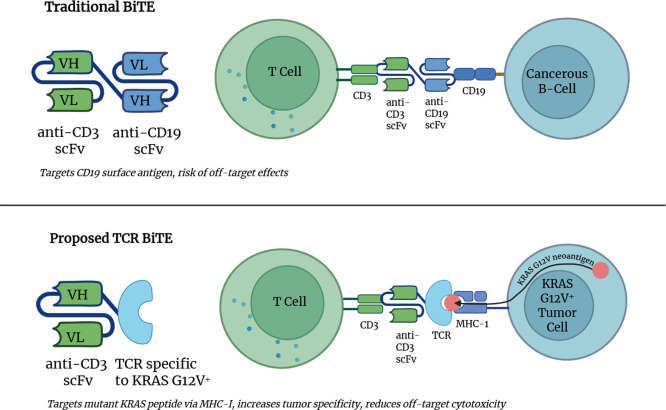
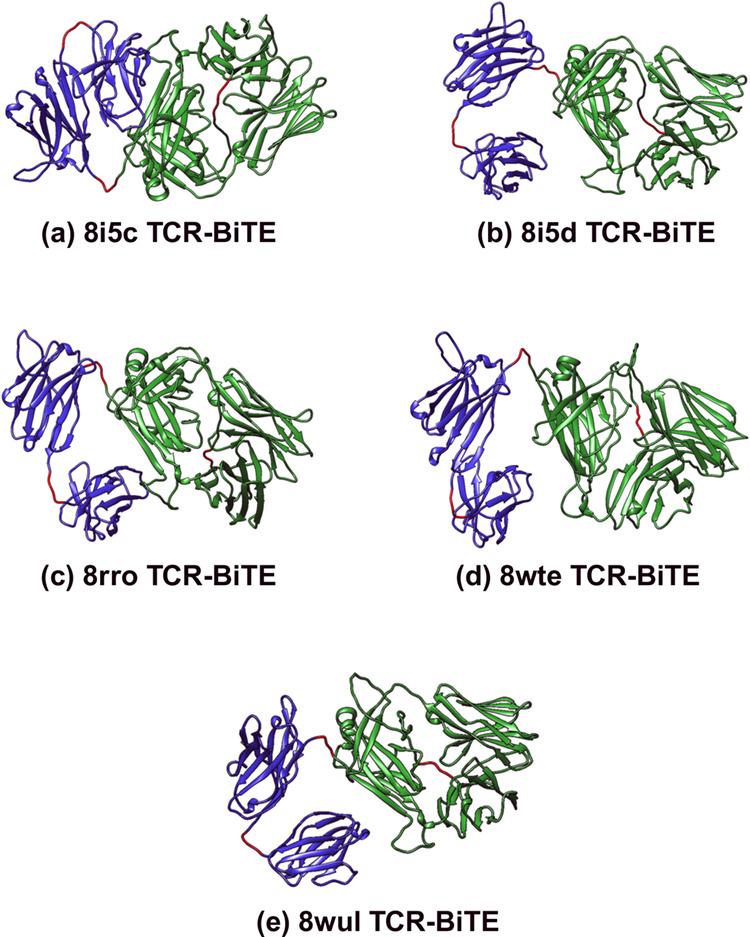
Bispecific T-cell engager (BiTE) therapy is a type of immunotherapy that redirects cytotoxic T cells to target tumor cells. Traditionally, a BiTE structure dual binds to the CD3 receptor on the T-cell surface and to the mutated antigen presented on the surface of the cancer cell as an extracellular protein. An example of this is blinatumomab, an FDA-approved BiTE structure for the treatment of B-cell acute lymphoblastic leukemia (B-ALL). However, traditional BiTE complexes are at risk of off-tumor effects due to their targeting of cell surface antigens, which are not specific to certain cancer variants. In this study, we utilized a computational approach, an area that remains underdeveloped in current immunotherapy design, to design the initial structures of two TCR-BiTEs that consist of a single-chain variable fragment (scFv) in conjunction with a T-cell receptor (TCR) that binds specifically to the KRAS G12V neoantigen, which currently does not have any FDA-approved targeted therapy treatments. Ultimately, we present two promising TCR-BiTEs that are specific to two different HLAs (HLA:03:01 and HLA:11:01) targeting KRAS G12V, serving as valuable starting points for further evaluation and design in vitro. We validated the design of our TCR-BiTE structures through AlphaFold tools, free energy estimation methods, and molecular dynamics analysis, thereby also providing a potential computational pipeline that can be applied in the design of TCR-BiTE structures targeting other mutations in addition to KRAS G12V.
Overview
The claims and statistics of this paper haven’t been checked yet.
Run the check — free, no account needed. It reads the open-access text and checks the sources it cites.
Integrity signals
Registry
Cites
Statistics
Figures
Verification
Claims the paper makes
The claims and statistics of this paper haven’t been checked yet.
Run the check — free, no account needed. It reads the open-access text and checks the sources it cites.
Self-check
Percentages, sums and reported differences re-computed from the paper’s own numbers.
The self-check needs the paper’s full text.
Citations
Cites
Highly accurate protein structure prediction with AlphaFold
Jumper, J., Evans, R., Pritzel, A., Green, T., Figurnov, M., Ronneberger, O., Tunyasuvunakool, K., Bates, R., Žídek, A., Potapenko, A., et al. (2021) · Nature · doi:10.1038/s41586-021-03819-2 · Cited by 43,764 · cited 2×
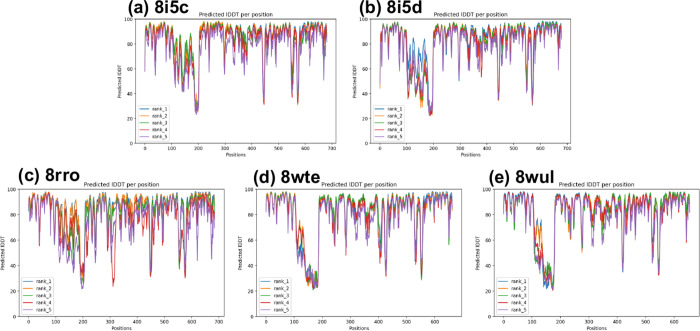
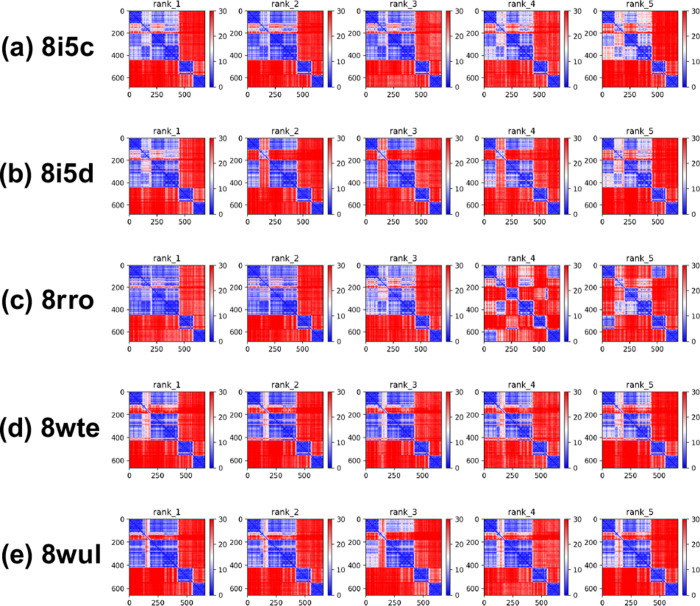
“15,16 The software was able to predict interdomain contracts that focused on the TCR variable regions and fusion components.”
Abraham, M. J., Murtola, T., Schulz, R., Páll, S., Smith, J. C., Hess, B., & Lindahl, E. (2015) · SoftwareX · doi:10.1016/j.softx.2015.06.001 · Cited by 27,190
Jorgensen, W. L., Maxwell, D. S., & Tirado-Rives, J. (1996) · Journal of the American Chemical Society · doi:10.1021/ja9621760 · Cited by 15,409
ColabFold - Making protein folding accessible to all
Mirdita, M., Schütze, K., Moriwaki, Y., Heo, L., Ovchinnikov, S., & Steinegger, M. (2021) · doi:10.1101/2021.08.15.456425 · Cited by 9,391
Reynisson, B., Alvarez, B., Paul, S., Peters, B., & Nielsen, M. (2020) · Nucleic Acids Research · doi:10.1093/nar/gkaa379 · Cited by 2,361
Statistical potential for assessment and prediction of protein structures
Shen, M., & Sali, A. (2006) · Protein Science · doi:10.1110/ps.062416606 · Cited by 2,307
Rapin, N., Lund, O., Bernaschi, M., & Castiglione, F. (2010) · PLoS ONE · doi:10.1371/journal.pone.0009862 · Cited by 1,169
KRAS Mutation: From Undruggable to Druggable in Cancer
Huang, L., Guo, Z., Wang, F., & Fu, L. (2021) · Signal Transduction and Targeted Therapy · doi:10.1038/s41392-021-00780-4 · Cited by 1,127
Regulation of protein-ligand binding affinity by hydrogen bond pairing
Chen, D., Oezguen, N., Urvil, P., Ferguson, C., Dann, S. M., & Savidge, T. C. (2016) · Science Advances · doi:10.1126/sciadv.1501240 · Cited by 931
Uniclust databases of clustered and deeply annotated protein sequences and alignments
Mirdita, M., von den Driesch, L., Galiez, C., Martin, M. J., Söding, J., & Steinegger, M. (2017) · Nucleic Acids Research · doi:10.1093/nar/gkw1081 · Cited by 759
The HADDOCK2.4 web server for integrative modeling of biomolecular complexes
Honorato, R. V., Trellet, M. E., Jiménez‐García, B., Schaarschmidt, J., Giulini, M., Reys, V., Koukos, P. I., Rodrigues, J., Karaca, E., van Zundert, G. C. P., et al. (2024) · Nature Protocols · doi:10.1038/s41596-024-01011-0 · Cited by 705
How Molecular Size Impacts RMSD Applications in Molecular Dynamics Simulations
Sargsyan, K., Grauffel, C., & Lim, C. (2017) · Journal of Chemical Theory and Computation · doi:10.1021/acs.jctc.7b00028 · Cited by 672
Weng, G., Wang, E., Wang, Z., Liu, H., Zhu, F., Li, D., & Hou, T. (2019) · Nucleic Acids Research · doi:10.1093/nar/gkz397 · Cited by 637
MMseqs2 desktop and local web server app for fast, interactive sequence searches
Mirdita, M., Steinegger, M., & Söding, J. (2019) · Bioinformatics · doi:10.1093/bioinformatics/bty1057 · Cited by 618
MGnify: the microbiome analysis resource in 2020
Mitchell, A. L., Almeida, A., Beracochea, M., Boland, M., Burgin, J., Cochrane, G., Crusoe, M. R., Kale, V., Potter, S. C., Richardson, L. J., et al. (2019) · Nucleic Acids Research · doi:10.1093/nar/gkz1035 · Cited by 562
ANARCI: antigen receptor numbering and receptor classification
Dunbar, J., & Deane, C. M. (2015) · Bioinformatics · doi:10.1093/bioinformatics/btv552 · Cited by 421
A normalized root‐mean‐spuare distance for comparing protein three‐dimensional structures
Carugo, O., & Pongor, S. (2001) · Protein Science · doi:10.1110/ps.690101 · Cited by 412
Linkers in the structural biology of protein–protein interactions
Reddy Chichili, V. P., Kumar, V., & Sivaraman, J. (2013) · Protein Science · doi:10.1002/pro.2206 · Cited by 363
Statistical potentials for fold assessment
Melo, F., Sánchez, R., & Šali, A. (2002) · Protein Science · doi:10.1002/pro.110430 · Cited by 349
The Performance of Several Docking Programs at Reproducing Protein–Macrolide-Like Crystal Structures
Castro‐Álvarez, A., Costa, A. M., & Vilarrasa, J. (2017) · Molecules · doi:10.3390/molecules22010136 · Cited by 256
Wang, Z., Zhang, X., Fang, C., Liu, X., Liao, Q., Wu, N., & Wang, J. (2024) · Immunology · doi:10.1111/imm.13793 · Cited by 238
SAbPred: a structure-based antibody prediction server
Dunbar, J., Krawczyk, K., Leem, J., Marks, C., Nowak, J., Regep, C., Georges, G. J., Kelm, S., Popovic, B., & Deane, C. M. (2016) · Nucleic Acids Research · doi:10.1093/nar/gkw361 · Cited by 202
Bispecific Antibodies and Antibody–Drug Conjugates for Cancer Therapy: Technological Considerations
Shim, H. (2020) · Biomolecules · doi:10.3390/biom10030360 · Cited by 183
Wu, J., Fu, J., Zhang, M., & Liu, D. (2015) · Journal of Hematology & Oncology · doi:10.1186/s13045-015-0195-4 · Cited by 176
Jawa, V., Terry, F. E., Gokemeijer, J., Mitra‐Kaushik, S., Roberts, B., Tourdot, S., & Groot, A. S. D. (2020) · Frontiers in Immunology · doi:10.3389/fimmu.2020.01301 · Cited by 167
High-affinity oligoclonal TCRs define effective adoptive T cell therapy targeting mutant KRAS-G12D
Sim, M. J. W., Lu, J., Spencer, M. K., Hopkins, F. R., Tran, E., Rosenberg, S. A., Long, E. O., & Sun, P. D. (2020) · Proceedings of the National Academy of Sciences · doi:10.1073/pnas.1921964117 · Cited by 127
Therapeutic high affinity T cell receptor targeting a KRASG12D cancer neoantigen
Poole, A. J., Karuppiah, V., Hartt, A., Haidar, J. N. S., Moureau, S., Dobrzycki, T., Hayes, C., Rowley, C. N., Dias, J. C., Harper, S. J., et al. (2022) · Nature Communications · doi:10.1038/s41467-022-32811-1 · Cited by 115
KRAS G12V neoantigen specific T cell receptor for adoptive T cell therapy against tumors
Lu, D., Chen, Y., Jiang, M., Wang, J., Li, Y., Ma, K., Sun, W., Zheng, X., Qi, J., Jin, W., et al. (2023) · Nature Communications · doi:10.1038/s41467-023-42010-1 · Cited by 101
Stolfi, P., Castiglione, F., Mastrostefano, E., Biase, I. D., Biase, S. D., Palmieri, G., & Prisco, A. (2022) · Frontiers in Immunology · doi:10.3389/fimmu.2022.998262 · Cited by 72
Toward mechanistic medical digital twins: some use cases in immunology
Laubenbacher, R., Adler, F., An, G. C., Castiglione, F., Eubank, S., Fonseca, L. L., Glazier, J. A., Helikar, T., Jett‐Tilton, M., Kirschner, D. E., et al. (2024) · Frontiers in Digital Health · doi:10.3389/fdgth.2024.1349595 · Cited by 66
The role of blinatumomab in patients with relapsed/refractory acute lymphoblastic leukemia
Benjamin, J. E., & Stein, A. S. (2016) · Therapeutic Advances in Hematology · doi:10.1177/2040620716640422 · Cited by 60
pLDDT Values in AlphaFold2 Protein Models Are Unrelated to Globular Protein Local Flexibility
Carugo, O. (2023) · Crystals · doi:10.3390/cryst13111560 · Cited by 46
Identification and affinity enhancement of T-cell receptor targeting a KRASG12V cancer neoantigen
Zhang, M., Xu, W. L., Luo, L., Guan, F., Wang, X., Zhu, P., Zhang, J., Zhou, X., Wang, F., & Ye, S. (2024) · Communications Biology · doi:10.1038/s42003-024-06209-2 · Cited by 25
Germline-Encoded TCR-MHC Contacts Promote TCR V Gene Bias in Umbilical Cord Blood T Cell Repertoire
Gao, K., Chen, L., Zhang, Y., Zhao, Y., Wan, Z., Wu, J., Lin, L., Kuang, Y., Lu, J., Zhang, X., et al. (2019) · Frontiers in Immunology · doi:10.3389/fimmu.2019.02064 · Cited by 24
Influence of the bispecific antibody IgG subclass on T cell redirection
Kapelski, S., Cleiren, E., Attar, R. M., Philippar, U., Häsler, J., & Chiu, M. L. (2019) · mAbs · doi:10.1080/19420862.2019.1624464 · Cited by 18
Cytokine Release Syndrome Following Blinatumomab Therapy
Ojemolon, P. E., Kalidindi, S., Ahlborn, T. A., Aihie, O., & Awoyomi, M. (2022) · Cureus · doi:10.7759/cureus.21583 · Cited by 17
Shende, S., Rathored, J., & Budhbaware, T. (2025) · Discover Oncology · doi:10.1007/s12672-025-02238-3 · Cited by 16
Sim, M. J. W., Hanada, K., Stotz, Z., Yu, Z., Lu, J., Brennan, P., Quastel, M. N., Gillespie, G. M. A., Long, E. O., Yang, J. C.-H., et al. (2024) · European Journal of Immunology · doi:10.1002/eji.202451079 · Cited by 8
Computational simulations of bispecific T cell engagers by a multiscale model
Su, Z., Almo, S. C., & Wu, Y. (2023) · Biophysical Journal · doi:10.1016/j.bpj.2023.12.012 · Cited by 7
Generalizable design parameters for soluble T cell receptor-based T cell engagers
Froning, K., Sereno, A., Huang, F., & Demarest, S. J. (2022) · Journal for ImmunoTherapy of Cancer · doi:10.1136/jitc-2021-004281 · Cited by 6
An Engineered Soluble Single‐Chain TCR Engager for KRAS‐G12V Specific Tumor Immunotherapy
Ma, K., Wang, J., Jiang, M., He, J., Li, F., Lu, D., Su, C., Chai, Y., Jin, W., Chen, Y., et al. (2025) · Advanced Science · doi:10.1002/advs.202500181 · Cited by 4
Mechanistic insights into ligand dissociation from the SARS-CoV-2 spike glycoprotein
Hasse, T., Mantei, E., Shahoei, R., Pawnikar, S. P., Wang, J., Miao, Y., & Huang, Y. M. (2024) · PLoS Computational Biology · doi:10.1371/journal.pcbi.1011955 · Cited by 3
Research works printed but not linked: 6
- Baeuerle P. A., 2009, Curr. Opin. Mol. Ther., 11, 22
- 10.1038/s41592-022-01488-1 · DOI · Paper page
- 10.3389/fimmu.2019.02064 · DOI
- 10.1093/bioinformatics/btv552 · DOI
- Zhou J., 2017, Cell. Mol. Immunol., 14, 826
- Paggi J. M., 2023, Nucleic Acids Res., 53, W306
Metadata
- Authors
- Shah, N., Sharma, G., Patel, V., Wu, M., Mummadi, A., Taneja, A., Shah, M., Le, G. B., Krishna, M., & Brah, H.
- Affiliations
- Aspiring Scholars Directed Research Program (US)
- Corresponding author
- Brah, Harman
- Venue
- ACS Omega
- Publisher
- American Chemical Society (ACS)
- Published
- 2026-03-09
- Volume
- 11
- Issue
- 11
- Pages
- 17366-17380
- ISSN
- 2470-1343 (ISSN-L)
- PMC
- PMC13019212
- OpenAlex
- W7134948581
- Cited by
- 0
- References
- 42
- FWCI
- 0.00
- Type
- journal article
- Language
- en
- Open access
- gold
- doi.org
- Licence
- Locations
- ACS Omega (publishedVersion, cc-by-nc-nd)
- ChemRxiv (acceptedVersion, cc-by)
- PubMed (publishedVersion)
- PubMed Central (publishedVersion, cc-by-nc-nd)
- Topics
- Life Sciences › Immunology and Microbiology › Immunology › Monoclonal and Polyclonal Antibodies Research
- Life Sciences › Biochemistry, Genetics and Molecular Biology › Molecular Biology › vaccines and immunoinformatics approaches
- Life Sciences › Biochemistry, Genetics and Molecular Biology › Molecular Biology › Protein Degradation and Inhibitors
- Keywords
- bispecific T-cell engagers, KRAS G12V mutation, neoantigens, T cell receptor engineering, scFv, HLA class I binding, cancer immunotherapy, computational protein design, on-target off-tumor toxicity, AlphaFold, free energy calculation, molecular dynamics
About these checks
Registry, retraction, Cites and statistics results are computed, not judged, with one exception: a printed reference that no index lists is read once by a model before it counts as a citation error. Claims are extracted by a model and kept only when their quote appears verbatim in the text; each cited source is then checked, with a model’s help, for whether it says what the claim relies on. Those verdicts can be wrong — read the claim’s quote and the cited source before relying on one.
Statistics and arithmetic are recomputed, not judged.
Confidence bands are shown only for fields calibrated on our annotated test set. None is calibrated yet, so no band is shown.
What counts as a claim ›How we measure confidence ›How we check this ›
Are you an author, or do you see a problem with this page? Request a review
Data sources
Bibliographic data: Semantic Scholar, OpenAlex, Crossref.
Contains information from the Semantic Scholar Academic Graph Datasets, made available under the ODC Attribution License (ODC-BY 1.0).
Semantic Scholar’s data is described in: Kinney, R., et al. (2023). The Semantic Scholar Open Data Platform. arXiv:2301.10140.
