

Pattern of Inner‐Core Differential Rotation From Long‐Term Earthquake Sequences and USArray Network
Open accessThe DOI matches its Crossref record; 39 of the 42 references it cites were found in a registry or an index; 6 of the 33 sources its claims cite were checked for support.
Abstract
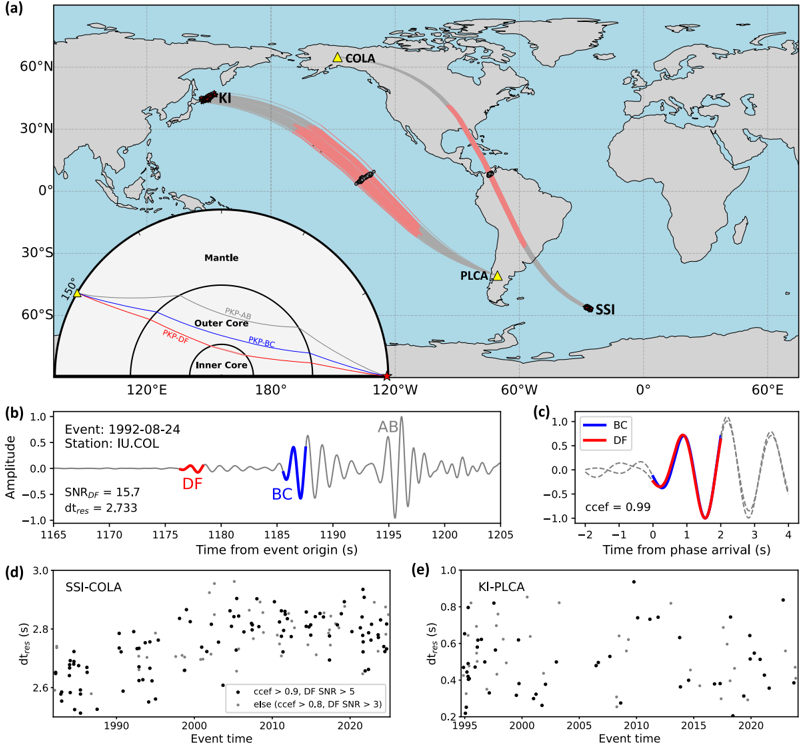
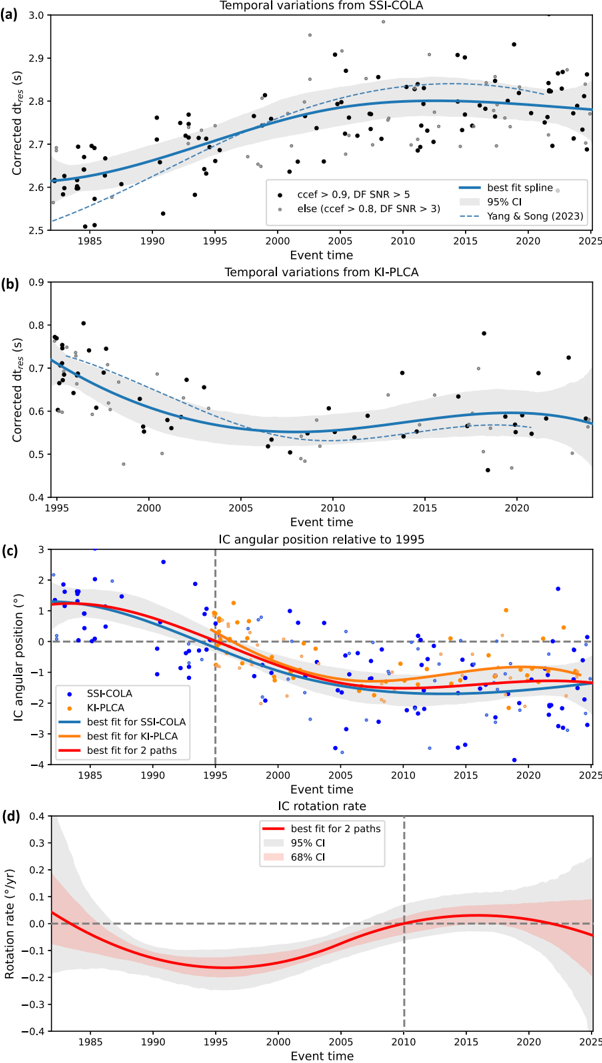
Results from two pathways, South Sandwich Islands to Alaska (1982–2024) and Kuril Islands to Argentina (1994–2024), reveal a consistent pattern that the IC successively rotated faster than the mantle by about 0.10°/yr from the early 1980s and decelerated to a near-zero rate around 2000, perhaps slower than the mantle after about 2010.
Overview
CoChat Summary
TL;DR
Wu et al. use individual earthquakes from long-term sequences along two PKP paths to track Earth’s inner-core differential rotation from 1982–2024. They find eastward super-rotation averaging ~0.10°/yr from the early 1980s, deceleration to near-zero around 2000, and little differential rotation after ~2010, consistent with multidecadal oscillation but not short-term bursts.
Key findings
- The SSI-COLA (1982–2024) and KI-PLCA (1994–2024) paths show a consistent pattern: the inner core super-rotated eastward by about 3° in about 30 years at an average rate of 0.10°/yr, decelerated to near-zero around 2000, and after about 2010 rotated at a rate indistinguishable from the mantle or perhaps slower. The best-fit reversal time is 2010, consistent with ~2009; the recent westward reversal is much slower, averaging 0.01°/yr with a maximum of 0.03°/yr. The reversal is well supported within the 68% CI but less certain under the 95% CI.
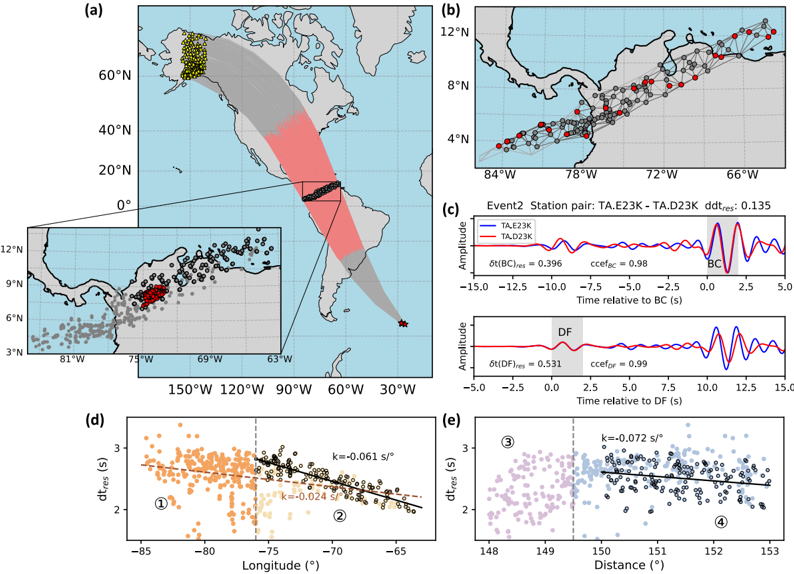
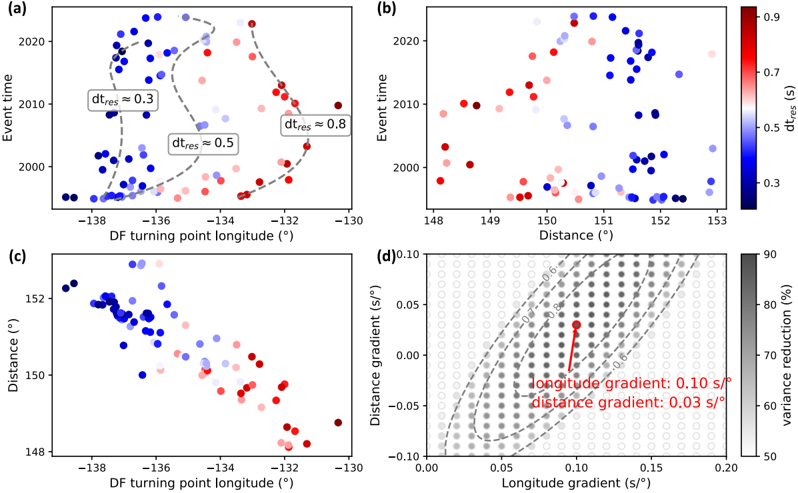
- Spatial calibration for SSI-COLA used a region at 150°–153° distance and east of 76°W to 63°W, with 167 dt_res points; linear gradients were 0.061 ± 0.003 s/° in longitude and 0.072 ± 0.022 s/° in distance. The average gradient over a larger region decreases to 0.024 s/°, which would imply a super-rotation estimate exceeding 0.2°/yr. For KI-PLCA, the optimal gradients were 0.10 s/° in longitude and 0.03 s/° in distance.
- The temporal data set yielded 151 and 85 dt_res measurements for SSI-COLA and KI-PLCA, respectively, compared with 50 and 4 repeating events in Yang & Song (2023). The spatial analysis from 5 events produced 1138 ddt_res measurements, 105 benchmark measurements, and 505 dt_res results, with average ccef of 0.98 ± 0.02.
- Inferred inner-core angular positions from the two paths are nearly identical despite opposite dt_res trends, supporting rigid-body rotation. The results are consistent with a multidecadal oscillation model but show little evidence for shorter-term oscillations or bursts; they are not consistent with a burst as large as 0.56° during 2001–2003.
Methods
- The study measures PKP DF and BC differential travel-time residuals relative to IASP91 for events of magnitude 5.0–6.5. SSI-COLA records use epicentral distances of 150°–153° and DF turning-point longitudes of 73°W–75°W; KI-PLCA records use 148°–153° and 130°W–140°W. Records are instrument-corrected, convolved with the WWSSN short-period response, band-pass filtered within 0.5–3.0 Hz, and selected by highest SNR; quality thresholds are SNR_DF = 3.0 and ccef = 0.80, followed by manual inspection.
- Spatial calibration uses USArray Transportable Array data in Alaska from 2014–2021 and 5 SSI events. A Delaunay network measures double-difference travel-time residuals between adjacent stations, with benchmark stations providing absolute constraints. Temporal data are corrected to a reference epicentral distance of 150° and turning-point longitudes of 74°W for SSI-COLA and 134°W for KI-PLCA.
- Rotation is inferred by fitting a two-piece B-spline to the spatially corrected temporal data and to the angular position relative to 1995, with bootstrap 95% confidence intervals. The rotation rate is the time derivative of the fitted angular position, and results from the two paths are combined.
Limitations
- The paper states that the event-based method is less precise than the doublet-based method, though it provides better temporal and spatial coverage. It also states that the spatial structure of the underlying inner-core region is poorly constrained and that assuming a linear trend over large spans may bias rotation-rate and pattern estimates. Scatter may arise from earthquake mislocation, mantle heterogeneity, measurement errors, and mismatch between possibly non-linear structure and the linear assumption.
- The paper notes that mantle structures beneath Alaska, particularly subducted slabs, could affect dt_res by up to 0.5 s. The subset used for gradient measurements lies outside the slab-affected region, and temporal records experience a similar effect, so the authors argue rotation-rate analysis is minimally impacted. For KI-PLCA, no sufficiently dense network exists for fine-scale spatial analysis, and its temporal data show large scatter. The reversal is less certain under the 95% CI, and the exact reversal time is not well constrained. Data before 1982 are not discussed because of larger uncertainties, poorer and sparser data, and possible larger earthquake-location errors.
- Evident from the text: strong inner-core heterogeneities mean temporal and spatial effects can interfere, so accurate rotation rates require careful structural calibration; the two-path consistency helps but does not eliminate this concern.
Model-written summary. Check it against the paper before relying on it.
Integrity signals
Registry
Cites
Statistics
Figures



Verification
Claims the paper makes
5 Valid · 1 Not valid · 14 Not checked · 50 Own results and interpretations
The sources with a verdict support this claim; the rest weren’t checked yet, have no full text we could read, or their verdicts aren’t rated yet.
In the paper
“The gravitational coupling between the IC and the mantle complicates the pattern of the IC rotation, resulting in a complex system with non-steady rotation rates (Buffett, 1997;Buffett & Glatzmaier, 2000).”
§ Pattern of Inner-Core Differential Rotation From Long-Term Earthquake Sequences and USArray Network > 1. Introduction
What the sources say
- Not checked — no full text of the sourcecites Buffett, 1997 matched to “Geodynamic estimates of the viscosity of the Earth's inner core” (1997) source
- Supportedcites Buffett & Glatzmaier, 2000 matched to “Gravitational braking of inner‐core rotation in geodynamo simulations” (2000) source
In Predictions of Inner-Core Rotation (passage 5; page not provided), the simulation incorporating gravitational coupling has significant departures from its mean rotation rate, including brief westward rotation. The opening summary (passage 1) also reports fluctuations about the mean, supporting the paraphrase that the modeled rotation is non-steady. (LLM, conf=0.88)
plainstates a cause- Asserted: passes — The authors put it forward as true.
- Checkable: passes — It can be checked against evidence.
- Load-bearing: passes — The paper’s conclusions depend on it.
- Based: passes — The paper gives a reason why it holds.
The sources with a verdict support this claim; the rest weren’t checked yet, have no full text we could read, or their verdicts aren’t rated yet.
In the paper
“By averaging more available data than possible from doublet pairs, we provide robust results supporting the transition model of the IC differential rotation proposed recently (Wang et al., 2024;Yang & Song, 2023)”
§ Pattern of Inner-Core Differential Rotation From Long-Term Earthquake Sequences and USArray Network > 6. Conclusions
What the sources say
- Supportedcites Wang et al., 2024 matched to “Inner core backtracking by seismic waveform change reversals” (2024) source
The Main section says the observed inner-core motion resembles the recent model in reference 27 and that the measurements confirm its general trend and a reversal. The References identify reference 27 as Yang and Song (2023). (LLM, conf=0.91)
- Not checked — no full text of the sourcecites Yang & Song, 2023 matched to “Multidecadal variation of the Earth’s inner-core rotation” (2023) source
boostedstates an associationn = 2- Asserted: passes — The authors put it forward as true.
- Checkable: passes — It can be checked against evidence.
- Load-bearing: passes — The paper’s conclusions depend on it.
- Based: passes — The paper gives a reason why it holds.
- Supported
A result the paper reports from its own data — it cites no other source for it, so there is none to check. The quote shows it is in the paper.
In the paper
“The longitudinal gradient of dt res west to 76°W (region 1 in Figure 2d) is smaller than that in the eastern region (region 2 in Figure 2d).”
§ Pattern of Inner-Core Differential Rotation From Long-Term Earthquake Sequences and USArray Network > Figures 2d and 2e
plain- Asserted: passes — The authors put it forward as true.
- Checkable: passes — It can be checked against evidence.
- Load-bearing: unclear — It is unclear whether the paper’s conclusions depend on it.
- Based: passes — The paper gives a reason why it holds.
A result the paper reports from its own data — it cites no other source for it, so there is none to check. The quote shows it is in the paper.
In the paper
“First, the measurements are of high quality, with average ccef as high as 0.98 ± 0.02 for both DF and BC phases.”
§ Pattern of Inner-Core Differential Rotation From Long-Term Earthquake Sequences and USArray Network > 3.1. Variations of the Spatial Gradients of SSI-COLA Path
plain- Asserted: passes — The authors put it forward as true.
- Checkable: passes — It can be checked against evidence.
- Load-bearing: passes — The paper’s conclusions depend on it.
- Based: passes — The paper gives a reason why it holds.
A result the paper reports from its own data — it cites no other source for it, so there is none to check. The quote shows it is in the paper.
In the paper
“The values show strong correlation between the distance and longitude (Figure 3c), which means the longitude and distance gradients are coupled.”
§ Pattern of Inner-Core Differential Rotation From Long-Term Earthquake Sequences and USArray Network > 3.2. Spatial-Temporal Variations of KI-PLCA Path
boostedstates an association- Asserted: passes — The authors put it forward as true.
- Checkable: passes — It can be checked against evidence.
- Load-bearing: unclear — It is unclear whether the paper’s conclusions depend on it.
- Based: passes — The paper gives a reason why it holds.
28 more claims
Create a free account to see all 70 claims and every source verdict.
- It may state two separate claims as one. 32
- Borderline: one of the tests for a substantial claim is unclear. 1
- The quote only partly states this claim. 4
- Probably not a substantial claim. 3
Citations
Cites
Matplotlib: a 2D graphics environment
Hunter, J. D. (2007) · Computing in Science & Engineering · doi:10.1109/mcse.2007.55 · Cited by 39,249
Traveltimes for global earthquake location and phase identification
Kennett, B. L. N., & Engdahl, E. R. (1991) · Geophysical Journal International · doi:10.1111/j.1365-246x.1991.tb06724.x · Cited by 3,594 · cited 1×
“…dt ( BC − DF ) = t ( BC ) − t ( DF ) is the differential travel time of phase BC and DF. dt ( BC − DF ) ref is the theoretical prediction from IASP91 model (Kennett & Engdahl, 1991), while dt ( BC − DF ) obs is measured by cross‐correlation between BC and DF phases based on 2‐s signal windows.”
ObsPy: A Python Toolbox for Seismology
Beyreuther, M., Barsch, R., Krischer, L., Megies, T., Behr, Y., & Wassermann, J. (2010) · Seismological Research Letters · doi:10.1785/gssrl.81.3.530 · Cited by 1,786
Glatzmaier, G. A., & Roberts, P. H. (1995) · Physics of the Earth and Planetary Interiors · doi:10.1016/0031-9201(95)03049-3 · Cited by 660 · cited 1×
“The Earth's solid inner core (IC) is expected to rotate at a different rate from the mantle under its electromagnetic coupling with the fluid outer core, which hosts the geodynamo (Glatzmaier & Roberts, 1995).”
Seismological evidence for differential rotation of the Earth's inner core
Song, X., & Richards, P. G. (1996) · Nature · doi:10.1038/382221a0 · Cited by 445 · cited 4×
“Seismic observations have provided critical evidence for IC differential rotation (Creager, 1997; Song & Richards, 1996; Vidale et al., 2000), and different models have been proposed.”
InfluentialSelf-citationGlobal Seismograph Network (GSN - IRIS/USGS)
Laboratory/USGS, A. S. (2015) · NSF Seismological Facility for the Advancement of Geoscience (SAGE) · doi:10.7914/sn/iu · Cited by 247
Geodynamic estimates of the viscosity of the Earth's inner core
Buffett, B. A. (1997) · Nature · doi:10.1038/41534 · Cited by 174 · cited 1×
“The gravitational coupling between the IC and the mantle complicates the pattern of the IC rotation, resulting in a complex system with non‐steady rotation rates (Buffett, 1997; Buffett & Glatzmaier, 2000).”
Array, I. T. (2015) · NSF Seismological Facility for the Advancement of Geoscience (SAGE) · doi:10.7914/sn/ta · Cited by 171
Inner Core Rotation Rate from Small-Scale Heterogeneity and Time-Varying Travel Times
Creager, K. C. (1997) · Science · doi:10.1126/science.278.5341.1284 · Cited by 167 · cited 5×
“Creager (1997) derived rotation rates using the mean gradient over an IC region spanning nearly 30° in longitude, but he also suggested that smaller‐scale lateral velocity variations might exist and thus affect the determination of the rotation rate.”
InfluentialInner Core Differential Motion Confirmed by Earthquake Waveform Doublets
Zhang, J., Song, X., Li, Y., Richards, P. G., Sun, X., & Waldhauser, F. (2005) · Science · doi:10.1126/science.1113193 · Cited by 149 · cited 4×
“Their estimated rotation rates (relative to the mantle) vary from the order of 1 ° / Myr to 1 ° / yr (Deuss, 2014; Waszek et al., 2011; Yang & Song, 2020a, 2022; Zhang et al., 2005).”
InfluentialSelf-citation
Cited by
Gravitational torque drives multidecadal variations in length of day
Zhang, H., & Dumberry, M. (2026) · Nature · doi:10.1038/s41586-026-10999-2 · Cited by 2
“However, only in recent years have such time histories been tentatively reconstructed on the basis of seismic observations 13–15 We have known for more than 30 years—from an angular momentum budget approach—that the decadal ΔLOD are caused by core–mantle interactions 1,2 .”
Gravitational forces inside Earth drag some decades out — and make others fly by
Jault, D., & Personnettaz, P. (2026) · Nature · doi:10.1038/d41586-026-02773-1
Metadata
- Authors
- Wu, K., Song, X., & Yang, Y.
- Affiliations
- Peking University (CN)
- Nanjing University (CN)
- Corresponding author
- Song, Xiaodong
- Yang, Yi
- Venue
- Geophysical Research Letters
- Publisher
- American Geophysical Union (AGU)
- Published
- 2026-01-04
- Volume
- 53
- Issue
- 1
- ISSN
- 0094-8276 (ISSN-L)
- 1944-8007
- OpenAlex
- W7118181975
- Cited by
- 2
- References
- 32
- Citations by year
- 2026: 2
- FWCI
- 7.45
- Type
- journal article
- Language
- en
- Open access
- gold
- doi.org
- Licence
- cc-by-nc-nd
- creativecommons.org/licenses/by-nc-nd/4.0/ (vor)
- doi.wiley.com/10.1002/tdm_license_1.1 (tdm)
- Locations
- Geophysical Research Letters (publishedVersion, cc-by-nc-nd)
- DOAJ (DOAJ: Directory of Open Access Journals) (submittedVersion, cc-by-sa)
- Funders
- National Natural Science Foundation of China (42394111, 92579105)
- Topics
- Physical Sciences › Earth and Planetary Sciences › Geophysics › earthquake and tectonic studies
- Physical Sciences › Earth and Planetary Sciences › Geophysics › High-pressure geophysics and materials
- Physical Sciences › Earth and Planetary Sciences › Geophysics › Seismic Waves and Analysis
- Keywords
- repeating earthquakes, doublets, USArray, event-based analysis
About these checks
Registry, retraction, Cites and statistics results are computed, not judged, with one exception: a printed reference that no index lists is read once by a model before it counts as a citation error. Claims are extracted by a model and kept only when their quote appears verbatim in the text; each cited source is then checked, with a model’s help, for whether it says what the claim relies on. Those verdicts can be wrong — read the claim’s quote and the cited source before relying on one.
The claim verdicts this report counts are experimental: their accuracy is not yet measured.
A language model drew the claims from the paper on 2026-10-10, under version 3 of the claim definition (model deepseek-v4.1-flash, prompt extract-v3).
A second model labelled each claim on 2026-10-10 (model jev-1.13-20260917, definition revision gold-guideline-v0.2).
Cited sources are checked with a language model’s help (gpt-6-sol).
Statistics and arithmetic are recomputed, not judged.
Confidence bands are shown only for fields calibrated on our annotated test set. None is calibrated yet, so no band is shown.
What counts as a claim ›How we measure confidence ›How we check this ›
Are you an author, or do you see a problem with this page? Request a review
How to cite
Cite CoChat for the checks on this page, and the paper for its own findings.
- This page
- CoChat. (2026). Citation check: Pattern of Inner‐Core Differential Rotation From Long‐Term Earthquake Sequences and USArray Network. https://app.cochat.ai/papers/10.1029/2025gl119295
- The paper
- Wu, K., Song, X., & Yang, Y. (2026). Pattern of Inner‐Core Differential Rotation From Long‐Term Earthquake Sequences and USArray Network. Geophysical Research Letters. https://doi.org/10.1029/2025gl119295
Data sources
Bibliographic data: Semantic Scholar, OpenAlex, Crossref.
Contains information from the Semantic Scholar Academic Graph Datasets, made available under the ODC Attribution License (ODC-BY 1.0).
Semantic Scholar’s data is described in: Kinney, R., et al. (2023). The Semantic Scholar Open Data Platform. arXiv:2301.10140.
