

The flexible action system: Click-based echolocation may replace certain visual functionality for adaptive walking
Open accessThe DOI matches its Crossref record; 47 of the 47 references it cites were found in a registry or an index.
Abstract
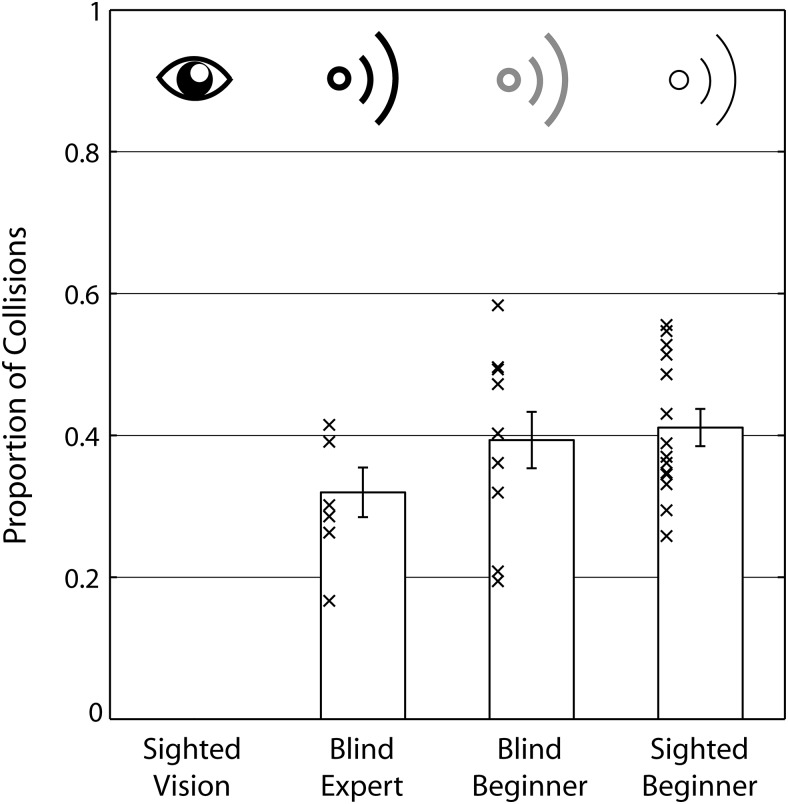
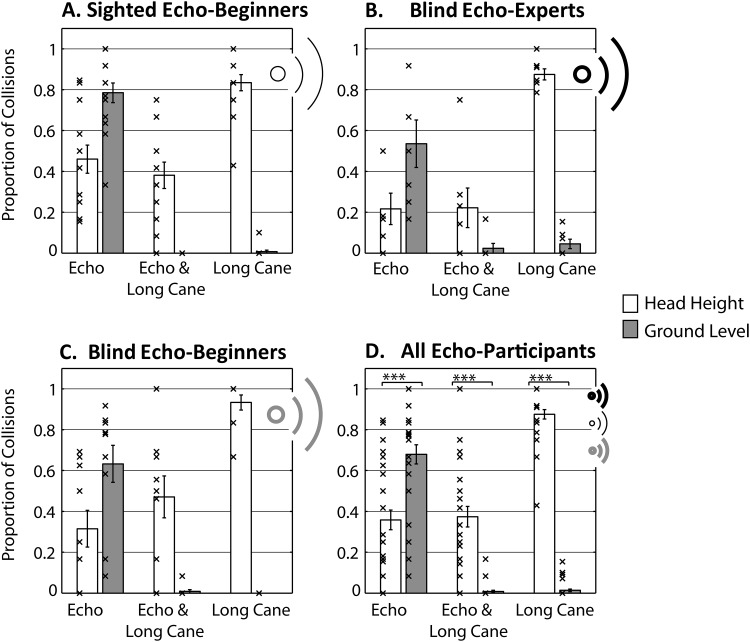
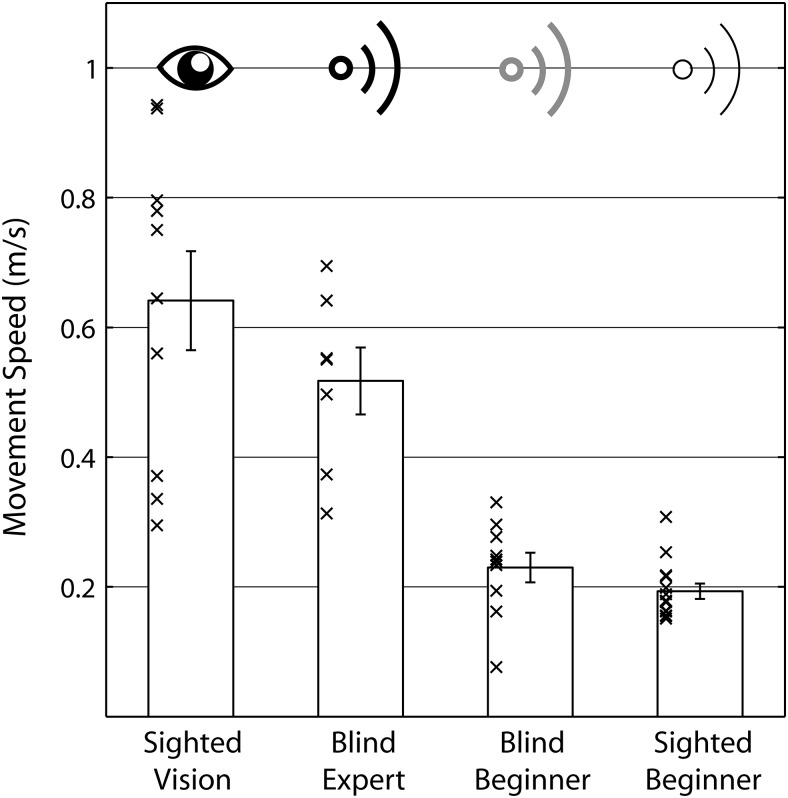
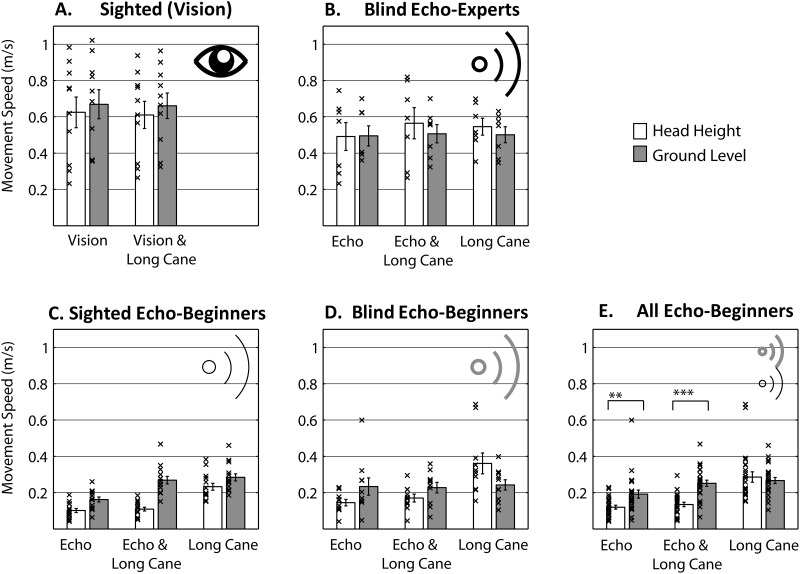
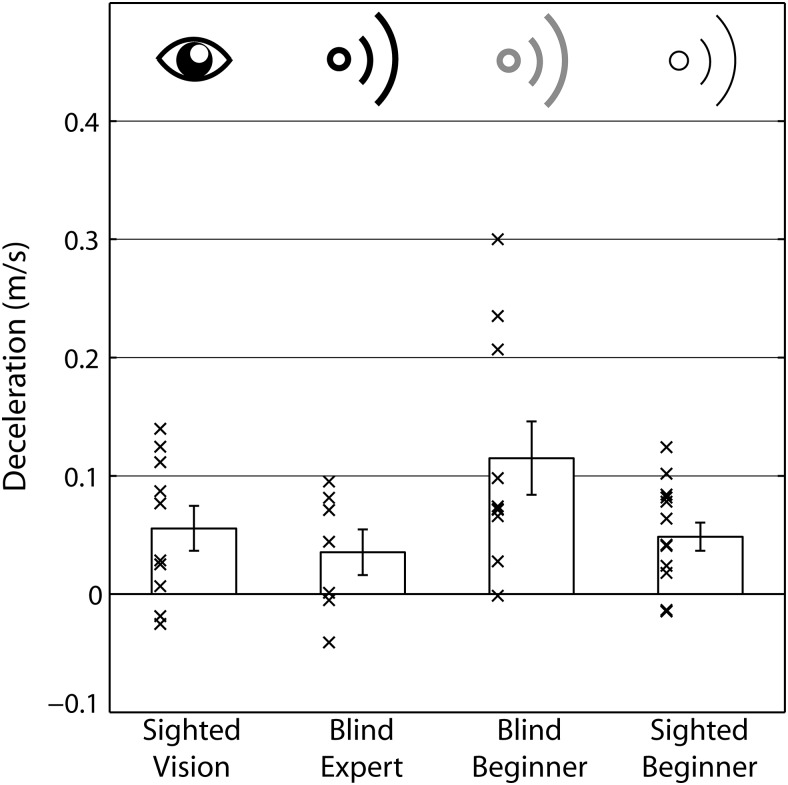
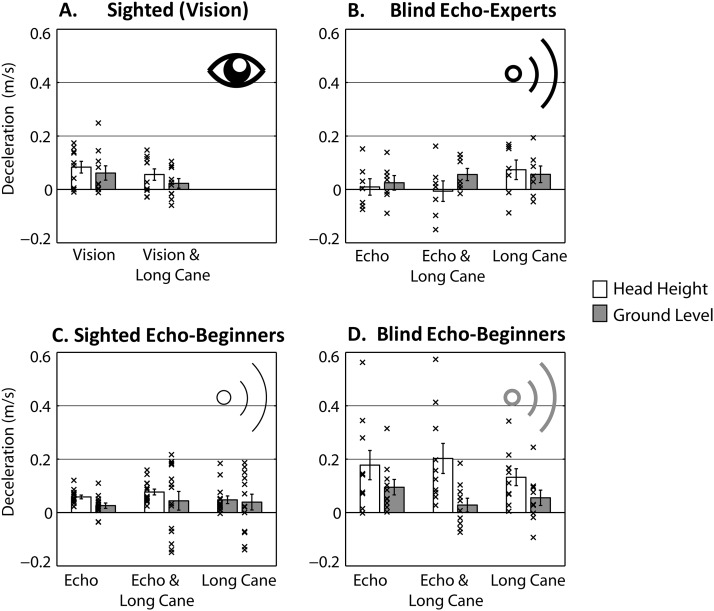
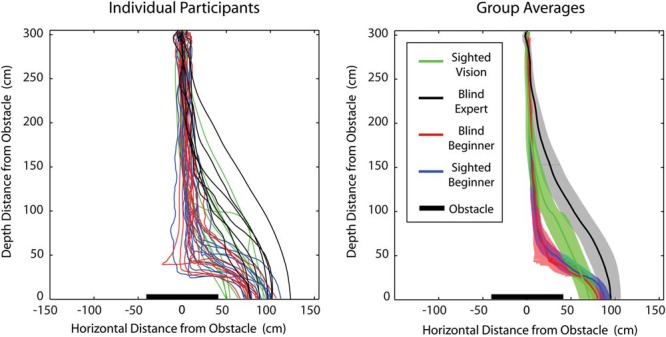
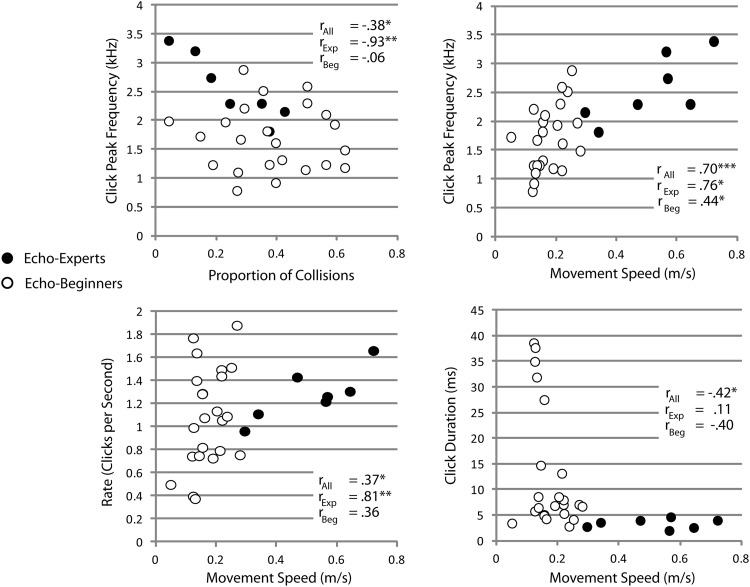
People use sensory, in particular visual, information to guide actions such as walking around obstacles, grasping or reaching. However, it is presently unclear how malleable the sensorimotor system is. The present study investigated this by measuring how click-based echolocation may be used to avoid obstacles while walking. We tested 7 blind echolocation experts, 14 sighted, and 10 blind echolocation beginners. For comparison, we also tested 10 sighted participants, who used vision. To maximize the relevance of our research for people with vision impairments, we also included a condition where the long cane was used and considered obstacles at different elevations. Motion capture and sound data were acquired simultaneously. We found that echolocation experts walked just as fast as sighted participants using vision, and faster than either sighted or blind echolocation beginners. Walking paths of echolocation experts indicated early and smooth adjustments, similar to those shown by sighted people using vision and different from later and more abrupt adjustments of beginners. Further, for all participants, the use of echolocation significantly decreased collision frequency with obstacles at head, but not ground level. Further analyses showed that participants who made clicks with higher spectral frequency content walked faster, and that for experts higher clicking rates were associated with faster walking. The results highlight that people can use novel sensory information (here, echolocation) to guide actions, demonstrating the action system's ability to adapt to changes in sensory input. They also highlight that regular use of echolocation enhances sensory-motor coordination for walking in blind people. (PsycINFO Database Record (c) 2019 APA, all rights reserved).
Overview
The claims and statistics of this paper haven’t been checked yet.
Free: it reads the open-access text and checks the first 5 claims that cite a source we can check. Create a free account to check every claim.
Integrity signals
Registry
Cites
Statistics
Figures
Verification
Claims the paper makes
The claims and statistics of this paper haven’t been checked yet.
Free: it reads the open-access text and checks the first 5 claims that cite a source we can check. Create a free account to check every claim.
Claims other papers make about this one
Each is checked against this paper’s own text: does it say what the citing paper says it does?
The source backs part of the claim, not all of it — or backs it for a different population, condition or comparison.
In the citing paper
“Laboratory research has shown that click-based echolocation provides sensory advantages above and beyond passive echolocation via ambient sound fields, e.g. [18–20] or active echolocation using footsteps or cane-taps [21,22].”
From Human click-based echolocation: Effects of blindness and age, and real-life implications in a 10-week training program (2021) · cites this paper as [22]
Experimental — accuracy not yet measured
Self-check
Percentages, sums and reported differences re-computed from the paper’s own numbers.
The self-check needs the paper’s full text.
Citations
Cites
Cross-modal plasticity: where and how?
Bavelier, D., & Neville, H. J. (2002) · Nature Reviews Neuroscience · doi:10.1038/nrn848 · Cited by 1,040 · cited 1×
“…using vision (e.g., judging shapes or sizes of distal objects), there has been comparably less work investigating this for visually guided actions (Bavelier & Neville, 2002; Burton, 2003; Maidenbaum, Abboud, & Amedi, 2014; Merabet & Pascual-Leone, 2010; Noppeney, 2007; Renier, De Volder, &…”
BackgroundNeural reorganization following sensory loss: the opportunity of change
Merabet, L. B., & Pascual-Leone, A. (2010) · Nature Reviews Neuroscience · doi:10.1038/nrn2758 · Cited by 751 · cited 1×
“…or sizes of distal objects), there has been comparably less work investigating this for visually guided actions (Bavelier & Neville, 2002; Burton, 2003; Maidenbaum, Abboud, & Amedi, 2014; Merabet & Pascual-Leone, 2010; Noppeney, 2007; Renier, De Volder, & Rauschecker, 2014; Röder & Rösler, 2004).”
BackgroundMilner, D., & Goodale, M. (2006) · Oxford University Press eBooks · doi:10.1093/acprof:oso/9780198524724.001.0001 · Cited by 582 · cited 1×
“In this context, research suggests that visual perceptual judgments and action guidance are controlled by partially overlapping but nonetheless distinct neural systems (Milner & Goodale, 2006).”
BackgroundBehavioral dynamics of steering, obstable avoidance, and route selection.
Fajen, B. R., & Warren, W. H. (2003) · Journal of Experimental Psychology: Human Perception and Performance · doi:10.1037/0096-1523.29.2.343 · Cited by 451
Echolocation behavior of big brown bats, Eptesicus fuscus, in the field and the laboratory
Surlykke, A., & Moss, C. F. (2000) · The Journal of the Acoustical Society of America · doi:10.1121/1.1315295 · Cited by 325 · cited 1×
“Bats also show marked changes in emission rates and peak frequencies, for example, when they approach a prey target (e.g., Ghose & Moss, 2006; Surlykke & Moss, 2000).”
BackgroundVisual cortex activity in early and late blind people
Burton, H. (2003) · The Journal of Neuroscience · doi:10.1523/jneurosci.23-10-04005.2003 · Cited by 270 · cited 1×
“…shapes or sizes of distal objects), there has been comparably less work investigating this for visually guided actions (Bavelier & Neville, 2002; Burton, 2003; Maidenbaum, Abboud, & Amedi, 2014; Merabet & Pascual-Leone, 2010; Noppeney, 2007; Renier, De Volder, & Rauschecker, 2014; Röder &…”
BackgroundA summary of research investigating echolocation abilities of blind and sighted humans
Kolarik, A. J., Cirstea, S., Pardhan, S., & Moore, B. C. J. (2014) · Hearing Research · doi:10.1016/j.heares.2014.01.010 · Cited by 270
Maidenbaum, S., Abboud, S., & Amedi, A. (2014) · Neuroscience & Biobehavioral Reviews · doi:10.1016/j.neubiorev.2013.11.007 · Cited by 230
Mohagheghi, A. A., Moraes, R., & Patla, A. E. (2004) · Experimental Brain Research · doi:10.1007/s00221-003-1751-7 · Cited by 222
Echolocation range and wingbeat period match in aerial-hawking bats
Holderied, M. W., & von Helversen, O. (2003) · Proceedings of the Royal Society of London. Series B: Biological Sciences · doi:10.1098/rspb.2003.2487 · Cited by 206 · cited 1×
“The association between movement speed and clicking rate mirrors data from bats, where higher wingbeat frequency (and thus higher movement speed) is associated with higher emission rates (e.g., Holderied & von Helversen, 2003; Jones, 1994; Schnitzler, Kalko, Miller, & Surlykke, 1987).”
BackgroundEffects of galvanic vestibular stimulation during human walking
Fitzpatrick, R. C., Wardman, D. L., & Taylor, J. L. (1999) · The Journal of Physiology · doi:10.1111/j.1469-7793.1999.0931s.x · Cited by 176
Human echolocation as a basic form of perception and action
Stroffregen, T. A., & Pittenger, J. B. (1995) · Ecological Psychology · doi:10.1207/s15326969eco0703_2 · Cited by 169 · cited 1×
“Humans can also echolocate, using emissions in the audible spectrum, such as mouth clicks (for reviews, see Kolarik, Cirstea, Pardhan, & Moore, 2014; Stoffregen & Pittenger, 1995; Thaler & Goodale, 2016).”
BackgroundThe echolocation and hunting behavior of the bat,Pipistrellus kuhli
Schnitzler, H. U., Kalko, E., Miller, L., & Surlykke, A. (1987) · Journal of Comparative Physiology A · doi:10.1007/bf00615246 · Cited by 168
Visual guidance of the human foot during a step
Reynolds, R. F., & Day, B. L. (2005) · The Journal of Physiology · doi:10.1113/jphysiol.2005.095869 · Cited by 162 · cited 1×
“There is a long tradition of investigating visual control for adaptive motor behaviors in humans (Fajen & Warren, 2003; Frenz & Lappe, 2005; Mohagheghi, Moraes, & Patla, 2004; Reynolds & Day, 2005).”
BackgroundEcholocation by Blind Men, Bats and Radar
Griffin, D. R. (1944) · Science · doi:10.1126/science.100.2609.589 · Cited by 148 · cited 1×
“Specifically, echolocation is the ability to infer spatial information based on sound reflections that arise from emissions being projected into the environment (Griffin, 1944).”
BackgroundCortical plasticity and preserved function in early blindness
Renier, L., De Volder, A. G., & Rauschecker, J. P. (2014) · Neuroscience & Biobehavioral Reviews · doi:10.1016/j.neubiorev.2013.01.025 · Cited by 144
The effects of visual deprivation on functional and structural organization of the human Brain
NOPPENEY, U. (2007) · Neuroscience & Biobehavioral Reviews · doi:10.1016/j.neubiorev.2007.04.012 · Cited by 140 · cited 1×
“…or sizes of distal objects), there has been comparably less work investigating this for visually guided actions (Bavelier & Neville, 2002; Burton, 2003; Maidenbaum, Abboud, & Amedi, 2014; Merabet & Pascual-Leone, 2010; Noppeney, 2007; Renier, De Volder, & Rauschecker, 2014; Röder & Rösler, 2004).”
Background"Pray before you step out": describing personal and situational blind navigation behaviors
Williams, M. A., Hurst, A., & Kane, S. K. (2013) · Proceedings of the 15th International ACM SIGACCESS Conference on Computers and Accessibility · doi:10.1145/2513383.2513449 · Cited by 138
Ghose, K., & Moss, C. F. (2006) · Journal of Neuroscience · doi:10.1523/jneurosci.4315-05.2006 · Cited by 134 · cited 1×
“Bats also show marked changes in emission rates and peak frequencies, for example, when they approach a prey target (e.g., Ghose & Moss, 2006; Surlykke & Moss, 2000).”
BackgroundEcholocation in humans: an overview
Thaler, L., & Goodale, M. A. (2016) · WIREs Cognitive Science · doi:10.1002/wcs.1408 · Cited by 127 · cited 1×
“Humans can also echolocate, using emissions in the audible spectrum, such as mouth clicks (for reviews, see Kolarik, Cirstea, Pardhan, & Moore, 2014; Stoffregen & Pittenger, 1995; Thaler & Goodale, 2016).”
BackgroundSelf-citationAbsolute travel distance from optic flow
Harald Frenz, A., & Lappe, M. (2005) · Vision Research · doi:10.1016/j.visres.2004.12.019 · Cited by 124 · cited 1×
“There is a long tradition of investigating visual control for adaptive motor behaviors in humans (Fajen & Warren, 2003; Frenz & Lappe, 2005; Mohagheghi, Moraes, & Patla, 2004; Reynolds & Day, 2005).”
BackgroundThaler, L., Reich, G. M., Zhang, X., Wang, D., Smith, G. E., Tao, Z., Abdullah, R. S. A. B. R., Cherniakov, M., Baker, C. J., Kish, D., et al. (2017) · PLOS Computational Biology · doi:10.1371/journal.pcbi.1005670 · Cited by 86 · cited 3×
“This is consistent with previous reports in the literature (Norman & Thaler, 2018; Thaler & Castillo-Serrano, 2016; Thaler et al., 2017), but in contrast to those previous reports that focused on a perceptual judgments the current finding is the first to relate click acoustics to movement during…”
BackgroundResultSelf-citationHuman Exploration of Enclosed Spaces through Echolocation
Flanagin, V. L., Schörnich, S., Schranner, M., Hummel, N., Wallmeier, L., Wahlberg, M., Stephan, T., & Wiegrebe, L. (2017) · Journal of Neuroscience · doi:10.1523/jneurosci.1566-12.2016 · Cited by 81 · cited 1×
“Using “‘static” perceptual tasks that did not require movement, we (Norman & Thaler, 2018; Thaler & Castillo-Serrano, 2016; Thaler et al., 2018) and others (Flanagin et al., 2017) have shown in previous research in human echolocation that acoustic features of clicks are related to performance.”
BackgroundTeng, S., & Whitney, D. (2011) · Journal of Visual Impairment & Blindness · doi:10.1177/0145482x1110500103 · Cited by 79 · cited 1×
“…by both blind and sighted people (Ekkel, van Lier, & Steenbergen, 2017; Kolarik, Scarfe, Moore, & Pardhan, 2016, 2017; Schörnich, Nagy, & Wiegrebe, 2012; Teng & Whitney, 2011; Thaler, Wilson, & Gee, 2014; Tonelli, Brayda, & Gori, 2016; Tonelli, Campus, & Brayda, 2018; Worchel & Mauney, 1951).”
Chrastil, E. R., Sherrill, K. R., Aselcioglu, I., Hasselmo, M. E., & Stern, C. E. (2017) · eneuro · doi:10.1523/eneuro.0346-16.2017 · Cited by 77
Day, B. L., & Guerraz, M. (2007) · The Journal of Physiology · doi:10.1113/jphysiol.2007.132092 · Cited by 76 · cited 1×
“…is other sensory information to drive such updates, for example, sensory information arising from vestibular and musculoskeletal sources (Chrastil, Sherrill, Aselcioglu, Hasselmo, & Stern, 2017; Day & Guerraz, 2007; Fitzpatrick, Wardman, & Taylor, 1999; Loomis, Klatzky, Golledge, & Philbeck, 1999).”
BackgroundEnhanced auditory spatial localization in blind echolocators
Vercillo, T., Milne, J. L., Gori, M., & Goodale, M. A. (2014) · Neuropsychologia · doi:10.1016/j.neuropsychologia.2014.12.001 · Cited by 72
The role of head movements in the discrimination of 2-D shape by blind echolocation experts
Milne, J. L., Goodale, M. A., & Thaler, L. (2014) · Attention, Perception, & Psychophysics · doi:10.3758/s13414-014-0695-2 · Cited by 63 · cited 1×
“…echo experts perform similarly to sighted people using vision when judging the weight of objects (Buckingham, Milne, Byrne, & Goodale, 2015), the physical size of objects (Milne et al., 2014) or the relative location of sounds with respect to one another (Vercillo, Milne, Gori, & Goodale, 2015).”
Self-citationCompensatory Plasticity as a Consequence of Sensory Loss
Röder, B., & Rösler, F. (2004) · The Handbook of Multisensory Processes · doi:10.7551/mitpress/3422.003.0055 · Cited by 63
Jones, G. A. (1994) · Functional Ecology · doi:10.2307/2390068 · Cited by 62 · cited 1×
“The association between movement speed and clicking rate mirrors data from bats, where higher wingbeat frequency (and thus higher movement speed) is associated with higher emission rates (e.g., Holderied & von Helversen, 2003; Jones, 1994; Schnitzler, Kalko, Miller, & Surlykke, 1987).”
BackgroundNeural Correlates of Human Echolocation of Path Direction During Walking
Fiehler, K., Schütz, I., Meller, T., & Thaler, L. (2015) · Multisensory Research · doi:10.1163/22134808-00002491 · Cited by 61
Self-citationKolarik, A. J., Scarfe, A. C., Moore, B. C. J., & Pardhan, S. (2017) · PLOS ONE · doi:10.1371/journal.pone.0175750 · Cited by 59 · cited 7×
“Following Kolarik et al. (2016, 2017), participant movement speed was measured for the final meter in the forward dimension before colliding with the obstacle (for trials in which a collision occurred), or before crossing the front aspect of the obstacle with their head (for trials in which no…”
BackgroundMethodResultInfluentialDiscovering Your Inner Bat: Echo–Acoustic Target Ranging in Humans
Schörnich, S., Nagy, A., & Wiegrebe, L. (2012) · Journal of the Association for Research in Otolaryngology · doi:10.1007/s10162-012-0338-z · Cited by 50 · cited 1×
“These values are consistent with previous data on clicks used for echolocation (De Vos & Hornikx, 2017; Schörnich et al., 2012; Thaler & Castillo-Serrano, 2016; Thaler et al., 2017).”
ResultThaler, L., De Vos, R., Kish, D., Antoniou, M., Baker, C., & Hornikx, M. (2018) · Proceedings of the Royal Society B: Biological Sciences · doi:10.1098/rspb.2017.2735 · Cited by 46
Self-citationDepth Echolocation Learnt by Novice Sighted People
Tonelli, A., Brayda, L. G., & Gori, M. (2016) · PLoS ONE · doi:10.1371/journal.pone.0156654 · Cited by 44
The Size-Weight Illusion Induced Through Human Echolocation
Buckingham, G., Milne, J. L., Byrne, C. M., & Goodale, M. A. (2014) · Psychological Science · doi:10.1177/0956797614561267 · Cited by 34
Thaler, L., & Castillo-Serrano, J. (2016) · PLOS ONE · doi:10.1371/journal.pone.0154868 · Cited by 32 · cited 3×
“This is consistent with previous reports in the literature (Norman & Thaler, 2018; Thaler & Castillo-Serrano, 2016; Thaler et al., 2017), but in contrast to those previous reports that focused on a perceptual judgments the current finding is the first to relate click acoustics to movement during…”
BackgroundResultSelf-citationBayes-Like Integration of a New Sensory Skill with Vision
Negen, J., Wen, L., Thaler, L., & Nardini, M. (2018) · Scientific Reports · doi:10.1038/s41598-018-35046-7 · Cited by 32
Self-citationThaler, L., Wilson, R. C., & Gee, B. K. (2014) · Experimental Brain Research · doi:10.1007/s00221-014-3883-3 · Cited by 27
Self-citationAn assessment of auditory-guided locomotion in an obstacle circumvention task
Kolarik, A. J., Scarfe, A. C., Moore, B. C. J., & Pardhan, S. (2016) · Experimental Brain Research · doi:10.1007/s00221-016-4567-y · Cited by 27 · cited 6×
“Following Kolarik et al. (2016, 2017), participant movement speed was measured for the final meter in the forward dimension before colliding with the obstacle (for trials in which a collision occurred), or before crossing the front aspect of the obstacle with their head (for trials in which no…”
BackgroundMethodResultInfluentialHuman Click-Based Echolocation of Distance: Superfine Acuity and Dynamic Clicking Behaviour
Thaler, L., de Vos, R., Kish, D., Antoniou, M., Baker, C., & Hornikx, M. (2019) · Journal of the Association for Research in Otolaryngology · doi:10.1007/s10162-019-00728-0 · Cited by 27 · cited 1×
“…experience in echolocation show dynamic adaptation of their clicks (e.g., intensity, number of clicks) to compensate for weaker target reflectors (Thaler et al., 2018, 2019), and there is the possibility that situational adaptation of click acoustics in experts may be the result of having had…”
BackgroundSelf-citationThe effect of practice on the perception of obstacles by the blind.
Worchel, P., & Mauney, J. (1951) · Journal of Experimental Psychology · doi:10.1037/h0055653 · Cited by 23 · cited 1×
“…by both blind and sighted people (Ekkel, van Lier, & Steenbergen, 2017; Kolarik, Scarfe, Moore, & Pardhan, 2016, 2017; Schörnich, Nagy, & Wiegrebe, 2012; Teng & Whitney, 2011; Thaler, Wilson, & Gee, 2014; Tonelli, Brayda, & Gori, 2016; Tonelli, Campus, & Brayda, 2018; Worchel & Mauney, 1951).”
A blind human expert echolocator shows size constancy for objects perceived by echoes
Milne, J. L., Anello, M., Goodale, M. A., & Thaler, L. (2015) · Neurocase · doi:10.1080/13554794.2014.922994 · Cited by 22
Self-citationNorman, L. J., & Thaler, L. (2018) · i-Perception · doi:10.1177/2041669518776984 · Cited by 21 · cited 3×
“This is consistent with previous reports in the literature (Norman & Thaler, 2018; Thaler & Castillo-Serrano, 2016; Thaler et al., 2017), but in contrast to those previous reports that focused on a perceptual judgments the current finding is the first to relate click acoustics to movement during…”
BackgroundResultSelf-citationEkkel, M. R., van Lier, R., & Steenbergen, B. (2017) · Experimental Brain Research · doi:10.1007/s00221-016-4833-z · Cited by 16
How body motion influences echolocation while walking
Tonelli, A., Campus, C., & Brayda, L. G. (2018) · Scientific Reports · doi:10.1038/s41598-018-34074-7 · Cited by 15
Acoustic Properties of Tongue Clicks used for Human Echolocation
de Vos, R., & Hornikx, M. (2017) · Acta acustica united with Acustica · doi:10.3813/aaa.919138 · Cited by 11 · cited 1×
“These values are consistent with previous data on clicks used for echolocation (De Vos & Hornikx, 2017; Schörnich et al., 2012; Thaler & Castillo-Serrano, 2016; Thaler et al., 2017).”
Result
Research works printed but not linked: 1
- Loomis J. M., Klatzky R. L., Golledge R. G., & Philbeck J. W. (1999). Human navigation by path integration In Golledge R. G. (Ed.), Wayfinding behavior: Cognitive mapping and other spatial processes (pp. 125– 151). Baltimore, MD: Johns Hopkins Press.
Cited by
Norman, L. J., Dodsworth, C., Foresteire, D., & Thaler, L. (2021) · PLOS ONE · doi:10.1371/journal.pone.0252330 · Cited by 59
“[18–20] or active echolocation using footsteps or cane-taps [21,22].”
BackgroundSelf-citationEcholocating bats accumulate information from acoustic snapshots to predict auditory object motion
Salles, A., Diebold, C. A., & Moss, C. F. (2020) · Proceedings of the National Academy of Sciences · doi:10.1073/pnas.2011719117 · Cited by 43
A framework to account for the effects of visual loss on human auditory abilities.
Kolarik, A. J., Pardhan, S., & Moore, B. C. J. (2021) · Psychological Review · doi:10.1037/rev0000279 · Cited by 46
Dernayka, A., Amorim, M., Leroux, R., Bogaert, L., & Farcy, R. (2021) · Sensors · doi:10.3390/s21206854 · Cited by 14
“For this kind of test, passive or active echolocation [22,23] may be the only possibility for avoiding obstacles (excluding chance).”
BackgroundTonelli, A., Campus, C., & Gori, M. (2020) · Neuropsychologia · doi:10.1016/j.neuropsychologia.2020.107617 · Cited by 7
Metadata
- Authors
- Thaler, L., Zhang, X., Antoniou, M., Kish, D. C., & Cowie, D.
- Affiliations
- Durham University (GB)
- Beijing Institute of Technology (CN)
- University of Birmingham (GB)
- Corresponding author
- Thaler, Lore
- Venue
- Journal of Experimental Psychology: Human Perception and Performance
- Published
- 2020-01
- Volume
- 46
- Issue
- 1
- Pages
- 21-35
- ISSN
- 0096-1523 (ISSN-L)
- 1939-1277
- PMC
- PMC6936248
- OpenAlex
- W2975827578
- Cited by
- 41
- References
- 47
- Citations by year
- 2026: 2 · 2025: 1 · 2024: 3 · 2023: 3 · 2022: 25 · 2021: 5 · 2020: 2
- FWCI
- 4.62
- Type
- journal article
- Language
- en
- Open access
- hybrid
- doi.org
- Licence
- Locations
- Journal of Experimental Psychology Human Perception & Performance (publishedVersion, cc-by)
- PubMed Central (publishedVersion, cc-by)
- PubMed (publishedVersion)
- Durham Research Online (Durham University) (publishedVersion, other-oa)
- Durham Research Online (Durham University) (acceptedVersion, cc-by)
- Durham Research Online (Durham University) (submittedVersion, cc-by)
- University of Birmingham Research Portal (University of Birmingham) (submittedVersion, other-oa)
- Funders
- Department for Business, Innovation and Skills in the United Kingdom (SC037733)
- Biotechnology and Biological Sciences Research Council (BB/M007847/1)
- Wolfson Research Institute
- Topics
- Life Sciences › Neuroscience › Cognitive Neuroscience › Tactile and Sensory Interactions
- Health Sciences › Health Professions › Occupational Therapy › Assistive Technology in Communication and Mobility
- Social Sciences › Psychology › Experimental and Cognitive Psychology › Spatial Cognition and Navigation
- Keywords
- obstacle avoidance, walking, sensorimotor adaptation, sensory substitution, long cane, visual impairment, sensorimotor coordination, collision frequency, walking speed
- MeSH terms
- Adolescent, Adult, Biomechanical Phenomena, Blindness, Canes, Female, Humans, Male, Sound Localization, Vision Disorders, Walking, Young Adult
About these checks
Registry, retraction, Cites and statistics results are computed, not judged, with one exception: a printed reference that no index lists is read once by a model before it counts as a citation error. Claims are extracted by a model and kept only when their quote appears verbatim in the text; each cited source is then checked, with a model’s help, for whether it says what the claim relies on. Those verdicts can be wrong — read the claim’s quote and the cited source before relying on one.
Statistics and arithmetic are recomputed, not judged.
Confidence bands are shown only for fields calibrated on our annotated test set. None is calibrated yet, so no band is shown.
What counts as a claim ›How we measure confidence ›How we check this ›
Are you an author, or do you see a problem with this page? Request a review
Data sources
Bibliographic data: Semantic Scholar, OpenAlex, Crossref.
Contains information from the Semantic Scholar Academic Graph Datasets, made available under the ODC Attribution License (ODC-BY 1.0).
Semantic Scholar’s data is described in: Kinney, R., et al. (2023). The Semantic Scholar Open Data Platform. arXiv:2301.10140.
