

The DOI matches its Crossref record; 61 of the 62 references it cites were found in a registry or an index.
Chronic preoperative pain and psychological robustness predict acute postoperative pain outcomes after surgery for breast cancer
Open accessAbstract
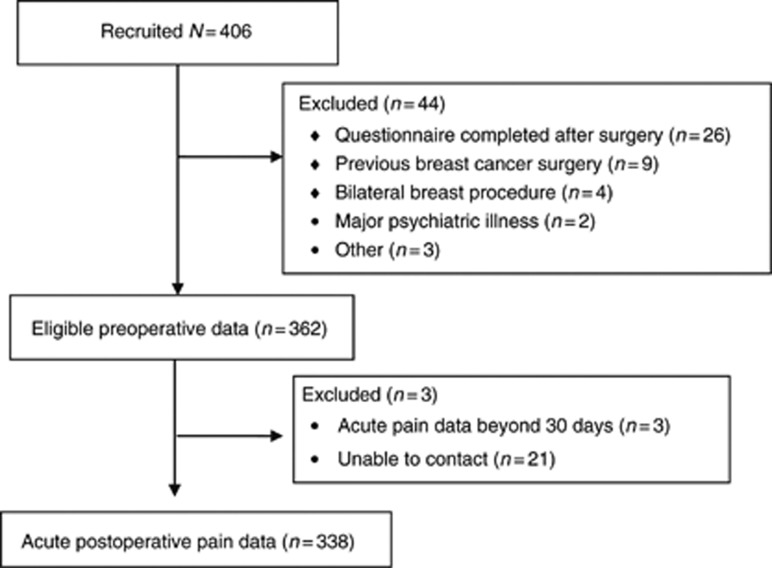
BACKGROUND: Few epidemiological studies have prospectively investigated preoperative and surgical risk factors for acute postoperative pain after surgery for breast cancer. We investigated demographic, psychological, pain-related and surgical risk factors in women undergoing resectional surgery for breast cancer. METHODS: Primary outcomes were pain severity, at rest (PAR) and movement-evoked pain (MEP), in the first postoperative week. RESULTS: In 338 women undergoing surgery, those with chronic preoperative pain were three times more likely to report moderate to severe MEP after breast cancer surgery (OR 3.18, 95% CI 1.45-6.99). Increased psychological 'robustness', a composite variable representing positive affect and dispositional optimism, was associated with lower intensity acute postoperative PAR (OR 0.63, 95% CI 0.48-0.82) and MEP (OR 0.71, 95% CI 0.54-0.93). Sentinel lymph node biopsy (SLNB) and intraoperative nerve division were associated with reduced postoperative pain. No relationship was found between preoperative neuropathic pain and acute pain outcomes; altered sensations and numbness postoperatively were more common after axillary sample or clearance compared with SLNB. CONCLUSION: Chronic preoperative pain, axillary surgery and psychological robustness significantly predicted acute pain outcomes after surgery for breast cancer. Preoperative identification and targeted intervention of subgroups at risk could enhance the recovery trajectory in cancer survivors.
Overview
The claims and statistics of this paper haven’t been checked yet.
Run the check — free, no account needed. It reads the open-access text and checks the sources it cites.
Integrity signals
Registry
Cites
Statistics
Figures
Verification
Claims the paper makes
The claims and statistics of this paper haven’t been checked yet.
Run the check — free, no account needed. It reads the open-access text and checks the sources it cites.
Claims other papers make about this one
Each is checked against this paper’s own text: does it say what the citing paper says it does?
In the citing paper
“observational and experimental studies suggesting that positive mood results in reduced symptom reporting.29-32”
From Religion, spirituality, and physical health in cancer patients: A meta‐analysis (2015) · cites this paper as [30]
Self-check
Percentages, sums and reported differences re-computed from the paper’s own numbers.
The self-check needs the paper’s full text.
Citations
Cites
The Hospital Anxiety and Depression Scale
Zigmond, A. S., & Snaith, R. P. (1983) · Acta Psychiatrica Scandinavica · doi:10.1111/j.1600-0447.1983.tb09716.x · Cited by 47,139
Development and validation of brief measures of positive and negative affect: The PANAS scales.
Watson, D., Clark, L. A., & Tellegen, A. (1988) · Journal of Personality and Social Psychology · doi:10.1037/0022-3514.54.6.1063 · Cited by 32,433 · cited 14×
“Preoperative pain may be amplified or accelerated by surgical incision, subsequent tissue injury, pathophysiological *Correspondence: Dr J Bruce; E-mail: julie.bruce@warwick.ac.uk Received 16 April 2012; revised 6 July 2012; accepted 7 July 2012; published online 31 July 2012 British Journal of Cancer (2012) 107, 937–…”
MethodInfluential(1970) · Cited by 24,983
Depression and quality of life in older persons: A review
Sivertsen, H., Bjørkløf, G. H., Engedal, K., Selbæk, G., & Helvik, A.-S. (2015) · Dementia and Geriatric Cognitive Disorders · doi:10.1159/000437299 · Cited by 14,152
Pain assessment: global use of the Brief Pain Inventory.
Cs, C., & Km, R. (1994) · PubMed · Cited by 5,178
Persistent postsurgical pain: risk factors and prevention
Kehlet, H., Jensen, T. S., & Woolf, C. J. (2006) · The Lancet · doi:10.1016/s0140-6736(06)68700-x · Cited by 4,086 · cited 1×
“…2012; accepted 7 July 2012; published online 31 July 2012 British Journal of Cancer (2012) 107, 937–946 & 2012 Cancer Research UK All rights reserved 0007 – 0920/12 www.bjcancer.com C li n ic a l S tu d ie s responses and local inflammatory processes (Kehlet et al, 2006; Gerbershagen et al, 2010).”
BackgroundHealth complaints, stress, and distress: Exploring the central role of negative affectivity.
Watson, D., & Pennebaker, J. W. (1989) · Psychological Review · doi:10.1037/0033-295x.96.2.234 · Cited by 3,030 · cited 3×
“…as it would appear to fit within the broader dimension of resources that characterise psychological positivism; thus combining a ‘habitual style of anticipating favourable outcomes’ (Scheier and Carver, 1987) and reflective of ‘energy, excitement and enthusiasm’ (Watson and Pennebaker, 1989).”
BackgroundBouhassira, D., Attal, N., Alchaar, H., Boureau, F., Brochet, B., Bruxelle, J., Cunin, G., Fermanian, J., Giniès, P., Grun-Overdyking, A., et al. (2005) · Pain · doi:10.1016/j.pain.2004.12.010 · Cited by 2,834 · cited 2×
“…symptom grids and the following validated neuropathic pain instruments: Selfcompleted Leeds Assessment of Neuropathic Symptoms and Signs pain scale (S-LANSS) (Bennett et al, 2005; Bouhassira and Attal, 2009), and the ‘Douleur Neuropathique 4’ (DN4) questionnaire (Bouhassira et al, 2005).”
BackgroundThe fear-avoidance model of musculoskeletal pain: Current state of scientific evidence
Leeuw, M., Goossens, M. E. J. B., Linton, S. J., Crombez, G., Boersma, K., & Vlaeyen, J. W. S. (2007) · Journal of Behavioral Medicine · doi:10.1007/s10865-006-9085-0 · Cited by 2,261 · cited 1×
“However, other mechanisms of effect are possible: anxiety or pain catastrophising may affect behaviours that could influence recovery, as per fear avoidance theories of chronic pain (Leeuw et al, 2007).”
BackgroundA new definition of neuropathic pain
Jensen, T., Baron, R., Haanpää, M., Kalso, E., Loeser, J., Rice, A., & Treede, R. (2011) · Pain · doi:10.1016/j.pain.2011.06.017 · Cited by 1,343 · cited 1×
“Postsurgical pain is known to be predominantly neuropathic in character (Bruce et al, 2004), whereby neuropathic pain is defined as ‘pain caused by a lesion or disease of the somatosensory system’ (Jensen et al, 2011).”
Background
Cited by
Sorted by citations
Religion, spirituality, and physical health in cancer patients: A meta‐analysis
Jim, H. S. L., Pustejovsky, J. E., Park, C. L., Danhauer, S. C., Sherman, A. C., Fitchett, G., Merluzzi, T. V., Munoz, A. R., George, L., Snyder, M. A., et al. (2015) · Cancer · doi:10.1002/cncr.29353 · Cited by 373
Powell, R., Scott, N. W., Manyande, A., Bruce, J., Vögele, C., Byrne-Davis, L. M., Unsworth, M., Osmer, C., & Johnston, M. (2016) · Cochrane Database of Systematic Reviews · doi:10.1002/14651858.cd008646.pub2 · Cited by 369
Self-citationHwang, E. S., Hyslop, T., Lynch, T., Frank, E. S., Pinto, D., Basila, D., Collyar, D. E., Bennett, A. V., Kaplan, C. P., Rosenberg, S. M., et al. (2019) · BMJ Open · doi:10.1136/bmjopen-2018-026797 · Cited by 305
“9 13 In addition, patients may experience complications from radiation (cardiac or pulmonary symptoms, secondary malignancies) or reconstruction (infection, loss of implant, need for multiple surgeries).”
Self-citationBruce, J., Thornton, A. J., Powell, R., Johnston, M., Wells, M., Heys, S. D., Thompson, A. M., Smith, C. W., Chambers, A. W., & Scott, N. W. (2014) · Pain · doi:10.1016/j.pain.2013.09.028 · Cited by 260
“Study methodology and calculation of sample size has been fully described in a previous publication [10].”
BackgroundMethodInfluentialSelf-citationPersistent post-mastectomy pain: risk factors and current approaches to treatment
Tait, R. C., Zoberi, K., Ferguson, M., Levenhagen, K., Luebbert, R. A., Rowland, K., Salsich, G. B., & Herndon, C. (2018) · The Journal of Pain · doi:10.1016/j.jpain.2018.06.002 · Cited by 190
Psychological correlates of acute postsurgical pain: a systematic review and meta-analysis
Sobol‐Kwapinska, M., Bąbel, P., Plotek, W., & Stelcer, B. (2016) · European Journal of Pain · doi:10.1002/ejp.886 · Cited by 166
Sagen, A., Kaaresen, R., Sandvik, L., Thune, I., & Risberg, M. A. (2014) · Archives of Physical Medicine and Rehabilitation · doi:10.1016/j.apmr.2013.12.015 · Cited by 128
Deumens, R., Steyaert, A., Forget, P., Schubert, M., Lavand'homme, P. M., Hermans, E., & Kock, M. D. (2013) · Progress in Neurobiology · doi:10.1016/j.pneurobio.2013.01.002 · Cited by 126
Schou Bredal, I., Smeby, N. A., Ottesen, S., Warncke, T., & Schlichting, E. (2014) · Journal of Pain and Symptom Management · doi:10.1016/j.jpainsymman.2013.12.239 · Cited by 123
“A recent study reported by Bruce et al.34 found that women who suffered from previous painful conditions, such as arthritis, lower back pain, and migraine, were up to three times more likely to experience severe pain in the week after breast cancer surgery.”
BackgroundSluka, K. A., Wager, T. D., Sutherland, S. P., Labosky, P. A., Balach, T., Bayman, E. O., Berardi, G., Brummett, C. M., Burns, J. W., Buvanendran, A., et al. (2023) · Pain · doi:10.1097/j.pain.0000000000002938 · Cited by 127
“after surgery with strong effect sizes, including having pain at rest and with movement,(6,16) widespread pain or multiple regions of pain, and acute pain trajectories.(2,14,17,23,31,45,51,63,87,102,108,114)”
BackgroundBrown, M. R. D., Ramirez, J. D., & Farquhar-Smith, P. W. (2014) · British Journal of Pain · doi:10.1177/2049463714542605 · Cited by 114
Schreiber, K. L., Zinboonyahgoon, N., Xu, X., Spivey, T., King, T. A., Dominici, L. S., Partridge, A. H., Golshan, M. A., Strichartz, G. R., & Edwards, R. R. (2018) · Journal of Pain · doi:10.1016/j.jpain.2018.11.004 · Cited by 103
“563 PROMIS Sleep 51 (9) 51 (8) 49 (9) 51 (10) 0.”
Wang, J.-P., Lu, S., Guo, L., Ren, C., & Zhang, Z. (2019) · Medicine · doi:10.1097/md.0000000000017708 · Cited by 92
“NRS score ≥4 (effect on general activity, mood, and postoperative mobility)([34]) was considered indicative of clinically relevant moderate pain, which is comparable with other literature.([35,36]) Patients were encouraged to request analgesic medication at any time.”
ResultRehberg, B., Mathivon, S., Combescure, C., Mercier, Y., & Savoldelli, G. L. (2016) · Clinical Journal of Pain · doi:10.1097/ajp.0000000000000380 · Cited by 76
Freeman, S. C., SCOTT, N. W., Powell, R., Johnston, M., Sutton, A. J., & Cooper, N. J. (2018) · Journal of Clinical Epidemiology · doi:10.1016/j.jclinepi.2018.02.012 · Cited by 77
Self-citationSipilä, R. M., Haasio, L., Meretoja, T. J., Ripatti, S., Estlander, A., & Kalso, E. A. (2017) · Pain · doi:10.1097/j.pain.0000000000000859 · Cited by 80
“Total time in the cold pressure test (s) 39 (6-90) 557”
Lötsch, J., Sipilä, R. M., Tasmuth, T., Kringel, D., Estlander, A., Meretoja, T. J., Kalso, E. A., & Ultsch, A. (2018) · Breast Cancer Research and Treatment · doi:10.1007/s10549-018-4841-8 · Cited by 67
“However, in addition to proposals of biochemical or genetic markers, clinical and psychological parameters have remained a basis of predictive assessments of the development of pain after surgery [4, 11, 30, 37].”
BackgroundResultBayman, E. O., Parekh, K. R., Keech, J. C., Larson, N., Weg, M. W. V., & Brennan, T. J. (2018) · Pain Medicine · doi:10.1093/pm/pny096 · Cited by 67
Optimism and the experience of pain: a systematic review
Basten-Günther, J., Peters, M., & Lautenbacher, S. (2019) · Behavioral Medicine · doi:10.1080/08964289.2018.1517242 · Cited by 66
Johansen, A., Schirmer, H., Stubhaug, A., & Nielsen, C. S. (2013) · Pain · doi:10.1016/j.pain.2013.10.013 · Cited by 63
“Three recent reports indicate that the presence of preoperative comorbid pain implies a 3-fold risk for acute post-surgical pain [6] and a 3to 5-fold risk for persistent post-surgical pain [35,36] after breast cancer surgery.”
BackgroundBaudic, S., Jayr, C., Albi-Feldzer, A., Fermanian, J., Masselin-Dubois, A., Bouhassira, D., & Attal, N. (2015) · Journal of Pain · doi:10.1016/j.jpain.2015.10.001 · Cited by 66
Intercostobrachial nerve handling and pain after axillary lymph node dissection for breast cancer
Andersen, K. G., Aasvang, E. K., Kroman, N. T., & Kehlet, H. (2014) · Acta Anaesthesiologica Scandinavica · doi:10.1111/aas.12393 · Cited by 60
Hartwig, M., Allvin, R., Bäckström, R., & Stenberg, E. (2017) · Obesity Surgery · doi:10.1007/s11695-017-2570-4 · Cited by 52
The Impact of Optimism on Cancer-Related and Postsurgical Cancer Pain: A Systematic Review
Forte, A. J., Guliyeva, G., McLeod, H. M., Dabrh, A. M. A., Salinas, M. G., Ávila, F. R., & Perlman, A. I. (2021) · Journal of Pain and Symptom Management · doi:10.1016/j.jpainsymman.2021.09.008 · Cited by 54
Potié, A., Roelants, F., Pospiech, A., Momeni, M., & Watremez, C. (2016) · Anesthesiology Research and Practice · doi:10.1155/2016/2942416 · Cited by 51
Okamoto, A., Yamasaki, M., Yokota, I., Mori, M., Matsuda, M., Yamaguchi, Y., Yamakita, S., Ueno, H., Sawa, T., Taguchi, T., et al. (2018) · Journal of Pain Research · doi:10.2147/jpr.s171680 · Cited by 47
“3,12,19,25 Preoperative information including age and presurgical pain were included, as these factors can have an influence on the severity of acute pain 26 and on the prevalence of chronic pain after the surgery.”
Breast cancer and chronic pain: a mixed methods review
Feeney, L. R., Tormey, S. M., & Harmon, D. C. (2018) · Irish Journal of Medical Science (1971 -) · doi:10.1007/s11845-018-1760-y · Cited by 45
Moloney, N. A., Pocovi, N. C., Dylke, E. S., Graham, P. L., & De Groef, A. (2021) · Pain Medicine · doi:10.1093/pm/pnaa363 · Cited by 43
Nerve Injuries in Aesthetic Breast Surgery: Systematic Review and Treatment Options
Ducic, I., Zakaria, H. M., Felder, J. M., & Fantus, S. A. (2014) · Aesthetic Surgery Journal · doi:10.1177/1090820x14536726 · Cited by 42
Bell, R. J., Robinson, P. J., Nazeem, F., Panjari, M., Fradkin, P., Schwarz, M. A., & Davis, S. R. (2013) · Journal of Cancer Survivorship · doi:10.1007/s11764-013-0306-6 · Cited by 40
“[17] reported that having a higher level of preoperative “psychological robustness” was associated with a reduced likelihood of reporting pain in the immediate postoperative period.”
BackgroundPinto, P. R., McIntyre, T., Araújo-Soares, V., Costa, P., & Almeida, A. (2015) · Annals of Behavioral Medicine · doi:10.1007/s12160-014-9662-3 · Cited by 38
“The literature has focused predominantly on negative psychological constructs, with fewer studies targeting positive psychological variables that could function as buffers or adaptive coping strategies, such as optimism [19–21].”
BackgroundPinto, P. R., McIntyre, T. M., Araújo‐Soares, V., Costa, P., Ferrero, R., & Almeida, A. (2017) · Journal of Pain Research · doi:10.2147/jpr.s126467 · Cited by 38
Oseni, T. O., Smith, B. L., Lehman, C. D., Vijapura, C. A., Pinnamaneni, N., & Bahl, M. (2020) · Annals of Surgical Oncology · doi:10.1245/s10434-020-08576-6 · Cited by 38
Springborg, A. H., Visby, L., Kehlet, H., & Foss, N. B. (2023) · Acta Anaesthesiologica Scandinavica · doi:10.1111/aas.14301 · Cited by 41
“48 Additionally, optimism was a significant predictor of acute pain after breast cancer surgery 49 and of chronic pain after hernia repair surgery.”
The Psychological Predictors of Acute and Chronic Pain in Women Following Breast Cancer Surgery
McCowat, M., Fleming, L., Vibholm, J., & Dixon, D. L. (2018) · Clinical Journal of Pain · doi:10.1097/ajp.0000000000000672 · Cited by 39
Lötsch, J., Sipilä, R. M., Dimova, V., & Kalso, E. A. (2018) · British Journal of Anaesthesia · doi:10.1016/j.bja.2018.06.007 · Cited by 35
Chiang, D. L. C., Rice, D. A., Helsby, N. A., Somogyi, A. A., & Kluger, M. T. (2019) · Pain Medicine · doi:10.1093/pm/pnz049 · Cited by 38
Nielsen, R. R., Nikolajsen, L., Krøner, K., Mølgaard, H., Vase, L., Jensen, T. S., & Terkelsen, A. J. (2014) · Acta Anaesthesiologica Scandinavica · doi:10.1111/aas.12457 · Cited by 34
Zinboonyahgoon, N., Luksanapruksa, P., Piyaselakul, S., Pangthipampai, P., Lohasammakul, S., Luansritisakul, C., Mali-ong, S., Sateantantikul, N., Chueaboonchai, T., & Vlassakov, K. V. (2019) · BMC Anesthesiology · doi:10.1186/s12871-019-0762-2 · Cited by 31
Should patients be optimistic about surgery? Resolving a conflicted literature
Sweeny, K. M., & Andrews, S. E. (2017) · Health Psychology Review · doi:10.1080/17437199.2017.1320771 · Cited by 29
“…and individual studies have assessed effects of optimism on objective health outcomes (for a review, see Mondloch, Cole, & Frank, 2001; see also Bruce et al., 2012, 2014; Powell et al., 2012; Ronaldson et al., 2014), although we suspect 376 K. SWEENY AND S. E. ANDREWS that the concerns raised…”
BackgroundThe Impact of Music on Nociceptive Processing
Chai, P. R., Gale, J., Patton, M. E., Schwartz, E., Jambaulikar, G. D., Taylor, S. W., Edwards, R. R., Boyer, E. W., & Schreiber, K. L. (2020) · Pain Medicine · doi:10.1093/pm/pnaa070 · Cited by 28
Prolonged Opioid Use After Surgery for Early-Stage Breast Cancer
Shen, C., Thornton, J. D., Gu, D., Dodge, D. G., Zhou, S., He, W., Zhao, H., & Giordano, S. H. (2020) · The Oncologist · doi:10.1634/theoncologist.2019-0868 · Cited by 26
“It has been shown that younger patients are more likely to develop persistent pain after breast cancer surgery, whereas older patients often have decreased pain perception and sensitivity [48, 49].”
BackgroundPredictors of Acute Postsurgical Pain After Inguinal Hernioplasty
Pinto, P. R., Vieira, A., Pereira, D., & Almeida, A. (2017) · Journal of Pain · doi:10.1016/j.jpain.2017.03.003 · Cited by 26
Surgeon perception versus reality: Opioid use after breast cancer surgery
Park, K. U., Kyrish, K., Terrell, J. A., Yi, M., Caudle, A. S., Hunt, K. K., Kuerer, H. M., Bedrosian, I., Thompson, A. M., & DeSnyder, S. M. (2019) · Journal of Surgical Oncology · doi:10.1002/jso.25395 · Cited by 24
“Previous studies have shown that patient psychological characteristics (psychological “robustness” and tolerance of pain) can profoundly impact perception of pain and other symptoms as a consequence of breast surgery.(21,33) Our group is currently working to delineate patient characteristics including factors such as…”
BackgroundSelf-citationKhalil, H., Shajrawi, A. M., & Henker, R. (2021) · International Journal of Orthopaedic and Trauma Nursing · doi:10.1016/j.ijotn.2021.100864 · Cited by 22
Berardi, G., Frey‐Law, L., Sluka, K. A., Bayman, E. O., Coffey, C. S., Ecklund, D. J., Vance, C. G. T., Dailey, D. L., Burns, J. W., Buvanendran, A., et al. (2022) · Frontiers in Medicine · doi:10.3389/fmed.2022.849214 · Cited by 25
Andersen, K. G., Duriaud, H. M., Aasvang, E. K., & Kehlet, H. (2015) · Acta Anaesthesiologica Scandinavica · doi:10.1111/aas.12641 · Cited by 22
Riecke, J., Zerth, S. F., Schubert, A., Wiesmann, T., Dinges, H., Wulf, H., & Volberg, C. (2023) · BMJ Open · doi:10.1136/bmjopen-2022-069977 · Cited by 24
Postmastectomy Pain Syndrome: A Narrative Review
Salati, S. A., AlSulaim, L. S., Alharbi, M. H., Alharbi, N., Alsenaid, T. M., Alaodah, S. A., Alsuhaibani, A. S., & Albaqami, K. A. (2023) · Cureus · doi:10.7759/cureus.47384 · Cited by 25
“…is not clear, though several possibilities have been suggested, including a higher histopathological tumor grade in younger patients with a requirement for adjuvant chemotherapy, generally decreased pain receptor sensitivity in older patients, and differences in estrogen receptor status [20-22].”
BackgroundCase Report: Scrambler Therapy for the Treatment of Chronic Post-Mastectomy Pain (cPMP)
Smith, T. J., Cheville, A. L., Loprinzi, C. L., & Longo-Schoberlein, D. (2017) · Cureus · doi:10.7759/cureus.1378 · Cited by 21
“Post-mastectomy pain occurs in about half of all breast cancer patients [3] with an increased incidence among those who had chronic preoperative pain [4].”
BackgroundBerger, J. M., Longhitano, Y., Zanza, C., & Sener, S. F. (2020) · Journal of Surgical Oncology · doi:10.1002/jso.26176 · Cited by 21
“The development of chronic pain is influenced by many factors including psychosocial issues, the type of breast cancer, perioperative chemotherapy or radiation, the presence of preoperative pain, perioperative medication management, particularly for pain, and recurrence of tumor.(2,3) The role played by the anesthetic…”
BackgroundAAAPT Diagnostic Criteria for Acute Pain Following Breast Surgery
Schreiber, K. L., Belfer, I., Miaskowski, C. A., Schumacher, M. A., Stacey, B. R., & de Ven, T. V. (2019) · Journal of Pain · doi:10.1016/j.jpain.2019.08.008 · Cited by 25
Patient education about recovery after colorectal surgery: systematic scoping review
Chapman, S. J., Helliwell, J. A., Lonsdale, M. D. S., Tiernan, J. P., & Jayne, D. G. (2020) · Colorectal Disease · doi:10.1111/codi.15337 · Cited by 19
Trompetter, H. R., Bonhof, C. S., van de Poll-Franse, L. V., Vreugdenhil, G., & Mols, F. (2021) · Supportive Care in Cancer · doi:10.1007/s00520-021-06352-0 · Cited by 19
Chronic pain and its correlates among long-term breast cancer survivors
Yin, M., Wang, C., Gu, K., Bao, P., & Shu, X. (2022) · Journal of Cancer Survivorship · doi:10.1007/s11764-022-01241-9 · Cited by 19
Patient-Reported Outcomes for Low-Risk Ductal Carcinoma In Situ
Partridge, A. H., Hyslop, T., Rosenberg, S. M., Bennett, A. V., Drier, S., Jönsson, M., Shimada, A., Li, Y., Li, Y., Lynch, T., et al. (2024) · JAMA Oncology · doi:10.1001/jamaoncol.2024.6556 · Cited by 18
Self-citationThe magnitude and associated factors of post-operative pain among adult patients
Othow, C. O., Ferede, Y. A., Tawuye, H. Y., & Aytolign, H. A. (2022) · Annals of Medicine and Surgery · doi:10.1016/j.amsu.2022.104406 · Cited by 30
Salama-Hanna, J., & Chen, G. L. (2013) · Medical Clinics of North America · doi:10.1016/j.mcna.2013.07.005 · Cited by 17
“Chronic pain patients undergoing surgery often experience more postoperative pain and consume more opioids than patients without chronic pain.(3,4) Possible”
BackgroundJoshi, G. P. (2014) · Plastic & Reconstructive Surgery · doi:10.1097/prs.0000000000000677 · Cited by 17
Munk, A., Reme, S. E., & Jacobsen, H. B. (2021) · Frontiers in Psychology · doi:10.3389/fpsyg.2021.630422 · Cited by 16
Mazda, Y., Jadin, S., & Khan, J. S. (2021) · Canadian Journal of General Internal Medicine · doi:10.22374/cjgim.v16isp1.529 · Cited by 21
Predictors of postoperative pain six months after breast surgery
Ghadimi, D. J., Looha, M. A., Akbari, M. E., & Akbari, A. (2023) · Scientific Reports · doi:10.1038/s41598-023-35426-8 · Cited by 16
Engel, S., Jacobsen, H. B., & Rème, S. E. (2023) · PLoS ONE · doi:10.1371/journal.pone.0287641 · Cited by 16
Sharma, P., Connolly, R. M., Torres, E. T. R., & Thompson, A. M. (2020) · American Society of Clinical Oncology Educational Book · doi:10.1200/edbk_281381 · Cited by 15
Self-citationLavelle, K., Sowerbutts, A. M., Bundred, N. J., Pilling, M. A., & Todd, C. J. (2015) · British journal of surgery · doi:10.1002/bjs.9796 · Cited by 12
Azad, A. D., Bozkurt, S., Wheeler, A. J., Curtin, C. M., Wagner, T. H., & Hernandez‐Boussard, T. (2020) · Journal of Surgical Oncology · doi:10.1002/jso.26070 · Cited by 10
Psychological interventions to reduce pain in patients with cancer
Lossignol, D. (2013) · Current Opinion in Oncology · doi:10.1097/cco.0b013e3283621090 · Cited by 10
“[14] have underlined the importance of preoperative pain in a prospective study among breast cancer patients (n1⁄4338).”
BackgroundYin, M., Gu, K., Cai, H., & Shu, X. (2023) · Breast Cancer · doi:10.1007/s12282-023-01472-3 · Cited by 9
“Preoperative pain due to pain disorders [56] and post-operative pain are highly predictive of persistent pain for as long as one year after surgery [59], possibly due to sensitization of pain receptors [60].”
BackgroundRaza, M. M., Zaslansky, R., Gordon, D. B., Wildisen, J. M., Komann, M., Stamer, U. M., & Langford, D. J. (2021) · Journal of Clinical Medicine · doi:10.3390/jcm10091887 · Cited by 8
“, cytokine [18], potassium channel [19] gene variations) or (3) surgery-induced tissue/nerve injury overlaying preexisting pain leads to central sensitization [20].”
BackgroundInfluentialA clinical tool to predict severe pain during wound dressing changes
Gardner, S. E., Bae, J., Ahmed, B., Abbott, L., Wolf, J. S., Hein, M., Carter, C., Hillis, S. L., Tandy, L. M., & Rakel, B. A. (2021) · Pain · doi:10.1097/j.pain.0000000000002553 · Cited by 8
Predictive Analytics for Inpatient Postoperative Opioid Use in Patients Undergoing Mastectomy
Dolendo, I. M., Wallace, A. M., Armani, A., Waterman, R. S., Said, E. T., & Gabriel, R. A. (2022) · Cureus · doi:10.7759/cureus.23079 · Cited by 8
“Significant associations have been observed between increased severity of acute pain and psychological distress such as anxiety, depression, pain catastrophizing, and surgical worry [21,22].”
BackgroundOptimismo disposicional y calidad de vida en mujeres con cáncer de mama
Pujol, S. P., & Font, A. (2014) · Psicooncología · doi:10.5209/rev_psic.2014.v11.n1.44914 · Cited by 8
Sherman, K. A., Winch, C. J., Koukoulis, A., & Koelmeyer, L. A. (2014) · European Journal of Pain · doi:10.1002/ejp.641 · Cited by 8
“These associations were younger age (Vadivelu et al., 2008), being unmarried (Vadivelu et al., 2008), more extensive breast surgery (e.g., mastectomy vs. wide local excision; Katz et al., 2005; Poleshuck et al., 2006; Gartner et al., 2009) and surgical removal of lymph nodes, specifically ALND versus SNB (Schrenk et a…”
BackgroundInfluentialHüppe, M., & Klinger, R. (2016) · Springer eBooks · doi:10.1007/978-3-662-50512-0_4 · Cited by 8
Kong, L., Gao, L., Zhang, H., Wang, X., & Zhang, J. (2023) · Journal of Pain Research · doi:10.2147/jpr.s387543 · Cited by 7
“These findings suggest that preoperative hookwire localization can influence the incidence of CPSP after VATS.”
MethodInfluentialChronic Pain Following Breast Reconstruction
Shiraishi, M., Sowa, Y., Inafuku, N., Sunaga, A., Yoshimura, K., & Okazaki, M. (2024) · Annals of Plastic Surgery · doi:10.1097/sap.0000000000003986 · Cited by 6
Kubulus, C., Mahlstedt, S., Wagenpfeil, G., Sessler, D. I., & Volk, T. J. (2023) · Journal of Clinical Anesthesia · doi:10.1016/j.jclinane.2023.111152 · Cited by 7
Are There Alternative Strategies for the Local Management of Ductal Carcinoma in Situ?
Rosso, K. J., Weiss, A. C., & Thompson, A. M. (2017) · Surgical Oncology Clinics of North America · doi:10.1016/j.soc.2017.08.002 · Cited by 6
Self-citationLogue, J., Stewart, S., Munro, J., Bruce, J., Grieve, E., Lean, M. E. J., Lindsay, R. S., Bruce, D. M., Ali, A., Briggs, A. H., et al. (2015) · BMJ Open · doi:10.1136/bmjopen-2015-008106 · Cited by 7
Self-citationManagement von Patienten mit chronischen Schmerzen in der Akut- und perioperativen Medizin
Erlenwein, J., Pfingsten, M., Hüppe, M., Seeger, D., Kästner, A., Graner, R., & Petzke, F. W. (2020) · Der Anaesthesist · doi:10.1007/s00101-019-00708-2 · Cited by 10
Xu, Y., Zhou, L., Tang, Q., Yu, F., Wu, J., Yan, S., Cai, M., Wan, J., Kang, Y., Luowu, L., et al. (2026) · Anaesthesia · doi:10.1111/anae.70215 · Cited by 5
“For example, Bruce et al. reported that greater psychological robustness and dispositional optimism were associated with lower levels of moderate-to-severe movement-evoked pain after breast cancer surgery [8].”
Suo, S., Liu, R., Yu, X., Wang, J., Wang, M., Zhang, Y., & Liu, Y. (2024) · BMC Women s Health · doi:10.1186/s12905-024-03430-3 · Cited by 9
“Moreover, disparities in estrogen receptor status between young and old patients, as well as decreased pain receptor sensitivity in old patients, are thought to be potential risk-related mechanisms [31].”
BackgroundLocalization of Chronic Pain in Postmastectomy Patients
Shiraishi, M., Sowa, Y., 児玉, 卓., Numajiri, T., Taguchi, T., & Amaya, F. (2022) · Annals of Plastic Surgery · doi:10.1097/sap.0000000000003146 · Cited by 4
Shiraishi, M., Sowa, Y., Tsuge, I., Shiraishi, A., Inafuku, N., Morimoto, N., & Nakayama, I. (2023) · Surgery Today · doi:10.1007/s00595-023-02676-y · Cited by 4
Stuhlreyer, J., & Klinger, R. (2021) · Journal of Clinical Medicine · doi:10.3390/jcm10091965 · Cited by 4
Seriano, K. N., Fabro, E. A. N., Torres, D. M., Ximenes, M. A., Santos, F. C. D. S., Soares, N. B., Thuler, L. C. S., & Bergmann, A. K. (2022) · Revista Brasileira de Cancerologia · doi:10.32635/2176-9745.rbc.2022v68n4.2673 · Cited by 3
The association between emotion regulation and pain during the immediate postpartum period
Cohen, S., Wainstock, T., Sheiner, E., Reuveni, I., & Pariente, G. (2023) · Archives of Gynecology and Obstetrics · doi:10.1007/s00404-023-07232-0 · Cited by 3
“This is consistent with previous studies which demonstrate the role of psychological factors, such as positive affect, dispositional optimism [28] and anxiety [29] in pain intensity among women after breast cancer and caesarian surgeries.”
Majumdar, J. R. (2024) · Oncology nursing forum · doi:10.1188/24.onf.7-16 · Cited by 3
“The frequency of post-operative pain following breast-conserving therapy ranged from as little as 9% to as much as 94% (Bruce et al., 2012; Killelea et al., 2018; Schreiber et al., 2019).”
BackgroundUkrainian National Consensus on Botulinum Therapy for Neuropathic Pain
Biloshytsky, V. V., Biloshytska, M. V., Гаврецький, А. І., Dmytrіiev, D., Cregg, R., Medytskyi, A. B., Romanenko, V. I., Sanotsky, Y., Segin, N., Fedoryshyn, L., et al. (2025) · Ukrainian Neurosurgical Journal · doi:10.25305/unj.313858 · Cited by 2
Ilala, T. T., Ayano, G. T., Kedir, Y. A., & Mamo, S. T. (2023) · Anesthesiology Research and Practice · doi:10.1155/2023/5668399 · Cited by 2
Tronnier, V. M. (2018) · Springer eBooks · doi:10.1007/978-3-662-53561-5_7 · Cited by 2
Interventions for reducing the use of opioids in breast reconstruction
Siotos, C., Cheah, M. A., Karahalios, A., Seal, S. M., Manahan, M. A., & Rosson, G. D. (2020) · Cochrane Database of Systematic Reviews · doi:10.1002/14651858.cd013568 · Cited by 1
“…such as sentinel lymph node biopsy versus axillary dissection (Spivey 2018) where intraoperative nerve division may be related with reduced pain (Bruce 2012), type of breast reconstruction performed, type of implant used (Siotos 2019b), and volume of implant or tissue expander inserted.”
BackgroundMethodRosenblom, M. F., Rème, S. E., & Jacobsen, H. B. (2025) · European Journal of Pain · doi:10.1002/ejp.4788 · Cited by 1
“Bruce et al. (2012) used the Positive and Negative Affect Scale (PANAS) (Watson, Clark, and Tellegen 1988) to measure negative affect and predict pain severity during the first week following breast and axillary surgery.”
Yang, H., Xie, X., Lin, L., Tan, Z., Liu, Z., Zhang, Y., Ji, F., & Che, Y. (2025) · Clinical Breast Cancer · doi:10.1016/j.clbc.2025.02.004 · Cited by 1
Is Preoperative Happiness Influencing BREAST-Q Outcomes?
Lava, C. X., Spoer, D. L., Li, K. R., Margulies, I. G., Corbett, J., Berger, L. E., Towfighi, P. N., Ghyasi, N., Ferdousian, S., Song, D. H., et al. (2025) · Plastic & Reconstructive Surgery · doi:10.1097/prs.0000000000012070 · Cited by 1
Bugada, D., Allegri, M., & Ingelmo, P. M. (2026) · Current Opinion in Anaesthesiology · doi:10.1097/aco.0000000000001675 · Cited by 1
Prehabilitation in preparation for surgery
McIsaac, D. I., Amado, L. A., Kidd, G., Wanczycki, C., Boden, I. J., Hladkowicz, E., & Gillis, C. (2026) · BMJ Medicine · doi:10.1136/bmjmed-2025-001969 · Cited by 2
Akutschmerztherapie bei Patienten mit chronischen Schmerzen
Erlenwein, J. (2019) · Springer Reference Medizin · doi:10.1007/978-3-662-57487-4_44 · Cited by 1
Sahni, S., & Khan, J. S. (2021) · IntechOpen eBooks · doi:10.5772/intechopen.96546 · Cited by 2
Erlenwein, J., Pfingsten, M., Hüppe, M., Seeger, D., Kästner, A., Graner, R., & Petzke, F. W. (2020) · Der Anaesthesist · Cited by 1
Metadata
- Authors
- on behalf of the Recovery Study Group, Bruce, J., Thornton, A. J., Scott, N. W., Marfizo, S., Powell, R., Johnston, M., Wells, M., Heys, S. D., & Thompson, A. M.
- Affiliations
- University of Warwick (GB)
- University of Aberdeen (GB)
- University of Dundee (GB)
- Aston University (GB)
- Ninewells Hospital (GB)
- Corresponding author
- Bruce, J
- Venue
- British Journal of Cancer
- Published
- 2012-07-31
- Volume
- 107
- Issue
- 6
- Pages
- 937-946
- ISSN
- 0007-0920 (ISSN-L)
- 1532-1827
- PMC
- PMC3464763
- OpenAlex
- W1971289412
- Cited by
- 121
- References
- 62
- Citations by year
- 2026: 6 · 2025: 8 · 2024: 6 · 2023: 12 · 2022: 8 · 2021: 11 · 2020: 12 · 2019: 8 · 2018: 13 · 2017: 9 · 2016: 5 · 2015: 5 · 2014: 10 · 2013: 6 · 2012: 1
- FWCI
- 7.18
- Type
- journal article
- Language
- en
- Open access
- hybrid
- doi.org
- Licence
- cc-by-nc-sa
- www.springer.com/tdm (unspecified)
- Locations
- British Journal of Cancer (publishedVersion, cc-by-nc-sa)
- Europe PMC (PubMed Central) (publishedVersion, cc-by-nc-sa)
- PubMed Central (publishedVersion, cc-by-nc-sa)
- PubMed (publishedVersion)
- Discovery Research Portal (University of Dundee) (publishedVersion)
- Research Explorer (The University of Manchester) (publishedVersion)
- Aston Publications Explorer (Aston University) (acceptedVersion)
- Warwick Research Archive Portal (University of Warwick) (acceptedVersion)
- Aberdeen University Research Archive (Aberdeen University) (submittedVersion)
- Funders
- Cancer Research UK (C23143/A7531)
- Topics
- Health Sciences › Medicine › Anesthesiology and Pain Medicine › Anesthesia and Pain Management
- Health Sciences › Medicine › Pediatrics, Perinatology and Child Health › Pediatric Pain Management Techniques
- Health Sciences › Medicine › Anesthesiology and Pain Medicine › Pain Management and Opioid Use
- Keywords
- breast cancer surgery, acute postoperative pain, dispositional optimism, positive affect, movement-evoked pain, sentinel lymph node biopsy, axillary surgery, nerve division, postoperative numbness, cancer survivorship
- MeSH terms
- Adaptation, Psychological, Adult, Aged, Breast Neoplasms, Factor Analysis, Statistical, Female, Humans, Mastectomy, Middle Aged, Pain Measurement, Pain, Postoperative, Postoperative Pain, Predictive Value of Tests, Prospective Studies, Severity of Illness Index, Temperament, Incidence, Multivariate Analysis, Logistic Models, Carcinoma, Ductal, Breast, Sentinel Lymph Node Biopsy, Preoperative Period, Chronic Pain
About these checks
Registry, retraction, Cites and statistics results are computed, not judged, with one exception: a printed reference that no index lists is read once by a model before it counts as a citation error. Claims are extracted by a model and kept only when their quote appears verbatim in the text; each cited source is then checked, with a model’s help, for whether it says what the claim relies on. Those verdicts can be wrong — read the claim’s quote and the cited source before relying on one.
Statistics and arithmetic are recomputed, not judged.
Confidence bands are shown only for fields calibrated on our annotated test set. None is calibrated yet, so no band is shown.
What counts as a claim ›How we measure confidence ›How we check this ›
Are you an author, or do you see a problem with this page? Request a review
