

The DOI matches its Crossref record; 61 of the 62 references it cites were found in a registry or an index.
Chronic preoperative pain and psychological robustness predict acute postoperative pain outcomes after surgery for breast cancer
Open accessAbstract
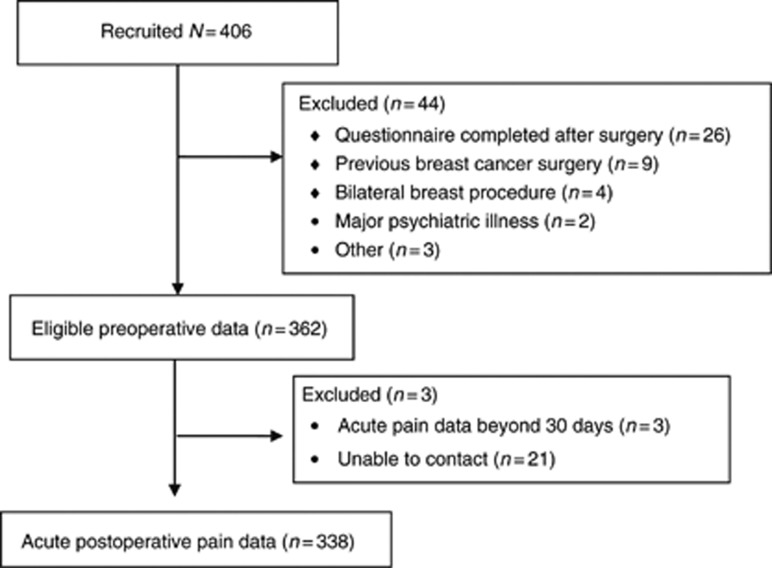
BACKGROUND: Few epidemiological studies have prospectively investigated preoperative and surgical risk factors for acute postoperative pain after surgery for breast cancer. We investigated demographic, psychological, pain-related and surgical risk factors in women undergoing resectional surgery for breast cancer. METHODS: Primary outcomes were pain severity, at rest (PAR) and movement-evoked pain (MEP), in the first postoperative week. RESULTS: In 338 women undergoing surgery, those with chronic preoperative pain were three times more likely to report moderate to severe MEP after breast cancer surgery (OR 3.18, 95% CI 1.45-6.99). Increased psychological 'robustness', a composite variable representing positive affect and dispositional optimism, was associated with lower intensity acute postoperative PAR (OR 0.63, 95% CI 0.48-0.82) and MEP (OR 0.71, 95% CI 0.54-0.93). Sentinel lymph node biopsy (SLNB) and intraoperative nerve division were associated with reduced postoperative pain. No relationship was found between preoperative neuropathic pain and acute pain outcomes; altered sensations and numbness postoperatively were more common after axillary sample or clearance compared with SLNB. CONCLUSION: Chronic preoperative pain, axillary surgery and psychological robustness significantly predicted acute pain outcomes after surgery for breast cancer. Preoperative identification and targeted intervention of subgroups at risk could enhance the recovery trajectory in cancer survivors.
Overview
The claims and statistics of this paper haven’t been checked yet.
Run the check — free, no account needed. It reads the open-access text and checks the sources it cites.
Integrity signals
Registry
Cites
Statistics
Figures
Verification
Claims the paper makes
The claims and statistics of this paper haven’t been checked yet.
Run the check — free, no account needed. It reads the open-access text and checks the sources it cites.
Claims other papers make about this one
Each is checked against this paper’s own text: does it say what the citing paper says it does?
In the citing paper
“observational and experimental studies suggesting that positive mood results in reduced symptom reporting.29-32”
From Religion, spirituality, and physical health in cancer patients: A meta‐analysis (2015) · cites this paper as [30]
Self-check
Percentages, sums and reported differences re-computed from the paper’s own numbers.
The self-check needs the paper’s full text.
Citations
Cites
The Hospital Anxiety and Depression Scale
Zigmond, A. S., & Snaith, R. P. (1983) · Acta Psychiatrica Scandinavica · doi:10.1111/j.1600-0447.1983.tb09716.x · Cited by 47,139
Development and validation of brief measures of positive and negative affect: The PANAS scales.
Watson, D., Clark, L. A., & Tellegen, A. (1988) · Journal of Personality and Social Psychology · doi:10.1037/0022-3514.54.6.1063 · Cited by 32,433 · cited 14×
“Preoperative pain may be amplified or accelerated by surgical incision, subsequent tissue injury, pathophysiological *Correspondence: Dr J Bruce; E-mail: julie.bruce@warwick.ac.uk Received 16 April 2012; revised 6 July 2012; accepted 7 July 2012; published online 31 July 2012 British Journal of Cancer (2012) 107, 937–…”
MethodInfluential(1970) · Cited by 24,983
Depression and quality of life in older persons: A review
Sivertsen, H., Bjørkløf, G. H., Engedal, K., Selbæk, G., & Helvik, A.-S. (2015) · Dementia and Geriatric Cognitive Disorders · doi:10.1159/000437299 · Cited by 14,152
Pain assessment: global use of the Brief Pain Inventory.
Cs, C., & Km, R. (1994) · PubMed · Cited by 5,178
Persistent postsurgical pain: risk factors and prevention
Kehlet, H., Jensen, T. S., & Woolf, C. J. (2006) · The Lancet · doi:10.1016/s0140-6736(06)68700-x · Cited by 4,086 · cited 1×
“…2012; accepted 7 July 2012; published online 31 July 2012 British Journal of Cancer (2012) 107, 937–946 & 2012 Cancer Research UK All rights reserved 0007 – 0920/12 www.bjcancer.com C li n ic a l S tu d ie s responses and local inflammatory processes (Kehlet et al, 2006; Gerbershagen et al, 2010).”
BackgroundHealth complaints, stress, and distress: Exploring the central role of negative affectivity.
Watson, D., & Pennebaker, J. W. (1989) · Psychological Review · doi:10.1037/0033-295x.96.2.234 · Cited by 3,030 · cited 3×
“…as it would appear to fit within the broader dimension of resources that characterise psychological positivism; thus combining a ‘habitual style of anticipating favourable outcomes’ (Scheier and Carver, 1987) and reflective of ‘energy, excitement and enthusiasm’ (Watson and Pennebaker, 1989).”
BackgroundBouhassira, D., Attal, N., Alchaar, H., Boureau, F., Brochet, B., Bruxelle, J., Cunin, G., Fermanian, J., Giniès, P., Grun-Overdyking, A., et al. (2005) · Pain · doi:10.1016/j.pain.2004.12.010 · Cited by 2,834 · cited 2×
“…symptom grids and the following validated neuropathic pain instruments: Selfcompleted Leeds Assessment of Neuropathic Symptoms and Signs pain scale (S-LANSS) (Bennett et al, 2005; Bouhassira and Attal, 2009), and the ‘Douleur Neuropathique 4’ (DN4) questionnaire (Bouhassira et al, 2005).”
BackgroundThe fear-avoidance model of musculoskeletal pain: Current state of scientific evidence
Leeuw, M., Goossens, M. E. J. B., Linton, S. J., Crombez, G., Boersma, K., & Vlaeyen, J. W. S. (2007) · Journal of Behavioral Medicine · doi:10.1007/s10865-006-9085-0 · Cited by 2,261 · cited 1×
“However, other mechanisms of effect are possible: anxiety or pain catastrophising may affect behaviours that could influence recovery, as per fear avoidance theories of chronic pain (Leeuw et al, 2007).”
BackgroundA new definition of neuropathic pain
Jensen, T., Baron, R., Haanpää, M., Kalso, E., Loeser, J., Rice, A., & Treede, R. (2011) · Pain · doi:10.1016/j.pain.2011.06.017 · Cited by 1,343 · cited 1×
“Postsurgical pain is known to be predominantly neuropathic in character (Bruce et al, 2004), whereby neuropathic pain is defined as ‘pain caused by a lesion or disease of the somatosensory system’ (Jensen et al, 2011).”
BackgroundScheier, M. F., & Carver, C. S. (1987) · Journal of Personality · doi:10.1111/j.1467-6494.1987.tb00434.x · Cited by 1,268 · cited 9×
“Optimism has been positively associated with a range of health outcomes, including symptom report and other recovery measures after surgery (Scheier and Carver, 1987; Peters et al, 2007).”
BackgroundMethodInfluentialThe attributional Style Questionnaire
Peterson, C., Semmel, A., von Baeyer, C., Abramson, L., Metalsky, G., & Seligman, M. (1982) · Cognitive Therapy and Research · doi:10.1007/bf01173577 · Cited by 1,226 · cited 1×
“…trait, has been broadly conceptualised as optimists attributing negative events to external factors, whereas pessimists attribute negative events to internal factors and generally considering these as persistent and stable rather than temporary (Peterson et al, 1982; Meevissen et al, 2011).”
BackgroundNeuPSIG guidelines on neuropathic pain assessment
Haanpää, M., Attal, N., Backonja, M., Baron, R., Bennett, M., Bouhassira, D., Cruccu, G., Hansson, P., Haythornthwaite, J. A., Iannetti, G. D., et al. (2011) · Pain · doi:10.1016/j.pain.2010.07.031 · Cited by 1,060 · cited 1×
“Although these detailed investigations have been recently endorsed within international guidelines for the assessment of neuropathic pain (Haanpää et al, 2011), these methods are largely incompatible with epidemiological, population-based studies.”
BackgroundPredictors of Postoperative Pain and Analgesic Consumption: A Qualitative Systematic Review
Ip, H. Y. V., Abrishami, A., Peng, P. W. H., Wong, J., & Chung, F. (2009) · Anesthesiology · doi:10.1097/aln.0b013e3181aae87a · Cited by 1,055 · cited 2×
“…identified preoperative pain, anxiety, age and type of surgery as significant predictors of acute postoperative pain after different types of surgery, although only two studies involving breast surgery were included, neither of which found any relationship with preoperative pain (Ip et al, 2009).”
BackgroundScheier, M. F., Matthews, K. A., Owens, J. F., Magovern, G. J., Lefebvre, R. C., Abbott, R. A., & Carver, C. S. (1989) · Journal of Personality and Social Psychology · doi:10.1037//0022-3514.57.6.1024 · Cited by 1,023 · cited 2×
“One early surgical study found that dispositional optimism was associated with the coping strategies of making plans and setting goals relevant to postoperative recovery by patients before undergoing coronary artery bypass surgery (Scheier et al, 1989).”
BackgroundWilkinson, E. (2002) · Nature Cell Biology · doi:10.1016/s1470-2045(02)00737-4 · Cited by 951
Prevalence of and Factors Associated With Persistent Pain Following Breast Cancer Surgery
Gärtner, R., Jensen, M.-B., Nielsen, J., Ewertz, M., Kroman, N., & Kehlet, H. (2009) · JAMA · doi:10.1001/jama.2009.1568 · Cited by 908 · cited 7×
“A Danish national cross-sectional study reported increased risk of chronic pain after breast cancer surgery in those reporting low back pain and headache, although findings were based upon patient recall of preoperative morbidity from 2 years previously (Gärtner et al, 2009).”
BackgroundMethodResultInfluentialGoldhirsch, A., Wood, W. C., Gelber, R. D., Coates, A. S., Thurlimann, B. J. K., & Senn, H.-J. (2003) · Journal of Clinical Oncology · doi:10.1200/jco.2003.04.576 · Cited by 699 · cited 1×
“However, It is worth noting that the four node sample technique is now of historical interest (Goldhirsch et al, 2003), although may still be routine in centres with limited access to nuclear medicine.”
BackgroundBennett, M., Smith, B. H., Torrance, N., & Potter, J. (2005) · Journal of Pain · doi:10.1016/j.jpain.2004.11.007 · Cited by 693 · cited 6×
“Patients reporting any ache, pain, discomfort, altered sensations or numbness in the previous week were asked to provide further information using upper body maps, pain-related symptom grids and the following validated neuropathic pain instruments: Selfcompleted Leeds Assessment of Neuropathic Symptoms and Signs pain…”
MethodInfluentialIt's Not over When it's Over: Long-Term Symptoms in Cancer Survivors—A Systematic Review
Harrington, C. B., Hansen, J. A., Moskowitz, M. C., Todd, B. L., & Feuerstein, M. (2010) · The International Journal of Psychiatry in Medicine · doi:10.2190/pm.40.2.c · Cited by 655 · cited 2×
“Moreover, it will enhance our understanding of the burden of pain-related adverse events in cancer survivors (Harrington et al, 2010).”
BackgroundAndersen, K. G., & Kehlet, H. (2011) · The Journal of Pain · doi:10.1016/j.jpain.2010.12.005 · Cited by 523 · cited 2×
“Painful adverse symptoms can last for many years after surgery for breast cancer and the adverse impact upon postoperative quality of life is well documented (Macdonald et al, 2005; Gärtner et al, 2009; Peuckmann et al, 2009; Andersen and Kehlet, 2011).”
BackgroundFleissig, A., Fallowfield, L. J., Langridge, C., Johnson, L., Newcombe, R. G., Dixon, J. M., Kissin, M. W., & Mansel, R. E. (2005) · Breast Cancer Research and Treatment · doi:10.1007/s10549-005-9025-7 · Cited by 493
The specific disease burden of neuropathic pain: Results of a French nationwide survey
Attal, N., Lanteri-Minet, M., Laurent, B., Fermanian, J., & Bouhassira, D. (2011) · Pain · doi:10.1016/j.pain.2011.09.014 · Cited by 427
(1994) · Medical Entomology and Zoology · Cited by 393
Powell, R., Scott, N. W., Manyande, A., Bruce, J., Vögele, C., Byrne-Davis, L. M., Unsworth, M., Osmer, C., & Johnston, M. (2016) · Cochrane Database of Systematic Reviews · doi:10.1002/14651858.cd008646.pub2 · Cited by 369
Self-citationRisk factors for acute pain and its persistence following breast cancer surgery
Katz, J., Poleshuck, E. L., Andrus, C. H., Hogan, L. A., Jung, B. F., Kulick, D. I., & Dworkin, R. H. (2005) · Pain · doi:10.1016/j.pain.2005.09.008 · Cited by 363 · cited 2×
“Severe pain in the acute postoperative period has consistently been found to predict chronic postsurgical pain, although few studies have prospectively examined whether this relationship exists after surgery for breast cancer (Katz et al, 2005).”
BackgroundSomatic and Psychologic Predictors of Long-term Unfavorable Outcome After Surgical Intervention
Peters, M. L., Sommer, M., de Rijke, J. M., Kessels, F., Heineman, E., Patijn, J., Marcus, M. A. E., Vlaeyen, J. W. S., & van Kleef, M. (2007) · Annals of Surgery · doi:10.1097/01.sla.0000245495.79781.65 · Cited by 356 · cited 15×
“Optimism has been positively associated with a range of health outcomes, including symptom report and other recovery measures after surgery (Scheier and Carver, 1987; Peters et al, 2007).”
BackgroundMethodResultInfluentialThe prevalence of chronic chest and leg pain following cardiac surgery: a historical cohort study
Bruce, J., Drury, N., Poobalan, A. S., Jeffrey, R. R., Smith, S. W. C., & Chambers, A. W. (2003) · Pain · doi:10.1016/s0304-3959(03)00017-4 · Cited by 350 · cited 2×
“Questionnaires and data collection tools were modelled on our previous quantitative studies of chronic pain (Smith et al, 1999; Bruce et al, 2003; Macdonald et al, 2005; Powell et al, 2012).”
MethodSelf-citationBenefits of Psychological Preparation for Surgery: a Meta-Analysis
Johnston, M., & Vögele, C. (1993) · Annals of Behavioral Medicine · doi:10.1093/abm/15.4.245 · Cited by 343 · cited 4×
“…psychological preparation for surgery, addressing preoperative emotions and cognitions, improves a range of recovery-related outcomes, including postoperative pain, suggesting there are opportunities for intervention before surgery for breast cancer (Johnston and Vögele, 1993; Powell et al, 2010).”
BackgroundInfluentialSelf-citationLong-term follow-up of breast cancer survivors with post-mastectomy pain syndrome
Macdonald, L., Bruce, J., Scott, N. W., Smith, W. C. S., & Chambers, W. A. (2005) · British Journal of Cancer · doi:10.1038/sj.bjc.6602304 · Cited by 338 · cited 4×
“Questionnaires and data collection tools were modelled on our previous quantitative studies of chronic pain (Smith et al, 1999; Bruce et al, 2003; Macdonald et al, 2005; Powell et al, 2012).”
BackgroundMethodInfluentialSelf-citationBecome more optimistic by imagining a best possible self: Effects of a two week intervention
Meevissen, Y. M. C., Peters, M. L., & Alberts, H. J. E. M. (2011) · Journal of Behavior Therapy and Experimental Psychiatry · doi:10.1016/j.jbtep.2011.02.012 · Cited by 335 · cited 1×
“…trait, has been broadly conceptualised as optimists attributing negative events to external factors, whereas pessimists attribute negative events to internal factors and generally considering these as persistent and stable rather than temporary (Peterson et al, 1982; Meevissen et al, 2011).”
BackgroundPain-related emotions modulate experimental pain perception and autonomic responses
Rainville, P., Bao, Q. V. H., & Chrétien, P. (2005) · Pain · doi:10.1016/j.pain.2005.08.022 · Cited by 333 · cited 1×
“For example, pain may seem less severe to those who are relaxed compared with those who are anxious (Rainville et al, 2005).”
BackgroundCatastrophizing: a risk factor for postsurgical pain
Pavlin, D. J., Sullivan, M. J. L., Freund, P. R., & Roesen, K. (2005) · The Clinical Journal of Pain · doi:10.1097/00002508-200501000-00010 · Cited by 326 · cited 1×
“The 13-item Pain Catastrophizing Scale (PCS) was used to capture pain catastrophizing, defined as an exaggerated negative orientation to aversive stimuli (Pavlin et al, 2005).”
MethodA retrospective cohort study of post mastectomy pain syndrome
Smith, C. S. W., Bourne, D., Squair, J., Phillips, D. O., & Chambers, A. W. (1999) · Pain · doi:10.1016/s0304-3959(99)00076-7 · Cited by 286 · cited 7×
“These descriptors were selected from the literature and from our previous research with women reporting chronic pain after breast cancer surgery (Smith et al, 1999; Macdonald et al, 2005; Baron et al, 2007).”
BackgroundMethodInfluentialChronic pain and other sequelae in long-term breast cancer survivors: nationwide survey in Denmark.
Peuckmann, V., Ekholm, O., Rasmussen, N. K., Groenvold, M., Christiansen, P., Møller, S., Eriksen, J., & Sjøgren, P. (2009) · European Journal of Pain · doi:10.1016/j.ejpain.2008.05.015 · Cited by 264 · cited 1×
“Painful adverse symptoms can last for many years after surgery for breast cancer and the adverse impact upon postoperative quality of life is well documented (Macdonald et al, 2005; Gärtner et al, 2009; Peuckmann et al, 2009; Andersen and Kehlet, 2011).”
BackgroundPhysical and Psychosocial Recovery in the Year After Primary Treatment of Breast Cancer
Ganz, P. A., Kwan, L. C., Stanton, A. L., Bower, J. E., & Belin, T. R. (2011) · Journal of Clinical Oncology · doi:10.1200/jco.2010.28.8043 · Cited by 251 · cited 2×
“Identification of those most at risk of acute and persistent postoperative complications is important for management and also supporting long-term recovery in these cancer survivors (Ganz et al, 2011).”
BackgroundPsychological Stress Impairs Early Wound Repair Following Surgery
Broadbent, E., Petrie, K. J., Alley, P. G., & Booth, R. J. (2003) · Psychosomatic Medicine · doi:10.1097/01.psy.0000088589.92699.30 · Cited by 247 · cited 2×
“Surgical worry was captured using a single item asking patients to rate ‘how worried you are about your operation’ (four-category response) modified from previous studies (Broadbent et al, 2003; Powell et al, 2012).”
BackgroundMethodSrikandarajah, S., & Gilron, I. (2011) · Pain · doi:10.1016/j.pain.2011.02.008 · Cited by 235 · cited 2×
“Pain at rest and MEP in the first postoperative week were studied using a threshold of X4 on the 0–10 NRS (Peters et al, 2007; Gärtner et al, 2009; Srikandarajah and Gilron, 2011).”
BackgroundMethodAcute and Persistent Postoperative Pain after Breast Surgery
Fecho, K., Miller, N. R., Merritt, S. A., Klauber‐DeMore, N., Hultman, C. S., & Blau, W. S. (2009) · Pain Medicine · doi:10.1111/j.1526-4637.2009.00611.x · Cited by 209 · cited 1×
“…and axillary clearance; other studies of pain outcomes have grouped the different surgical procedures that patients undergo to their axilla together, have used binary comparisons or have excluded axillary procedures completely (Steegers et al, 2008; Fecho et al, 2009; Gärtner et al, 2009).”
BackgroundTasmuth, T., Estlanderb, A.-M., & Kalso, E. (1996) · Pain · doi:10.1016/s0304-3959(96)03219-8 · Cited by 203 · cited 1×
“The full Positive and Negative Affect Scale (PANAS) was used to capture affect; the timing of the stem question ‘how you generally feel’ was applied, with higher scores indicating greater positive affect (range 10–50) (Watson et al, 1988).”
MethodRichards, M., Corner, J. L., & Maher, J. (2011) · British Journal of Cancer · doi:10.1038/bjc.2011.416 · Cited by 181
Shack, L., Jordan, C., Thomson, C. S., Mak, V., & Møller, H. (2008) · BMC Cancer · doi:10.1186/1471-2407-8-271 · Cited by 180 · cited 3×
“One early surgical study found that dispositional optimism was associated with the coping strategies of making plans and setting goals relevant to postoperative recovery by patients before undergoing coronary artery bypass surgery (Scheier et al, 1989).”
BackgroundKehlet, H., & Rathmell, J. P. (2010) · Anesthesiology · doi:10.1097/aln.0b013e3181cf423d · Cited by 146 · cited 2×
“This study complies with current demands for larger postsurgical studies with detailed preoperative data collection and comprehensive assessment of pain history (location, character, duration, comorbidity), psychological and physical health before surgery (Kehlet and Rathmell, 2010; Katz, 2011).”
MethodSteegers, M. A. H., Wolters, B., Evers, A. W. M., Strobbe, L. J. A., & Wilder‐Smith, O. H. G. (2008) · Journal of Pain · doi:10.1016/j.jpain.2008.04.001 · Cited by 121 · cited 1×
“…and axillary clearance; other studies of pain outcomes have grouped the different surgical procedures that patients undergo to their axilla together, have used binary comparisons or have excluded axillary procedures completely (Steegers et al, 2008; Fecho et al, 2009; Gärtner et al, 2009).”
BackgroundPre-Operative Emotional States and Post-Operative Recovery
Johnston, M. (2015) · Advances in psychosomatic medicine · doi:10.1159/000411845 · Cited by 115
Self-citationPreoperative back pain is associated with diverse manifestations of central neuroplasticity
Wilder‐Smith, O. H. G., TASSONYI, E., & Arendt‐Nielsen, L. (2002) · Pain · doi:10.1016/s0304-3959(01)00430-4 · Cited by 107 · cited 3×
“The mechanisms for pain predicting pain are unclear, although likely to be due to neuroplasticity from sustained alterations to central nervous function, e.g., central neuroplasticity has been demonstrated in patients with chronic low back pain before spinal surgery (Wilder-Smith et al, 2002).”
BackgroundInfluentialThe gross anatomy of the extrathoracic course of the intercostobrachial nerve
Loukas, M., Hullett, J., Louis, R. G., Holdman, S., & Holdman, D. (2006) · Clinical Anatomy · doi:10.1002/ca.20226 · Cited by 105 · cited 1×
“Preservation of the intercostobrachial nerve (ICBN) may be difficult because of anatomical location, traversing the axilla in close relation to the axillary lymph nodes (Loukas et al, 2006).”
BackgroundAcute pain services in Europe: a 17-nation survey of 105 hospitals
Rawal, Allvin, & Party, E. A. P. W. (1998) · European Journal of Anaesthesiology · doi:10.1046/j.1365-2346.1998.00306.x · Cited by 100 · cited 1×
“Despite advances in perioperative anaesthesia and analgesia, studies suggest that fewer than half of patients receive adequate pain relief after surgery (Rawal and Allvin, 1998).”
BackgroundPowell, R., Johnston, M., Smith, W. C. S., King, P. M., Chambers, W. A., Krukowski, Z. H., McKee, L., & Bruce, J. (2011) · European Journal of Pain · doi:10.1016/j.ejpain.2011.08.010 · Cited by 94 · cited 2×
“Surgical worry was captured using a single item asking patients to rate ‘how worried you are about your operation’ (four-category response) modified from previous studies (Broadbent et al, 2003; Powell et al, 2012).”
MethodSelf-citationPredictors of physical and emotional recovery 6 and 12 months after surgery
Peters, M. L., Sommer, M., van Kleef, M., & Marcus, M. A. E. (2010) · British journal of surgery · doi:10.1002/bjs.7152 · Cited by 83 · cited 1×
“In a heterogeneous sample of surgical patients, not including those with breast cancer, higher levels of dispositional optimism before surgery preoperatively predicted better mental health and vitality at 12-month follow-up (Peters et al, 2010).”
BackgroundClinical and Demographic Characteristics of Patients With Chronic Pain After Major Thoracotomy
Gottschalk, A., & Ochroch, E. A. (2008) · Clinical Journal of Pain · doi:10.1097/ajp.0b013e318174badd · Cited by 70 · cited 2×
“Pain intensity in the initial hours and days whilst hospitalised is masked by analgesic use, thus it has been argued that later acute pain scores are more reflective of overall acute postoperative pain (Gottschalk and Ochroch, 2008).”
BackgroundQuantitative Assessment of Chronic Postsurgical Pain Using the McGill Pain Questionnaire
Bruce, J., Poobalan, A. S., Smith, W. C. S., & Chambers, W. A. (2004) · Clinical Journal of Pain · doi:10.1097/00002508-200403000-00002 · Cited by 68
Self-citationBaron, R. H., Fey, J. V., Borgen, P. I., Stempel, M. M., Hardick, K., & Zee, K. J. V. (2007) · Annals of Surgical Oncology · doi:10.1245/s10434-006-9334-z · Cited by 61 · cited 1×
“These descriptors were selected from the literature and from our previous research with women reporting chronic pain after breast cancer surgery (Smith et al, 1999; Macdonald et al, 2005; Baron et al, 2007).”
MethodKatz, J. D. (2011) · Pain · doi:10.1016/j.pain.2011.10.044 · Cited by 54 · cited 4×
“This study complies with current demands for larger postsurgical studies with detailed preoperative data collection and comprehensive assessment of pain history (location, character, duration, comorbidity), psychological and physical health before surgery (Kehlet and Rathmell, 2010; Katz, 2011).”
BackgroundMethodInfluentialAssessment of postoperative pain – need for action!
Kehlet, H., & Dahl, J. B. (2011) · Pain · doi:10.1016/j.pain.2011.03.013 · Cited by 42 · cited 1×
“…2012; accepted 7 July 2012; published online 31 July 2012 British Journal of Cancer (2012) 107, 937–946 & 2012 Cancer Research UK All rights reserved 0007 – 0920/12 www.bjcancer.com C li n ic a l S tu d ie s responses and local inflammatory processes (Kehlet et al, 2006; Gerbershagen et al, 2010).”
BackgroundAcute pain services in Europe: a 17-nation survey of 105 hospitals
Rawal, N., & Allvin, R. (1998) · European Journal of Anaesthesiology · doi:10.1097/00003643-199805000-00019 · Cited by 40
All in one: Is it possible to assess all dimensions of any pain with a simple questionnaire?
Bouhassira, D., & Attal, N. (2009) · Pain · doi:10.1016/j.pain.2009.04.001 · Cited by 32 · cited 1×
“…symptom grids and the following validated neuropathic pain instruments: Selfcompleted Leeds Assessment of Neuropathic Symptoms and Signs pain scale (S-LANSS) (Bennett et al, 2005; Bouhassira and Attal, 2009), and the ‘Douleur Neuropathique 4’ (DN4) questionnaire (Bouhassira et al, 2005).”
Powell, R., Bruce, J., Johnston, M., Vögele, C., SCOTT, N. W., Shehmar, M., & Roberts, T. E. (2010) · Cochrane Database of Systematic Reviews · doi:10.1002/14651858.cd008646 · Cited by 28
Self-citationGerbershagen, H. U., Dagtekin, O., Gaertner, J., Petzke, F. W., Heidenreich, A., Sabatowski, R., & Özgür, E. (2010) · European Journal of Anaesthesiology · doi:10.1097/eja.0b013e3283349d9a · Cited by 24 · cited 1×
“…2012; accepted 7 July 2012; published online 31 July 2012 British Journal of Cancer (2012) 107, 937–946 & 2012 Cancer Research UK All rights reserved 0007 – 0920/12 www.bjcancer.com C li n ic a l S tu d ie s responses and local inflammatory processes (Kehlet et al, 2006; Gerbershagen et al, 2010).”
BackgroundPre‐operative pain and sensory function in groin hernia
Aasvang, E. K., Hansen, J. B., & Kehlet, H. (2009) · European Journal of Pain · doi:10.1016/j.ejpain.2008.11.015 · Cited by 20 · cited 1×
“Our NRS cutoff of X4 to indicate clinically relevant moderate to severe pain is comparable with other literature of breast surgery and other surgical procedures (Peters et al, 2007; Aasvang et al, 2009; Gärtner et al, 2009).”
Result(1993) · Annals of Behavioral Medicine · doi:10.1093/abm/15.supplement.abm0s12 · Cited by 1
Cited by
Sorted by citations
Religion, spirituality, and physical health in cancer patients: A meta‐analysis
Jim, H. S. L., Pustejovsky, J. E., Park, C. L., Danhauer, S. C., Sherman, A. C., Fitchett, G., Merluzzi, T. V., Munoz, A. R., George, L., Snyder, M. A., et al. (2015) · Cancer · doi:10.1002/cncr.29353 · Cited by 373
Powell, R., Scott, N. W., Manyande, A., Bruce, J., Vögele, C., Byrne-Davis, L. M., Unsworth, M., Osmer, C., & Johnston, M. (2016) · Cochrane Database of Systematic Reviews · doi:10.1002/14651858.cd008646.pub2 · Cited by 369
Self-citationHwang, E. S., Hyslop, T., Lynch, T., Frank, E. S., Pinto, D., Basila, D., Collyar, D. E., Bennett, A. V., Kaplan, C. P., Rosenberg, S. M., et al. (2019) · BMJ Open · doi:10.1136/bmjopen-2018-026797 · Cited by 305
“9 13 In addition, patients may experience complications from radiation (cardiac or pulmonary symptoms, secondary malignancies) or reconstruction (infection, loss of implant, need for multiple surgeries).”
Self-citationBruce, J., Thornton, A. J., Powell, R., Johnston, M., Wells, M., Heys, S. D., Thompson, A. M., Smith, C. W., Chambers, A. W., & Scott, N. W. (2014) · Pain · doi:10.1016/j.pain.2013.09.028 · Cited by 260
“Study methodology and calculation of sample size has been fully described in a previous publication [10].”
BackgroundMethodInfluentialSelf-citationPersistent post-mastectomy pain: risk factors and current approaches to treatment
Tait, R. C., Zoberi, K., Ferguson, M., Levenhagen, K., Luebbert, R. A., Rowland, K., Salsich, G. B., & Herndon, C. (2018) · The Journal of Pain · doi:10.1016/j.jpain.2018.06.002 · Cited by 190
Metadata
- Authors
- on behalf of the Recovery Study Group, Bruce, J., Thornton, A. J., Scott, N. W., Marfizo, S., Powell, R., Johnston, M., Wells, M., Heys, S. D., & Thompson, A. M.
- Affiliations
- University of Warwick (GB)
- University of Aberdeen (GB)
- University of Dundee (GB)
- Aston University (GB)
- Ninewells Hospital (GB)
- Corresponding author
- Bruce, J
- Venue
- British Journal of Cancer
- Published
- 2012-07-31
- Volume
- 107
- Issue
- 6
- Pages
- 937-946
- ISSN
- 0007-0920 (ISSN-L)
- 1532-1827
- PMC
- PMC3464763
- OpenAlex
- W1971289412
- Cited by
- 121
- References
- 62
- Citations by year
- 2026: 6 · 2025: 8 · 2024: 6 · 2023: 12 · 2022: 8 · 2021: 11 · 2020: 12 · 2019: 8 · 2018: 13 · 2017: 9 · 2016: 5 · 2015: 5 · 2014: 10 · 2013: 6 · 2012: 1
- FWCI
- 7.18
- Type
- journal article
- Language
- en
- Open access
- hybrid
- doi.org
- Licence
- cc-by-nc-sa
- www.springer.com/tdm (unspecified)
- Locations
- British Journal of Cancer (publishedVersion, cc-by-nc-sa)
- Europe PMC (PubMed Central) (publishedVersion, cc-by-nc-sa)
- PubMed Central (publishedVersion, cc-by-nc-sa)
- PubMed (publishedVersion)
- Discovery Research Portal (University of Dundee) (publishedVersion)
- Research Explorer (The University of Manchester) (publishedVersion)
- Aston Publications Explorer (Aston University) (acceptedVersion)
- Warwick Research Archive Portal (University of Warwick) (acceptedVersion)
- Aberdeen University Research Archive (Aberdeen University) (submittedVersion)
- Funders
- Cancer Research UK (C23143/A7531)
- Topics
- Health Sciences › Medicine › Anesthesiology and Pain Medicine › Anesthesia and Pain Management
- Health Sciences › Medicine › Pediatrics, Perinatology and Child Health › Pediatric Pain Management Techniques
- Health Sciences › Medicine › Anesthesiology and Pain Medicine › Pain Management and Opioid Use
- Keywords
- breast cancer surgery, acute postoperative pain, dispositional optimism, positive affect, movement-evoked pain, sentinel lymph node biopsy, axillary surgery, nerve division, postoperative numbness, cancer survivorship
- MeSH terms
- Adaptation, Psychological, Adult, Aged, Breast Neoplasms, Factor Analysis, Statistical, Female, Humans, Mastectomy, Middle Aged, Pain Measurement, Pain, Postoperative, Postoperative Pain, Predictive Value of Tests, Prospective Studies, Severity of Illness Index, Temperament, Incidence, Multivariate Analysis, Logistic Models, Carcinoma, Ductal, Breast, Sentinel Lymph Node Biopsy, Preoperative Period, Chronic Pain
About these checks
Registry, retraction, Cites and statistics results are computed, not judged, with one exception: a printed reference that no index lists is read once by a model before it counts as a citation error. Claims are extracted by a model and kept only when their quote appears verbatim in the text; each cited source is then checked, with a model’s help, for whether it says what the claim relies on. Those verdicts can be wrong — read the claim’s quote and the cited source before relying on one.
Statistics and arithmetic are recomputed, not judged.
Confidence bands are shown only for fields calibrated on our annotated test set. None is calibrated yet, so no band is shown.
What counts as a claim ›How we measure confidence ›How we check this ›
Are you an author, or do you see a problem with this page? Request a review
