

The DOI matches its Crossref record; 211 of the 211 references it cites were found in a registry or an index.
Does low-energy sweetener consumption affect energy intake and body weight? A systematic review, including meta-analyses, of the evidence from human and animal studies
Open accessAbstract
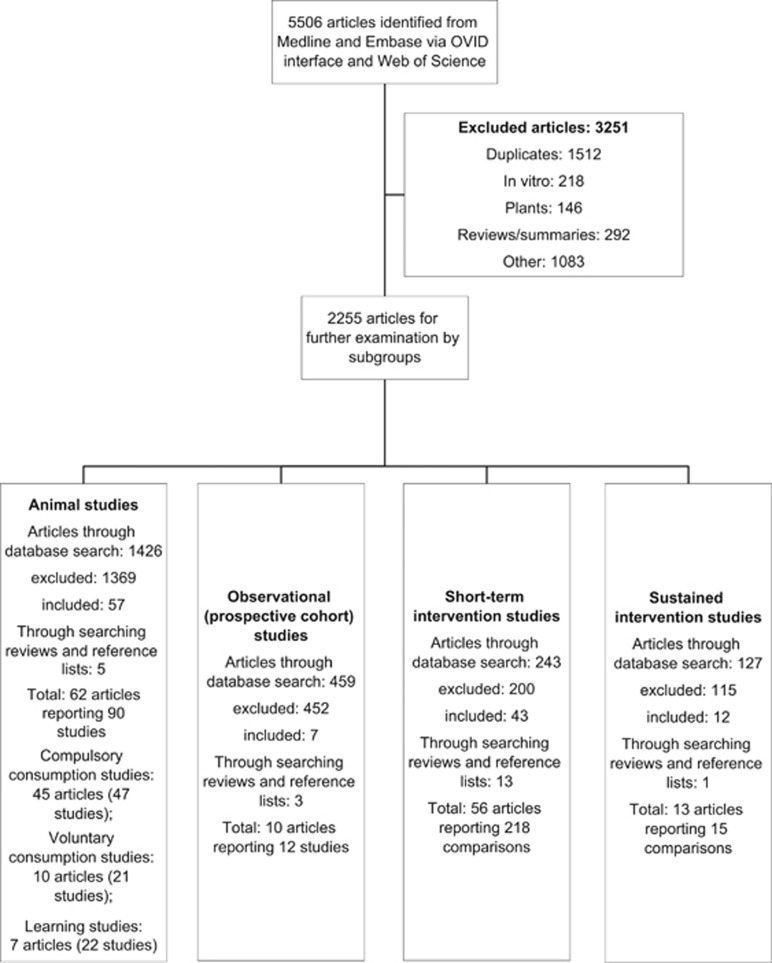
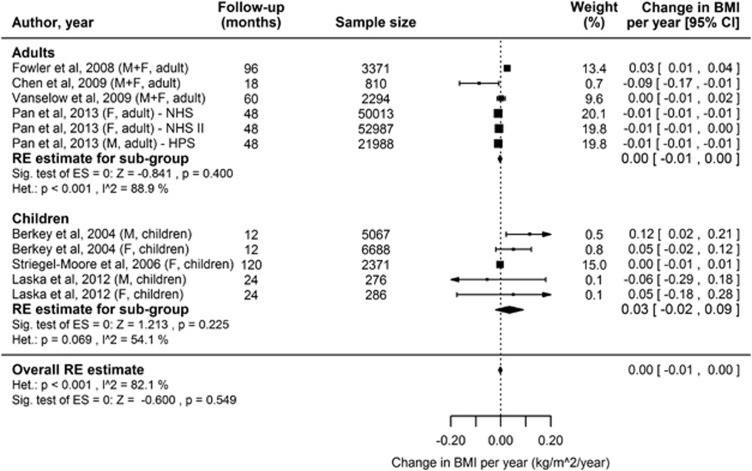
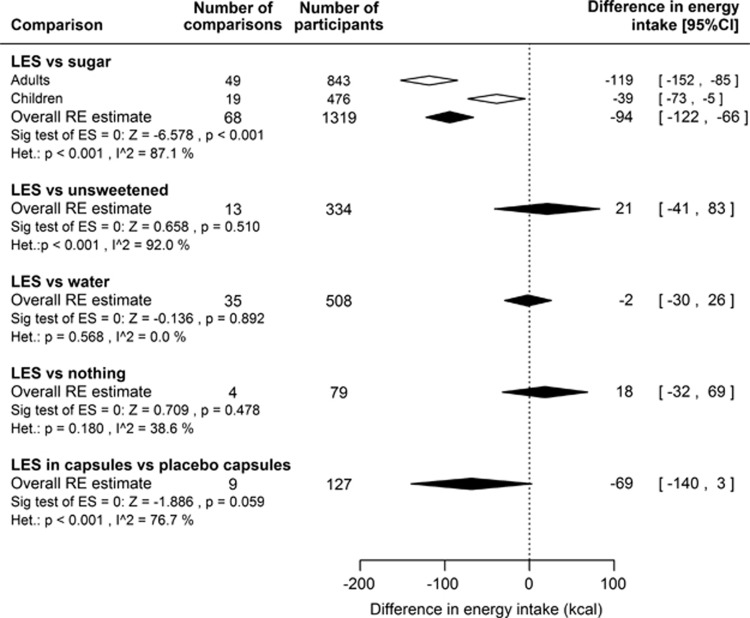
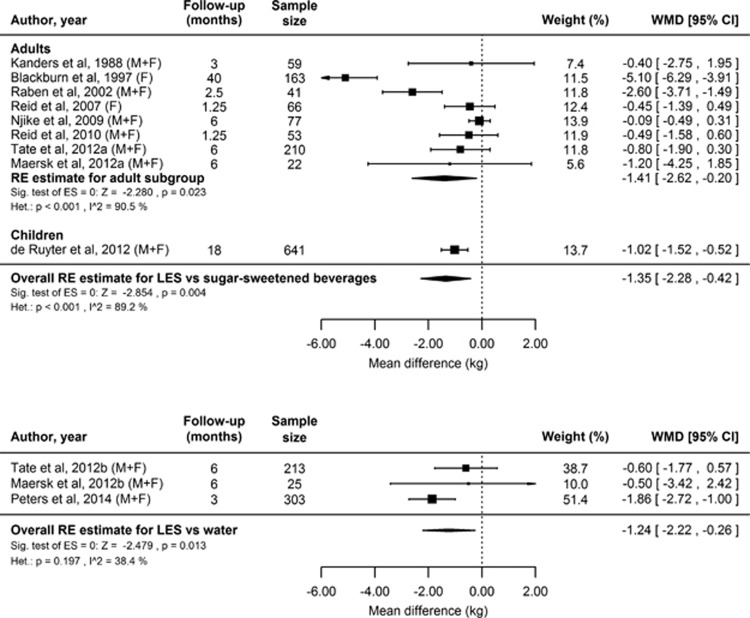
By reducing energy density, low-energy sweeteners (LES) might be expected to reduce energy intake (EI) and body weight (BW). To assess the totality of the evidence testing the null hypothesis that LES exposure (versus sugars or unsweetened alternatives) has no effect on EI or BW, we conducted a systematic review of relevant studies in animals and humans consuming LES with ad libitum access to food energy. In 62 of 90 animal studies exposure to LES did not affect or decreased BW. Of 28 reporting increased BW, 19 compared LES with glucose exposure using a specific 'learning' paradigm. Twelve prospective cohort studies in humans reported inconsistent associations between LES use and body mass index (-0.002 kg m(-)(2) per year, 95% confidence interval (CI) -0.009 to 0.005). Meta-analysis of short-term randomized controlled trials (129 comparisons) showed reduced total EI for LES versus sugar-sweetened food or beverage consumption before an ad libitum meal (-94 kcal, 95% CI -122 to -66), with no difference versus water (-2 kcal, 95% CI -30 to 26). This was consistent with EI results from sustained intervention randomized controlled trials (10 comparisons). Meta-analysis of sustained intervention randomized controlled trials (4 weeks to 40 months) showed that consumption of LES versus sugar led to relatively reduced BW (nine comparisons; -1.35 kg, 95% CI -2.28 to -0.42), and a similar relative reduction in BW versus water (three comparisons; -1.24 kg, 95% CI -2.22 to -0.26). Most animal studies did not mimic LES consumption by humans, and reverse causation may influence the results of prospective cohort studies. The preponderance of evidence from all human randomized controlled trials indicates that LES do not increase EI or BW, whether compared with caloric or non-caloric (for example, water) control conditions. Overall, the balance of evidence indicates that use of LES in place of sugar, in children and adults, leads to reduced EI and BW, and possibly also when compared with water.
Overview
The claims and statistics of this paper haven’t been checked yet.
Run the check — free, no account needed. It reads the open-access text and checks the sources it cites.
Integrity signals
Registry
Cites
Statistics
Figures
Verification
Claims the paper makes
The claims and statistics of this paper haven’t been checked yet.
Run the check — free, no account needed. It reads the open-access text and checks the sources it cites.
Claims other papers make about this one
Each is checked against this paper’s own text: does it say what the citing paper says it does?
In the citing paper
“There is mixed evidence from systematic reviews and meta-analyses for nonnutritive sweetener use with regard to weight management, with some finding benefit in weight loss (233-235) while other research suggests an association with weight gain (236,237).”
From 5. Facilitating Positive Health Behaviors and Well-being to Improve Health Outcomes:Standards of Care in Diabetes—2023 (2023) · cites this paper as [234]
Self-check
Percentages, sums and reported differences re-computed from the paper’s own numbers.
The self-check needs the paper’s full text.
Citations
Cites
Ludwig, D. S., Peterson, K. E., & Gortmaker, S. L. (2001) · The Lancet · doi:10.1016/s0140-6736(00)04041-1 · Cited by 2,414
Intake of sugar-sweetened beverages and weight gain: a systematic review
Malik, V. S., Schulze, M. B., & Hu, F. B. (2006) · The American Journal of Clinical Nutrition · doi:10.1093/ajcn/84.2.274 · Cited by 2,100
Consumption of high-fructose corn syrup in beverages may play a role in the epidemic of obesity
Bray, G. A., Nielsen, S. J., & Popkin, B. M. (2004) · The American Journal of Clinical Nutrition · doi:10.1093/ajcn/79.4.537 · Cited by 1,990
Glasgow, R. E., Lichtenstein, E., & Marcus, A. C. (2003) · American Journal of Public Health · doi:10.2105/ajph.93.8.1261 · Cited by 1,836
Te Morenga, L., Mallard, S., & Mann, J. (2012) · BMJ · doi:10.1136/bmj.e7492 · Cited by 1,629
Appetite control: methodological aspects of the evaluation of foods
Blundell, J. E., de Graaf, C., Hulshof, T. G., Jebb, S. A., Livingstone, B., Lluch, A., Mela, D. J., Salah, S., Schuring, E. A. H., van der Knaap, H. C. M., et al. (2010) · Obesity Reviews · doi:10.1111/j.1467-789x.2010.00714.x · Cited by 1,069
A Trial of Sugar-free or Sugar-Sweetened Beverages and Body Weight in Children
de Ruyter, J. C., Olthof, M. R., Seidell, J. C., & Katan, M. B. (2012) · New England Journal of Medicine · doi:10.1056/nejmoa1203034 · Cited by 814
A Randomized Trial of Sugar-Sweetened Beverages and Adolescent Body Weight
Ebbeling, C. B., Feldman, H. A., Chomitz, V. R., Antonelli, T. A., Gortmaker, S. L., Osganian, S. K., & Ludwig, D. S. (2012) · New England Journal of Medicine · doi:10.1056/nejmoa1203388 · Cited by 699
Raben, A., Vasilaras, T. H., Møller, A. C., & Astrup, A. (2002) · The American Journal of Clinical Nutrition · doi:10.1093/ajcn/76.4.721 · Cited by 667
Maersk, M., Belza, A., Stødkilde-Jørgensen, H., Ringgaard, S., Chabanova, E., Thomsen, H., Pedersen, S. B., Astrup, A., & Richelsen, B. (2012) · The American Journal of Clinical Nutrition · doi:10.3945/ajcn.111.022533 · Cited by 603
Research works printed but not linked: 3
- Reis TA, Goulart P, de Oliveira RME, Oliveira Ld, de Abreu PS, Azevedo Ad . Metabolic parameters of wistar rats subjected to diet supplemented with stevia and sugar. Semina: Ciéncias Agrarias (Londrina) 2011; 32: 1477–1488.
- EFSA. EFSA Panel on Food Additives and Nutrient Sources added to food. Scientific opinion on the safety of steviol glycosides for the proposed uses as a food additive. EFSA J 2010; 8: 1–84.
- Carvalho P, Sousa M, Barros R, Padrao P, Moreira P, Teixeira V . Impact of morning ingestion of sugary and sweetened beverages on energy and fluid intake throughout day. Ann Nutr Metab 2013; 63: 1448–1449.
Cited by
Sorted by citations
5. Lifestyle Management:Standards of Medical Care in Diabetes—2019
American Diabetes Association (2019) · Diabetes Care · doi:10.2337/dc19-s005 · Cited by 700
“Most systematic reviews and metaanalyses show benefits for nonnutritive sweetener use in weight loss (128,129); however, some research suggests an association with weight gain (130).”
Background4. Lifestyle Management: Standards of Medical Care in Diabetes—2018
American Diabetes Association (2018) · Diabetes Care · doi:10.2337/dc18-s004 · Cited by 563
“Most systematic reviews and metaanalyses show benefits for nonnutritive sweetener use in weight loss (119,120); however, some research suggests an association with weight gain (121).”
BackgroundMalik, V. S., Li, Y., Pan, A., De Koning, L., Schernhammer, E., Willett, W. C., & Hu, F. B. (2019) · Circulation · doi:10.1161/circulationaha.118.037401 · Cited by 421
Sensory influences on food intake control: moving beyond palatability
McCrickerd, K., & Forde, C. G. (2015) · Obesity Reviews · doi:10.1111/obr.12340 · Cited by 465
Azad, M. B., Abou-Setta, A. M., Chauhan, B. F., Rabbani, R., Lys, J., Copstein, L., Mann, A. S., Jeyaraman, M. M., Reid, A. E., Fiander, M., et al. (2017) · Canadian Medical Association Journal · doi:10.1503/cmaj.161390 · Cited by 410
Metadata
- Authors
- Rogers, P. J., Hogenkamp, P. S., de Graaf, C., Higgs, S., Lluch, A., Ness, A. R., Penfold, C., Perry, R., Putz, P., Yeomans, M. R., & Mela, D. J.
- Affiliations
- University of Bristol (GB)
- Uppsala University (SE)
- University of Birmingham (GB)
- Danone (France) (FR)
- University Hospitals Bristol NHS Foundation Trust (GB)
- University of Sussex (GB)
- Unilever Research and Development Vlaardingen (NL)
- Venue
- International Journal of Obesity
- Published
- 2015-09-14
- Volume
- 40
- Issue
- 3
- Pages
- 381-394
- ISSN
- 0307-0565 (ISSN-L)
- 1476-5497
- PMC
- PMC4786736
- OpenAlex
- W2171131656
- Cited by
- 358
- References
- 210
- Citations by year
- 2026: 16 · 2025: 19 · 2024: 24 · 2023: 29 · 2022: 33 · 2021: 26 · 2020: 53 · 2019: 34 · 2018: 46 · 2017: 44 · 2016: 31 · 2015: 2
- FWCI
- 5.26
- Type
- journal article
- Language
- en
- Open access
- hybrid
- doi.org
- Locations
- International Journal of Obesity (publishedVersion, cc-by)
- Europe PMC (PubMed Central) (publishedVersion, cc-by)
- PubMed Central (publishedVersion, cc-by)
- PubMed (publishedVersion)
- Explore Bristol Research (publishedVersion, cc-by)
- Socio-Environmental Systems Modeling (acceptedVersion, cc-by)
- Figshare (submittedVersion, cc-by)
- Bristol Research (University of Bristol) (submittedVersion, cc-by)
- Sussex Research Online (University of Sussex) (submittedVersion, cc-by)
- KTH Publication Database DiVA (KTH Royal Institute of Technology) (submittedVersion, other-oa)
- University of Birmingham Research Portal (University of Birmingham) (submittedVersion, cc-by)
- Data Archiving and Networked Services (DANS) (submittedVersion, cc-by)
- Funders
- University Hospitals Bristol NHS Foundation Trust
- National Institute for Health and Care Research (NF-SI-0513-10083)
- European Commission (607310)
- University of Bristol
- Wageningen University and Research
- Topics
- Health Sciences › Nursing › Nutrition and Dietetics › Biochemical Analysis and Sensing Techniques
- Health Sciences › Medicine › Endocrinology, Diabetes and Metabolism › Diet, Metabolism, and Disease
- Life Sciences › Neuroscience › Endocrine and Autonomic Systems › Regulation of Appetite and Obesity
- Keywords
- energy intake, body weight, body mass index, sugar-sweetened beverages, ad libitum feeding, energy density, weight gain, reverse causality, animal studies, prospective cohort, randomized controlled trials
- MeSH terms
- Animals, Body Weight, Energy Intake, Humans, Obesity, Sweetening Agents, Reproducibility of Results, Weight Gain, Body Mass Index, Randomized Controlled Trials as Topic, Evidence-Based Medicine, Models, Animal, Non-Nutritive Sweeteners, Observational Studies as Topic
About these checks
Registry, retraction, Cites and statistics results are computed, not judged, with one exception: a printed reference that no index lists is read once by a model before it counts as a citation error. Claims are extracted by a model and kept only when their quote appears verbatim in the text; each cited source is then checked, with a model’s help, for whether it says what the claim relies on. Those verdicts can be wrong — read the claim’s quote and the cited source before relying on one.
Statistics and arithmetic are recomputed, not judged.
Confidence bands are shown only for fields calibrated on our annotated test set. None is calibrated yet, so no band is shown.
What counts as a claim ›How we measure confidence ›How we check this ›
Are you an author, or do you see a problem with this page? Request a review
