

Two-dimensional gas of massless Dirac fermions in graphene
Open accessThe DOI matches its Crossref record; 32 of the 32 references it cites were found in a registry or an index; 12 of the 52 sources its claims cite were checked for support.
Abstract
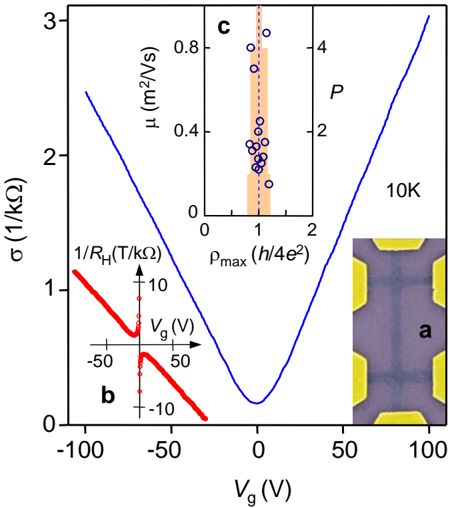
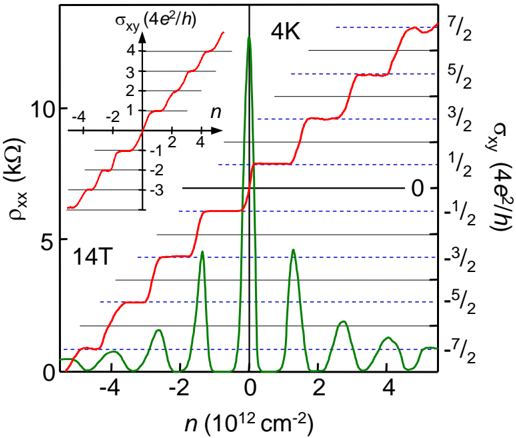
Quantum electrodynamics (resulting from the merger of quantum mechanics and relativity theory) has provided a clear understanding of phenomena ranging from particle physics to cosmology and from astrophysics to quantum chemistry. The ideas underlying quantum electrodynamics also influence the theory of condensed matter, but quantum relativistic effects are usually minute in the known experimental systems that can be described accurately by the non-relativistic Schrödinger equation. Here we report an experimental study of a condensed-matter system (graphene, a single atomic layer of carbon) in which electron transport is essentially governed by Dirac's (relativistic) equation. The charge carriers in graphene mimic relativistic particles with zero rest mass and have an effective ‘speed of light’ c* ≈ 106 m s-1. Our study reveals a variety of unusual phenomena that are characteristic of two-dimensional Dirac fermions. In particular we have observed the following: first, graphene's conductivity never falls below a minimum value corresponding to the quantum unit of conductance, even when concentrations of charge carriers tend to zero; second, the integer quantum Hall effect in graphene is anomalous in that it occurs at half-integer filling factors; and third, the cyclotron mass mc of massless carriers in graphene is described by E = mcc*2. This two-dimensional system is not only interesting in itself but also allows access to the subtle and rich physics of quantum electrodynamics in a bench-top experiment.
Overview
CoChat Summary
TL;DR
Graphene is a two-dimensional gas of massless Dirac fermions with linear dispersion and an effective speed of light \(c^* \approx 10^6\) m/s. Transport measurements reveal an anomalous half-integer quantum Hall effect, a minimum conductivity, cyclotron mass \(m_c = E/c^{*2}\), and a \(\pi\) Berry-phase shift in Shubnikov–de Haas oscillations.
Key findings
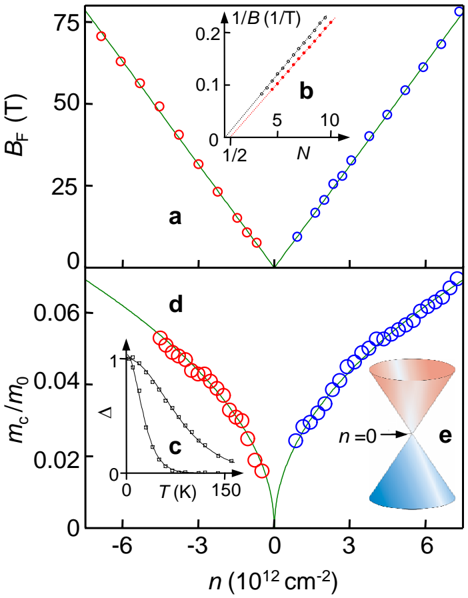
- Graphene’s charge carriers behave as massless Dirac fermions: the data imply \(E = \hbar k c^*\) for both electrons and holes, with \(c^* \approx 1 \times 10^6\) m/s; the cyclotron mass varies between \(\approx 0.02\) and \(0.07\,m_0\) and follows \(m_c \propto n^{1/2}\).
- The integer quantum Hall effect is anomalous: plateaux occur at half-integer \(\nu\), with sequence \((4e^2/h)(N+\tfrac12)\) and the first plateau at \(2e^2/h\); two-layer graphene returns to the normal integer sequence.
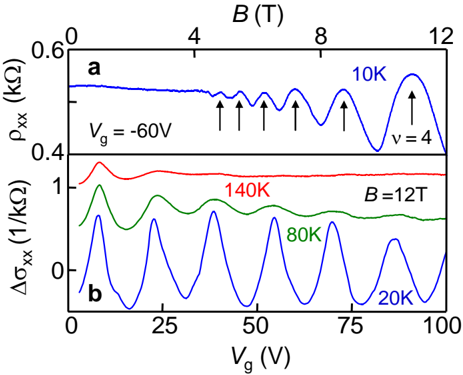
- Shubnikov–de Haas oscillations show a single set for electrons and holes, with \(B_F = \beta n\), \(\beta \approx 1.04 \times 10^{-15}\) T·m\(^2\) (\(\pm 2\%\)), yielding degeneracy \(f=4\); the oscillations exhibit a phase shift of \(\pi\) attributed to Berry’s phase.
- Conductivity never falls below a minimum: \(\rho_{\max} \approx 6.5\) k\(\Omega\) in 15 devices (experimental error \(\approx 15\%\)), associated with \(h/fe^2 = 6.45\) k\(\Omega\), independent of mobility (which varied by a factor of 10) and of temperature between 4 and 100 K.
Methods
- Graphene samples were obtained by micromechanical cleavage of graphite, followed by identification and selection of monolayers using optical, scanning-electron, and atomic-force microscopies; selected films were processed into multi-terminal devices, with some devices made from 2 or 3 layers.
- Transport measurements included the electric field effect, Hall coefficient, Shubnikov–de Haas oscillations, and quantum Hall effect in magnetic fields; mobility was measured between 10 and 100 K, minimum conductivity between 4 and 100 K, and SdHO up to 140 K and room temperature.
- Analysis used fan diagrams to determine \(B_F\), fits of SdHO amplitude to \(T/\sinh(2\pi^2 k_B T m_c / h eB)\), and semiclassical expressions \(B_F = (h/2\pi e)S(E)\) and \(m_c = (h^2/2\pi)\partial S(E)/\partial E\) to infer \(E \propto k\).
Limitations
- The paper has no dedicated limitations section; stated caveats include that mobility was “probably still limited by defects in parent graphite,” that the two-layer finite-mass result is “to be published elsewhere,” and that most theories suggest a minimum conductivity of \(\approx e^2/\pi h\), in disagreement with the experiment.
- Evident from the text: devices are unprotected from the environment (though stable under ambient conditions), some measured devices consisted of 2 or 3 graphene layers, and the transition region was often shifted from zero \(V_g\) due to chemical doping, although annealing normally eliminated the shift.
- The inference of linear dispersion relies on a semiclassical model that the paper says is justified by recent theory, so the experimental conclusion depends on that theoretical framework.
Model-written summary. Check it against the paper before relying on it.
Integrity signals
Registry
Cites
Statistics
Figures
Verification
Claims the paper makes
3 Valid · 5 Not valid · 11 Not checked · 51 Own results and interpretations
The cited sources support only part of this claim — read each source’s verdict below.
In the paper
“d) Shubnikov-de Haas oscillations in graphene exhibit a phase shift of π due to Berry's phase”
- Also stated in: § Two-Dimensional Gas of Massless Dirac Fermions in Graphene · plain
“The shift is due to Berry's phase [9,15].”
What the sources say
- Partly supportedcites [9] Berger, C. et al. Ultrathin epitaxial graphite: 2D electron gas properties and a route toward graphene-based nanoelectronics. J. Phys. Chem. B 108, 19912–19916 (2004) sourceExperimental — accuracy not yet measured
The Figure 2 caption (p. 3) reports Shubnikov–de Haas oscillations in an epitaxial graphene sample. The discussion on pp. 3–4 addresses their occurrence and period, but does not report a π phase shift or attribute one to Berry’s phase. (LLM, conf=0.85)
- Partly supportedcites [15] Gusynin, V. P. & Sharapov, S. G. Unconventional integer quantum Hall effect in grapheme. Preprint at http://xxx.lanl.gov/abs/cond-mat/0506575 (2005). sourceExperimental — accuracy not yet measured
Our copy (Introduction, p. 1) does state that 'the phase of de Haas van Alphen and Shubnikov de Haas oscillations for Dirac quasiparticles is shifted ... compared to the phase of non-relativistic quasiparticles' (citing Refs. 7-10), so the existence of a phase shift in graphene is supported; the magnitude symbol itself is lost in our copy's undecoded formulas. What is NOT supported is the causal attribution to Berry's phase: no passage of our copy mentions Berry's phase at all (searched: 'Berry phase pseudospin topological phase π', 'oscillation phase factor'). Instead the paper explains the unconventional magneto-transport phenomena by the quantum anomaly of the n = 0 Landau level — its halved degeneracy and B-independent energy (p. 1 and p. 3) — and relates the oscillation minima to fillings ν_B = 2n+1 (p. 3). (LLM, conf=0.75)
plainstates a cause- Asserted: passes — The authors put it forward as true.
- Checkable: passes — It can be checked against evidence.
- Load-bearing: passes — The paper’s conclusions depend on it.
- Based: passes — The paper gives a reason why it holds.
- Also stated in: § Two-Dimensional Gas of Massless Dirac Fermions in Graphene · plain
The cited sources that could be checked couldn’t confirm or dispute this claim.
In the paper
“we invoke the formal expression [9-12] for the energy of massless relativistic fermions in quantized fields, EN =[2 e h c ∗ 2 B ( N +½ ± ½)] 1/2”
What the sources say
- Could not verifycites [9] Berger, C. et al. Ultrathin epitaxial graphite: 2D electron gas properties and a route toward graphene-based nanoelectronics. J. Phys. Chem. B 108, 19912–19916 (2004) sourceExperimental — accuracy not yet measured
The discussion of magnetoconductance (p. 3) says Shubnikov–de Haas oscillations indicate quantization of the electron energy spectrum, but it gives no energy formula. Searches for massless relativistic fermions, Landau levels, and the N + 1/2 ± 1/2 term found no passage stating the claimed expression. (LLM, conf=0.76)
- Not checked — no full text of the sourcecites [10] Bunch, J. S., Yaish, Y., Brink, M., Bolotin, K. & McEuen, P. L. Coulomb oscillations and Hall effect in quasi-2D graphite quantum dots. Nano Lett. 5, 287–290 (2005) source
- Not checked — no full text of the sourcecites [11] Dresselhaus, M. S. & Dresselhaus, G. Intercalation compounds of graphite. Adv. In Phys. 51, 1–186 (2002) source
- Not matchedcites [12] Brandt, N. B., Chudinov, S. M. & Ponomarev, Y. G. Semimetals 1: Graphite and Its Compounds (North-Holland, Amsterdam, 1988)
We searched by its title and found no matching paper.
plain- Asserted: passes — The authors put it forward as true.
- Checkable: passes — It can be checked against evidence.
- Load-bearing: passes — The paper’s conclusions depend on it.
- Based: passes — The paper gives a reason why it holds.
- Could not verify
The cited sources that could be checked couldn’t confirm or dispute this claim.
In the paper
“The employed semiclassical model is fully justified by a recent theory for graphene [9], which shows that SdHO's amplitude can indeed be described by the above expression T /sinh(2 π 2 k B Tm c / h eB ) with m c = E / c ∗ 2 .”
What the sources say
- Could not verifycites [9] Berger, C. et al. Ultrathin epitaxial graphite: 2D electron gas properties and a route toward graphene-based nanoelectronics. J. Phys. Chem. B 108, 19912–19916 (2004) sourceExperimental — accuracy not yet measured
The discussion of magnetoconductance (pp. 3–4) reports observed Shubnikov–de Haas oscillations, but does not give a theory for their amplitude. Searches for the temperature-dependent amplitude expression and m_c = E/c*² found no passage addressing either, so our copy cannot verify the attributed claim. (LLM, conf=0.76)
boostedstates a cause- Asserted: passes — The authors put it forward as true.
- Checkable: passes — It can be checked against evidence.
- Load-bearing: passes — The paper’s conclusions depend on it.
- Based: passes — The paper gives a reason why it holds.
- Could not verify
The cited sources that could be checked couldn’t confirm or dispute this claim.
In the paper
“The latter can be viewed as a direct consequence of the Atiyah-Singer index theorem that plays an important role in quantum field theory and the theory of superstrings [13,14].”
What the sources say
- Not checked — no full text of the sourcecites [13] Vonsovsky, S. V. & Katsnelson, M. I. Quantum Solid State Physics (Springer, New York, 1989) source
- Could not verifycites [14] Gusynin, V. P. & Sharapov, S. G. Magnetic oscillations in planar systems with the Dirac-like spectrum of quasiparticle excitations. Phys. Rev. B 71, 125124 (2005) sourceExperimental — accuracy not yet measured
Our copy of Gusynin & Sharapov II gives the relativistic Landau-level spectrum with n = 0, 1, ... in the Introduction (p. 1) and discusses the lowest level E_1 and its crossing of the Fermi surface (Discussion, p. 6; Sect. II.B, p. 6), but it never invokes or discusses the Atiyah-Singer index theorem, topology, or zero-mode counting as the reason for a level pinned at E = 0. Searches on 'Atiyah-Singer index theorem zero-energy Landau level', 'index theorem topological zero modes chiral anomaly', and 'zero-energy Landau level n=0 degeneracy independent of field strength' returned only the spectrum/quantization-condition passages. Since the index-theorem grounding is simply not addressed in our copy (and no alternative work is credited for it there), the attribution can be neither confirmed nor contradicted. (LLM, conf=0.68)
plainstates a cause- Asserted: passes — The authors put it forward as true.
- Checkable: passes — It can be checked against evidence.
- Load-bearing: unclear — It is unclear whether the paper’s conclusions depend on it.
- Based: passes — The paper gives a reason why it holds.
The cited sources that could be checked couldn’t confirm or dispute this claim.
In the paper
“in agreement with band structure calculations [6,7]”
What the sources say
- Could not verifycites [6] Novoselov, K. S. et al. Two dimensional atomic crystals. Proc. Natl Acad. Sci. USA 102, 10451–10453 (2005) sourceExperimental — accuracy not yet measured
The discussion of graphene transport in “Two Dimensional Atomic Crystals” (p. 3) reports carrier concentrations and mobilities, but not a fitted c* or a comparison with band-structure calculations. Searches for the velocity, its approximate value, and band-structure calculations found no passage addressing that comparison. (LLM, conf=0.76)
- Could not verifycites [7] Novoselov, K. S. et al. Electric field effect in atomically thin carbon films. Science 306, 666–669 (2004) sourceExperimental — accuracy not yet measured
The discussion on p. 2 says graphene is expected to have linear energy dispersion and massless carriers, but gives no calculated velocity to compare with c* ≈ 1·10^6 m/s. Searches for the velocity and band-structure comparison found no passage in our copy establishing the claimed agreement. (LLM, conf=0.73)
plainstates an association- Asserted: passes — The authors put it forward as true.
- Checkable: passes — It can be checked against evidence.
- Load-bearing: passes — The paper’s conclusions depend on it.
- Based: passes — The paper gives a reason why it holds.
- Could not verify
34 more claims
Create a free account to see all 70 claims and to verify the 10 references still open.
- It may state two separate claims as one. 27
- Probably not a substantial claim. 8
Claims other papers make about this one
Each is checked against this paper’s own text: does it say what the citing paper says it does?
The source backs part of the claim, not all of it — or backs it for a different population, condition or comparison.
In the citing paper
“Recently, the non-relativistic electrons in graphene monolayer were found to obey the massless relativistic dispersion known as the Dirac cone, leading to the realization of analogies to Zitterbewegung and Klein tunneling in low-energy condensed-matter physics and atom optics 4 -19 .”
From Observation of interaction-induced phenomena of relativistic quantum mechanics (2021) · cites this paper as [4]
Experimental — accuracy not yet measuredThe source backs part of the claim, not all of it — or backs it for a different population, condition or comparison.
In the citing paper
“Dirac points in graphene1–3 or photonic graphene12 belong to the first type, which occur in lattices with unbroken T. These occur in pairs and are stabilized by a symmetry of the underlying lattice.”
From Observation of an unpaired photonic Dirac point (2020) · cites this paper as [1]
Experimental — accuracy not yet measuredThe cited source says what the claim attributes to it.
In the citing paper
“The energy spectrum of ˆ H 1 is E n = sgn( n ) ℏ Ω √ | n | , where n = 0 , ± 1 , . . . , see Fig. 1.”
From Theory of electron Zitterbewegung in graphene probed by femtosecond laser pulses (2009) · cites this paper as [36]
The cited source says what the claim attributes to it.
In the citing paper
“Around Dirac cones, conduction and valence bands intersect linearly at a degenerate point resulting in the linear energy band and massless relativistic transport of electrons as quasiparticles [4].”
From Observing movement of Dirac cones from single-photon dynamics (2021) · cites this paper as [4]
The check wasn’t confident either way, so it gives no verdict — never disputed.
In the citing paper
“photonic Dirac points are known to occur in pairs in “photonic graphene” and other similar photonic crystals”
From Observation of an unpaired photonic Dirac point (2020) · cites this paper as [1]
Experimental — accuracy not yet measured
3 more claims about this paper
Create a free account to see every claim other papers make about this one.
Citations
Cites
Electric Field Effect in Atomically Thin Carbon Films
Novoselov, K. S., Geim, A. K., Morozov, S. V., Jiang, D., Zhang, Y., Dubonos, S. V., Grigorieva, I. V., & Firsov, A. A. (2004) · Science · doi:10.1126/science.1102896 · Cited by 66,834
Self-citationTwo-dimensional atomic crystals
Novoselov, K. S., Jiang, D., Schedin, F., Booth, T. J., Khotkevich, V. V., Morozov, S. V., & Geim, A. K. (2005) · Proceedings of the National Academy of Sciences · doi:10.1073/pnas.0502848102 · Cited by 11,788
Self-citationScaling Theory of Localization: Absence of Quantum Diffusion in Two Dimensions
Abrahams, E., Anderson, P. W., Licciardello, D. C., & Ramakrishnan, T. V. (1979) · Physical Review Letters · doi:10.1103/physrevlett.42.673 · Cited by 6,134
Berger, C., Song, Z., Li, T., Li, X., Ogbazghi, A. Y., Feng, R., Dai, Z., Marchenkov, A. N., Conrad, E. H., First, P. N., et al. (2004) · The Journal of Physical Chemistry B · doi:10.1021/jp040650f · Cited by 3,548
The Universe in a Helium Droplet
Volovik, G. E. (2009) · doi:10.1093/acprof:oso/9780199564842.001.0001 · Cited by 2,632
Intercalation compounds of graphite
Dresselhaus, M. S., & Dresselhaus, G. (2002) · Advances in Physics · doi:10.1080/00018730110113644 · Cited by 2,139
Geometry, Topology and Physics
Nakahara, M. (1990) · doi:10.1887/0750306068 · Cited by 1,620
Geometry, Topology and Physics
Nakahara, M. (2018) · CRC Press eBooks · doi:10.1201/9781315275826 · Cited by 1,505
Unconventional Integer Quantum Hall Effect in Graphene
Gusynin, V. P., & Sharapov, S. G. (2005) · Physical Review Letters · doi:10.1103/physrevlett.95.146801 · Cited by 1,374
Field Theories of Condensed Matter Systems
Fradkin, E. (2007) · Medical Entomology and Zoology · Cited by 1,118
Research works printed but not linked: 1
- Mott, N.F. & Davis, E.A. Electron Processes in Non-Crystalline Materials (Clarendon Press, Oxford, 1979).
Cited by
Items 19,501–19,600 of 21,614
Gauge fields and strain engineering
Katsnelson, M. I. (2012) · Cambridge University Press eBooks · doi:10.1017/cbo9781139031080.011
Self-citationSpin Dependent Transport through a Carbon Nanotube Quantum Dot in the Kondo Regime
Lipiński, S., & Krychowski, D. (2011) · InTech eBooks · doi:10.5772/19779
(2020) · ACS symposium series · doi:10.1021/bk-2020-1359.ot001
Printed graphene antennas and systems for RFID applications
Leng, T. (2018) · Research Explorer (The University of Manchester)
Au-free Ohmic Contacts to Gallium Nitride and Graphene
Ravikirthi, P. (2014) · OakTrust (Texas A&M University Libraries)
Turbulentlike conductance fluctuations in the integer quantum Hall transition in graphene
Anonymous, Fonseca, D. B., González, I. R. R., et al. (2026) · Physical review. E · doi:10.1103/rzj5-38bv
Multiscale Simulations of High Performance Capacitors and Nanoelectronic Devices
Bernholc, J., Jiang, J., Ranjan, V., et al. (2008) · doi:10.1109/dod.hpcmp.ugc.2008.78
Quantum speed limits in deformed Dirac systems and their AdS4 duals
Pourhassan, B., & Farahani, H. (2026) · Annals of Physics · doi:10.1016/j.aop.2026.170531
Formation of Epitaxial Graphene Layers on 6H-SiC Induced by Electron Beam Irradiation
Go, H. (2012) · Scholarworks@UNIST (Ulsan National Institute of Science and Technology)
Russell, R., Medeiros, A., Rowley, A., et al. (2026) · ACS Applied Nano Materials · doi:10.1021/acsanm.6c00918
Sudarsanam, P., & Singh, L. (2020) · ACS symposium series · doi:10.1021/bk-2020-1359.pr001
Estrutura eletrônica do candidato a semimetal topológico ZrTe2
Moya, P. H. A. (2023) · Digital Library of Theses and Dissertations (Universidade de São Paulo) · doi:10.11606/d.43.2023.tde-31012024-131842 · Cited by 1
Amplification of terahertz radiation by plasmonic graphene metasurfaces
Popov, V. V., Otsuji, T., & Ryzhii, V. (2014) · International Congress on Advanced Electromagnetic Materials in Microwaves and Optics · doi:10.1109/metamaterials.2014.6948662
Mamsurov, I. V., Mamsurov, I. V., Халилов, В. Р., et al. (2016) · Теоретическая и математическая физика · doi:10.4213/tmf9073
Chen, J., Zheng, B., & Lu, G. (2015) · Springer eBooks · doi:10.1007/978-3-319-15302-5_1
The α-Helical Scale Law of Cosmic Evolution
林, 衡. (2018) · Biophysics · doi:10.12677/biphy.2018.63006
Crystal lattice dynamics, structure, and thermodynamics
Katsnelson, M. I. (2020) · Cambridge University Press eBooks · doi:10.1017/9781108617567.011 · Cited by 1
Self-citationMagoula, K., Zacharatos, F., Zurutuza, A., Centeno, A., Hirvenoja, T., Brunström, A., Kilpi, O., & Zergioti, I. (2026) · physica status solidi (a) · doi:10.1002/pssa.70411
“…makes it a strong candidate for the replacement of conventional silicon technologies, particularly as its unique band structure‐where charge carriers behave as massless Dirac fer mions with linear dispersion [3, 8]‐ could enable ultra‐wide opera tional bandwidth [13, 14] in integrated circuits.”
High-pressure lattice dynamics study of few-layer α -In2Se3
Feng, S., Ghosh, A., Vijayan, G., et al. (2026) · Journal of Applied Physics · doi:10.1063/5.0302874
“For instance, graphene demonstrates ultrahigh carrier mobility absent in graphite 5 , while monolayer MoS 2 transitions from an indirect to a direct bandgap semiconductor 6 .”
Quantum transport via evanescent waves
Katsnelson, M. I. (2012) · Cambridge University Press eBooks · doi:10.1017/cbo9781139031080.004
Self-citationHobara, R., Akiyama, R., & Hasegawa, S. (2026) · ACS Applied Electronic Materials · doi:10.1021/acsaelm.5c01881
Novel two-dimensional tph-CN2 with a sign-tunable Poisson's ratio
She, Y., Zou, Y., Zhao, L., et al. (2025) · Materials Science in Semiconductor Processing · doi:10.1016/j.mssp.2025.109883
Comparative Chemistry and Patent Conversion—Plating from the Frontiers of Graphene
万, 尹. (2018) · Journal of Comparative Chemistry · doi:10.12677/cc.2018.22006
Nonlinear Optical Spectroscopy of Single Walled Carbon Nanotubes.
Lal, V. (2012) · Deep Blue (University of Michigan)
Quantum theory of the dispersion of the laser light
Pardy, M. (2018) · Intellectual Archive · doi:10.32370/2018_11_1
Unveiling the Nanoelectronic Potential of HH-rGY: A Multi-scale Study of a Novel 2D Semiconductor
Kotoko, K. J., Beltako, K., Michelini, F. V., et al. (2026) · The Journal of Physical Chemistry C · doi:10.1021/acs.jpcc.6c00743
Betal, A., Bera, J., & Sahu, S. (2020) · arXiv (Cornell University) · doi:10.48550/arxiv.2004.13955
Energetics and electronic structure of Janus WSSe formation by continuous chalcogen substitutions
Gao, Y., Maruyama, M., & Okada, S. (2024) · Japanese Journal of Applied Physics · doi:10.35848/1347-4065/ad45cf
BIOCOMPATIBLE GRAPHENE OXIDE (GO) NANOBIOSENSOR USED FOR QUANTITATIVE ANALYSIS OF GLUCOSE
BILAL, M. H., MEHMOOD, R., Fakhar-e-alam, M., et al. (2021) · Digest Journal of Nanomaterials and Biostructures · doi:10.15251/djnb.2021.161.19
Interacting Electrons in Graphene
Stauber, T., Parida, P., Trushin, M., Ulybyshev, M., Boyda, D., Boyda, D., & Schliemann, J. (2019) · Wiley eBooks · doi:10.1002/9781119468455.ch22
Chaiyachad, S., Singsen, S., Eknapakul, T., et al. (2022) · Research Square · doi:10.21203/rs.3.rs-1971657/v1
Xu, N. S., Ding, J. W., Wang, B. L., et al. (2018) · The European Physical Journal B · doi:10.1140/epjb/e2018-90281-7
Madmeli, A., Madmeli, K., & Ganji, J. (2025) · Sustainable materials and technologies · doi:10.1016/j.susmat.2025.e01428
Xie, S., Hou, J., Xue, Q., et al. (2023) · Reports of China's Basic Research · doi:10.1007/978-981-99-1361-9_2
巫, 露. (2021) · Material Sciences · doi:10.12677/ms.2021.115065
Graphene magnetoplasmonic principles, structures and devices
Chamanara, N., & Caloz, C. (2015) · PolyPublie (École Polytechnique de Montréal)
Rathod, A., Solanki, M. B., Bloch, M. N., et al. (2026) · physica status solidi (b) · doi:10.1002/pssb.70307
Nanotechnology to Improve Electrochemical Bio-sensing
Carrara, S. (2010) · Springer eBooks · doi:10.1007/978-1-4419-6169-3_5
Fundamental Low-Temperature Properties of Dielectrophoretically Assembled Reduced Graphene OxidePreprint
Park, S., Ha, J., Oh, J., et al. (2021) · SSRN Electronic Journal · doi:10.2139/ssrn.3969116
Shi, W. (2021) · Applied Physics Research · doi:10.5539/apr.v13n1p50
Effect of Defect on Thermal Conductivity of GraphenePreprint
Rohman, N., MOHIUDDIN, T. M. G., & Selvaraj, R. (2024) · SSRN Electronic Journal · doi:10.2139/ssrn.4711322
Fabrication of graphene quantum hall resistance standard in a cryogen-table-top system
He, H., Janssen, T. J. B. M., Rozhko, S., et al. (2016) · Conference on Precision Electromagnetic Measurements · doi:10.1109/cpem.2016.7540516
Alternating field-induced phase transition in zigzag carbon nanotubes
Belonenko, M. B., Lebedev, N. G., & YANYUSHKINA, N. N. (2010) · Journal of Russian Laser Research · doi:10.1007/s10946-010-9163-1
Plasmonic excitations in nanorings: Thickness dependent unusual coupling effects
Xu, K. Y., Zhu, S., Han, K., et al. (2022) · Optik · doi:10.1016/j.ijleo.2022.169114
2D Materials for Oxygen Evolution Reactions
Senthil, C., & Gupta, R. K. (2025) · Springer eBooks · doi:10.1007/978-981-16-4480-1_41-1
3D Graphene for Metal–Air Batteries
Mo, R., & An, Y. (2023) · Carbon nanostructures · doi:10.1007/978-3-031-36249-1_13
Plasmonic nanolasers based on graphene-insulator-metal platform
Li, H., Hong, K., Hsu, C., et al. (2019) · Microoptics Conference · doi:10.23919/moc46630.2019.8982904
Optimization of Current-Voltage Characteristics of Graphene-Based Biosensors
Karimi, H., Rahmani, R., Akbari, E., Rahmani, M., & Ahamdi, M. T. (2016) · Advances in computer and electrical engineering book series · doi:10.4018/978-1-5225-0736-9.ch010
Tunneling Conductance in d x 2 − y 2 + id xy Mixed Wave Superconductor Graphene Junctions
Li, X. (2010) · Communications in Theoretical Physics · doi:10.1088/0253-6102/54/6/31
Magnetic control of electron scattering in silicene quantum dots
Azar, M. E., Feddi, E., Díaz, P., Laroze, D., & Jellal, A. (2026) · Annals of Physics · doi:10.1016/j.aop.2026.170543
Li, Y., Qiao, W., Zhou, T., et al. (2026) · RSC Applied Interfaces · doi:10.1039/d6lf00138f
Học, N. Q., Vuong, P. V., Nhan, T. L. T., Huy, N. D. Q., Khoi, L. B., Trung, N. B., Toan, N. C., & Tuấn, T. A. (2026) · Physics Letters A · doi:10.1016/j.physleta.2026.131473
Novel conductance step in carbon nanotube with wing-like zigzag graphene nanoribbons
Hong, L. (2017) · Chinese Physics B · doi:10.1088/1674-1056/26/11/116101
Electronic transport properties monitored by selective functionalization in Bernal bilayer graphenePreprint
Khabthani, J. J., Missaoui, A., Mayou, D., et al. (2021) · arXiv (Cornell University)
Huang, J.-W., & Guo, Y. (2026) · Physical review. B./Physical review. B · doi:10.1103/hcvc-wqjy
Tight-binding implementation of the quantum kinetic equation for graphene
Panferov, A. D., & Shcherbakov, I. A. (2024) · Izvestiya of Saratov University Physics · doi:10.18500/1817-3020-2024-24-3-198-208 · Cited by 2
“В простейшем случае это реализуется с использованием при-ближения безмассовых дираковских фермионов (massless fermions – MLF) [8–10].”
Zhang, W. (2020) · theses.fr (ABES) · doi:10.70675/ab08f701z51d6z4edezae3ez190ef6689bcb
Jiao, Y. (2018) · Queensland University of Technology · doi:10.5204/thesis.eprints.116196
Topological Dirac Nodal‐Line Structure in Orthorhombic‐Ti3N2
Yao, Z., Zhang, X., Feng, X., & Wen, B. (2018) · Advanced Theory and Simulations · doi:10.1002/adts.201700018
Chen, R., Gao, Z., Liu, Y., Song, K., Ma, F., & Jiao, Y. (2025) · Physical Chemistry Chemical Physics · doi:10.1039/d5cp02040a
Renormalised Intrinsic and Extrinsic Impurity Induced Spin-orbit Scattering in Graphene
Gislesen, H., & Skarsvåg, H. L. (2012) · NVA (Nasjonalt vitenarkiv)
Magnetic control of Goos–Hänchen shifts and group delay time in monolayer WSe2
Fattasse, Y., Aitouni, R. E., Mekkaoui, M., et al. (2026) · Physics Letters A · doi:10.1016/j.physleta.2026.131960
Synthesis, Purification, and Chemical Modification of CNTs
Chandrasekhar, P. (2018) · Springer eBooks · doi:10.1007/978-3-319-69378-1_3
Radiation Problems Accompanying Carrier Production by an Electric Field in the Graphene
Gavrilov, S. P., Gitman, D. M., Dmitriev, V. V., Panferov, A. D., & Smolyansky, S. A. (2020) · Universe · doi:10.3390/universe6110205 · Cited by 6
“n,tout). Todescribethe carrierquantum motion weuse the Diracmodel of thegraphene which describesthe carries in a vicinity of one of the two Dirac points at boundaries of the Brillouin zone, see Refs. [31,71,72] for a review. This model consider non interacting between themselves carries placed in the external field. 5…”
BackgroundComparison of electronic and magnetic properties of armchair and zigzag Ψ-graphene nanoribbons
Afsharnia, V., & Yadollahi, A. M. (2025) · Journal of Molecular Graphics and Modelling · doi:10.1016/j.jmgm.2025.109232
Graphene band engineering by single atomic layer intercalation
Vincent, T. (2019) · theses.fr (ABES) · doi:10.70675/132cb649ze745z4a46zb64fz14927ee60b44
Geometric Phase and Related Phenomena in Quantum Nanosystems
Xiong, S. (2009) · Springer eBooks · doi:10.1007/978-0-387-30440-3_247
CHERN–SIMONS THEORY OF FRACTIONAL QUANTUM HALL EFFECT IN (PSEUDO) MASSLESS DIRAC ELECTRONS
ZENG, H. (2011) · International Journal of Modern Physics B · doi:10.1142/s0217979211100606
Anisotropic localization behavior of graphene in the presence of diagonal and off-diagonal disorders
Wang, L.-M., Shi, S.-C., & Zhang, W. (2013) · Chinese Physics B · doi:10.1088/1674-1056/22/12/127201
Theoretical Design of Edge-Disordered Graphene Nanorribbon FETs
Takashima, K., & Yamamoto, T. (2018) · Vacuum and Surface Science · doi:10.1380/vss.61.354
Fate of a multiple-band Fermi liquid that is coupled with critical ϕ4 bosons
Pan, Z., & Shindou, R. (2020) · Physical review. B./Physical review. B · doi:10.1103/physrevb.102.235158
Quantum Hall Effects in Graphene
Torres, L. E. F. F., Roche, S., & Charlier, J. (2020) · Cambridge University Press eBooks · doi:10.1017/9781108664462.009
Angle-resolved photoemission spectroscopy of graphene, graphite, and related compounds
Sato, T., & Takahashi, T. (2011) · Elsevier eBooks · doi:10.1016/b978-0-323-96027-4.10005-1
Thermoelastic deformations in graphene and analogous two-dimensional materials
Kholodov, A. S. (2016) · Mathematical Models and Computer Simulations · doi:10.1134/s2070048216050100
Chiral Symmetry and Electron-Electron Interaction in Many-Body Gap Formation in Graphene
Hamamoto, Y., Hatsugai, Y., & Aoki, H. (2012) · Journal of Physics Conference Series · doi:10.1088/1742-6596/400/4/042015
Mechanics and Electromechanics of Two-Dimensional Atomic Membranes
Park, H. S. (2020) · Springer eBooks · doi:10.1007/978-3-319-44680-6_44
Heterogeneous Integration on Graphene Substrate
Nagase, M. (2017) · Journal of The Japan Institute of Electronics Packaging · doi:10.5104/jiep.20.382
Zulfiqar, E., Zulfiqar, T., Ahmed, S., Abbas, G., & Alay-e-Abbas, S. M. (2026) · Surfaces and Interfaces · doi:10.1016/j.surfin.2026.108910
Terahertz time-domain spectroscopy: From proteins to nanostructures
George, P. A. (2009) · eCommons (Cornell University)
Moez, A. A., Salem, M. A., Elmeleegi, H. A., et al. (2023) · Semiconductors · doi:10.1134/s1063782621060075
Roy, K. (2020) · Springer theses · doi:10.1007/978-3-030-59627-9_1
Kohlenstoffgruppe: Elemente der vierten Hauptgruppe
Sicius, H. (2021) · Springer eBooks · doi:10.1007/978-3-662-55939-0_4
Kaladzhyan, V., & Bena, C. (2017) · SciPost Physics · doi:10.21468/scipost.report.106
First-principles study of Cl-terminated silicon nanoribbons electronic properties
Djabri, I., Derradji, N. E., & Belghit, R. (2016) · Journal of Physics Conference Series · doi:10.1088/1742-6596/758/1/012002
Horing, N. J. M., Mancini, J. D., & Ashendorf, E. (2026) · Physica Scripta · doi:10.1088/1402-4896/ae7d6a
“A key feature of the TMD Landau level spectrum—absent in graphene [2–4]—is the valley-polarized zeroth level ϵ 0 ,ν = − ν ∆ [7, 14], which sits on opposite sides of the gap in the K and K ′ valleys [11] and sets the low-energy scale for magneto-bound-state formation.”
InfluentialQuantum H all Effect, the SI Ohm, and the SI Farad
Göbel, E. E., & Siegner, U. (2019) · doi:10.1002/9783527814480.ch5
Hyperbolic metamaterials based on graphene sheets with different values of chemical potentials
Kudyshev, Z. A., Gabitov, I. R., Kissan, A., et al. (2016) · Physical Sciences and Technology · doi:10.26577/phst-2016-2-100
Lv, T., Luo, L., Zhou, C., et al. (2024) · SSRN Electronic Journal · doi:10.2139/ssrn.4905065
Two distinct ballistic processes in graphene
Lewkowicz, M., Rosenstein, B., & Nghiem, D. (2012) · Journal of Physics Conference Series · doi:10.1088/1742-6596/400/4/042038
Thermal Transport in Two-Dimensional Nanolayers
Gonzalez-Munoz, S. (2026) · Springer theses · doi:10.1007/978-3-032-14271-9_4
Kong, L. B., Boey, F., Huang, Y., Xu, Z. J., Zhou, K., Li, S., Que, W., Huang, H., & Zhang, T.-S. (2017) · doi:10.1201/9781315370606-12
Inaniya, J., Rani, B., Bhattacharyya, A. J., et al. (2020) · Materials Today Proceedings · doi:10.1016/j.matpr.2020.01.393
RetractedTopological superconductivity in two-dimensional ScSiX (X = Cl, Br) monolayers
Kong, P., Wang, J., Jiang, Z., et al. (2026) · Journal of Materials Chemistry C · doi:10.1039/d6tc01187j
Yuan, L., Li, Z., Yang, J., et al. (2011) · arXiv (Cornell University) · doi:10.48550/arxiv.1112.4984
Semiconductor Materials and Nanostructures
Toropov, A. A., & Shubina, T. V. (2015) · Oxford University Press eBooks · doi:10.1093/acprof:oso/9780199699315.003.0006
Xiao, J., Liang, Q., He, M., et al. (2026) · Materials Horizons · doi:10.1039/d6mh01175f
Jada, A. (2025) · Elsevier eBooks · doi:10.1016/b978-0-443-26608-9.00013-5
Metadata
- Authors
- Novoselov, K. S., Geim, A. K., Morozov, S. V., Jiang, D., Katsnelson, M. I., Grigorieva, I. V., Dubonos, S. V., & Firsov, A. A.
- Affiliations
- University of Manchester (GB)
- Institute of Microelectronics Technology and High Purity Materials (RU)
- Radboud University Nijmegen (NL)
- Corresponding author
- Novoselov, K. S.
- Geim, A. K.
- Venue
- Nature
- Published
- 2005-11
- Volume
- 438
- Issue
- 7065
- Pages
- 197-200
- ISSN
- 0028-0836 (ISSN-L)
- 1476-4687
- OpenAlex
- W2125284466
- Semantic Scholar
- 228e604ea7c1333a99663b6b547cf47b98e721e7
- Cited by
- 21,611
- References
- 32
- Citations by year
- 2026: 442 · 2025: 677 · 2024: 798 · 2023: 924 · 2022: 992 · 2021: 1082 · 2020: 1230 · 2019: 1268 · 2018: 1350 · 2017: 1395 · 2016: 1501 · 2015: 1473 · 2014: 1387 · 2013: 1382 · 2012: 1375
- FWCI
- 217.72
- Type
- journal article
- Language
- en
- Open access
- green
- arxiv.org
- Licence
- www.springer.com/tdm (tdm)
- Locations
- Nature (publishedVersion)
- PubMed (publishedVersion)
- arXiv (Cornell University) (submittedVersion)
- RePEc: Research Papers in Economics (submittedVersion)
- Research Explorer (The University of Manchester) (submittedVersion)
- Radboud Repository (Radboud University) (submittedVersion)
- arXiv (Cornell University)
- Topics
- Physical Sciences › Materials Science › Materials Chemistry › Graphene research and applications
- Physical Sciences › Physics and Astronomy › Condensed Matter Physics › Topological Materials and Phenomena
- Physical Sciences › Physics and Astronomy › Atomic and Molecular Physics, and Optics › Quantum Electrodynamics and Casimir Effect
- Keywords
- graphene, massless Dirac fermions, two-dimensional Dirac fermions, quantum Hall effect, cyclotron mass, electron transport, relativistic electrons
About these checks
Registry, retraction, Cites and statistics results are computed, not judged, with one exception: a printed reference that no index lists is read once by a model before it counts as a citation error. Claims are extracted by a model and kept only when their quote appears verbatim in the text; each cited source is then checked, with a model’s help, for whether it says what the claim relies on. Those verdicts can be wrong — read the claim’s quote and the cited source before relying on one.
The claim verdicts this report counts are experimental: their accuracy is not yet measured.
A language model drew the claims from the paper on 2026-10-10, under version 3 of the claim definition (model deepseek-v4.1-flash, prompt extract-v3).
A second model labelled each claim on 2026-10-10 (model jev-1.13-20260917, definition revision gold-guideline-v0.2).
Cited sources are checked with a language model’s help (gpt-6-sol and qwen3.8-omni-flash).
Statistics and arithmetic are recomputed, not judged.
Confidence bands are shown only for fields calibrated on our annotated test set. None is calibrated yet, so no band is shown.
What counts as a claim ›How we measure confidence ›How we check this ›
Are you an author, or do you see a problem with this page? Request a review
Data sources
Bibliographic data: Semantic Scholar, OpenAlex, Crossref.
Contains information from the Semantic Scholar Academic Graph Datasets, made available under the ODC Attribution License (ODC-BY 1.0).
Semantic Scholar’s data is described in: Kinney, R., et al. (2023). The Semantic Scholar Open Data Platform. arXiv:2301.10140.
