

Two-dimensional gas of massless Dirac fermions in graphene
Open accessThe DOI matches its Crossref record; 32 of the 32 references it cites were found in a registry or an index; 12 of the 52 sources its claims cite were checked for support.
Abstract
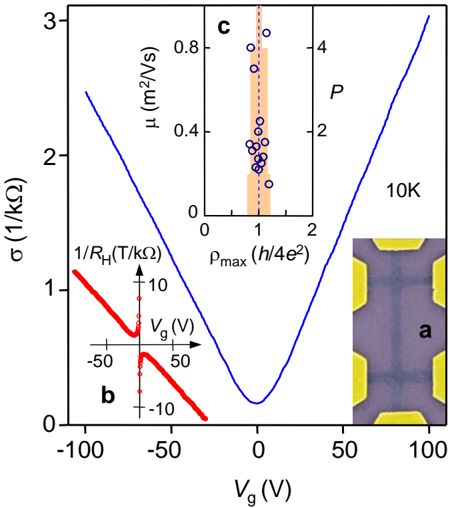
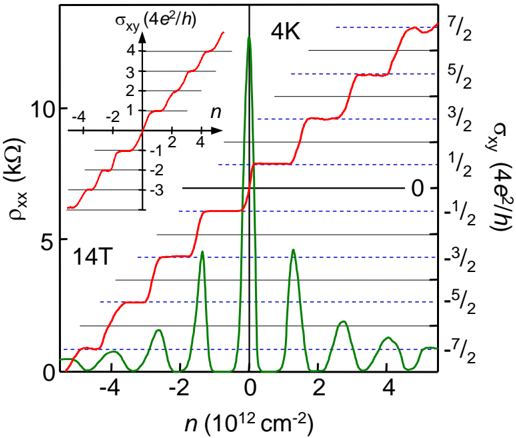
Quantum electrodynamics (resulting from the merger of quantum mechanics and relativity theory) has provided a clear understanding of phenomena ranging from particle physics to cosmology and from astrophysics to quantum chemistry. The ideas underlying quantum electrodynamics also influence the theory of condensed matter, but quantum relativistic effects are usually minute in the known experimental systems that can be described accurately by the non-relativistic Schrödinger equation. Here we report an experimental study of a condensed-matter system (graphene, a single atomic layer of carbon) in which electron transport is essentially governed by Dirac's (relativistic) equation. The charge carriers in graphene mimic relativistic particles with zero rest mass and have an effective ‘speed of light’ c* ≈ 106 m s-1. Our study reveals a variety of unusual phenomena that are characteristic of two-dimensional Dirac fermions. In particular we have observed the following: first, graphene's conductivity never falls below a minimum value corresponding to the quantum unit of conductance, even when concentrations of charge carriers tend to zero; second, the integer quantum Hall effect in graphene is anomalous in that it occurs at half-integer filling factors; and third, the cyclotron mass mc of massless carriers in graphene is described by E = mcc*2. This two-dimensional system is not only interesting in itself but also allows access to the subtle and rich physics of quantum electrodynamics in a bench-top experiment.
Overview
CoChat Summary
TL;DR
Graphene is a two-dimensional gas of massless Dirac fermions with linear dispersion and an effective speed of light \(c^* \approx 10^6\) m/s. Transport measurements reveal an anomalous half-integer quantum Hall effect, a minimum conductivity, cyclotron mass \(m_c = E/c^{*2}\), and a \(\pi\) Berry-phase shift in Shubnikov–de Haas oscillations.
Key findings
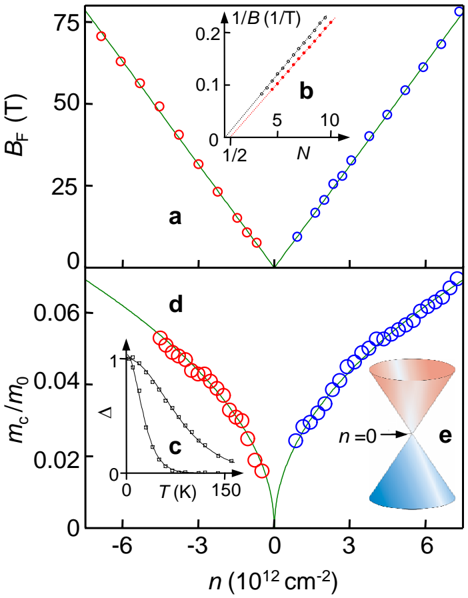
- Graphene’s charge carriers behave as massless Dirac fermions: the data imply \(E = \hbar k c^*\) for both electrons and holes, with \(c^* \approx 1 \times 10^6\) m/s; the cyclotron mass varies between \(\approx 0.02\) and \(0.07\,m_0\) and follows \(m_c \propto n^{1/2}\).
- The integer quantum Hall effect is anomalous: plateaux occur at half-integer \(\nu\), with sequence \((4e^2/h)(N+\tfrac12)\) and the first plateau at \(2e^2/h\); two-layer graphene returns to the normal integer sequence.
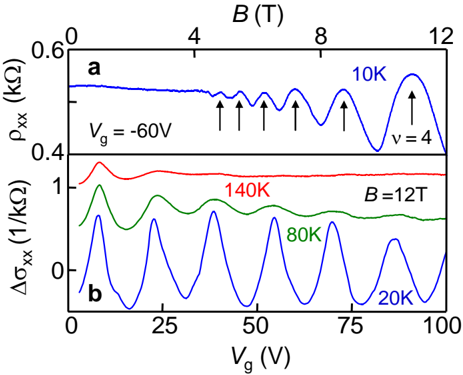
- Shubnikov–de Haas oscillations show a single set for electrons and holes, with \(B_F = \beta n\), \(\beta \approx 1.04 \times 10^{-15}\) T·m\(^2\) (\(\pm 2\%\)), yielding degeneracy \(f=4\); the oscillations exhibit a phase shift of \(\pi\) attributed to Berry’s phase.
- Conductivity never falls below a minimum: \(\rho_{\max} \approx 6.5\) k\(\Omega\) in 15 devices (experimental error \(\approx 15\%\)), associated with \(h/fe^2 = 6.45\) k\(\Omega\), independent of mobility (which varied by a factor of 10) and of temperature between 4 and 100 K.
Methods
- Graphene samples were obtained by micromechanical cleavage of graphite, followed by identification and selection of monolayers using optical, scanning-electron, and atomic-force microscopies; selected films were processed into multi-terminal devices, with some devices made from 2 or 3 layers.
- Transport measurements included the electric field effect, Hall coefficient, Shubnikov–de Haas oscillations, and quantum Hall effect in magnetic fields; mobility was measured between 10 and 100 K, minimum conductivity between 4 and 100 K, and SdHO up to 140 K and room temperature.
- Analysis used fan diagrams to determine \(B_F\), fits of SdHO amplitude to \(T/\sinh(2\pi^2 k_B T m_c / h eB)\), and semiclassical expressions \(B_F = (h/2\pi e)S(E)\) and \(m_c = (h^2/2\pi)\partial S(E)/\partial E\) to infer \(E \propto k\).
Limitations
- The paper has no dedicated limitations section; stated caveats include that mobility was “probably still limited by defects in parent graphite,” that the two-layer finite-mass result is “to be published elsewhere,” and that most theories suggest a minimum conductivity of \(\approx e^2/\pi h\), in disagreement with the experiment.
- Evident from the text: devices are unprotected from the environment (though stable under ambient conditions), some measured devices consisted of 2 or 3 graphene layers, and the transition region was often shifted from zero \(V_g\) due to chemical doping, although annealing normally eliminated the shift.
- The inference of linear dispersion relies on a semiclassical model that the paper says is justified by recent theory, so the experimental conclusion depends on that theoretical framework.
Model-written summary. Check it against the paper before relying on it.
Integrity signals
Registry
Cites
Statistics
Figures
Verification
Claims the paper makes
3 Valid · 5 Not valid · 11 Not checked · 51 Own results and interpretations
The cited sources support only part of this claim — read each source’s verdict below.
In the paper
“d) Shubnikov-de Haas oscillations in graphene exhibit a phase shift of π due to Berry's phase”
- Also stated in: § Two-Dimensional Gas of Massless Dirac Fermions in Graphene · plain
“The shift is due to Berry's phase [9,15].”
What the sources say
- Partly supportedcites [9] Berger, C. et al. Ultrathin epitaxial graphite: 2D electron gas properties and a route toward graphene-based nanoelectronics. J. Phys. Chem. B 108, 19912–19916 (2004) sourceExperimental — accuracy not yet measured
The Figure 2 caption (p. 3) reports Shubnikov–de Haas oscillations in an epitaxial graphene sample. The discussion on pp. 3–4 addresses their occurrence and period, but does not report a π phase shift or attribute one to Berry’s phase. (LLM, conf=0.85)
- Partly supportedcites [15] Gusynin, V. P. & Sharapov, S. G. Unconventional integer quantum Hall effect in grapheme. Preprint at http://xxx.lanl.gov/abs/cond-mat/0506575 (2005). sourceExperimental — accuracy not yet measured
Our copy (Introduction, p. 1) does state that 'the phase of de Haas van Alphen and Shubnikov de Haas oscillations for Dirac quasiparticles is shifted ... compared to the phase of non-relativistic quasiparticles' (citing Refs. 7-10), so the existence of a phase shift in graphene is supported; the magnitude symbol itself is lost in our copy's undecoded formulas. What is NOT supported is the causal attribution to Berry's phase: no passage of our copy mentions Berry's phase at all (searched: 'Berry phase pseudospin topological phase π', 'oscillation phase factor'). Instead the paper explains the unconventional magneto-transport phenomena by the quantum anomaly of the n = 0 Landau level — its halved degeneracy and B-independent energy (p. 1 and p. 3) — and relates the oscillation minima to fillings ν_B = 2n+1 (p. 3). (LLM, conf=0.75)
plainstates a cause- Asserted: passes — The authors put it forward as true.
- Checkable: passes — It can be checked against evidence.
- Load-bearing: passes — The paper’s conclusions depend on it.
- Based: passes — The paper gives a reason why it holds.
- Also stated in: § Two-Dimensional Gas of Massless Dirac Fermions in Graphene · plain
The cited sources that could be checked couldn’t confirm or dispute this claim.
In the paper
“we invoke the formal expression [9-12] for the energy of massless relativistic fermions in quantized fields, EN =[2 e h c ∗ 2 B ( N +½ ± ½)] 1/2”
What the sources say
- Could not verifycites [9] Berger, C. et al. Ultrathin epitaxial graphite: 2D electron gas properties and a route toward graphene-based nanoelectronics. J. Phys. Chem. B 108, 19912–19916 (2004) sourceExperimental — accuracy not yet measured
The discussion of magnetoconductance (p. 3) says Shubnikov–de Haas oscillations indicate quantization of the electron energy spectrum, but it gives no energy formula. Searches for massless relativistic fermions, Landau levels, and the N + 1/2 ± 1/2 term found no passage stating the claimed expression. (LLM, conf=0.76)
- Not checked — no full text of the sourcecites [10] Bunch, J. S., Yaish, Y., Brink, M., Bolotin, K. & McEuen, P. L. Coulomb oscillations and Hall effect in quasi-2D graphite quantum dots. Nano Lett. 5, 287–290 (2005) source
- Not checked — no full text of the sourcecites [11] Dresselhaus, M. S. & Dresselhaus, G. Intercalation compounds of graphite. Adv. In Phys. 51, 1–186 (2002) source
- Not matchedcites [12] Brandt, N. B., Chudinov, S. M. & Ponomarev, Y. G. Semimetals 1: Graphite and Its Compounds (North-Holland, Amsterdam, 1988)
We searched by its title and found no matching paper.
plain- Asserted: passes — The authors put it forward as true.
- Checkable: passes — It can be checked against evidence.
- Load-bearing: passes — The paper’s conclusions depend on it.
- Based: passes — The paper gives a reason why it holds.
- Could not verify
The cited sources that could be checked couldn’t confirm or dispute this claim.
In the paper
“The employed semiclassical model is fully justified by a recent theory for graphene [9], which shows that SdHO's amplitude can indeed be described by the above expression T /sinh(2 π 2 k B Tm c / h eB ) with m c = E / c ∗ 2 .”
What the sources say
- Could not verifycites [9] Berger, C. et al. Ultrathin epitaxial graphite: 2D electron gas properties and a route toward graphene-based nanoelectronics. J. Phys. Chem. B 108, 19912–19916 (2004) sourceExperimental — accuracy not yet measured
The discussion of magnetoconductance (pp. 3–4) reports observed Shubnikov–de Haas oscillations, but does not give a theory for their amplitude. Searches for the temperature-dependent amplitude expression and m_c = E/c*² found no passage addressing either, so our copy cannot verify the attributed claim. (LLM, conf=0.76)
boostedstates a cause- Asserted: passes — The authors put it forward as true.
- Checkable: passes — It can be checked against evidence.
- Load-bearing: passes — The paper’s conclusions depend on it.
- Based: passes — The paper gives a reason why it holds.
- Could not verify
The cited sources that could be checked couldn’t confirm or dispute this claim.
In the paper
“The latter can be viewed as a direct consequence of the Atiyah-Singer index theorem that plays an important role in quantum field theory and the theory of superstrings [13,14].”
What the sources say
- Not checked — no full text of the sourcecites [13] Vonsovsky, S. V. & Katsnelson, M. I. Quantum Solid State Physics (Springer, New York, 1989) source
- Could not verifycites [14] Gusynin, V. P. & Sharapov, S. G. Magnetic oscillations in planar systems with the Dirac-like spectrum of quasiparticle excitations. Phys. Rev. B 71, 125124 (2005) sourceExperimental — accuracy not yet measured
Our copy of Gusynin & Sharapov II gives the relativistic Landau-level spectrum with n = 0, 1, ... in the Introduction (p. 1) and discusses the lowest level E_1 and its crossing of the Fermi surface (Discussion, p. 6; Sect. II.B, p. 6), but it never invokes or discusses the Atiyah-Singer index theorem, topology, or zero-mode counting as the reason for a level pinned at E = 0. Searches on 'Atiyah-Singer index theorem zero-energy Landau level', 'index theorem topological zero modes chiral anomaly', and 'zero-energy Landau level n=0 degeneracy independent of field strength' returned only the spectrum/quantization-condition passages. Since the index-theorem grounding is simply not addressed in our copy (and no alternative work is credited for it there), the attribution can be neither confirmed nor contradicted. (LLM, conf=0.68)
plainstates a cause- Asserted: passes — The authors put it forward as true.
- Checkable: passes — It can be checked against evidence.
- Load-bearing: unclear — It is unclear whether the paper’s conclusions depend on it.
- Based: passes — The paper gives a reason why it holds.
The cited sources that could be checked couldn’t confirm or dispute this claim.
In the paper
“in agreement with band structure calculations [6,7]”
What the sources say
- Could not verifycites [6] Novoselov, K. S. et al. Two dimensional atomic crystals. Proc. Natl Acad. Sci. USA 102, 10451–10453 (2005) sourceExperimental — accuracy not yet measured
The discussion of graphene transport in “Two Dimensional Atomic Crystals” (p. 3) reports carrier concentrations and mobilities, but not a fitted c* or a comparison with band-structure calculations. Searches for the velocity, its approximate value, and band-structure calculations found no passage addressing that comparison. (LLM, conf=0.76)
- Could not verifycites [7] Novoselov, K. S. et al. Electric field effect in atomically thin carbon films. Science 306, 666–669 (2004) sourceExperimental — accuracy not yet measured
The discussion on p. 2 says graphene is expected to have linear energy dispersion and massless carriers, but gives no calculated velocity to compare with c* ≈ 1·10^6 m/s. Searches for the velocity and band-structure comparison found no passage in our copy establishing the claimed agreement. (LLM, conf=0.73)
plainstates an association- Asserted: passes — The authors put it forward as true.
- Checkable: passes — It can be checked against evidence.
- Load-bearing: passes — The paper’s conclusions depend on it.
- Based: passes — The paper gives a reason why it holds.
- Could not verify
34 more claims
Create a free account to see all 70 claims and to verify the 10 references still open.
- It may state two separate claims as one. 27
- Probably not a substantial claim. 8
Claims other papers make about this one
Each is checked against this paper’s own text: does it say what the citing paper says it does?
The source backs part of the claim, not all of it — or backs it for a different population, condition or comparison.
In the citing paper
“Recently, the non-relativistic electrons in graphene monolayer were found to obey the massless relativistic dispersion known as the Dirac cone, leading to the realization of analogies to Zitterbewegung and Klein tunneling in low-energy condensed-matter physics and atom optics 4 -19 .”
From Observation of interaction-induced phenomena of relativistic quantum mechanics (2021) · cites this paper as [4]
Experimental — accuracy not yet measuredThe source backs part of the claim, not all of it — or backs it for a different population, condition or comparison.
In the citing paper
“Dirac points in graphene1–3 or photonic graphene12 belong to the first type, which occur in lattices with unbroken T. These occur in pairs and are stabilized by a symmetry of the underlying lattice.”
From Observation of an unpaired photonic Dirac point (2020) · cites this paper as [1]
Experimental — accuracy not yet measuredThe cited source says what the claim attributes to it.
In the citing paper
“The energy spectrum of ˆ H 1 is E n = sgn( n ) ℏ Ω √ | n | , where n = 0 , ± 1 , . . . , see Fig. 1.”
From Theory of electron Zitterbewegung in graphene probed by femtosecond laser pulses (2009) · cites this paper as [36]
The cited source says what the claim attributes to it.
In the citing paper
“Around Dirac cones, conduction and valence bands intersect linearly at a degenerate point resulting in the linear energy band and massless relativistic transport of electrons as quasiparticles [4].”
From Observing movement of Dirac cones from single-photon dynamics (2021) · cites this paper as [4]
The check wasn’t confident either way, so it gives no verdict — never disputed.
In the citing paper
“photonic Dirac points are known to occur in pairs in “photonic graphene” and other similar photonic crystals”
From Observation of an unpaired photonic Dirac point (2020) · cites this paper as [1]
Experimental — accuracy not yet measured
3 more claims about this paper
Create a free account to see every claim other papers make about this one.
Citations
Cites
Electric Field Effect in Atomically Thin Carbon Films
Novoselov, K. S., Geim, A. K., Morozov, S. V., Jiang, D., Zhang, Y., Dubonos, S. V., Grigorieva, I. V., & Firsov, A. A. (2004) · Science · doi:10.1126/science.1102896 · Cited by 66,834
Self-citationTwo-dimensional atomic crystals
Novoselov, K. S., Jiang, D., Schedin, F., Booth, T. J., Khotkevich, V. V., Morozov, S. V., & Geim, A. K. (2005) · Proceedings of the National Academy of Sciences · doi:10.1073/pnas.0502848102 · Cited by 11,788
Self-citationScaling Theory of Localization: Absence of Quantum Diffusion in Two Dimensions
Abrahams, E., Anderson, P. W., Licciardello, D. C., & Ramakrishnan, T. V. (1979) · Physical Review Letters · doi:10.1103/physrevlett.42.673 · Cited by 6,134
Berger, C., Song, Z., Li, T., Li, X., Ogbazghi, A. Y., Feng, R., Dai, Z., Marchenkov, A. N., Conrad, E. H., First, P. N., et al. (2004) · The Journal of Physical Chemistry B · doi:10.1021/jp040650f · Cited by 3,548
The Universe in a Helium Droplet
Volovik, G. E. (2009) · doi:10.1093/acprof:oso/9780199564842.001.0001 · Cited by 2,632
Intercalation compounds of graphite
Dresselhaus, M. S., & Dresselhaus, G. (2002) · Advances in Physics · doi:10.1080/00018730110113644 · Cited by 2,139
Geometry, Topology and Physics
Nakahara, M. (1990) · doi:10.1887/0750306068 · Cited by 1,620
Geometry, Topology and Physics
Nakahara, M. (2018) · CRC Press eBooks · doi:10.1201/9781315275826 · Cited by 1,505
Unconventional Integer Quantum Hall Effect in Graphene
Gusynin, V. P., & Sharapov, S. G. (2005) · Physical Review Letters · doi:10.1103/physrevlett.95.146801 · Cited by 1,374
Field Theories of Condensed Matter Systems
Fradkin, E. (2007) · Medical Entomology and Zoology · Cited by 1,118
Research works printed but not linked: 1
- Mott, N.F. & Davis, E.A. Electron Processes in Non-Crystalline Materials (Clarendon Press, Oxford, 1979).
Cited by
Items 19,601–19,700 of 21,614
Carrier Type Reversal of Graphene Multilayered Thin Films
Elmeleegi, H. A., Mandouh, Z. S. E., & Taher, F. A. E.-R. (2014) · Ukrainian Journal of Physics · doi:10.15407/ujpe59.04.0426
Davydov, A. S., Krasnov, A. A., & Kuzmin, V. A. (2021) · Теоретическая и математическая физика · doi:10.4213/tmf10048
Saint-Jalm, R. (2019) · theses.fr (ABES) · doi:10.70675/070d70bfz9650z4c77z80d0z6f88dd04b660 · Cited by 2
Huey, W. L. B., & Goldberger, J. E. (2022) · Elsevier eBooks · doi:10.1016/b978-0-12-823824-0.00006-x
Electrical responses of graphene layers to extrinsic charges
Shi, Y. M. (2010) · DR-NTU (Nanyang Technological University) · doi:10.32657/10356/42382
Sharon, M., & Sharon, M. (2015) · Wiley eBooks · doi:10.1002/9781118842577.refs
Carbon-/boron-/nitrogen-substituted germaneness
Wang, Y., Shih, J.-H., Li, W.-B., & Lin, M.-F. (2023) · Elsevier eBooks · doi:10.1016/b978-0-443-15801-8.00016-5
Qi, H., Xu, S., Wu, S., Wen, F., Liu, R., & wu, Z. (2026) · Optics Express · doi:10.1364/oe.610327
Fourfold vacancy configuration in monolayer SiGe: A first-principles prediction
Ababil, A., Shabrina, P. A., Fajariah, N., et al. (2026) · AIP conference proceedings · doi:10.1063/5.0295611
Yue, S., Nguyen, D. C. T., & Oh, W. (2018) · Asian Journal of Chemistry · doi:10.14233/ajchem.2018.21361
Temperature Evolution of Quasi-one-dimensional C60 Nanostructures on Rippled GraphenePreprint
Chen, C., Zheng, H., Mills, A., et al. (2015) · arXiv (Cornell University) · doi:10.48550/arxiv.1505.01404
Quantum transport in gapped graphene under strain and laser–electrostatic barriers
Chnafa, H., Cortes, C., Laroze, D., et al. (2026) · Physica B Condensed Matter · doi:10.1016/j.physb.2026.418702
Two Dimensional, Emerging, Ordered and Disordered Semiconductor Materials and Optoelectronic Devices
Banerjee, A. (2025) · Synthesis lectures on engineering, science, and technology · doi:10.1007/978-3-031-98044-2_14
Exploring Novel Electronic and Optoelectronic Devices based on Layered Materials
Yan, R. (2017) · eCommons (Cornell University) · doi:10.7298/x4028ph0
One-pot exfoliation with simultaneous functionalization of graphene via wireless polarization
Bazylevska, A., Zarkua, Z., Arnauts, G., et al. (2025) · Electrochimica Acta · doi:10.1016/j.electacta.2025.146230
Xie, L., Wang, L., Ma, Y., Lu, H., & Yang, Y. (2024) · Physical Chemistry Chemical Physics · doi:10.1039/d4cp03793f · Cited by 1
(2015) · Pan Stanford eBooks · doi:10.1201/b18258-2
Ergotropy Dynamics in a Dissipative Graphene Quantum BatteryPreprint
Verma, D., Sankaranarayanan, R., & Indrajith, V. S. (2026) · SSRN Electronic Journal · doi:10.2139/ssrn.6383083
Yakunin, M. V., Neverov, V. N., Bogolyubskii, A. S., et al. (2026) · Journal of Experimental and Theoretical Physics Letters · doi:10.1134/s0021364026601247
“…behavior of the magnetoconduc-tivity components (which allows smoothing out instabilities during the transition through the CNP; see, for example, [4, 21]), which are derived from the measured components of the magnetoresistance tensor: In this case, the passage of the Fermi level through the gap…”
Quantum Hall Effect in Graphene
Fujita, S., & Suzuki, A. (2013) · doi:10.1002/9783527676668.ch12
Salazar, M. V., Fereidooni, M., Paz, C. V., et al. (2023) · SSRN Electronic Journal · doi:10.2139/ssrn.4635512
Alsalman, O., Wekalao, J., Sharma, Y., et al. (2026) · Materials Today Advances · doi:10.1016/j.mtadv.2026.100905
Quantum coherence and entanglement negativity in AB-stacked bilayer graphene
Chkaifa, R., Mhamdi, H., Habiballah, N., et al. (2026) · Applied Physics A · doi:10.1007/s00339-026-10080-9
Sapezhinskaya, T. A., Belosludtseva, A. A., & Bobenko, N. G. (2026) · Physica B Condensed Matter · doi:10.1016/j.physb.2026.419448
Graphene in Field Effect Transistor-Based Biosensors
Malhotra, B. D., & Nara, S. (2023) · Elsevier eBooks · doi:10.1016/b978-0-12-821541-8.00005-6 · Cited by 1
Broadband Excitation and Active Control of Terahertz Plasmons in GraphenePreprint
Khorrami, M. A., & El‐Ghazaly, S. (2014) · arXiv (Cornell University) · doi:10.48550/arxiv.1404.1533
Theoretical Study of Si-Rich Transition-Metal Silicides with Double-Graphene-Like Structures
Miyazaki, T., & Kanayama, T. (2006) · MRS Proceedings · doi:10.1557/proc-0958-l01-07
Magneto-Optical Properties of Armchair Nanographene Ribbons under Spatially Modulated Electric Field
Chen, S.-C., Chiu, C., & Lin, M.-F. (2011) · Japanese Journal of Applied Physics · doi:10.1143/jjap.50.01af14
First-Principles Study of the Reaction between Fluorinated Graphene and Ethylenediamine
Jin, T., Chen, Y., Wang, J., et al. (2019) · Molecules · doi:10.3390/molecules24020284
Bag Boundaries for Quasispinor Confinement Within Nanolanes on a Graphene Sheet
Koohsarian, Y., & Naji, A. (2023) · Annalen der Physik · doi:10.1002/andp.202200450
Teleb, N. H., Sakr, M. A. S., Alkhamisi, M. M., et al. (2026) · Structural Chemistry · doi:10.1007/s11224-026-02848-9
Tunable beam manipulation via graphene
Nasari, H., & Abrishamian, M. S. (2014) · doi:10.1109/istel.2014.7000698
Nanocarbon based field effect transistors for biosensing applications
Sudibya, H. G. (2011) · DR-NTU (Nanyang Technological University) · doi:10.32657/10356/46295
Atomic chain of carbon atoms: Smallest negative differential resistance device
Bhowmick, R., Chattopadhyaya, M., Chakraborty, J., et al. (2021) · Journal of Physics Conference Series · doi:10.1088/1742-6596/1797/1/012047
Theoretical Study on Response of Nanointerface Systems to Light and Voltage Bias
Iida, K. (2020) · Molecular Science · doi:10.3175/molsci.14.a0110
Induced vacuum charge of massless fermions in Coulomb and Aharonov–Bohm potentials in 2+1 dimensions
Mamsurov, I. V., & Khalilov, V. R. (2016) · Theoretical and Mathematical Physics · doi:10.1134/s0040577916080043
Superconductivity in bulk 2H-MoS 2 via carrier doping
Tan, M., Mei, H., Li, K., et al. (2026) · Chinese Physics B · doi:10.1088/1674-1056/ae3c93
Global well-posedness in a Hartree–Fock model for graphene
Borrelli, W., & Morellini, U. (2025) · Journal of Physics A Mathematical and Theoretical · doi:10.1088/1751-8121/add973
“For all these reasons, it has attracted a huge interest in the last decades [11].”
Physics of Graphene: Basic to FET Application
Goto, H. (2019) · Springer eBooks · doi:10.1007/978-981-13-3417-7_2 · Cited by 1
Haruna, M., Agorku, E. S., Asare–Donkor, N. K., et al. (2026) · Molecular Catalysis · doi:10.1016/j.mcat.2026.115845
The effect of field effect device channel dimensions on the effective mobility of graphene
Venugopal, A., Chan, J., Kirk, W. P., et al. (2011) · Conference digest · doi:10.1109/drc.2011.5994424
Caractérisation du phosphore noir pour des applications optoélectroniques hyperfréquences
Penillard, A. (2018) · theses.fr (ABES) · doi:10.70675/be3e686cz75ebz4fe8z982azd3132e131ebb
Li, T., Chen, Y., Liu, Y., et al. (2015) · Advances in engineering research/Advances in Engineering Research · doi:10.2991/icimm-15.2015.306
Low temperature casting of graphene into various 3-D shapes
Wan, S., Bi, H., Yin, K., et al. (2013) · doi:10.1109/nems.2013.6559832
Functionalized epitaxial graphene as versatile platform for air quality sensors
Rodner, M. (2021) · Linköping studies in science and technology. Dissertations · doi:10.3384/diss.diva-174680
Monte Carlo simulation study of spin transport in multilayer graphene with Bernal stacking
Misra, S., Ghosh, B., Nandal, V., et al. (2012) · Journal of Applied Physics · doi:10.1063/1.4739730
Surface-induced Zeeman effect of moiré surface states in topological insulators
Ji, H., & Yuan, N. F. Q. (2026) · Physical review. B./Physical review. B · doi:10.1103/q5ps-pv4l · Cited by 1
Spectroscopy and microscopy of graphene on metals:
Dedkov, Y. S. (2014) · Vakuum in Forschung und Praxis · doi:10.1002/vipr.201400553
R-graphyne monolayers as anodic material for future K-ion batteries: A DFT study
Singh, N. K., Qasim, S. M., Aldulaimi, A., et al. (2025) · Surface Science · doi:10.1016/j.susc.2025.122860
Electric Gap Control in a Semiconductor
Santos, M. C., & da Silva, E. L. (2014) · Portuguese National Funding Agency for Science, Research and Technology (RCAAP Project by FCT)
Sun, D. (2023) · Lecture notes in mechanical engineering · doi:10.1007/978-981-99-2921-4_44
Dirac-like spectrum for surface waves in an ultrasonic crystal
Gangemi, N. T., Sieck, C. F., Vignola, J. F., Turo, D., Baldwin, J. W., Liskey, S. W., Edmunds, A. D., Wilson, W. B., Photiadis, D. M., & Matis, B. R. (2024) · Physical Review Applied · doi:10.1103/physrevapplied.22.044008
Transport Evidence of Topological Surface States in Pbbi6te10Preprint
Mudgal, M., Meena, P., Tiwari, V. K., et al. (2024) · SSRN Electronic Journal · doi:10.2139/ssrn.5076939
Anh, N. P. Q., Cừu, H. V., Tan, T., et al. (2025) · Nanoscale Advances · doi:10.1039/d5na00181a
Computational exploration of two-dimensional materials for photocatalytic water splitting
Alhaidar, A. (2024) · Queensland University of Technology · doi:10.5204/thesis.eprints.248235 · Cited by 5
A Review on Device quality graphene from crude sources
Kaur, M., Amandeep, A., & Tripathi, P. (2019) · Journal of Emerging Technologies and Innovative Research
Jang, J., Ra, H., Ahn, J., et al. (2021) · Research Square · doi:10.21203/rs.3.rs-514895/v1
Klein Tunneling and Ballistic Transport in Graphene and Related Materials
Torres, L. E. F. F., Roche, S., & Charlier, J. (2020) · Cambridge University Press eBooks · doi:10.1017/9781108664462.007
Nguyễn, X. T., Nguyễn, T. M. H., Mai, T. P., et al. (2025) · Can Tho University Journal of Science · doi:10.22144/ctujos.2025.023
Frontiers in Plasmonics Applications
Toropov, A. A., & Shubina, T. V. (2015) · Oxford University Press eBooks · doi:10.1093/acprof:oso/9780199699315.003.0008
The Diffusion and Clustering Formation of Gold Atoms on Alpha-Graphyne
Kılıç, M. E. (2021) · Iğdır Üniversitesi Fen Bilimleri Enstitüsü Dergisi · doi:10.21597/jist.849054
Betal, A., Bera, J., Meghnani, H., Gandi, A. N., & Sahu, S. (2022) · SSRN Electronic Journal · doi:10.2139/ssrn.4096809
Strain-induced pseudo-magnetic fields in graphene for novel optoelectronic applications
Luo, M. (2022) · DR-NTU (Nanyang Technological University) · doi:10.32657/10356/161423
Theory of engineering flat bands in graphene using doubly-periodic electrostatic gatingPreprint
Hougland, N., Ramachandran, R., Levy, J., et al. (2021) · arXiv (Cornell University) · doi:10.48550/arxiv.2110.15477
Kaur, M., Kumar, S., Sharma, V., Kumar, S., Goswamy, J. K., & Twinkle (2026) · Journal of Materials Science Materials in Electronics · doi:10.1007/s10854-026-17560-x
Azevedo, D. L., Coutinho, S. S., Santos, W. O., et al. (2026) · Journal of Molecular Graphics and Modelling · doi:10.1016/j.jmgm.2026.109367
Nair, A. S., Mane, R. S., Jha, N., et al. (2024) · MRS Advances · doi:10.1557/s43580-024-00999-7
Quantum transport via evanescent waves
Katsnelson, M. I. (2020) · Cambridge University Press eBooks · doi:10.1017/9781108617567.005
Self-citationTchedie, H., Hova, H., Sodoga, K., et al. (2026) · Physica B Condensed Matter · doi:10.1016/j.physb.2026.419363
Curcella, A. (2018) · theses.fr (ABES) · doi:10.70675/0d8e5978zb979z4c54z8b41zcac4c6cc8aea
The many-body ground states of the graphene quantum Hall effect and their edge channels
Coissard, A. (2021) · theses.fr (ABES) · doi:10.70675/a6229b73zcf7fz4868z8817zfccd34acb872 · Cited by 6
Bordoloi, U., Kumawat, S., Umapathy, G. R., et al. (2026) · Journal of Alloys and Compounds · doi:10.1016/j.jallcom.2026.190112
Liu, F., Chen, L., Guo, Q., et al. (2015) · Nonlinear Optics · doi:10.1364/nlo.2015.nw4a.27
Yotsuya, S., Endo, T., Miyata, Y., et al. (2026) · Matter · doi:10.1016/j.matt.2026.102658
Modeling and Performance Evaluation of a Top Gated Graphene MOSFET
Sarker, J., Shifat, A. S. M. Z., & Shuvro, R. A. (2017) · Advances in Science Technology and Engineering Systems Journal · doi:10.25046/aj0203177
Functionalization of Graphene Oxide Layers Simultaneously with Liquid Phase Exfoliation
Anjo, L., Arshakyan, A., Gasparyan, N., et al. (2023) · Armenian Journal of Physics · doi:10.54503/18291171-2023.16.2-56
Novel Two-Dimensional Tph-Cn2 with a Sign-Tunable Poisson's RatioPreprint
She, Y., Zou, Y., Zhao, L., et al. (2025) · SSRN Electronic Journal · doi:10.2139/ssrn.5196719
Graphene—Two-Dimensional Crystal
Güçlü, A. D., Potasz, P., Korkusiński, M., & Hawrylak, P. (2014) · Nanoscience and technology · doi:10.1007/978-3-662-44611-9_2
Broadband excitation and active control of terahertz plasmons in graphene
Khorrami, M. A., & El‐Ghazaly, S. (2014) · IEEE MTT-S International Microwave Symposium digest · doi:10.1109/mwsym.2014.6848391
Liu, H., Huang, Y., Xue, X., Lei, Z., & Xu, X. (2024) · International Conference on Optoelectronic Information and Optical Engineering (OIOE) · doi:10.1117/12.3030530
Schmirander, T., & Prada, M. (2026) · Physical review. B./Physical review. B · doi:10.1103/kfjj-nftm
Horie, R., Hirosue, R., Kanasaki, J., et al. (2023) · Journal of Physics Condensed Matter · doi:10.1088/1361-648x/acbffc
Zhang, M., Wang, Z., Wei, Y. Q., et al. (2023) · Materials Research Express · doi:10.1088/2053-1591/acca68
6G'de Nesnelerin İnterneti Teknolojisinin Medikal Alandaki Gelişmeleri
Sak, S., & Akkaş, M. A. (2024) · Bilgisayar bilimleri ve mühendisliği dergisi. · doi:10.54525/bbmd.1454186
Landau levels of multilayer graphene ribbons
Huang, Y. C., Lu, C. L., Chang, C. P., et al. (2010) · Diamond and Related Materials · doi:10.1016/j.diamond.2009.12.012
Synthetic Electric Fields Influence the Non‐Stationary Processes in Graphene
Firsova, N. E., Firsova, N. E., & Firsov, Y. A. (2019) · Handbook of Graphene · doi:10.1002/9781119468455.ch24
Single-layer Cu2X (X = O, S, Se): auxetic materials modulated by strain engineering
Li, C., Zhang, Q., Zhang, E., & Zhang, S. (2023) · Applied Physics Express · doi:10.35848/1882-0786/acf185
Contribution of many-body effects into thermoelectricity and heat transport in graphene
Shafraniuk, S. (2017) · Elsevier eBooks · doi:10.1016/b978-0-323-44397-5.00006-8
Leon, J. A., Alves, E. S., Elias, D. C., et al. (2010) · MRS Proceedings · doi:10.1557/proc-1259-s14-12
Large sensor array based on functionalized graphene devices
Luo, Z., Singer, D. W., Berck, M., et al. (2010) · doi:10.1109/inec.2010.5424637
Nonmonotonic entropy evolution of carriers in graphene generated by strong laser field
Kravtcov, K. Y., Dmitriev, V. V., Panferov, A. D., et al. (2019) · Saratov Fall Meeting: Laser Physics, Photonic Technologies, and Molecular Modeling · doi:10.1117/12.2521602
Three-Dimensional Micro-Channel Structure of Graphene Field-Effect Transistor
Liu, H. Z., Liu, W., Liu, J. H., et al. (2011) · Advanced materials research · doi:10.4028/www.scientific.net/amr.291-294.3112
Niimi, Y., Kambara, H., & Fukuyama, H. (2007) · Physica E Low-dimensional Systems and Nanostructures · doi:10.1016/j.physe.2007.08.143
Metadata
- Authors
- Novoselov, K. S., Geim, A. K., Morozov, S. V., Jiang, D., Katsnelson, M. I., Grigorieva, I. V., Dubonos, S. V., & Firsov, A. A.
- Affiliations
- University of Manchester (GB)
- Institute of Microelectronics Technology and High Purity Materials (RU)
- Radboud University Nijmegen (NL)
- Corresponding author
- Novoselov, K. S.
- Geim, A. K.
- Venue
- Nature
- Published
- 2005-11
- Volume
- 438
- Issue
- 7065
- Pages
- 197-200
- ISSN
- 0028-0836 (ISSN-L)
- 1476-4687
- OpenAlex
- W2125284466
- Semantic Scholar
- 228e604ea7c1333a99663b6b547cf47b98e721e7
- Cited by
- 21,611
- References
- 32
- Citations by year
- 2026: 442 · 2025: 677 · 2024: 798 · 2023: 924 · 2022: 992 · 2021: 1082 · 2020: 1230 · 2019: 1268 · 2018: 1350 · 2017: 1395 · 2016: 1501 · 2015: 1473 · 2014: 1387 · 2013: 1382 · 2012: 1375
- FWCI
- 217.72
- Type
- journal article
- Language
- en
- Open access
- green
- arxiv.org
- Licence
- www.springer.com/tdm (tdm)
- Locations
- Nature (publishedVersion)
- PubMed (publishedVersion)
- arXiv (Cornell University) (submittedVersion)
- RePEc: Research Papers in Economics (submittedVersion)
- Research Explorer (The University of Manchester) (submittedVersion)
- Radboud Repository (Radboud University) (submittedVersion)
- arXiv (Cornell University)
- Topics
- Physical Sciences › Materials Science › Materials Chemistry › Graphene research and applications
- Physical Sciences › Physics and Astronomy › Condensed Matter Physics › Topological Materials and Phenomena
- Physical Sciences › Physics and Astronomy › Atomic and Molecular Physics, and Optics › Quantum Electrodynamics and Casimir Effect
- Keywords
- graphene, massless Dirac fermions, two-dimensional Dirac fermions, quantum Hall effect, cyclotron mass, electron transport, relativistic electrons
About these checks
Registry, retraction, Cites and statistics results are computed, not judged, with one exception: a printed reference that no index lists is read once by a model before it counts as a citation error. Claims are extracted by a model and kept only when their quote appears verbatim in the text; each cited source is then checked, with a model’s help, for whether it says what the claim relies on. Those verdicts can be wrong — read the claim’s quote and the cited source before relying on one.
The claim verdicts this report counts are experimental: their accuracy is not yet measured.
A language model drew the claims from the paper on 2026-10-10, under version 3 of the claim definition (model deepseek-v4.1-flash, prompt extract-v3).
A second model labelled each claim on 2026-10-10 (model jev-1.13-20260917, definition revision gold-guideline-v0.2).
Cited sources are checked with a language model’s help (gpt-6-sol and qwen3.8-omni-flash).
Statistics and arithmetic are recomputed, not judged.
Confidence bands are shown only for fields calibrated on our annotated test set. None is calibrated yet, so no band is shown.
What counts as a claim ›How we measure confidence ›How we check this ›
Are you an author, or do you see a problem with this page? Request a review
Data sources
Bibliographic data: Semantic Scholar, OpenAlex, Crossref.
Contains information from the Semantic Scholar Academic Graph Datasets, made available under the ODC Attribution License (ODC-BY 1.0).
Semantic Scholar’s data is described in: Kinney, R., et al. (2023). The Semantic Scholar Open Data Platform. arXiv:2301.10140.
